
欧派家居

Search documents
志邦家居:2024年报&2025年一季报点评:一季度收入微降,国补带动直营高增-20250509
Guoxin Securities· 2025-05-09 05:05
Investment Rating - The investment rating for the company is "Outperform the Market" [6][4][26] Core Views - The company experienced a slight decline in revenue in Q1 2025, with a revenue of 0.82 billion, down 0.3% year-on-year, and a net profit of 0.04 billion, down 10.9% year-on-year. The decline in revenue is attributed to the pressure from the real estate sector and weak consumer demand, but the impact was mitigated by the implementation of national subsidy policies [1][2][3] - The company has initiated a deep transformation in domestic retail since Q4 2024, which, combined with the effects of national subsidies, has led to a significant narrowing of revenue decline in Q1 2025 [1][4] - The company plans to distribute a cash dividend of 6 yuan for every 10 shares, with a payout ratio of 67.95%, an increase of 16.6 percentage points year-on-year [1][4] Revenue and Profit Analysis - In 2024, the company reported a total revenue of 5.26 billion, down 14.0% year-on-year, and a net profit of 0.39 billion, down 35.2% year-on-year. The revenue for Q4 2024 was 1.58 billion, down 27.7% year-on-year [1][5] - The revenue breakdown for 2024 shows a decline in various segments: distribution (-18.9%), direct sales (-0.8%), bulk sales (-16.2%), and overseas sales (+37.3%). In Q1 2025, the revenue changes were -25.0% for distribution, +205.8% for direct sales, -55.8% for bulk sales, and +3.5% for overseas sales [2][4] Margin and Cost Control - The gross margin for 2024 was 36.3%, down 0.8 percentage points, and the net margin was 7.3%, down 2.4 percentage points. In Q1 2025, the gross margin further decreased to 32.2%, down 5.1 percentage points [3][4] - The company effectively controlled expenses in Q1 2025, with sales, management, R&D, and financial expense ratios at 17.1%, 7.2%, 4.9%, and 0.2%, respectively, showing a year-on-year decrease [3][4] Future Earnings Forecast - The earnings forecast has been adjusted downwards, with expected net profits for 2025, 2026, and 2027 at 0.42 billion, 0.47 billion, and 0.52 billion, respectively, reflecting year-on-year growth of 9.0%, 12.6%, and 10.7% [4][5] - The diluted EPS for the same years is projected to be 0.96, 1.08, and 1.20 yuan, with corresponding P/E ratios of 11, 10, and 9 times [4][5]

一文解读央行降准降息影响及投资策略
Sou Hu Cai Jing· 2025-05-08 16:34
Group 1 - The core viewpoint of the news is that the People's Bank of China announced a reduction in the reserve requirement ratio and interest rates to stimulate economic growth and support employment amid weak economic data [1][3][4] - The reduction in the reserve requirement ratio by 0.5 percentage points is expected to release approximately 1 trillion yuan in long-term funds [4] - The cut in the re-lending rate by 0.25 percentage points aims to alleviate the financial pressure on small and medium-sized enterprises [4] Group 2 - The immediate impact on the stock market is expected to be positive, with sectors such as real estate, consumer goods, and high-debt industries likely to benefit from lower financing costs [5][6] - Historical comparisons show that after previous rate cuts, the A-share market has generally performed well, with the 10-year government bond yield dropping to 1.6%, the lowest since 2005 [8][9] - The potential for further interest rate cuts exists if economic conditions remain weak, with a possibility of a 10 basis point reduction in the third quarter [10][11] Group 3 - The real estate market may stabilize in first-tier cities, but there are still significant inventory pressures in third- and fourth-tier cities, indicating a divergence in recovery [11] - There is a high likelihood that deposit rates will follow suit and decrease, potentially pushing more funds into the stock market [12] - Investment strategies suggest a balanced approach with a focus on sectors like real estate, automotive, and technology, while avoiding export-dependent industries [13][15]







24、25Q1家居板块综述:国补促经营修复,盈利能力分化,赛道进入精细化运营阶段
Xinda Securities· 2025-05-08 14:01
Investment Rating - The investment rating for the home furnishing sector is "Positive" [2] Core Insights - The report highlights that the national subsidy policy has begun to show effects, leading to a convergence in revenue decline and a differentiation in profitability within the industry. The real estate sector has gradually reached its bottom after a year of adjustment, with new home transactions stabilizing and second-hand home transactions recovering. The home decoration market is expected to maintain a "442" structure in 2024, with new homes accounting for 40%, existing homes for 40%, and second-hand homes for 20% [2][9] - Leading companies in the home furnishing sector are transitioning from store expansion to refined operations, focusing on cost reduction and exploring new market opportunities such as home renovation and e-commerce. For instance, Oppein has encouraged dealers to consolidate resources and close inefficient stores, significantly reducing various assessment indicators to focus on market advantages [2][3][9] Industry Overview - The national subsidy policy has normalized, positively impacting domestic sales. In Q4 2024, leading companies like Kuka and Zhijia showed revenue growth, with Kuka's domestic sales increasing by approximately 12.9% year-on-year in Q1 2025. The report anticipates that orders and revenues for leading companies will see tangible growth starting from Q2 2025 [3][10] - In terms of exports, companies like Kuka and Oppein are expected to maintain double-digit growth in overseas sales, with Oppein establishing a solid sales network in 146 countries and regions, achieving a revenue increase of 34.4% in overseas channels in 2024 [4][11] Segment Analysis - The core categories, particularly cabinets and wardrobes, are showing signs of recovery, with supporting categories also improving. Leading companies are actively implementing whole-home strategies and enhancing scene-based designs. For example, Oppein is building a more comprehensive supply chain system for home products and renovation materials [5][6] - The report notes that the profitability of leading companies is diverging, with Oppein achieving a gross margin of 34.3% in Q1 2025, while others like Zhijia experienced a decline in gross margin due to internal reforms and channel subsidies [7][9] Sales Channels - Retail channels are recovering first, while bulk channels are under pressure, with a general decline of over 20% in Q1 2025. The report indicates that the performance of single stores has improved, with leading companies like Oppein and Zhijia reporting year-on-year revenue increases of 10% and 43%, respectively [6][9]


鲁班到家登顶全国服务订单量第一,正在成为大家居服务新基建
36氪· 2025-05-08 09:49
Core Viewpoint - The article emphasizes that "service" in the home furnishing industry is evolving from a mere after-sales patch to the starting point of a new industrial efficiency revolution [1][16]. Market Overview - Following the high-growth era of the real estate industry, China's home furnishing consumption structure is undergoing profound changes, with a slowdown in new housing demand and an increase in second-hand housing transactions [2]. - The installation and maintenance service market in China is projected to exceed 700 billion yuan in 2024, reaching 896.1 billion yuan by 2029, with a compound annual growth rate of 4.9% over five years [2]. Role of Third-Party Service Platforms - Third-party service platforms play a crucial role in this burgeoning market, with Luban Daijia emerging as a leading platform based on actual service order volume [2][8]. - The ranking based on "real service fulfillment data" is more reflective of the essence and value of the service industry compared to traditional GMV metrics [2]. Luban Daijia's Business Model - Luban Daijia is defined as a "platform-based, comprehensive" representative, evolving alongside the digital transformation of the industry [7]. - The platform utilizes an S2B2C model to address service radius issues for traditional home furnishing brands, providing quality standards and digital support [7][8]. Service Standardization and Efficiency - The platform aggregates over 3 million blue-collar workers nationwide, achieving comprehensive coverage of home service needs [8]. - By establishing a standardized service capability and a digital dispatch system, Luban Daijia enhances service efficiency and reduces fulfillment costs by 30% to 40% [8]. Quality Control and Customer Satisfaction - Luban Daijia implements a comprehensive service management system, achieving a service satisfaction rate of 98.52% [10][12]. - The platform's approach transforms offline experience into online standards, ensuring service replicability and consistency [12]. Future Trends and Social Impact - The aging population in China is driving demand for home improvement services, with the market for elderly-friendly home installations growing at an annual rate of 12% [14]. - Luban Daijia's platform not only addresses service gaps but also plays a social role by providing training and opportunities for unemployed workers and veterans [15]. Conclusion - The home furnishing industry is experiencing a significant shift from a product-driven to a service-driven model, with Luban Daijia redefining industry standards and enhancing the connection between workers and brands [15][16].

欧派家居(603833):2024A、2025Q1点评:国补带动经营向好,盈利延续改善,坚定大家居战略
Changjiang Securities· 2025-05-08 09:45
Investment Rating - The investment rating for the company is "Buy" and is maintained [8]. Core Views - The company achieved revenue of 18.925 billion, net profit attributable to shareholders of 2.599 billion, and net profit excluding non-recurring items of 2.316 billion in 2024, representing declines of 17%, 14%, and 16% year-on-year respectively. For Q4 2024, the figures were 5.046 billion, 568 million, and 553 million, showing year-on-year declines of 19%, 22%, and a slight increase of 1% respectively. The first quarter of 2025 showed a revenue of 3.447 billion, net profit of 308 million, and net profit excluding non-recurring items of 266 million, with year-on-year changes of -5%, +41%, and +86% respectively [2][6][11]. Summary by Sections Revenue and Profitability - The overall revenue for 2024 decreased by 14% compared to the previous year, but the decline narrowed from -21% in Q3 2024. The company is expected to see continued improvement in Q2 2025, with contract liabilities increasing by 169% year-on-year by the end of Q1 2025 [7][11]. Channel and Product Performance - In Q4 2024, retail, bulk, and export sales saw year-on-year declines of 22%, 23%, and an increase of 49% respectively. The integrated home segment showed resilience, with annual growth rates of 26% and a decline of 19% for the retail segment. In Q1 2025, retail and bulk sales were down by 1% and 29%, while exports increased by 46% [7][11]. Margin Improvement - The gross margin has shown improvement for eight consecutive quarters, with Q4 2024 and Q1 2025 gross margins increasing by 2.3 and 4.3 percentage points year-on-year respectively. This improvement is attributed to internal efficiency measures and a shift towards higher-margin direct sales [11][13]. Strategic Initiatives - The company is optimizing its channel structure and advancing its integrated home strategy, which has strengthened its operational resilience and competitiveness. In 2024, the number of distribution stores decreased by 966, while the number of effective retail integrated home stores increased by over 450, reaching more than 1,100 [11][13]. Future Outlook - The company plans to enhance profit quality as a core goal for 2025, focusing on internal transformation and cost reduction. This includes a granular approach to profit centers and optimizing product development and delivery processes [11][13]. Financial Projections - The company is expected to distribute 1.5 billion in dividends in 2024, with a payout ratio of 58% and a dividend yield of 3.7%. Projected net profits for 2025-2027 are 2.89 billion, 3.17 billion, and 3.57 billion respectively, with corresponding price-to-earnings ratios of 14, 13, and 11 times [11][12].
2024年上市家居企业净利润整体承压,行业仍面临深度调整,专家称“不得不更重视C端零售市场”
Mei Ri Jing Ji Xin Wen· 2025-05-08 07:49
Core Viewpoint - The home furnishing industry is facing significant challenges due to a reduction in bulk transactions and engineering procurement, leading companies to focus more on the retail market for consumers [1] Industry Overview - The home furnishing industry is undergoing deep adjustments and transformation pressures, with many leading companies experiencing declines in both revenue and net profit [2] - By the end of 2024, the top five companies by revenue are: Oppein Home (18.925 billion), Kuka Home (18.480 billion), Henglin Home (11.029 billion), Sofia (10.494 billion), and Xilinmen (8.729 billion) [2] - Among these top companies, only Henglin Home and Xilinmen saw revenue growth, with increases of 34.59% and 0.59% respectively; only Sofia achieved net profit growth of 8.69% [2][3] Performance Analysis - In 2024, 39 out of 64 listed home furnishing companies reported revenue growth, accounting for about 60%; however, only 23 companies reported net profit growth, which is less than 40% [3] - Companies with notable revenue growth include Zhongyuan Home (+45.42%), Henglin Home (+34.59%), and Yongyi Home (+34.22%); while those with significant net profit growth include Qu Mei Home (+46.49%), Sentai Shares (+32.89%), and Songlin Technology (+26.65%) [3] - The top five companies by revenue saw declines: Oppein Home (-16.93%), Sofia (-10.04%), and Kuka Home (-3.81%) [3] Sector Challenges - The custom home furnishing sector is particularly affected, with leading companies like Oppein and Sofia experiencing revenue shrinkage, and others like Shangpin Home and PIANO facing losses exceeding 100 million [4] - The soft furniture sector also shows losses, with Mengbaihe reporting a net loss of 151 million [4] Market Dynamics - The common challenge across the industry is the weak demand stemming from adjustments in the real estate market [8] - The home decoration market is expected to maintain a "442" structure, with new homes (40%), existing homes (40%), and second-hand homes (20%), which puts pressure on both engineering and retail channels [8] Strategic Shifts - In response to industry challenges, some leading companies are accelerating their transition to a "big home" model, integrating product categories and optimizing channels [10] - Oppein Home has expanded its retail "big home" stores to over 1,100, increasing by more than 450 stores compared to the beginning of the year, and has seen overseas revenue grow by 34.42% to 430 million [10] - Sofia is also transitioning to a "big home" strategy, expanding its product categories to cover a wide range of home furnishing needs [11] Growth Initiatives - Henglin Home is pursuing growth through "manufacturing and brand going overseas," with overseas revenue reaching 9.887 billion, accounting for nearly 90% of total revenue [12] - The company has seen a 196.47% increase in online sales, reaching 4.325 billion, and has expanded its product offerings beyond office chairs to include soft furniture and new material flooring [12]
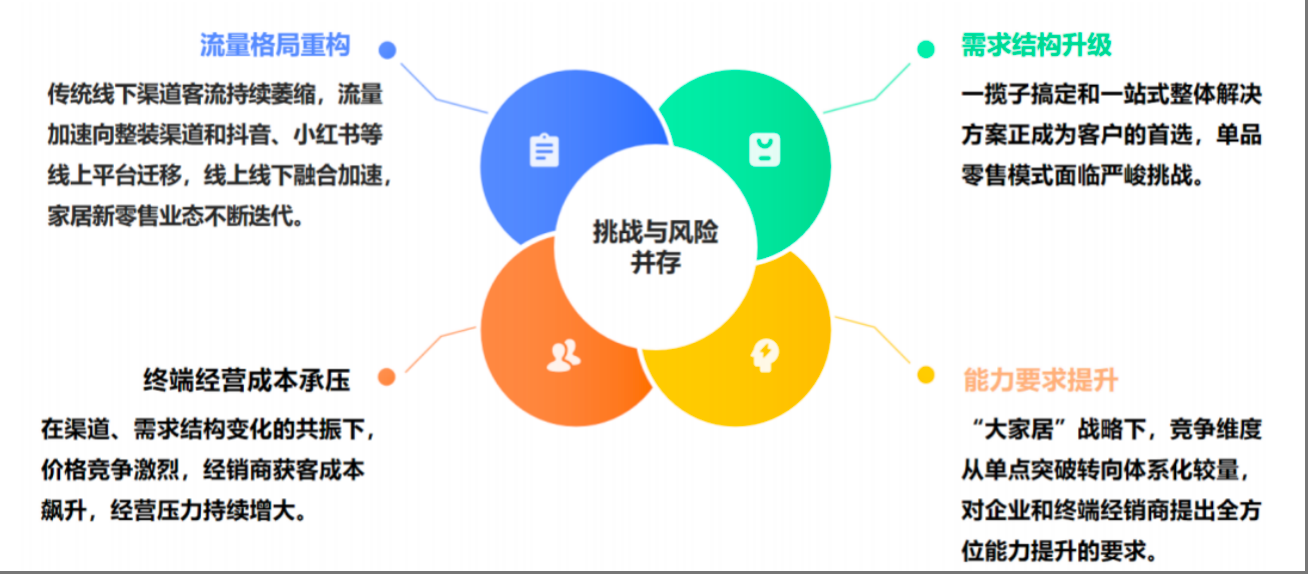
欧派家居(603833):盈利能力稳中有升 大家居战略稳步推进
Xin Lang Cai Jing· 2025-05-08 04:34
Core Viewpoint - The company reported a decline in revenue and net profit for 2024, but showed signs of recovery in Q1 2025, with a significant increase in net profit compared to the previous year [1][2]. Financial Performance - In 2024, the company achieved revenue of 18.92 billion, down 17% year-on-year, and a net profit of 2.6 billion, down 14% year-on-year. The adjusted net profit was 2.32 billion, down 16% year-on-year [1]. - For Q4 2024, the company reported revenue of 5.05 billion, down 19% year-on-year, and a net profit of 570 million, down 22% year-on-year. The adjusted net profit was 550 million, up 1% year-on-year [1]. - In Q1 2025, the company achieved revenue of 3.45 billion, down 5% year-on-year, but net profit increased by 41% to 310 million, with adjusted net profit rising by 86% to 270 million [1]. Product and Channel Performance - In 2024, revenue from various product lines included: cabinets (5.45 billion, -22%), wardrobes (9.79 billion, -18%), sanitary ware (1.09 billion, -4%), wooden doors (1.13 billion, -18%), and other products (890 million, +8%) [1]. - Revenue by channel in 2024 was: distribution (14.04 billion, -20%), direct sales (830 million, +0.6%), and bulk sales (3.05 billion, -15%) [1]. Strategic Initiatives - The company is committed to its home furnishing development strategy, with over half of its distributors operating or piloting retail home furnishing businesses by the end of 2024, increasing effective retail home furnishing stores to over 1,100 [2]. - The company aims to deepen its risk control in bulk business while exploring new business models, achieving nearly 50% growth in non-real estate development project business volume in 2024 [2]. - The company is transitioning from single customization to integrated solutions and is moving towards a large-scale building materials integration platform, with multi-category bulk projects accounting for over 50% in 2024 [2]. Cost Management and Profitability - The company effectively controlled costs, achieving an overall gross margin of 35.9% in 2024, up 1.8 percentage points year-on-year [2]. - The sales, management, R&D, and financial expense ratios were 10.0%, 6.9%, 5.4%, and -1.3% respectively, with absolute amounts for sales, management, and R&D expenses decreasing [2]. - The net profit margin for 2024 was 13.7%, an increase of 0.4 percentage points year-on-year [2]. Profit Forecast - The company maintains a strong industry leadership position, with expectations for net profits of 2.82 billion, 3.04 billion, and 3.22 billion for 2025, 2026, and 2027 respectively, and maintains a "recommended" rating [3].
鲁班到家登顶全国服务订单量第一,正在成为大家居服务新基建
3 6 Ke· 2025-05-08 01:06
Core Insights - The Chinese home furnishing consumption structure is undergoing significant changes as the era of high growth in the real estate industry comes to an end, with a shift towards home updates, repairs, and functional improvements becoming a rapidly growing segment of household spending [1][7] - The market for home installation and maintenance services in China is projected to exceed 700 billion yuan in 2024 and reach 896.1 billion yuan by 2029, with a compound annual growth rate of 4.9% over five years [1][4] - Luban Home has emerged as a leading platform in the home installation and maintenance service sector, ranking first in actual service order volume in 2024, based on real service fulfillment data rather than traditional GMV metrics [1][3] Industry Trends - The demand for new housing is slowing, while second-hand home transactions are increasing, leading to a reconfiguration of living spaces among middle-class families [1][7] - The home service industry is transitioning from a "connection intermediary" model to one focused on "delivery capability," with platforms like Luban Home leveraging technology for a full-process closed loop [3][4] - The home service market is characterized by a lack of standardization, with many consumers expressing dissatisfaction with the unpredictability of service quality [3][5] Company Overview - Luban Home operates a platform that aggregates over 3 million blue-collar workers across all provincial administrative regions in China, achieving nationwide coverage for home services [4][6] - The platform employs a service standardization system, including skill certification, service tiering, and a star rating system, to ensure service quality and controllability [4][6] - Luban Home's business model includes a wide range of service categories, covering furniture, home appliances, and smart home installations, among others, thus expanding its market reach [4][6] Service Standardization - The company has developed a comprehensive service management system that quantifies service quality through metrics such as fulfillment orders, customer satisfaction ratings, and service radius [5][6] - Luban Home's service model includes a full range of offerings from installation to maintenance, utilizing intelligent algorithms for optimal technician allocation based on various factors [5][6] - The platform has achieved a service satisfaction rate of 98.52%, reflecting its commitment to standardizing service delivery [6] Future Outlook - As China's population ages, the demand for home services tailored to older adults is expected to grow, with the market for such services experiencing an annual growth rate of 12% over the past three years [7][8] - Luban Home is positioned to address the challenges of an aging workforce in the service industry by providing training programs and incentives for blue-collar workers [7][8] - The company is facilitating a shift from a product-driven to a service-driven industry, redefining the connection between workers and brands while enhancing overall service efficiency [8]

欧派家居集团股份有限公司关于2024年年度及2025年第一季度业绩说明会召开情况的公告
Shang Hai Zheng Quan Bao· 2025-05-07 20:34
Core Viewpoint - The company held an earnings briefing on May 6, 2025, to discuss its 2024 annual and 2025 Q1 performance, emphasizing its strategies to enhance operational efficiency and adapt to market challenges [1][2]. Group 1: Financial Performance - Despite a challenging real estate market, the company reported improvements in gross margin and net margin for 2024 and Q1 2025, attributed to cost control measures and operational efficiency enhancements [2][3]. - The company implemented a dynamic monitoring mechanism for raw material prices, which helped maintain reasonable procurement costs [5][17]. Group 2: Strategic Initiatives - The company plans significant capital expenditures in 2025, focusing on the construction of new bases and upgrading production equipment to enhance efficiency and product quality [4][5]. - The company is committed to a management strategy aimed at improving operational efficiency through organizational restructuring and digital transformation [3][10]. Group 3: Market Adaptation - The company is responding to the ongoing adjustments in the real estate sector by diversifying its business model, including exploring non-real estate projects and enhancing its supply chain management [10][17]. - The company is actively engaging in the transformation of its retail partners to adapt to the integrated home furnishing model, which requires a comprehensive upgrade in capabilities [6][7]. Group 4: Policy Impact - Recent government policies promoting consumption and home renovation have positively influenced market demand, aligning with the company's long-term strategies focused on sustainability and innovation [5][6]. - The company anticipates that the impact of national subsidies will stabilize its accounts receivable credit impairment losses, as the real estate sector receives more support [5][6]. Group 5: Future Outlook - The company aims to enhance its operational quality and scale through a "land to household" reform, focusing on precise responsibility allocation and profit-sharing mechanisms [7][8]. - The company is exploring opportunities in the overseas market while maintaining a cautious approach to resource allocation [13][14].
欧派家居20250507
2025-05-07 15:20
Summary of the Conference Call for Oppein Home Company Overview - **Company**: Oppein Home - **Industry**: Home Furnishing and Interior Design Key Financial Performance - **2024 Revenue**: 18.93 billion CNY, a decrease of 16.9% year-on-year [2][3] - **2024 Net Profit**: 2.6 billion CNY, a decrease of 14.4% year-on-year [2][3] - **Q1 2025 Revenue**: 3.45 billion CNY, a decrease of 4.8% year-on-year [2][5] - **Q1 2025 Net Profit**: 310 million CNY, an increase of 41% year-on-year [2][5] - **Gross Margin**: 34.3% in Q1 2025, the highest for the same period historically [2][5] Sales Channel Performance - **Distribution Channel Revenue**: 14.04 billion CNY, down 20% year-on-year [2][6] - **Engineering Channel Revenue**: 3.05 billion CNY, down 15% year-on-year, but non-real estate project volume increased by nearly 50% [2][6] - **Direct Sales Revenue**: 830 million CNY, with a compound annual growth rate of 20% over five years [2][6] - **Overseas Channel Revenue**: 430 million CNY, an increase of 34% year-on-year [2][6] Cost Control and Profitability Measures - **Gross Margin for 2024**: 35.9%, an increase of 1.76 percentage points year-on-year [2][7][8] - **Cost Control Initiatives**: - Dynamic monitoring of bulk material prices - Optimization of supply chain - Accelerated smart manufacturing - SKU simplification - Application of new materials and processes [2][7][8] Dividend Policy - **Planned Dividend**: 2.48 CNY per share annually for the next three years, totaling 1.5 billion CNY per year, representing 58% of net profit [2][9] Future Development Strategies - **Strategic Focus**: Seven major transformations including marketing organization, delivery system, supply chain, and internal audit reforms [2][4][10] - **Capital Expenditure for 2025**: 321 million CNY, focused on construction and upgrades [2][4][13] Market and Policy Impact - **Government Subsidy Policies**: Positive impact on demand and market confidence, with Oppein leading in subsidy orders [2][17] - **Challenges**: Ongoing pressure from the real estate market and cautious consumer spending [2][18] Transformation and Innovation - **Home Furnishing Reform**: Continuous process with positive effects observed [2][19] - **Dealer Transformation**: Approximately 70% of original retail agents expected to successfully transition to the home furnishing model [2][20] Risk Management - **Accounts Receivable Management**: Enhanced risk assessment and credit control measures, with a bad debt provision ratio of 29.87% [2][14] AI and Technology Integration - **AI Implementation**: Significant investments in AI to enhance financial management and operational efficiency [2][15][28] Supply Chain and Consumer Experience - **Supply Chain Advantages**: High efficiency and accuracy in product delivery, contributing to a strong market position [2][30] International Expansion - **Overseas Market Strategy**: Exploring new markets with a focus on cost-effectiveness before establishing manufacturing bases abroad [2][35] Conclusion - **Long-term Vision**: Aim to become a leading consumer goods company through innovation, efficiency, and enhanced consumer experience [2][29][26]