博时基金

Search documents
上周超500亿资金抄底股票ETF,恒生科技、中证500、创业板指、科创50“吸金”居前
Ge Long Hui· 2025-11-25 00:40
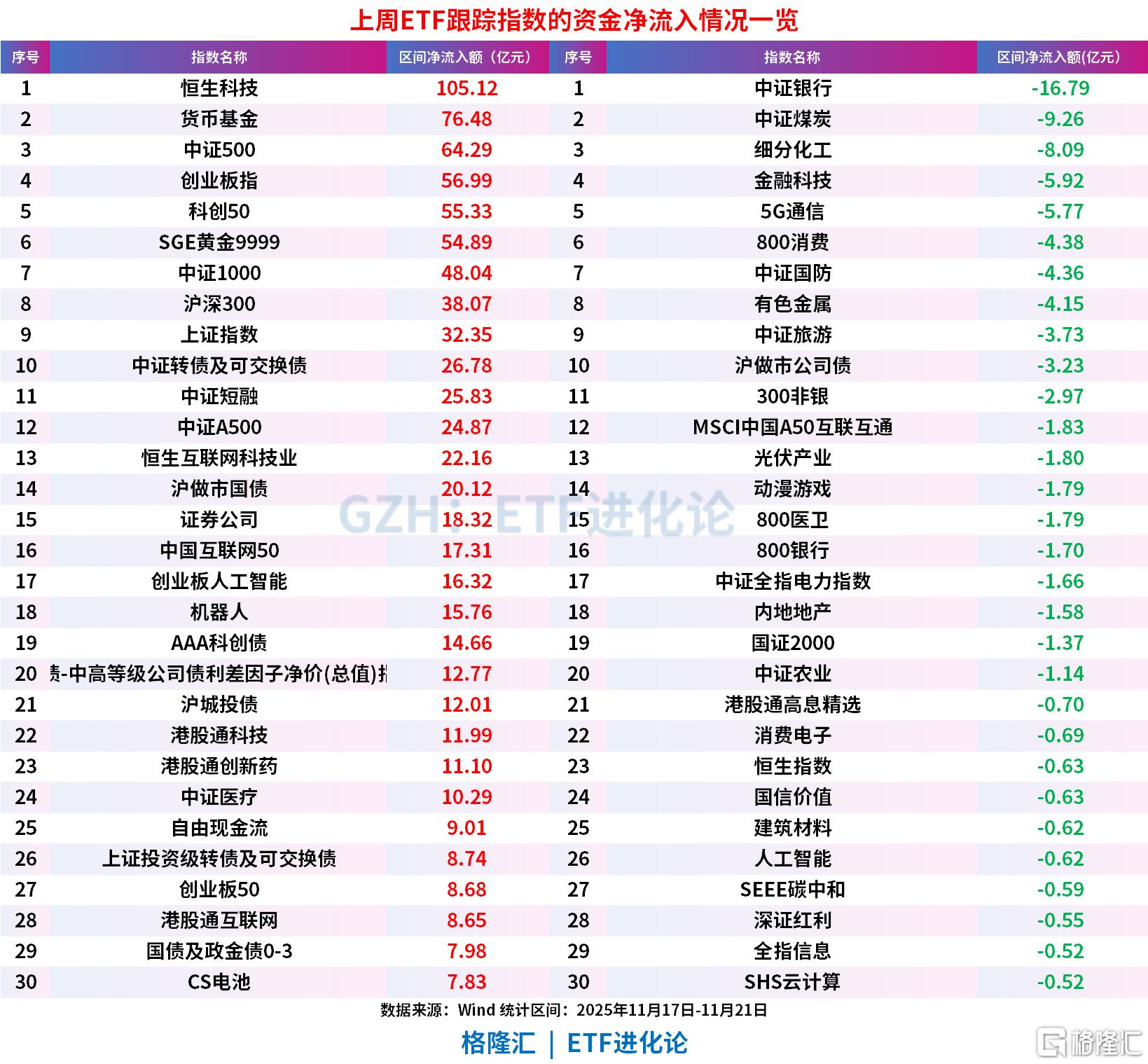
Market Performance - The A-share market saw a decline across major indices last week, with the CSI 300, Shanghai Composite Index, and SME Index showing returns of -3.77%, -3.90%, and -5.10% respectively. The ChiNext Index, CSI 1000, and CSI 500 had lower returns of -6.15%, -5.80%, and -5.78% respectively [1] - In terms of industry performance, banks, food and beverage, and media sectors had relatively better returns of -0.87%, -1.36%, and -1.39% respectively, while sectors like comprehensive, electric equipment and new energy, and basic chemicals lagged with returns of -9.47%, -9.41%, and -8.24% respectively [1] Fund Flows - The ETF market experienced a net inflow of 98 billion, with stock ETFs contributing 54.577 billion, QDII stock ETFs 15.544 billion, commodity ETFs 6.495 billion, bond ETFs 13.8 billion, and money market fund ETFs 7.648 billion. Notably, on November 21, there was a significant inflow of 50 billion aimed at "bottom-fishing" through ETFs [2] - Specific indices such as Hang Seng Technology, money market funds, CSI 500, ChiNext Index, and others saw net inflows ranging from 10.512 billion to 0.3235 billion, while sectors like CSI Bank, CSI Coal, and others experienced net outflows [2][4] ETF Performance - The top-performing ETFs included the S&P Biotechnology ETF and Emerging Asia ETF, with weekly gains of 1.35% and 0.67% respectively. Conversely, several new energy and photovoltaic ETFs saw significant declines, with losses ranging from -11.70% to -13.44% [12][14] - A total of 41 new funds were launched last week, with a combined issuance scale of 35.635 billion, marking an increase from the previous week. This included 14.022 billion in equity funds, 8.056 billion in mixed funds, and 13.557 billion in bond funds [15] Regulatory Changes - The Shanghai and Shenzhen stock exchanges announced new regulations requiring the 5.7 trillion ETF market to standardize fund names. The revised guidelines mandate that fund names must include core investment elements and the fund manager's abbreviation, with a deadline for compliance set for March 31, 2026 [15] - Sixteen hard technology-themed funds were approved on November 21, including the first seven AI ETFs, three chip ETFs, and four chip design theme ETFs, involving multiple fund management companies [16]


从喧嚣到冷静:公募REITs的价值重估时刻
Shang Hai Zheng Quan Bao· 2025-11-24 18:03
Core Viewpoint - The REITs market experienced a significant downturn in the second half of the year after a strong performance in the first half, with the market index retreating nearly 8% from its peak, attributed to valuation corrections, changes in funding preferences, and a wave of unlocks in the market [1][2][3] Market Performance - The CSI REITs total return index rose by 21.55% from a low of 925.46 in December 2024 to a high of 1124.91 in June 2023, but has since entered a downward trend [1] - The REITs market is facing pressure due to a combination of factors including a hot equity market drawing funds towards higher risk returns, changes in the operational performance of infrastructure assets, and a significant increase in supply without corresponding demand [2][3] Unlocking Pressure - In November alone, five REITs with over 7 billion shares faced unlocking, creating short-term selling pressure in the market [3] - The unlocking of shares is seen as a normal phase in the REITs market's development, potentially providing long-term investment opportunities if prices drop significantly [3] Investment Logic Shift - The cooling of the secondary market is affecting the primary market, with recent REIT offerings experiencing significantly lower subscription rates compared to previous high-demand scenarios [4][5] - Investors are shifting focus from speculative trading to value-based investment, emphasizing the quality of underlying assets and rational pricing [5][6] Long-term Investment Opportunities - The current market adjustments are viewed as creating new investment opportunities, particularly for high-quality assets with stable cash flows [6][7] - Analysts recommend focusing on defensive assets with high dividend yields and growth-oriented assets that have been temporarily undervalued [6][7]
银行理财资产配置专题分析:25Q3 理财的基金投资有何变化?
Hua Yuan Zheng Quan· 2025-11-24 14:07
Report Industry Investment Rating There is no information provided in the text about the report's industry investment rating, so this section is skipped. Core Viewpoints of the Report - In 25Q3, the scale of wealth management increased steadily, with a super - seasonal rise of 1.5 trillion yuan. The break - even rate of wealth management first rose and then fell rapidly in October. The industry has entered the era of wealth management companies, and regulatory requirements are approaching those of public funds [2][6][13]. - In 25Q3, bank wealth management reduced its allocation to public funds. It significantly increased the allocation of cash and bank deposits, while reducing the allocation of equity assets and public funds, and the bond allocation ratio decreased [29]. - In 25Q3, wealth management reduced its allocation to bond - type funds. It mainly reduced the allocation of bond - type funds and increased the allocation of international/QDII funds, stock - type funds, and alternative investment funds [47][49]. Summary by Relevant Catalogs 1. 25Q3 Wealth Management Scale Steadily Grows - **Entering the Era of Wealth Management Companies**: Since 2018, a series of regulatory policies have been introduced, narrowing the gap between bank wealth management regulatory requirements and public funds. As of October 2025, 32 wealth management companies have been approved to be established and all are in operation. In H1 2025, the net profit of most wealth management companies increased year - on - year, with an overall growth of 1.7% [6][9][10]. - **25Q3 Scale Growth**: As of September 2025, the wealth management scale was 32.13 trillion yuan, with a super - seasonal increase of 1.5 trillion yuan in 25Q3. In October, the scale increased by 1.5 trillion yuan, higher than the seasonal increment. Most wealth management companies' scales increased in 25Q3, with different growth rates among different types of companies. Fixed - income products' Q3 scale increased compared to Q2, while equity products' Q3 scale decreased [13][14][16][18]. - **Break - even Rate and Performance Benchmark**: The break - even rate of wealth management rose from late July and then decreased rapidly in October. As of November 9, 2025, it was about 0.39%. The average performance comparison benchmark of newly issued RMB fixed - income wealth management products has been declining, and it is expected to slowly fall to around 2.0% [22][25]. 2. Bank Wealth Management Reduced Allocation to Public Funds in 25Q3 - **25Q3 Public Fund Investment Proportion Declined**: In 25Q3, wealth management significantly increased the allocation of cash and bank deposits, while reducing the allocation of equity assets and public funds. The proportion of public funds decreased by 0.3 pct compared to 25H1. The investment behavior of wealth management companies in public funds was differentiated in 25Q3 [29][30]. - **Asset Allocation Changes in H1 2025**: Large - bank wealth management companies generally increased the allocation of public funds, with the overall scale rising to 0.4 trillion yuan and the proportion rising to 3.8%. Joint - stock bank wealth management companies also generally increased the allocation of public funds and slightly increased the allocation of deposit - type assets. Most urban and rural commercial bank wealth management companies increased the allocation of deposit - type and public fund - type assets and reduced the allocation of bond - type assets in H1 2025. The indirect investment proportion has increased in recent years [34][38][43]. 3. 25Q3 Wealth Management Reduced Allocation to Bond - Type Funds - **Overall Public Fund Allocation**: In 25Q3, the allocation of public funds by wealth management decreased slightly. As of September 2025, the scale of public funds allocated by wealth management was about 1.3 trillion yuan, with a proportion of 3.9%, a decrease of 0.3 pct compared to 25Q2 [47]. - **Allocation of Different Types of Public Funds**: Bond - type funds are still the main type of public funds allocated by bank wealth management. In 25Q3, wealth management increased the allocation of international/QDII funds, stock - type funds, and alternative investment funds, while reducing the allocation of bond - type funds. Among bond - type funds, it increased the allocation of secondary bond funds, medium - and long - term pure bond funds, and convertible bond funds, and reduced the allocation of short - term pure bond funds. Among stock and hybrid funds, it increased the allocation of passive index - type stock funds [49][56][65].
海外市场震荡触发QDII限购潮,多只跨境基金收紧申购通道
Hua Xia Shi Bao· 2025-11-24 12:56
Core Viewpoint - The recent surge in demand for QDII funds, driven by ongoing volatility in overseas markets, has led to a wave of purchase restrictions across various QDII products, indicating a proactive management approach by fund companies to control product scale and performance [2][3][4]. Group 1: QDII Fund Purchase Restrictions - As of November 24, multiple QDII funds, including Bosera Hang Seng Technology ETF and Huaxia S&P 500 ETF, have suspended large-scale subscriptions and regular investment plans [2][4]. - Nearly 90 QDII products have tightened investment channels since November, with some funds lowering the minimum investment threshold to as low as 10 yuan [2][5]. - Fund companies like Huatai-PineBridge and Morgan Stanley have significantly reduced subscription limits, with some products now allowing a maximum of only 10 yuan for single-day subscriptions [4][5]. Group 2: Reasons Behind Purchase Restrictions - The primary drivers for the recent purchase restrictions are structural tensions in foreign exchange quotas and fund companies' active management of product scale and performance [3][6]. - The rapid growth in fund size could lead to increased redemption costs and dilution of existing returns, prompting fund companies to limit new inflows to protect the interests of current investors [6]. Group 3: Market Dynamics and Risks - The tightening of subscription channels has led to increased premiums in the secondary market for certain popular QDII products, with some experiencing premiums exceeding 10% [7][8]. - Fund companies have issued multiple risk warnings regarding the high premiums of their products, advising investors against blindly chasing high-priced funds [7][8]. Group 4: Future Market Outlook - Optimism regarding the future of the U.S. stock market persists, with expectations of continued positive performance supported by factors such as potential Federal Reserve interest rate cuts and the ongoing development of AI technology [9]. - Conversely, caution is advised as market sentiment shifts, with concerns about high valuations and the sustainability of business models in the AI sector becoming more pronounced [10].

操作:注意!信号有变!散户一定要做好两手准备!看好了
Ge Long Hui· 2025-11-24 12:55
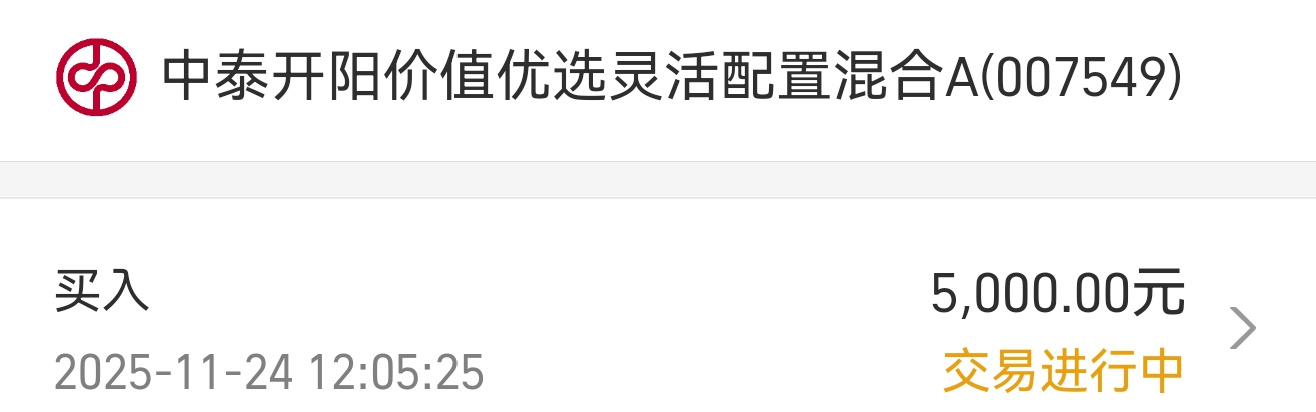
Market Overview - The market is experiencing fluctuations, with the main index showing signs of retreat after an upward movement, indicating a potential adjustment period ahead [1] - The current market environment is characterized by increased volatility, leading to a more conservative investment approach [2] Investment Strategy - The company has reduced its investment position from 700,000 to over 400,000, reflecting a cautious stance amid market uncertainties [1] - A focus on dollar-cost averaging and maintaining liquidity to respond to market changes is emphasized [1] Fund Investments - The company has increased its investment in the Morgan Huikai Growth Mixed Fund by 10,000, citing the fund manager's strong track record with an annualized return of 11.57% over nine years [2] - An additional investment of 5,000 has been made in the Zhongtai Kaiyang Value-Selected Flexible Allocation Mixed Fund, which has a balanced portfolio across various sectors, reducing volatility [2] - A 5,000 investment in the E-Fund CSI Military Industry Index (LOF) is noted, with expectations of growth due to stable defense spending and industry upgrades [3] Sector Analysis - The military industry is highlighted for its strong policy support and stable demand, with a focus on technological advancements and high barriers to entry [3] - The chip industry is currently facing a pullback, with the company opting to observe before making further investments [4] - The bond market is showing mixed signals, with the company maintaining its current holdings [7] - The renewable energy sector is in a consolidation phase, with plans to wait for a clearer trend before investing [7] - The Hong Kong stock market has shown some rebound but remains unstable, prompting a wait-and-see approach [7]
债券ETF跟踪:信用债类ETF大幅净流入
ZHONGTAI SECURITIES· 2025-11-24 12:27
Report Summary 1. Report Industry Investment Rating No information about the industry investment rating is provided in the report. 2. Core Viewpoints - Bond - type ETFs had significant net inflows in the past week, with credit - type ETFs leading the way, and large cumulative net inflows throughout the year [3]. - The net values of various bond ETF products recovered significantly in the past week, with some products performing well and others showing different trends [4]. - Credit - bond ETFs and science - innovation bond ETFs had certain increases in unit net value, and their discount rates were at specific levels [5]. 3. Summary by Relevant Catalogs 3.1 Funds Flow - As of November 21, 2025, bond - type ETFs had a total net inflow of 12.729 billion yuan in the past week. Interest - rate, credit, and convertible - bond ETFs had net inflows of 3.538 billion yuan, 6.636 billion yuan, and 2.555 billion yuan respectively. Among credit - type ETFs, short - term financing, corporate bonds, and urban investment bonds had net inflows of 2.598 billion yuan, 1.269 billion yuan, and 1.212 billion yuan respectively, while market - making credit bonds had a net outflow of 252 million yuan, and science - innovation bonds had a net inflow of 1.809 billion yuan. - As of November 21, 2025, the cumulative net inflows of interest - rate, credit, and convertible - bond ETFs for the year were 74.2 billion yuan, 445.363 billion yuan, and 25.137 billion yuan respectively, with a total of 544.7 billion yuan [3]. 3.2 Net Value Performance - Throughout the week, the net values of various bond ETF products recovered significantly. As of November 21, 2025, the 5 - year local - bond ETF and 10 - year local - bond ETF performed well, rising 0.15% and 0.14% respectively. The government - financial bond ETF and 0 - 4 local - bond ETF both rose 6BP. Treasury - bond ETFs and state - development - bond ETFs performed steadily. Convertible - bond ETFs and Shanghai - Stock - Exchange convertible - bond ETFs fell 1.72% and 1.37% respectively last week [4]. 3.3 Performance of Credit - Bond ETFs and Science - Innovation Bond ETFs - As of November 21, 2025, the median unit net values of credit - bond ETFs and science - innovation bond ETFs were 1.0126 and 1.0008 respectively, rising 0.01% and 0.02% throughout the week. Among credit - bond ETFs, Dacheng Credit - Bond ETF performed well, rising 0.04%. Among science - innovation bond ETFs, Fuguo, Boshi, and JingShun Science - Innovation Bond ETFs performed relatively well. As of November 21, 2025, the median discount rate of credit - bond ETFs was 25BP, and that of science - innovation bond ETFs was 22BP [5]. 3.4 Credit - Type ETF Duration Tracking - As of November 21, 2025, the holding durations of short - term financing ETFs, corporate - bond ETFs, and urban - investment - bond ETFs were 0.40 years, 1.84 years, and 2.21 years respectively. Among market - making credit - bond ETFs, the median holding durations of products tracking the Shanghai - market - making corporate - bond and Shenzhen - market - making corporate - bond indexes were 3.789 years and 2.87 years respectively. Among science - innovation bond ETFs, the median holding durations of products tracking the AAA science - innovation bond, Shanghai - AAA science - innovation bond, and Shenzhen - AAA science - innovation bond indexes were 3.47 years, 3.56 years, and 3.24 years respectively [8]. 3.5 Report Abstract - Last week, the ChinaBond New Composite Index rose 0.03% throughout the week. Short - term pure - bond and medium - long - term pure - bond funds rose 0.02% and 0.02% respectively. The ChinaBond AAA Science - Innovation Bond Index and the Shanghai Stock Exchange Benchmark Market - Making Corporate - Bond Index rose 0.03% and 0.03% respectively [7].
AI应用全线爆发,58位基金经理发生任职变动
Sou Hu Cai Jing· 2025-11-24 08:47
Market Performance - On November 24, the three major A-share indices closed higher, with the Shanghai Composite Index rising by 0.05% to 3836.77 points, the Shenzhen Component Index increasing by 0.37% to 12585.08 points, and the ChiNext Index up by 0.31% to 2929.04 points [1]. Fund Manager Changes - In the past 30 days (October 25 to November 24), a total of 644 fund managers have left their positions across various funds. On November 24 alone, 72 funds announced changes in their fund managers [3]. - The reasons for the changes include 15 fund managers leaving due to job changes from managing 40 funds, 6 due to product expiration from managing 9 funds, and 3 for personal reasons from managing 23 funds [3]. Fund Manager Performance - Lu Yushan from Southern Fund currently manages assets totaling 1.109 billion yuan, with the highest return of 147.82% achieved in the Southern Reform Opportunity fund over 6 years and 305 days [5]. - Yu Haiyan from E Fund manages assets of 440.629 billion yuan, with the highest return of 155.84% from the E Fund CSI 300 Non-Bank ETF over 11 years and 154 days [5]. Fund Research Activity - In the past month, the most active fund company in conducting company research was Chuangjin Hexin Fund, which researched 214 listed companies. Other active fund companies included Bosera Fund, Huaxia Fund, and Ping An Fund, researching 117, 113, and 112 companies respectively [7]. - The medical device industry was the most researched sector, with 639 instances of research, followed by the chemical products industry with 502 instances [7]. Recent Company Focus - The most researched company in the last month was Luxshare Precision, with 76 fund management companies participating in the research. Other notable companies included Lens Technology and Ninebot, with 74 and 72 fund management companies involved respectively [8]. - In the past week (November 17 to November 24), Ninebot was the most researched company, receiving attention from 47 fund institutions, followed by Lens Technology, Rongbai Technology, and Boying Special Welding [9].


中铁装配股价涨6.03%,博时基金旗下1只基金位居十大流通股东,持有91.85万股浮盈赚取94.61万元
Xin Lang Cai Jing· 2025-11-24 06:48
Group 1 - The core viewpoint of the news is the significant increase in the stock price of China Railway Prefabricated Construction Co., Ltd., which rose by 6.03% to 18.12 CNY per share, with a trading volume of 383 million CNY and a turnover rate of 11.34%, resulting in a total market capitalization of 4.456 billion CNY [1] - China Railway Prefabricated Construction Co., Ltd. was established on August 31, 2006, and listed on March 19, 2015. The company specializes in the research, production, sales, and assembly of prefabricated construction products, including new wall materials, building structure materials, interior and exterior decoration materials, landscape materials, and integrated housing [1] - The main business revenue composition of the company is 98.84% from prefabricated construction products and services, while other supplementary sources account for 1.16% [1] Group 2 - Among the top ten circulating shareholders of China Railway Prefabricated Construction, Bosera Fund's Bosera Innovation Economy Mixed A (010994) entered the list in the third quarter, holding 918,500 shares, which is 0.47% of the circulating shares. The estimated floating profit today is approximately 946,100 CNY [2] - Bosera Innovation Economy Mixed A (010994) was established on January 12, 2021, with a latest scale of 401 million CNY. Year-to-date returns are 30.44%, ranking 1917 out of 8209 in its category; the one-year return is 26.44%, ranking 2011 out of 8129; and since inception, the return is 21.99% [2] Group 3 - The fund manager of Bosera Innovation Economy Mixed A (010994) is Tian Junwei, who has a cumulative tenure of 10 years and 176 days. The total asset scale of the fund is 866 million CNY, with the best fund return during his tenure being 164.2% and the worst being -35.11% [3]

散户认购越积极,亏损概率越大?ETF新老赛道建仓策略分化
券商中国· 2025-11-24 03:57
Core Insights - The article discusses the significant divergence in ETF (Exchange-Traded Fund) building strategies amid rising risk aversion, highlighting the differences in institutional participation and stock coverage speed between traditional and emerging ETF sectors [1][2]. ETF Building Strategies - There is a notable disparity in the building pace of new ETFs, with traditional sector ETFs seeing higher institutional participation and faster stock coverage compared to previously popular sectors that now have a higher retail investor ratio and cautious institutional involvement [1][2]. - The newly launched Penghua Hang Seng Biotechnology ETF has a staggering 97.08% retail investor participation, with only about 3% held by institutional investors, and a cautious stock position of less than 2% as of November 20 [2]. Performance of Different Sectors - Some sectors that have not performed well this year are becoming targets for new ETF investments, such as the Bosera National Industrial Software ETF, which achieved a stock position of 47% just a week before its launch [3]. - The article notes that the first major holding of the Bosera ETF, BGI Genomics, has seen a year-to-date decline of approximately 16% [3]. Lessons from Previous ETF Launches - The cautious approach in the biotechnology sector may stem from past experiences where high retail participation led to poor performance, as seen with earlier launched biotechnology ETFs that have not generated positive returns [4][5]. - The article highlights that the Huatai-PineBridge Hang Seng Biotechnology ETF, despite being launched in a hot market, has lost 15% of its value within two months, indicating that high initial enthusiasm can serve as a contrary indicator [5]. Shift in Investment Focus - As the year-end approaches, there is a shift in focus towards traditional low-position industries, with some fund companies suggesting a cautious approach to high-position sectors [6]. - The market is showing a preference for traditional sectors like electricity, coal, and steel, while technology sectors are being overlooked, reflecting a demand for safer investments [6]. Future Market Outlook - The article suggests that for the market to continue its upward trend, macro policies and industrial logic need to align, particularly in emerging tech industries like AI and robotics, which are at a critical commercialization phase [7]. - The potential for systemic revaluation in traditional economic sectors is highlighted, contingent on supportive policies from both supply and demand sides [7].

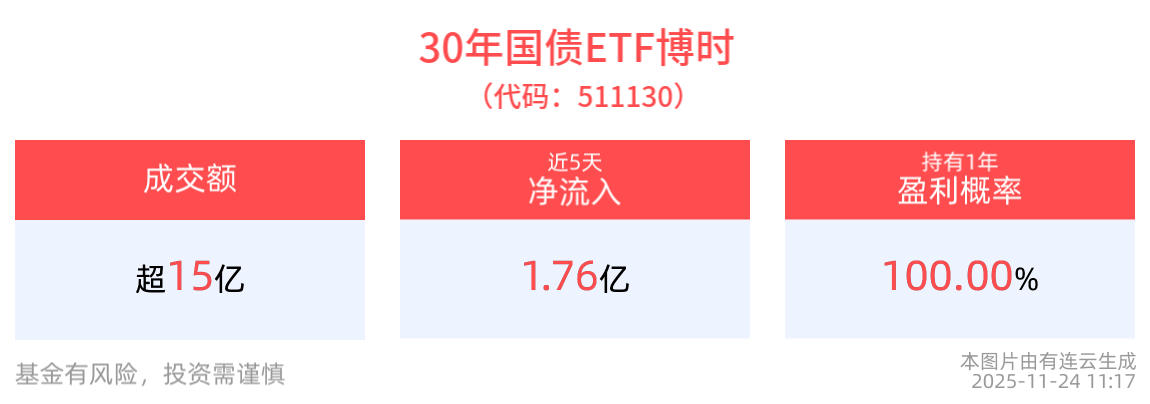
国债密集发行,积极财政政策持续发力,30年国债ETF博时(511130)红盘上行,盘中交投活跃
Sou Hu Cai Jing· 2025-11-24 03:40
Group 1 - The core viewpoint of the news highlights the ongoing issuance of government bonds, indicating a strong implementation of proactive fiscal policies to support economic growth [3] - As of November 24, 2025, the 30-year government bond ETF from Bosera has seen a slight increase of 0.11%, with a one-year cumulative rise of 3.34% [2] - The latest scale of the 30-year government bond ETF from Bosera has reached 18.932 billion yuan, with a recent net outflow of 120 million yuan [3] Group 2 - The Ministry of Finance is actively issuing government bonds, with 97 billion yuan in coupon bonds and 60 billion yuan in discount bonds scheduled for auction on November 24, 2025 [3] - The central bank conducted a reverse repurchase operation of 338.7 billion yuan with a stable interest rate of 1.40%, while major interbank bond yields have seen slight increases [2] - The current market outlook suggests a coexistence of short-term fluctuations and long-term easing in the bond market, driven by policy support and asset allocation needs [3]