
高盛

Search documents
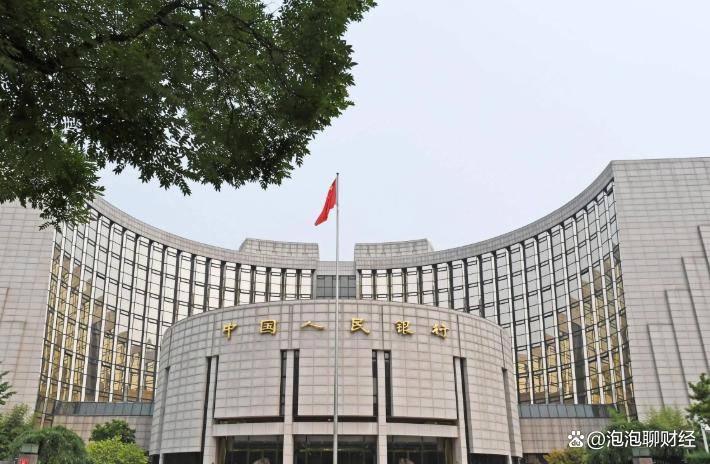
央行紧急行动,散户别碰中小盘!美联储9月降息前,机构在狂买这些股票
Sou Hu Cai Jing· 2025-08-03 03:43
Group 1 - The global liquidity turning point has been reached, and a new round of market trends in A-shares is potentially on the horizon [1][9] - International capital has already sensed this change, with $3 billion flowing into overseas China ETFs on July 29, 80% of which went to A50 index constituents [3] - Global funds have shifted their allocation to Chinese stocks from underweight to overweight, with an increase of 1.2 percentage points [3] Group 2 - The release of the July non-farm payroll data caused significant market reactions, with the June data being revised down from 147,000 to 14,000, a correction exceeding 90% [4] - The disappointing July non-farm report, showing only 73,000 new jobs, led to a surge in the probability of a Fed rate cut in September from 40% to 82% [4][6] - Major investment banks like Goldman Sachs and Citigroup have adjusted their forecasts, predicting multiple rate cuts by the Fed [6] Group 3 - The market reacted sharply, with the dollar index dropping 1.05%, marking the largest single-day decline in three months, while international gold prices surged 1.8% to over $2,280 per ounce [6] - Despite a drop in the Shanghai Composite Index, northbound capital saw a net inflow of 4.7 billion yuan on August 1, focusing on brokerage and gold stocks [6][7] - In July, northbound capital's net buying reached over 60 billion yuan, with a focus on brokerages, insurance, and leading consumer stocks [6] Group 4 - The impact of rate cuts on A-shares is not uniform; historical data suggests that while the SSE 50 Index may rise, the CSI 2000 Index could fall [7] - Brokerages reported strong performance in July, with Guotai Junan's mid-year report projecting a 210% increase, leading to significant institutional buying [7] - The gold market is also seeing increased activity, with the People's Bank of China increasing gold reserves for eight consecutive months, surpassing 2,280 tons [9] Group 5 - For ordinary investors, choosing appropriate investment tools is crucial in this complex market environment, with index funds being a preferred option [9] - The CSI 300 ETF saw net subscriptions exceeding 12 billion yuan in July, with institutional holdings at 85% [9] - The brokerage ETF benefits from policy support and strong performance, with leading brokerages averaging a price-to-earnings ratio of only 12 times [9]

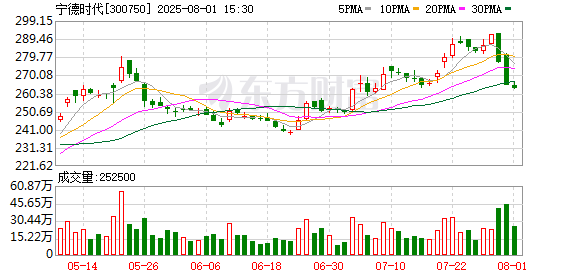
谁在做空宁德时代?超45亿元分红难阻A+H股全线跌价
Hua Xia Shi Bao· 2025-08-02 12:31
Core Viewpoint - Despite achieving revenue and profit growth in the first half of the year, CATL's performance has not been well-received by the capital market, with significant stock price declines following the earnings report [2][4]. Financial Performance - In the first half of 2025, CATL reported revenue of 178.886 billion yuan, a year-on-year increase of 7.27%, and a net profit of 30.485 billion yuan, up 33.33% year-on-year [5]. - The company announced a cash dividend of 10.07 yuan per 10 shares, totaling approximately 4.57 billion yuan [5]. Stock Market Reaction - Following the earnings report, CATL's A-shares fell from 292 yuan to 263 yuan, a decline of nearly 10%, while H-shares dropped from 462 HKD to 403 HKD, a decrease of nearly 13% [2][4]. - The stock price decline was attributed to a combination of factors, including a previous rapid increase in share price and market sentiment regarding solid-state battery commercialization [9][10]. Analyst Opinions - Morgan Stanley has positioned CATL as a technology-driven platform company, emphasizing its continuous technological evolution and ecosystem development as core competitive advantages [6]. - Several domestic brokerages have issued positive ratings for CATL, with reports highlighting its stable performance and improving profitability [6]. Market Expectations - Investor sentiment has been affected by CATL's management comments regarding solid-state batteries, which indicated that while the company has made significant R&D progress, true commercialization is still some time away [10]. - High expectations for CATL's performance were not met, particularly in the second quarter, leading to downward adjustments in profit forecasts by analysts [10][11]. Competitive Landscape - CATL is currently embroiled in patent disputes with competitors, which reflects the competitive tensions within the battery industry [13][15]. - The global battery market is witnessing significant growth, with CATL maintaining a leading position in both the power battery and energy storage battery sectors [14].

“黑天鹅”来袭!全线下跌!
Zheng Quan Shi Bao· 2025-08-02 00:10
Core Viewpoint - The introduction of "reciprocal tariffs" by the U.S. has triggered global market turmoil, leading to declines in both U.S. and European stock markets [1][6]. Market Performance - U.S. stock indices closed lower, with the Dow Jones Industrial Average down 1.23% at 43,588.58, the S&P 500 down 1.60% at 6,238.01, and the Nasdaq down 2.24% at 20,650.13 [2][3]. - For the week, the Dow Jones fell 2.92%, the S&P 500 dropped 2.36%, and the Nasdaq decreased by 2.17% [2]. - European markets also experienced declines, with Germany's DAX down 2.66%, France's CAC40 down 2.91%, and the UK's FTSE 100 down 0.70% [2][3]. Economic Indicators - Recent data indicates a significant slowdown in the U.S. labor market, with non-farm payrolls adding only 73,000 jobs in July, below expectations, and the unemployment rate rising to 4.2% [6][7]. - Revisions to previous months' employment data showed a drastic reduction, with May's job additions revised down from 144,000 to 19,000 and June's from 147,000 to 14,000 [6]. - The labor market's rapid deterioration raises concerns about a potential recession, as indicated by the market's heightened risk aversion [6][7]. Tariff Developments - President Trump signed an executive order to increase tariffs on Canada from 25% to 35%, effective August 1, and indicated adjustments to "reciprocal tariffs" for other countries, with rates ranging from 10% to 41% [7][8]. - This move has intensified market fears and contributed to the overall decline in stock prices [6][7]. Oil Market Impact - International oil prices fell sharply, with U.S. crude down 2.89% to $67.26 per barrel and Brent crude down 3.00% to $69.55 per barrel [9][10]. - The decline in oil prices is attributed to disappointing U.S. employment data and ongoing production increases by OPEC+, which has raised concerns about a potential oversupply in the market [10]. Precious Metals and Bonds - On August 1, international precious metals futures saw gains, with COMEX gold futures rising 2.01% to $3,416.00 per ounce and silver futures up 1.07% to $37.11 per ounce [11]. - U.S. Treasury yields fell across the board, with the 2-year yield down 25.49 basis points to 3.698% and the 10-year yield down 14.62 basis points to 4.220% [11].

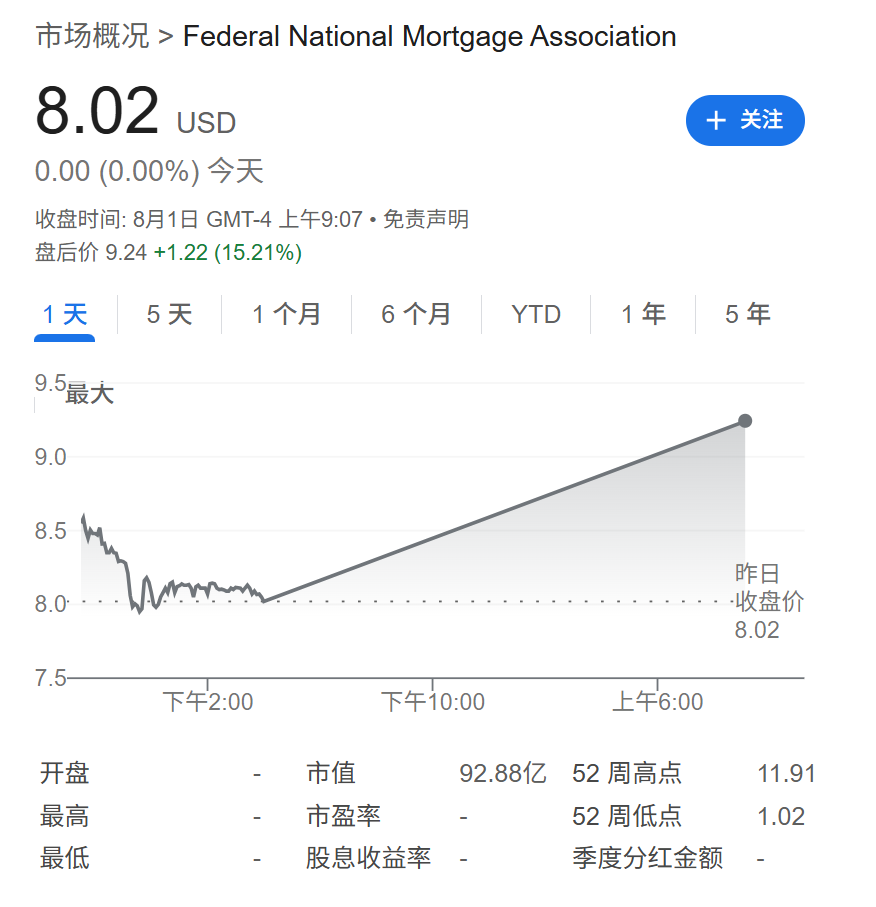
“两房”涨超15%!报道:特朗普推进房利美和房地美私有化
Hua Er Jie Jian Wen· 2025-08-01 14:02
Core Viewpoint - The U.S. government is considering privatizing Fannie Mae and Freddie Mac, which could lead to one of the largest IPOs in history, addressing a significant post-crisis issue [1][5]. Group 1: Government's Actions - President Trump is actively seeking advice from top Wall Street bank executives on how to monetize Fannie Mae and Freddie Mac and return them to the public market [1][5]. - Meetings have taken place with executives from major banks, including Jamie Dimon of JPMorgan Chase, and plans are in place to meet with Goldman Sachs and Bank of America [1][5]. Group 2: Market Implications - The potential privatization could result in substantial economic benefits for the government, banks, and existing shareholders, with analysts suggesting it may lead to significant underwriting fees for selected banks [6]. - Following the news, shares of Fannie Mae rose by 15% and Freddie Mac increased by 5.7% in the OTC market [1]. Group 3: Challenges Ahead - The privatization process is complex, with key issues such as the percentage of shares the government will sell in the initial public offering and the rights of existing shareholders still unresolved [6]. - The Congressional Budget Office (CBO) has indicated that selling government-held shares could yield a mixed financial outcome, estimating potential gains of $206 billion if the companies were placed under bankruptcy management [6].
金十图示:2025年08月01日(周五)美股热门股票行情一览(美股盘初)
news flash· 2025-08-01 14:01
Market Capitalization Summary - The market capitalization of major companies shows significant variations, with Oracle at 7860.84 billion and Mastercard at 7239.28 billion, while companies like Pfizer and Sony have market caps of 1497.38 billion and 1332.65 billion respectively [2][3][4]. - Notable declines were observed in companies such as Exxon Mobil, which decreased by 10.66 (-4.20%), and Visa, which fell by 10.36 (-3.50%) [2][3]. Stock Performance - Oracle's stock increased by 0.29 (+0.30%), while Mastercard's rose by 23.78 (+3.21%) [2]. - Companies like American Airlines and Home Depot saw slight increases of 1.55 (+0.42%) and 2.70 (+1.79%) respectively, while Procter & Gamble experienced a decline of 1.66 (-3.51%) [2][3]. Sector Analysis - The technology sector remains strong, with companies like AMD and Cisco showing resilience, while traditional sectors like energy and telecommunications face challenges [2][3]. - Financial institutions like Bank of America and Wells Fargo reported mixed results, with slight increases in stock prices despite overall market volatility [2][3]. Notable Company Movements - Disney's stock decreased by 5.09 (-3.57%), reflecting ongoing challenges in the entertainment sector [3]. - Companies like Uber and BlackRock also faced declines, with Uber down by 25.51 (-2.31%) [3][4]. Summary of Key Companies - Major players such as Exxon Mobil, Visa, and Pfizer are experiencing fluctuations in their market caps and stock prices, indicating a volatile market environment [2][3][4]. - The performance of companies like Delta Airlines and Yum! Brands shows a mixed outlook, with Delta increasing by 1.51 (+1.05%) while Yum! Brands fell by 2.61 (-4.91%) [5].

对手合并催生变局 传美国铁路巨头CSX(CSX.US)聘请高盛评估战略选项
智通财经网· 2025-08-01 06:37
Group 1 - CSX Transportation is exploring strategic options for industry consolidation in response to a merger between two major competitors, with discussions currently in preliminary stages with Goldman Sachs [1] - The recent $72 billion acquisition of Norfolk Southern by Union Pacific has intensified pressure on CSX and other competitors like Berkshire Hathaway's BNSF to consider mergers to maintain market competitiveness [1] - CSX's CEO Joe Hinrichs has expressed openness to merger discussions, highlighting the company's extensive operational network covering 26 states and parts of Canada, with a total rail length of approximately 20,000 miles [1] Group 2 - Historically, mergers in the railroad industry have been challenging due to strict regulatory environments; however, the appointment of Patrick Fuchs as chairman of the Surface Transportation Board has created more favorable conditions for such transactions [2]

人民币兑美元汇率创两个月新低
Sou Hu Cai Jing· 2025-08-01 01:11
Core Viewpoint - The recent decline in the RMB/USD exchange rate is attributed to various factors, including the impact of tariff policies, the performance of the US dollar index, and the ongoing trade negotiations between China and the US [2][3][6]. Exchange Rate Trends - As of July 31, the onshore and offshore RMB/USD exchange rates were reported at 7.193 and 7.2019, respectively, marking a continuous decline over five days and a cumulative drop of 0.38% for July [2]. - The RMB/USD central parity rate also fell to 7.1494, deviating significantly from market expectations, indicating a stronger than anticipated market response [2]. Trade Negotiations Impact - The recent US-China trade negotiations have not exceeded market expectations, contributing to the depreciation of the RMB. The lack of concrete outcomes from the talks has led to a weaker market sentiment [3][6]. - The extension of the existing tariff measures for 90 days was the only confirmed outcome from the negotiations, which did not provide the market with the anticipated clarity [6][7]. Economic Factors - The US dollar index has reached a two-month high, which has been a significant factor in the RMB's decline. The stability of the US economy and the Fed's reluctance to cut interest rates have supported the dollar [9][10]. - China's economic fundamentals, including trade surplus and consumer demand, are also influencing the RMB's performance. However, concerns about insufficient domestic demand persist [7][8]. Future Outlook - Analysts predict that the RMB/USD exchange rate may rise to 7.1 in the next three to six months, driven by expectations of a resolution in trade negotiations and continued strong export performance [4][13]. - Goldman Sachs forecasts that the onshore RMB/USD exchange rate could reach 7.10 and 7.00 in the next three to six months, reflecting a cautious but optimistic outlook [5][13]. External Influences - The ongoing strength of the US dollar and the potential for future Fed rate cuts are expected to play crucial roles in shaping the RMB's exchange rate dynamics [10][14]. - The recent data indicates that China's import and export scale remains robust, with significant growth in foreign currency deposits, suggesting a stable liquidity environment for the RMB [14].
全球铜市:关税冲击下的韧性与机遇
Qi Huo Ri Bao· 2025-08-01 00:53
Market Overview - In the first half of 2025, copper prices experienced significant fluctuations, with LME copper price reaching $9,878 per ton, marking a year-to-date increase of 12.49%, while Shanghai copper futures rose by 8.27% to 79,870 CNY per ton [1] - The U.S. tariff policies under President Trump have caused considerable market disruptions, leading to concerns about a global economic recession, which impacted stock and futures markets [2][3] - The International Monetary Fund (IMF) revised its global economic growth forecast for 2025 from 3.3% to 2.8%, with developed economies' growth expectations lowered from 1.9% to 1.4% [3] Supply Analysis - Global copper mine production from January to April 2025 totaled 7.5254 million metric tons, an increase of 2.64% year-on-year, but major copper producers reported a decline in output [8][9] - The anticipated global copper mine increment for 2025 is between 220,000 to 300,000 tons, with significant contributions expected from projects like Oyu Tolgoi and Kamoa-Kakula [11] - Domestic copper concentrate production in China for January to March 2025 reached 427,800 tons, a year-on-year increase of 5.26%, but still below levels from 2022 and 2023 [12] Demand Analysis - In the U.S., new housing starts have declined, while automotive sales remain stable, contributing limited growth to copper consumption [17] - In China, investment in power grid projects increased by 14.59% year-on-year, and the production of new energy vehicles surged by 48.35% [17] - Overall, domestic copper consumption is expected to show resilience, with strong growth in the power grid sector and stable performance in the automotive sector [17] Trade Flow Changes - The U.S. initiated a "232 investigation" into copper imports, leading to significant changes in global copper trade flows, with COMEX and LME markets experiencing increased arbitrage trading [18][19] - Chile's refined copper exports decreased by 11.1% year-on-year, while exports to the U.S. saw a significant increase of 116.11% [19] - As of June 30, 2025, global copper inventories decreased by 20.59% year-on-year, indicating tightening supply conditions [19] Outlook for the Second Half - The copper market is expected to maintain high prices due to the impact of U.S. tariff policies, supply constraints, and resilient demand [20] - If no major risk events occur, copper prices may continue to rise, potentially reaching new highs, although there is a risk of temporary price corrections following the implementation of U.S. tariffs [21]
华尔街多空激辩:估值折价,谷歌(GOOGL.US)被低估还是陷入“创新者窘境”?
智通财经网· 2025-07-31 04:08
Core Viewpoint - Alphabet's strong Q2 earnings report has sparked significant debate on Wall Street, with some investors optimistic about its future while others express concerns over regulatory pressures and competition from AI-driven alternatives [1][5]. Financial Performance - Alphabet reported a 14% year-over-year revenue growth and a 32% increase in operating profit for Q2, demonstrating strong financial health [1][2]. - The company's operating profit margin stands at 32.4%, significantly above the industry average [2]. - The expected P/E ratio for Alphabet is 19.5, lower than the S&P 500 average of 22.4 and nearly 30 times lower than other major tech stocks [3]. Competitive Landscape - Alphabet faces increasing competition from both traditional rivals and emerging AI-focused companies, with the U.S. Department of Justice accusing it of illegal monopoly in the advertising market [4]. - Regulatory challenges in the U.S. and EU could force Alphabet to alter its business model, potentially impacting key assets like the Chrome browser and its advertising exchange [4][6]. Bullish/Bearish Debate - Bears argue that Alphabet's core search business, which accounts for two-thirds of its profits, is at risk from AI alternatives like ChatGPT and Perplexity [5][6]. - Bulls counter that Alphabet's Q2 performance indicates resilience, with search revenue still growing by 12% year-over-year, and AI features enhancing user engagement [6]. - Alphabet's cloud business has shown a remarkable 31% revenue growth, supporting the success of its diversification strategy [6]. Analyst Ratings - Analysts have mixed views, with some downgrading Alphabet to "sell" due to regulatory risks and competition, while others, like Goldman Sachs, have raised target prices, citing strong performance and AI investments as growth drivers [7][8].
