招商蛇口

Search documents
房地产行业2025年10月楼市、地市、政策、房企全扫描
2025-11-20 02:16
Q&A 房地产行业 2025 年 10 月楼市、地市、政策、房企全扫 描 20251119 摘要 10 月新房成交面积环比增长 7%,但同比下降 19.5%,三四线城市降 幅更大。一线城市表现分化,深圳同比降幅高达 61%。二线城市中,南 宁是唯一实现同、环比正增长的城市。 10 月二手房市场整体走弱,成交面积环比减少 15%,同比减少 30%。 一线城市降幅略小于二线城市。北京、深圳等热点城市 1-10 月仍保持 正增长,但三四线城镇整体呈现负增长态势。 截至 10 月底,重点监测城市库存规模与去化周期小幅回落,整体去化 周期为 18.2 个月。新盘开盘去化率平均值为 34%,一线城市仅为 22%,北京、上海等热点区域热度回落。 受优质土地供应节奏放缓影响,全国 300 城土地交易量同比下降 13%。一类城镇交易量大增,但楼面价下跌 30%。全国平均溢价率仅 3.5%,土地市场整体疲软。 10 月百强企业销售额同比大跌 40%。2025 年 1 至 10 月,百强房企的 拿地金额达到 1.03 万亿元,同比增长 45%。中海地产、招商蛇口领衔 拿地金额榜单。 10 月份房地产市场的新房成交情况如何? 10 ...
多个“10万+”项目集中入市:华润置地上海高端市场寻破局
2 1 Shi Ji Jing Ji Bao Dao· 2025-11-19 13:09
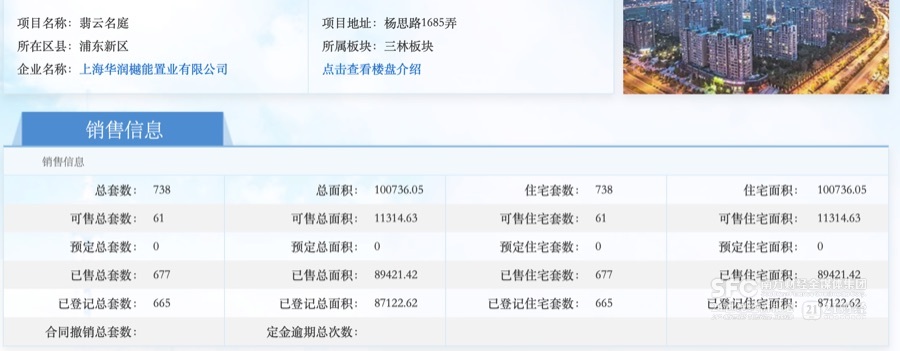
Core Insights - China Resources Land has made significant strides in the Shanghai real estate market since its return in 2023, competing with established state-owned enterprises like Jinmao [1] - The company ranked third in sales in Shanghai for the period from January to October 2025, with a sales amount of 34.17 billion yuan, trailing only Poly Developments and China Merchants Shekou [1] - Despite a strong start, sales in October showed signs of slowing down, raising concerns about the company's ability to navigate challenges in the high-end market [1] Sales Performance - In the first seven months of 2025, sales in Shanghai accounted for approximately 20% of the company's total sales [1] - The company is expected to maintain or slightly increase its sales proportion in Shanghai due to the launch of high-end projects in the second half of the year [1] - The Feiyun Yuefu project achieved a high sales rate of 91.73%, with 677 out of 738 units sold, indicating successful marketing efforts [2] Market Challenges - High-end projects are facing pressure on sales, with newer projects showing lower absorption rates compared to earlier launches [2][4] - The Huaihai Riverside project has seen a significantly lower absorption rate, with only 74.79% and 17.8% of units sold in its two phases, respectively [5] - The competitive landscape in Shanghai's high-end market is intensifying, with other developers also vying for high-net-worth clients [4][9] Strategic Moves - The company has made strategic acquisitions, including a 24.47 billion yuan purchase of land in the Shanghai Bund area [2] - Upcoming projects like Luanqi Binjiang are expected to enter the market with a price of 136,700 yuan per square meter, contributing to the company's sales [8] - The company is also focusing on enhancing product quality and design to attract high-net-worth individuals, despite facing challenges in construction and market positioning [9][10] Financial Position - China Resources Land has successfully issued 4.3 billion yuan and 300 million USD in dual-currency green bonds, which may help reduce financing costs and support its high-end market strategy [10] - The company has been actively expanding its land reserves in Shanghai, ranking first in land acquisition in 2023 with 21.76 billion yuan [11] - However, the integration of commercial and residential developments has not met expectations, impacting overall profitability [11][12]


土拍速递|北京城建溢价竞得北京二环内宅地,2号子地块将建设为四合院整院出售
克而瑞地产研究· 2025-11-19 09:08
Core Viewpoint - The article discusses the successful auction of two residential land parcels in Beijing, totaling a transaction price of 3.27 billion yuan, highlighting the competitive bidding environment and the implications for the real estate market in the region [1][3]. Summary by Sections Land Transaction Details - On November 19, two residential land parcels in Beijing were successfully auctioned for a total price of 3.27 billion yuan. The Tian Tan North parcel was won by Beijing Urban Construction for 2.028 billion yuan, resulting in a floor price of 116,000 yuan per square meter based on a residential construction area of 17,500 square meters, while the surrounding comparable housing price is 150,000 yuan per square meter [3][5]. - The Future Science City parcel was sold at a base price of 1.24 billion yuan, with the winning bid from Future Science City Real Estate (Changping State-owned Assets), where the saleable residential portion has a floor price of approximately 20,000 yuan per square meter, compared to a surrounding comparable housing price of 50,000 yuan per square meter [3][5]. Competitive Bidding Process - The Tian Tan North parcel underwent a competitive bidding process with two prior offers before reaching a final bid of 2.028 billion yuan after 38 rounds of bidding, resulting in a nominal floor price of 81,120 yuan per square meter and a premium rate of 4% [5][6]. Location and Development Requirements - The Tian Tan North parcel is located in a core area within Beijing's second ring, close to the North Gate of the Temple of Heaven, approximately 3 kilometers from Tiananmen Square. The area is characterized by low plot ratio and high residential comfort, with convenient transportation links and mature amenities nearby [6][9]. - The parcel consists of four sub-parcels, with specific construction requirements including a maximum height limit of 3.3 meters for certain areas and a traditional courtyard layout, prohibiting the construction of villas and private estates [9][11]. Market Context - Within a 2-kilometer radius of the Tian Tan North parcel, there are no similar projects currently for sale, with the nearest comparable project being the Jin Yu Chi parcel, which is set to be auctioned in July 2024. The surrounding market has seen significant price variations, with recent land sales in Beijing showing premium rates exceeding 10% for several parcels since 2025 [11][13].

中铁置业营销总李昂跳槽招商蛇口,接替“闪电”离职的于海波
Xin Lang Cai Jing· 2025-11-19 05:05
Group 1 - Li Ang, the marketing head of China Railway Real Estate, has recently left to join China Merchants Shekou in Beijing as the deputy general manager, overseeing marketing efforts [1][5] - Li Ang has extensive marketing experience in the real estate sector, having worked with various companies including Longfor and Oceanwide, and has a strong focus on the Beijing market, which is a key area for China Merchants Shekou [1][8] - China Railway Real Estate has faced significant performance challenges, reporting a loss of 1.749 billion yuan in 2022 and projected losses of 1.452 billion yuan in 2024 [4] Group 2 - China Railway Real Estate is a wholly-owned subsidiary of China Railway Group and was established to strengthen its real estate sector, with a focus on major urban areas [3] - The company has eight regional offices and has implemented a national development strategy, but many of its regional offices have struggled to acquire land in recent years [3][4] - In contrast, China Merchants Shekou has shown a more stable performance, achieving a net profit of 2.497 billion yuan in the first three quarters of the year, with a significant portion of its sales coming from its core markets [7][8] Group 3 - The frequent changes in leadership at China Merchants Shekou's Beijing office indicate a dynamic and possibly unstable marketing strategy, with recent departures and new appointments [6][7] - The real estate industry is shifting focus from scale to quality, emphasizing product quality and service upgrades, which aligns with Li Ang's expertise and could benefit China Merchants Shekou's market expansion [8]

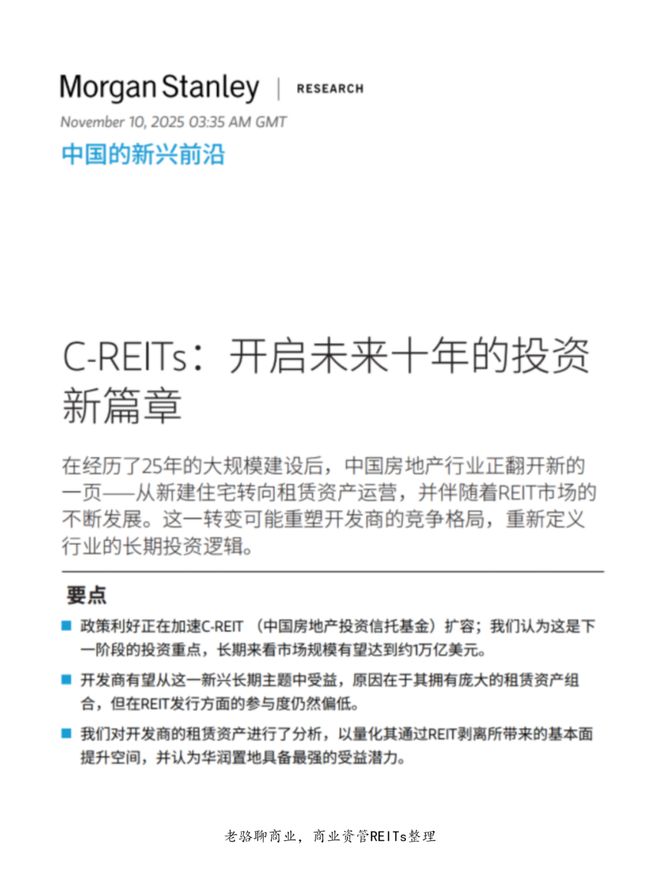
C-REITs:开启未来十年的投资新篇章
Xin Lang Cai Jing· 2025-11-19 04:31
Core Insights - The Chinese real estate industry is transitioning from new residential construction to rental asset operations, alongside the development of the REIT market, which may reshape the competitive landscape for developers and redefine long-term investment logic [1][3]. Group 1: C-REIT Expansion - Policy incentives are accelerating the expansion of C-REITs (China Real Estate Investment Trusts), with the market size expected to reach approximately $1 trillion in the long term [2][4]. - Developers are likely to benefit from this emerging long-term theme due to their large rental asset portfolios, although their participation in REIT issuance remains low [2][4]. - The analysis of developers' rental assets indicates that China Resources Land has the strongest potential for benefit from REIT spin-offs [2][4]. Group 2: Market Dynamics - Since Q3 2025, favorable policies have accelerated the issuance of domestic REITs, expanding the asset range and issuer backgrounds [6]. - C-REITs are expected to become an important asset class over the next 10 to 20 years due to their stable returns and low correlation with the stock market [6]. - The limited trading volume of C-REITs suggests that listed developers are a good entry point into this rapidly expanding theme [6]. Group 3: Key Beneficiaries - In-depth analysis shows that China Resources Land (1109.HK) has the highest short-term benefit potential, followed by New World Development (601155.SS) and Longfor Group (0960.HK) due to their large shopping center portfolios [7]. - Other companies with rich non-retail rental assets, such as China Overseas Land (0688.HK), China Merchants Shekou (001979.SZ), Vanke (2202.HK), and Poly Developments (600048.SS), may also benefit in the medium term as the REIT coverage expands [7]. Group 4: C-REIT Development History - The development of C-REITs over the past 25 years can be divided into four phases: initial preparation, gradual development, accelerated promotion, and full-speed phase [9]. - The regulatory framework for C-REITs was first proposed in the early 2000s, with significant progress made since the first public REIT was listed in mid-2021 [8][9]. Group 5: Current Market Status - As of September 2025, there are 75 publicly listed C-REITs with a cumulative issuance scale of approximately RMB 200 billion and a market value of about RMB 220 billion [10]. - Despite significant growth since the first public REITs were listed, C-REITs currently account for only 0.15% of the total market value of China's stock market [10]. Group 6: Future Potential - The potential market size for C-REITs is estimated to reach $1 trillion, which is 32 times the current market value of approximately $31 billion [15][16]. - The estimated value of commercial properties completed since 2000 is around $4.9 trillion, indicating a significant opportunity for C-REITs to capture a larger market share [14][15].


申万宏源证券晨会报告-20251119
Shenwan Hongyuan Securities· 2025-11-19 00:45
Group 1: Computer Industry Investment Strategy - The year 2025 marks the beginning of domestic computing power industrialization, with significant advancements in domestic AI chips and server architecture, enhancing overall computing performance [10] - The gap between Chinese and American large models is narrowing, with expectations of further convergence and potential surpassing in certain areas by 2026 [10] - The software industry is entering an optimal layout window as AI revenue for many companies exceeds 10%, indicating a technological revolution [10] - Investment focus areas include Deep Research, AI programming, multi-modal applications, and industry-specific agents [10] Group 2: Real Estate Industry Investment Strategy - The real estate market is expected to structurally bottom out, with five major opportunities identified, including stabilization of residents' balance sheets and improved housing affordability [12][18] - The policy direction will focus on stabilizing demand and promoting high-quality development, which will benefit real estate companies [18] - Predictions for 2025-2026 include a decline in sales volume and prices, but core cities are expected to stabilize sooner due to healthier supply-demand relationships [18] Group 3: Pharmaceutical Industry Investment Strategy - Chinese pharmaceutical companies are increasingly leading global multi-center clinical trials, with a growing number of new drugs successfully commercialized overseas [15] - The shift from "fast following" to "innovation leading" in drug development positions Chinese companies to redefine the global pharmaceutical landscape [15] - Investment directions include biotech transitioning to biopharma and the revaluation of traditional pharmaceutical companies during their innovation transformation [15]
地产公司密集换帅,近半年平均每周都有“一把手”换人
第一财经· 2025-11-18 13:19
Core Viewpoint - A silent personnel storm is sweeping through the real estate industry, with over 20 chairmen of real estate companies changing since June, indicating a significant shift in management as companies adapt to new industry conditions [3][5][11]. Group 1: Changes in Leadership - Since the beginning of 2025, large-scale organizational adjustments in real estate companies have become the norm, with a notable increase in leadership changes in the second half of the year [5][6]. - Notable changes include the resignation of Lu Jiming as chairman of Guangming Real Estate due to reaching retirement age, and the appointment of Wang Wei as the new chairman [5]. - Other companies like Dalong Real Estate and Beijing Zhuzong have also seen leadership changes, with significant adjustments in their management teams [6][7]. Group 2: Reasons Behind Changes - The adjustments in leadership, particularly among state-owned enterprises, reflect the ongoing reforms in state-owned enterprises aimed at optimizing resource allocation and enhancing management control [9]. - The pressure from declining sales and continuous losses since 2022 has prompted many companies to adjust their management teams to cope with market challenges [13]. - The shift from large-scale development to refined operations and asset-light models necessitates new leadership capable of navigating these changes [13]. Group 3: Financial Implications - The total remuneration for chairmen of listed real estate companies has decreased, with total salaries dropping from 86.57 million yuan in 2022 to 69.38 million yuan in 2024 [14]. - This reduction in compensation reflects the need for management to adapt to new market conditions and emphasizes the importance of financial safety and operational efficiency [14]. Group 4: Future Management Requirements - The evolving real estate landscape demands that managers possess enhanced capabilities, including product management, operational efficiency, and investment precision [14]. - The ability to identify new market opportunities and make strategic adjustments is becoming increasingly critical for leadership in the real estate sector [14].



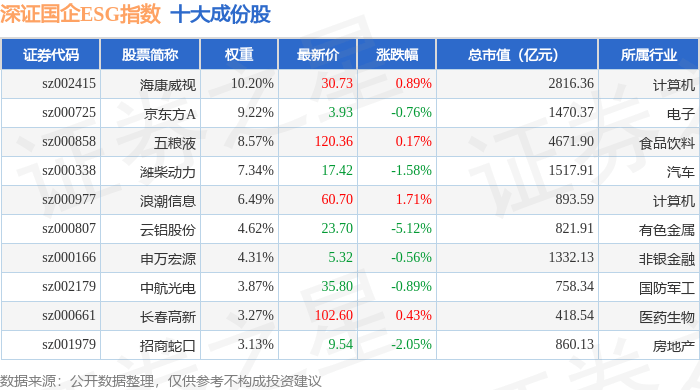
11月18日深证国企ESG(970055)指数跌0.8%,成份股中来股份(300393)领跌
Sou Hu Cai Jing· 2025-11-18 10:30
Core Points - The Shenzhen State-owned Enterprise ESG Index (970055) closed at 1382.09 points, down 0.8%, with a trading volume of 27.288 billion yuan and a turnover rate of 1.05% [1] - Among the index constituents, 15 stocks rose while 35 fell, with Inspur Information leading the gainers at 1.71% and Zhonglai Co., Ltd. leading the decliners at 7.27% [1] Index Constituents - The top ten constituents of the Shenzhen State-owned Enterprise ESG Index include Hikvision, BOE Technology Group, Wuliangye Yibin, Weichai Power, Inspur Information, Yun Aluminum, Shenwan Hongyuan, AVIC Optoelectronics, Changchun High-tech, and China Merchants Shekou [1] - The weights of the top constituents are as follows: Hikvision (10.20%), BOE Technology Group (9.22%), Wuliangye Yibin (8.57%), Weichai Power (7.34%), and Inspur Information (6.49%) [1] Capital Flow - The net outflow of main funds from the index constituents totaled 1.02 billion yuan, while retail investors saw a net inflow of 574 million yuan [1] - Detailed capital flow for specific stocks shows that Zhongtung High-tech had a net inflow of 168 million yuan from main funds, while Inspur Information experienced a net outflow of 74.51 million yuan from main funds [2]

地产公司密集换帅,近半年平均每周都有“一把手”换人
Di Yi Cai Jing· 2025-11-18 10:29
Core Insights - A silent personnel storm is sweeping through the real estate industry, with over 20 chairmen of real estate companies changing since early June, averaging one change per week [2][7] - The changes are predominantly seen in state-owned enterprises, reflecting a need for management to adapt to new industry conditions and enhance internal management capabilities, product innovation, and operational efficiency [2][6] Group 1: Leadership Changes - Major state-owned enterprises like China Minmetals, Beijing Construction Group, and China Overseas Land have seen significant leadership changes, indicating a trend of high-level adjustments in the sector [3][5] - Specific examples include the resignation of Lu Jiming from Guangming Real Estate due to retirement and the appointment of Wang Wei as the new chairman [3] - Other notable changes include the resignation of Li Wenjiang from Dalong Real Estate and the appointment of Zhao Changsong as acting chairman [4] Group 2: Reasons for Changes - The adjustments in leadership are attributed to the need for resource optimization and management reform within state-owned enterprises, as well as the pressures faced by private companies [6][8] - The real estate sector has been under significant pressure, with over 60% of listed companies reporting losses in the first half of 2025, prompting high-level changes as a response to market and performance pressures [8] Group 3: Financial Adjustments - The total compensation for chairmen of listed real estate companies has decreased from 86.57 million yuan in 2022 to 69.38 million yuan in 2024, reflecting the industry's adaptation to new market conditions [9] - The need for management to shift focus from land acquisition and high leverage to financial security and operational efficiency is emphasized [9]
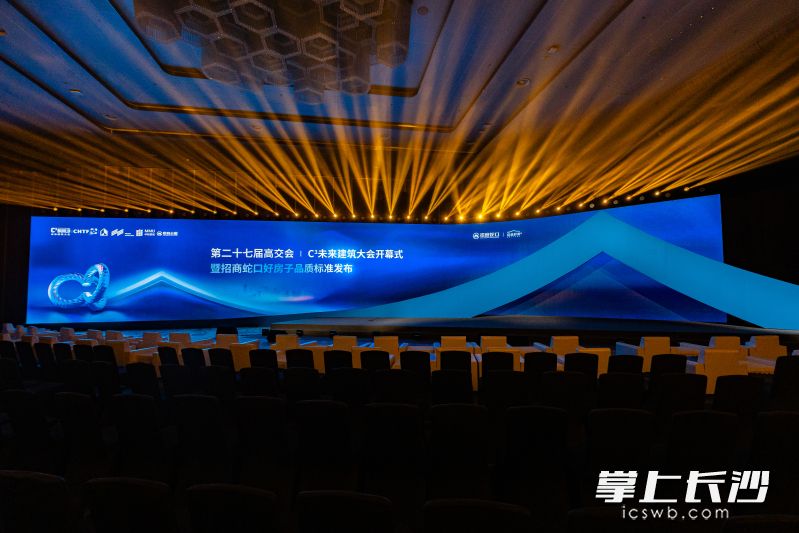
推动“好房子”建设,招商蛇口在高交会发布品质标准新范式
Chang Sha Wan Bao· 2025-11-18 07:05
Core Insights - The 27th China International High-Tech Achievements Fair (C³ Future Architecture Conference) was held in Shenzhen, where the "Good House Quality Standards" by China Merchants Shekou became a focal point, attracting over 400 representatives from government, industry, and the supply chain [1][3] Industry Trends - The transition from "housing for all" to "quality housing" in China's housing construction is set for 2025, with the concept of "Good House" included in the government work report for the first time, and the "Good House Residential Construction Standards" implemented on May 1 [4] - Enhancing residential quality and services is crucial for the real estate industry to return to its core and achieve high-quality development, as emphasized during the conference [4] Company Initiatives - China Merchants Shekou, as the first company to launch the "Good House" product, showcased its practical achievements in translating national policies into executable and perceptible living solutions, providing an innovative model for high-quality development in the real estate sector [3][4] - The "Good House+" quality standard system was released, summarizing 46 years of experience in the living space sector, aiming to contribute a model for industry transformation [6] - The quality standard system includes three main value propositions: "Smart and Safe Quality Home," "Naturally Harmonious Aesthetic Home," and "Long-lasting Community Home," covering seven dimensions and 485 technical modules [6] Practical Applications - Six benchmark projects, including Beijing's "招商序," Chengdu's "锦城序," and Xi'an's "玺," have been established as the first samples of the new standards [8] - In Shenzhen, three strategic new products are set to launch in key locations, with the "招商玺" project embodying the concept of "A Home for a Lifetime," integrating top global design resources [8] - A themed exhibition area at the conference provided a tangible understanding of the "Good House" concept, showcasing the seven quality standards and the practical applications of the 485 technical modules [8]