
中伟股份

Search documents
镍研究:印尼镍矿业政策分析与展望
2025-12-29 01:04
Summary of Nickel Industry Research: Indonesia Nickel Mining Policy Analysis and Outlook Industry Overview - The focus is on the nickel mining industry in Indonesia, particularly the government's policies affecting nickel quotas and pricing for 2026 [1][2]. Key Points and Arguments Nickel Quota and Pricing Changes - Indonesia plans to reduce the preliminary nickel mining quota for 2026 to 250 million tons, significantly lower than the actual usage of 288 million tons in 2025 [1][2]. - The government is expected to raise the nickel benchmark price from approximately $23 per ton to around $50 per ton, which will increase production costs for mining companies [1][2]. - The new pricing formula is anticipated to be implemented around the Lunar New Year in 2025, with a differentiation between hydrometallurgical and pyrometallurgical nickel pricing [2][4]. Environmental Regulations and Penalties - The Indonesian government is enforcing strict environmental checks, imposing fines of up to $400,000 per hectare for companies that damage forests [1][6]. - The total fines related to nickel mining are estimated to be around $5 billion, affecting major nickel mining companies in Indonesia [6][7]. Mining Rights and Supply Dynamics - The government plans to redistribute mining rights, with new regulations expected in the first quarter of 2026, which may lead to increased market supply by 2027 [1][8]. - Many nickel iron projects in Indonesia have been delayed or canceled, with existing projects operating at low capacity or idled [1][9]. Impact on Small Mining Companies - The reduction in quotas and increase in benchmark prices will pose significant challenges for smaller mining companies that may struggle to obtain supplementary quotas [5][18]. - The prioritization of companies that have exhausted their quotas, own shares in processing plants, and are geographically closer to mining sites will reshape the competitive landscape [5][20]. Future Supply and Demand - New hydrometallurgical projects are expected to increase demand for nickel ore, with several projects planned to come online, significantly boosting production capacity [3][10]. - The overall nickel supply is expected to remain tight in 2026, despite potential increases in production from new projects [8][19]. Cost Structure and Tax Implications - The adjustment of the underground resource tax calculation aims to align the guidance price with market prices, potentially increasing tax liabilities for some mining companies [3][16]. - The increase in benchmark prices will lead to higher production costs, which may force companies to raise product prices to maintain profit margins [5][17]. Market Sentiment and Price Outlook - Current market conditions indicate a significant oversupply, with high inventories of pure nickel, making substantial price increases unlikely in the near term [31]. - The anticipated nickel price peak is around $16,000 per ton, with limited upward movement expected due to the current supply-demand dynamics [31]. Additional Important Information - The illegal mining rate in Indonesia is very low, estimated at less than 1%, due to strict regulations and monitoring [12]. - The nickel ore quality is declining, with current acceptance levels around 1.4% nickel content, which may impact future supply [19]. - The government is expected to release new quotas in the first quarter of 2026, which may influence inventory strategies among mining companies [21][23].
锂电板块近况更新-26年1月排产景气度不减-产业链价格博弈进入深水区
2025-12-29 01:04
Summary of Conference Call Records Industry Overview - The lithium battery sector is experiencing strong production levels, with January 2025 production expected to be the highest on record, showing a year-on-year increase of over 30% [1][2] - Concerns regarding the adjustment of national subsidies for new energy vehicles may weaken demand, but actual demand is expected to be deferred to Q1 2026, supported by new subsidy policies and tax incentives for car manufacturers [1][4] Key Points and Arguments - **Production and Demand**: - January 2026 production data shows a slight decline of 3-4% month-on-month, but overall production remains strong, with a year-on-year increase of 30-40% [2] - Major battery manufacturers like CATL are expected to maintain production levels, with a projected year-on-year growth of 40-50% despite a slight downward adjustment in production guidance [2][4] - **Energy Storage Sector**: - The energy storage sector is anticipated to have strong demand in 2026, with stable or increasing production from leading manufacturers, providing significant support for Q1 production [5] - **Price Dynamics**: - The lithium carbonate futures price has surged, driven by market speculation, with short-term price increases expected in the supply chain [1][6] - The price of lithium hexafluorophosphate (LiPF6) is expected to rise further in Q1 2026, with current prices around 170,000 CNY per ton for spot orders and over 120,000 CNY for large clients [12] Investment Strategies - **Focus on High-Elasticity Materials**: - Investment strategies should prioritize high-elasticity upstream materials like lithium hexafluorophosphate and companies benefiting from the pricing benchmark shift of lithium carbonate [7] - Recommended companies include CATL and Penghui, with CATL expected to achieve a profit target of 90 billion CNY, potentially increasing to 100 billion CNY [7][8] - **Market Opportunities**: - The battery sector is currently undervalued, with companies like CATL, Yiwei Lithium Energy, and Zhonghang Lithium Battery trading at valuations below 20 times earnings, presenting a potential investment opportunity [11] Additional Insights - **Supply Chain Tensions**: - The supply chain is experiencing intense negotiations regarding price increases, particularly in the energy storage sector, where price adjustments are easier due to tight processes [6] - The recent increase in nickel prices is expected to significantly impact the profitability of ternary precursor manufacturers, with potential supply shortages anticipated due to regulatory changes in Indonesia [17][18] - **Future Trends in Solid-State Batteries**: - The solid-state battery sector is expected to see significant developments in Q1 2026, with key projects and tenders set to launch, indicating potential growth opportunities [19][20] Conclusion - The lithium battery and energy storage sectors are poised for growth, supported by strong production levels and favorable market conditions. Investment strategies should focus on high-elasticity materials and undervalued companies within the sector, while monitoring supply chain dynamics and regulatory changes that could impact profitability.

电力设备与新能源行业12月第5周周报:光伏产业链涨价趋势形成,锂电材料价格博弈加剧-20251229
Bank of China Securities· 2025-12-29 01:03
Investment Rating - The report maintains an "Outperform" rating for the power equipment and new energy industry [1]. Core Insights - The photovoltaic industry chain is experiencing a price increase trend, while the price competition for lithium battery materials is intensifying [1]. - In the fourth quarter, which is the peak sales season for new energy vehicles, domestic sales of new energy vehicles are expected to maintain high growth in 2025, driving demand for batteries and materials [1]. - The solid-state battery industrialization is progressing, and attention should be paid to the verification progress of related materials and equipment companies [1]. - The report emphasizes a "de-involution" strategy as the main investment theme for photovoltaics, with the integration and acquisition of polysilicon production capacity becoming more proactive [1]. - The demand for wind power is expected to continue growing, with a focus on wind turbines and offshore wind power [1]. - The energy storage sector remains highly prosperous, with recommendations to focus on energy storage cells and large-scale integrated plants [1]. - Hydrogen energy is anticipated to open up demand for green hydrogen, with a focus on downstream hydrogen-based energy applications [1]. - The report suggests monitoring core suppliers in the nuclear fusion sector as it represents a long-term catalytic direction for future energy development [1]. Summary by Sections Market Overview - The power equipment and new energy sector rose by 5.37% this week, outperforming the Shanghai Composite Index, which increased by 1.88% [10]. - The wind power sector saw the highest increase at 7.14%, followed by the photovoltaic sector at 6.56% [13]. Lithium Battery Market - The price of lithium carbonate has continued to rise, with battery-grade lithium carbonate priced at approximately 98,000 RMB per ton, reflecting an 8% increase [25]. - The price of lithium iron phosphate battery cells has also seen an upward trend, with prices for various models ranging from 0.285 to 0.425 RMB per watt-hour [26]. Photovoltaic Market - The price of polysilicon remains stable, with tight supply and weak downstream demand affecting price transmission [15]. - The price of silicon wafers has shown a significant increase, driven by rising silver prices and industry self-discipline [16]. - The price of battery cells has increased to 0.34 RMB per watt, with manufacturers actively raising prices due to cost pressures [17]. Energy Storage Market - The price of energy storage systems has rebounded, with prices for various configurations ranging from 0.40 to 0.82 RMB per watt-hour [27]. - The demand for energy storage remains strong, particularly in overseas markets, contributing to price stability [26].
欣旺达携手中伟股份进军固态电池领域 近四年研发费119.85亿总资产达1004亿
Xin Lang Cai Jing· 2025-12-28 23:33
Core Viewpoint - Company Xiwanda (300207.SZ) is expanding its partnerships in the lithium-ion battery sector by signing a strategic cooperation framework agreement with Zhongwei New Materials Co., Ltd. to focus on solid-state battery materials development and industrialization [1][2]. Group 1: Strategic Cooperation - Xiwanda's subsidiary, Xiwanda Power Technology Co., Ltd., will collaborate with Zhongwei New Materials to develop a series of solid-state battery materials, aiming for industrialization [2]. - The partnership will focus on three main areas: developing high energy density, high safety, and long cycle life solid-state battery cathode precursor materials; co-developing solid-state battery cathode materials and batteries for commercial applications; and exploring industrial cooperation models for solid-state battery materials [2][3]. Group 2: Financial Performance - Xiwanda has invested approximately 11.985 billion yuan in R&D over the past four years, with annual R&D expenses of 2.742 billion yuan, 2.711 billion yuan, 3.330 billion yuan, and 3.202 billion yuan respectively [6]. - The company's total assets have grown from 42.63 billion yuan at the end of 2021 to 100.4 billion yuan by the end of September 2025 [5]. - In the first three quarters of 2025, Xiwanda achieved a revenue of 43.534 billion yuan, a year-on-year increase of 13.73%, and a net profit attributable to shareholders of 1.405 billion yuan, up 15.94% year-on-year [5]. Group 3: Market Position - Xiwanda is recognized as a leading player in the global lithium-ion battery sector, ranking among the top ten in global power battery installations and top ten in global energy storage cell shipments [2]. - The company has established a diversified business model with five major segments: consumer products, power technology, energy technology, smart hardware, and innovation & ecology [5]. Group 4: Legal Matters - Xiwanda Power is currently involved in a lawsuit amounting to 2.314 billion yuan initiated by Weir Electric Vehicle Technology Co., Ltd. over alleged quality issues with battery cells delivered between June 2021 and December 2023 [3][4].

广西重塑关键金属产业版图 从“资源大区”迈向“产业强区”
Zhong Guo Xin Wen Wang· 2025-12-28 06:21
Core Viewpoint - The construction of the Nandan Key Metals High-Quality Development Comprehensive Experimental Zone in Guangxi is a significant step towards transforming the region's key metals industry, focusing on high-end, intelligent, green, large-scale, and park-based development [1][5]. Group 1: Industry Transformation - Guangxi is recognized as a key region for critical metals in China, holding significant reserves of nine critical metals, including tin, antimony, and rare earth elements [1][3]. - The region has historically faced challenges due to a fragmented industry structure and environmental pressures, which have hindered high-quality development [1][4]. - A comprehensive action plan has been initiated to address illegal mining and heavy metal pollution, aiming to consolidate mining rights and manage small, scattered enterprises [1][4]. Group 2: Strategic Initiatives - The Nandan Key Metals High-Quality Development Comprehensive Experimental Zone is designated as a pilot and demonstration area for industrial transformation in Guangxi [2]. - A total of 35 key projects related to nine critical metals and other non-ferrous metals have been signed and launched in Guangxi [2]. - The "Nine Chains and Three Clusters" industrial system aims to extend the industrial chains of critical metals and enhance high-value segments such as high-purity materials and advanced alloys [3]. Group 3: Innovation and Green Development - Plans to establish the Guangxi Key Metals Research Institute and high-level laboratories are underway to boost innovation capabilities [4]. - The region is promoting green mining and factory initiatives, focusing on clean production technologies and ecological restoration of historical tailings [4]. - The Nandan zone is prioritized as a key project, with efforts to shut down non-compliant enterprises and accelerate the integration of mining rights [4]. Group 4: Investment and Support - Local authorities are actively engaging with industry giants to attract investment and support for the key metals sector [4]. - Financial systems have introduced specific loans and subsidies to alleviate financing challenges for enterprises in the region [4]. - The overall goal is to transition from a resource-exporting model to a globally influential key metals industry and advanced manufacturing cluster [5].
深市“双提升”:471家率先行动 分红占净利润比重2年提升近11个百分点
Di Yi Cai Jing· 2025-12-27 03:26
Core Viewpoint - The "Quality Return Dual Improvement" initiative launched by the Shenzhen Stock Exchange aims to enhance the development quality and investment value return capabilities of listed companies, with 471 companies disclosing action plans by November 2025 [1][2]. Group 1: Company Participation and Focus Areas - Among the 471 companies, 293 are part of the Shenzhen Component Index, 88 are in the CSI 300 Index, and 82 belong to the ChiNext Index, collectively representing about 50% of the total market capitalization of the Shenzhen market [2]. - The companies involved span 30 industries, including electronics, power equipment, pharmaceuticals, and computers, with nearly 70% being private enterprises [2]. - The action plans of these companies emphasize three focal points: focusing on core business, focusing on technological innovation, and focusing on regulatory operations [2]. Group 2: Financial Performance and R&D Investment - In 2024, the "Dual Improvement" companies achieved a total operating revenue of 9.8 trillion yuan, a year-on-year increase of 3.6%, and a net profit of 743.39 billion yuan [4]. - For the first three quarters of 2025, these companies reported an operating revenue of 7.5 trillion yuan, up 6.9% year-on-year, and a net profit of 651.3 billion yuan, reflecting a 10.8% increase [4]. - The R&D investment of these companies accounted for 4.3% of their operating revenue in the first half of 2025, up 0.1 percentage points year-on-year, with total R&D expenditure representing 59.5% of the Shenzhen market [4]. Group 3: Shareholder Returns and Market Response - From 2022 to 2024, the annual total dividend of the "Dual Improvement" companies had a compound growth rate of 10.0%, with the 2024 dividend amounting to 43.6% of net profit, an increase of 10.9 percentage points from 2022 [5]. - Approximately 80% of the companies (378) maintained continuous dividends over the past three years, enhancing the stability and predictability of returns for investors [5]. - The average stock price increase for the 471 "Dual Improvement" companies from February 2024 to November 2025 was 77.2%, surpassing the growth of the Shenzhen Component Index [6].
深市“双提升”:471家率先行动,分红占净利润比重2年提升近11个百分点
Di Yi Cai Jing· 2025-12-27 03:07
Core Insights - The "Quality Return Dual Improvement" initiative launched by the Shenzhen Stock Exchange aims to enhance the development quality and investment value return capabilities of listed companies, with 471 companies having disclosed action plans by November 2025 [1][2] Group 1: Company Participation and Industry Coverage - Among the 471 companies, 293 are part of the Shenzhen Component Index, 88 are in the CSI 300 Index, and 82 belong to the ChiNext Index, collectively representing about 50% of the total market capitalization of Shenzhen [2] - The participating companies span 30 industries, including electronics, power equipment, pharmaceuticals, and computers, with a significant presence of private enterprises, accounting for nearly 70% of the participants [2] Group 2: Focus Areas of Improvement - The action plans from the listed companies emphasize three main focuses: enhancing core business awareness, improving technological innovation capabilities, and strengthening regulatory operations [2] - Specific examples include Mindray Medical (300760.SZ) increasing R&D investment and global expansion, and BYD (002594.SZ) planning R&D expenditures of 54.2 billion yuan in 2024 [2] Group 3: Shareholder Returns and Buybacks - Companies are increasing dividend and buyback efforts, with firms like BOE Technology Group (000725.SZ) disclosing future shareholder return plans, and Anke Bio (300009.SZ) maintaining 16 consecutive years of cash dividends [3] - The average annual dividend growth rate for "dual improvement" companies from 2022 to 2024 is 10.0%, with 2024 dividends accounting for 43.6% of net profits, a 10.9 percentage point increase from 2022 [5] Group 4: Financial Performance and Market Response - In terms of financial performance, "dual improvement" companies achieved a total revenue of 9.8 trillion yuan in 2024, a 3.6% year-on-year increase, and a net profit of 743.39 billion yuan [4] - The average stock price increase for these companies from February 2024 to November 2025 was 77.2%, surpassing the Shenzhen Component Index, with a total market capitalization of 21.2 trillion yuan by November 2025 [6]
【储能】中伟股份与欣旺达签署固态电池战略合作协议
Xin Lang Cai Jing· 2025-12-26 12:26
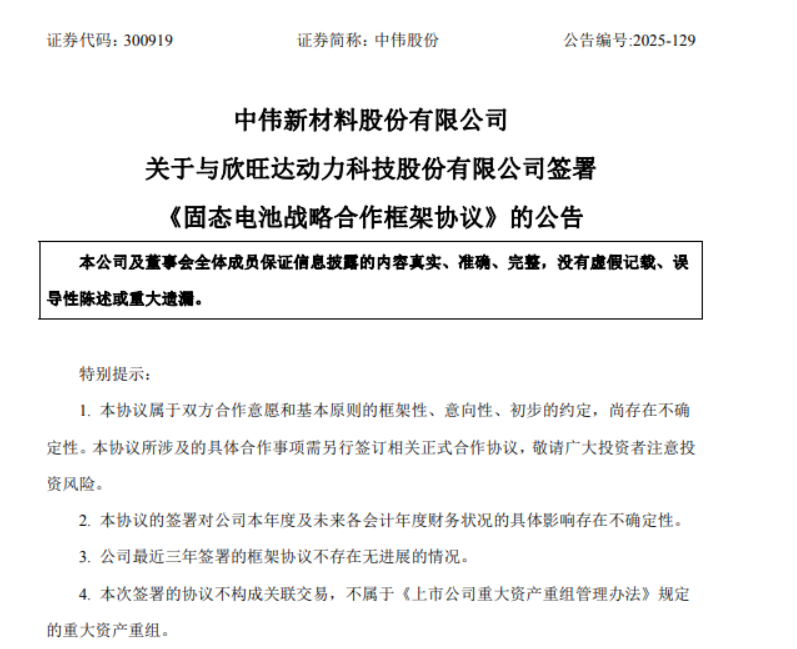
Core Viewpoint - Zhongwei New Materials Co., Ltd. has signed a strategic cooperation framework agreement with Xinwanda Power Technology Co., Ltd. to collaborate on the research and industrialization of key materials for solid-state batteries, focusing on applications in electric vehicles and energy storage systems [1][4]. Group 1: Cooperation Focus - The cooperation will concentrate on three main areas: 1. Joint development of new precursor materials for solid-state batteries, which must exhibit high energy density, safety, and long cycle life [3][6]. 2. Xinwanda will lead the development of cathode materials and complete cells based on the precursors provided by Zhongwei, facilitating practical applications in energy storage [3][6]. 3. Both companies will explore mass production pathways to scale up solid-state battery materials [3][6]. Group 2: Company Background - Zhongwei is a leading global supplier of ternary precursors, with significant expertise in high-nickel and single-crystal precursor technologies [3][6]. - Xinwanda has been investing in semi-solid and all-solid-state battery research and has established a product line specifically for energy storage batteries [3][6]. Group 3: Strategic Importance - The collaboration aims to bridge the "materials - cells - applications" chain, particularly addressing the stringent safety and cycle life requirements for large-scale energy storage projects, thereby accelerating the transition of solid-state battery technology from laboratory to engineering [3][6]. - Solid-state batteries are expected to offer advantages in energy storage, including reduced risk of thermal runaway, extended lifespan, and simplified thermal management systems [3][6]. Group 4: Future Plans - A joint technical team will be established to advance material validation and pilot testing, as well as to assess the feasibility of building complementary production capacity [4][7]. - This signing marks a significant step for both companies in the next-generation battery technology landscape and provides a new collaborative model for exploring high safety and long-duration energy storage technologies in the domestic energy storage industry [4][7].

东兴证券晨报-20251226
Dongxing Securities· 2025-12-26 06:55
Economic News - The Ministry of Ecology and Environment proposed to strengthen cybersecurity and information technology infrastructure, integrating big data, AI, and blockchain with ecological governance [1] - The Fengtai District of Beijing has registered a government industrial investment fund matrix with an initial scale of no less than 10 billion yuan, expected to launch in 2026 [1] - Hainan Province reported over 400 million yuan in "zero tariff" imports during the first week of its customs closure, indicating ongoing policy benefits and enhanced industrial momentum [1] - The National Development and Reform Commission emphasized industry management, focusing on reducing crude steel output while promoting technological innovation in key industries [1] - The National Venture Capital Guidance Fund has officially launched, with a target scale of 50 billion yuan for the Beijing-Tianjin-Hebei region fund [1] - Japan's government approved a record budget of approximately 122.3092 trillion yen for the fiscal year 2026 [1] - As of the end of November, China's total installed power generation capacity reached 3.79 billion kilowatts, a year-on-year increase of 17.1% [1] - The photovoltaic industry association confirmed the establishment of a polysilicon capacity integration acquisition platform to address intense competition in the sector [1] - The State-owned Assets Supervision and Administration Commission initiated pilot projects for data resource development among state-owned enterprises [1] - A new national standard for electric vehicle energy consumption will be implemented starting January 1, 2026, marking a global first [1] Company News - Landun Optoelectronics holds a 4.9533% stake in Shanghai Xingsi Semiconductor through its wholly-owned subsidiary, focusing on 5G and satellite communication applications [2] - Defang Nano plans annual equipment maintenance from December 26, 2025 [2] - Zhongwei Co. signed a strategic cooperation framework agreement with Xinwanda Power Technology to develop solid-state battery materials [4] - Jinlongyu intends to establish an industrial merger and acquisition fund with a subscribed scale of 1.5 billion yuan [4] - Del's shares are advancing the construction of a solid-state battery pilot line, expected to be completed in the first half of 2026 [4] Industry Research - The Ministry of Commerce announced anti-dumping duties on EU pork imports, effective December 17, 2025, with rates ranging from 4.9% to 19.8% [5] - EU pork imports accounted for 51% of China's total pork imports, but only 2.03% of total consumption, indicating a limited impact on the overall market [6] - The anti-dumping duties are expected to reduce EU pork imports, leading to a diversification of import sources for China [6] - The domestic pork market remains under pressure, with a breeding sow inventory of 39.9 million heads, indicating a continued oversupply [7] - The anti-dumping measures are anticipated to improve the domestic supply-demand balance in the short term, with a focus on enhancing breeding efficiency and reducing costs [7] - The dairy industry is facing challenges due to low domestic milk prices, with a need to accelerate the development of deep processing of dairy products [12] - The temporary anti-subsidy measures on EU dairy products are expected to benefit domestic companies engaged in high-value-added processing [12]
京东年终奖投入涨幅超70%;英伟达收编芯片独角兽丨科技风向标
2 1 Shi Ji Jing Ji Bao Dao· 2025-12-26 02:43
Group 1: Company Developments - JD.com announced that 92% of its employees will receive year-end bonuses, with a year-on-year increase of over 70%, marking the largest increase in the industry this year [2] - ByteDance reported the dismissal of 120 employees for internal violations, with 28 of them being publicly named, including 14 referred to judicial authorities for criminal offenses [4] - Alibaba Cloud denied rumors regarding its client Xiaohongshu moving away from its services, labeling the claims as false [5] Group 2: Industry Trends - The gaming industry saw a total of 1,771 game licenses issued in 2025, including 1,676 domestic and 95 imported games, with December alone accounting for 144 domestic and 3 imported games [13] - The semiconductor industry is facing challenges as the Chinese Ministry of Commerce expressed strong opposition to the U.S. imposing additional tariffs on Chinese semiconductor products [16] - The robotics sector is set to showcase advancements with the 2026 Beijing Yizhuang humanoid robot half marathon scheduled for April 19, featuring both human and robot participants [6] Group 3: Strategic Partnerships and Investments - XWANDA announced a strategic cooperation framework agreement with Zhongwei Co., focusing on the development of solid-state battery materials [8][9] - Ruisheng Intelligent confirmed a procurement project for domestic computing power equipment and services worth 152 million yuan [10] - Unigroup Guowei plans to invest 300 million yuan in establishing a new company for automotive domain control chips, with a significant asset valuation increase of 3723.15% [15]

