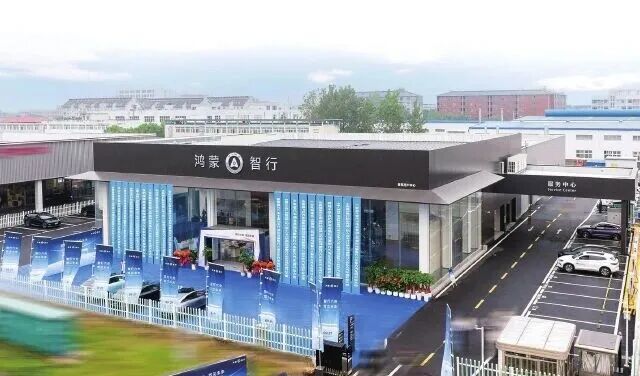
鸿蒙智行

Search documents
从辅助到自动,L3终于破冰
虎嗅APP· 2025-12-27 10:30
Core Viewpoint - The article discusses the significant advancements in China's L3-level conditional autonomous driving, highlighting the transition from technical exploration to regulatory compliance and commercialization, marked by the issuance of market access permits for L3 vehicles by the Ministry of Industry and Information Technology by the end of 2025 [2][7]. Group 1: Market Access and Technical Testing - The distinction between "market access" and "technical testing" is emphasized, with current market access being limited to well-structured environments, while true L3 capabilities are being tested in real-world scenarios [2][4]. - The ongoing L3 road tests are primarily conducted on highways, but the real challenges lie in low-probability, high-risk scenarios such as construction zones and sudden obstacles [4][5]. Group 2: Technical Challenges and Innovations - Adverse weather conditions in China pose significant challenges for sensor redundancy and algorithm integration, which are crucial for L3 technology to transition from laboratory settings to commercial applications [5]. - The recent testing by Hongmeng Zhixing showcases its L3 autonomous driving system's ability to handle complex real-world conditions, drawing industry attention [5][7]. Group 3: Industry Dynamics and Competition - The competition in L2-level driving assistance has led to a homogenization of technology, with many companies focusing on hardware without effective software integration, resulting in suboptimal user experiences [8][9]. - High-tech companies must leverage L3 competition to demonstrate their technological advantages and establish industry barriers, as the current L3 access and testing are strategic moves to build a protective industry moat [9][10]. Group 4: Human-Machine Interaction and Safety - L3 autonomous driving represents a shift in driving responsibility from humans to systems under specific conditions, allowing drivers to divert their attention, which marks a significant evolution in automotive technology [10][11]. - The human-machine co-driving model requires systems to meet stringent safety standards, ensuring that control can be safely returned to humans in emergencies [11][12]. Group 5: Legal and Ethical Considerations - The transition from "probabilistic safety" to "deterministic responsibility" is crucial for L3 commercialization, necessitating systems that can handle rare but high-risk scenarios effectively [14][15]. - Legal responsibility in accidents involving autonomous vehicles must be clearly defined, requiring precise data recording capabilities and unified standards for accountability [15][16]. Group 6: Systematic Barriers and Data Utilization - Comprehensive technical capabilities are essential for competitive advantage in L3 autonomous driving, with Hongmeng Zhixing developing a three-pronged approach of self-research, data cycles, and large-scale validation [18][20]. - The WEWA architecture enables a shift from rule-based to cognitive-driven systems, enhancing the ability to handle complex driving scenarios through advanced data processing and decision-making [20][21]. Group 7: Safety Strategies and Redundancy - Safety is a critical factor in L3 development, with systems needing to avoid single-point failures and ensure robust performance in extreme conditions [24][25]. - Hongmeng Zhixing employs a multi-sensor fusion strategy to maintain reliable perception and decision-making capabilities in adverse weather and complex environments [25][26]. Group 8: Data Accumulation and Quality - High-quality data accumulation is a significant barrier in the industry, with Hongmeng Zhixing leveraging a large user base to create a rich data network for model training [27][28]. - Effective data extraction and processing are vital for advancing intelligent driving, ensuring that the data used for training is valuable and not merely abundant [28][30]. Group 9: Future of Autonomous Driving - The gradual realization of L3 autonomous driving will redefine the relationship between people, vehicles, and roads, transforming cars into "third living spaces" [30]. - Trust in human-machine interaction is foundational for this evolution, necessitating rigorous testing in real-world conditions to ensure safety and reliability [30].

鸿蒙智行开启的L3路测,通向一个怎样的未来?
36氪· 2025-12-26 13:08
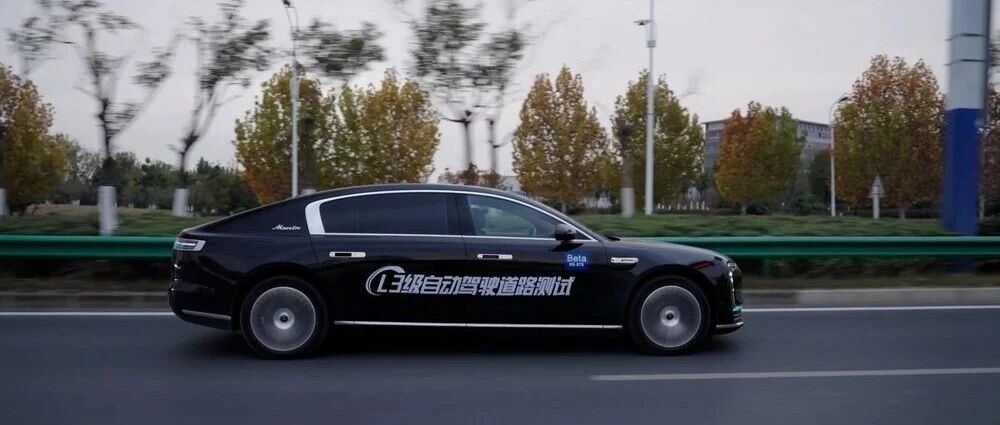
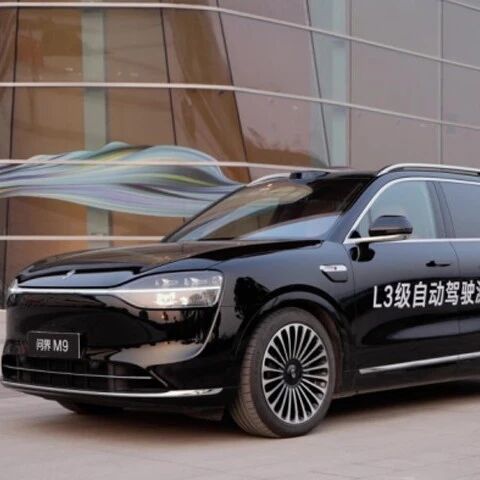
Core Viewpoint - The article discusses the recent approval of L3 conditional autonomous driving vehicles by the Ministry of Industry and Information Technology in China, highlighting the significance of real-world testing by companies like Hongmeng Zhixing to validate their systems and advance the industry [1][3][28]. Group 1: L3 Development and Testing - Hongmeng Zhixing has initiated real-world testing of L3 autonomous driving systems in cities like Chongqing and Hefei, utilizing its mass-produced models, the Zun Jie S800 and Wen Jie M9, to validate performance under actual traffic conditions [1][3]. - The testing videos demonstrate the vehicle's ability to autonomously navigate, change lanes, and overtake in traffic, showcasing the system's capability to execute dynamic driving tasks without the driver needing to hold the steering wheel [13][15]. - The company emphasizes the importance of extensive real-world testing to bridge the gap between functional demonstrations and user trust in L3 systems, addressing challenges such as human-machine interaction and responsibility delineation [8][10][24]. Group 2: Technical and Safety Considerations - The distinction between L2 and L3 lies in the shift of responsibility from the driver to the system, necessitating a robust safety engineering framework focused on system reliability and extensive validation standards [7][24]. - Hongmeng Zhixing's L3 system is built on the WEWA architecture, which allows for the creation of complex virtual driving scenarios, enabling the system to learn from extreme situations and improve decision-making capabilities [15][16]. - The company has developed a multi-source sensor array to enhance perception capabilities, ensuring reliable performance in challenging conditions such as heavy rain and fog [19][21]. Group 3: Market Outlook and Industry Impact - The market for L3 autonomous vehicles in China is projected to grow significantly, from 150 billion yuan in 2025 to 800 billion yuan by 2030, with a compound annual growth rate of 38.7% [25][30]. - Hongmeng Zhixing's proactive approach in L3 testing positions it as a leader in the industry, setting a high standard for engineering validation and potentially reshaping user trust in autonomous driving technology [26][30]. - The company aims to establish a competitive edge through data-driven improvements and a comprehensive safety framework, addressing the industry's need for reliable autonomous vehicles [16][30].
鸿蒙智行大酒店 勇闯汽车零售创新之路
Xin Lang Cai Jing· 2025-12-26 12:21
Core Viewpoint - The automotive industry is witnessing a significant transformation with the emergence of the "Hongmeng Intelligent Hotel," which offers a luxurious customer experience that surpasses traditional 4S stores of brands like Mercedes-Benz, BMW, and Audi. This initiative has led to a monthly delivery of over 80,000 new vehicles within the Hongmeng Intelligent system, indicating a strong market presence and customer engagement [2][15]. Group 1: Strategic Developments - The recent gathering of the five brands under Hongmeng Intelligent in Shanghai marks a deepening of strategic cooperation, focusing on enhancing collaboration in research, manufacturing, charging, and marketing [2][15]. - The establishment of a standardized service system aims to create the first cross-brand shared after-sales service network in the industry, ensuring high-quality service across the entire process from pre-sale to after-sale [2][15]. Group 2: Customer Experience and Challenges - The "Hongmeng Intelligent Hotel" has gained popularity for its unique offerings, such as diverse regional menus and a welcoming atmosphere, which have been well-received by customers [4][17]. - However, there are concerns regarding the sustainability of free services due to rising operational costs, leading to changes in several complimentary policies [3][16][24]. Group 3: Industry Comparisons and Innovations - The concept of shared after-sales service networks is not entirely new, as other companies like SAIC and Toyota have implemented similar strategies to enhance service efficiency and customer satisfaction [21][22]. - Analysts suggest that the shift from direct sales to a dealer model may help reduce costs and accelerate market coverage, indicating a strategic pivot in the operational approach of Hongmeng Intelligent [19][23]. Group 4: Future Directions - The company is currently focused on enhancing user experience as part of a three-step development strategy, with future expansions likely to prioritize efficiency and scale over lavish customer services [25].
L3专用牌照上车,重庆发出国内首张,北京连发三张,消费者下个月就能体验
3 6 Ke· 2025-12-24 00:40
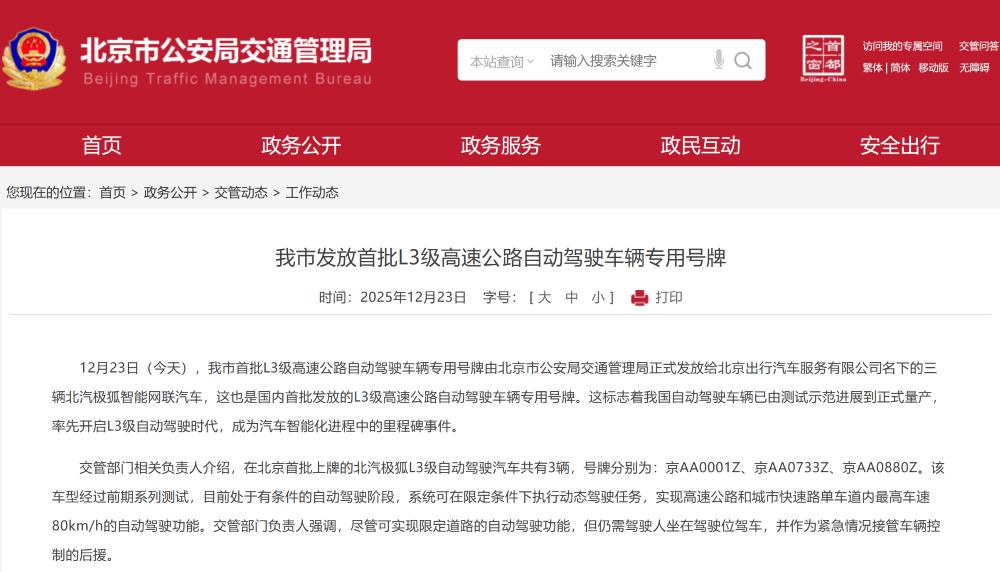
L3级自动驾驶车型已经可以上牌了。 车东西12月23日消息,就在今天,北京市首批L3级高速公路自动驾驶车辆专用号牌由北京市公安局交通管理局正式发放给北京出行汽车服务有限公司名 下的三辆北汽极狐智能网联汽车。 ▲北京市公安局交通管理局公告 在北京首批上牌的北汽极狐L3级自动驾驶汽车共有3辆,号牌分别为:京AA0001Z、京AA0733Z、京AA0880Z。 就在几天前,深蓝汽车董事长邓承浩在社交媒体上发文表示,深蓝汽车获得了自动驾驶专用号牌"渝AD0001Z",邓承浩还提到牌照最后的"Z"代表自动驾 驶,并称这是"第一块"。 ▲深蓝汽车董事长邓承浩在社交媒体上发文 12月15日,国家工业和信息化部正式许可两款L3级自动驾驶车型产品,首次以国家层面政策明确支持L3级自动驾驶车型的生产准入,一纸公告宣布中国 正式进入L3元年。 而随后各大车企纷纷响应,据车东西不完全统计,包括12月15日后的三天内就有6家车企官方宣布或有媒体报道正在进行L3级自动驾驶测试。 | 序号 | 车企 | 车型 | 类型 | 地点 宣布日期 | 来源 | | --- | --- | --- | --- | --- | --- | | 1 | ...

“鸿蒙大饭店”暂停营业?免费吃饭、充电,经销商压力巨大!
Sou Hu Cai Jing· 2025-12-17 11:46
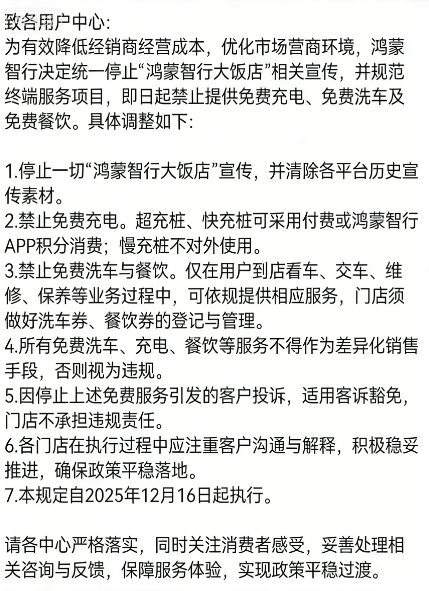
也就是说,之前网友调侃的"花 40 万充饭卡,再送一辆价值 40 万的车"从此以后,饭卡失效了。 一觉醒来,鸿蒙智行的车主天塌了! 昨天,网上流传着一张图片,称鸿蒙车主最爱的"鸿蒙大饭店"要暂停营业了,并且,官方将统一停止"鸿蒙 大饭店"的有关宣传,并且停止提供免费充电、免费洗车以及免费餐饮等服务。 不过,这张图片没有抬头、没有署名、没有公章,可信度存疑。但鸿蒙智行官方又直到现在都没有发布声 明进行辟谣,所以不论车主还是准车主,都陷入了尴尬的"等待通告"状态。 当然,有车主前往鸿蒙智行店内,被明确告知,以前那种白吃白喝的过度服务已经没有了,因为经销商压 力实在太大。 之前,笔者和一位鸿蒙智行管理层做过交流,据他反馈,虽然"鸿蒙大饭店"的名号打出去后,来店内参观 的人流量大了很多,但经销商也承担了巨大的成本。 比如,店里每个月伙食费多了 6 万,充电费多了 2 万,这还没算洗车、矿泉水,以及接待服务方面的支 出。 甚至有客户周末两天把车开到店里,一家老小蹭吃蹭喝蹭空调,不能赶走,还必须要各种服务伺候好。因 为一旦店端接到消费者的投诉,就会吃罚款,严重者甚至暂停合作。 不过,现在鸿蒙智行总部已经放松了这方面的要求 ...
“鸿蒙大饭店”真的要取消了!
Sou Hu Cai Jing· 2025-12-17 03:16
Core Viewpoint - The company, Hongmeng Zhixing, has decided to stop all promotional activities related to "Hongmeng Zhixing Grand Hotel" and to standardize terminal service projects, which includes the cessation of free charging, car washing, and dining services to reduce dealer operating costs and optimize the market environment [2][4]. Summary by Sections Policy Changes - The company will cease all promotions related to "Hongmeng Zhixing Grand Hotel" and remove historical promotional materials from all platforms [4]. - Free charging, car washing, and dining services will no longer be provided at stores [4]. - The policy of free use of supercharging and fast charging stations will be canceled, with future services available through payment or points via the Hongmeng Zhixing App [5]. Service Adjustments - Car washing and dining services will only be available during specific customer interactions such as vehicle viewing, delivery, maintenance, and care, and must be managed with proper documentation [5]. - Charging and dining services cannot be used as differential marketing strategies, and violations will result in store accountability [5]. Customer Communication - The company has instructed user centers to effectively communicate and explain these changes to customers to ensure a smooth transition in service experience [5]. Market Impact - The new policy is expected to benefit actual car owners by concentrating service resources, thus improving their experience, while it will negatively impact those who previously exploited free services [9]. - This shift represents a necessary transition from marketing gimmicks to sustainable long-term operations, emphasizing the importance of matching services to genuine user needs rather than offering excessive free benefits [9].

小鹏拿下L3测试牌照!广州市指定高快速路段允许有条件测试
Nan Fang Du Shi Bao· 2025-12-16 11:11
Core Insights - Xiaopeng Motors has obtained an L3 autonomous driving road test license in Guangzhou, allowing conditional autonomous driving tests on designated high-speed road sections [1] - The company has embedded hardware in its vehicles to support L3 autonomous driving by 2025, and it plans to release its second-generation VLA model in Q1 2026, which will enhance autonomous driving capabilities [1][3] Group 1 - Xiaopeng Motors' CEO He Xiaopeng emphasized that the new VLA model is crucial for achieving fully autonomous driving across various scenarios [3] - A bet was made by He Xiaopeng regarding the performance of Xiaopeng's VLA compared to Tesla's FSD V14.2 by August 30, 2026, highlighting the competitive landscape in autonomous driving technology [4] - Recent developments in L3 autonomous driving commercialization have been noted, with multiple domestic automakers receiving approvals for L3 capabilities, indicating a rapid acceleration in the deployment of advanced autonomous driving [4]

“鸿蒙大饭店”不再提供免费餐食:地主家也没有余粮了?
Xin Lang Cai Jing· 2025-12-16 08:36
Core Viewpoint - The recent announcement by Hongmeng Zhixing to stop free services such as charging, car washing, and dining reflects a shift in the electric vehicle industry from a "money-burning" market strategy to a focus on profitability and cost management [3][14]. Group 1: Service Experience and Cost Management - In recent years, "service experience" has been a key differentiator for many brands in the electric vehicle market, with companies offering free services to enhance customer loyalty and drive sales [4][16]. - The costs associated with free services, including charging, washing, and dining, have become significant, especially during rapid store expansion, leading to a reassessment of these expenditures [4][16]. - The adjustment by Hongmeng Zhixing can be seen as a "cost restructuring," focusing resources on core business areas such as sales, delivery, and after-sales service, which are directly linked to user experience and brand reputation [6][18]. Group 2: Industry Trends and User Expectations - The recent changes signal a broader industry trend where companies are moving from "welfare competition" to a focus on core product features, battery technology, smart driving, and after-sales service efficiency [9][21]. - User expectations are evolving from being attracted by free services to prioritizing the actual performance, safety, and long-term costs of vehicles, indicating a shift in focus from superficial benefits to substantive value [9][21]. - The new service model introduced by Hongmeng Zhixing emphasizes "precise rights" rather than universal benefits, aiming to enhance service quality and efficiency while controlling costs [8][20].
11月乘用车市场销量分析:新能源逆势增长 头部品牌领跑赛道
Zhong Guo Zhi Liang Xin Wen Wang· 2025-12-16 05:09
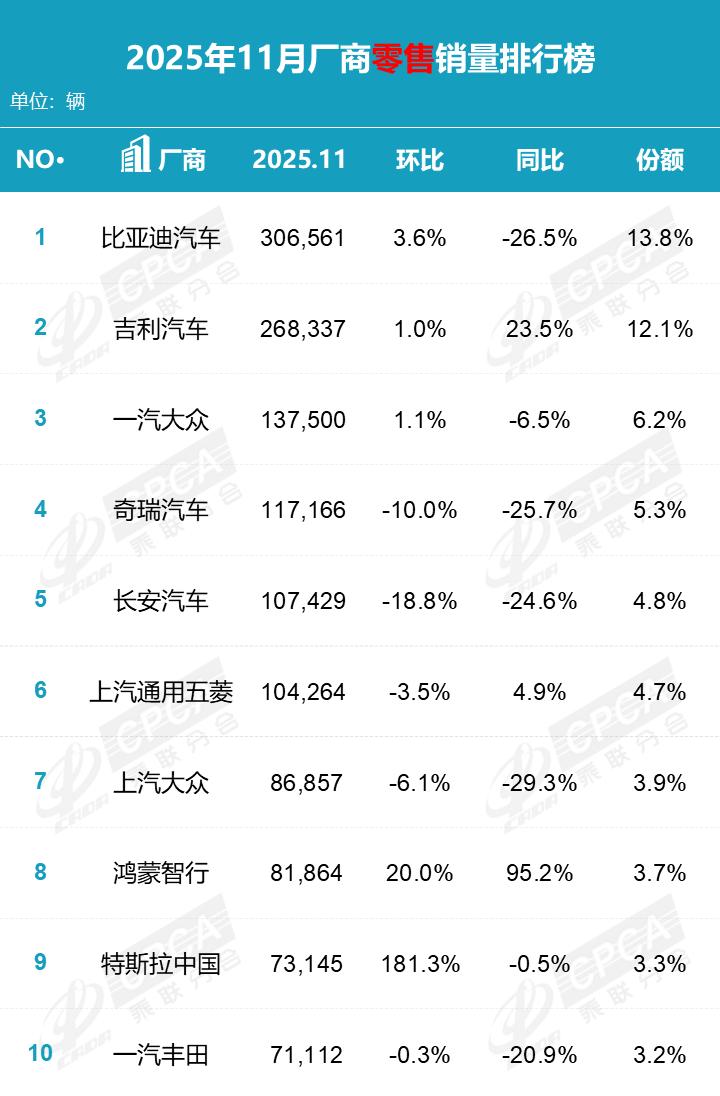
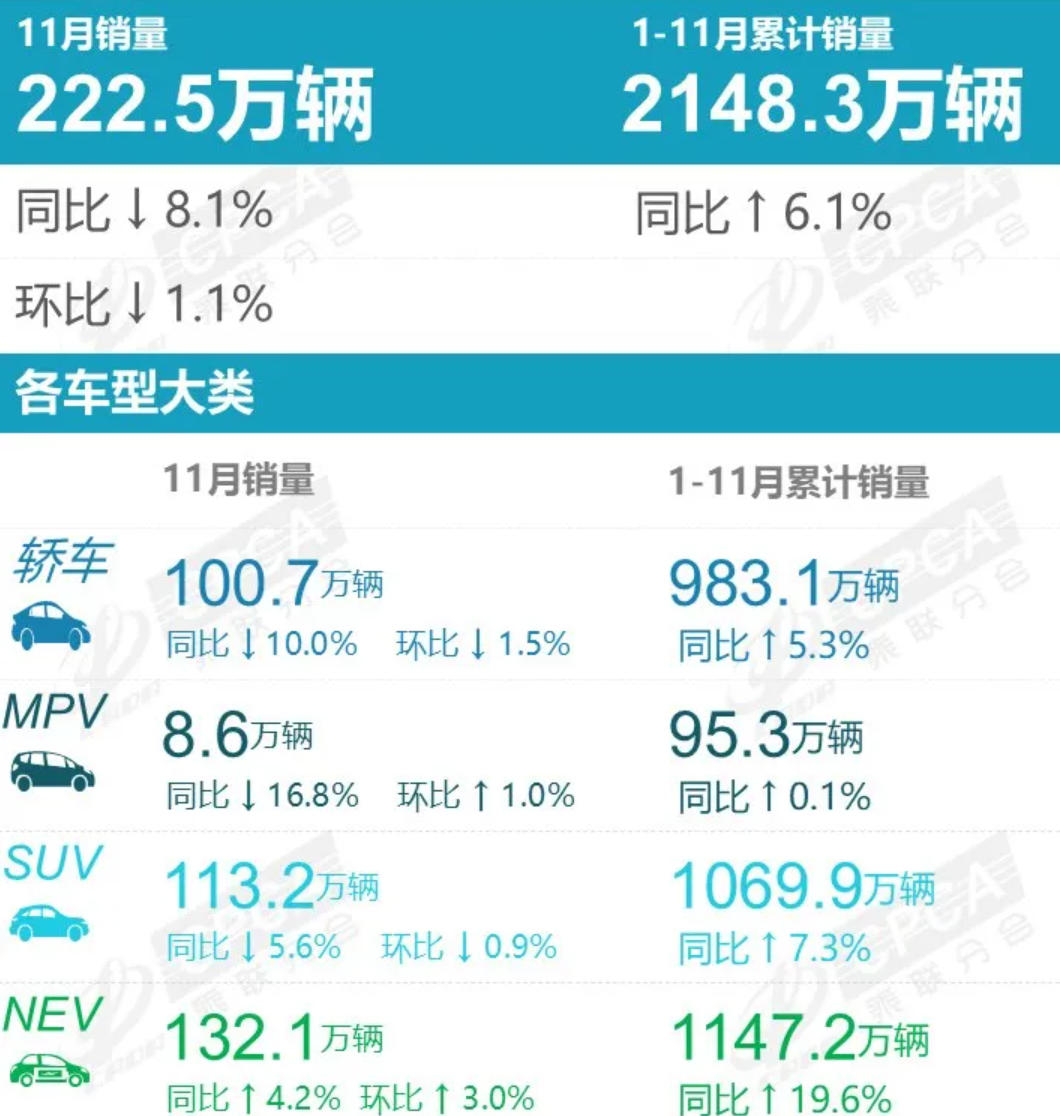
Group 1: Overall Market Performance - In November, the domestic passenger car market faced pressure, with retail sales reaching 2.225 million units, a year-on-year decline of 8.1% and a month-on-month decline of 1.1% [1] - The new energy vehicle (NEV) market, however, showed resilience with sales of 1.321 million units, a year-on-year increase of 4.2% and a month-on-month increase of 3.0%, achieving a penetration rate of over 59% [1] Group 2: Segment Performance - The sedan market saw retail sales of 1.007 million units, down 10.0% year-on-year and slightly down 1.5% month-on-month, with NEV sedans becoming a key growth point [4] - The MPV market was the weakest segment, with retail sales of 86,000 units, a year-on-year decline of 16.8% and a slight month-on-month increase of 1.0% [4] - The SUV market, while also facing year-on-year declines, performed better than sedans and MPVs, with retail sales of 1.132 million units, down 5.6% year-on-year and down 0.9% month-on-month; NEV SUVs sold 683,000 units, up 12.5% year-on-year [4] Group 3: Brand Performance - Among the top ten manufacturers, five were domestic brands, capturing 61% of the total market sales; domestic brands sold 1.49 million units, down 4% year-on-year, while joint venture brands sold 490,000 units, down 19% [4] - BYD led the sales with 306,561 units, although it experienced a year-on-year decline of 26.5% [7] - Geely ranked second with sales of 268,337 units, showing a year-on-year increase of 23.5%, becoming the fastest-growing company among the top brands [9] Group 4: Competitive Landscape - The German brands, particularly FAW-Volkswagen, maintained a stable performance in the shrinking joint venture market, with retail sales of 137,500 units [5] - SAIC Volkswagen's sales were 86,857 units, down 29.3% year-on-year, but it still retained a solid base in the fuel vehicle market [6] - New entrants like Hongmeng Zhixing and Xiaomi Auto showed significant growth, with Hongmeng Zhixing achieving a year-on-year increase of 95.2% [11][18] Group 5: Future Outlook - The market is expected to enter a phase of aggressive sales push in December, with domestic brands likely to maintain their lead in the NEV sector [18] - The competition is shifting from traditional product competition to a focus on technological strength and product quality, indicating a trend towards high-quality development in the automotive industry [18]


11月国内乘用车销量同比下滑,一汽大众重回第三
3 6 Ke· 2025-12-15 04:14
作为汽车市场年底冲刺销量的关键期,今年11月的国内乘用车销量同比下滑。 不过,在12月5日的股东大会上,比亚迪集团董事长王传福对比亚迪销量表现进行回应。他称:"今年比 亚迪国内市场销量出现下滑,一方面由于比亚迪当前技术领先度不及前几年,技术成果的市场惊艳度有 所下降,叠加行业同质化特征渐显,这一变化符合产品及技术发展的周期性规律。另一方面,低温充电 速度慢等用户需求痛点,也亟待通过技术突破予以解决。" 12月11日,中国汽车工业协会(下称"中汽协")发布最新一期的汽车工业产销情况,今年11月,乘用车 国内销量241.4万辆,环比增长1%,同比下降6.5%。作为参考,去年同期,乘用车国内销量环比增长 12.8%、同比增长17.5%;2023年11月该数据亦录得同、环比双增。 此外,根据此前乘联会披露的数据,今年11月,国内狭义乘用车市场零售销量达222.5万辆,同比下降 8.1%,环比下降1.1%。 乘联会秘书长崔东树指出:"今年国内车市零售累计增速从1-2月增长1.2%,3-6月增长15%,7-9月增速 徘徊在6%左右,10-11月回落到偏低状态,呈现4季度高基数的减速特征,基本符合年初判断的'前低中 高后平 ...