长安汽车

Search documents
长安汽车:公司主要业务涵盖整车研发、制造、销售以及发动机的研发、生产
Zheng Quan Ri Bao Wang· 2026-01-09 14:11
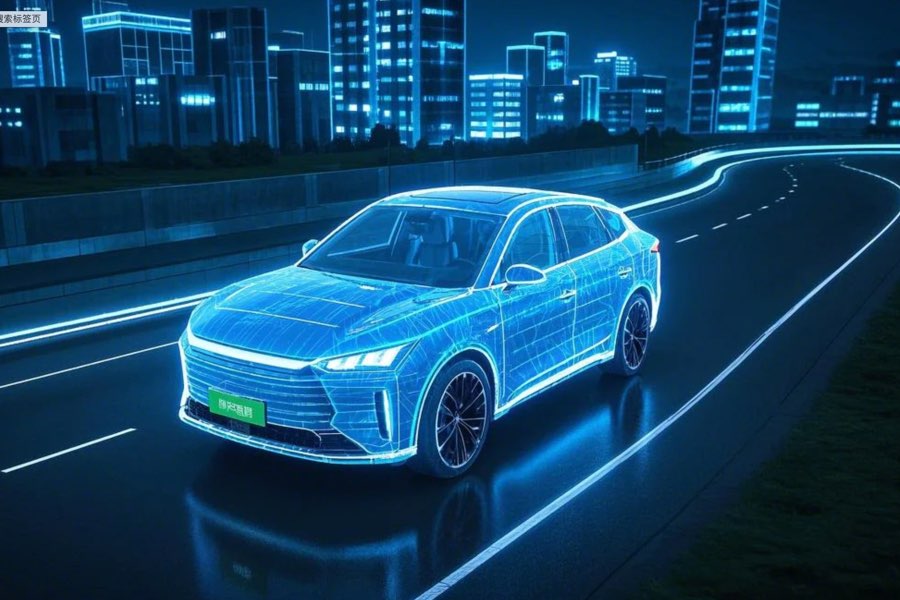
Core Viewpoint - Changan Automobile is actively advancing its core technologies in the automotive industry, including electric battery, motor, and control systems, while also exploring new business areas such as smart cockpit and assisted driving technologies [1] Group 1: Company Overview - Changan Automobile operates in the automotive manufacturing sector, focusing on the research, development, manufacturing, and sales of complete vehicles and engines [1] - The company is expanding its business into automotive life services, new marketing strategies, and battery swapping services [1] Group 2: Technological Advancements - The company is prioritizing the development of core technologies represented by "three electrics" (battery, motor, and electronic control) [1] - Changan is also investing in intelligent technologies such as smart cockpits and assisted driving systems [1] Group 3: Future Industry Exploration - The company is exploring future industries, including humanoid robots and flying cars, to build a comprehensive industrial ecosystem [1]

2025年前11月央企战略性新兴产业领域营收突破11万亿元
Zhong Guo Xin Wen Wang· 2026-01-09 14:02
同时,国有企业研发投入强度显著提升。李镇透露,"十四五"以来中央企业研发经费年均增长6.5%, 2022年至2024年连续三年破万亿元,基础研究投入年均增长达19%。 各地、各中央企业聚焦成果转化,注重搭建从技术到产品的"桥梁",中央企业对外开放中试验证平台 134个,在16个重点行业打造800多个应用场景。 李镇表示,深化提升行动在时间上已经"收官",但深化改革不能"收兵"。各单位要为新一轮改革做好准 备。(完) 中新社北京1月9日电 (记者 庞无忌)中国国务院国资委副主任李镇9日在北京透露,2025年1月至11月, 中央企业在战略性新兴产业领域的营收突破11万亿元(人民币,下同)。这与2024年全年水平基本相当。 当日,国务院国资委召开"国有企业改革深化提升行动经验交流会"。李镇在此间表示,截至目前,国企 改革深化提升行动主体任务已基本完成。国资国企历经多轮改革,整体面貌发生了根本性变化。 他指出,国有经济向新质生产力布局明显提速,战略性重组和专业化整合持续发力。中国雅江集团、中 国资环集团、中国长安汽车、中国数联物流等新央企组建,资源配置效率进一步提升。中央企业开展一 系列专业化整合,着力推动产业向重点 ...
2026年车企销量目标出炉:增幅最高近70%
Jing Ji Guan Cha Wang· 2026-01-09 13:53
Core Viewpoint - The automotive market in China is expected to see a slight growth in 2026, with total sales projected at approximately 35.5 million units, a 2% increase year-on-year, while retail sales of passenger cars are estimated at around 24 million units, reflecting a 1% growth. Despite this modest growth forecast, several automakers have set ambitious sales targets, indicating an intensifying competition for market share as the industry transitions from expansion to competition for existing market segments [2]. Group 1: New Energy Vehicle Manufacturers - New energy vehicle manufacturers maintain optimistic growth expectations, with target growth rates exceeding 30%, significantly higher than the 13% forecasted growth for new energy passenger vehicles by the China Passenger Car Association [3]. - Leap Motor aims for a sales target of 1 million units in 2026, representing a growth rate of 67.5%. In 2025, Leap Motor sold 597,000 units, achieving a remarkable 103% year-on-year increase and becoming the sales champion among new energy vehicle manufacturers [3]. - NIO's growth target for 2026 is set between 456,000 and 489,000 units, reflecting a growth rate of 40%-50%. In 2025, NIO sold 326,000 units, marking a 46.9% increase but falling short of its 440,000-unit target [4]. - Xiaomi Auto has set a sales target of 550,000 units for 2026, with a growth rate of 34%. In 2025, it sold 410,000 units, exceeding its previous target of 350,000 units [4]. Group 2: Traditional Automakers - Traditional automakers are generally more cautious, with Changan Automobile setting a target growth rate of 13.3% for 2026, aiming for total sales of 3.3 million units, including 1.4 million new energy vehicles, which would require a 26.2% year-on-year increase [6]. - Geely Automobile has a target growth rate of 14%, with a total sales goal of 3.45 million units for 2026. In 2025, Geely sold 3.025 million units, achieving a 39% increase [6]. - Chery Group also targets a growth rate of 14%, aiming for total sales of 3.2 million units in 2026. In 2025, it sold 2.806 million units, reflecting a 7.8% increase [7]. - Great Wall Motors has set a relatively high target growth rate of 36% for 2026, with a sales goal of 1.8 million units. In 2025, it sold 1.324 million units, marking a 7.33% increase [7]. - Dongfeng Group has established a sales target of 3.25 million units for 2026, with a growth rate of 30%, including 1.7 million new energy vehicles, which would require a 63% increase [8].






增动能、调结构、优监管——从深化提升行动“成绩单”看国企改革攻坚新成效
Xin Hua Wang· 2026-01-09 13:42
Group 1: Core Achievements of State-Owned Enterprise Reform - The main tasks of the state-owned enterprise reform deepening and enhancement action have been largely completed, with core functions and competitiveness of state-owned enterprises increasingly strengthened [1] - The overall landscape of state-owned assets and enterprises has undergone fundamental changes, addressing critical issues that hinder high-quality development [1] Group 2: Enhancing Development Potential - Since the 14th Five-Year Plan, central enterprises' R&D expenditure has grown by an average of 6.5% annually, with continuous annual investments exceeding 1 trillion yuan from 2022 to 2024, and basic research investment increasing by 19% annually [2] - The establishment of 134 pilot verification platforms in key industries and the implementation of 100 pilot reforms for empowering scientific and technological achievements have been initiated [2] Group 3: Structural Adjustment - Optimizing the layout and structure of state-owned assets is a key focus of the reform, essential for accelerating the transformation of momentum and supporting the construction of a modern industrial system [4] - New central enterprises have been established, and 116 strategic reorganizations have been conducted to develop pillar industries, with central enterprises' revenue in strategic emerging industries expected to exceed 11 trillion yuan by November 2025 [4] Group 4: Regulatory Enhancements - The effectiveness of state-owned asset supervision has been improved through the continuous advancement of regulatory functions and the establishment of a matrix-style regulatory model that balances object and behavior supervision [6] - The integration of artificial intelligence into the regulatory process has been emphasized, with platforms developed to enhance risk identification and management [7]
固态电池供应商备战2027:目标定好了,路线还在争
Jing Ji Guan Cha Wang· 2026-01-09 12:33
Core Insights - The solid-state battery industry is experiencing renewed interest from investors due to clear profitability and order visibility in the supply chain, with a significant focus on achieving mass production by 2027 [2][3][6] - Major automotive companies are targeting 2027 for the application of solid-state batteries in vehicles, with many planning to complete product development or testing by 2026 [4][5] Industry Developments - Companies like Tian Shi Ke Feng have begun to engage with potential investors after overcoming initial funding challenges, with plans to expand production capacity significantly in 2026 [2] - The Ministry of Industry and Information Technology has identified solid-state batteries as a key area for development, aiming to establish 3-5 leading companies by 2027 [3] Technical Challenges - The path to mass production of solid-state batteries is fraught with challenges, including material technology discrepancies and shortages in core equipment [6][8] - The industry is divided on material technology routes, with significant competition between oxide and sulfide electrolytes, each having distinct advantages and challenges [10][12] Material Innovations - Solid-state batteries are recognized for their high energy density and intrinsic safety, making them suitable for various applications, although their cost-effectiveness in electric vehicles remains a concern [7][8] - The development of silicon-carbon and lithium metal anodes is ongoing, with companies reporting progress in small-scale trials [9][10] Equipment and Production - The lack of mature mass production equipment poses a significant barrier, with many companies resorting to self-developed solutions to meet production demands [14][19] - The production process for solid-state batteries requires high precision and specialized equipment, which increases costs and complicates the manufacturing process [20][21] Market Dynamics - The solid-state battery supply chain is characterized by a collaborative approach among suppliers and manufacturers, with a focus on meeting evolving technical requirements from cell manufacturers [23][24] - The competitive landscape is marked by a "race" among cell manufacturers to explore various material suppliers, emphasizing the need for continuous innovation and adaptation [24]




收官2025!全年零售超2300万辆 近八成A/H股上市车企完成销量增长
Xin Lang Cai Jing· 2026-01-09 12:01
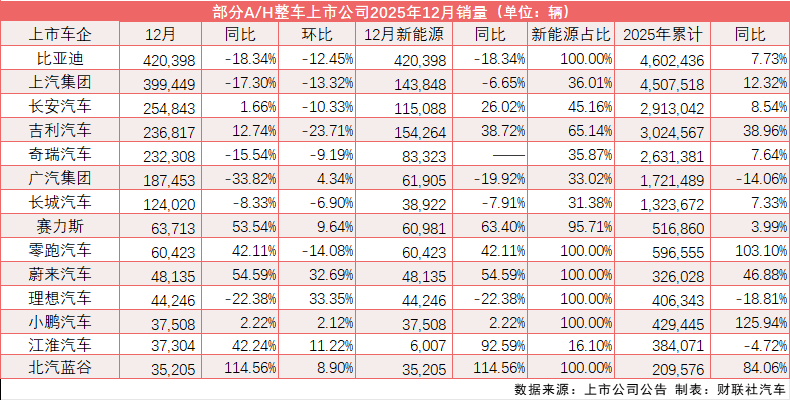
Core Insights - The overall retail sales of passenger cars in China for 2025 are projected to reach 23.744 million units, representing a year-on-year growth of 3.8% [1] - The market trend is expected to follow a "U-shaped" pattern, with a sustained demand for vehicle replacements in 2024-2025 [1] - The actual sales performance exceeded initial expectations, with a revised growth forecast for the passenger car market [1] Company Performance - BYD leads the market with a total sales volume of 4.602 million units in 2025, with overseas sales reaching 1.05 million units, a 145% increase year-on-year [3] - SAIC Motor follows closely with 4.507 million units sold, marking a 12.32% increase, driven by its transition to new energy vehicles and expansion in overseas markets [4] - Geely's total sales reached 3.025 million units, a growth of 38.96%, with new energy vehicle sales increasing by 90% [4] - Changan Automobile sold 2.913 million units, up 8.54%, benefiting from the synergy of multiple new energy brands [5] - Chery Automobile achieved sales of 2.631 million units, a 7.64% increase, with notable export performance [5] - Great Wall Motors sold 1.324 million units, a growth of 7.33%, with significant increases in new energy and overseas sales [5] New Energy Vehicle Trends - New energy vehicle sales for SAIC reached 1.643 million units, a 33.1% increase, contributing to a historical high [4] - Geely's new energy vehicle sales are projected to reach 2.22 million units in 2026, indicating a penetration rate increase from 55.8% to 64.3% [4] - New entrants like Leap Motor and Xpeng Motors are experiencing rapid growth, with Leap Motor achieving a 103.1% increase in annual deliveries [6] - Xpeng Motors delivered 429,000 units, a 125.94% increase, and plans to launch several new models in 2026 [6] Market Outlook - The passenger car market is expected to maintain a steady performance in 2026, with overall sales projected to be flat compared to 2025 [2] - Export growth for passenger vehicles is anticipated to remain above 10% [2] - The market for small electric vehicles is expected to slow down, with growth projected at around 10% due to policy impacts [8]
小米汽车销量创新高,华为鸿蒙月销逼近9万,12月国产新能源百花齐放
Xin Lang Cai Jing· 2026-01-09 11:54
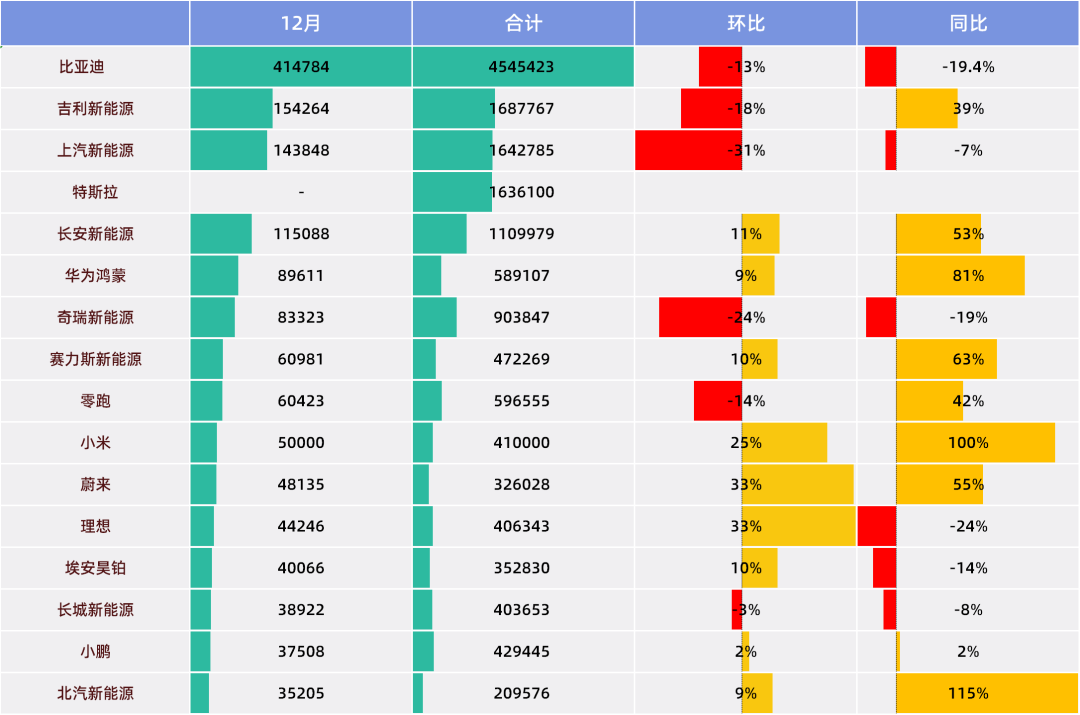
Core Insights - BYD's sales surged from 426,000 units in 2020 to 4.545 million units in 2025, achieving a compound annual growth rate of 60% [1] - Despite rapid growth, BYD faced intense competition from other automakers and did not meet its performance targets in 2025 [1] - The Chinese automotive market is undergoing significant changes, with many companies preparing for global expansion [1] Sales Performance - In December, BYD sold 414,784 units, a decrease of 13% month-over-month and 19.4% year-over-year [3] - Among 15 Chinese automakers, only five achieved both month-over-month and year-over-year sales growth [4] - The average sales volume dropped to 94,427 units in December, primarily due to declines in the first and second-tier companies [4] Market Dynamics - The Chinese government continues to support the automotive market with subsidies exceeding 1.1 billion yuan [2] - The competition is intensifying, with several brands achieving historical sales highs, particularly in the third tier [6] - The central economic work conference emphasized the importance of domestic demand, indicating ongoing support for the automotive sector [7] Company-Specific Developments - Only five out of 14 automakers met their sales targets for 2025, with companies like Li Auto and Aion falling short [8] - BYD's electric vehicle sales reached 2.2567 million units, surpassing Tesla's 1.636 million units for the first time [11] - The export volume of Chinese automobiles is expected to exceed 7 million units in 2025, with BYD emerging as a key player [14] Technological Advancements - The introduction of L3 autonomous driving technology is gaining momentum, with several companies, including BYD and Huawei, conducting road tests [17][18] - The competition for L3 autonomous driving capabilities is expected to intensify in 2026 [18] Brand Strategies - Huawei's HarmonyOS ecosystem has expanded, contributing to record sales for its vehicles [19] - Xiaomi's sales reached over 500,000 units in 2025, but the company faced a public relations crisis that may impact future products [21][23] - NIO and Xpeng have shifted to lower price segments to maintain competitiveness, with NIO achieving a record monthly sales of 48,135 units in December [24][27] Future Outlook - The automotive industry is expected to continue evolving rapidly, with companies focusing on both domestic and international markets [49] - The competitive landscape is shifting, with traditional automakers adapting to new market realities and consumer preferences [49]



机构调研策略周报(2026.01.05-2026.01.09):机械设备、电子等行业持续获机构关注-20260109
Yuan Da Xin Xi· 2026-01-09 11:24
Investment Rating - The report does not explicitly provide an investment rating for the industry or companies discussed [28]. Core Insights - The report highlights that the mechanical equipment, electronics, and computer industries are currently receiving significant attention from institutional investors, with a notable increase in the number of institutions conducting research in these sectors [10][12]. - Key companies such as Ice Wheel Environment and Nengke Technology are leading in institutional research, showcasing their advancements in high-growth areas like data center cooling and aerospace digitalization [24][26]. Summary by Sections 1. Institutional Research on Popular Industries - During the week of January 5 to January 9, 2026, the mechanical equipment, computer, electronics, automotive, and basic chemicals sectors were the most researched by institutions, with a particular focus on the computer and automotive sectors in the past five days [10][12]. - Over the past 30 days, the same sectors maintained high interest, with mechanical equipment and electronics receiving the most attention from research institutions [12]. 2. Institutional Research on Popular Companies - In the week of January 5 to January 9, 2026, Ice Wheel Environment and BOE Technology Group were among the top companies researched, each receiving attention from more than 10 institutions [16][19]. - Over the past 30 days, Ice Wheel Environment, Kebo Technology, and Dazhu Laser were highlighted for their significant research activity, with Ice Wheel Environment receiving 13 research visits [20][21]. 3. Key Company Research Insights Ice Wheel Environment - The focus of the research on Ice Wheel Environment included advancements in data center liquid cooling, nuclear thermal management, and the commercialization of "dual carbon" technologies. The company has successfully implemented its cooling systems in major projects like the National Supercomputing Center in Guangzhou and is expanding into international markets [24][26]. - The company has also made strides in nuclear power technologies, with successful applications in several nuclear power plants and recent wins in projects related to small modular reactors [24]. Nengke Technology - Nengke Technology showcased its leadership in the aerospace sector, having served over 200 aerospace clients with total orders exceeding 1 billion yuan. The company is leveraging AI technologies in various manufacturing processes, including rocket assembly quality inspection and CAD drawing recognition [25][26]. - The company is also initiating product development in remote sensing based on new customer demands for satellite monitoring, and it has received approval for a fundraising initiative to support the development of three AI platforms [26].


WEMONEY研究室·数字金融周报|光大银行“乐惠金”现幽灵债务;国有大行黄金积存业务再提门槛
Sou Hu Cai Jing· 2026-01-09 11:07
Group 1: Banking Sector Developments - Major state-owned banks are raising the threshold for gold accumulation business, requiring personal clients to have a risk tolerance level of C3 or above to purchase gold starting January 12, 2026 [1] - A wave of deposit maturities is expected, with an estimated 50 trillion yuan in one-year and above fixed deposits maturing this year, primarily concentrated in two to three-year deposits [2] - In 2025, city commercial banks faced significant penalties, totaling 875 million yuan, with the Shenzhen Rural Commercial Bank receiving the largest fine of 12.84 million yuan for multiple violations [3] Group 2: Investment Activities - Several financial asset investment companies (AIC) under joint-stock banks have begun investing in emerging industries, with notable investments in sectors like semiconductors and clean energy [4] - The establishment of Yunnan Rural Commercial Bank is underway, aiming to become the first bank in the province with over 1 trillion yuan in deposits, consolidating various rural credit institutions [6] Group 3: Insurance Sector Changes - The insurance industry is experiencing a wave of personnel changes, with 81 instances of leadership transitions reported in 2025, indicating a trend towards internal promotions and a preference for specialized talent [6] - Ping An Life has made significant stock purchases in Agricultural Bank and China Merchants Bank, triggering regulatory notifications due to increased shareholding [7] Group 4: Consumer Finance Updates - China Bank Consumer Finance has undergone a major equity change, with its bad loan sales reaching 13.84 billion yuan, and the non-performing loan rate increasing from 2.80% in 2022 to 3.56% in 2024 [9] - Beijing Financial Regulatory Bureau has approved an increase in registered capital for North Bank Consumer Finance by 150 million yuan, raising its total registered capital to 1 billion yuan [10] Group 5: Financial Technology Developments - The People's Bank of China has revoked the payment license of China Steel Yintong, marking the 108th payment license cancellation, indicating ongoing regulatory scrutiny in the payment sector [11] - Guangzhou Heli Bao Payment Technology has been fined over 74 million yuan for multiple regulatory violations, highlighting compliance challenges in the payment industry [12]

2025车企目标达成率透视:巨头稳健、新势力分化,新能源与出口双引擎驱动
Ju Chao Zi Xun· 2026-01-09 10:11
Core Insights - The Chinese automotive market has undergone significant changes in 2025, moving away from broad high growth to a more structured competitive landscape, with increasing penetration of new energy vehicles (NEVs) and a shift in the importance of overseas markets from a strategic option to a core pillar for survival and development [2] Group 1: Annual Goals and Performance - BYD demonstrated strong resilience, achieving a sales target of 460.24 million units, which is a 100.05% target achievement rate after a pragmatic adjustment from an initial goal of 550 million units [3] - Other traditional automakers like Geely (302.46 million units), SAIC Motor (450.75 million units), and Chery (280.64 million units) also met or closely approached their annual targets, indicating stability during their transformation [3] - In contrast, Li Auto's sales of 40.63 million units fell significantly short of its adjusted target of 64 million units, achieving only about 58% of its goal, highlighting challenges in product iteration and market expansion [5] Group 2: Growth Dynamics - The growth drivers for the automotive industry are clearly identified as internal growth in the NEV sector and expansion into overseas markets [9] - BYD maintained its leading position in the NEV market with sales of 460.24 million units, while new entrants like Leap Motor and Xpeng Motors achieved impressive growth rates of 103.13% and 125.88%, respectively [10] - Traditional automakers like Chery and Geely have made positive strides in transitioning to NEVs, but companies like Dongfeng and GAC face significant growth pressures due to slower transitions [12] Group 3: Export Performance - Exports have become a critical variable in determining industry rankings, with BYD's exports skyrocketing from 416,000 units in 2024 to 1,046,000 units in 2025, a growth of over 150% [12] - Chery led exports with 1,344,000 units, while SAIC Motor also surpassed 1,070,000 units in overseas sales, contributing to a total export of 4,386,800 units among the top five Chinese automakers [12] - Tesla's export growth in China was weak, with only 222,700 units exported from January to November 2025, indicating increasing competition from local brands in the international market [13] Group 4: Future Outlook - The market performance in 2025 indicates a shift from relying solely on domestic market growth to a comprehensive capability competition among automakers [15] - Strategic resilience and operational rationality are crucial, with companies like BYD successfully adjusting targets based on market feedback, while others like Xiaomi and Leap Motor are breaking through by precisely targeting niche markets [15] - The competition has evolved from mere sales volume expansion to a comprehensive comparison of technological depth, product ecosystem breadth, user operation precision, and sustainable profitability [16]