小米

Search documents
电商品牌非做即时零售不可?
雷峰网· 2025-11-27 07:59
Core Viewpoint - The article discusses the transformation of supply chains in the e-commerce sector, particularly focusing on the rise of instant retail and the establishment of "brand official flagship lightning warehouses" by Meituan, which allows brands to quickly enter the instant retail market with minimal investment [2][3][8]. Group 1: Instant Retail Trends - Brandization is becoming a core trend in the instant retail sector, with many brands establishing official flagship stores on platforms like Meituan's flash purchase service [2]. - Since October, hundreds of brands, including Sony PlayStation and L'Oreal, have entered Meituan's instant retail channel, indicating a shift towards closer consumer engagement [3][6]. Group 2: Sales Performance - During this year's Double 11 shopping festival, brands that joined Meituan's "brand official flagship lightning warehouse" saw sales increase by nearly 400% compared to before the event, with some brands experiencing over tenfold growth [6][11]. - Over 800 brands, including Apple and Huawei, reported sales growth exceeding 100% year-on-year during the same period, highlighting the effectiveness of instant retail channels [6][11]. Group 3: Supply Chain Innovation - Meituan's lightning warehouse model has evolved to support brands in quickly entering the instant retail market without the need for self-built storage facilities, thus reducing entry costs [8][19]. - The "brand official flagship lightning warehouse" model allows brands to maintain their independent identity while benefiting from shared logistics and digital systems provided by Meituan [8][19]. Group 4: Market Potential - The instant retail market is projected to exceed 2 trillion yuan by 2030, indicating significant growth potential as traditional e-commerce channels face stagnation [11][12]. - Instant retail offers high repurchase rates and low return rates, making it an attractive channel for brands seeking growth [12][14]. Group 5: Quality Assurance - Meituan has implemented policies to ensure product quality, including a comprehensive service guarantee plan that covers authenticity and return services for high-value items [19]. - The shift from merely providing products to ensuring quality reflects the evolving consumer expectations in the instant retail space [18][19].


科力装备:2025年8月公司以自有资金2000万元投资设立子公司微纳新材
Zheng Quan Ri Bao Wang· 2025-11-27 07:12
Core Viewpoint - Company Keli Equipment (301552) is expanding its business by investing 20 million yuan to establish a wholly-owned subsidiary, Micro-Nano New Materials, focusing on the development and preparation of nano-coating materials, which have diverse applications across multiple industries [1] Group 1: Investment and Subsidiary Establishment - In August 2025, the company will invest 20 million yuan of its own funds to set up the subsidiary Micro-Nano New Materials, holding 100% equity [1] Group 2: Product Development and Applications - The company is developing a series of nano-coating materials that offer various functionalities such as light absorption, heating defogging, chrome replacement, wear resistance, and antibacterial properties [1] - The nano-coating materials are targeted not only at the automotive industry but also have potential applications in robotics, mobile devices, and other sectors to address industry pain points [1] Group 3: Technological Breakthroughs and Industry Adoption - The company's anti-VOC pollution light-absorbing coating technology has achieved a full-process technological breakthrough from R&D to industrialization [1] - The technology has been applied in specific models from major manufacturers including Xiaomi, NIO, Li Auto, Xpeng, BYD, Volkswagen, Geely, Chery, and Changan, indicating strong industry adoption [1] - With the increasing penetration rate of new energy vehicles, the company's new technologies in the field of assisted driving are expected to gain further popularity [1]
海光芯正IPO营收三年翻8倍,胡朝阳给战投“0元送股”
Sou Hu Cai Jing· 2025-11-27 06:37
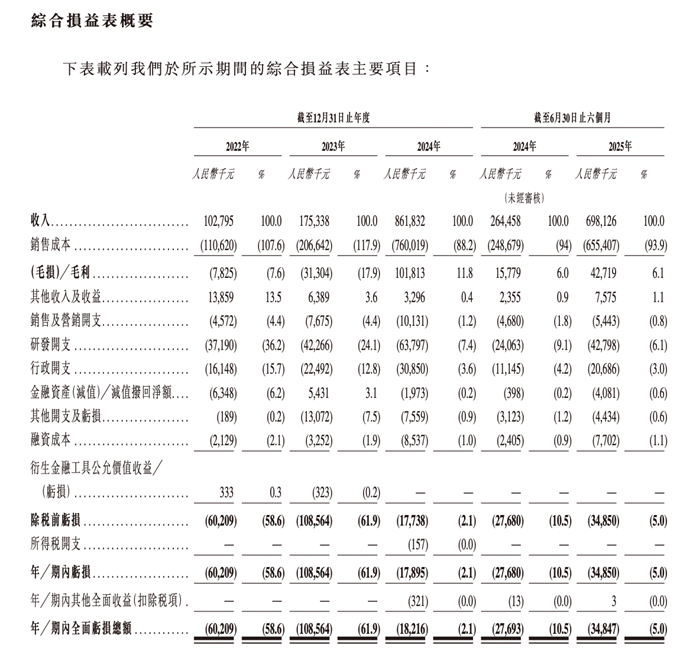
Core Viewpoint - The company, Haiguang Xinzhen Technology Co., Ltd., has experienced significant revenue growth, with an eightfold increase over three years, and is now preparing for an IPO on the Hong Kong Stock Exchange [1][3]. Revenue Growth and Financial Performance - Haiguang Xinzhen's revenue increased from 102.8 million yuan in 2022 to 861.8 million yuan in 2024, representing an over eightfold growth [3]. - The company's losses narrowed significantly, with net losses of 60.2 million yuan in 2022, 108.6 million yuan in 2023, and 17.8 million yuan in 2024 [3]. - In the first half of 2025, the company achieved revenue of 698.1 million yuan, a year-on-year increase of 164% [3]. Market Position and Product Offering - Haiguang Xinzhen ranks as the tenth largest global provider of professional optical modules by revenue in 2024 and is the fastest-growing among the top ten providers from 2022 to 2024 [3]. - The company specializes in optical interconnect products, including optical modules and active optical cables (AOC), which are widely used in AI data centers for high-speed data transmission [3]. Investment and Shareholder Structure - Prior to the IPO, the founder and key shareholders held 21.11% of the company's equity, with significant investments from Alibaba and Xiaomi [5][6]. - The company has undergone multiple funding rounds, with its valuation reaching 2.66 billion yuan after the latest round [6]. R&D and Innovation - Haiguang Xinzhen has a strong R&D team, with 101 researchers, accounting for about 30% of its total workforce [14]. - The company has filed for nearly 40 patents, including 16 invention patents, indicating a robust focus on innovation [15][18]. - R&D expenses as a percentage of total revenue have decreased from 36.2% in 2022 to 6.1% in the first half of 2025, reflecting improved operational efficiency [14]. Industry Trends and Market Potential - The global AI optical module market is projected to grow from 3.9 billion yuan in 2020 to 42.8 billion yuan in 2024, with a compound annual growth rate (CAGR) of 82.2% [9]. - China's optical module market is expected to maintain the highest growth rate globally, with a CAGR of 89.4% from 2020 to 2024 [10].

英伟达市值一个月内蒸发5万亿元|首席资讯日报
首席商业评论· 2025-11-27 04:12
Group 1: AI Chip Market Dynamics - Nvidia's market value has evaporated by 500 billion yuan within a month due to emerging competition in the AI chip market, particularly from Google's self-developed AI chip, TPU, which is reportedly in talks for external collaborations with major tech companies like Meta [2] - Analysts on Wall Street refute the notion of a "zero-sum game" in the AI chip market, suggesting that companies like Google and Nvidia can coexist and thrive in the trillion-dollar AI infrastructure sector [9] Group 2: Automotive Industry Insights - Li Xiang, CEO of Li Auto, stated that the most valuable robots in the next decade will be cars with autonomous capabilities, envisioning cars as the core form of embodied intelligence [4] - Li Auto reported a quarterly revenue of 27.4 billion yuan for Q3 2025, with a total revenue of 83.5 billion yuan for the first three quarters, and a significant R&D expenditure of 3 billion yuan for the quarter, indicating strong financial health with cash reserves of 98.9 billion yuan [12] Group 3: Corporate Developments - The founder of Hua Yu Hua, Hua Shan, claimed that the restaurant chain Xibei is being manipulated, leading to a public dispute with Luo Yonghao, who demanded an apology from Hua Shan [6][7] - Zhi Yuan's Peng Zhihui has been elected as the chairman of the board for the company, bringing a wealth of experience from previous roles at OPPO and Huawei [8] Group 4: Entertainment Industry Highlights - The animated film "Zootopia 2" has set a record for the highest single-day box office for an imported animated film in China, grossing over 213 million yuan on its opening day, showcasing the strong appeal of established IPs [10]



超400亿资金加仓港股科技类ETF
2 1 Shi Ji Jing Ji Bao Dao· 2025-11-27 02:07
Core Viewpoint - The Hong Kong technology sector has experienced a correction after reaching a yearly high in early October, with major indices showing declines of over 7% in the past month. Despite this, ETF funds have been increasing their positions in the sector, indicating investor confidence in the long-term value of technology companies [1][4][5]. Group 1: Market Performance - The Hong Kong technology sector indices, including the CSI Hong Kong Stock Connect Technology Index and the Hang Seng Technology Index, have seen declines of 7.20%, 7.39%, and 8.58% respectively [4]. - Major technology stocks such as Alibaba and SMIC have experienced significant price drops of 6.24% and 15.06% respectively in the past month [3]. - Despite the downturn, there has been a net inflow of 439 billion yuan into technology-related ETFs in the past month, with 13 Hang Seng Technology ETFs attracting over 240 billion yuan [1][6]. Group 2: Investor Sentiment - Investors are optimistic about the long-term growth potential of technology companies in Hong Kong, viewing the current market adjustment as temporary [7]. - The current price-to-earnings ratio (P/E) of the Hang Seng Technology Index is 22.5, which is at the 27th percentile over the past decade, indicating a favorable valuation level [7]. - The influx of funds into technology ETFs suggests that investors recognize the current valuation levels of Hong Kong technology stocks [7]. Group 3: AI and Market Dynamics - Concerns regarding an "AI bubble" have emerged, but some analysts believe that AI technology still holds significant potential, and short-term market fluctuations do not diminish the investment value of the underlying industries [12]. - The ongoing AI revolution is seen as a long-term trend rather than a bubble, with the potential for substantial productivity improvements and market applications [11][12]. - Companies that can effectively integrate leading AI models with diverse business scenarios are expected to benefit the most from the ongoing changes in the industry [12]. Group 4: Future Outlook - Analysts suggest that if short-term pressures on the Hong Kong market are alleviated, the influx of capital and the presence of high-quality assets could support a continued bullish trend [8]. - The technology sector is expected to remain a key focus, particularly as AI continues to drive market dynamics and create opportunities for leading companies [8]. - The valuation of the Hong Kong technology sector is currently attractive, with a significant discount compared to the NASDAQ 100 index, providing a potential for valuation recovery [9].

超400亿资金加仓港股科技类ETF
21世纪经济报道· 2025-11-27 02:01
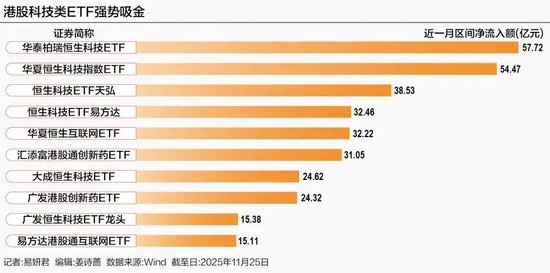
Core Viewpoint - The Hong Kong technology sector has experienced a correction after reaching a yearly high in early October, with significant ETF inflows indicating investor confidence in the long-term value of technology companies despite short-term volatility [1][4][5]. Group 1: Market Performance - The Hong Kong technology indices, including the CSI Hong Kong Stock Connect Technology Index and the Hang Seng Technology Index, have seen declines exceeding 7% in the past month [1][4]. - Major technology stocks like Alibaba and SMIC have faced price drops of 6.24% and 15.06% respectively over the same period [4]. - The Hang Seng Technology Index's price-to-earnings ratio (PE-TTM) stands at 22.5 times, which is at the 27th percentile over the past decade, indicating a relatively low valuation [6][9]. Group 2: ETF Inflows - Despite the market correction, technology-focused ETFs in Hong Kong have seen a net inflow of 439 billion yuan in the past month, with 13 Hang Seng Technology ETFs attracting over 240 billion yuan [1][5]. - Specific ETFs such as Huatai-PB Hang Seng Technology ETF and Huaxia Hang Seng Technology Index ETF have recorded net inflows of 57.72 billion yuan and 54.47 billion yuan respectively [5][6]. Group 3: Investor Sentiment and Future Outlook - Investors remain optimistic about the long-term growth potential of leading technology companies like Tencent, Alibaba, and Xiaomi, which are seen as having strong technological foundations and market positions [6][9]. - The market is currently influenced by external factors such as the U.S. Federal Reserve's hawkish stance, which has raised concerns about liquidity and market valuations [4][5]. - Analysts suggest that if short-term pressures on the Hong Kong market are alleviated, there is potential for continued upward momentum driven by institutional investments [8][9]. Group 4: AI Bubble Concerns - Concerns regarding an "AI bubble" have emerged, but some analysts argue that the current fluctuations do not diminish the underlying investment value of AI technologies [5][10]. - The potential of AI technologies is still seen as significant, with leading companies that can integrate AI into diverse business scenarios likely to benefit the most [11].

闭环训练终于补上了!AD-R1:世界模型端到端闭环强化学习新框架(澳门大学&理想等)
自动驾驶之心· 2025-11-27 00:04
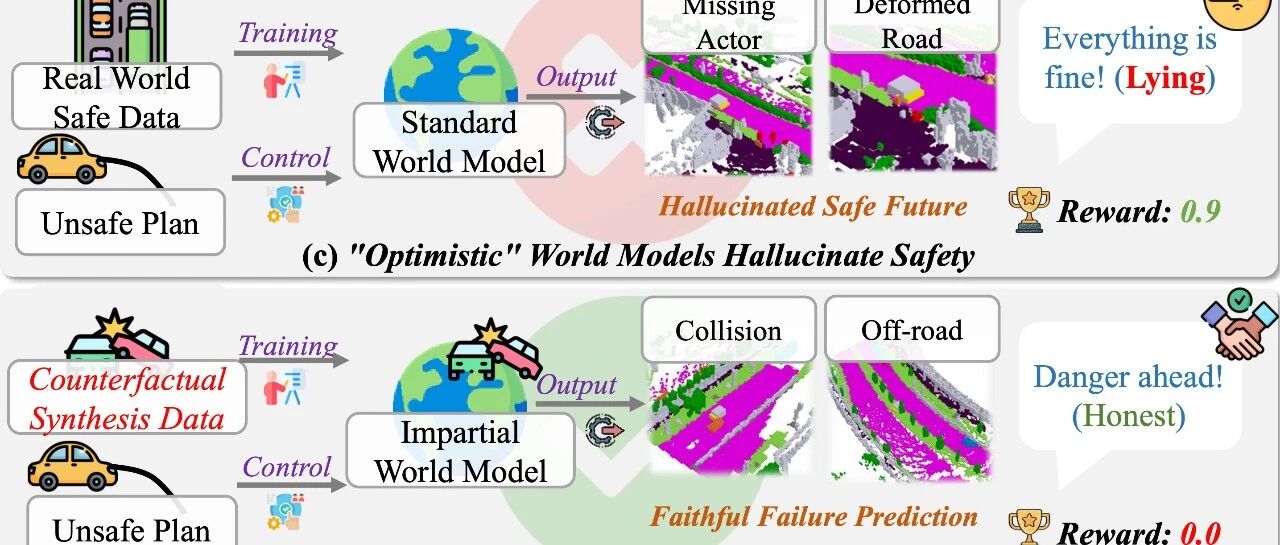
Core Insights - The article discusses the advancements in autonomous driving through the introduction of the AD-R1 framework, which utilizes an Impartial World Model to address the "optimistic bias" found in traditional world models [2][3][57] - The framework allows for closed-loop reinforcement learning, enabling autonomous vehicles to learn from imagined failures, thereby improving safety and decision-making capabilities [9][57] Group 1: Background and Challenges - End-to-end autonomous driving has transformed the industry, but challenges remain, particularly with long-tail event failures due to distribution shifts [6] - Traditional reinforcement learning methods rely on external simulators, which have limitations such as simulation-to-reality gaps and lack of interactivity [6][9] - The need for a paradigm shift towards learning 3D/4D world models as high-fidelity generative simulators is emphasized [6] Group 2: Optimizing World Models - The AD-R1 framework introduces a new approach to mitigate the optimistic bias in world models, which often fail to predict negative outcomes [2][7] - The Impartial World Model (IWM) is designed to accurately reflect the consequences of both safe and unsafe behaviors, enhancing the reliability of predictions [3][10] - A counterfactual synthesis pipeline is implemented to generate a diverse training dataset that includes reasonable collision and lane deviation scenarios [3][10] Group 3: Experimental Results - The IWM significantly outperforms traditional models in risk prediction tasks, demonstrating its ability to accurately foresee failures [47][48] - The application of the AD-R1 framework leads to notable improvements in safety and performance metrics across various baseline models, with absolute increases in planning decision metrics (PDMS) of 1.7% and 1.1% [49] - Ablation studies reveal that the introduction of counterfactual synthesis and model-level optimizations are critical for enhancing causal fidelity and overall performance [51][52] Group 4: Future Directions - Future research may focus on generating counterfactual failure samples from unlabeled data to reduce reliance on high-precision annotations [57] - Expanding the framework to more complex multi-agent interaction scenarios could further enhance the robustness of autonomous driving systems in long-tail events [57]
瑞士学者:为什么小米能实现强势回归?
Xin Lang Ke Ji· 2025-11-26 23:12
Core Insights - The article discusses the impact of geopolitical uncertainties on technology development and highlights the blurring boundaries between hardware, software, and services in the tech industry [1][3]. Group 1: Industry Trends - The traditional segmented business models in the tech industry are becoming obsolete, with companies now focusing on providing a complete user experience rather than specializing in hardware or software [3]. - The IMD's Future Readiness Indicator evaluates companies based on their long-term competitiveness across seven dimensions, including financial foundation, investor growth expectations, business diversity, employee structure, R&D investment, early innovation outcomes, and cash and debt management [3][4]. Group 2: Company Performance - The 2025 Future Readiness Indicator reveals a clear divide between strong and weak companies, with some leveraging AI and geopolitical changes for growth while others remain trapped by outdated success paths [4]. - In the pharmaceutical sector, leading companies like Johnson & Johnson, Roche, and AstraZeneca have built comprehensive systems from basic research to next-generation treatment platforms, while others struggle due to reliance on traditional products [4]. Group 3: Fashion Industry Insights - In the fashion industry, platformization and supply chain resilience are critical, with luxury brands leveraging "super luxury combinations" to enhance lifestyle offerings [5]. - Companies that fail to adapt and modernize their brand culture are losing touch with contemporary consumers, while those with diversified ecosystems can absorb market shocks and turn volatility into an advantage [5]. Group 4: Technology Giants - Leading tech companies such as NVIDIA, Microsoft, Google, and Meta are not just selling products but are controlling the entire IT technology stack, allowing them to manage workflows effectively [6][7]. - Xiaomi is highlighted as a unique case, successfully expanding from smartphones to home appliances and vehicles while maintaining a connected ecosystem that enhances user experience [7]. Group 5: AI Investment Landscape - The current investment landscape in the U.S. is characterized by significant funding directed towards AI-driven projects, with major companies investing approximately $600 to $700 billion every six months [8]. - Concerns arise regarding the sustainability of these investments if AI applications do not yield substantial returns, prompting tech giants to hedge their bets by ensuring that traditional companies can create real value through AI [9]. Group 6: Competitive Advantages - The article emphasizes that the strongest companies are those that do not rely on a single product but possess the capability to manage entire ecosystems [5][6]. - The next wave of innovation is expected to focus on real-world interactions, with significant investments in robotics and AI applications that extend beyond traditional industries [9][10].

车主冲进总部一年后,极氪开出“后悔药”
汽车商业评论· 2025-11-26 23:07
Core Viewpoint - The article discusses the trend of hardware upgrades in the electric vehicle (EV) industry, highlighting the recent crowdfunding initiatives by various companies, including Zeekr, to enhance their vehicles' capabilities and address customer dissatisfaction with previous models [4][9][12]. Group 1: Zeekr's Hardware Upgrade Initiative - Zeekr announced a crowdfunding plan for upgrading the smart driving system of its 2024 models, increasing computing power from 48 TOPS to 700 TOPS [4]. - The decision to offer a crowdfunding upgrade follows customer backlash over the release of newer models with better features at the same price, leading to a negative perception among existing owners [6][10]. - Over 70,000 eligible Zeekr owners can participate in this upgrade, and the response has been overwhelmingly positive, with many owners appreciating the initiative [6][8]. Group 2: Industry-Wide Hardware Upgrade Trends - The trend of hardware upgrades is not unique to Zeekr; other brands like Xpeng and Avita are also implementing similar initiatives to enhance their vehicles [12][16]. - Xpeng announced a crowdfunding plan for upgrading its smart cockpit and driving chips, significantly increasing the computing power of its vehicles [12][13]. - The article notes that the rapid pace of technological advancement in the EV sector has led to vehicles being treated more like fast-moving consumer goods, with frequent updates and upgrades [12][18]. Group 3: Challenges and Costs of Hardware Upgrades - The costs associated with hardware upgrades are significant, with Zeekr's upgrade requiring the replacement of nearly 60 components, leading to a material cost exceeding 30,000 yuan per vehicle [25]. - The complexity of hardware upgrades involves not only physical components but also extensive software adaptations, which can take months to complete [25][21]. - The article highlights that while software upgrades are often free, hardware upgrades typically come with substantial fees, making it a challenging proposition for many consumers [27][34]. Group 4: Future Implications and Regulatory Considerations - The article suggests that hardware upgrades can extend the lifecycle of vehicles and positively impact their resale value, as standardized interfaces are used [34]. - There is an ongoing discussion about the need for regulatory frameworks to manage hardware upgrades in the EV sector, similar to existing regulations for software updates [34].