
百度

Search documents
小确幸悦己消费避险属性,芒果超媒《声鸣远扬》将播出:互联网传媒周报20251013-20251017-20251019
Shenwan Hongyuan Securities· 2025-10-19 11:24
Investment Rating - The industry investment rating is "Overweight" indicating a positive outlook for the sector compared to the overall market performance [10]. Core Insights - The report highlights the rising trend of "small happiness" self-consumption as a relative safe haven amid increasing risk aversion, with specific companies like Pop Mart and Damai Entertainment showing strong growth potential through innovative product offerings and expansion strategies [3][5]. - The gaming sector is experiencing significant adjustments, with major companies like Tencent and Century Huatong expected to maintain strong performance despite market volatility, while the AI video segment is emerging as a key area for growth [3][5]. Summary by Relevant Sections Consumer Sector - Pop Mart is ramping up production capacity and expanding product categories, with successful new IP launches and international expansion, achieving rapid sales growth during peak seasons [3]. - Damai Entertainment's core IP Chiikawa has seen high demand in mainland China, indicating strong market interest and potential for future growth [3]. Gaming Sector - Tencent Holdings is projected to have a market cap of 50,823 million RMB with a revenue growth of 13% year-on-year, while its PE ratio is expected to be 20 for 2025 [5]. - Century Huatong is also highlighted with a projected revenue increase of 21% year-on-year, indicating a positive outlook for its gaming products [5]. Cloud Computing and Entertainment - Alibaba's cloud computing segment is expected to grow at a rate of 11% year-on-year, with a market cap of 26,914 million RMB [5]. - Mango TV is anticipated to see a turnaround in its operations, benefiting from favorable policy changes in the long video sector [3]. AI and Technology - The report emphasizes the importance of AI in video production, with companies like Bilibili and Kuaishou positioned to leverage AI advancements for monetization [3]. - The technology sector has faced a 14% adjustment since October 2, but the report suggests that the fundamentals remain strong, driven by advancements in domestic models and chips [3].






互联网行业AI商业化双主线:云基建护航场景应用共振
HTSC· 2025-10-19 07:03
Investment Rating - Maintain "Buy" rating for key companies in the AI and cloud infrastructure sectors [8] Core Insights - The report emphasizes two main investment lines: cloud infrastructure service providers benefiting from downstream demand and application scenario commercialization, particularly in advertising and vertical applications [17][19] - The rapid growth in token usage for AI models indicates a strong demand for AI applications, with significant increases in daily token calls for major platforms [18][26] - The report highlights the cost advantages of domestic AI models compared to international counterparts, with prices approximately 50% lower, facilitating broader market penetration [31][35] Summary by Sections Investment Rating - The report maintains a "Buy" rating for several key companies, including Alibaba, Baidu, Tencent, Kuaishou, and others, indicating strong growth potential in the AI and cloud sectors [11] Cloud Infrastructure - Cloud infrastructure is identified as the foundational layer for AI applications, with major players like Alibaba, Baidu, and Tencent developing comprehensive capabilities to support AI development [19][42] - The report notes that the cost of cloud computing is significantly lower than building in-house capabilities, enhancing the attractiveness of cloud services for AI development [19] AI Application Commercialization - The commercialization of AI in advertising is highlighted, with AI technologies improving efficiency and effectiveness in ad campaigns, leading to increased ROI for advertisers [20][21] - Vertical applications of AI are also expanding, with significant advancements in sectors such as video generation, recruitment, and office automation, showcasing the versatility and market potential of AI technologies [21][24] Market Dynamics - The report contrasts the focus on large model technology with the importance of application scenarios for AI commercialization, suggesting that companies with strong scene-based applications will have a competitive edge [22][25] - The increasing integration of AI into industry workflows is expected to drive demand for customized B-end services, which are seen as critical for differentiation in the market [23][24]
中概股启动新一轮回港上市,什么信号?
Zheng Quan Shi Bao· 2025-10-19 05:00
Core Viewpoint - The recent wave of Chinese companies returning to the Hong Kong stock market is led by technology-intensive new economy firms, enhancing the market's ecosystem and providing new investment opportunities [1][12]. Group 1: Recent Listings and Announcements - Hesai-W successfully completed its dual listing in Hong Kong on September 16, marking the first Chinese company to return to the Hong Kong market this year [3]. - Tianjing Bio announced its intention to dual list in Hong Kong, aiming to leverage a new business model and enhance its market position in Asia [6]. - WeRide and Pony.ai have initiated their listing processes in Hong Kong, with Pony.ai already passing the listing hearing [1][5]. Group 2: Market Trends and Statistics - Since the revision of the Hong Kong Stock Exchange listing rules in 2018, a total of 34 Chinese companies have returned to the Hong Kong market, with 22 achieving dual primary listings and 12 opting for secondary listings [8]. - The return of companies like Alibaba, JD.com, and NetEase has significantly upgraded the market structure and liquidity of the Hong Kong stock market [8]. - The market has seen a concentration of returns from 2020 to 2022, with 29 companies listed during this period, while only one company returned in 2023 [8]. Group 3: Market Performance and Outlook - Many returning companies have substantial market capitalizations, with Alibaba's market cap exceeding HKD 3 trillion, making it a cornerstone of the Hong Kong market [9]. - The biotechnology sector is experiencing varied stock price performances due to long R&D cycles and high policy sensitivity, while the smart vehicle sector remains robust [9]. - Hong Kong is actively attracting quality issuers globally, with expectations that it will continue to be the preferred destination for returning Chinese companies [9]. Group 4: Regulatory and Structural Changes - The Hong Kong government is facilitating the return of Chinese companies, believing it will inject new vitality into the market and enhance its growth potential [11]. - Recommendations for reform include establishing a dedicated service office for returning companies and relaxing regulatory requirements for high-growth firms [11]. - The return of Chinese companies is seen as a strategic move to mitigate external risks and represents a significant opportunity for the Hong Kong capital market [12].

银行、科技双双企稳,黄金高台跳水
Ge Long Hui· 2025-10-19 04:59
银行股企稳反转,其中齐昂银行大涨5.84%,阿莱恩斯西部银行上涨3.07%,联合银行上涨2.68%,美国 银行上涨1.67%,花旗集团上涨0.84%;高盛、摩根大通、摩根士丹利等股逆势小跌。 科技股止跌企稳,其中特斯拉大涨2.46%,苹果上涨1.96%,奈飞上涨1.33%英特尔、英伟达、谷歌、微 软、META等股均小幅收涨;高通、超威公司、亚马逊等股逆势小跌。 低开高走后全天震荡上行,截至收盘三大指数集体收涨,其中道指上涨0.52%,纳指上涨0.52%,标指 上涨0.53%。盘面上,银行、科技分化反转,中概股相对弱势,黄金高开低走。 中概股低开高走但维持弱势,截至收盘中国金龙下跌0.14%,其中蔚来、爱奇艺、腾讯音乐等股跌幅均 在1%上方,理想汽车、小鹏汽车、百度、哔哩哔哩等股均小幅收跌;阿里巴巴、京东、拼多多、腾讯 控股等逆势收涨。 COMEX黄金高开低走,截至收盘下跌0.85%报4267.9美元/盎司,盘中最低报4196美元/盎司,最高报 4392美元/盎司。对于黄金,目前是矛盾的,一方面是对高价的恐惧,一方面是趋势。 理财就是一场修行,有人修有人度,结果就是看谁踩准了点,把握住了机会。 ...
新加坡国资起诉蔚来,是真有问题还是空头炒作?
Hu Xiu· 2025-10-18 06:42
Core Viewpoint - NIO's stock price experienced significant volatility due to a lawsuit filed by Singapore's GIC, alleging that NIO inflated revenue through a subsidiary, Wuhan Weinan Battery, misleading investors [2][15][21] Group 1: Stock Price Movement - On October 16, NIO's Hong Kong stock fell by nearly 9% after a 13% drop during the day [1] - The following day, NIO's stock price rebounded by 2% [3] Group 2: Lawsuit Details - GIC's lawsuit claims that NIO misled investors by exaggerating revenue and profits through its relationship with Wuhan Weinan Battery [15] - The lawsuit is currently on hold, pending the outcome of a related class action lawsuit filed by U.S. investors [23] Group 3: Financial Context - Between August 2020 and July 2022, GIC purchased approximately 54.45 million shares of NIO, which are now at a loss due to the bear market and NIO's ongoing lack of profitability [6] - NIO's battery leasing model (BaaS) allows consumers to purchase vehicles at a lower upfront cost while paying a monthly battery rental fee, which has implications for revenue recognition [16][21] Group 4: Accounting Practices - NIO's accounting practices, while compliant with regulations, have raised concerns about revenue recognition and transparency [21][26] - The establishment of Wuhan Weinan Battery allows NIO to front-load some future revenue, potentially enhancing its market valuation [21][26] Group 5: Market Reactions and Comparisons - The situation reflects common practices in the U.S. market, where companies like Apple and Nvidia have faced similar lawsuits for misleading disclosures [8][12][13] - The long-term impact on NIO will depend on its ability to sustain sales growth, similar to how Luckin Coffee rebounded after its financial scandal [29][30]


港股速报|港股全线下挫 中兴通讯H股跌超12%
Mei Ri Jing Ji Xin Wen· 2025-10-17 10:19
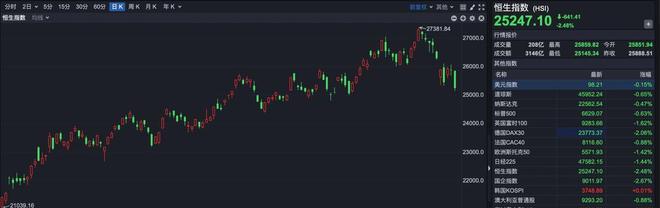
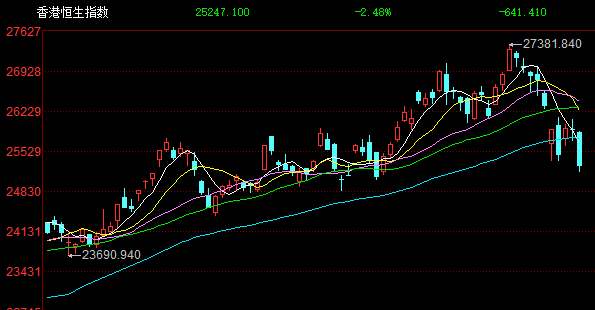
Market Overview - The Hong Kong stock market experienced a significant decline, with the Hang Seng Index closing at 25,247.10 points, down 641.41 points, representing a drop of 2.46%, marking the lowest closing since September 5 [1] - The Hang Seng Technology Index closed at 5,760.38 points, down 243.18 points, a decrease of 4.05%, with a cumulative decline of over 14% since the peak on October 2 [3] Company Performance - ZTE Corporation's H-shares (00763.HK) fell over 12%, with an intraday maximum drop of 14%, while its A-shares (000063.SZ) closed at the daily limit down [5] - Other tech stocks also faced declines, with Baidu, Alibaba, Meituan, and Kuaishou dropping over 4%, and Xiaomi and Bilibili down over 3% [9] Sector Performance - All sectors in the Wind Hong Kong secondary industry index declined, with semiconductors, hardware equipment, and defense industries experiencing the largest drops [7] - Notable declines in new consumption concept stocks included Weilian Meishi (09985.HK) and Blukoo (00325.HK), both down over 6%, while Nayuki Tea (02150.HK) and Pop Mart (09992.HK) fell over 4% [8] Capital Flow - As of market close, southbound funds recorded a net inflow of over 6.3 billion HKD into Hong Kong stocks [10] Market Outlook - Short-term outlook for the Asia-Pacific market appears bleak due to increased uncertainty in news, leading to heightened risk aversion. The market may continue to experience volatility in the absence of positive catalysts [12] - In the medium to long term, the initiation of a rate-cutting cycle by the Federal Reserve may lead to a "double easing" effect in China and the U.S., potentially driving sustained inflows into Hong Kong stocks and fostering a slow bull market trend [12]

港股速报 | 港股全线下挫 中兴通讯H股跌超12%
Mei Ri Jing Ji Xin Wen· 2025-10-17 08:45
Market Overview - The Hong Kong stock market experienced a significant decline, with the Hang Seng Index closing at 25,247.10 points, down 641.41 points, representing a drop of 2.46%, marking the lowest closing since September 5 [1] - The Hang Seng Tech Index closed at 5,760.38 points, down 243.18 points, a decrease of 4.05%. Since the peak on October 2, the index has seen a cumulative decline of over 14% [3] Company Focus - ZTE Corporation's H-shares (00763.HK) fell over 12%, with an intraday maximum drop of 14%. The A-shares (000063.SZ) hit the daily limit down [5] - New consumption concept stocks also saw declines, with companies like Weilang Meishi (09985.HK) and Blukoo (00325.HK) dropping over 6%, while Nayuki Tea (02150.HK) and Pop Mart (09992.HK) fell over 4% [8] Sector Performance - All sectors in the Wind Hong Kong secondary industry index declined, with semiconductors, hardware equipment, and defense industries experiencing the largest drops [7] - Specific sector declines included: - Defense and military down 5.18% - Hardware equipment down 5.51% - Semiconductor down 3.55% [8] Other Notable Stocks - Tech stocks also faced declines, with Baidu, Alibaba, Meituan, and Kuaishou all dropping over 4%. Xiaomi and Bilibili fell over 3%, while Tencent decreased by over 1% [9] - Apple-related stocks, such as Q Technology, saw a drop of over 9%, and solar energy stocks continued their downward trend, with Sunshine Energy falling over 5% [9] Capital Flow - As of market close, southbound funds net bought over 6.3 billion HKD in Hong Kong stocks [9] Market Outlook - Short-term outlook for the Asia-Pacific market appears bleak due to increased uncertainty in news, leading to heightened risk aversion. Without new positive catalysts, the market may continue to experience volatility [11] - In the medium to long term, with the Federal Reserve entering a rate-cutting cycle, a "double easing" effect between China and the U.S. is expected, which may lead to sustained capital inflow and a gradual bullish trend for Hong Kong stocks [11]
港股收评:恒生科技大跌4%,科技金融齐跌,半导体军工齐挫,黄金股逆势上涨!阿里巴巴跌4%,新华保险跌7.16%,广发证券跌近7%
Ge Long Hui· 2025-10-17 08:38
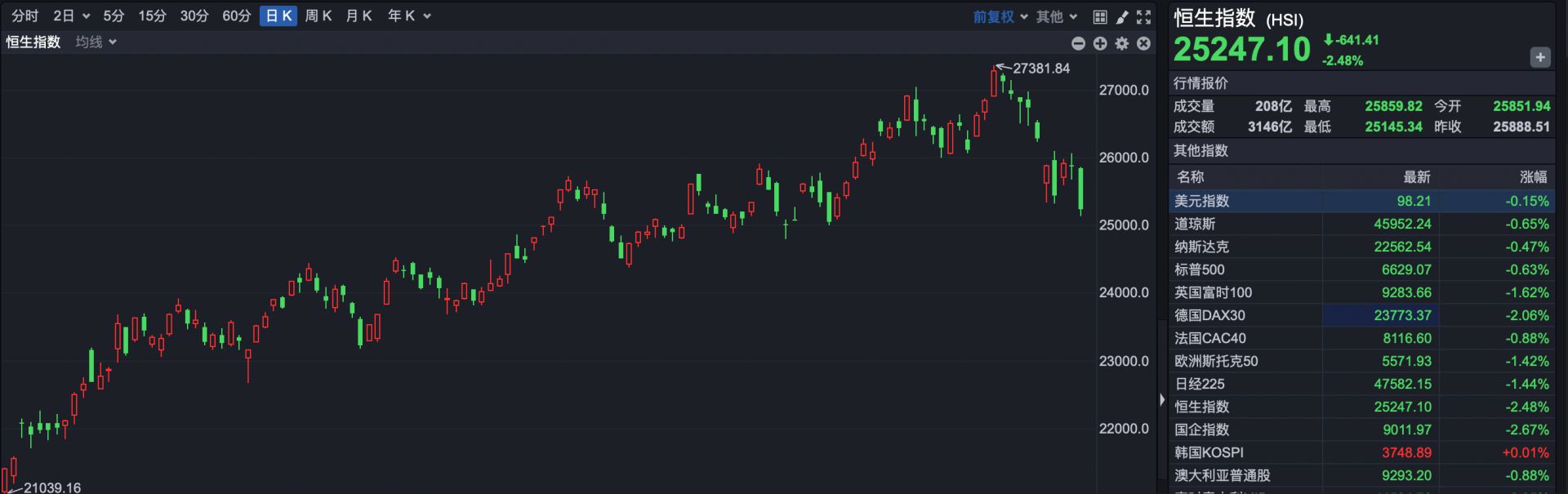
Core Points - The Hong Kong stock market experienced a significant decline, with the Hang Seng Technology Index dropping by 4.05% to close at 5760 points, the Hang Seng Index falling by 2.48% to 25247 points, and the National Enterprises Index decreasing by 2.67%, barely holding above the 9000-point mark [1][3] Group 1: Market Performance - The three major indices in Hong Kong reached recent adjustment lows due to a collective downturn in large technology stocks, major financial stocks (banks, insurance, securities), and state-owned enterprises [1][3] - Notable declines included Meituan and Alibaba, both dropping over 4%, while Xinhua Insurance fell by 7.16%, GF Securities by nearly 7%, and Industrial and Commercial Bank of China by 1.2% [3] Group 2: Sector Performance - Various sectors faced declines, including semiconductor stocks, Apple-related stocks, military industry stocks, automotive stocks, nuclear power stocks, lithium battery stocks, high-speed rail infrastructure stocks, coal stocks, and domestic real estate stocks [3] - Conversely, retail stocks and gold and silver jewelry stocks saw gains, with Chow Tai Fook rising by 5% after announcing its third price increase of the year, and Lao Pu Gold increasing by over 3% [3] Group 3: Notable Stock Movements - Biopharmaceutical stocks showed strength, with Yaojie Ankang surging over 22% after a previous increase of over 46%, and Xuan Zhu Biotechnology reaching a new high with a 16.9% rise on its third day of listing [3]

百度、阿里等科技股:港股下挫,多板块齐跌航司向好
Sou Hu Cai Jing· 2025-10-17 04:44
【10月17日港股上午盘三大指数下挫,市场情绪低迷】10月17日,港股上午盘三大指数再度下挫。恒生 科技指数跌幅最大,午间收跌2.81%,失守6000点,刷新近期调整新低。恒生指数、指数分别下跌 1.61%及1.67%,恒指跌超400点,报25472点。 盘面上,大型科技股集体走低,大市承压明显。百度跌 3.6%,阿里巴巴跌超3%,小米等均跌超2%。半导体芯片等热门板块齐挫,丘钛科技等多股跌幅较大。 教育股集体低迷,金价跳水,黄金股等跟跌。 另一方面,零售股逆势活跃,航空股再度走高。三大航 司9月运营数据亮眼,行业景气好转有望持续。 本文由 AI算法生成,仅作参考,不涉投资建议,使用风险自担 ...
港股午评:恒科指大跌2.8%失守6000点,科技股弱势,半导体、光伏板块跌幅明显
Ge Long Hui· 2025-10-17 04:08
Market Overview - The Hong Kong stock market experienced a decline in the morning session, with the Hang Seng Tech Index falling the most by 2.81%, dropping below 6000 points and reaching a new recent low [1] - The Hang Seng Index and the Hang Seng China Enterprises Index also saw declines of 1.61% and 1.67%, respectively, with the Hang Seng Index down over 400 points, closing at 25,472 points, indicating a pessimistic market sentiment [1] Sector Performance - Major technology stocks, which serve as market indicators, collectively declined, putting significant pressure on the market. Notable declines included Baidu down 3.48%, Alibaba down 3.16%, and Xiaomi and Meituan both down nearly 3% [1] - Semiconductor stocks, Apple-related stocks, photovoltaic stocks, automotive stocks, and robotics concept stocks also faced declines, with notable drops such as Q Technology down over 9%, Hon Teng Precision down 8.8%, and GCL-Poly Energy down 6.5% [1] - Education stocks, which had seen a significant rise the previous day, also turned sluggish [1] - Gold prices fell sharply, dropping below $4,280, leading to a majority of gold stocks declining, along with copper and aluminum stocks [1] Resilient Sectors - In contrast, retail stocks showed resilience, and airline stocks rose again, with the three major airlines reporting strong operational data for September, suggesting a potential continuation of industry recovery [1]