
三星

Search documents
华为折叠屏国内份额超70%,苹果今年能带来惊喜吗?
Guan Cha Zhe Wang· 2026-01-22 09:12
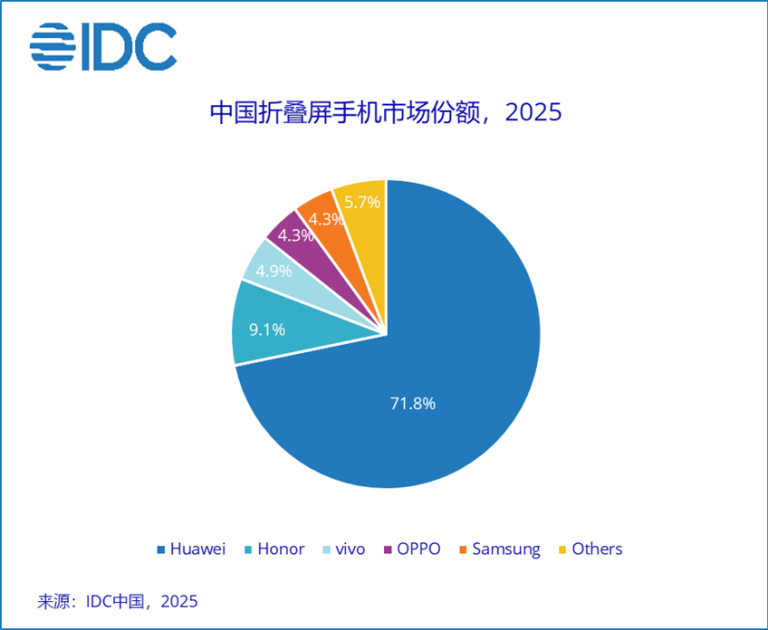
Core Insights - The Chinese foldable smartphone market is projected to see a shipment of approximately 10.01 million units in 2025, marking a year-on-year growth of 9.2%, contrasting with a slight decline of 0.6% in the overall smartphone market [1] - Huawei leads the market with a significant share of 71.8%, while other brands like Honor, Vivo, and OPPO have much smaller shares, with Xiaomi dropping out of the top five [1][3] - The foldable smartphone segment is experiencing a bottleneck phase, with hardware improvements no longer sufficient to drive significant sales growth, leading to a decline in market performance [3][4] Market Dynamics - Huawei's dominance is attributed to its comprehensive product lineup, including various foldable designs and a focus on balanced capabilities rather than just lightweight models [4] - Other manufacturers have introduced innovative products, such as OPPO's Find N5 and Vivo's lightweight foldable, but these have not significantly challenged Huawei's market position [3][4] - The foldable smartphone market only accounts for 3.5% of total smartphone shipments in China, leading some companies like Xiaomi to reconsider their strategies in this niche [4][6] Technological Innovations - Manufacturers are focusing on soft-hard collaboration to enhance user experience, with Huawei's MateX7 introducing AI capabilities to improve functionality [6] - Competitors like OPPO and Vivo are also exploring compatibility with Apple ecosystems to attract users [6] - The anticipated entry of Apple's foldable phone, expected in 2026, is generating significant market interest, with expectations for superior hardware and software integration [7][9] Future Outlook - The smartphone market is expected to face cost pressures due to rising storage prices, potentially leading to a noticeable decline in shipments in 2026 [9] - The success of Apple's foldable device and its impact on the market remains a key point of interest for industry stakeholders [9]


苹果官网限时优惠最高降千元 iPhone 17系列不在内!
Zhong Guo Jing Ying Bao· 2026-01-22 09:00
苹果中国官网为迎接2026年新春开启了为期4天的限时优惠,官网几乎所有产品都有折扣,除了最新发 布的iPhone 17系列。 1月22日,苹果中国官网推出"新春限时优惠活动",用户于1月24日至1月27日以符合条件的支付方式购 买iPhone、Mac、iPad和Apple Watch等指定产品最高立省1000元。 但《中国经营报》记者留意到,在这场新春大促中,2025年秋季才发布的最新旗舰——iPhone 17系列 并未出现在优惠名单之中。 具体来看,iPhone 16系列的多款机型则享受了不同程度的优惠,iPhone 16及iPhone 16 Plus可立省300 元,而iPhone 16e则可节省200元,MacBook Pro最高降1000元,MacBook Air降700—800元。 近几年,苹果几乎每年农历新年前都会在中国官网推出为期数天的"限时优惠"活动,这已成为其固定营 销日历的一部分。2024年9月发布的iPhone 16系列,在苹果2025年1月的"叱咤福利"新年促销活动中就有 400—500元的优惠。 事实上,记者留意到,从苹果直营渠道2025年"双11"购物促销就可以看出,iPhone ...
黄仁勋透露:英伟达已取代苹果,成为台积电最大客户
Hua Er Jie Jian Wen· 2026-01-22 08:55
Core Insights - The rise of artificial intelligence (AI) is reshaping the global semiconductor supply chain, with Nvidia becoming TSMC's largest customer, surpassing Apple due to explosive demand for AI processors [1][3][4] Group 1: Market Dynamics - The shift in customer rankings highlights the strong demand for enterprise-level AI capital expenditures, which is significantly driving up the demand for wafer foundry capacity [3] - Enterprise customers are willing to invest heavily in GPUs for AI capabilities, leading to a demand model that is less price-sensitive compared to traditional consumer electronics [5] - As production capacity shifts towards AI chips, TSMC may be increasing prices for Apple, indicating a potential change in supply chain dynamics due to evolving end-user demand [3][6] Group 2: Historical Context - Nvidia's current position as TSMC's largest customer marks a return to a status it held in the early 2000s before Apple became the dominant client in the 2010s [4] - Apple's long-standing position as TSMC's top customer was primarily driven by its successful iPhone and iPad products, but this has now been disrupted by the AI surge [4][5] Group 3: Future Implications - The dramatic shift in demand may lead to changes in TSMC's pricing strategy and production priorities, potentially affecting Apple's standing as a key client [6] - Nvidia's success is closely tied to the current AI market hype, and any downturn in AI demand could allow Apple to reclaim its position as TSMC's largest customer [6]



【买卖芯片找老王】260122 美光/海力士/三星/闪迪/江波龙/赛灵思/ON
芯世相· 2026-01-22 08:09
Core Insights - The article discusses the challenges of managing excess inventory in the chip industry, highlighting the financial burden of storage and capital costs associated with unsold materials [1] - It promotes a service called "Chip Superman," which has served 22,000 users and offers rapid transaction completion for inventory clearance [2][10] - The article lists various semiconductor components available for sale at discounted prices, indicating a significant inventory of over 50 million chips valued at over 100 million [9] Group 1: Inventory Management - Excess inventory of 100,000 units incurs monthly storage and capital costs of at least 5,000, leading to a potential loss of 30,000 over six months [1] - The article emphasizes the need for effective promotion strategies for unsold materials to mitigate financial losses [1] Group 2: Sales and Services - "Chip Superman" has a large inventory with over 1,000 models and 100 brands, facilitating quick sales, often within half a day [2][10] - The service aims to assist those struggling to sell their inventory by providing a platform for better pricing and visibility [11] Group 3: Product Listings - A detailed list of available semiconductor components is provided, including brands like Micron, Xilinx, ON Semiconductor, and Samsung, with quantities ranging from thousands to hundreds of thousands [5][6] - The article also includes a section for requested components, indicating active demand in the market [7][8]



存储涨疯了,终端厂商开始扛不住了
芯世相· 2026-01-22 08:09
Core Viewpoint - The article discusses the significant price increase in storage components, particularly DRAM and NAND Flash, driven by rising demand from AI applications and the resulting impact on various consumer electronics and automotive industries [3][16][20]. Group 1: Impacted End Products - By Q4 2025, various manufacturers across mobile phones, PCs, laptops, and even the automotive sector began to publicly acknowledge the cost pressures from rising storage prices, leading to price hikes or reduced shipment forecasts [3][5]. - Xiaomi has signed long-term supply agreements to mitigate cost increases and has raised the price of its new model, Xiaomi 17 Ultra, by 500 yuan due to increased memory costs [5][6]. - Other smartphone manufacturers, including Redmi, iQOO, Lenovo, and OPPO, have also raised prices by up to 20% and some have canceled product launches due to memory price surges [6][7]. - Major PC manufacturers like Lenovo, Dell, and HP are also planning price increases, with Dell's commercial PCs seeing price hikes of up to 30% [8][9][10]. Group 2: Price Trends and Market Dynamics - Storage prices have been on a significant upward trend since August 2023, with major manufacturers like Samsung and Micron announcing price increases and even pausing quotes [13][14]. - In December 2025, storage module prices continued to rise, with fluctuations ranging from 10.42% to 68.42%, while DRAM prices surged significantly [15][19]. - The market is experiencing a "seller's market" dynamic, where the balance of power is shifting towards suppliers due to limited availability and rising costs [18][19]. Group 3: Future Outlook and Industry Challenges - The ongoing shortage of high-end storage chips is expected to persist until at least 2028, driven by AI demand, which is reshaping the storage market [20]. - The structural changes in production capacity are leading to reduced availability for consumer electronics, with potential impacts on automotive electronics and home appliances [16][20]. - The article warns that if storage prices exceed a certain threshold, demand may decline, leading to a challenging environment for manufacturers who must balance profit margins with market share [19][20].

存储芯片价格开启“疯涨”模式,行业超级周期确立长牛格局,科创芯片设计ETF易方达(589030)有望持续受益
Xin Lang Cai Jing· 2026-01-22 06:52
Core Viewpoint - The semiconductor industry is experiencing a supply-demand gap, particularly in memory chips, which is expected to continue until at least 2027, driven by increased demand from AI infrastructure and supply cuts from major manufacturers [1] Group 1: Market Performance - The Shanghai Stock Exchange Sci-Tech Innovation Board Chip Design Theme Index (950162) rose by 0.34% as of January 22, 2026, indicating active market trading [1] - The E Fund Chip Design ETF (589030) showed a tight balance between buying and selling, with a turnover rate of 39.6% and a transaction volume of 1.11 billion yuan, reflecting vibrant market activity [1] Group 2: Industry Insights - Micron has confirmed that the shortage of memory chips will extend beyond 2026, while Samsung and SK Hynix are reducing NAND flash production, further widening the supply-demand gap and driving prices upward [1] - The demand for high-bandwidth memory (HBM) is surging due to AI infrastructure development, which may benefit memory interface chips and storage controller chips, accelerating breakthroughs in domestic storage chip design and expanding growth potential [1] Group 3: Investment Recommendations - Nomura analysts predict that the "super cycle" in the storage industry will last at least until 2027, with significant new supply not expected until early 2028 [1] - Investors are advised to overweight storage leaders in 2026, focusing on the "price-profit-valuation" triad as the main investment theme for storage, rather than viewing storage solely as an HBM-related opportunity [1] Group 4: Index Overview - The E Fund Chip Design ETF (589030) closely tracks the Shanghai Stock Exchange Sci-Tech Innovation Board Chip Design Theme Index, which includes listed companies involved in chip design to reflect the overall performance of the sector [1]
存储NAND紧俏,卫浴大牌Toto大涨!
Hua Er Jie Jian Wen· 2026-01-22 06:23
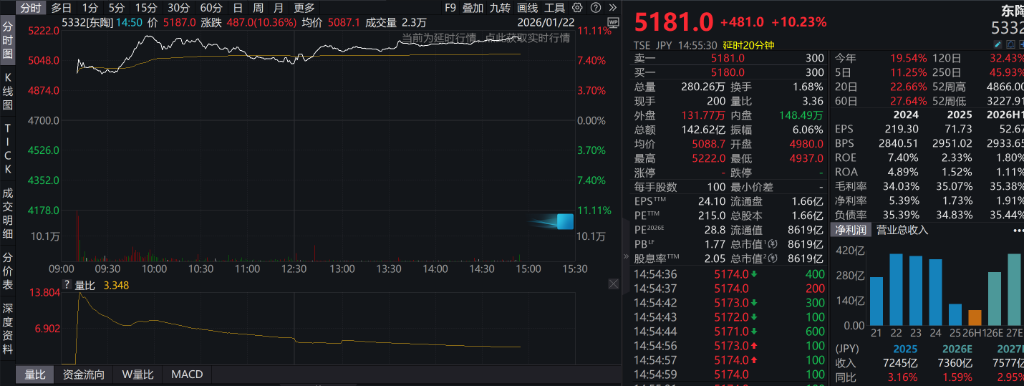
Core Insights - The AI boom is reshaping global supply chains, benefiting companies like Toto, known for its bathroom fixtures, due to its semiconductor materials business [1] - Goldman Sachs upgraded Toto's rating, citing increased demand for its electrostatic chucks used in NAND storage chip manufacturing as AI infrastructure expands [1][2] - Toto's stock surged by 11%, marking its largest increase since February 2021, reflecting the significant impact of AI data center expansion on upstream supply chains [1] Company Overview - Toto has been a key player in the semiconductor and display supply chains for decades, with new business areas accounting for 42% of its total revenue for the fiscal year ending March 2025 [2] - The electrostatic chuck, produced by Toto since 1988, is crucial for fixing silicon wafers during chip manufacturing, helping to control temperature and prevent contamination [2] Market Dynamics - Major tech companies like Meta Platforms and Amazon are investing billions in AI service data centers, leading to a widespread shortage of semiconductor products [3] - This surge in demand has prompted global storage chip manufacturers, including SK Hynix, Samsung, and Kioxia, to expand production, directly increasing demand for products from upstream suppliers like Toto [3] Industry Trends - Toto is not the only Japanese consumer goods giant benefiting from the chip boom; companies like Ajinomoto and Kao have also established semiconductor-related businesses [4] - The rise in Toto's stock coincided with a broader rebound in AI-related stocks, indicating investor interest in undervalued assets that can benefit from the global competition in computing power [4]
招商证券:26Q1存储价格涨幅超市场预期 关注行业密集财报催化
智通财经网· 2026-01-22 05:57
Core Viewpoint - The global storage prices have accelerated in Q3 and Q4 of 2025, with expectations for Q1 2026 prices to exceed forecasts due to tight supply and increasing AI demand outpacing capacity expansion [1] Group 1: Market Dynamics - AI storage is driving increased demand, necessitating an optimized multi-tier storage system to accommodate the rapidly growing KV cache space [1] - The supply of DRAM is expected to grow slower than demand, with major manufacturers like Samsung and SK Hynix projecting production increases of 5% and 8% respectively for 2026, but still falling short of market needs [3] - NAND supply is becoming more concentrated in enterprise-level products, with expected production cuts from major players like Samsung and SK Hynix due to prioritization of DRAM profitability [3] Group 2: Price Trends - In Q1 2026, DRAM prices are projected to increase by 55%-60% quarter-on-quarter, driven by a shift in production capacity towards server and HBM applications [4] - NAND prices are expected to rise by 33%-38% in the same period, influenced by supply constraints and the prioritization of server demands [4] - Major NAND manufacturers are implementing long-term contracts with significant price increases, with some contracts seeing nearly double the previous prices [4] Group 3: Company Performance - Major global storage companies are set to release strong earnings forecasts, with Samsung predicting a revenue increase of 23% year-on-year for Q4 2025 [5] - Biwei Storage anticipates a revenue increase of 165% year-on-year for Q4 2025, while Nanya Technology expects record revenue and significant profit growth [5] - The upcoming earnings reports from major players like Hynix, Samsung, and Western Digital are expected to positively impact the overall market [7] Group 4: Investment Recommendations - The focus should be on storage manufacturers, storage module/chip companies, and storage testing/packaging sectors due to the ongoing price increases and demand growth [7] - Potential opportunities in storage control chips and interface chips should be monitored as the market evolves [7] - Key investment targets include major global storage companies, module manufacturers, niche storage firms, and testing/packaging service providers [8][9]


TCL电子(01070.HK):与索尼达成战略合作 有望推动全球品牌力和盈利能力提升
Ge Long Hui· 2026-01-22 05:44
Core Viewpoint - TCL Electronics and Sony have signed a strategic cooperation memorandum to establish a joint venture focused on Sony's home entertainment business, with TCL holding 51% and Sony 49% of the new company, expected to start operations in April 2027 [1] Group 1: Joint Venture Details - The joint venture will operate globally, covering product development, design, manufacturing, sales, logistics, and customer service for products including televisions and home audio systems [1] - Sony's television brand has a strong legacy but has seen declining market performance due to factors like the shift of the LCD panel supply chain to China and Sony's lower cost control and operational efficiency [1] Group 2: Market Performance - Sony's global television revenue and shipment volume have been declining since 2021, with projected revenue of 26.6 billion RMB and shipment of approximately 4.8 million units in 2024, compared to TCL's revenue of 54.9 billion RMB and shipment of about 28.9 million units [1] - The new company is expected to leverage TCL's advantages in Mini LED technology, vertical supply chain, and cost efficiency, while integrating Sony's audio-visual technology and high-end brand value [2] Group 3: Financial Outlook - TCL Electronics is projected to achieve a net profit of approximately 2.33 to 2.57 billion HKD in 2025, representing a year-on-year growth of 45% to 60% [2] - The company aims for continued growth through globalization and mid-to-high-end development strategies, with significant improvements in its large-size display business and high profitability in its internet business [2] Group 4: Investment Recommendation - TCL Electronics is positioned as a leading player in the global television industry, with expectations to increase its overseas market share through enhanced brand marketing and channel coverage [3] - The company is forecasted to have EPS of 0.98, 1.21, and 1.48 HKD for 2025 to 2027, with a target price of 13.34 HKD based on a 2026 P/E ratio of 11 [3]
全球布局加码-再论黑电成长空间
2026-01-22 02:43
Summary of Key Points from Conference Call Industry Overview - The global black electronics market is currently dominated by Samsung, with an annual shipment volume of approximately 35-36 million units, accounting for about 17%-18% of the global market share. TCL and Hisense follow closely, each with around 30 million units shipped. LG ranks fourth among the top ten brands, six of which have Chinese backgrounds, indicating a significant scale advantage for Chinese brands in the global market [5][6][15]. Company Developments - TCL Electronics plans to establish a joint venture with Sony, where TCL will hold 51% and Sony 49%. This new company will focus on Sony's home entertainment business, including televisions and audio products, and is expected to begin operations in April 2027 [2][4]. - The collaboration aims to optimize Sony's television business in response to declining market share and profitability pressures, while providing TCL with an opportunity to enhance its high-end brand presence [1][4]. Market Dynamics - The global black electronics market maintains a stable total shipment volume of around 200 million units annually, with domestic shipments exceeding 30 million and overseas shipments over 160 million [6]. - The penetration rate of Mini LED technology has surpassed 30%, offering significant opportunities for high-end product categories in overseas markets [1][7]. Strategic Opportunities - Chinese manufacturers are accelerating their brand expansion overseas by enhancing product structures and promoting new technologies like Mini LED. Collaborations with established brands like Sony are crucial for improving brand image and market positioning [1][8][9]. - The upcoming 2026 FIFA World Cup is expected to boost overseas demand for black electronics, with domestic manufacturers planning to leverage this event for marketing and local channel partnerships [11]. Financial Implications - The expansion of domestic television hardware overseas is driving growth in internet content businesses, which have a much higher profitability than hardware sales. This is seen as a key driver for increasing overseas revenue and profits [3][10]. - The ongoing support from national subsidy policies and the rising penetration of Mini LED technology are expected to enhance profitability in the domestic black electronics industry [14]. Long-term Outlook - Long-term projections indicate that Chinese black electronics companies are likely to achieve higher valuation premiums through scale growth and profit improvement. As leading Chinese firms increase their shipment volumes, traditional leaders like LG and Sony face declining market shares [15].
