可复美

Search documents
4541.8亿美妆护肤全景扫描:从规模竞争到技术竞争
FBeauty未来迹· 2026-02-07 10:54
Core Viewpoint - The beauty and skincare industry is undergoing a transformation where consumers are redefining what is worth spending on, shifting from impulsive buying to more rational decision-making focused on efficacy and long-term value [3][4]. Market Overview - By 2025, the beauty and skincare market is projected to reach a sales volume of 454.18 billion yuan, with a year-on-year growth of 9.7%, driven by both volume and price increases [5]. - The market growth is characterized by structural price changes, with a notable increase in the average transaction price due to a rise in the share of functional and mid-to-high-end products [8]. Consumer Behavior - Consumers are increasingly focused on efficacy, experience, and certainty of value, leading to a multi-tiered market with diverse price segments and consumer needs [4][8]. - The low-price segment (0-300 yuan) accounts for 74.1% of the beauty market, while the skincare market sees 56.3% in the same range, with the sub-100 yuan segment experiencing the fastest growth at 20.6% year-on-year [8]. Brand Dynamics - Leading brands are shifting from scale expansion to product innovation, with high-end anti-aging products becoming a significant growth driver, resulting in increased market concentration and share [11][12]. - Mid-tier brands face pressure but can achieve growth through targeted strategies, such as focusing on specific consumer needs like sensitive skin repair or anti-aging for younger demographics [14]. Anti-Aging Market Insights - The anti-aging market is entering a new phase driven by precise technology and widespread demand, with sales expected to reach 129.83 billion yuan in 2025, reflecting a year-on-year growth of 26.3% [15][17]. - Facial anti-aging products dominate the market, with facial care sets and serums leading in sales, emphasizing the importance of ingredient efficacy [19]. Product Trends - The demand for anti-aging products is increasingly focused on core functions such as hydration, wrinkle reduction, and skin repair, indicating a blend of basic skincare and anti-aging needs [24]. - New product innovations in the anti-aging segment are centered around collagen enhancement and multi-functional benefits, with brands like L'Oréal and Estée Lauder leading the way [28][29]. Makeup Market Trends - The makeup market is seeing a shift towards natural beauty and health-focused aesthetics, with sales growth of 15.8% year-on-year, reflecting changing consumer preferences [30]. - The demand for lightweight, hydrating makeup products is rising, with cushion foundations experiencing significant growth, indicating a balance between efficiency and effectiveness [35]. Marketing and Consumer Engagement - Social media platforms are becoming crucial for trend amplification, with discussions around natural beauty and individual expression reshaping consumer decision-making [43][44]. - The beauty and skincare industry is moving towards a competitive landscape focused on technology credibility, efficacy perception, and user understanding, indicating a shift from price-based competition to value-driven strategies [44].


调查 | 00后真的愿意为美妆代言人买单吗?
FBeauty未来迹· 2026-02-07 10:54
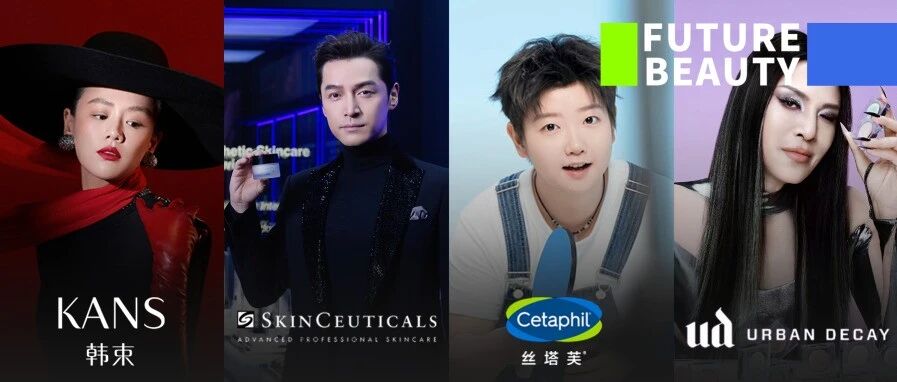
美妆代言正在变成一件"不好判断对错"的事。 官宣还在继续,明星也没有退场,但效果却越来越难以预期——有的代言被疯狂转发,却不一 定带来购买;有的合作看似波澜不惊,却在很长一段时间里持续发挥作用。代言依然重要,却 不再等同于有效。 这种不确定性,首先体现在消费者这一端。 《FBe a u t y未来迹》近期针对近1 0 0 0位0 0后消费者展开调查发现:超过七成的受访者仍然认为 美妆品牌"有代言人很重要",但真正会因为代言人直接下单的比例,已经明显降低。代言更像 一个被看见的入口,而不是决定购买的理由。 当0 0后逐渐成为美妆消费的主力,这种变化正在倒逼品牌重新思考一个问题:在今天的市场环 境中,代言人究竟还能为品牌解决什么,又不能替品牌完成什么。 从2 0 2 6年开年的几次标志性代言选择开始,这个问题被摆到了台前。 2 0 2 6年刚刚开始,美妆行业的代言人营销就显得格外热闹。 如果仔细看,会发现品牌们在"怎么用代言人"这件事上,已经走向了两条明显不同的方向。一 条路看起来喧哗、抽象、甚至有点失控;另一条路则显得克制、稳定,几乎不打算参与热闹本 身。 春节前夕,韩束发布的马年广告片,很快成为讨论中心。 画 ...
品牌投B站,为什么冰火两重天?
3 6 Ke· 2026-01-29 12:44
去年双11,我们曾在一篇文章里提到B站的情况: 前段时间,跟B站内部人交流,他们也说,今年带货广告客户数量有显著增长,尤其是高客 单的品牌。11月12日,他们发了大促战报,投放带货广告的客户数比去年同期翻了一倍多, 千元以上消费品GMV同比增长63%。 品牌涌入新渠道,短期内推高投放和GMV,但如果操作不慎有可能翻船。在最近,有商家在我们的社 群转发帖子,"品牌投B站,是不是疯了?",引起不少人的兴趣;有人说转化难,有人说投了没赚到钱。 吐槽归吐槽,去年还是有许多品牌投B站拿到了结果。特别是数码、家居、小家电等耐消品,涌现出许 多靠大单品获得很好销量的案例。比如荣耀Magic8,在B站投放带货,15日GMV就超过4500万元,单 稿件投流ROI超40,效果超过同期的抖音和小红书。 品牌投B站,为啥冰火两重天?其实不难理解,这些新兴平台有许多认知和信息门槛,也有一些品牌品 类与平台匹配的问题。最近,借着B站官方的AD TALK、Z100榜单等,我们也借此梳理它的商业化逻 辑。 一批品牌正在打透B站,"价值断层"带来新空间 截至去年三季度,B站广告收入已经连续11个季度增长超20%。连续增长的数据表明,一批品牌吃 ...

确定性增量,珀莱雅们“杀回”线下
Xin Lang Cai Jing· 2026-01-27 01:57
Core Insights - The beauty industry is witnessing a shift as leading brands are refocusing on offline channels, which are expected to become a significant growth area by 2026 [1][3] - Major companies like Marubi, Proya, and Shiseido are signaling a strategic pivot towards offline sales, indicating a collective recognition of the potential profitability in this space [1][3][4] Group 1: Market Trends - The past year has seen brands expressing concerns over high competition, expensive traffic, and declining online sales, leading to a reevaluation of growth strategies [1][2] - Data from 2023-2024 shows slight increases in offline revenues for major brands, but their overall contribution to total revenue is declining, highlighting a need for strategic investment in offline channels [3][4] Group 2: Strategic Shifts - Natural堂 has demonstrated the potential of offline channels, with average annual revenues exceeding 1.6 billion yuan over the past three years, indicating that offline can still be a vital growth area [4] - The increasing costs of online traffic and the saturation of online platforms are pushing beauty brands to reconsider their channel strategies, making offline channels a more attractive option for sustainable growth [4][5] Group 3: OTC Channel Opportunities - The OTC (Over-the-Counter) channel is emerging as a key battleground for domestic brands, with over 30% of the top 100 cosmetic brands already having products displayed in pharmacies [6][7] - Major pharmacy chains are actively seeking to expand their beauty product offerings, with plans to introduce personal care items in a significant number of their stores [6][7] Group 4: Brand Strategies - Brands are adopting targeted product strategies for different channels, with Marubi launching new products specifically for offline sales and Proya entering the OTC market with a focus on medical and cosmetic synergy [8][9] - The emphasis is on creating engaging in-store experiences and building emotional connections with consumers to enhance brand loyalty and drive sales [10][11]


美妆线下零售,迎来关键时刻
3 6 Ke· 2026-01-15 09:38
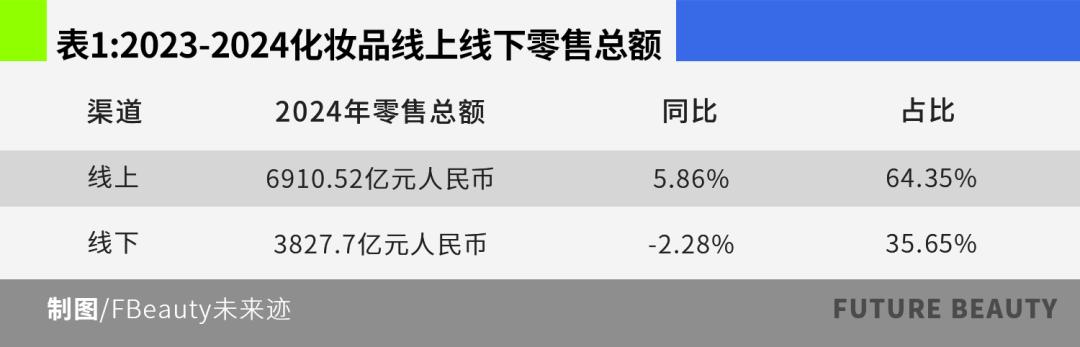
Key Insights - The offline cosmetics retail market in China is projected to reach 382.77 billion RMB in 2024, reflecting a year-on-year decline of 2.28% and accounting for 35.65% of the total cosmetics retail market [1][2] - The online cosmetics retail market is expected to grow to 691.05 billion RMB in 2024, with a year-on-year increase of 5.86%, representing 64.35% of the total market [2] Offline Channel Overview - The retail total for department stores and shopping centers is projected to be 147.18 billion RMB in 2024, down 8.8% year-on-year, while supermarkets are expected to see a retail total of 69.84 billion RMB, up 7% [3][4] - The cosmetics store channel is expected to generate 144.16 billion RMB, down 1.91%, and OTC pharmacy channels are projected to reach 2.17 billion RMB, down 4.4% [3][4] Market Share Trends - The market share of department stores and shopping centers in the total cosmetics retail market decreased from 15.41% in 2023 to 13.71% in 2024, while the cosmetics store channel remains stable at 13.42% [5][6] - The number of counters in department stores has sharply decreased from approximately 15,415 in 2019 to 9,502 in 2023, a reduction of 5,913 [6] Brand Performance - High-end brands dominate the department store channel, accounting for 86% of sales in 2023, while mass brands represent only 0.0037% [10][11] - The market share of European and American brands in department stores increased from 66.8% in 2021 to 74.3% in 2023, while Japanese and Korean brands have seen declines [12] Growth Drivers - The growth in department store cosmetics retail sales is primarily driven by lower-tier markets, with luxury brands opening counters in second and third-tier cities [13] Consumer Behavior Changes - The traditional cosmetics store model is facing challenges due to the rise of e-commerce, leading to a significant decline in foot traffic and sales [19] - Cross-industry retailing, such as clothing and accessory stores expanding into cosmetics, is becoming more prevalent, with some stores generating nearly 50% of their revenue from cosmetics [21] Future Trends - The cosmetics retail landscape is undergoing structural changes, with department stores focusing on high-end products while cosmetics stores innovate through light beauty services and new business models [46] - The OTC pharmacy channel is expected to grow, particularly for functional skincare products, as consumer trust in these products increases [40][42]
知行数据观察:化妆水/爽肤水品类
知行战略咨询· 2026-01-14 14:24
Investment Rating - The report does not explicitly state an investment rating for the industry Core Insights - The facial skincare market is expanding, with e-commerce sales projected to grow by 19.4% year-on-year in 2024, while Tmall's market share is expected to decline to 30.5% [9][11] - Douyin has emerged as the leading platform for sales, surpassing 1340.39 billion in sales by 2024, marking a significant increase of 53.6% [9][10] - The market is entering a phase of stock competition, focusing on differentiation rather than scale expansion, as total sales growth is projected to be only 2.8% from 2023 to 2025 [19] Summary by Sections Market Overview - The facial skincare category is a core segment of the beauty industry, with a focus on hydrating and soothing products [8] - The market is characterized by a stable demand for basic hydration, while anti-aging and soothing effects are emerging as key growth trends [12][14] Sales Performance - E-commerce sales for facial skincare products reached 98.1 billion in 2023, with a projected increase to 121.8 billion by 2025, reflecting a modest growth rate [20] - Douyin's sales in the facial skincare category reached 54.27 billion in 2023, showing a year-on-year growth of 16%, while Tmall's sales declined by 11% [21][30] Consumer Trends - Anti-aging and hydration are identified as essential selling points, with a high willingness to pay among consumers [14] - The report highlights a significant opportunity in the sensitive skin and repair segments, which currently have a supply-demand gap [14][15] Brand Analysis - The top brands on Tmall are dominated by international high-end brands, while Douyin features a higher proportion of domestic brands with rapid growth [26][30] - The report notes that brands like La Mer and Lancôme dominate the high-price segment on Tmall, while domestic brands like Rellet and Dr. Wu are gaining traction on Douyin [27][33] Channel Dynamics - Douyin is becoming the primary growth channel, with a sales share increasing from 46% to 55% by 2025, while Tmall's share is declining [17][19] - The report indicates that live streaming is a key driver of sales on Douyin, accounting for 72% of sales in the facial skincare category [23]

“心价比”时代的礼赠革新:可复美×潮宏基跨界礼盒的商业之道
Jin Rong Jie· 2026-01-12 01:47
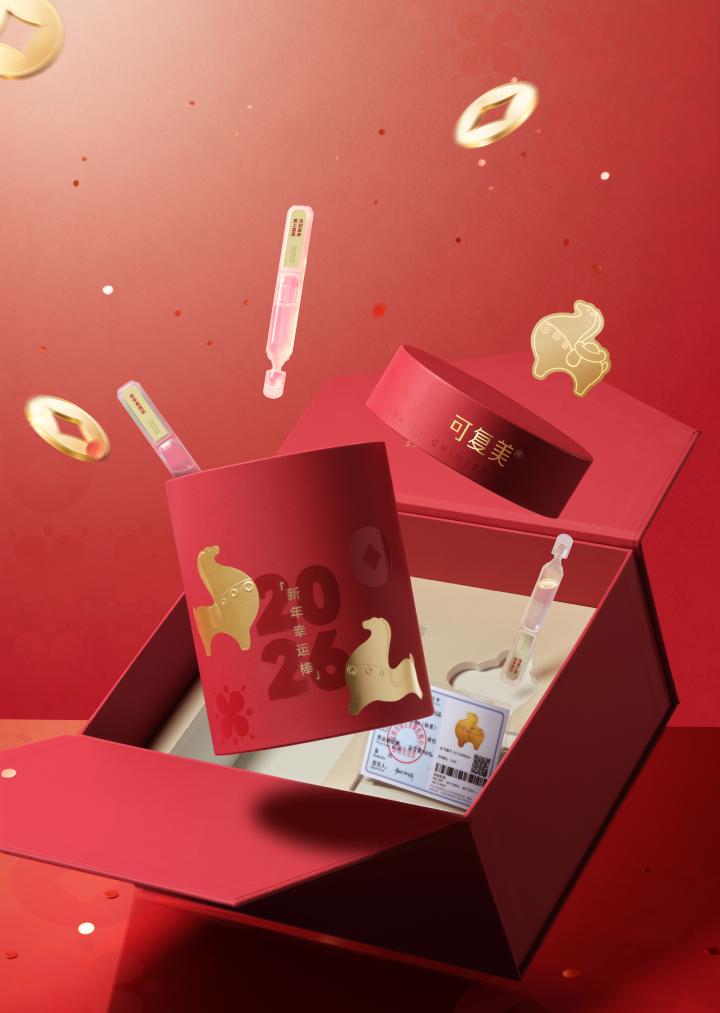
Core Insights - The consumer market in 2026 shows a clear trend towards "value for money," where consumers prioritize emotional value, practicality, and preservation over mere functionality [1] - The collaboration between skincare brand Kefu Mei and jewelry brand Chao Hong Ji has resulted in a customized New Year gift box that combines functional skincare with emotional and collectible gold jewelry [1][3] Group 1: Product Innovation - The gift box features 60 Kefu Mei collagen sticks, each with different blessings, and a gold horse-shaped ornament from Chao Hong Ji, symbolizing good fortune and prosperity [1][4] - This is the first time Kefu Mei has integrated functional skincare products with emotionally valuable gold jewelry, targeting the light luxury consumer segment and the gift market [1][4] Group 2: Strategic Significance - The choice to incorporate gold is based on a deep understanding of the current economic environment and consumer psychology, as gold serves as a "hard currency" that provides value stability and anti-inflation properties [3] - This strategy transcends traditional holiday marketing, offering a dual financial and emotional value proposition for Kefu Mei's skincare products [3] Group 3: Brand Collaboration - Chao Hong Ji's craftsmanship and brand reputation provide strong quality assurance for Kefu Mei, enhancing the emotional significance of the gift box [4] - The gold ornament embodies traditional cultural values, transforming the functional aspect of the collagen sticks into a heartfelt wish for enduring friendship and well-being [4] Group 4: Marketing Strategy - The emotional TV commercial featuring Li Jiaqi and his mother deepens the emotional connection, elevating the product from a mere skincare tool to a medium of intergenerational love [6] - This marketing approach not only enhances the emotional attributes of the product but also resonates with the cultural phenomenon of "young people managing the New Year" [6] Group 5: Commercial Value Logic - The combination of collagen sticks and gold jewelry reflects a complementary value logic, addressing consumer concerns about practicality and emotional significance in gift-giving [8][9] - The design of 60 collagen sticks ensures high usage frequency, while the gold ornament adds asset value, creating a dual certainty of utility and emotional connection for gift-givers [9] Group 6: Market Segmentation - Kefu Mei's innovative practice has successfully opened a new niche market that bridges beauty, light luxury jewelry, and gifting, characterized by high certainty in expressing intentions [10] - This collaboration creates a threefold value unit of "daily usability," "emotional significance," and "asset value," addressing the utility anxiety in gift-giving scenarios [10] Group 7: Industry Implications - The trend of consumer upgrading indicates that purely functional products can no longer meet diverse consumer needs, necessitating cross-industry collaboration and scene innovation for value breakthroughs [11] - Kefu Mei's approach demonstrates that functional brands can expand emotional and cultural value while maintaining professionalism, potentially defining the next consumer paradigm [11]

“十全大补”面膜神话落幕:又一外资护肤品撤离中国
Guan Cha Zhe Wang· 2026-01-08 04:45
Core Insights - Filorga, a well-known French skincare brand, announced its withdrawal from the Chinese market, closing its Tmall flagship store on January 31, 2026, along with its 3.03 million followers and popular products like the "Ten Full Nourishing Mask" [1] - The exit of Filorga is part of a broader trend, with over 60 foreign beauty brands leaving the Chinese market between 2024 and 2025, indicating a significant retreat of foreign skincare brands [1] - Domestic beauty brands have gained market share, surpassing foreign brands for the first time in 2023, with Proya becoming the first domestic brand to exceed 10 billion yuan in revenue [1] Group 1: Filorga's Market Performance - Filorga entered the Chinese market in 2015 and quickly gained popularity, achieving a sales record of over 1 billion yuan during the 2018 Double Eleven shopping festival, with a year-on-year growth of 148% [2] - However, growth slowed significantly after 2020, attributed to ineffective pricing strategies and a lack of competitive advantage against domestic brands [2][3] - The brand's high-priced star product, the mask priced at 599 yuan, failed to maintain its premium image due to frequent discounts, while domestic competitors offered more affordable alternatives [2] Group 2: Challenges in Channel Operations - Filorga's online sales performance was poor, with only 2.5 million to 5 million yuan in sales on Douyin in 2025, indicating a lack of effective online marketing strategies [3] - The closure of physical stores resulted in a loss of high-end brand image and direct consumer engagement opportunities [3] - In contrast, other brands under the L'Oréal group, such as La Roche-Posay and Kiehl's, maintained strong market positions through effective product offerings and operational strategies [3] Group 3: Broader Industry Trends - The withdrawal of Filorga aligns with Colgate's global strategy to streamline operations, as the company's personal care segment saw a 2.05% decline in net sales in the first half of 2025 [4] - Similar strategic adjustments are occurring across the foreign beauty sector, with brands like Shiseido and LVMH also closing stores or withdrawing from the market due to declining performance [5] - Domestic brands like Proya and Winona have shown significant growth, with Proya achieving over 10.778 billion yuan in revenue in 2024, marking a year-on-year increase of over 20% [5] Group 4: Future Outlook - Analysts suggest that the challenges faced by foreign brands are not solely due to their foreign status but rather their inability to adapt to the Chinese market and consumer preferences [6] - L'Oréal's success is attributed to its localized operations, contrasting with Filorga's failure to establish a coherent market strategy in China [6] - The Chinese high-end beauty market is expected to continue facing challenges, but opportunities remain for brands that can effectively engage with local consumers [6]
2026大消费:看不清的市场,藏不住的增长
Tai Mei Ti A P P· 2026-01-05 00:40
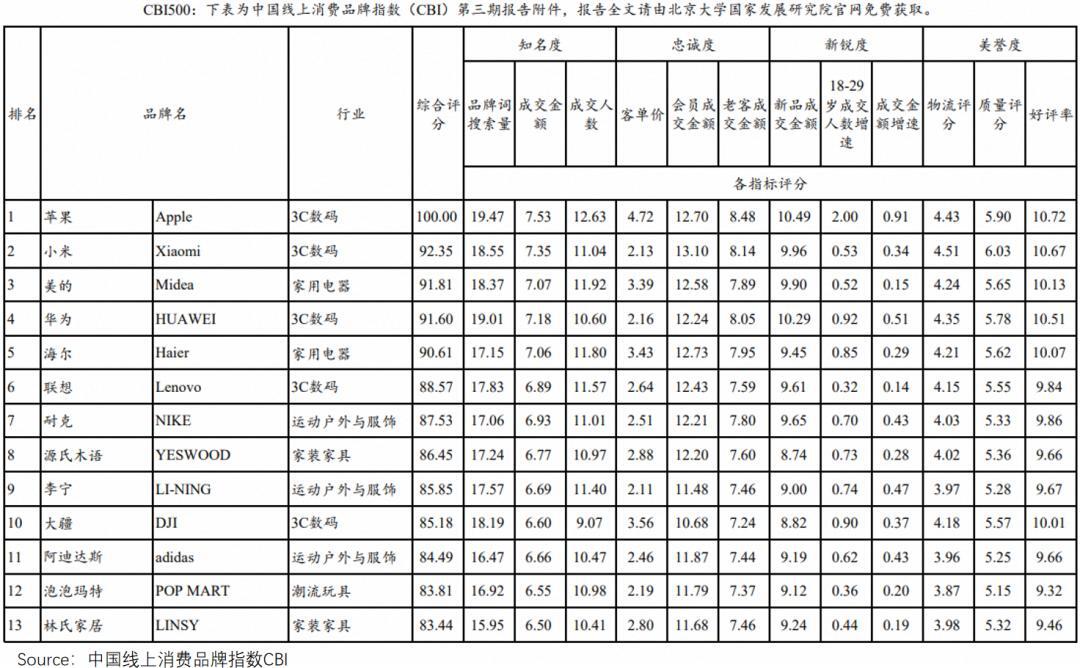
Group 1 - The consumer market in China is viewed as one of the biggest investment opportunities by 2026, but there are differing opinions on where and how to invest [1] - Traditional consumption sectors like liquor, apparel, and beauty have faced challenges, yet some brands have managed to achieve stock price increases of 30% to 50% [2] - The complexity of the consumer market requires investors to connect macro trends with micro behaviors to identify structural opportunities [3] Group 2 - The "China Online Consumption Brand Index" (CBI) and the "Global Brand China Online 500" list reveal significant shifts in consumer preferences, with traditional liquor brands like Moutai and Wuliangye declining while newer brands like Pop Mart are rising [3][4] - The CBI index reflects the performance of brands based on real consumer behavior, including sales, price, search volume, and reputation [4] - The liquor industry is undergoing a transformation, with brands like Jian Nan Chun and Shanxi Fenjiu adapting to new consumer preferences, particularly among younger demographics [6][7][13] Group 3 - The outdoor apparel market is shifting from niche enthusiasts to mainstream consumers, with brands like Berghaus gaining traction due to their stylish and affordable offerings [17] - Emerging brands in the cosmetics sector, such as Huazhi Xiao, are capitalizing on specific consumer trends and achieving significant growth in brand rankings [20][22] - The CBI index serves as a lens to identify changes in consumer demand and potential growth opportunities across various sectors [24] Group 4 - Pop Mart's financial performance shows a significant increase in overseas revenue, yet the stock has faced volatility due to market sentiment rather than fundamentals [26][28] - The brand maintains a leading position in the industry despite short-term fluctuations, indicating strong brand loyalty and potential for future growth [29][30] - The luxury gold market is experiencing challenges as competition increases, impacting customer loyalty and market positioning for brands like Laopufeng [40][35] Group 5 - The beauty industry is witnessing a resurgence for brands like Chanel and YSL as they adapt to new marketing channels and consumer preferences [22] - The investment landscape is influenced by varying investor strategies, with short-term traders reacting differently than long-term investors to market signals [34][41] - The Chinese consumer market is complex and requires a multifaceted approach to uncover hidden opportunities [42]

扎堆中高端商场!国货美妆开店潮又来了
Sou Hu Cai Jing· 2025-12-30 17:57
Core Insights - Domestic beauty brands are increasingly expanding their offline presence as online traffic growth reaches its peak, with brands like Lin Qingxuan and Mao Geping leading the charge in opening new stores [1][2][3] - The shift to offline retail is driven by the need to enhance brand image and consumer trust through personalized customer service, despite the challenges of increased costs and supply chain management [1][4][7] Group 1: Expansion Strategies - Major domestic beauty brands are focusing on high-end shopping centers and have begun to penetrate lower-tier markets, with Lin Qingxuan and Mao Geping opening stores in cities like Luoyang and Chifeng [2][3] - New entrants to the offline market, such as Gu Yu and Hua Xizi, are utilizing pop-up stores to establish their brand presence in key urban areas [3][4] Group 2: Consumer Engagement and Sales Performance - Offline stores are reported to have higher conversion and repurchase rates, with Mao Geping's offline member repurchase rate increasing from 28.7% to 30.3% year-on-year, compared to 24.1% for online [7] - Lin Qingxuan's average transaction value in offline channels reached 1,026 yuan, significantly higher than the 497 yuan in online channels, indicating a strong consumer willingness to spend in physical stores [7] Group 3: Challenges and Market Dynamics - The competitive landscape for domestic beauty brands has intensified, with many brands adopting franchise and partnership models to accelerate store expansion, as seen with Lin Qingxuan increasing its number of distributors from 15 to 93 [8][11] - The offline retail environment remains challenging, with high operational costs and the need for skilled beauty consultants, leading to increased sales expenses for brands like Mao Geping [15] - The recent resurgence of beauty collection stores, which saw a sales increase of 0.39% year-on-year, provides a low-cost avenue for domestic brands to expand their market reach [12][13]