
价格内卷

Search documents
电商低价战要停了?2026新规一出,商家欢呼消费者却慌了?
Sou Hu Cai Jing· 2026-01-15 14:12
Core Viewpoint - The article discusses the ongoing price wars in the e-commerce sector and the upcoming regulations in 2026 aimed at curbing unfair practices, suggesting a shift in focus from price competition to product quality and service improvement [1][7]. Group 1: E-commerce Price Wars - E-commerce platforms have been engaged in aggressive price competition, initially promoting "lowest prices" but later resorting to complex discount strategies that confuse consumers [3][5]. - The tactics have included penalties for merchants who do not comply with price competition, leading to a chaotic environment for both consumers and businesses [5][7]. Group 2: Regulatory Changes - New regulations set to take effect in April 2026 will prohibit forced price reductions and the coercion of merchants regarding pricing, aiming to eliminate "dark box operations" in the industry [7][10]. - These regulations are seen as a significant move to protect merchants and restore fair competition in the e-commerce landscape [7][10]. Group 3: Shift in Consumer Preferences - A significant portion of consumers (27.8%) prioritize product quality over low prices, indicating a shift in consumer behavior away from price-centric purchasing [10]. - The previous cycle of price competition has been described as a "vicious cycle," where low margins hinder innovation, and the new regulations are expected to allow businesses to focus on improving products and services instead [10].


BDO行业“三箭齐发”破解结构性矛盾
Zhong Guo Hua Gong Bao· 2026-01-06 03:11
Core Viewpoint - The BDO industry is focusing on addressing structural contradictions through technological innovation, downstream applications, and a unified national market to enhance profitability and prevent disorderly competition [1][2] Group 1: Industry Challenges and Strategies - The BDO industry aims to tackle potential market risks by creating a fair, innovative, and mutually beneficial ecosystem while preventing "involution" and disorderly competition [1] - A consensus was reached on the need for "production limits to stabilize prices" and the establishment of a "capacity warning mechanism" to reverse the trend of companies operating at a loss to dilute fixed costs [1] - The industry is encouraged to shift towards high-end and differentiated transformation, optimizing the development structure and phasing out outdated capacities to promote healthy growth [1] Group 2: Future Development Logic - The development logic for the BDO industry during the "14th Five-Year Plan" period will focus on transforming existing facilities into high-end material inputs rather than merely building more production units [2] - There is an emphasis on promoting the application of biodegradable plastics and leveraging the technological value of functional plastics, as well as advancing BDO's development in high-performance fibers, new energy batteries, and biomedical materials [2]
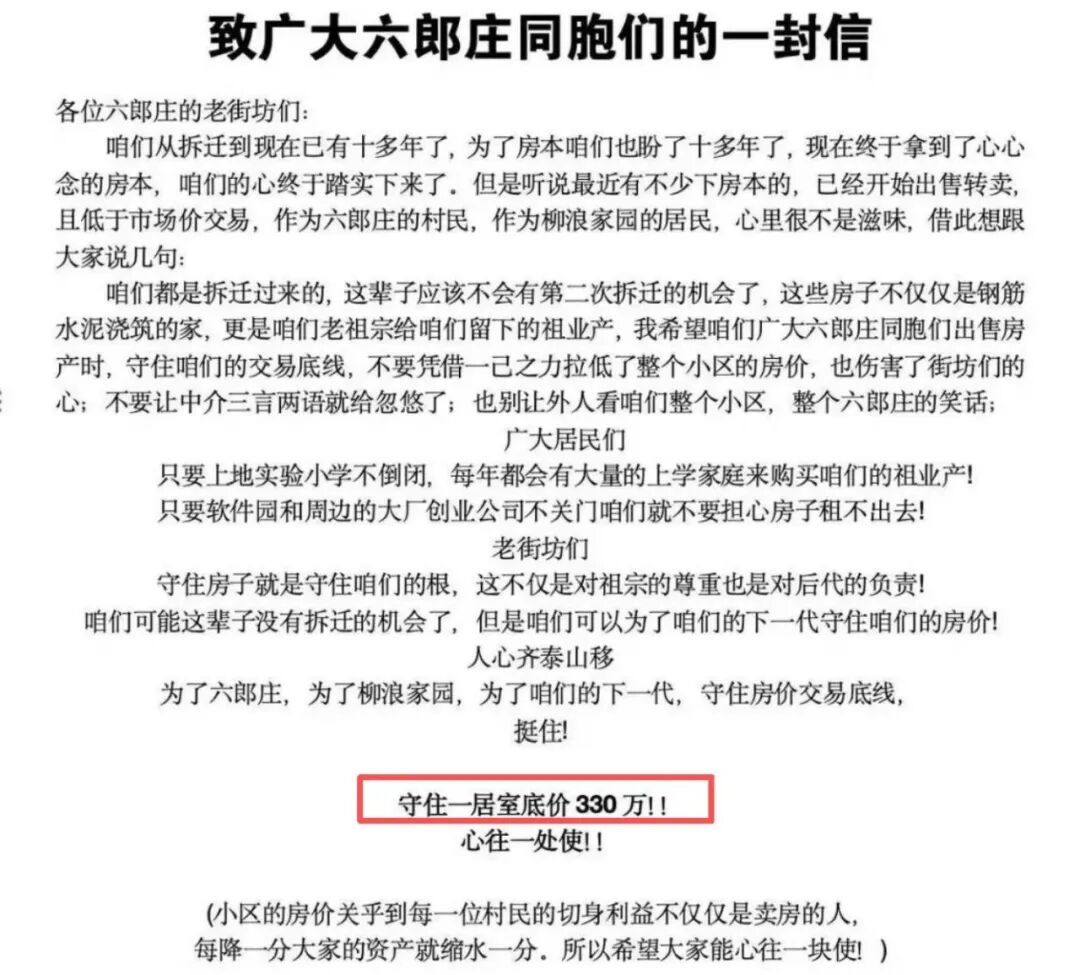
北京二手房市场现“保价联盟”:守住一居室底价330万元!
Mei Ri Jing Ji Xin Wen· 2025-12-18 12:54
Core Viewpoint - The recent formation of a "price protection alliance" among homeowners in Beijing's second-hand housing market aims to stabilize property prices amid concerns of declining values due to urgent sales and market fluctuations [1][5]. Group 1: Price Protection Alliance - Homeowners in the Liulangzhuang area have expressed concerns over properties being sold below market value, leading to the establishment of a "price protection alliance" to maintain price stability for future generations [1][5]. - A letter from homeowners emphasizes the importance of maintaining property values, citing the presence of local schools and businesses as factors that support demand for housing [5]. Group 2: Market Conditions and Pricing - Recent listings in the Liulangzhuang area show that 47-square-meter units are being quoted at prices below the desired 3.3 million yuan, with some listings at 2.9 million yuan and 3.1 million yuan [3][4]. - The average listing price for second-hand homes in the Liulangzhuang area is reported at 7.4 million yuan per square meter, with a notable increase in viewing activity, indicating sustained interest despite price concerns [4]. Group 3: Comparative Analysis with Other Projects - The nearby Xiangshuwan project has issued a more cautious approach, urging homeowners to consider the overall community value and avoid drastic price cuts that could destabilize the market [7]. - In contrast, the Xiangshuwan project has seen significant price adjustments, with some listings dropping from 4.1 million yuan to 3.85 million yuan within a few months, reflecting broader market pressures [5][10]. Group 4: Broader Market Trends - Data indicates that the average price for second-hand homes in Beijing has decreased by 1.44% month-on-month and 6.08% year-on-year, with an average price of approximately 6.5 million yuan per square meter for the year [20]. - The overall sales area for new residential properties in Beijing has declined by 4.6% year-on-year, highlighting a challenging market environment for both new and second-hand properties [20].
遭低价冲击、股价大降,if椰子水不香了?
Bei Jing Shang Bao· 2025-11-20 14:00
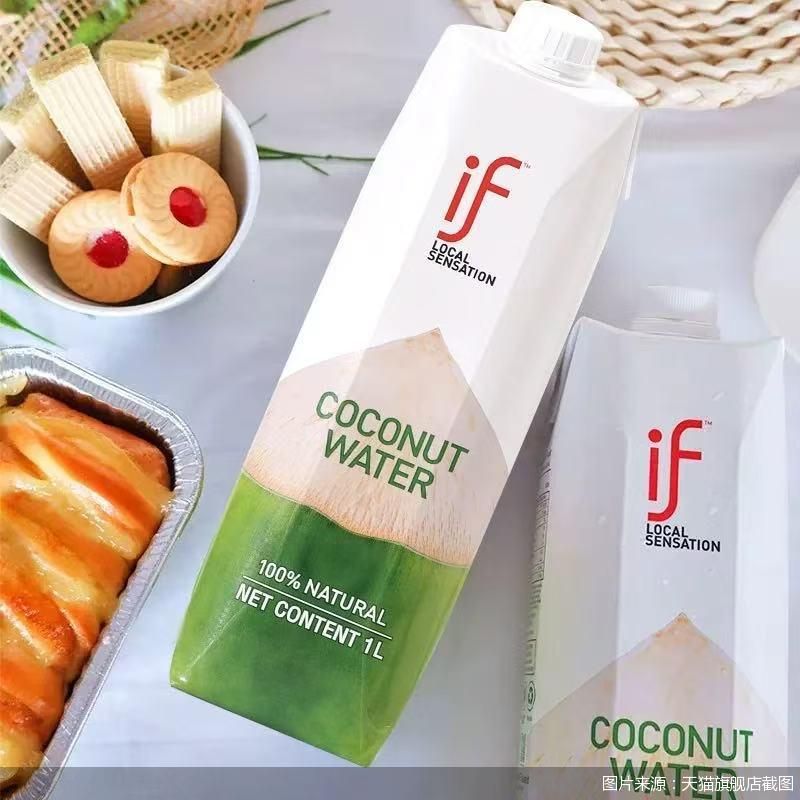
Core Viewpoint - IFBH, the parent company of if coconut water, has seen a significant decline in stock price and market capitalization due to increasing competition and price wars in the coconut water market, leading to concerns about its future growth prospects [1][8]. Company Overview - IFBH was established in 2013 and launched if coconut water, entering the Chinese market in 2017. It quickly became a market leader due to its high cost-performance ratio [3]. - In 2024, if coconut water achieved sales of 1.1 billion yuan, a year-on-year increase of 80%, with 97% of revenue coming from the Chinese market. It maintained a market share of 34%, significantly ahead of its largest competitor, Vita Coco [3]. Market Dynamics - The coconut water market in China is rapidly expanding, with the number of brands increasing from 32 to over 50 between 2023 and 2025, intensifying competition for IFBH [1]. - The price of coconut water has been decreasing, with some products dropping to as low as 2 yuan per bottle, leading to a price war that has affected IFBH's market position [6][7]. Financial Performance - As of November 20, IFBH's stock price fell to 18.83 HKD per share, marking a decline of over 60% from its peak of 48.8 HKD, with a market capitalization of approximately 5.021 billion HKD [1][8]. - The company's financial report for the first half of 2025 showed revenue of 94.46 million USD, a year-on-year increase of 31.5%, but net profit decreased by 4.9% [7]. Strategic Moves - To strengthen its market position, IFBH is accelerating localization efforts, including strategic partnerships with major companies like COFCO and establishing a regional headquarters in Shanghai [5]. - The company is advised to focus on brand building and product innovation to enhance competitiveness and avoid being driven out by lower-quality competitors [8].
电视市场遭遇“最冷三季度”,腰部品牌生存告急
Xi Niu Cai Jing· 2025-11-07 12:19
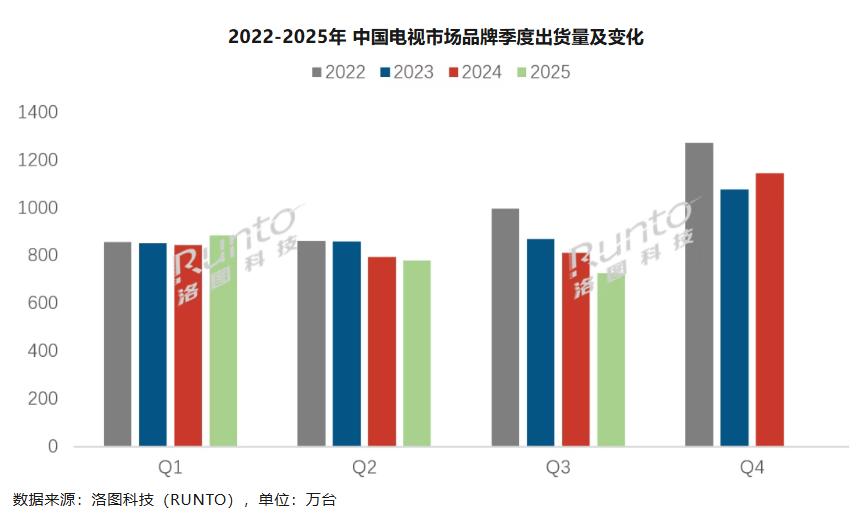
Core Insights - The third quarter of this year marks the only quarter in the past five years to experience a sequential decline in sales [3] - The overall TV retail volume in Q3 was 6.15 million units, a year-on-year decrease of 12.1%, while retail revenue fell by 8.1% to 25.2 billion yuan [4] Market Dynamics - The dual decline in sales is largely attributed to the demand being pulled forward by last year's national subsidy policy, which has led to a natural market adjustment cycle [8] - The rapid consumption of the national subsidy fund, with 162 billion yuan allocated by May, has restricted consumer purchasing flexibility, as funds are now distributed more precisely [8] - The expansion of subsidy categories from 8 to 12 has diverted funds away from traditional categories like TVs, further reducing available subsidies for these products [8] Consumer Trends - Despite an overall decline in TV sales, retail revenue saw a slight increase of 5.1%, indicating a trend towards higher-end products as consumers prefer larger and more advanced models [9] - Mid-tier brands are struggling in this environment, with second-tier brands like Changhong, Haier, and Konka experiencing a combined shipment decline of 12.2%, exceeding the industry average [10] Company Performance - Konka reported a net profit loss of 383 million yuan in the first half of 2025, with a gross margin of only 3.23% in its consumer electronics business, indicating severe profitability challenges [13] - Changhong's TV business revenue decreased by approximately 2.11% to 7.054 billion yuan, with a significant portion of its sales attributed to OEM production for brands like Xiaomi and Huawei [18] - Haier's TV division has struggled to replicate its success in major appliances, facing challenges in brand positioning and market focus, leading to a lack of competitive advantage [21] Competitive Landscape - The top brands, including Hisense, TCL, Xiaomi, and Skyworth, also faced pressure, with a combined shipment decline of over 8% in Q3 [22] - The market is witnessing a "price war" phenomenon, particularly during promotional events, with significant price reductions across various TV sizes [22] - The market is increasingly polarized, with leading brands maintaining a larger market share while mid-tier brands face existential challenges [22][23] Future Outlook - The ongoing market contraction suggests that the TV industry may face a prolonged period of difficulty, with a potential acceleration in the elimination of struggling mid-tier brands [24]






价格补贴、反内卷与产能过剩
虎嗅APP· 2025-10-07 13:11
Group 1 - The article discusses the phenomenon of price competition and overcapacity in various industries, using oil, water, and milk as case studies [5] - The first case study focuses on the oil crisis of the 1970s, highlighting how low oil prices prior to the crisis led to a significant change in consumer behavior and the automotive industry in the U.S. [6][10] - It explains that the low oil prices were not solely due to exploitation by capitalist countries but were also driven by the need to expand market size and create consumer habits [9] Group 2 - The second case study examines the pricing strategies in Japan's retail sector, particularly the phenomenon where 2L bottled water is cheaper than 550ml, illustrating competitive pricing and consumer sensitivity [11][13] - It notes that this pricing strategy is a result of long-term deflation and competitive pressure, leading to a situation where retailers use lower-priced larger bottles to attract customers [12][14] Group 3 - The final case study addresses the "milk dumping" incidents during the Great Depression in the U.S., where milk was discarded instead of being distributed to those in need [16][21] - It outlines the complexities behind this phenomenon, including actions taken by farmers, industry associations, and government interventions aimed at stabilizing milk prices [17][19]

关于破解内卷困局,电池界大咖们这样说→
Guo Ji Jin Rong Bao· 2025-09-19 11:09
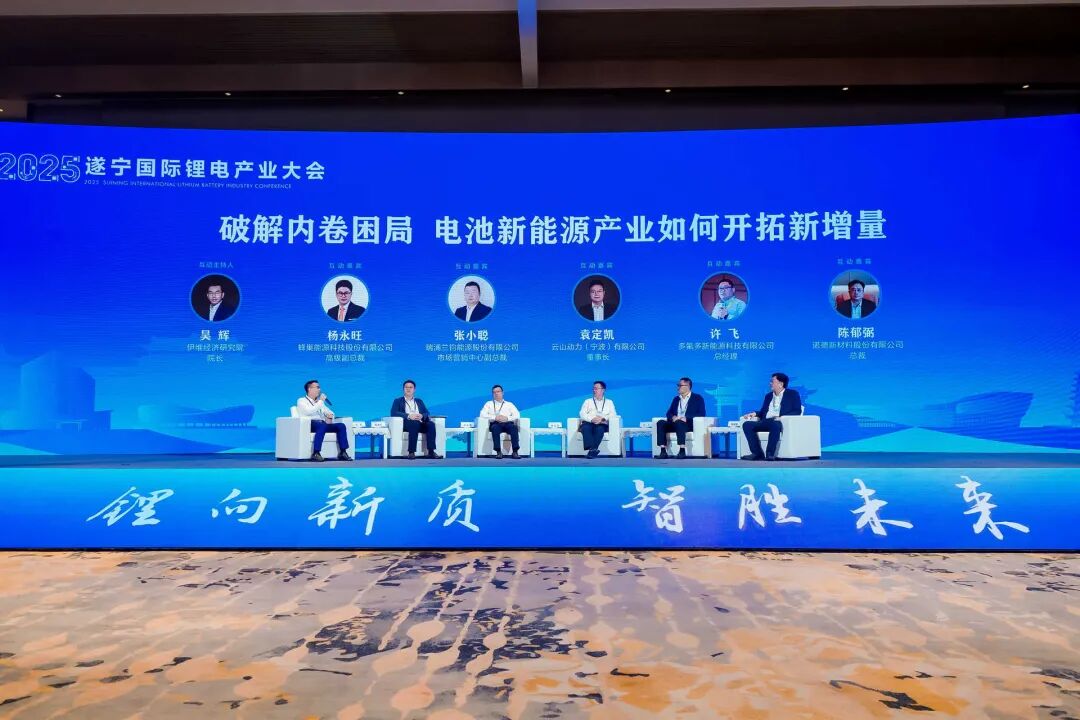
Core Insights - The 2025 Suining International Lithium Battery Industry Conference discussed the current "involution" dilemma in the lithium battery industry, emphasizing the need to explore new markets and applications to drive growth [1] Group 1: Industry Trends - The lithium battery industry is facing a slowdown in market growth and a fundamental shift in supply-demand dynamics, necessitating the exploration of new markets and applications to create additional growth [1] - Companies are encouraged to focus on quality and technology rather than engaging in price competition, as highlighted by Hive Energy's commitment to long-termism and technological innovation [3] Group 2: Market Expansion Strategies - Rui Pu Lan Jun Energy has shifted from a "product coverage" model to an "industrial chain going abroad" approach, with exports of power batteries accounting for one-third and energy storage batteries over 60% of total exports [3] - Cloud Mountain Power emphasizes the potential for growth in existing markets, particularly in regions with lower penetration rates, such as Northeast China, where addressing low-temperature performance could yield an additional 6%-10% market growth [4] Group 3: Challenges and Solutions - The competitive pressure in overseas markets is significant, with domestic companies facing challenges such as unclear customer positioning and weak intellectual property protection, which can lead to a loss of direction [4] - Nord New Materials is focusing on expanding into the Portuguese market due to favorable labor costs and strong sunlight, while also emphasizing the importance of quality and technological advancement in new market development [5]
南华期货硅产业链企业风险管理日报-20250911
Nan Hua Qi Huo· 2025-09-11 12:20
1. Report Industry Investment Rating No relevant content provided. 2. Core Views of the Report Industrial Silicon - Supply - The low - electricity - price environment in Southwest China's wet season is ending, and the growth rate of furnace - starting in Xinjiang is also slower than expected. The overall supply pressure is expected to gradually ease [4]. - Demand - The demand from the organic silicon industry has slowed, while the demand from the recycled aluminum alloy remains stable. The demand from the polysilicon sector is expected to increase steadily in the next two months [4]. - Market Outlook - If the supply - side production rate enters a downward channel and the downstream polysilicon demand improves, the oversupply situation may ease, and the industry may reach a price bottom - reversal point [4]. Polysilicon - Supply - The production plan in September is expected to increase month - on - month, exacerbating the supply - side surplus pressure. The increasing number of daily warehouse receipts also exerts pressure on the futures market [10]. - Demand - The production rhythm of silicon wafers and battery cells continues to slow, and the demand for polysilicon is restricted by factors such as lagging terminal installation demand and inventory digestion pressure [10]. - Market Outlook - If major enterprises in the industry reach effective integration agreements, it will fundamentally improve the supply - demand pattern and form long - term support for the market. Currently, investors are advised to be cautious [10]. 3. Summary by Relevant Catalogs Industrial Silicon Futures Data - The closing price of the industrial silicon main contract is 8740 yuan/ton, with a daily increase of 75 yuan (0.87%) and a weekly increase of 225 yuan (2.64%) [12]. - The trading volume of the main contract decreased by 275329 lots (44.20%) daily and 24186 lots (6.51%) weekly [12]. - The open interest of the main contract increased by 9706 lots (3.49%) daily and 10466 lots (3.77%) weekly [12]. Spot Data - The price of 99 industrial silicon in Xinjiang and Tianjin remained unchanged, while the price of 553 in Xinjiang increased by 100 yuan/ton (1.14%) [20][21]. - The price of 421 in Yunnan increased by 100 yuan/ton (1.14%), and the price of industrial silicon powder and some downstream products also had price changes [21]. Basis and Warehouse Receipts - The total number of industrial silicon warehouse receipts is 50093 lots, an increase of 48 lots (1.23%) from the previous period [34]. - The inventory in some delivery warehouses remained stable, while the inventory in Tianjin delivery warehouse increased by 198 tons (0.92%) [34]. Polysilicon Futures Data - The closing price of the polysilicon main contract is 53710 yuan/ton, with a daily increase of 825 yuan (1.56%) and a weekly increase of 1515 yuan (2.90%) [36]. - The trading volume of the main contract decreased by 133683 lots (32.45%) daily but increased by 10216 lots (3.81%) weekly [36]. - The open interest of the main contract decreased by 746 lots (0.54%) daily and 9624 lots (6.59%) weekly [36]. Spot Data - The prices of N - type polysilicon products such as N - type re - feeding materials and N - type dense materials had slight weekly increases [42]. - The prices of silicon wafers, battery cells, and components also had different degrees of changes [42]. Basis and Warehouse Receipts Data - The basis of the polysilicon main contract is - 2470 yuan/ton, with a daily decrease of 845 yuan (52.00%) and a weekly decrease of 1405 yuan (131.92%) [48]. - The total number of polysilicon warehouse receipts is 7690 lots, an increase of 320 lots (4.3%) [36].

小米高管:小米不参与家电行业的价格内卷、不在意短期排名,一个月、一个季度的排名根本不重要
Xin Lang Ke Ji· 2025-08-20 02:03
Core Viewpoint - Xiaomi Group emphasizes its focus on long-term strategy over short-term rankings in the home appliance industry, asserting confidence in achieving its annual goals despite market challenges [1][1]. Financial Performance - In Q2, Xiaomi's revenue from home appliances grew by 66%, with air conditioning average selling price (ASP) increasing by approximately 10%, indicating a successful performance amidst a competitive pricing environment [1][1]. Strategic Positioning - Xiaomi's president, Lu Weibing, reiterated that the company will not engage in price wars within the home appliance sector and does not prioritize short-term rankings, highlighting the importance of long-term market positioning [1][1]. - The company expresses complete confidence in its home appliance business and aims to meet its initial targets for the year [1][1].
小米卢伟冰回应家电价格战:不参与行业价格内卷,不在意一时的短期排名
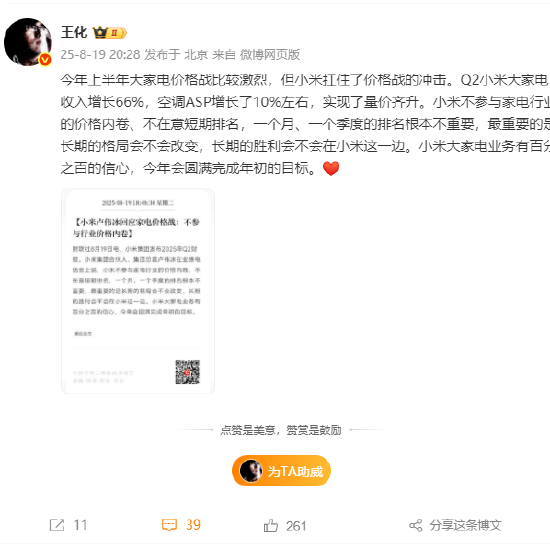
Zheng Quan Shi Bao Wang· 2025-08-19 10:57
Core Viewpoint - Xiaomi Group's president, Lu Weibing, emphasized the company's resilience in the face of intense price competition in the home appliance sector, stating that Xiaomi is focused on long-term market positioning rather than short-term rankings [1] Group 1: Financial Performance - In the second quarter, Xiaomi's revenue from home appliances grew by 66% [1] - The average selling price (ASP) of air conditioners increased by approximately 10%, indicating a simultaneous rise in both volume and price [1] Group 2: Market Strategy - Xiaomi is not participating in the price war within the home appliance industry and is not concerned with short-term rankings, highlighting a strategic focus on long-term market dynamics [1] - The company believes that the most important factor is whether the long-term competitive landscape will change in its favor [1]