
债券

Search documents
原油价格推演下的:通胀、债券和权益中观利润传导:
Guo Tai Jun An Qi Huo· 2026-03-24 14:00
1. Report Industry Investment Rating No information provided. 2. Core Viewpoints of the Report - The report analyzes the impact of crude oil price changes on inflation, bonds, and mid - level industry profits. It estimates the potential increase in crude oil prices under different scenarios of the Strait of Hormuz blockade, and details the effects on inflation in the US and China, as well as the performance of US Treasury bonds and Chinese bonds. It also examines how crude oil price changes affect the cost and profit of mid - level industries [3][4]. 3. Summary According to the Table of Contents 3.1 Crude Oil Supply Loss Assessment and Price Limit Deduction - Before the Middle East geopolitical conflict, about 24 million barrels per day of various oil products (mainly crude oil) from major Middle Eastern oil - producing countries were exported through the Strait of Hormuz. After the blockade, the total oil product exports from the Strait of Hormuz dropped to about 13.72 million barrels per day, with an actual supply loss of about 14 million barrels per day (subject to correction by factors such as production increases in other countries, "reserve releases" by IEA member countries, and refinery load reduction). - Using the average Brent price of about $71 per barrel in February before the war as the starting point, if the blockade lasts for 8 - 12 weeks, the Brent oil price central range may be between $86 - 95 per barrel at the lower bound and $85 - 123 per barrel at the upper bound. If the blockade extends to 16 weeks, Brent is likely to stabilize in the $100 - 105 per barrel range and may challenge the 2022 high of $140 per barrel [3][8][9]. 3.2 Impact of Crude Oil Prices on US Inflation, Inflation Expectations, and US Treasury Bonds 3.2.1 Four Weeks into the War: Major Asset Pricing of Risks Remains Relatively Restrained - The current situation has evolved into a more intense and long - lasting conflict. Major asset markets' responses to risks are relatively muted compared to the 2022 situation. The real - time supply gap caused by the Strait of Hormuz blockade is the core factor affecting the market, and the spot market for energy and chemical industries is experiencing a supply shortage [13][15]. 3.2.2 Crude Oil - Inflation Transmission: Using a Macro Model to Analyze the Impact of Oil Prices on Inflation - If crude oil prices rise by $10, $20, $30, or $50, the year - on - year CPI increase in the first quarter will be 0.15%, 0.3%, over 0.4%, and 0.7% respectively, and in the second to fourth quarters, it will be 0.2%, 0.4%, nearly 0.6%, and 0.95 - 1.0% respectively [20][22]. 3.2.3 The " $100 per Barrel" Watershed Effect: Regression Analysis of Brent Crude Oil Year - on - Year, CPI Year - on - Year, and Inflation Expectations - The regression analysis shows that the year - on - year change in US CPI can be explained by about 17% of the change in crude oil prices. When the oil price exceeds $100, inflation expectations will deviate significantly from the linear regression level. Currently, inflation expectations are underestimated, and there is an upward adjustment space [26][30][31]. 3.2.4 US Treasury Bond Market Strategy: The Impact of Inflation + VaR Risks May Not End - Currently, the pricing of inflation expectations in the US Treasury bond market is insufficient. The Strait of Hormuz issue remains unresolved, and oil prices still have upward risks. The Back structure of the inflation curve will flatten the US Treasury bond yield curve. In a "stagflation" environment, ultra - short - term Treasury bonds show a "cash is king" characteristic [40][41]. 3.3 Impact of Crude Oil Prices on Chinese Inflation and Chinese Treasury Bonds - The correlation between crude oil prices and China's PPI is as high as 0.78, while the correlation with CPI is only 0.21. If oil prices rise by 10%, China's PPI will rise by about 0.66 percentage points. In different scenarios where the average crude oil price rises to $100 - $150 per barrel, the corresponding PPI readings will range from 2.3% to 6.7% [50][53]. - In the scenario of rising crude oil prices and increasing inflation pressure, macro - control should focus on cost relief and structural optimization on the supply side. In the scenario of oil prices rising and then falling, policies will focus on boosting domestic demand. In both stagflation and slow - recovery scenarios, risks in interest - rate bonds need to be vigilant. The report maintains a defensive strategy for interest - rate bonds, recommending flexible strategies such as hedging at high prices, positive arbitrage at appropriate times, and stage - based long - position in inter - period spreads [54][55][60]. 3.4 Impact of Crude Oil Prices on Mid - level Industry Profits 3.4.1 Cost Side: Industries Sensitive to Crude Oil Price Increases - Industries that directly consume crude oil in production are mainly concentrated in petroleum refining and petrochemicals. Industries that indirectly consume crude oil through intermediate products are mainly in basic chemicals, agricultural chemicals, transportation, mining and smelting, textiles, and heat supply [64]. 3.4.2 Profit Side: Upstream Oil and Gas Exploration Benefits, while Mid - and Down - stream Industries Show Differentiated Performance - During the 2022 Russia - Ukraine conflict, industries with significantly expanded gross profit margins in A - shares were mainly in three areas: direct beneficiaries (upstream oil and gas exploration, oil transportation); indirect beneficiaries (coal industry chain); and downstream industries with rigid demand and smooth cost transfer (some fine chemicals). On the contrary, some mid - and down - stream industries with high sensitivity to crude oil prices experienced gross profit margin contraction due to difficult cost transfer [72][73][74].
2026年1-2月进出口数据点评:出口同比持续超预期增长
KAIYUAN SECURITIES· 2026-03-11 13:15
1. Report Industry Investment Rating No information about the report industry investment rating is provided in the given content. 2. Core Viewpoints of the Report - The export growth in January - February 2026 exceeded expectations. The cumulative export from January to February increased by 21.8% year - on - year, and the export in February alone increased by 39.6% year - on - year, far exceeding the market's forecast [3]. - The reasons for the export growth exceeding expectations are the later Spring Festival in 2026 and the improvement of external demand. The development of the AI - related industrial chain, export diversification, and positive port high - frequency data also contributed to the growth. Although the Spring Festival holiday in March may put pressure on imports and exports, the long - term positive trend remains unchanged [4][5]. - The root cause of China's continuous export exceeding expectations lies in the high cost - performance of Chinese goods, which is the result of domestic "involution" and technological progress. Even after "anti - involution", China's price advantage may last for a long time, so the report is optimistic about China's exports [6]. - In the bond market, on March 10, the long - term yield first rose and then fell. The report predicts that the target range of the 10 - year Treasury bond is 2 - 3%, with a central value of 2.5% [7][8]. 3. Summary by Relevant Catalogs 3.1 2026 January - February Import and Export Data - **Import and Export Growth**: In February 2026, imports increased by 13.8% year - on - year (25.7% in January), and exports increased by 39.6% year - on - year (10.0% in January). The trade surplus increased by 190.9% year - on - year. The cumulative export from January to February increased by 21.8% year - on - year, and imports increased by 19.8% year - on - year [3]. - **Exceeding Expectations**: The export in February far exceeded the market's forecast. The median and average of the 4 - institution forecast for February's export year - on - year growth were +4.0% and +3.8% respectively, while the actual growth was 39.6%. The median and average of the 6 - institution forecast for the cumulative export year - on - year growth from January to February were +7.5% and +7.3% respectively, and the actual growth was 21.8% [3]. 3.2 Reasons for the Export Growth Exceeding Expectations in January - February 2026 - **Spring Festival Factor**: The Spring Festival in 2026 was in late February, later than in 2025. The holiday disturbance was postponed, which was one of the reasons for the export growth exceeding expectations [4]. - **External Demand Improvement**: The external demand improved, and the export momentum was strong, with the export amount at a historical high [4]. - **Product Structure**: The development of the AI - related industrial chain promoted the high - growth of exports of electromechanical products and high - tech products. From January to February, the cumulative export of electromechanical products increased by 27.1% year - on - year, and the export of integrated circuits increased by 72.6% year - on - year, while high - tech products increased by 26.9% year - on - year [5]. - **Export Destination**: Except for the United States, exports to other major countries increased significantly. From January to February, exports to ASEAN increased by 29.4% year - on - year, and exports to Africa increased by 49.9% year - on - year [5]. - **Port High - Frequency Data**: The monthly average weekly container throughput of key ports in January and February increased by 13.5% and 10.9% year - on - year respectively, and the weekly throughput in the first 7 weeks was higher than that in the same period of 2025 [5]. 3.3 Root Cause of China's Continuous Export Exceeding Expectations The root cause is the high cost - performance of Chinese goods, which is the result of domestic "involution" and technological progress. Even after "anti - involution", China's price advantage may last for a long time due to the faster price increase in other countries [6]. 3.4 Bond Market Situation - **Market Performance on March 10**: The long - term yield first rose and then fell. The yield of the 10 - year Treasury bond's second - active bond reached 1.8190% in the early trading, and then the bond market recovered in the afternoon [7]. - **Bond Market Outlook**: It is predicted that the target range of the 10 - year Treasury bond is 2 - 3%, with a central value of 2.5%. The factors considered include economic fundamentals, monetary policy, inflation, capital interest rates, and the real estate market [8].
预告 | 2026年1月彭博终端用户专享课程
彭博Bloomberg· 2026-01-05 06:05
Group 1 - The article highlights a series of upcoming Bloomberg seminars and workshops scheduled for January 2026, focusing on various financial tools and market analysis techniques [3][4][5][6][7][10] - The seminars cover topics such as credit bond analysis, fundamental analysis tools for companies and industries, investment portfolio performance analysis, and macroeconomic tracking using Bloomberg models [5][6][7][10] - Specific dates and times for the seminars are provided, indicating a structured approach to educating users on Bloomberg terminal functionalities and market insights [4][5][6][10] Group 2 - The article emphasizes the importance of understanding basic functionalities of the Bloomberg terminal for new users, particularly in analyzing bonds, foreign exchange, stocks, commodities, and derivatives [5][6] - It also mentions specialized sessions on interest rate swaps and currency swaps, indicating a focus on fixed income and derivatives markets [8] - The seminars are designed to cater to both beginners and those looking to deepen their knowledge in specific areas of finance [5][6][10]


贵金属早报-20251225
Yong An Qi Huo· 2025-12-25 08:00
Price Performance - The latest prices of London Gold, London Silver, London Platinum, London Palladium, WTI Crude Oil, and LME Copper are $4480.80, $69.74, $2208.00, $1837.00, $58.38, and $12223.50 respectively, with changes of $31.40, $0.00, $125.00, $64.00, $0.00, and $291.50 [1] - The latest values of the US Dollar Index, Euro to US Dollar, British Pound to US Dollar, US Dollar to Japanese Yen, and US 10 - year TIPS are 97.95, 1.18, 1.35, 155.94, and 1.94 respectively, with changes of 0.04, -0.00, -0.00, -0.32, and 0.00 [1] Trading Data - The latest COMEX silver inventory, SHFE silver inventory, gold ETF holdings, silver ETF holdings, SGE silver inventory are 14023.94, 881.95, 1068.27, 16446.97, 693.35 respectively [1] - The changes in SHFE silver inventory, gold ETF holdings, silver ETF holdings, SGE gold deferred - fee payment direction, and SGE silver deferred - fee payment direction are -17.71, 3.71, -56.40, 0.00, -1.00 respectively [1]
股市即将变盘的逻辑,财富洗牌的前夜
Sou Hu Cai Jing· 2025-11-27 05:11
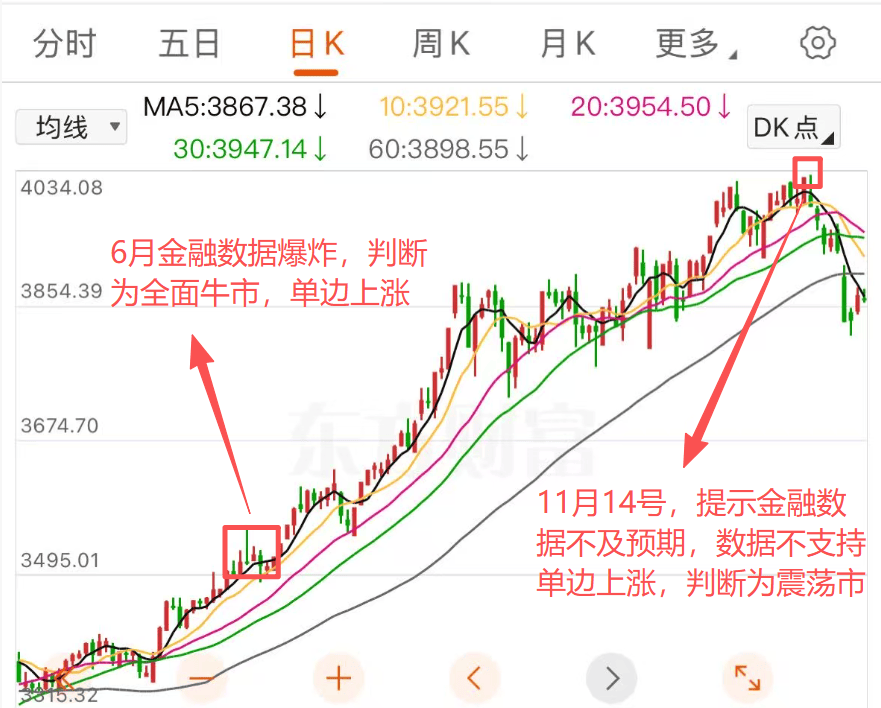
Core Viewpoint - The stock market began a downward trend starting November 14, triggered by the release of disappointing financial data for October on November 13, which did not meet expectations [1][3]. Financial Data Analysis - On July 14, the central bank released June financial data that significantly exceeded expectations, leading to a bullish market trend [3]. - The October financial data released on November 13 was below expectations, resulting in a noticeable decline in the stock market starting November 14 [3][4]. - The primary reason for the explosive data in July was the unexpected increase in money supply driven by bond purchases, while the October data reflected a downturn in bond issuance, impacting money supply growth [5][12]. Monetary Mechanism Explanation - The central bank is the issuer of currency, and the total money supply (M2) is determined by the base currency and the reserve requirement ratio [5][7]. - Commercial banks can create money through asset expansion, which includes buying bonds, but they must first attract deposits [6][9]. - The difference between commercial banks and the central bank in money creation lies in the need for deposits and the type of money created (derived vs. base money) [9][10]. Market Outlook - The recent data indicated a turning point for both M1 and M2, primarily due to a decline in bond issuance [13]. - Despite the downward pressure, the market is expected to stabilize rather than enter a prolonged decline, as the bond market can be adjusted by issuers in response to economic conditions [13]. - The long-term outlook remains optimistic, with confidence in the market's potential for recovery driven by bond issuance mechanisms [13][14]. Sector Focus - Future national development priorities include technology, new productive forces, and industrial upgrades, which may lead to high valuations in tech sectors [15]. - Traditional sectors, while not the focus of future growth, have lower valuations and may present safer investment opportunities [15][16].
普徕仕:缺乏官方数据或令美联储陷入困局 保持对小型股平衡观点
Zhi Tong Cai Jing· 2025-10-17 02:51
Group 1 - The core viewpoint highlights the negative impact of a prolonged U.S. government shutdown on the economy and the ongoing challenges faced by the Federal Reserve due to a lack of official data [1] - The recent interest rate cut by the Federal Reserve has reignited market interest in small-cap stocks, which have outperformed large-cap stocks by nearly 4% since April [2] - Employment data has shown a concerning trend, with a reported loss of 91,100 jobs from April 2024 to March 2025, raising investor concerns about data reliability [1] Group 2 - The Federal Reserve's recent interest rate cut has led to an increased allocation to U.S. small-cap stocks, shifting the allocation stance to neutral for large-cap stocks [2] - The macro environment is favorable for growth stocks, particularly in the AI/technology sector, prompting a shift towards growth-oriented investments [2] - The company maintains a low allocation to bonds due to inflation and fiscal stimulus financing demands, which may keep interest rates under pressure [2]
国庆快乐!
集思录· 2025-09-30 13:59
Core Viewpoint - The article discusses the recent performance of the Sci-Tech Innovation 50 Index, highlighting its significant rise and high price-to-earnings ratio of 180, raising questions about sustainability and future expectations in the investment landscape [1]. Group 1 - The Sci-Tech Innovation 50 Index has experienced continuous growth, leading to a price-to-earnings ratio of 180, which is notably high compared to historical averages [1]. - There is a growing concern among investors regarding the sustainability of such high valuations and the potential impact on future investment returns [1]. - The article prompts readers to reflect on their investment expectations and strategies in light of the current market conditions [1].

李大霄:感谢投资者的重要态度
Xin Lang Zheng Quan· 2025-09-23 04:01
Core Insights - The article discusses the recent statements from four key regulatory bodies, including the central bank and the securities regulatory commission, regarding the impacts on stocks, bonds, deposits, loans, and the potential effects of the Federal Reserve's interest rate cuts [1] Group 1: Regulatory Impact - The central bank's stance on monetary policy is expected to influence market liquidity and investor sentiment significantly [1] - The securities regulatory commission emphasizes the importance of maintaining market stability amid changing economic conditions [1] Group 2: Market Reactions - Investors are closely monitoring the implications of the Federal Reserve's potential interest rate cuts on both equity and fixed-income markets [1] - The article highlights that changes in interest rates could lead to shifts in capital flows, affecting stock valuations and bond yields [1]
创年内新高!8月美国上市ETF狂吸金1193亿美元 全年万亿关口在望
Zhi Tong Cai Jing· 2025-09-04 05:52
Group 1: ETF Market Overview - In August, U.S. listed ETFs saw a net inflow of $119.3 billion, surpassing July's $115.9 billion and marking the highest monthly record of the year [1] - Year-to-date, the cumulative net inflow for ETFs has surged to $792.6 billion, with the potential to exceed $1 trillion for the second consecutive year [1] - Equity ETFs led the market with a net inflow of $46.5 billion, followed by fixed income ETFs with $40.2 billion [1] Group 2: Performance of Specific ETFs - The S&P 500 ETF - Vanguard (VOO.US) has increased by 11.4% year-to-date, attracting a net inflow of $9.2 billion in August, totaling $81.8 billion in cumulative net inflows [1] - The S&P 500 ETF - iShares (IVV.US) also performed well, with a monthly net inflow of $7.9 billion [1] Group 3: Bond and Alternative Asset ETFs - Bond ETFs gained popularity, with the Short-Term Corporate Bond ETF - Vanguard (VCSH.US) and the 0-3 Month U.S. Treasury ETF - iShares (SGOV.US) among the top inflows for the month [2] - The iShares iBoxx Investment Grade Corporate Bond ETF (LQD.US) saw a net inflow of nearly $3 billion, influenced by narrowing investment-grade bond spreads [2] - The SPDR Gold ETF (GLD.US) attracted a net inflow of $2.6 billion as gold prices approached historical highs, driven by increased demand for safe-haven assets [2] - The Ethereum ETF - iShares (ETHA.US) benefited from Ethereum reaching a four-year high, resulting in a net inflow of $3.4 billion in August [2]