
全球央行政策分化

Search documents
瑞郎延续强势震荡避险走势
Jin Tou Wang· 2026-01-29 02:39
Core Viewpoint - The Swiss Franc (CHF) maintains a strong and volatile position in the global market due to its safe-haven status and stable monetary policy, despite economic growth challenges and export pressures [1][2][3]. Group 1: CHF Performance - As of January 29, 2026, the CHF/USD exchange rate is at 1.3026, reflecting a cumulative increase of over 3% since the beginning of the year [1]. - The CHF has shown a stepwise upward trend against the USD since mid-January, with a notable daily fluctuation exceeding 180 basis points [1]. - The CHF has appreciated from 1.2601 on January 1 to 1.3026 by January 29, marking a 3.37% increase [1]. Group 2: Market Dynamics - The CHF remains stable against the Euro, benefiting from aligned policies of the European Central Bank (ECB) and the Swiss National Bank (SNB), while showing a short-term upward trend against the Chinese Yuan [2]. - The influx of safe-haven capital is a key driver of the CHF's strength, influenced by geopolitical tensions and economic uncertainties [2]. - As of Q3 2025, Switzerland's net international investment position reached 10.294 trillion CHF, exceeding 100% of GDP, supported by substantial foreign exchange reserves of 894.2 billion USD [2]. Group 3: Monetary Policy and Economic Outlook - The SNB maintains a zero interest rate policy and is prepared to intervene in the foreign exchange market to prevent excessive CHF appreciation, ensuring the competitiveness of key export sectors [3]. - The divergence in global central bank policies, particularly with the Federal Reserve's rate cuts, enhances the CHF's appeal, compressing the CHF/USD interest rate differential [3]. - Economic forecasts indicate a slowdown in Swiss GDP growth from 1.2% in 2025 to 1.0% in 2026, with a projected unemployment rate of 3.0% and low inflation at 0.4%, which may limit the CHF's appreciation potential [3]. Group 4: Short-term Volatility Factors - Expectations of SNB foreign exchange interventions are critical for short-term CHF fluctuations, particularly if the CHF/USD rate exceeds 1.32 [4]. - Market predictions for the CHF's annual performance show divergence, with estimates for the USD/CHF rate ranging from 0.79-0.81 (CHF/USD 1.23-1.27) [4]. - Key variables influencing short-term CHF movements include SNB intervention, Federal Reserve rate decisions, and geopolitical developments [4]. Group 5: Long-term Outlook - The CHF's strong position is likely to persist, supported by global policy divergence and ongoing safe-haven demand, though growth limitations from weak economic performance and export pressures may cap appreciation [5]. - Future monitoring of SNB policy meetings, Eurozone economic data, and global risk events will be essential in determining the CHF's trading range and breakout direction [5].
瑞士法郎强势震荡格局下 多空博弈
Jin Tou Wang· 2026-01-28 02:57
Core Viewpoint - The Swiss Franc (CHF) continues to show strong fluctuations influenced by safe-haven capital inflows, global central bank policy divergence, and economic fundamentals, with medium to long-term trends driven by policy stability and external risk events [1][2]. Group 1: Currency Performance - As of January 28, 2026, the CHF has appreciated against the Chinese Yuan (CNY) to 9.0686, marking a 1.28% increase from the previous trading day [1]. - The CHF is trading at 1.0693 against the US Dollar (USD), with the USD further declining to 0.7669, reflecting a 1.24% drop, indicating the weakening of the USD supports the CHF [1]. - The CHF maintains a stable range against the Euro (EUR) between 1.08 and 1.09, showcasing its defensive attributes compared to other currencies [1]. Group 2: Central Bank Policy - The Swiss National Bank (SNB) has kept the policy interest rate at 0% as of December 2025, reiterating the need for foreign exchange interventions while maintaining a loose monetary stance following a 25 basis point cut in June 2025 [1]. - The SNB's leadership has indicated a reluctance to reintroduce negative interest rates due to potential adverse effects on pensions, reinforcing expectations of policy stability [1]. - Market predictions suggest that the zero interest rate policy will likely remain until the second half of 2027, aimed at preventing excessive CHF appreciation and supporting domestic demand [1]. Group 3: Economic Outlook - The Swiss economy is characterized by a "weak external, strong internal" dynamic, with exports facing pressure from high tariffs, particularly in the watch and food processing sectors, leading to a 7.3% year-on-year decline in watch exports as of November 2025 [2]. - Despite a recent tariff agreement with the US that reduced rates from 39% to 15%, the recovery of the export sector is expected to take time [2]. - Domestic low interest rates are driving housing prices up, effectively boosting consumption and investment, which helps mitigate some of the export weaknesses [3]. Group 4: Future Projections - The Swiss economy is projected to see GDP growth slow from 1.2% in 2025 to 1.0% in 2026, with an expected unemployment rate of 3.0% and inflation at only 0.4% [3]. - Institutions forecast that the CHF will continue to experience strong fluctuations, with limited volatility under the balance of opposing forces [3]. - Exchange rate predictions indicate that the USD/CHF will range between 0.79 and 0.81 throughout the year, while the EUR/CHF is expected to remain stable, with potential declines towards 0.91 by year-end [3].
避险支撑短线走强 美元中长期仍承压
Jin Tou Wang· 2026-01-06 01:57
Core Viewpoint - The recent performance of the US dollar shows a "short-term strong, long-term weak" divergence, supported by geopolitical risk aversion but constrained by fundamental pressures [1][2]. Group 1: Federal Reserve Policy - The Federal Reserve's policy direction is the main anchor for dollar fluctuations, with a cumulative rate cut of 75 basis points in 2025, bringing the current federal funds rate to a range of 3.50%-3.75% [1]. - The December meeting indicated a potential further rate cut in 2026, but recent statements from officials reveal a division, with some suggesting the Fed is close to halting rate cuts [1][2]. Group 2: Geopolitical and Economic Factors - The US military action against Venezuela has heightened global risk aversion, leading to a short-term inflow of funds into dollar assets, which has been a key driver for the recent dollar rebound [2]. - However, analysts believe that a single geopolitical event is unlikely to reverse the long-term trend, as the dollar index fell by 9.41% in 2025, marking its worst annual performance since 2017 due to weakening US economic conditions and "de-dollarization" trends [2]. Group 3: Technical Analysis - The dollar index is currently in a short-term oscillation pattern, with resistance at the 100 level and support around 97.50, indicating a temporary balance between bullish and bearish forces [2]. - Technical indicators show limited momentum, with the short-term moving average system not providing a clear trend signal, and the RSI not entering the strong buy zone [2]. Group 4: Future Outlook - The dollar is expected to remain in a tug-of-war between bullish and bearish forces, with short-term support from geopolitical tensions and hawkish Fed statements [3]. - Long-term downward pressures persist due to the continuation of the Fed's rate cut cycle, weakening US economic resilience, and ongoing issues related to the twin deficits and global central bank diversification [3].
铝:区间震荡,氧化铝:底部横盘,铸造铝合金:跟随电解铝
Guo Tai Jun An Qi Huo· 2025-12-25 03:00
Report Industry Investment Rating - Aluminum: Range-bound [1] - Alumina: Bottom consolidation [1] - Cast aluminum alloy: Follow electrolytic aluminum [1] Report's Core View - The report updates the fundamental data of aluminum, alumina, and cast aluminum alloy, including futures market and spot market data, and also mentions relevant market news and trend intensities [1][3] Summary by Related Catalogs Futures Market - **Aluminum**: The closing price of the Shanghai aluminum main contract was 22,330, up 135 from T - 1. The trading volume was 294,532, and the open interest was 296,924. The LME aluminum 3M closing price was 2,957, up 1. The LME cancellation warrant ratio was 14.05%, down 0.27% [1] - **Alumina**: The closing price of the Shanghai alumina main contract was 2,554, up 34 from T - 1. The trading volume was 171,600, and the open interest was 110,145. The spread between the near - month contract and the first - continuous contract was - 16 [1] - **Aluminum alloy**: The closing price of the aluminum alloy main contract was 21,480, up 215 from T - 1. The trading volume was 7,414, and the open interest was 15,141. The spread between the near - month contract and the first - continuous contract was - 150 [1] Spot Market - **Aluminum**: The pre - baked anode market price was 6,187, unchanged. The electrolytic aluminum enterprise profit and loss was 5,823.24, up 181.65. The domestic aluminum ingot social inventory was 588,000 tons, unchanged [1] - **Alumina**: The domestic alumina average price was 2,719, down 18. The alumina enterprise profit and loss in Shanxi was - 152, down 5 [1] - **Aluminum alloy**: The theoretical profit of ADC12 was - 22, down 21. The three - place inventory totaled 47,253, down 113 [1] Market News - The US dollar may have its "worst year" since 2003, falling nearly 10%. The divergence of global central bank policies is the driving force for the collapse. The euro and other non - US currencies have strengthened comprehensively, and gold has reached a record high [3] - The Japanese finance minister repeatedly emphasized the "discretionary power" to intervene in the foreign exchange market, pushing the market's expectation of intervention to a high point. The key defense line for the US dollar against the yen is seen at 160 [3] Trend Intensity - Aluminum trend intensity: 0; Alumina trend intensity: 0; Aluminum alloy trend intensity: 0 [3]
大跌近10%!美元恐创2003年以来“最惨一年”,全球央行政策分化成崩盘推手
Hua Er Jie Jian Wen· 2025-12-24 12:26
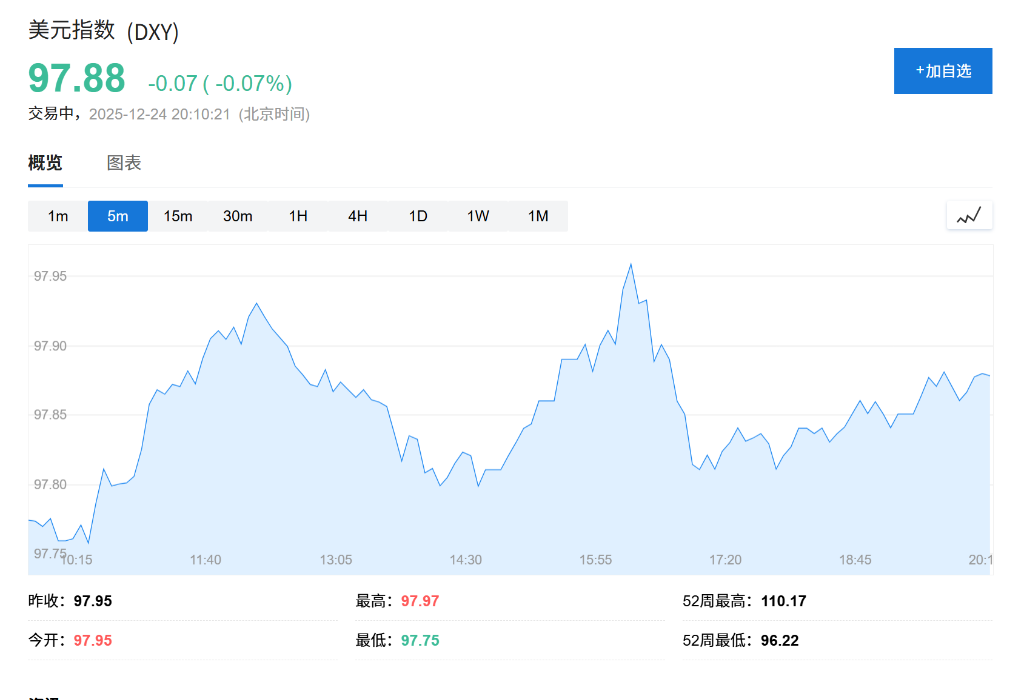
Core Viewpoint - The US dollar is experiencing a historic sell-off due to rising expectations of interest rate cuts by the Federal Reserve and hawkish stances from major global central banks, with the dollar index hitting a two-and-a-half-month low and a year-to-date decline of nearly 10% [1][4]. Group 1: US Dollar Performance - The dollar index fell to 97.767, marking a potential record annual decline since 2003, and the worst performance since 2017 [1]. - The euro has risen over 14% against the dollar this year, potentially achieving its best annual performance since 2003 [1]. Group 2: Interest Rate Expectations - Despite solid US GDP data, market expectations for interest rate cuts by the Federal Reserve remain strong, with predictions of two more 25 basis point cuts by 2026 [4][5]. - In contrast, central banks in the Eurozone, Australia, and New Zealand are signaling tightening policies, with some markets anticipating rate hikes instead of cuts [4][6]. Group 3: Currency Movements - The weakness of the dollar has led to a rise in non-US currencies, with the British pound and Australian dollar reaching multi-month highs [4]. - The Australian dollar has appreciated by 8.4% against the US dollar this year, while the New Zealand dollar has also reached a two-and-a-half-month high [6]. Group 4: Gold and Safe-Haven Assets - The depreciation of fiat currencies has driven spot gold prices to a historical high, reflecting a trend of capital flowing into safe-haven assets amid global policy uncertainty [4][9]. Group 5: Japanese Yen Intervention Risks - The Japanese yen has weakened despite a recent interest rate hike by the Bank of Japan, raising concerns about potential market intervention by Japanese authorities [10]. - The Japanese Finance Minister has indicated that the government has "free hand" in managing excessive volatility in the yen, which has temporarily halted its decline [10].

经济学家宋清辉:2026全球经济或将进入局部紧缩期
Sou Hu Cai Jing· 2025-12-23 22:07
Group 1 - The divergence in global central bank policies, with Japan raising interest rates, the European Central Bank holding steady, and the Bank of England cutting rates, may push the global economy into a localized contraction period [1][8] - The lack of a unified easing approach could lead to capital outflows from emerging markets [1][8] Group 2 - Recent U.S. employment data showed improvement, potentially linked to changes in tariff policies, but the impact of additional tariffs on prices has yet to be fully realized [6] - The U.S. economy is described as being in a "fragile balance," with cooling job markets weakening consumer wage growth [6][7] - There is an increasing likelihood of interest rate cuts by the Federal Reserve in 2026, influenced by poor employment and inflation indicators [6][7] - The potential appointment of a new Federal Reserve chair supportive of rate cuts could further solidify this trend [6][7]

深夜下跌!超9万人爆仓
Mei Ri Jing Ji Xin Wen· 2025-12-14 16:39
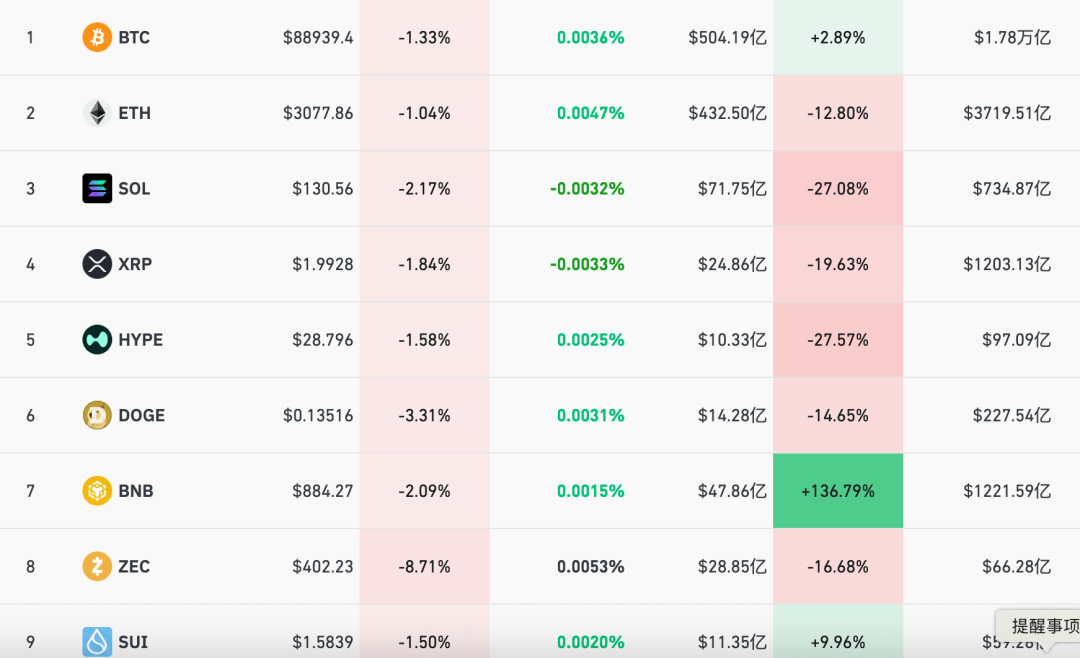
Group 1 - Global capital markets experienced a significant downturn on December 12, with declines in U.S. stocks, gold, and silver, followed by a general drop in cryptocurrencies on December 14 [1] - Bitcoin (BTC) was priced at $88,939.4, down 1.33%, with a market cap of $504.19 billion, while Ethereum (ETH) fell 1.04% to $3,077.86, with a market cap of $432.50 billion [2] - Over 92,000 liquidations occurred within 24 hours, indicating heightened volatility in the cryptocurrency market [2][3] Group 2 - Uncertainty surrounds the Federal Reserve's interest rate decisions, with Chairman Jerome Powell's stance on potential rate cuts in January remaining unclear, leading to increased speculation [3][4] - Kevin Walsh's probability of becoming the next Federal Reserve Chairman has significantly increased following endorsements from President Trump and influential figures like JPMorgan CEO Jamie Dimon, with his nomination probability rising by 17 to 24 percentage points in prediction markets [3] - The market anticipates a divergence in monetary policy among major central banks, with the Bank of Japan expected to implement a notable rate hike, contrasting with the general trend of rate cuts observed globally [4]
当美联储“独自降息”,其他央行甚至开始加息,美元贬值将成为2026年焦点
美股IPO· 2025-12-11 13:00
Core Viewpoint - The Federal Reserve has lowered interest rates by 25 basis points, and the market widely expects the Fed to maintain an accommodative policy next year, while other central banks like those in Europe, Canada, Japan, Australia, and New Zealand are generally maintaining a tightening stance [1][3]. Group 1: Federal Reserve Actions - The Federal Reserve's recent decision to lower rates by 25 basis points aligns with market expectations, indicating a dovish tone despite some hawkish signals from Fed officials [3][4]. - Major Wall Street banks, including Morgan Stanley and Citigroup, predict further rate cuts in January, with expectations of a continued easing cycle [4][5]. Group 2: Global Central Bank Divergence - There is a noticeable divergence in monetary policy among global central banks, with the Fed continuing to lower rates while others, like the European Central Bank (ECB), maintain a tightening approach [3][7]. - ECB officials have emphasized their independence from the Fed's actions, indicating that they will not necessarily follow the Fed's lead in monetary policy adjustments [7][10]. Group 3: Impact of Currency Fluctuations - The anticipated divergence in monetary policy is expected to manifest through currency markets, with the dollar facing depreciation pressure, which could influence the ECB's policy decisions [3][10]. - The ECB's chief economist noted that a 10% appreciation of the euro could significantly suppress inflation, with the most pronounced effects occurring within the first year [9][10]. Group 4: Inflation Projections - The ECB has revised its inflation forecast for 2026 down to 1.7%, below its 2% target, indicating potential challenges if the Fed's rate cuts lead to further euro appreciation [10][11]. - The ECB's policy decisions may be constrained by the transmission effects of exchange rate fluctuations on inflation, despite their stated commitment to policy independence [10][11].
澳联储鹰派信号美联储降息 澳元走势迎关键窗口
Jin Tou Wang· 2025-12-11 12:55
Group 1 - The Australian dollar (AUD) has shown strong performance against the US dollar (USD) since December 2025, driven by the divergence in monetary policies between the Reserve Bank of Australia (RBA) and the Federal Reserve (Fed) [1] - The RBA's recent hawkish stance, including maintaining the cash rate and signaling a potential for future rate hikes due to inflation concerns, has shifted market expectations [1][2] - Economic indicators in Australia, such as private demand, the real estate market, and a tight labor market, support the RBA's hawkish turn, despite previous significant declines in inflation [2] Group 2 - The divergence in global central bank policies has increased the volatility of the AUD/USD exchange rate, with market expectations for a hawkish stance from several non-US central banks [2] - The demand for Australian resources, particularly driven by global AI investment and the transition to renewable energy, has provided support for the AUD, although challenges remain, such as lower-than-expected GDP growth and productivity issues [2] - There is a general optimism among institutions regarding the future of the AUD/USD exchange rate, with predictions of potential rate hikes by the RBA in 2026 and expectations for the exchange rate to rise in the first half of next year [3]
上半年最后2次!市场降低“明年美联储降息预期”,2026将成全球央行“政策拐点”?
Hua Er Jie Jian Wen· 2025-12-10 02:31
Core Viewpoint - The market is reducing expectations for significant interest rate cuts by the Federal Reserve in 2026, while major central banks like the ECB and the Bank of Canada are facing rising rate hike expectations, potentially reshaping the global monetary policy landscape by 2026 [1][5]. Group 1: Federal Reserve's Rate Expectations - Traders now expect the Federal Reserve to cut rates by only 50 basis points in 2026, primarily concentrated in the first half of the year, a significant reduction from previous expectations of three cuts [1][2]. - The SOFR futures contracts indicate a narrowing of the expected rate cut path, with the spread between December 2025 and December 2026 contracts reaching the smallest negative value since June [2]. - Market sentiment is shifting towards a neutral stance among Treasury investors, with the 10-year Treasury yield at its highest level since September, indicating a decline in bullish momentum [2]. Group 2: Inflation Risks and Policy Implications - Analysts suggest that persistent inflation pressures could undermine the credibility of the Federal Reserve's anti-inflation measures, raising the risk of rate hikes in 2026 [2][3]. - The expectation of fiscal stimulus and unexpected growth in corporate earnings may contribute to higher inflation risks, complicating the Fed's rate cut strategy [3][4]. Group 3: Global Central Bank Divergence - In contrast to the Fed's expected rate cuts, several major central banks are anticipated to raise rates, with the ECB's likelihood of rate hikes surpassing that of cuts by 2026 [5]. - The divergence in monetary policy is partly attributed to the lesser-than-expected impact of the Trump trade war on U.S. trading partners, which may exacerbate the decline of the U.S. dollar [5].