无就业增长

Search documents
美国失业者看着账单崩溃:GDP创新高,我却连一份工作都找不到
Sou Hu Cai Jing· 2026-02-11 10:45
Economic Growth and Employment Disparity - The U.S. economy in 2026 is expected to experience high growth with low employment, characterized by a K-shaped recovery where growth benefits only a small segment of the population [1][7] - GDP growth is projected at approximately 2.8%, significantly higher than the market consensus of 2.0%, while the unemployment rate is expected to stabilize around 4.5% [1][4] Drivers of Economic Growth - The primary driver of growth is the surge in productivity driven by AI, which is expected to contribute nearly half of the GDP growth, contrasting with traditional labor expansion models [3][6] - Tax cuts from the "Inflation Reduction Act" are incentivizing companies to invest in technology and automation rather than hiring more employees, further enhancing the "machine replaces human" effect [3][6] Labor Market Dynamics - The labor supply is constrained due to immigration policy tightening and an aging population, leading to a significant decline in available workforce [5][6] - The demand side is also weak, as companies prioritize AI and automation over hiring, resulting in a low recruitment willingness and a potential "no job growth" phase [6][10] Sectoral and Regional Disparities - High-growth sectors such as AI, semiconductors, and renewable energy are thriving, while traditional industries like manufacturing and retail are struggling, leading to a concentration of high-skill jobs and a decline in low-skill positions [7][12] - The economic divide is further exacerbated by regional disparities, with tech and finance hubs on the coasts growing faster than traditional industrial areas [12] Long-term Economic Implications - The structural changes in the economy signify a shift towards a model where growth is driven by technology and capital, while employment opportunities are increasingly dependent on skills and luck [12] - The disconnect between economic growth and personal income is expected to persist, with the potential for a prolonged period of "no job growth" [10][12]


美国劳动者报酬占GDP比重跌至1947年来的最低水平
财富FORTUNE· 2026-01-28 13:07
Core Viewpoint - Despite soaring corporate profits and continuous GDP growth in the U.S., the labor force has not shared in the prosperity, with labor compensation's share of GDP declining to its lowest level since 1947 [1][2]. Group 1: Labor Market Trends - Labor compensation's share of GDP is projected to drop to 53.8% by Q3 2025, down from 54.6% in the previous quarter and below the decade average of 55.6% [1]. - The U.S. unemployment rate slightly decreased to 4.4% in December 2025, but remains higher than the 4.1% rate from a year prior, with only 584,000 new jobs added in 2025 compared to 2 million in 2024 [2]. Group 2: Economic Disparities - The contrasting performance of corporate profits and labor market data raises concerns about a "no job growth" phenomenon, exacerbating the K-shaped economic recovery where the rich get richer and the poor get poorer [4]. - The decline in labor income share is attributed to wealth distribution favoring capital, with automation replacing human jobs while productivity continues to rise [4][5]. Group 3: Automation and Job Replacement - Automation is expected to replace 25% of total work hours, with AI-driven productivity improvements potentially leading to a 6% to 7% job loss, equating to up to 1 million unemployed individuals [5]. - Despite the potential job losses from automation, new job creation from technological advancements may mitigate the impact [5]. Group 4: Immigration Policy Impact - Tightened immigration policies have led to a reduction of 881,000 foreign workers since January 2025, which has negatively affected job opportunities for domestic workers [9]. - The decrease in foreign labor contradicts claims that such policies would increase the domestic labor force, as evidenced by rising unemployment rates [9][10]. Group 5: Skills Training and Workforce Development - Addressing the automation trend and expanding the labor force requires a focus on skills training and retraining programs, which have not received adequate resources from both political parties [11][12]. - A significant increase in enrollment in vocational schools among Generation Z indicates a shift towards careers less susceptible to automation, with a 16% rise in community college enrollment for vocational programs in 2024 [11].
高盛:预计美联储2026年6月和9月各降息25个基点
Zheng Quan Shi Bao Wang· 2026-01-12 00:41
Economic Growth Forecast - Goldman Sachs projects that the US GDP growth rate will reach 2.8% by 2026, which is more optimistic than the forecasts from economists surveyed by Bloomberg [1] Inflation and Consumer Prices - The core Personal Consumption Expenditures (PCE) inflation rate is expected to reach 2.1% in December, while the core Consumer Price Index (CPI) is anticipated to slow to 2% [1] Labor Market and Employment - The unemployment rate is expected to stabilize at 4.5%, but there is a risk of "no job growth" due to companies utilizing artificial intelligence to reduce labor costs [1] Federal Reserve Interest Rate Policy - The Federal Reserve is expected to lower interest rates by 25 basis points in June and September 2026 to address uncertainties in the labor market [1] Consumer Spending and Business Investment - Tax cuts, real wage growth, and increased wealth will continue to support consumer spending, while business investment is projected to be the strongest component of GDP in 2026, benefiting from loose financial conditions, reduced policy uncertainty, and tax incentives [1] Political Landscape - In the upcoming midterm elections, the cost of living is expected to be a major political issue, leading the White House to avoid further significant tariff increases [1]
美国迎来2011年以来最疲软就业市场
财富FORTUNE· 2026-01-09 13:05
Core Viewpoint - The current U.S. labor market is characterized by "low hiring, low layoffs," indicating a new normal rather than a temporary fluctuation, with economic growth strong but employment data stagnating [2][5]. Group 1: Employment Market Analysis - The U.S. employment market is experiencing its weakest performance since 2011, with an average of only 17,000 new jobs added monthly over the past six months, the lowest since the global financial crisis [2]. - The private sector has seen a slightly better performance, averaging 44,000 new jobs monthly, but this is still at a decade-low level [2]. - The U6 unemployment rate has risen to 8.7%, and the number of job openings per unemployed person has dropped to 1.0, both reaching their lowest levels since 2017 [2]. Group 2: Economic Growth and Consumer Behavior - The U.S. GDP annualized growth rate reached 4.3% in the third quarter, driven by a surge in consumer spending and a $166 billion increase in corporate profits [6]. - However, real disposable income for households has stagnated, indicating that consumer spending is being maintained through savings depletion, borrowing, and cutbacks in spending [6]. Group 3: K-Shaped Recovery - The U.S. economy is entering a K-shaped growth phase, where affluent households benefit from stock market gains and property appreciation, while lower-income families face affordability pressures and stagnant real incomes [6]. - Companies are finding ways to grow without hiring more staff, focusing on productivity improvements rather than expanding their workforce [7]. Group 4: Long-term Labor Market Trends - Goldman Sachs warns of a "no job growth" scenario, where despite rising output, most industries, except healthcare, are experiencing stagnant or negative job growth [7][10]. - The impact of artificial intelligence on labor demand is expected to create long-term headwinds for job growth, as companies increasingly focus on reducing labor costs [7][10]. - The demographic shift, including declining birth rates and an aging population, is expected to limit labor supply contributions to economic growth [8].


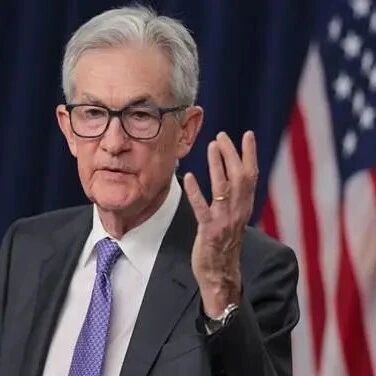
就业市场陷“停滞危机”,穆迪警告:美国经济已站在悬崖边缘
Jin Shi Shu Ju· 2025-12-17 08:40
Core Viewpoint - The U.S. labor market is not collapsing but has entered a stagnation phase, showing no significant growth or decline, with non-farm payrolls increasing modestly by 64,000 in November after a decrease of approximately 105,000 in October, and the unemployment rate rising to 4.6%, the highest in four years [1][2]. Group 1 - The stagnation in the labor market is more dangerous than it appears, as there is a complete lack of forward momentum, with net hiring showing minimal progress throughout the year [2]. - The unemployment rate continues to rise despite a growing labor force, indicating weak demand rather than mass layoffs or hiring freezes [2][5]. - Goldman Sachs analysts have warned that the U.S. is entering a "no job growth" phase, where productivity is replacing labor, potentially leading to long-term resistance to labor demand [3]. Group 2 - Since the beginning of the year, the unemployment rate has increased by approximately 0.6 percentage points, which, although gradual, has significant implications [4]. - The economy is still growing, supported by structural productivity improvements and significant investments in artificial intelligence, allowing businesses to increase output without significantly increasing headcount [5]. - There has been a notable increase in the number of people working part-time for economic reasons, rising by nearly 1 million to 5.5 million in November, indicating a trend of reduced hours or inability to find full-time work [5][6]. Group 3 - The stagnation in job creation could be as dangerous as a recession, as rising unemployment may undermine consumer confidence over time [6]. - The risk of an economic recession is concerning, with the current economic stability partly due to the AI investment boom, which has bolstered household wealth [7]. - If the boost from AI investments diminishes, the economy may struggle to find new growth drivers, potentially leading to recession risks [8].
热点思考 | 两个美国:“K型经济”的成因与出路(申万宏观·赵伟团队)
Sou Hu Cai Jing· 2025-12-14 17:41
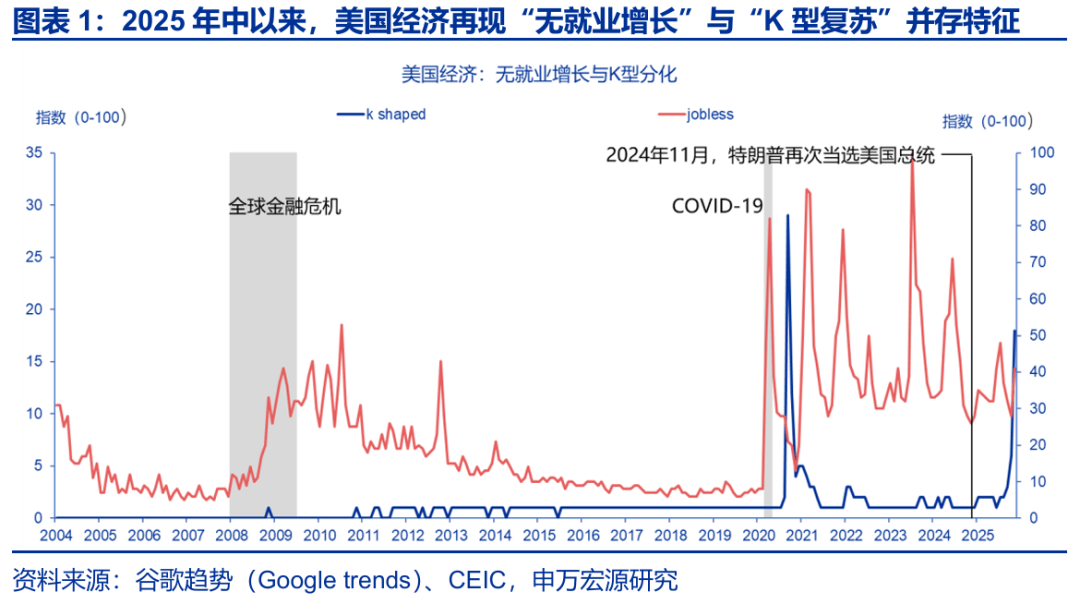
Group 1 - The core viewpoint of the article discusses the emergence of "jobless growth" and "K-shaped recovery" in the U.S. economy since mid-2025, questioning whether the economy can escape these characteristics in 2026 [1][4][77] - The U.S. economy has shown structural imbalances characterized by "jobless growth" and "K-shaped economy," with non-farm payrolls declining significantly since early 2025, averaging only 18,000 new jobs per month from June to August, far below historical non-recession averages [1][5][77] - The "K-shaped economy" reflects a divergence in consumption, employment, wages, and wealth, where high-income households experience significantly higher consumption growth compared to low-income households [20][30][67] Group 2 - The causes of the "K-shaped economy" are identified as a combination of economic slowdown, monetary easing, the impact of Trump's policies, and a structural bull market in U.S. stocks, with "jobless growth" being a primary factor [2][43][64] - The labor market has become increasingly relaxed, with low-wage groups feeling the economic downturn first and recovering last, indicating a structural issue in income and wealth distribution [2][53][67] - The article highlights that the "K-shaped gap" is difficult to bridge, raising the question of whether growth will be inclusive or if recession will eliminate wealth [3][77][94] Group 3 - The article posits that the U.S. economy is in a late cycle, with a shift from labor-driven growth to capital and technology-driven growth, leading to a decline in job opportunities and stagnant income growth [40][53][77] - The impact of tariffs and immigration policies has contributed to the decline in job creation, with a significant portion of the slowdown attributed to government layoffs and the effects of tariffs on employment [56][59][64] - The long-term trend of income and wealth inequality in the U.S. has been exacerbated since the 1980s, with the top 1% of income earners capturing a larger share of wealth, indicating a systemic issue in wealth distribution [67][94]
热点思考 | 两个美国:“K型经济”的成因与出路(申万宏观·赵伟团队)
赵伟宏观探索· 2025-12-14 16:20
Group 1 - The core viewpoint of the article is that since mid-2025, the U.S. economy has exhibited characteristics of "jobless growth" and a "K-shaped recovery," raising questions about whether the economy can transition out of this K-shaped feature in 2026, either through jobless growth dragging down overall growth or high growth leading to full employment [2][5][89] Group 2 - The U.S. economy has been experiencing structural imbalances characterized by "jobless growth" and a "K-shaped economy" since early 2025, with non-farm payrolls declining to an average of 18,000 per month from June to August 2025, significantly below historical non-recession averages [2][6][89] - The K-shaped economy is marked by disparities in consumption, employment, wages, and wealth, where high-income households see significantly higher consumption growth compared to low-income households, and the wealth gap continues to widen [2][23][89] Group 3 - The causes of the K-shaped economy include economic slowdown, monetary easing, the impact of Trump's policies, and a structurally bullish stock market, with "jobless growth" being a primary factor contributing to the K-shaped economy [3][50][89] - The labor market has become more relaxed, with low-wage groups being the first to feel the economic downturn and the last to benefit from recovery, indicating that the U.S. economy has entered a late cycle [3][62][89] Group 4 - The article discusses the difficulty in bridging the K-shaped gap, suggesting that the U.S. economy may not significantly improve in 2026, with a potential shift from "jobless growth" to "low employment growth," but the K-shaped characteristics may persist due to a weak labor market balance [4][90][89] - Historically, the K-shaped recovery phenomenon has been observed after previous recessions, where unemployment rates remained high during recovery phases, indicating a pattern that may repeat in the current economic context [4][90][89] Group 5 - The article highlights that the K-shaped characteristics of the U.S. economy are not merely cyclical but trend-based, with significant structural forces at play since the 1980s, leading to increasing income and wealth inequality [4][77][89] - The wealth distribution has become increasingly concentrated, with the top 20% of households holding 71% of net assets and 87% of corporate equity and mutual fund assets, while the bottom 20% hold only about 3% [35][89]

两个美国:“K 型经济”的成因与出路
Shenwan Hongyuan Securities· 2025-12-14 12:02
Economic Characteristics - Since mid-2025, the U.S. economy has exhibited "jobless growth" with an average monthly non-farm employment increase dropping to 18,000, significantly below the historical average of 109,000 during non-recession periods[1][12] - The U.S. economy is experiencing a "K-shaped economy," characterized by diverging consumption, employment, wages, and wealth, where high-income households see consumption growth significantly outpacing that of low-income households[1][2] Causes of K-shaped Economy - The "jobless growth" phenomenon is attributed to structural imbalances in the economy, including economic slowdown, monetary easing, and the impacts of Trump's policies on immigration and tariffs, alongside a structural bull market in U.S. stocks[2][42] - The labor market has become increasingly relaxed, with low-wage groups feeling the economic downturn first and recovering last, leading to a widening gap in income and wealth distribution[2][43] Long-term Trends - The K-shaped characteristics of income and wealth distribution in the U.S. have been developing since the 1980s, with real labor income growth lagging behind productivity growth, reflecting the rise of capital and technology over labor[2][62] - The wealth distribution is heavily skewed, with the top 20% of households holding 71% of net assets and 87% of corporate equity and mutual fund assets, while the bottom 20% hold only about 3%[2][31] Future Outlook - The U.S. economy may transition from "jobless growth" to "low employment growth" in 2026, but the K-shaped characteristics are unlikely to change significantly due to a persistently relaxed labor market and continued expansion of AI capital expenditures[3][68] - Historical cases of "jobless recovery" indicate that total demand must expand to elevate labor demand and tighten the labor market, a path that may be challenging to achieve in the current economic climate[3][68]
两个美国:“K型经济”的成因与出路
Shenwan Hongyuan Securities· 2025-12-14 09:29
Economic Overview - Since mid-2025, the U.S. economy has exhibited characteristics of "jobless growth" and a "K-shaped economy," with non-farm employment numbers declining to an average of 18,000 per month from June to August, significantly below the historical average of 109,000 during non-recession periods[1][15] - The GDP growth rate remains robust, supported by AI capital expenditures, despite the lack of job growth[1][21] K-shaped Economy Characteristics - The K-shaped economy is marked by a divergence in consumption, employment, wages, and wealth, where high-income households experience significantly higher consumption growth compared to low-income households[1][26] - For instance, the spending growth difference in air travel and furniture between high and low-income families reached 10.5 and 10.2 percentage points, respectively, as of November 1[1][27] Causes of K-shaped Economy - The "jobless growth" phenomenon is attributed to structural imbalances in the economy, including the late-cycle economic phase, monetary easing, and the impacts of Trump's policies on immigration and tariffs[2][45] - Since the 1980s, the growth of real labor income has lagged behind productivity growth, indicating a long-term trend of increasing income and wealth inequality[2][66] Labor Market Dynamics - The labor market has transitioned from a tight supply to a surplus, with the Labor Market Conditions Index (LMCI) dropping from a peak of 1.46 in January 2022 to 0.25 by August 2025, indicating a loosening labor market[2][51] - The unemployment rate for marginalized groups, such as low-education and minority populations, has risen significantly, while the unemployment rate for white individuals remains low[2][46] Future Economic Outlook - In 2026, the U.S. economy is expected to shift from "jobless growth" to "low employment growth," but the K-shaped characteristics may persist due to a weak labor market balance[3][81] - The equilibrium employment number has decreased to 30,000-80,000 jobs per month, suggesting that maintaining a low unemployment rate will not necessarily lead to a return to high employment growth[3][83]
海外高频 | 美联储FOMC会议偏鸽,关注下周经济数据(申万宏观·赵伟团队)
申万宏源宏观· 2025-12-14 09:24
Group 1 - The Federal Reserve's December FOMC meeting was dovish, with a 25 basis point rate cut and a restart of asset purchases, indicating a cautious approach to monetary policy [2][69][73] - The Eurozone's fiscal stance for 2026 is projected to remain neutral, with a deficit rate of 3.2% in 2025 and 3.3% in 2026, alongside a slight increase in government debt from 88.8% to 89.8% [63][64] - The U.S. job market remains resilient, with October JOLT job openings at 7.67 million, exceeding market expectations of 7.12 million [73] Group 2 - Developed market stock indices showed mixed performance, with the S&P 500 down 0.6% and the Nasdaq down 1.6%, while emerging markets generally saw gains [3][8] - The 10-year U.S. Treasury yield rose by 5.0 basis points to 4.19%, reflecting a trend of increasing yields across developed nations [17][23] - Commodity prices mostly declined, with WTI crude oil down 4.4% to $57.4 per barrel and COMEX gold up 2.5% to $4,302.7 per ounce [45][51] Group 3 - The dollar index fell by 0.6% to 98.40, while the offshore yuan appreciated to 7.0535 against the dollar [29][39] - The Eurozone's defense spending exemption is expected to increase government expenditures, contributing to the overall fiscal dynamics [63] - The U.S. economy is projected to grow at a rate of 3.6% in the third quarter, indicating stability despite rising initial jobless claims [75]