
流动性调控

Search documents
呵护节前流动性 央行开展3114亿元逆回购
Xin Lang Cai Jing· 2026-02-10 21:07
央行多重操作"呵护"下,2月10日,市场资金面边际转松,银存间1天质押式回购(DR001)开盘报 1.3%,上日加权平均价报1.3347%;银存间7天质押式回购(DR007)开盘报1.47%,上日加权平均价报 1.4909%。 多位专家认为,央行的一系列操作,确保了节前流动性压力整体可控,市场有望平稳跨年。东方金诚首 席宏观分析师王青表示,央行灵活搭配各类工具进行调控,预计本周市场流动性收紧幅度将低于往年同 期。 在此背景下,央行近日的公开市场操作,展现出了前瞻布局与灵活调控的特征。为提前对冲春节长假的 影响,央行已于2月5日和6日连续两日各投放3000亿元14天期逆回购,直接覆盖跨节资金需求。本周 内,若14天期工具保持适度力度,叠加今日大幅加量的7天期逆回购,央行投放的跨节资金总量将能有 效匹配甚至覆盖预估的资金缺口。这种"7天+14天"逆回购工具的灵活搭配,确保了短期流动性供给的充 足与期限结构的合理。 (来源:经济参考报) 临近春节,中国人民银行公开市场操作力度显著加大。2月10日,央行以利率招标方式开展了3114亿元7 天期逆回购操作,中标利率维持在1.40%不变。鉴于当日有1055亿元逆回购到期, ...
央行连续加量续作MLF,全年净投放超1万亿元
Sou Hu Cai Jing· 2025-12-25 23:52
Core Viewpoint - The People's Bank of China (PBOC) continues to signal stable liquidity in the market by increasing the Medium-term Lending Facility (MLF) operations, ensuring a net injection of funds to support the financial market's stability as the year-end approaches [1] Group 1 - In December, the PBOC conducted a 177.1 billion yuan 7-day reverse repurchase operation at a fixed rate of 1.4% [1] - On the same day, 88.3 billion yuan in 7-day reverse repos and 300 billion yuan in MLF were set to mature, while the PBOC implemented a 400 billion yuan MLF operation, resulting in a total net injection of 188.8 billion yuan [1] - Experts indicate that the continued increase in MLF operations in December aims to provide mid-term liquidity to ensure smooth financial market operations at the year's end [1] Group 2 - The total net injection from MLF operations for the entire year of 2025 is projected to exceed 1 trillion yuan, indicating ongoing support for market liquidity [1]
400亿债券发行背后,财政部在下一盘什么大棋?
Sou Hu Cai Jing· 2025-12-03 09:51
Core Viewpoint - The issuance of short-term bonds by the Ministry of Finance reflects a strong demand in the market and indicates a strategic adjustment in monetary policy to manage liquidity effectively [1][3][5]. Group 1: Short-term Bond Issuance - The Ministry of Finance recently issued 63-day bonds with a scale of 40 billion yuan and an issuance rate of 1.2891%, which is lower than market expectations of 1.2400% [1]. - The issuance of 91-day bonds was also noted, with a scale of 55 billion yuan and a rate of 1.2675%, again below the expected 1.2900% [1]. - The total issuance of 63-day bonds since May has reached 115 billion yuan, with June alone accounting for 34% of the annual plan [3]. Group 2: Market Demand and Liquidity - The high bid-to-cover ratio of 2.45 indicates strong institutional demand for short-term bonds, suggesting a robust appetite for these financial instruments [1]. - The current liquidity environment is characterized by a low financing cost of around 1.2%, which is 30 basis points lower than the rates for commercial bank interbank certificates [5]. - The issuance strategy aims to absorb excess liquidity while providing a signal for future monetary policy adjustments [6]. Group 3: Strategic Implications - The issuance of short-term bonds serves multiple purposes: it covers 23% of the maturing medium-term lending facility (MLF) in June, sets a policy interest rate ceiling, and reserves space for potential acceleration of special bonds [6]. - The Ministry's approach of adjusting the issuance scale and rates is designed to maintain a balance between short-term liquidity management and long-term financing needs [8]. - The recent behavior of the bond market, including the narrowing of the yield spread between different maturities, indicates a strategic maneuver by the Ministry to prevent excessive leverage while supporting long-term financing costs [7].


8000亿元买断式逆回购落地 利率仍现上行
Bei Jing Shang Bao· 2025-11-18 03:15
Core Viewpoint - The People's Bank of China (PBOC) is implementing a series of liquidity operations to maintain a stable monetary environment, with a focus on increasing liquidity while keeping interest rates steady [1][2][3]. Group 1: Liquidity Operations - On November 17, the PBOC conducted a 1.40% fixed-rate reverse repurchase operation of 283 billion yuan for 7 days, resulting in a net injection of 163.1 billion yuan after 119.9 billion yuan of reverse repos matured [1]. - The PBOC also executed an 800 billion yuan 6-month buyout reverse repo operation, which added 500 billion yuan to the existing liquidity, continuing the trend of increased liquidity management [1][2]. - In November, the PBOC's net injection through buyout reverse repos reached 500 billion yuan, marking a 100 billion yuan increase from October and the sixth consecutive month of increased operations [2]. Group 2: Interest Rate Trends - The Shanghai Interbank Offered Rate (Shibor) has shown an upward trend since November 13, with the overnight rate rising from 1.3150% to 1.5080%, an increase of 19.3 basis points [1]. - The 7-day Shibor increased from 1.4740% to 1.5140%, while the 1-month Shibor saw a slight rise from 1.5180% to 1.5200% [1]. - The PBOC aims to maintain a balance in liquidity, indicating that while short-term funding may experience tension, the overall liquidity remains reasonable [2]. Group 3: Monetary Policy Outlook - The PBOC's third-quarter monetary policy report emphasizes the need for moderately loose monetary policy, aiming to keep social financing conditions relatively loose [3]. - Analysts suggest that a new round of reserve requirement ratio (RRR) cuts may occur before the end of the year, driven by external environment fluctuations and domestic economic conditions [3]. - The focus for the fourth quarter will be on "quantity and price coordination" and structural effectiveness, utilizing tools like buyout reverse repos and medium-term lending facilities (MLF) to optimize credit structure [4].

8000亿元买断式逆回购落地利 率仍现上行
Bei Jing Shang Bao· 2025-11-17 16:47
Core Viewpoint - The People's Bank of China (PBOC) is actively managing liquidity through various operations, indicating a trend towards maintaining stable interest rates while ensuring sufficient liquidity in the market [1][4][5]. Group 1: Liquidity Operations - On November 17, the PBOC conducted a fixed-rate reverse repo operation of 2,830 billion yuan at a rate of 1.40%, resulting in a net injection of 1,631 billion yuan after accounting for 1,199 billion yuan maturing [1]. - The PBOC also executed an 800 billion yuan six-month buyout reverse repo operation, increasing the amount by 500 billion yuan, continuing the trend of enhanced liquidity management [1][4]. Group 2: Interest Rate Trends - Since November 13, the Shanghai Interbank Offered Rate (Shibor) has shown an upward trend, with the overnight rate rising from 1.3150% to 1.5080%, an increase of 19.3 basis points [3]. - The seven-day Shibor increased from 1.4740% to 1.5140%, while the one-month Shibor saw a slight rise from 1.5180% to 1.5200% [3]. Group 3: Economic Context and Policy Outlook - The recent rise in funding rates is attributed to factors such as tax periods, government bond payments, and the impact of the "Double 11" shopping festival, which temporarily tightened liquidity in the banking system [3][4]. - The PBOC aims to provide a stable medium-term funding environment while maintaining reasonable liquidity, as indicated in its third-quarter monetary policy report [4]. - Analysts suggest that a new round of reserve requirement ratio (RRR) cuts may occur before the end of the year, driven by external economic fluctuations and domestic growth dynamics [5]. - The fourth quarter is expected to see continued moderate easing of monetary policy, focusing on coordinated volume and price strategies [6].

国泰海通|固收:买卖国债如何理解:从“长”计议
国泰海通证券研究· 2025-10-28 12:00
Core Viewpoint - The resumption of government bond trading is more significant for long-term logic than for short-term market points, indicating a potential shift in monetary policy and market stability [1][2]. Group 1: Short-term Market Reactions - The People's Bank of China (PBOC) announced the resumption of government bond trading, which may serve as a response to recent market conditions and the Fourth Plenary Session's directives [1]. - The bond market showed a stronger performance in long-term bonds compared to short-term ones, with 10-year and 30-year government bonds declining over 5 basis points [1]. - The strengthening of the RMB in the night market suggests that foreign capital may interpret the resumption as an expansionary economic stimulus policy [1]. Group 2: Long-term Implications - The primary significance of resuming government bond trading is to provide a safety net for the bond market, establishing an upper limit on long-term interest rates and enhancing the safety cushion for long-term bond investments [2]. - The resumption allows for better coordination with fiscal policies, especially as government leverage increases, preventing rapid upward movement of bond market interest rates that could constrain fiscal space [2]. Group 3: Flexible Operations Post-Resumption - The operations following the resumption of government bond trading are expected to be more flexible, with uncertainty regarding the pace, direction, duration, and scale of transactions [3]. - The approach may resemble the reform of reverse repos and MLF, allowing for adjustments based on market conditions rather than a fixed strategy [3]. Group 4: Broader Market Impact - The resumption of government bond trading is not only beneficial for the bond market but is also expected to support the stock market in the medium to long term [4]. - The fundamental nature of government bond trading as a liquidity management tool can complement fiscal issuance, potentially benefiting equity assets in a broader economic context [4]. - The current bond market conditions validate the expectation of a "weak front, strong back" scenario for the fourth quarter, with opportunities for capital gains in long-term bonds [4].


国泰海通 · 晨报1029|买卖国债如何理解:从“长”计议
国泰海通证券研究· 2025-10-28 12:00
Core Viewpoint - The resumption of government bond trading by the People's Bank of China (PBOC) is seen as a significant move to stabilize the bond market and provide a safety net for long-term interest rates, enhancing the attractiveness of long-term bond investments and trading opportunities [4][5]. Group 1: Short-term Market Reactions - The recent announcement of resuming government bond trading comes amid a strong stock market and stable bond market, indicating a potential response to the Fourth Plenary Session's directives [4]. - The bond market's short-term reaction shows that long-term bonds (10-year and 30-year) have seen yields drop by over 5 basis points, reflecting accumulated bullish sentiment rather than immediate PBOC actions [4]. - The strengthening of the RMB in the night market suggests that foreign investors may interpret the resumption of bond trading as an expansionary economic stimulus policy [4]. Group 2: Long-term Implications - The primary significance of resuming government bond trading is to provide insurance for the bond market, establishing an upper limit on long-term interest rates and improving the safety cushion for long-term bond investments [5]. - The PBOC's stance indicates a favorable overall bond market pricing, which opens up space for downward adjustments in long-term interest rates while maintaining control over potential disturbances from a strengthening stock market [5]. - In the context of increasing fiscal efforts and government leverage, the bond market's interest rate center should not rise too quickly, necessitating PBOC's bond purchases to support liquidity [5]. Group 3: Flexible Operations Post-Resumption - The operations of government bond trading post-resumption are expected to be more flexible, with uncertainty regarding the timing, direction, duration, and scale of transactions [6]. - The approach may resemble the reform of reverse repos and Medium-term Lending Facility (MLF), allowing for adjustments based on market conditions rather than fixed strategies [6]. - Given the ample medium- to long-term funding already available, the release of significant funds through government bond trading is not anticipated, limiting the speculative value of short-term bonds [6]. Group 4: Broader Market Impact - The resumption of government bond trading is not only beneficial for the bond market but is also expected to support the stock market in the medium to long term [7]. - As a liquidity management tool, government bond trading can complement fiscal issuance, potentially benefiting equity assets under conditions of liquidity easing and fiscal stimulus [7]. - The short-term bond market is expected to validate the assessment of a "weak front, strong back" scenario for the fourth quarter, with the current 30-10 bond yield spread still having room for convergence [7].

DLS MARKETS:美银准备金持续下降,美联储面临流动性调控挑战
Sou Hu Cai Jing· 2025-10-24 03:43
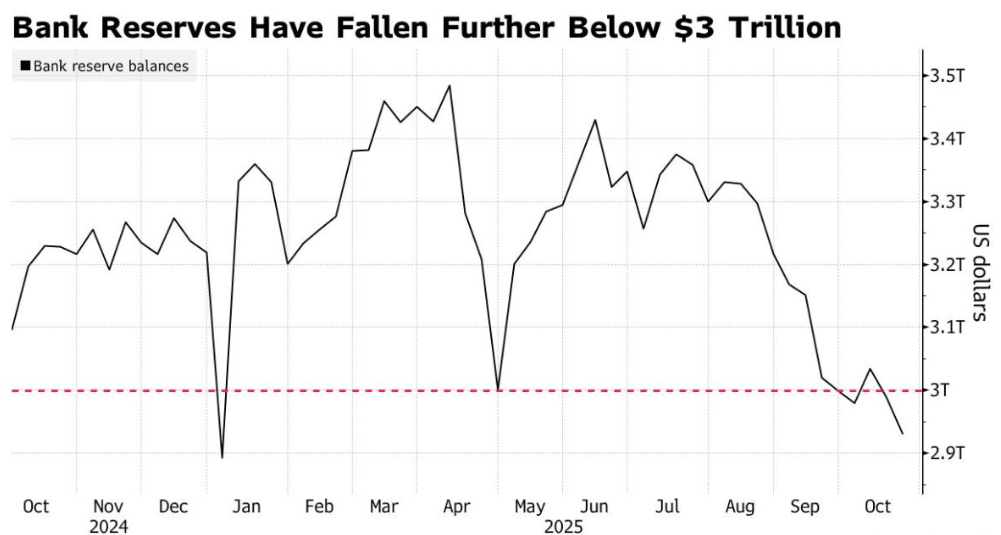
Group 1 - The scale of reserves in the US banking system is continuously declining, recently falling below the important threshold of $3 trillion for two consecutive weeks, reaching a low of $2.93 trillion as of the week ending October 22, which is the lowest level since January of this year [1] - A significant reason for the decrease in reserves is the US government's increased bond issuance to replenish the treasury cash following the debt ceiling increase, which is tightening market liquidity [3] - The tightening of liquidity is reflected not only in the decline of reserves but also in the fluctuations of money market rates, indicating that the banking system's reserves are shifting from "ample" to "tight" [3] Group 2 - The usage of the Federal Reserve's reverse repurchase tool, which was once a "reservoir" to alleviate excess funds, is also shrinking, indicating a further tightening of overall liquidity [4] - The Federal Reserve's balance sheet is approximately $6.6 trillion, and it continues to withdraw funds from the market through its "quantitative tightening" policy [4] - Federal Reserve Chairman Powell's recent statement that "bank reserves are slightly above ample levels" is seen as a significant signal, with the "ample level" referring to the minimum reserve scale needed for stable financial system operation [4]
大会期间资金平稳或仍占主导
Tianfeng Securities· 2025-10-19 03:43
1. Report Industry Investment Rating - Not provided in the given content 2. Core Viewpoints - The funding situation has entered a comfortable state again in mid - early October, with limited disturbances and many supporting factors, and it is expected to remain stable next week [1][21] - Historically, funding disturbances in October are mainly concentrated in the second half, but important meetings have limited direct impact on the funding situation. This year, the funding situation is expected to maintain a seasonal stable state [20][21] 3. Summary by Directory 3.1 Next Week's Funding Still Expected to Be Stable - In mid - early October, the funding situation entered a comfortable state, with factors like holiday cash withdrawal funds flowing back, fiscal expenditures in place, and significant net long - term liquidity injection from the central bank [1][11] - Historically, funding disturbances in October are mainly in the second half due to tax payments and cross - month pressures. Important meetings in October in recent years have limited impact on the funding situation [17][20] - This year, the funding situation is expected to be seasonally stable. Next week's disturbances are limited, mainly government bond issuances on Monday and Friday, and relatively high certificate of deposit maturities on Tuesday and Friday. The central bank's precise control is expected to keep the funding situation loose [21] 3.2 Open Market: Next Week's Maturity Scale to Decline - From 10/13 - 10/17, the open - market net injection was - 6979 billion yuan. From 10/20 - 10/24, the open - market maturity is 7891 billion yuan [3][27] 3.3 Government Bonds: To Issue Over 800 Billion Yuan Next Week - From 10/13 - 10/17, government bonds were issued worth 3083 billion yuan. From 10/20 - 10/24, the planned issuance is 8802 billion yuan, with net treasury bond payment of 21.6 billion yuan and net local bond payment of 136.7 billion yuan [4][36] 3.4 Excess Reserve Tracking and Forecast - It is predicted that the excess reserve ratio in October 2025 will be about 1.43%, a month - on - month decrease of about 0.42 pct and a year - on - year decrease of 0.33 pct [40] 3.5 Money Market: Large Banks' Lending Willingness Continues to Recover - Most funding interest rates declined. As of 10/17, compared with 10/10, DR001 rose 0.21 BP, DR007 fell 1.44 BP, R001 rose 3.83 BP, and R007 fell 1.65 BP [5] - The average net lending of the banking system's funds was 4.07 trillion yuan, with state - owned large banks' average net lending at 4.38 trillion yuan, and the overnight lending ratio at 97% [5] 3.6 Interbank Certificates of Deposit 3.6.1 Primary Market: Issuance Scale to Increase - From 10/13 - 10/17, the total issuance of interbank certificates of deposit was 727.6 billion yuan, with a net financing of 23.4 billion yuan, an increase compared to 10/9 - 10/11 [6] - Next week (10/20 - 10/26), the maturity scale of interbank certificates of deposit is 603 billion yuan, an increase of 109.4 billion yuan compared to this week [76] 3.6.2 Secondary Market: Yields to Rise Slightly - Yields of certificates of deposit of all maturities rose. Yields of 1M, 3M, 6M, 9M, and 1Y AAA - rated certificates of deposit changed by 3, 3, 2, 1, 0 BP respectively [90]
央行提前“补水”流动性平稳跨季无忧
Zhong Guo Zheng Quan Bao· 2025-09-29 20:45
Group 1 - The People's Bank of China (PBOC) conducted a 7-day reverse repo operation of 288.6 billion yuan, resulting in a net injection of 48.1 billion yuan after 240.5 billion yuan matured on the same day [1] - The PBOC is expected to continue using various monetary policy tools to maintain ample liquidity, especially considering the upcoming National Day holiday and quarter-end factors [1][2] - Recent actions by the PBOC, including significant mid-term liquidity injections, aim to enhance the precision and effectiveness of liquidity management [1] Group 2 - The PBOC's two 14-day reverse repo operations within a week indicate its intention to ensure stable liquidity across the quarter [2] - Experts predict that the central bank may flexibly use multiple monetary policy tools to keep liquidity abundant, with expectations for a decrease in the central rate of funding in October compared to September [2] - The PBOC aims to support consumption and effective investment while maintaining financial market stability and ensuring the RMB exchange rate remains stable [2]