资产配置再平衡

Search documents
债市日报:2月12日
Xin Hua Cai Jing· 2026-02-12 08:13
Core Viewpoint - The bond market shows slight differentiation in performance, with government bond futures experiencing a decline while interbank bond yields continue to decrease, indicating a "warm yet restrained" market sentiment ahead of the Spring Festival [1][4]. Market Performance - Government bond futures closed with half of the contracts down; the 30-year main contract fell by 0.03% to 112.7, while the 10-year main contract rose by 0.02% to 108.585 [2]. - Interbank bond yields generally decreased, with the 10-year government bond yield down by 1 basis point to 1.776% and the 30-year government bond yield down by 0.15 basis points to 2.2255% [2]. Overseas Bond Market - In North America, U.S. Treasury yields rose across the board, with the 2-year yield increasing by 6.41 basis points to 3.512% [3]. - In Asia, Japanese bond yields fell, with the 5-year and 10-year yields down by 0.4 basis points and 1.2 basis points, respectively [3]. - In the Eurozone, yields on 10-year bonds from France, Germany, Italy, and Spain all decreased, indicating a general trend of declining yields [3]. Liquidity Conditions - The central bank conducted a net injection of 448 billion yuan through reverse repos, with a total of 1665 billion yuan in 7-day reverse repos and 4000 billion yuan in 14-day reverse repos [4]. - The Shibor rates for short-term instruments mostly declined, with the overnight rate rising slightly by 0.2 basis points to 1.368% [4]. Institutional Perspectives - Citic Securities noted that while CPI remains low, PPI is steadily rising, which may have a marginal impact on bond market pricing; the sentiment-driven bond market may continue to show slight strength until the Spring Festival [5]. - Shenwan Hongyuan indicated that the bond market may enter a phase of compressed spreads, with ongoing market dynamics influenced by the balance of asset allocation and the potential for capital to flow from bonds to equities [6].
近期市场反馈及思考10:配置盘主导的债券行情如何演绎?
Shenwan Hongyuan Securities· 2026-02-11 13:11
Group 1 - The bond market in January was characterized by a correction of pessimistic expectations rather than a reinforcement of easing expectations, with banks and insurance companies increasing their allocation while brokers and funds sold off [9][10] - The bond market may enter a phase of compressed spreads, with various types of spreads being targeted for excess returns, as the market approaches critical points without clear negative signals [10][11] - The core factors driving the configuration-led market include the ability of funding costs and deposit rates to decrease further, and whether the 10-year government bond can break through key levels [10][11] Group 2 - The primary contradictions in the bond market include asset allocation rebalancing, capital outflow from the stock market, and expectations of rising prices, with the first two being the most critical [11][12] - The relationship between stocks and bonds in 2026 continues to reflect a rebalancing of asset allocation, with the stock market showing signs of strength but still needing to monitor capital flows into equities [14][15] - The insurance sector is shifting its liabilities towards dividend insurance, which may affect its preference for long-term bonds, while fixed-income funds are facing challenges in attracting new liabilities [14][17] Group 3 - The continuous decline in the scale of credit bond ETFs since the beginning of the year, with a drop of 101 billion to 514.2 billion, indicates a potential stabilization as selling pressure eases and valuation improves [21][22] - The strong performance of perpetual bonds in early January can be attributed to several factors, including easing valuation pressures and increased demand from insurance companies [24] - The current credit strategy suggests extending duration to 3-5 years for high-grade bonds, while focusing on specific sectors and grades that offer value [25] Group 4 - The core theme in the convertible bond market is pricing elasticity, with demand remaining high despite supply constraints due to maturing bonds and strong redemption expectations [26][29] - The strategy for convertible bonds emphasizes the importance of maintaining adequate positions to achieve relative returns, as low positions may hinder performance [27] - Excess returns in the convertible bond market are expected to come from elastic varieties, particularly those with low premium rates and smaller market caps [29]
备战巨量到期资金,“固收+”策略成新宠
中国基金报· 2026-01-16 12:44
Core Viewpoint - A significant competition for over 30 trillion yuan in maturing deposits has begun, with "fixed income +" becoming a favored choice for bank wealth management products as investors seek low-volatility and stable returns [2][3]. Group 1: Market Dynamics - Since the end of September 2024, despite a temporary recovery in equity markets and strong performance in assets like gold, investors continue to prefer low-volatility wealth management products [2]. - The estimated maturing deposits in 2026 include approximately 20.7 trillion yuan from two-year deposits, 9.6 trillion yuan from three-year deposits, and 2.0 trillion yuan from five-year deposits, totaling around 32 trillion yuan [4]. - Major financial institutions are eager to capture this wealth, with bank wealth management and insurance products being key contenders [5]. Group 2: Product Trends - In 2024, the top 14 wealth management companies saw nearly 4 trillion yuan growth in low-volatility, shorter-duration open-ended products, with a further increase of over 3 trillion yuan in the first 11 months of 2025, accounting for nearly 90% of the overall growth in wealth management scale [5]. - The "fixed income +" strategy has emerged as a crucial choice for investors aiming for stable growth in a low-interest-rate environment [8]. - As of September 30, 2025, the growth rate of "fixed income +" funds (including first and second-tier bond funds and bond-mixed funds) reached 39.5%, while pure bond funds experienced a decline of 10% [8]. Group 3: Asset Allocation - With the stock market showing steady growth in 2025, the risk-return profile of equity assets has significantly improved, with the Sharpe ratio rising from 0.21 in 2024 to nearly 1 [6]. - The demand for 10-year government bonds has shifted from trading desks to banks, which are now the primary players in pricing, contributing to a stabilization effect in the market [8]. - Analysts predict that wealth management companies will further expand their offerings of products with equity components, while maintaining a solid base of low-volatility products [9].


备战巨量到期资金,“固收+”策略成新宠
Zhong Guo Ji Jin Bao· 2026-01-16 12:44
Core Insights - A significant competition for over 30 trillion yuan in maturing deposits has begun, with "fixed income +" becoming a favored choice for bank wealth management products [1][2] - Investors are showing a preference for low-volatility and stable financial products despite a recovery in equity markets and strong performance in assets like gold [1] - The bond market has experienced a notable shift in style, with the pricing power of 10-year government bonds transitioning from trading desks to banks [1][4] Group 1: Maturing Deposits - It is estimated that approximately 32 trillion yuan in two-year, three-year, and five-year fixed deposits will mature in 2026, with 20.7 trillion yuan, 9.6 trillion yuan, and 2.0 trillion yuan respectively [2] - The influx of maturing deposits is expected to create a demand for stable financial products, which banks are well-positioned to fulfill [2] Group 2: Investment Trends - The top 14 wealth management companies have seen a growth of nearly 4 trillion yuan in low-volatility, short-holding period open-end products in 2024, and over 3 trillion yuan in the first 11 months of 2025, accounting for nearly 90% of the overall growth in wealth management scale [3] - The average duration of fixed income products is expected to remain around 0.7 years, maintaining a stable market positioning [3] Group 3: "Fixed Income +" Strategy - The "fixed income +" fund category has experienced a remarkable growth rate of 39.5% year-on-year as of September 30, 2025, while pure bond funds have seen a decline of 10% [4] - The contribution of A-shares to the returns of "fixed income +" products exceeded 60% in the third quarter of 2025, with many products achieving significant excess returns [4][5] - The demand for 10-year government bonds from banks is acting as a stabilizing force in the market, leading to a trend of reduced volatility in government bond yields [4][5]
从“读懂中国”到“算力解码” 外资巨头加码中国市场AI投研
Zhong Guo Zheng Quan Bao· 2026-01-14 20:50
Core Insights - International asset management firms are increasingly integrating artificial intelligence (AI) into their investment research processes in China, moving from reliance on human expertise to leveraging computational power for insights [1][4] - Bridgewater Associates has announced a recruitment for a "China Policy AI Research Assistant," indicating a strategic shift towards AI-driven analysis of China's macroeconomic policies and asset trends [2][4] Group 1: Bridgewater's AI Strategy - The newly created position at Bridgewater aims to enhance understanding of China's policy environment and its economic impacts through AI tools and large language models [2][4] - Bridgewater's internal AIA Lab focuses on using AI and machine learning to generate excess returns by combining macroeconomic fundamental research with systematic execution [4][5] - The firm is transitioning its talent strategy to include more data scientists, reflecting a broader industry trend of integrating subjective research with AI capabilities [5][7] Group 2: Market Outlook and Investment Trends - As of early 2026, there is a notable increase in foreign investment in Chinese assets, with Bridgewater suggesting a reallocation of portfolios away from U.S. assets towards Asian markets [8][10] - Analysts predict a strong performance for Chinese technology stocks in 2026, with specific sectors such as AI, aerospace, and innovative consumer goods expected to thrive [9][10] - Recent data shows significant net inflows into various U.S.-listed Chinese ETFs, indicating growing confidence among international investors in the Chinese market [9][10]
年末基金投资体检,别忽视了这一项
Sou Hu Cai Jing· 2025-12-11 11:35
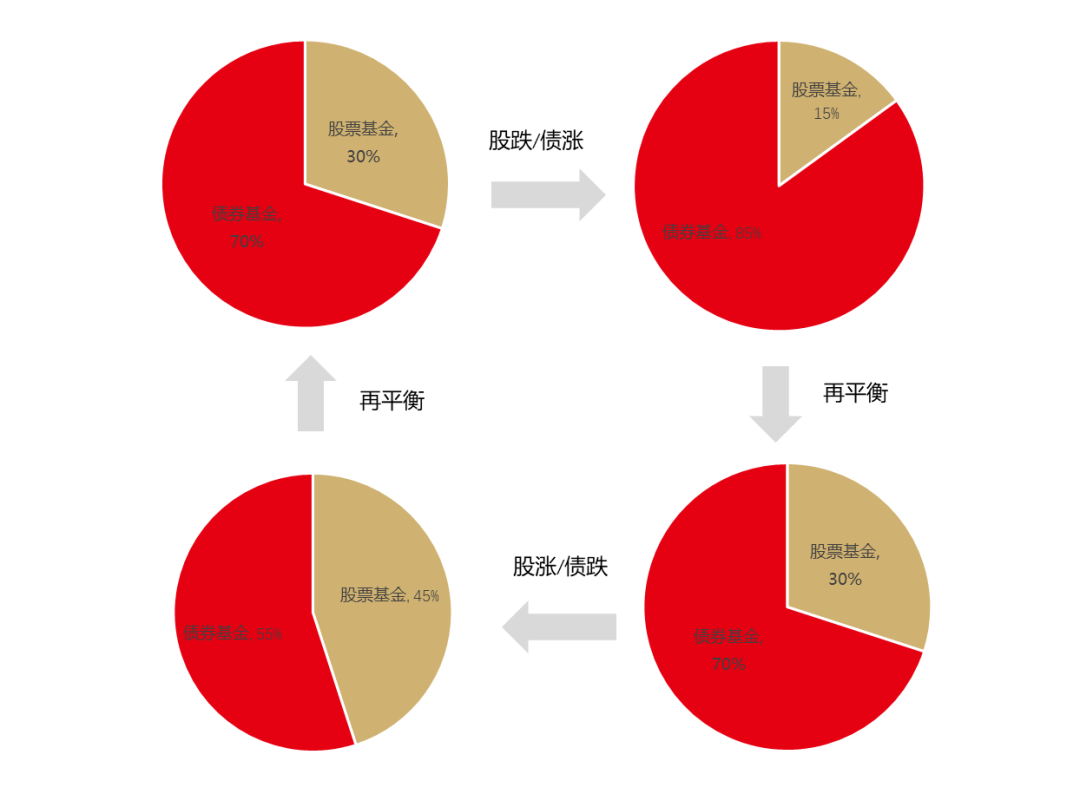
Core Insights - The article emphasizes the importance of year-end investment review and asset allocation rebalancing as a critical aspect of investment strategy [1][5][16] Group 1: Investment Review and Rebalancing - Year-end investment review is likened to a vehicle check-up, where asset rebalancing is compared to minor adjustments of the steering wheel [2] - A simplified formula for analyzing investment performance is introduced: Investor Return = α + β - γ, where α represents fund selection ability, β indicates market opportunities, and γ reflects investor behavior losses [3][4] - The article highlights that many investors do not solely invest in one fund but rather multiple funds, making overall account performance more significant than individual fund performance [4] Group 2: Rebalancing Principles - The principle of rebalancing involves periodically adjusting asset proportions back to initial target values, selling overperforming assets and buying underperforming ones [5] - A simplified simulation illustrates that a conservative investor with an initial 70% bond and 30% stock allocation may need to rebalance if stock allocation drops to 15%, suggesting buying undervalued stocks to regain target allocation [5][6] Group 3: Rebalancing Effectiveness - Data analysis using the CSI A500 Index and the CSI All Bond Index shows that both quarterly and annual rebalancing strategies outperform a buy-and-hold strategy in terms of cumulative returns and reduced risk metrics [8][9] - The results indicate that annual rebalancing yields a cumulative return of 116.71% with a maximum drawdown of -16.69%, while quarterly rebalancing achieves 118.20% with a maximum drawdown of -13.95% [9][10] Group 4: Practical Rebalancing Guidelines - The article outlines a four-step process for effective rebalancing, including reviewing investment goals, checking asset allocation deviations, executing rebalancing through direct adjustments or incremental funding, and establishing a rebalancing discipline [11][12][13] - It suggests setting a rebalancing frequency and a deviation threshold to trigger rebalancing actions, with examples from major hedge funds [12][13] Group 5: Behavioral Aspects of Rebalancing - The article notes that rebalancing can be psychologically challenging, as investors may hesitate to sell assets that have performed well or buy those that have underperformed [8][14] - It concludes that any rebalancing strategy is better than inaction, emphasizing the importance of execution in maintaining investment discipline [14][16]
券商策略会门口“卖衣服”?申万宏源:建议关注策略会本身
Nan Fang Du Shi Bao· 2025-11-22 09:59
Core Viewpoint - The recent annual investment strategy conference held by Shenwan Hongyuan featured an outdoor clothing sale, which attracted attention but was stated to have no significant impact on the conference itself [4][5]. Company Overview - Shenwan Hongyuan hosted its annual investment strategy conference at the Grand Hyatt Hotel in Shanghai, with over 1,900 investors and representatives from 518 listed companies in attendance [8]. - The conference included a main forum and 12 sub-forums covering various core areas such as asset allocation, high-end manufacturing, artificial intelligence, consumption, and cyclical sectors [8]. Market Outlook - The macroeconomic outlook for 2026 suggests that the "15th Five-Year Plan" will accelerate reform dividends, with nominal GDP expected to improve and the economy transitioning from atypical recovery to a virtuous cycle [10]. - The strategy indicates a two-phase bull market for A-shares, with an initial high-level adjustment followed by a comprehensive bull market in the second half of 2026 [10]. - The bond market is anticipated to experience fluctuations, focusing on "asset allocation rebalancing" and "price recovery" as key themes for 2026 [10].



央行重启债券买卖,四季度配置再平衡持续推进
Mei Ri Jing Ji Xin Wen· 2025-11-20 01:12
Core Viewpoint - The fourth quarter is expected to be a process of asset allocation rebalancing, with significant importance placed on asset allocation this year, particularly in the context of the equity market's substantial rise in the second and third quarters [1] Group 1: Bond Market Dynamics - The People's Bank of China (PBOC) has recently announced the resumption of bond buying, which is a liquidity injection tool aimed at addressing short-term liquidity pressures in the bond market [1][2] - The PBOC's bond buying in October was limited to 20 billion, but if extended over a month, it could return to a normal level of around 100 billion, indicating a continued commitment to maintaining a loose monetary environment [2] - The resumption of bond buying is expected to stabilize the bond market, particularly for ten-year government bonds, suggesting that the market will enter a period of reduced volatility [2] Group 2: Market Conditions and Supply Pressure - The bond market is expected to return to its allocation characteristics, with a focus on longer-duration bonds that exhibit lower volatility, particularly the ten-year bonds [3] - There is significant supply pressure in the bond market due to weak demand from the real economy, but this pressure is expected to ease towards the end of the year, especially after November [3][4] - The year-end period is typically a time when large traditional bond investment institutions, such as banks and insurance companies, engage in pre-allocating bonds for the upcoming year, leading to a temporary imbalance in supply and demand [3] Group 3: Economic Stimulus and Market Outlook - Current fiscal stimulus measures are expected to be moderate, with a focus on 500 billion in policy financial tools and another 500 billion in advance local government bond issuance, which may support stable economic growth but not lead to significant upturns [4] - The overall economic environment remains weak, with indicators such as PMI and financing data suggesting that the economy is still in a bottoming phase, which is reflected in the real estate sector as well [4] - The bond market is seen as relatively favorable under these conditions, with limited upward risks and a stable environment expected through the year-end window [5] Group 4: Investment Recommendations - The bond market is viewed as having high allocation value, particularly from November to the pre-Spring Festival period, with limited space for further declines in yields [5] - The central bank's lack of intent to lower interbank funding prices suggests that the bond market will maintain a stable yield level, with the ten-year government bond being a key focus for investors seeking both allocation and trading opportunities [5][6] - The ten-year government bond ETF (511260) is highlighted as an advantageous investment tool, providing easy access to the bond market and supporting flexible trading options for investors [6]
\年末抢跑+双降\预期及债市有效策略的探讨:近期市场反馈及思考7
Shenwan Hongyuan Securities· 2025-11-04 09:00
Group 1 - The core view of the report indicates that the Q4 market may not experience the same "running ahead" trend as in previous years, with a weaker attitude towards institutional buying in the bond market [6][7][8] - The report suggests that the central bank's resumption of bond purchases is primarily aimed at injecting long-term liquidity and replacing financial liabilities at low costs, with potential buying space estimated between 870 billion and 1.15 trillion [9][10] - The probability of interest rate cuts may marginally increase, but remains low, with the decision on reserve requirement ratios depending on the scale of bond purchases [11][12] Group 2 - Current market trading congestion has decreased compared to Q3, but many funds still maintain high durations, indicating a mixed sentiment among investors [12] - The report highlights that strategies for Q4 and 2026 may shift from duration strategies to interest rate arbitrage strategies, with an increased focus on asset allocation [15] - Credit bonds have shown strong performance since October, but the report warns that this trend may not be sustainable due to potential regulatory impacts and reduced demand for credit bonds [16][18] Group 3 - The implementation of new accounting standards for insurance in early 2026 may weaken the allocation power of insurance towards perpetual bonds, with a more significant negative impact expected on bank perpetual bonds [20][21] - The new VAT regulations on bond interest income may create pricing discrepancies between new and old financial bonds, affecting investor choices and market dynamics [23][24] - The report discusses the impact of stock market inflows on convertible bonds, suggesting that increased risk appetite may lead to higher demand for convertible bonds, benefiting their prices [27][28] Group 4 - The report emphasizes the need to adjust the investment framework for convertible bonds, shifting from a cyclical price perspective to a focus on the underlying stock's fundamental elasticity [29][30]
连平:美联储降息对国际资本市场的影响
Di Yi Cai Jing Zi Xun· 2025-10-02 09:32
Core Viewpoint - The Federal Reserve announced a 0.25 percentage point interest rate cut, bringing the federal funds target rate to a range of 4% to 4.25%, marking the beginning of the second phase of rate cuts aimed at preemptively addressing potential economic and financial risks [2] Group 1: Federal Reserve Actions - The recent rate cut is characterized as a preemptive measure rather than a crisis response, intended to mitigate potential economic downturns [2] - The Fed may implement 1-2 additional rate cuts in the remaining quarter of the year, with a total reduction of 0.25-0.5 percentage points depending on economic growth and inflation trends [2] Group 2: Market Reactions - The rate cut is generally favorable for the stock market, enhancing financing accessibility and reducing corporate financing costs, but its positive impact on global markets should not be overestimated [2] - Significant capital outflows from U.S. equities have been observed, with approximately $259 billion exiting U.S. long-term equity mutual funds in the first half of the year, and a record outflow of $357.4 billion in July [3] Group 3: Global Capital Flows - Funds flowing out of U.S. equities are primarily being reallocated to U.S. bonds and money markets, indicating a shift towards safer assets rather than a large-scale migration to foreign equities [4] - Despite some capital inflow into non-U.S. markets, the overall scale remains limited, with only $13.6 billion flowing into global equity funds outside the U.S. in July [3][4] Group 4: Future Outlook - As the Fed continues its moderate rate cut strategy, most funds are expected to remain within the U.S. financial markets, although some investors may seek undervalued assets globally [5] - A potential aggressive rate cut by the Fed could lead to a temporary boost in global markets, benefiting developed markets like Europe and Japan, as well as emerging markets [5]