
输入性因素

Search documents
数据点评 | 为何2月通胀“再超预期”?(申万宏观·赵伟团队)
赵伟宏观探索· 2026-03-09 16:03
Core Viewpoints - February inflation "exceeded expectations" due to input factors and improvement in service consumption [2][67] - February PPI year-on-year "exceeded expectations" driven by rising international prices of non-ferrous metals and crude oil, with a month-on-month increase of 0.4% [2][67] - The increase in copper smelting prices is attributed to strong demand from AI-related industries, contributing significantly to PPI growth [2][67] PPI Analysis - February PPI year-on-year was -0.9%, an increase of 0.5 percentage points from the previous month [39] - The main contributors to the month-on-month PPI increase were non-ferrous metal smelting and international oil prices, with oil prices contributing 0.2% to the month-on-month PPI [2][67] - Low capacity utilization in downstream sectors continues to exert downward pressure on PPI, with specific industries like pharmaceuticals and food showing negative month-on-month PPI changes [11][67] CPI Analysis - February CPI showed a significant rebound, rising 1.1 percentage points to 1.3% year-on-year, influenced by the timing of the Spring Festival [3][68] - Service CPI increased notably, with core service prices such as air tickets and transportation rentals rising significantly [3][68] - Food CPI showed weaker performance, with year-on-year growth of 1.7%, and specific categories like fresh vegetables and pork experiencing declines [25][68] Future Outlook - The company has revised its PPI and CPI year-on-year central estimates upward, anticipating that if international oil prices remain above $100 per barrel, PPI could return to around 0% in March and turn positive in April [4][69] - The annual PPI forecast has been adjusted to 0.2%, while the CPI central estimate is revised to approximately 0.8% [4][69] Regular Tracking - February CPI and PPI both showed year-on-year increases, with notable contributions from food prices, particularly eggs [70][44] - Non-food CPI categories such as transportation and communication also saw marginal increases [50][70] - Overall service CPI increased, with household services showing a significant rise [57][70]

通胀数据点评:为何2月通胀“再超预期”?
Shenwan Hongyuan Securities· 2026-03-09 15:20
Inflation Data Summary - February CPI increased to 1.3% year-on-year, up from 0.2% in January and exceeding the expected 0.9%[1] - February PPI recorded a year-on-year decline of -0.9%, an improvement from -1.4% in January, with a month-on-month increase of 0.4%[1][7] Key Drivers of Inflation - The rise in February CPI was primarily driven by the timing of the Spring Festival and a significant increase in service CPI, which rose by 1.1% month-on-month[3] - Core service CPI showed strong performance, with notable price increases in airfares (31.1%), vehicle rentals (24.7%), travel agency fees (15.8%), and accommodation (7.3%)[3][15] PPI Analysis - The year-on-year increase in PPI was influenced by rising international prices of non-ferrous metals and crude oil, contributing 0.4% to the month-on-month PPI increase[2][8] - Domestic coal and steel prices had minimal impact on PPI, contributing 0% to the month-on-month change[2][10] Future Outlook - If international oil prices remain above $100 per barrel, PPI could return to around 0% year-on-year in March and potentially turn positive in April, with an annual forecast adjustment to 0.2%[4][27] - CPI forecast for the year has been revised upward to approximately 0.8%, driven by oil price transmission and improved service consumption[4][27] Risks - Potential risks include tighter-than-expected food supply and energy supply constraints due to geopolitical factors[5][44]
数据点评 | 为何2月通胀“再超预期”?(申万宏观·赵伟团队)
申万宏源宏观· 2026-03-09 15:13
Core Viewpoints - February inflation "exceeded expectations" due to input factors and improvement in service consumption [2][67] - February PPI year-on-year "exceeded expectations" driven by rising international prices of non-ferrous metals and crude oil, with a month-on-month increase of 0.4% [2][67] - The increase in copper smelting prices is attributed to strong demand from AI-related industries, contributing significantly to PPI growth [2][67] PPI Analysis - February PPI year-on-year was -0.9%, an increase of 0.5 percentage points from the previous month [39] - The rise in PPI is primarily driven by non-ferrous metal prices, with copper smelting prices increasing by 3.7% month-on-month [67] - International oil prices also contributed to PPI growth, with a month-on-month increase of 0.2% [67] CPI Analysis - February CPI showed a significant rebound, rising 1.1 percentage points month-on-month to 1.3%, influenced by the timing of the Spring Festival [3][68] - Service CPI increased by 1.1% month-on-month, outperforming previous years during the Spring Festival [3][68] - Core service CPI saw substantial increases in prices for air tickets, transportation rentals, travel agency fees, and accommodation [3][68] Food and Core Goods CPI - Food CPI increased by 2.4 percentage points year-on-year to 1.7%, but the month-on-month increase of 1.9% was below the previous year's performance [25][68] - Core goods CPI remained flat at -1.7% year-on-year, with a month-on-month increase of 0.1% primarily influenced by gold prices [25][68] Future Outlook - The company has revised the PPI and CPI year-on-year central forecast upwards due to input factors and changes in service consumption [4][69] - If international oil prices remain above $100 per barrel, PPI may return to around 0% in March and turn positive in April, with an annual PPI forecast of 0.2% [4][69] - The annual CPI central forecast has been adjusted to approximately 0.8% due to oil price transmission and improvements in service consumption [4][69] Regular Tracking - February CPI and PPI both showed a year-on-year increase [70] - Significant price increases were noted in food items, particularly eggs, which rose by 6.3 percentage points [70] - Non-food CPI categories such as transportation and communication tools also saw marginal increases [70]

宏观经济点评:输入性因素带动PPI环比延续高增
KAIYUAN SECURITIES· 2026-03-09 10:44
Group 1: CPI Insights - February CPI year-on-year increased to 1.3%, up 1.1 percentage points from the previous value of 0.2%[2] - Food CPI month-on-month rose by 1.9%, marking a significant increase from the previous value[3] - Core CPI month-on-month reached a historical high, increasing to 0.7%, above seasonal levels for five consecutive months[4] Group 2: PPI Insights - February PPI year-on-year improved to -0.9%, up 0.5 percentage points from the previous value of -1.4%[5] - PPI month-on-month remained stable at 0.4%, tying for the highest since 2024[5] - Input factors contributed 0.48 percentage points to PPI, with the oil and chemical chain showing significant upward movement[30] Group 3: Future Inflation Predictions - March CPI is expected to be around -0.2% month-on-month, with a year-on-year forecast of approximately 1.6%[6] - PPI is anticipated to show a year-on-year increase, with a full-year average forecast of about 0.5%[6] - The potential for PPI to turn positive on a year-on-year basis is significant if current trends continue[37] Group 4: Risk Factors - Risks include unexpected policy changes and significant fluctuations in commodity prices[42]
2月通胀点评:输入性因素的影响或放大
Bank of China Securities· 2026-03-09 07:39
Inflation Overview - February CPI increased by 1.3% year-on-year, the highest in nearly three years, driven significantly by food prices which contributed approximately 0.30 percentage points to the CPI increase[7] - February CPI rose by 1.0% month-on-month, marking the highest growth in two years, with food prices contributing about 0.33 percentage points[7] - Core CPI in February grew by 1.8% year-on-year, up 1.0 percentage points from January[4] Price Contributions - Service prices increased by 1.6% year-on-year, contributing approximately 0.75 percentage points to the CPI[7] - In February, the combined impact of airfares, transportation rentals, travel agency fees, and hotel accommodation accounted for about 0.32 percentage points of the CPI increase[6] - The prices of aquatic products, fresh fruits, pork, lamb, beef, eggs, and poultry collectively influenced the CPI to rise by approximately 0.34 percentage points[5] PPI Trends - February PPI increased by 0.4% month-on-month, with production materials rising by 0.5%[18] - Year-on-year, February PPI decreased by 0.9%, but the decline is narrowing, indicating a potential upward trend in PPI throughout the year[25] - The increase in PPI is influenced by rising international prices of non-ferrous metals and crude oil, which have led to price increases in related domestic industries[24] Risks and Outlook - The report highlights risks of a second wave of global inflation and potential rapid economic downturns in Europe and the U.S.[37] - The ongoing geopolitical tensions in the Middle East have caused international oil prices to rise sharply, which may further impact domestic inflation in March[7]
PPI同比降幅收窄至-1.4%,国际金属价格上涨成主要推手
Xin Lang Cai Jing· 2026-02-20 05:14
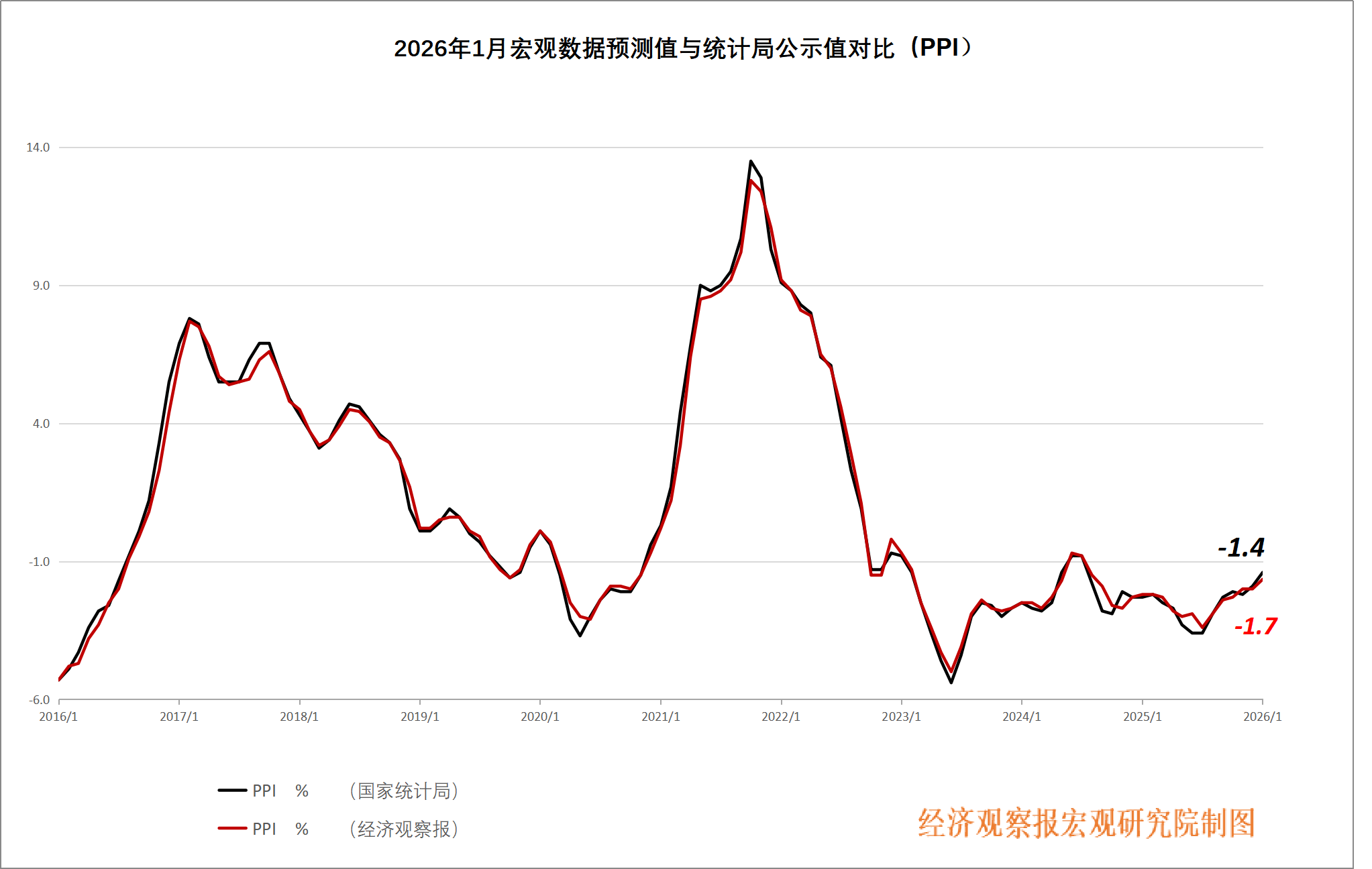
Core Viewpoint - The January 2026 economic data indicates a narrowing of the Producer Price Index (PPI) year-on-year from -1.9% to -1.4%, primarily influenced by rising international metal prices [1] Group 1: PPI Trends - The PPI increased by 0.4% month-on-month in January, with the growth rate expanding, indicating stronger input factors driving prices [1] - The rise in international non-ferrous metal prices has led to significant increases in domestic prices for the non-ferrous metal mining and selection industry, as well as the non-ferrous metal smelting and rolling industry, with month-on-month price increases of 5.7% and 5.2% respectively [1] - Specific price increases for smelting include silver up by 38.2%, copper by 8.4%, gold by 4.8%, and aluminum by 2.3% [1] Group 2: External Influences - Geopolitical risks have intensified, pushing up international oil prices, which in turn has led to month-on-month price increases of 0.6% in basic chemical raw material manufacturing and 0.4% in chemical fiber manufacturing [1] - The strong upward trend in international metal prices, particularly for copper, gold, and silver, combined with geopolitical risks affecting oil prices, suggests that short-term input factors may continue to support PPI [1] Group 3: Future Outlook - The annual PPI year-on-year central tendency is expected to rise, but maintaining a trend of recovery will require more policy efforts, such as subsidies, to promote sustained improvement in domestic demand [1]
9月份CPI环比上涨0.1% 消费市场运行总体平稳
Ren Min Ri Bao Hai Wai Ban· 2025-10-20 06:13
Group 1: Consumer Price Index (CPI) Insights - In September, the Consumer Price Index (CPI) increased by 0.1% month-on-month but decreased by 0.3% year-on-year, with the core CPI (excluding food and energy) rising by 1.0%, marking the fifth consecutive month of growth [1][2] - Food prices rose by 0.7% month-on-month, contributing approximately 0.13 percentage points to the CPI increase, while clothing prices increased by 0.8% due to seasonal changes [1] - Service prices declined by 0.3%, with significant drops in airfare, hotel accommodation, and tourism prices, collectively impacting the CPI by approximately 0.17 percentage points [1] Group 2: Producer Price Index (PPI) Insights - The Producer Price Index (PPI) remained flat month-on-month and decreased by 2.3% year-on-year, with the decline narrowing by 0.6 percentage points compared to the previous month [2][3] - The PPI's year-on-year decline was influenced by a lower comparison base from the previous year and the positive effects of macroeconomic policies, leading to price stabilization in certain industries [3] - Improvements in supply-demand structures and the impact of international oil price fluctuations contributed to the PPI trends, with coal processing prices rising by 3.8% month-on-month [2][3]
核心CPI同比涨幅回升至1%
Sou Hu Cai Jing· 2025-10-15 05:14
Core Insights - The Consumer Price Index (CPI) decreased by 0.3% year-on-year in September, while the core CPI, excluding food and energy, increased by 1.0%, marking the first return to a 1% increase in nearly 19 months [1][2][4] - The Producer Price Index (PPI) saw a year-on-year decline of 2.3%, but the rate of decline narrowed by 0.6 percentage points compared to August [5][6] CPI Analysis - The decline in CPI was primarily driven by a significant drop in food prices, which fell by 4.4% year-on-year, and energy prices, which decreased by 2.7%, contributing approximately 0.2 percentage points to the overall CPI decline [3] - Seasonal factors, such as the end of summer and the timing of the Mid-Autumn Festival, led to a decrease in prices for air tickets, hotel accommodations, and tourism services by 13.8%, 7.4%, and 6.1% respectively [3] Core CPI Insights - The continuous rise in core CPI reflects the effectiveness of domestic demand expansion policies and an improving market supply-demand relationship [4][7] - The core CPI's increase for five consecutive months indicates a positive trend in consumer spending and economic circulation [4] PPI Insights - The PPI remained flat month-on-month for two consecutive months, with certain industries showing positive price changes due to effective macroeconomic policies and capacity management [6] - Specific industries, such as coal processing and battery manufacturing, experienced a narrowing of price declines, indicating a potential recovery in those sectors [6] Future Outlook - Experts suggest that further efforts are needed to expand domestic demand and regulate competition among enterprises to promote reasonable price recovery [1][7] - The government is expected to continue implementing measures to boost consumption and effective investment, which may positively impact both CPI and PPI in the coming months [7]
国家统计局:9月供需结构改善带动部分行业价格明显企稳 输入性因素影响国内石油相关行业价格环比下降
Di Yi Cai Jing· 2025-10-15 01:44
Core Insights - The Producer Price Index (PPI) remained stable month-on-month for two consecutive months, indicating a stabilization in prices across various industries driven by improved supply-demand dynamics [1][2] - Year-on-year, the PPI decreased by 2.3%, but the decline was less severe than the previous month, reflecting the positive impact of macroeconomic policies and structural adjustments in certain industries [2] Group 1: Month-on-Month PPI Analysis - The PPI showed notable month-on-month price increases in coal processing (up 3.8%), coal mining and washing (up 2.5%), and black metal smelting and rolling (up 0.2%), all of which have risen for two consecutive months [1] - Prices for photovoltaic equipment and components shifted from a decrease of 0.2% last month to an increase of 0.8% this month, indicating a recovery in this sector [1] - Conversely, prices in the petroleum-related industries declined due to falling international oil prices, with oil extraction prices down 2.7% and refined petroleum product manufacturing prices down 1.5% [1] Group 2: Year-on-Year PPI Trends - The year-on-year decline in PPI was influenced by a lower comparison base from the previous year, with several industries showing reduced price declines, including coal processing and black metal smelting [2] - The construction of a unified national market has led to improved price stability in various sectors, with significant reductions in price declines for coal processing (down 8.3%), black metal smelting (down 3.4%), and coal mining (down 3.0%) [2] - Upgrades in industrial structure and the release of consumer potential have resulted in price increases in specific sectors, such as aircraft manufacturing (up 1.4%) and electronic materials (up 1.2%) [2]
6月通胀数据点评:核心CPI同比持续回升
Tai Ping Yang Zheng Quan· 2025-07-09 23:30
Group 1: CPI Analysis - China's June CPI increased by 0.1% year-on-year, reversing a four-month decline, exceeding market expectations[4] - The month-on-month CPI decreased by 0.1%, but the decline was narrower than the previous month by 0.1 percentage points[6] - Industrial consumer goods prices stabilized and contributed to the CPI increase, with a reduction in the downward impact on CPI by approximately 0.18 percentage points[6] Group 2: PPI Analysis - China's June PPI decreased by 3.6% year-on-year, with the decline widening by 0.3 percentage points compared to the previous month[4] - The PPI's further decline reflects accumulated supply-side pressures and weak demand[23] - Upstream industrial prices faced significant pressure, with mining industry prices dropping by 13.2% year-on-year[27] Group 3: Price Trends - Core CPI, excluding food and energy, rose by 0.7%, marking a 14-month high, supported by resilient service prices[20] - Energy prices increased by 0.1% month-on-month, reversing the previous downward trend, influenced by geopolitical factors[16] - Food prices decreased by 0.4% month-on-month, but the decline was smaller than seasonal expectations by 0.5 percentage points[14]