
中美贸易

Search documents
高频:海运价格持续修复,关注中美贸易转机
CAITONG SECURITIES· 2025-10-25 11:31
Report Industry Investment Rating No information provided in the given content. Core Viewpoints - This week, the SCFI continued to rise. The container shipping bookings from China to the US have recovered to last year's level, and the US's restrictive measures may trigger a "rush to export" effect. Sino-US trade relations may see a turnaround. [2] - Real estate sales remained weak. New home sales were far below the seasonal level, while second-hand home sales were basically in line with the seasonality. [2] - Rebar and cement prices remained stable. In the short term, coking coal and coke performed well, supporting the steel price, but in the long term, it was limited by the weak supply-demand pattern. [2] - In terms of investment and production, commodity prices showed mixed trends. Rebar prices were flat, glass futures prices decreased, asphalt prices increased, and cement prices were basically unchanged. [2] - In industrial production, the operating rates were differentiated. The blast furnace operating rate of steel mills, PTA operating rate, and automobile tire operating rate increased, while the petroleum asphalt operating rate and coking enterprise operating rate decreased, and the polyester filament operating rate remained basically unchanged. [2] - In consumption, the mobility was strong. Subway ridership and domestic flights were above the seasonal level, automobile consumption was in line with the seasonality, and movie box office was below the seasonal level. [2] - In terms of inflation, pork prices decreased, vegetable prices increased, and oil prices increased. [2] - In exports, the SCFI increased, and the BDI decreased. [2] Summary by Directory 1. Real Estate Sales: Weak Real Estate Sales, Beijing Provides Support - New home sales this week (October 17 - October 23) increased slightly month-on-month, and the year-on-year decline continued to narrow. The new home sales area in Wind 20 cities increased by 2.83% month-on-month and decreased by 13.03% year-on-year. [7] - New home sales in first-tier and third/fourth-tier cities were significantly stronger than the previous period but weaker than the same period last year. Second-tier cities saw negative growth both month-on-month and year-on-year. [7] - In key cities, most cities saw an increase in new home sales month-on-month. Beijing was the only city with positive year-on-year growth. [7] - Second-hand home sales decreased slightly month-on-month and significantly year-on-year. All key cities saw a decline in second-hand home sales compared to the same period last year. [7] 2. Investment: Commodity Prices Show Mixed Trends - Commodity prices showed mixed trends this week. Rebar and cement prices were basically flat, glass futures prices decreased, and asphalt prices increased. [36] 3. Production: Operating Rates Show Differentiation - Operating rates showed differentiation this week. The blast furnace operating rate of steel mills, PTA operating rate, and automobile tire operating rate increased, while the petroleum asphalt operating rate and coking enterprise operating rate decreased, and the polyester filament operating rate remained basically unchanged. [45] 4. Consumption: Strong Mobility - Subway ridership and domestic flights were above the seasonal level, automobile sales were in line with the seasonality, and movie box office was below the seasonal level. [58] 5. Exports: SCFI Increases, BDI Decreases - The SCFI index increased this week, while the BDI index and CRB spot index decreased slightly. [61] 6. Prices: Pork Prices Decrease, Vegetable and Oil Prices Increase - Pork prices decreased, vegetable prices increased, oil prices increased, and rebar prices were basically flat. [65]
出大事了!微妙关头,全美50州揭竿而起,要求特朗普立刻下台,中国这一招美国招架不住
Sou Hu Cai Jing· 2025-10-24 11:38
再者,之前科技和人工智能板块涨得太多,估值本来就虚高,遇到这种突发的坏消息,投资者肯定不敢再冒风险,这些高估值板块自然就开始大跌。还有美 国政府"停摆"带来的麻烦,一方面关键经济数据没法按时发布,投资者没了参考,心里没底;另一方面,政府"停摆"期间,不光让员工临时休假,还让大批 公务员永久离职,这不仅影响了几千个家庭的消费能力,也让华尔街对美国未来的经济没了信心。摩根大通的首席执行官都警告,未来半年到两年,美股大 幅回调的风险会越来越大。 股市乱就算了,美国老百姓也忍不了了,直接上街抗议。10月18日那天,纽约、洛杉矶、华盛顿、芝加哥这些主要城市,还有全美国2700多个城镇,近700 万民众都举行了和平示威游行。大家反对的事儿可不少,像政府暴力打击移民、强行派国民警卫队进城市,还有加征关税这些政策都在反对名单里。 在纽约,超过10万人参加游行,连美国国会参议院民主党领袖查克·舒默都来了。人们举着"美国移民与海关执法局离开街头""宪法不是可有可无"的旗帜和 横幅,喊着"没有法治就没有和平"的口号在街上游行。曼哈顿有个居民说,现在美国农产品卖不出去,农民都快破产了,物价还一个劲地涨,本来该用在医 疗补助上的钱也被 ...

中美贸易担忧缓和,基本金属再度走强
Zhong Xin Qi Huo· 2025-10-24 02:32
1. Report Industry Investment Rating - No specific industry investment rating is provided in the report. 2. Core Viewpoints of the Report - In the short - to - medium term, against the backdrop of tight scrap and ore supplies, there is a high risk of contraction in the smelting sector, and the supply - demand balance of base metals is expected to tighten, which supports base metal prices. However, weak demand limits the upside potential of prices. In the long term, there are still expectations of potential incremental stimulus policies in China, and supply disruptions in copper, aluminum, and tin remain, so the prices of copper, aluminum, and tin are expected to rise [3]. 3. Summary by Related Catalogs 3.1行情观点 3.1.1 Copper - **Viewpoint**: After the release of the communiqué of the Fourth Plenary Session of the 20th Central Committee, copper prices are showing a strong trend. - **Logic**: Macroeconomic sentiment has warmed up with the release of the communiqué and the resumption of Sino - US trade negotiations. On the supply - demand side, copper ore supply disruptions are increasing, and the cost and difficulty of scrap copper recycling have risen, leading to a decline in electrolytic copper production. Although the peak demand season has arrived, high prices have suppressed demand to some extent. - **Outlook**: Copper supply constraints remain, and considering the improved macro - sentiment, copper prices are expected to be oscillating with an upward bias [8]. 3.1.2 Alumina - **Viewpoint**: As the operating capacity of smelters declines, alumina prices are oscillating. - **Logic**: High - cost production capacity has reduced output, but the reduction is insufficient, and China still maintains a strong inventory build - up trend. Ore prices have shown a slight decline, so there is still pressure on the upside of the disk price. - **Outlook**: Alumina is expected to oscillate in the short term. It is recommended to wait and see or conduct short - term trading, and pay attention to the potential increase in volatility [10]. 3.1.3 Aluminum - **Viewpoint**: The risk of Mozal's shutdown has intensified, and aluminum prices have slightly rebounded. - **Logic**: The macro - tone at home and abroad is positive. On the supply side, some replacement capacities are being put into production, and the operating capacity and utilization rate are at a high level. On the demand side, orders in the peak season have improved marginally, and social inventories have started to decline. The current copper - aluminum price ratio is above 4.0, and the valuation of aluminum is relatively low. - **Outlook**: In the short term, aluminum prices are expected to be oscillating with an upward bias. In the medium term, the supply increase is limited, and demand remains resilient, so the center of aluminum prices is expected to rise [11]. 3.1.4 Aluminum Alloy - **Viewpoint**: With strong cost support, the disk is oscillating upward. - **Logic**: The tight supply of scrap aluminum is difficult to change in the short term, providing strong cost support. Although some enterprises have slightly reduced production due to unclear policies and weak demand, the overall reduction is not large. Demand has improved marginally, and social inventories and warehouse receipts have continued to rise. - **Outlook**: In the short term, prices are expected to oscillate within a range. In the medium term, due to unclear policy implementation and potential raw material disruptions, prices are expected to continue to oscillate [12]. 3.1.5 Zinc - **Viewpoint**: With optimistic macro - expectations and an open export window, pay attention to short - selling opportunities at high zinc prices. - **Logic**: Macroeconomic sentiment is optimistic. In the short term, zinc ore supply has become looser, and smelters' profitability is good, so their production willingness is strong. Domestic consumption is in the transition period between peak and off - peak seasons, and demand expectations are average. The overall fundamentals are in surplus, but the "soft squeeze" of LME zinc has not ended. - **Outlook**: In October, zinc ingot production will remain high, and demand recovery is limited, so inventories may continue to accumulate. Zinc prices are expected to oscillate [14]. 3.1.6 Lead - **Viewpoint**: Due to supply disruptions in recycled lead and low social inventories, lead prices have risen significantly. - **Logic**: On the spot side, the spot discount has narrowed slightly, and the price difference between primary and recycled lead has increased. On the supply side, the profitability of recycled lead smelters has improved, and production has increased slightly. On the demand side, the operating rate of lead - acid battery factories has recovered, and demand remains high. - **Outlook**: After the Fed's interest rate cut, the US dollar may still decline. After the holidays, lead supply growth has been slightly lower than expected, and demand is in the peak season. Lead prices are expected to be oscillating with an upward bias [15]. 3.1.7 Nickel - **Viewpoint**: With LME nickel inventories exceeding 250,000 tons, nickel prices are oscillating widely. - **Logic**: Market sentiment still dominates the disk. The industrial fundamentals are weakening marginally. Ore supply is relatively loose, and the reality of excess electrolytic nickel is serious, with significant inventory accumulation. - **Outlook**: In the short term, nickel prices are expected to oscillate widely [18]. 3.1.8 Stainless Steel - **Viewpoint**: With low warehouse receipts, the stainless - steel disk is rising. - **Logic**: Nickel - iron prices have weakened, and chromium prices are relatively stable. Stainless - steel production has increased in September, but the sustainability of demand in the "Golden September and Silver October" peak season needs to be monitored. Social inventories have decreased slightly, and warehouse receipts have continued to decline. - **Outlook**: Downstream demand is slightly lower than expected, and cost support has a certain boosting effect on steel prices. Stainless - steel prices are expected to oscillate within a range in the short term [22]. 3.1.9 Tin - **Viewpoint**: With supply constraints remaining, tin prices are oscillating. - **Logic**: There have been continuous supply disruptions in tin. Indonesia has taken measures to restrict supply, and the resumption of production in the Wa State's Manxiang mining area is slow. The domestic tin ore supply is tight, and the processing fee for tin concentrate remains low. - **Outlook**: With tight supply at the mine end, tin prices are expected to oscillate [23]. 3.2行情监测 - **Comprehensive Index**: The commodity index increased by 0.70% to 2250.50, the commodity 20 index increased by 0.58% to 2546.54, the industrial products index increased by 1.12% to 2229.03, and the PPI commodity index increased by 0.86% to 1342.15 [148]. - **Plate Index**: The non - ferrous metals index on October 23, 2025, increased by 0.70% on the day, 1.60% in the past 5 days, 3.15% in the past month, and 7.08% since the beginning of the year [149].
中辉期货豆粕日报-20251024
Zhong Hui Qi Huo· 2025-10-24 02:22
Report Industry Investment Ratings - Not provided in the given content Core Views of the Report - The short - term trend of soybean meal is bearish consolidation, rapeseed meal follows the trend of soybean meal and is also in short - term bearish consolidation; palm oil, soybean oil, and rapeseed oil will see a short - term decline; cotton prices face upward pressure; for red dates, it is advisable to short at high prices; and for live pigs, short on rebounds [1]. Summary According to Each Variety Soybean Meal - **Price and Market Conditions**: The futures price of the main contract closed at 2938 yuan/ton, up 53 yuan or 1.84% from the previous day. The national average spot price was 3011.71 yuan/ton, up 21.71 yuan or 0.73%. The national average soybean crushing profit was - 163.0885 yuan/ton, up 4.27 yuan. The basis of soybean meal 01 was - 38 yuan/ton, down 53 yuan [2]. - **Supply and Demand**: As of October 17, 2025, the national port soybean inventory was 988.4 million tons, a decrease of 20.8 million tons from last week. The soybean inventory of 125 oil mills was 768.7 million tons, an increase of 2.94 million tons. The domestic oil mills' profit from pressing is in a loss state, with stronger price - holding intentions. The downstream replenishment enthusiasm is low [3]. - **Outlook**: Brazil's rainfall in the next 15 days is expected to be below normal. Weather factors support the price of soybean meal to stop falling and consolidate. The Sino - US negotiation is expected to run above the recent low, but the rebound space is limited due to uncertainties [4]. Rapeseed Meal - **Price and Market Conditions**: The futures price of the main contract was 2339 yuan/ton, up 32 yuan or 1.39%. The national average spot price was 2495.79 yuan/ton, up 18.95 yuan or 0.77%. The national average rapeseed pressing profit was - 317.6005 yuan/ton, up 33.53 yuan [5]. - **Supply and Demand**: As of October 17, the coastal oil mills' rapeseed inventory was 0.6 million tons, a decrease of 1.2 million tons from last week. The rapeseed meal inventory was 0.78 million tons, a decrease of 0.37 million tons. The demand for rapeseed meal enters the off - season as the temperature drops [6]. - **Outlook**: Trade policies and high inventory lead to a mix of long and short factors. It follows the trend of soybean meal due to the lack of new drivers [1]. Palm Oil - **Price and Market Conditions**: The futures price of the main contract was 9132 yuan/ton, down 32 yuan or - 0.35%. The national average price was 9098 yuan/ton, down 140 yuan or - 1.52%. The weekly commercial inventory was 57.57 million tons, an increase of 2.81 million tons [7]. - **Supply and Demand**: From October 1 - 20, 2025, Malaysia's palm oil exports increased, but the growth rate slowed down, and the production increased significantly. The approaching Indian Festival of Lights reduces the purchase demand [8]. - **Outlook**: It is expected to continue to accumulate inventory in October, with a short - term decline and a short - term volatile market [1]. Cotton - **Price and Market Conditions**: The price of the main contract CF2601 was 13575 yuan/ton, up 40 yuan or 0.30%. The national cotton commercial inventory was 143.34 million tons, an increase of 28 million tons [9]. - **Supply and Demand**: In the US, the new cotton harvest is over half - way. In Brazil, the new cotton processing and inspection is over 70%. In China, the new cotton picking progress is nearly 70%. The downstream demand is in a seasonal weakening trend [10][11]. - **Outlook**: The international cotton price is under pressure from supply but supported by India's MSP import tariff. The domestic cotton price is under pressure from new cotton harvest and import increase. The new - year cotton cost will be fixed soon, and the price faces upward pressure [12]. Red Dates - **Price and Market Conditions**: The price of the main contract CJ2601 was 11165 yuan/ton, down 100 yuan or - 0.89%. The physical inventory of 36 sample points was 9167 tons, a decrease of 158 tons [13]. - **Supply and Demand**: The new - season red dates in Xinjiang are about to be harvested. The estimated new - season output is 56 - 62 million tons, with a confirmed reduction but no significant supply - demand gap. The demand is gradually improving as the temperature drops [15]. - **Outlook**: There is still pressure after the new fruits are on the market. Short at high prices before and after the new red dates are harvested [16]. Live Pigs - **Price and Market Conditions**: The price of the main contract Ih2601 was 12200 yuan/ton, down 20 yuan or - 0.16%. The national average spot price was 11900 yuan/ton, up 10 yuan or 0.08%. The national sample enterprise pig inventory was 3839.01 million tons, an increase of 56.61 million tons [17]. - **Supply and Demand**: In the short - term, the planned slaughter in October increased. The second - fattening entry increased in some areas. In the medium - term, the number of newborn piglets in September increased. In the long - term, the number of breeding sows decreased. The demand decreased after the holidays [18]. - **Outlook**: The supply pressure is transferred to the end of November to early December. The short - term market is a rebound, and it is advisable to short on rebounds [19].
市场乐观预期中美会谈 豆粕期货呈偏强震荡运行
Jin Tou Wang· 2025-10-23 08:07
Core Viewpoint - The domestic oilseed market shows mixed performance, with soybean meal futures experiencing a strong upward trend despite high supply and inventory levels [1][2]. Group 1: Market Performance - Soybean meal futures opened at 2887.00 CNY/ton and reached a high of 2942.00 CNY/ton, with a closing increase of 2.30% [1]. - The market is characterized by a strong performance, with soybean meal showing a fluctuating upward trend [1]. Group 2: Supply and Demand Dynamics - High supply and inventory levels are suppressing soybean meal prices, but low prices for soybean oil and meal are leading to increased support from oil mills [1]. - Domestic soybean procurement by oil mills is slow, providing a firm cost support for soybean meal, limiting downward price movement [1]. Group 3: External Influences - The Trump administration's plan to provide billions in aid to farmers is noted, alongside Brazil's soybean exports increasing to 7.34 million tons in October, up over 1 million tons year-on-year [1]. - The market is cautious due to the lack of significant external information, focusing instead on the high inventory levels of soybean meal [2]. Group 4: Future Outlook - The market is expected to experience wide fluctuations in the short term, with a reference pressure level for soybean meal at 3000-3100 CNY/ton [1]. - Future attention will be on the U.S. resuming report publications, adjustments in production estimates, and outcomes of U.S.-China trade negotiations [2].
中辉期货豆粕日报-20251023
Zhong Hui Qi Huo· 2025-10-23 02:11
1. Report Industry Investment Ratings - No specific industry - wide investment ratings are provided in the report. 2. Core Views of the Report - **Short - term bearish consolidation**: For soymeal, rapeseed meal, palm oil, soybean oil, rapeseed oil, cotton, and live pigs, the short - term trends are either bearish consolidation or downward pressure. For example, soymeal is expected to have short - term bearish consolidation due to potential Argentine bean meal re - entry and Trump's remarks, and the current Sino - US trade tariffs provide some support at around 2800 [1][4]. - **Rebound and short - selling**: For live pigs, the short - term market is seen as a rebound, but it is recommended to short - sell on rebounds due to increasing supply pressure in Q4 and weakening demand after the festival [1][17]. - **High - level shock**: Palm oil is in a high - level shock state with a short - term adjustment trend due to the slowdown in the month - to - month export growth rate of Malaysian palm oil in the first 20 days [1][8]. - **Range - bound shock**: ICE cotton market is expected to maintain a range - bound shock, and the domestic cotton market has short - term upward pressure [1][12]. - **Sell on rallies**: For jujubes, based on the current production forecast and inventory, there is still pressure after the new fruit is on the market. It is recommended to sell on rallies before and after the new jujubes are harvested [1][15]. 3. Summary by Variety Soymeal - **Price and profit**: The latest futures price (main contract daily close) is 2885 yuan/ton, down 0.14% from the previous day. The national average soybean crushing profit is - 167.3596 yuan/ton, a decrease of 28.02 yuan/ton from the previous day [2]. - **Inventory**: As of October 17, 2025, the national port soybean inventory is 988.4 million tons, a decrease of 20.8 million tons from the previous week. The 125 oil - mill soybean inventory is 768.7 million tons, an increase of 2.94 million tons from the previous week, and the bean meal inventory is 97.62 million tons, a decrease of 10.29 million tons from the previous week [3]. - **Market situation**: The spot market has sufficient supply, but the oil - mill profit is in a loss state, leading to an increase in the willingness to support prices. The downstream replenishment enthusiasm is low, and they mainly replenish inventory at low prices [3]. Rapeseed Meal - **Price and profit**: The latest futures price (main contract daily close) is 2307 yuan/ton, down 0.60% from the previous day. The national average rapeseed spot crushing profit is - 351.1355 yuan/ton, a decrease of 40.52 yuan/ton from the previous day [5]. - **Inventory**: As of October 17, the coastal area's main oil - mill rapeseed inventory is 0.6 million tons, a decrease of 1.2 million tons from the previous week, and the rapeseed meal inventory is 0.78 million tons, a decrease of 0.37 million tons from the previous week [6]. - **Market situation**: The international market has an expected increase in Canadian rapeseed production. The domestic market is in a de - stocking state, but the demand enters the seasonal off - season. It follows the trend of soymeal due to the lack of new driving factors [6]. Palm Oil - **Price and inventory**: The latest futures price (main contract daily close) is 9164 yuan/ton, down 1.40% from the previous day. As of October 17, 2025, the national key - area palm oil commercial inventory is 57.57 million tons, an increase of 2.81 million tons from the previous week [7][8]. - **Market situation**: The month - to - month export growth rate of Malaysian palm oil in the first 20 days has slowed down, which is bearish for the market sentiment. Considering the unchanged biodiesel policy, it is a short - term adjustment trend [1][8]. Cotton - **Price and inventory**: The latest price of the main contract CF2601 is 13535 yuan/ton, down 0.04% from the previous day. The national cotton commercial inventory has increased to 143.34 million tons, 20 million tons lower than the same period [9]. - **Market situation**: In the US, the new cotton harvest is over half - way. In Brazil, the new cotton processing and inspection is over 70%. Domestically, the new cotton picking progress is nearly 70%. The supply is under pressure, and the demand is seasonally weak. The main contract price is approaching the intensive hedging pressure level, and there is a risk of re - pricing decline [1][12]. Jujubes - **Price and inventory**: The latest price of the main contract CJ2601 is 11265 yuan/ton, down 1.01% from the previous day. The physical inventory of 36 sample points this week is 9167 tons, a decrease of 158 tons from the previous week [13][14]. - **Market situation**: The new jujubes in Xinjiang are about to be harvested, and there is a risk of short - term speculation. The demand is gradually improving, but there is no obvious inflection point. It is recommended to sell on rallies before and after the new jujubes are harvested [1][15]. Live Pigs - **Price and inventory**: The latest price of the main contract 1h2601 is 12220 yuan/ton, down 0.12% from the previous day. The national sample - enterprise pig inventory is 3839.01 million tons, an increase of 56.61 million tons from the previous month [16]. - **Market situation**: In the short term, the October planned slaughter volume of enterprises has increased. The increase in the standard - fat price difference has stimulated some secondary fattening. The supply pressure in Q4 is still high, and the demand has declined after the festival. It is recommended to short - sell on rebounds [1][17].
美国硬抗关税也得买,“每天从中国进口额仍有10亿美元”
Guan Cha Zhe Wang· 2025-10-22 09:39
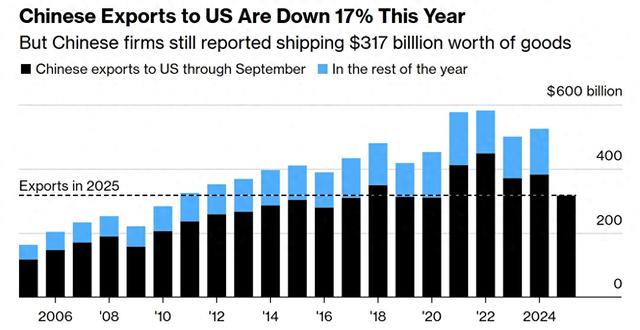
Core Insights - The article highlights the resilience of Chinese exports despite ongoing trade tensions with the U.S., suggesting that many Chinese products remain indispensable to the U.S. market, thereby enhancing China's bargaining power in upcoming trade negotiations [1][4]. Trade Performance - Chinese exports to the U.S. reached over $100 billion in Q3 2023, contributing to a trade surplus of nearly $67 billion, despite an overall decline in trade volume [1][4]. - In September, China's exports grew by 8.3% year-on-year, surpassing economists' expectations, indicating a robust export performance [9][11]. Product-Specific Insights - Certain products, such as electric bicycles and refined copper, saw significant export growth, with electric bicycle exports valued at over $500 million and refined copper exports rising to $270 million [4][5]. - The export of smartphones, laptops, and computer components to the U.S. amounted to nearly $8 billion, despite being less than half of the previous year's figures [5]. Market Dynamics - The article notes that the U.S. tariffs have had limited impact on the import of certain Chinese goods due to their critical role in global supply chains, particularly in sectors like rare earths and electronics [1][4]. - Analysts suggest that the restructuring of supply chains to replace Chinese goods would take time, indicating a continued reliance on Chinese products [1][8]. Future Outlook - There is speculation that the U.S. and China may seek to ease trade tensions in the coming weeks, with both sides potentially making concessions [11]. - The Chinese government emphasizes the need for continued efforts to stabilize foreign trade amid a complex external environment [11].
供应充足 短期豆粕缺乏上行的驱动力
Jin Tou Wang· 2025-10-22 08:06
News Summary Core Viewpoint - The EU's soybean meal import volume for the 2025/26 season is projected to decrease by 1% year-on-year, indicating a tightening supply in the market [1]. Group 1: Market Data - As of October 19, the EU's soybean meal import volume stands at 5.41 million tons [1]. - Brazil's soybean export volume for October is expected to reach 7.34 million tons, slightly above previous estimates [1]. - Brazil's soybean meal export volume is projected at 2.09 million tons, also higher than earlier forecasts [1]. - The Dalian Commodity Exchange reported a decrease in soybean meal futures warehouse receipts to 42,582 contracts, down by 150 contracts from the previous trading day [1]. Group 2: Institutional Perspectives - Domestic soybean supply is currently ample, with oil mills operating at high capacity; however, the enthusiasm for downstream replenishment is low, leading to a slow pace of soybean meal inventory reduction [2]. - Concerns regarding the long-term supply gap due to stalled US-China soybean trade are diminishing, with near-term soybean procurement nearly complete and steady progress in long-term procurement [2]. - Short-term soybean meal prices are expected to remain in a range-bound consolidation without upward momentum, with key factors to monitor including US-China trade developments and soybean arrival volumes [2]. - Weather forecasts indicate that Brazil's production areas will experience continuous rainfall starting at the end of October, which is favorable for crop conditions [2]. - There is an expectation of improved US-China trade relations, with significant gains in the domestic stock market and potential agreements on soybean procurement [2]. - Current spot supply remains sufficient, and the short-term market structure is unlikely to change, with expectations of weak and fluctuating soybean meal prices [2].

中辉期货今日重点推荐-20251022
Zhong Hui Qi Huo· 2025-10-22 03:51
1. Report Industry Investment Ratings - Not provided in the given content 2. Core Views of the Report - **Short - term Bearish Consolidation**: This view applies to both soybean meal and rapeseed meal. For soybean meal, factors such as the harvest and listing of US soybeans, the potential entry of Argentine soybean meal into the Chinese market, and the lack of strong bullish drivers contribute to this outlook. Rapeseed meal follows the trend of soybean meal due to the lack of new driving factors and the complexity of trade - related factors [1]. - **Short - term Fluctuation**: Palm oil and soybean oil are expected to experience short - term fluctuations. Palm oil is affected by the price competition of US soybean oil and the relatively good export data from Malaysia in the first fifteen days of the month. Soybean oil is influenced by factors like the US government shutdown, the harvest of US soybeans, and the decline in crude oil prices, as well as the high domestic inventory [1]. - **High - level Fluctuation**: Rapeseed oil is forecasted to maintain a high - level fluctuation. This is due to the low operating rate of oil mills, the market's mindset of hoarding and price - holding, and the entry into the consumption peak season, despite the lack of actual trading in the spot market [1]. - **Upward Pressure**: Cotton is under upward pressure. The increase in supply from the harvest of US cotton and other Northern Hemisphere countries, along with the high level of unpriced buy orders, restricts the upward movement of cotton prices. In the Chinese market, the continuous harvest of new cotton and the increase in imports also put pressure on the supply side [1]. - **Sell on Rally**: For both red dates and live pigs, the strategy is to sell on rally. For red dates, the expected supply pressure after the new fruit is listed, combined with the potential for short - term speculation, leads to this strategy. For live pigs, the increasing supply pressure in Q4 and the decline in post - festival demand support this approach [1]. 3. Summaries According to Related Catalogs 3.1 Soybean Meal - **Market Data**: As of October 17, 2025, the national port soybean inventory was 988.4 million tons, a decrease of 20.8 million tons from the previous week. The soybean inventory of 125 oil mills was 768.7 million tons, an increase of 2.94 million tons from the previous week. The soybean meal inventory was 97.62 million tons, a decrease of 10.29 million tons from the previous week. The average physical inventory days of domestic feed enterprises' soybean meal was 7.93 days, a decrease of 0.41 days from October 10 [3]. - **Analysis**: The supply in the spot market is sufficient, but the oil mills' profit is in a loss state, leading to a stronger willingness to hold prices. The potential entry of Argentine soybean meal into the Chinese market may further fill the supply gap. The poor outlook for Brazil in the next fifteen days has led to a small - scale rebound of soybean meal at a low level. The Sino - US trade tariff provides short - term support around 2800 yuan/ton. Due to the lack of strong bullish drivers, soybean meal is expected to remain in a weak consolidation state [4]. 3.2 Rapeseed Meal - **Market Data**: As of October 17, the coastal area's main oil mills' rapeseed inventory was 0.6 million tons, a decrease of 1.2 million tons from the previous week. The rapeseed meal inventory was 0.78 million tons, a decrease of 0.37 million tons from the previous week. The unfulfilled contracts were 0.98 million tons, a decrease of 0.67 million tons from the previous week [6]. - **Analysis**: The international market sees an expected increase in the production of Canadian rapeseed. In the Chinese market, rapeseed meal is in a state of inventory reduction, but the demand enters the seasonal off - season as the temperature drops. The extension of the anti - dumping investigation on Canadian rapeseed indicates that Sino - Canadian trade negotiations will take time, and the bullish impact is limited considering the trade flow of Australian rapeseed. Due to the lack of new driving factors, it follows the trend of soybean meal [6]. 3.3 Palm Oil - **Market Data**: As of October 17, 2025, the national key areas' palm oil commercial inventory was 57.57 million tons, an increase of 2.81 million tons from the previous week. The export data from different institutions in Malaysia in the first fifteen days of October showed an increase compared to the same period last month [9]. - **Analysis**: The price competition of US soybean oil and the good export data of Malaysian palm oil in the first fifteen days of the month create a situation of mixed bullish and bearish factors. Palm oil is expected to maintain a high - level fluctuation, and short - term long positions can be considered when the price stabilizes at a low level, but the upward space is limited [9]. 3.4 Cotton - **Market Data**: In the US, the new cotton harvest is about 40% - 50% complete. In Brazil, more than 50% of the new cotton has been processed and inspected, and the export in September accelerated significantly. In Australia, the new cotton sowing has good soil moisture, and the new - season production is expected to exceed the average level. In China, the new cotton picking progress is nearly 70%, the public inspection volume is 82.3 million tons, and the sales progress is 6.7%. The domestic cotton commercial inventory has increased to 143.34 million tons [11][12]. - **Analysis**: The increase in supply from the harvest of US cotton and other Northern Hemisphere countries, along with the support from India's MSP import tariff and the high level of unpriced buy orders, restricts the upward movement of cotton prices. In the Chinese market, the continuous harvest of new cotton and the increase in imports put pressure on the supply side. The downstream demand is in a seasonal weakening trend, and the foreign trade performance remains under pressure. The main contract price is approaching the intensive hedging pressure level, and there is a risk of price re - adjustment and decline [13]. 3.5 Red Dates - **Market Data**: The estimated new - season production of red dates is between 56 - 62 million tons, a decrease compared to previous years. The physical inventory of 36 sample enterprises this week is 9167 tons, a decrease of 158 tons from the previous week [16]. - **Analysis**: Based on the current production forecast and the carry - over inventory, there is still expected supply pressure after the new fruit is listed. In the short term, the new - season red dates in Xinjiang are about to be harvested, and there is a risk of short - term speculation. The demand is expected to gradually improve as the temperature drops, but there is no obvious inflection point yet. The strategy is to sell on rally around the time of the new jujube harvest [17]. 3.6 Live Pigs - **Market Data**: In the short term, the planned slaughter volume of enterprises in October increased by 5.48% compared to the previous month. The average slaughter weight increased by 0.01 kg this week. The number of newly - born piglets in September increased by 0.11 million heads compared to the previous month. The number of breeding sows decreased in August and September [19]. - **Analysis**: The widening of the price difference between standard and fattened pigs has led to an increase in the entry of secondary fattening in North China and Northeast China, shifting the supply pressure to the end of November to early December. In the short term, the slaughter progress in early October was slow, and the supply pressure in Q4 is expected to increase. The post - festival demand has gradually declined, and the wholesale and sales have slowed down. The short - term market rebound is recommended to be used as an opportunity to sell [20].