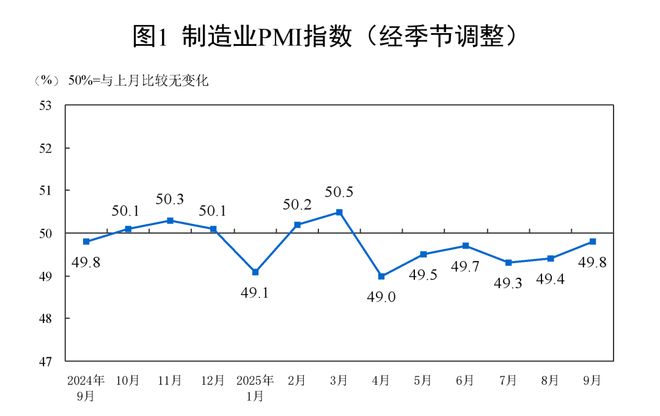
制造业采购经理指数(PMI)

Search documents
10月份制造业PMI为49% 大型企业产需持续释放
Zheng Quan Ri Bao· 2025-10-31 16:08
Group 1: Manufacturing Sector - In October, the Manufacturing Purchasing Managers' Index (PMI) decreased to 49%, down 0.8 percentage points from September, indicating a slowdown in manufacturing activities [1] - The production index and new orders index for manufacturing were 49.7% and 48.8%, respectively, reflecting declines of 2.2 and 0.9 percentage points from September [1] - PMI for large, medium, and small enterprises were 49.9%, 48.7%, and 47.1%, showing declines of 1.1, 0.1, and 1.1 percentage points respectively [1] Group 2: Key Industries - The PMIs for high-tech manufacturing, equipment manufacturing, and consumer goods sectors were 50.5%, 50.2%, and 50.1%, respectively, all remaining in the expansion zone and significantly above the overall manufacturing level [2] - The high-energy-consuming industries had a PMI of 47.3%, down 0.2 percentage points from September, indicating a decline in economic activity [2] Group 3: Non-Manufacturing Sector - The Non-Manufacturing Business Activity Index rose to 50.1%, up 0.1 percentage points from September, indicating expansion in the non-manufacturing sector [3] - The service sector's business activity index was 50.2%, reflecting a slight increase and improved economic conditions, particularly in transportation, accommodation, and entertainment sectors, which saw indices above 60.0% [3] - The construction sector's business activity index fell to 49.1%, down 0.2 percentage points from September, indicating a slight decline in construction activity [3] Group 4: Economic Outlook - Overall, the non-manufacturing sector continues to stabilize, with positive changes in investment and consumption-related activities [4] - The effectiveness of growth-stabilizing policies is expected to strengthen domestic demand in the fourth quarter, supporting the achievement of annual economic and social development goals [4]
2025年10月份制造业采购经理指数(PMI)49.0%
Guo Jia Tong Ji Ju· 2025-10-31 09:38
Core Insights - The manufacturing Purchasing Managers' Index (PMI) for October is 49.0%, a decrease of 0.8 percentage points from the previous month, indicating a decline in manufacturing activity [1] Group 1: PMI Overview - The PMI for large, medium, and small enterprises are 49.9%, 48.7%, and 47.1% respectively, all below the critical point, with declines of 1.1, 0.1, and 1.1 percentage points compared to last month [1] Group 2: Sub-Indices Analysis - The production index is at 49.7%, down 2.2 percentage points, indicating a slowdown in manufacturing production [3] - The new orders index is at 48.8%, a decrease of 0.9 percentage points, suggesting a decline in market demand for manufacturing [4] - The raw materials inventory index is at 47.3%, down 1.2 percentage points, indicating a continued reduction in the inventory of major raw materials [5] - The employment index is at 48.3%, a slight decrease of 0.2 percentage points, reflecting a minor decline in employment levels within manufacturing [6] - The supplier delivery time index is at 50.0%, down 0.8 percentage points, remaining at the critical point, indicating that supplier delivery times are stable compared to the previous month [7]
有利因素逐渐增多,制造业PMI有望回升
2 1 Shi Ji Jing Ji Bao Dao· 2025-10-31 09:23
Core Viewpoint - The manufacturing Purchasing Managers' Index (PMI) for October is at 49.0%, indicating a decline of 0.8 percentage points from the previous month, but there are expectations for gradual recovery in the future [1] Group 1: Manufacturing PMI Analysis - The October manufacturing PMI decline aligns with market expectations, primarily due to seasonal factors from overlapping holidays and increased uncertainty in international trade, leading to reduced production and investment expansion [1][2] - The production index and new orders index for October are at 49.7% and 48.8% respectively, indicating simultaneous slowdowns in both production and demand [2] - The new export orders index has decreased by 1.9 percentage points compared to September, remaining below the boom line for the first ten months of the year, reflecting the complexities in international trade [2] Group 2: Economic Outlook and Policy Measures - The overall market sentiment remains optimistic, with the recent release of the 15th Five-Year Plan proposal enhancing confidence in high-tech industries [3] - The central bank's current monetary policy is focused on utilizing existing structural policy tools, with an emphasis on sectors like digital economy and artificial intelligence [3] - The upcoming year is seen as a critical starting point for the 15th Five-Year Plan, with significant project construction and commencement expected, reinforcing the "investment in people" concept [3]
10月份我国制造业PMI为49.0%
Xin Hua Wang· 2025-10-31 04:15
Core Viewpoint - In October, the manufacturing Purchasing Managers' Index (PMI) decreased to 49.0%, reflecting a decline influenced by pre-holiday demand release and a complex international environment [1][2]. Group 1: PMI and Production Indices - The production index and new orders index for October were reported at 49.7% and 48.8%, respectively, showing declines of 2.2 and 0.9 percentage points from the previous month [1]. - The PMI for large, medium, and small enterprises was recorded at 49.9%, 48.7%, and 47.1%, indicating decreases of 1.1, 0.1, and 1.1 percentage points, respectively [1]. - Large enterprises maintained production and new orders indices at 50.9% and 50.1%, remaining in the expansion zone for six consecutive months [1]. Group 2: Industry Performance - Three key industries—high-tech manufacturing, equipment manufacturing, and consumer goods—sustained expansion with PMIs of 50.5%, 50.2%, and 50.1%, respectively [1]. - The production activity expectation index stood at 52.8%, indicating a continued optimistic outlook among most manufacturing enterprises [1]. Group 3: Market Dynamics - The construction of a unified national market is progressing, leading to positive changes in market prices, with the equipment manufacturing purchase and factory price indices rising for three consecutive months [2]. - Despite a slight slowdown in production activities in October, new growth drivers and consumer goods manufacturing showed steady growth, providing a solid foundation for macroeconomic stability [2].
国信期货有色(镍)周报:底部区间,持续震荡-20251019
Guo Xin Qi Huo· 2025-10-18 23:30
Group 1: Report Title and Date - Report Title: "Bottom Range, Continuous Fluctuation - Guoxin Futures Non - Ferrous (Nickel) Weekly Report" [2][3] - Report Date: October 19, 2025 [3] Group 2: Report Structure - The report includes three parts: market review, fundamental analysis, and future outlook [4] Group 3: Market Review - This part presents the price trends of domestic and foreign main nickel futures contracts [6] Group 4: Fundamental Analysis - **Upstream**: It shows the inventory of Chinese nickel ore ports [10] - **Mid - stream**: It includes the prices of electrolytic nickel, nickel sulfate, and the import volume of ferronickel and the price of 8 - 12% ferronickel, etc [12][14][16] - **Downstream**: It covers the price, position, and inventory of stainless steel, as well as the production of power and energy - storage batteries and new - energy vehicles [18][25][27] Group 5: Future Outlook - **Macroeconomic Situation**: The Fed Chairman Powell said the employment and inflation outlook in the US "seem not to have changed much", and the market expects the Fed to cut interest rates twice this year, which will provide more space for China's domestic monetary policy. China's manufacturing PMI in September was 49.8%, up 0.4 percentage points from the previous month, showing an improving manufacturing climate [32] - **Market Trends**: Shanghai nickel showed a trend of rising first and then falling this week. The premium and discount of refined nickel brands were stable with average trading. The supply of nickel ore in the Philippines was affected by weather, while the supply in the Indonesian market was relatively loose. The price of nickel sulfate rebounded recently, but its medium - term trend remains to be seen. Stainless steel mills were cautious in raw material procurement, with weak terminal demand and slow inventory reduction. It is expected that the operating range of the main Shanghai nickel contract will be approximately 118,000 - 128,000 yuan/ton, and that of the main stainless - steel contract will be about 12,200 - 13,300 yuan/ton [32]
国信期货有色(镍)周报:底部区间,震荡偏强-20251012
Guo Xin Qi Huo· 2025-10-12 02:46
Group 1: Report Title and Date - Report title: "Bottom Range, Oscillating with an Upward Bias - Guosen Futures Non - Ferrous (Nickel) Weekly Report" [2][3] - Report date: October 12, 2025 [3] Group 2: Industry Investment Rating - No industry investment rating is provided in the report. Group 3: Core Viewpoints - The US Federal Reserve's September meeting minutes suggest that most participants believe further monetary policy easing is appropriate this year, and the market expects two more interest rate cuts. In China, the manufacturing PMI in September was 49.8%, showing continued improvement in manufacturing sentiment [36]. - The Shanghai nickel market showed an oscillating trend this week with no obvious trend. Refined nickel demand remains weak. Nickel ore circulation in the coastal areas of the Philippines has slowed due to weather, while the nickel ore market in Indonesia has a relatively loose supply. The high - frequency data of nickel sulfate shows a recent price rebound, but whether it can change the weak situation in the medium term remains to be seen. In the stainless - steel market, steel mills are cautious in raw material procurement, terminal demand is weak, and inventory reduction is slow. The expected operating range of the Shanghai nickel main contract is approximately 118,000 to 128,000 yuan/ton, and that of the stainless - steel main contract is about 12,200 to 13,300 yuan/ton [36]. Group 4: Summary by Directory 1. Market Review - This part presents the historical price trends of domestic and foreign main nickel futures contracts, but no specific analysis is provided in the text [7][8]. 2. Fundamental Analysis 2.1 Upstream: China's Nickel Ore Port Inventory - The report shows the historical data of China's nickel ore port inventory, but no specific analysis is provided [12][13]. 2.2 Mid - stream: Electrolytic Nickel Price - The historical price data of electrolytic nickel (1, Ni99.90, domestic and imported) are presented, without specific analysis [14][15]. 2.3 Mid - stream: Nickel Sulfate Price - The historical average price data of nickel sulfate in China are shown, without specific analysis [16][17]. 2.4 Mid - stream: Monthly Import Volume of Ferronickel and Fubao Price of 8 - 12% Ferronickel - The historical monthly import volume data of ferronickel in China and the Fubao price data of 8 - 12% ferronickel are presented, without specific analysis [18][19]. 2.5 Downstream: Stainless - Steel Market - Stainless - steel price: The historical closing price data of stainless - steel futures are shown, without specific analysis [20][21]. - Stainless - steel futures positions: The historical position data of stainless - steel futures are presented, without specific analysis [22][23]. - Wuxi stainless - steel inventory: The historical inventory data of Wuxi stainless - steel and Wuxi 300 - series stainless - steel are shown, without specific analysis [25][26]. 2.6 Downstream: Production of Power and Energy - Storage Batteries - The historical monthly production data of China's power and energy - storage batteries (ternary materials) and total production data are presented, without specific analysis [28][29]. 2.7 Downstream: New - Energy Vehicle Production - The historical monthly production data of China's new - energy vehicles are shown, without specific analysis [30][31]. 3. Future Outlook - In the US, inflation data is in line with expectations, employment data is lower than expected, and the market expects two more interest rate cuts this year. In China, the manufacturing PMI continues to improve, indicating a consolidation of the economic recovery momentum in the third quarter [36]. - The Shanghai nickel market is oscillating, refined nickel demand is weak, the supply situation of upstream nickel ore varies, the nickel sulfate price has rebounded recently, and the stainless - steel market has weak demand and slow inventory reduction. The expected operating ranges of the Shanghai nickel and stainless - steel main contracts are given [36].
欧元区制造业表现分化
Sou Hu Cai Jing· 2025-10-10 22:45
Group 1 - The Eurozone's manufacturing PMI fell to 49.5 in September, indicating a return to recession and highlighting insufficient economic recovery momentum [1] - Germany's composite PMI rose to 52.4, surpassing analyst expectations, with services PMI reaching an 8-month high of 52.5, while manufacturing PMI dropped to 48.5, the lowest in four months [1] - France's manufacturing PMI declined to 48.1, and the composite PMI fell to 48.4, marking the fastest contraction since May, reflecting instability linked to domestic political uncertainty [2] Group 2 - The Eurozone's overall composite PMI for September was 51.2, indicating resilience in the services sector, but market sentiment remains low with deteriorating overseas orders [2] - Multiple factors contribute to the manufacturing sector's challenges, including trade tensions, rising energy costs, and a slowdown in global economic growth [3] - The decline in manufacturing is expected to ease commodity inflation pressures but increases the risk of economic slowdown, with the European Central Bank facing a delicate balance between preventing recession and avoiding excessive easing [4]
9月亚洲制造业PMI与上月持平 保持平稳扩张态势
Zhong Guo Xin Wen Wang· 2025-10-06 16:13
Core Insights - The Asian manufacturing Purchasing Managers' Index (PMI) for September 2025 stands at 50.9%, remaining stable compared to the previous month and marking five consecutive months above 50 [1] - The average PMI for Asian manufacturing in Q3 is 50.8%, an increase of 0.4 percentage points from Q2 [1] - China's manufacturing PMI has shown a continuous month-on-month increase for two months, with a larger growth rate compared to the previous month [1] - India's manufacturing PMI has decreased from the previous month but remains above 57 [1] - Among ASEAN countries, Thailand and Myanmar have seen significant increases in their manufacturing PMIs, both above 53, while Vietnam, Indonesia, and Singapore are slightly above 50, and the Philippines and Malaysia are below 50 [1] - Japan and South Korea's manufacturing PMIs have shown mixed results, with one declining and the other increasing, with Japan below 50 and South Korea above 50 [1] - Overall, the Asian economy is experiencing stable expansion in Q3, with stronger growth momentum compared to Q2, and demonstrating greater resilience than Europe, the Americas, and Africa [1] - Policy support for economic recovery from major Asian countries is robust, and the Regional Comprehensive Economic Partnership (RCEP) has played a significant role in enhancing regional trade cooperation [1] - The global manufacturing PMI for September 2025 is at 49.7%, a slight decrease of 0.2 percentage points from the previous month [1]
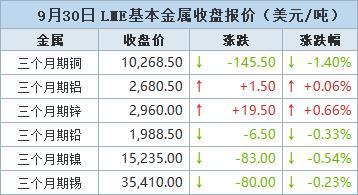
金属普跌 期铜下跌,中国国庆长假前出现获利了结【9月30日LME收盘】
Wen Hua Cai Jing· 2025-10-01 05:17
Group 1: Copper Market Overview - On September 30, LME copper prices declined as traders took profits after reaching a 15-month high, with three-month copper down by $145.5, or 1.4%, closing at $10,268.5 per ton [1] - The copper price increased by 4% in the third quarter, influenced by the suspension of operations at Indonesia's Grasberg copper mine, leading analysts to lower supply forecasts for 2025 and 2026 [3] - The LME spot copper premium narrowed from $73 per ton to $28 per ton, reflecting reduced supply expectations due to Grasberg's operational pause [3] Group 2: Chinese Market Dynamics - The Yangshan copper premium, indicating China's copper import demand, fell by 6% to a six-week low of $50 per ton, as trading activity is expected to be limited during China's National Day holiday from October 1 to 8 [3] - China's manufacturing PMI for September was reported at 49.8%, a 0.4 percentage point increase from the previous month, indicating continued improvement in manufacturing sentiment [3] Group 3: Other Base Metals Performance - Three-month aluminum prices increased by $1.5, or 0.06%, while zinc prices rose by $19.5, or 0.66% [2] - Three-month lead prices decreased by $6.5, or 0.33%, with Shanghai Futures Exchange lead inventories dropping by 15% to the lowest level since February [4] - Three-month tin prices fell by $80, or 0.23%, closing at $35,410.0 per ton, despite reaching a high of $35,510 on April 4 [4]

国家统计局发布9月重要数据
2 1 Shi Ji Jing Ji Bao Dao· 2025-09-30 11:27
Core Insights - The manufacturing Purchasing Managers' Index (PMI) for September is reported at 49.8%, an increase of 0.4 percentage points from the previous month, indicating continued improvement in manufacturing activity [1][6][7] Manufacturing Activity - The production index reached 51.9%, up 1.1 percentage points, marking a six-month high, suggesting active manufacturing production [6][7] - The new orders index is at 49.7%, a slight increase of 0.2 percentage points, indicating a modest improvement in market demand [6][7] - Large enterprises reported a PMI of 51.0%, while medium and small enterprises reported PMIs of 48.8% and 48.2%, respectively, indicating varying levels of activity across different enterprise sizes [6] Sector Performance - Key sectors such as equipment manufacturing, high-tech manufacturing, and consumer goods showed PMIs of 51.9%, 51.6%, and 50.6%, respectively, all above the manufacturing average, indicating robust activity [9] - The consumer goods sector has returned above the threshold line, reaching its highest level this year [2][9] Inventory and Pricing - The raw materials inventory index is at 48.5%, up 0.5 percentage points, indicating a continued reduction in inventory levels, albeit at a slower pace [10] - The purchasing price index for raw materials is at 53.2%, down 0.1 percentage points, while the factory price index is at 48.2%, down 0.9 percentage points, suggesting a narrowing profit margin for manufacturers [9][10] Business Confidence - The production and business activity expectations index has risen for three consecutive months, now at 54.1%, indicating improved confidence among manufacturers regarding market conditions [10]