资产多元化

Search documents
4000美元不是梦? 这些因素影响未来金价走势
Di Yi Cai Jing· 2025-09-29 23:52
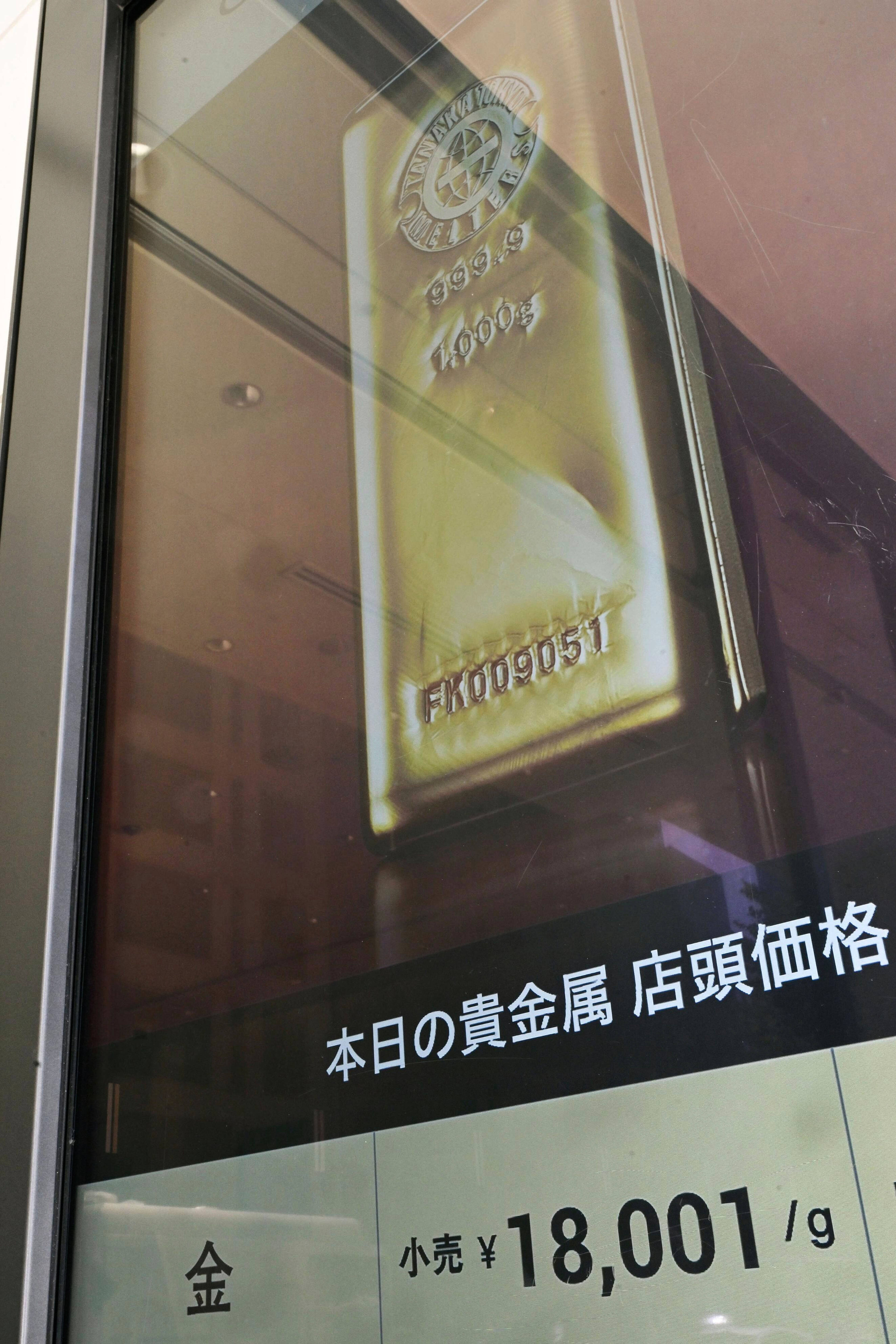
Core Viewpoint - Deutsche Bank believes that central banks and exchange-traded funds (ETFs) are becoming the main driving forces behind gold prices, which recently surpassed $3,800, reaching a historical high due to various factors including U.S. interest rate cut expectations and geopolitical tensions [1] Group 1: Economic Indicators and Market Sentiment - The U.S. Commerce Department reported that the core Personal Consumption Expenditures (PCE) index rose by 0.2% month-on-month and remained stable at 2.9% year-on-year, aligning with market expectations [3] - Traders currently estimate a nearly 90% probability of a Federal Reserve rate cut in October and about a 65% chance of another cut in December, driven by the recent moderate inflation data [4] - Investor sentiment is optimistic, with expectations that gold prices may test historical highs again this week, although heavy long positions in the gold market may require caution [4] Group 2: Geopolitical and Government Factors - The U.S. government faces a shutdown risk, with President Trump scheduled to meet with congressional leaders to negotiate funding extensions [4] - The potential government shutdown may delay the release of key economic data, including job vacancies and non-farm payroll reports, which investors are closely monitoring [5] Group 3: Gold Demand and Supply Dynamics - Central banks are expected to continue increasing their gold holdings, with annual net purchases exceeding 1,000 tons since 2022, and projected to reach 900 tons by 2025 [6] - The World Gold Council (WGC) indicates that central bank purchases will account for 23% of total annual demand from 2022 to 2025, double the average from 2016 to 2021 [6] Group 4: Currency and Investment Trends - The U.S. dollar index fell by nearly 0.3%, dropping below 98, with a cumulative decline of over 10% this year due to Fed rate cut expectations and trade policies [8] - The relationship between gold and the dollar has been notably inverse, with a weaker dollar supporting gold prices [8] Group 5: ETF Investment and Market Impact - Gold ETFs have become a significant source of demand, with inflows reaching 397 tons in the first half of the year, the highest since 2020 [9] - Deutsche Bank reports that the influence of ETFs on gold pricing has increased by 50% over the past three years, supporting a bullish price target of $4,000 per ounce [9] Group 6: Retail and Jewelry Demand - Retail investment in gold products shows strong demand, with gold bar investment expected to grow by 10% in 2024, while coin purchases are projected to decline by 31% [10] - Jewelry demand is sensitive to price changes, with high gold prices leading to a decrease in demand, particularly in major markets like China and India [11]


大人国际(01957):近期正探讨收购最多100枚比特币的可能性
智通财经网· 2025-09-29 23:49
智通财经APP讯,大人国际(01957)发布公告,公司近期正探讨运用集团内部资源,透过公开市场加密货 币交易所平台收购最多100枚比特币(一种加密货币)的可能性。 董事会审慎评估全球经济的不确定性,以及各国政府采取前所未有的财政刺激措施-此举因全球央行激 进增加货币供应量,导致法定货币价值面临贬值压力。该项潜在投资可能使公司得以多元化其资产组 合,同时顺应不断演变的全球金融格局。 此外,于持续增加数码资产储备同时,公司亦将与更多加密生态系统合作,为全球投资者创造可持续的 价值增长。 ...
A股上周回调,多只公募FOF单周跌超1% 业内:投资者可以关注股债多元机会
Sou Hu Cai Jing· 2025-09-24 12:46
Group 1 - The Federal Reserve's recent decision to cut interest rates by 25 basis points marks the first rate cut since December 2024, leading to a notable pullback in the A-share market [1][2] - The A-share market experienced a mixed performance, with the Shanghai Composite Index declining by 1.30%, while the Shenzhen Component and ChiNext Index increased by 1.14% and 2.34%, respectively [2] - Publicly offered Fund of Funds (FOF) saw significant weekly pullbacks, with many products experiencing declines exceeding 1%, particularly in stock-type FOFs [2] Group 2 - Morgan Asset Management suggests that the increased probability of two more rate cuts by the Federal Reserve reduces the attractiveness of cash returns, while long-term government bonds may present capital gain opportunities [3] - The report indicates that the potential for a weaker dollar could sustain resilience in non-U.S. markets and gold, with structural opportunities in A-shares, Hong Kong stocks, and Japanese stocks [3] - Tianfeng Securities highlights that the bond market is likely to continue oscillating within a range, with ongoing market dynamics influenced by the lack of new narrative logic [3] Group 3 - The QDII (Qualified Domestic Institutional Investor) funds have shown strong performance in the overseas equity markets, with a structural differentiation in the fund market [4] - As of mid-2025, the total number of QDII funds reached 307, with a total scale of approximately 678.27 billion RMB, marking a historical high [5] - The QDII fund structure is primarily composed of individual investors, although the average proportion of institutional investors has risen to 26%, indicating potential for future FOF investments in related QDII funds [5]
达利欧唱多黄金:涨势未完,建议投资者配置10%资金
智通财经网· 2025-09-19 12:24
Core Viewpoint - Ray Dalio, founder of Bridgewater Associates, suggests that increasing global debt pressures will lead to currency devaluation, strengthening gold and alternative currencies [1] Group 1: Investment Recommendations - Dalio recommends investors allocate approximately 10% of their portfolios to gold for diversification [1] - He emphasizes the growing importance of alternative currencies in wealth and currency reserves [1] Group 2: Economic Concerns - Dalio warns that excessive government spending and rising debt in the U.S. have become "unsustainable," posing a significant risk to the country's monetary order [1] - He estimates that the U.S. government needs to sell an additional $12 trillion in bonds to cover a $2 trillion budget deficit, $1 trillion in interest payments, and $9 trillion in maturing debt [1] Group 3: Market Trends - Gold has experienced a strong upward trend, rising 40% this year, marking the most significant annual increase since 1979 [1] - The current rise in gold prices is attributed to loose monetary policies and a weakening dollar, making gold and silver preferred investment options [1]
财富自由的黄金三角:赚钱、省钱、理财缺一不可
Sou Hu Cai Jing· 2025-09-16 02:44
Group 1 - The core concept emphasizes the importance of the "iron triangle" of wealth management: earning, saving, and investing, which must work together to achieve financial freedom [1][9] - Earning is the starting point of wealth accumulation, but it is not the endpoint; enhancing value creation ability is crucial [2][9] - Saving is not merely about frugality but involves rational planning and distinguishing between needs and wants, providing a safety net for investments [3][7] Group 2 - Investing acts as an accelerator for wealth growth, relying on proper asset allocation and the power of compounding [4][7] - The synergy between earning, saving, and investing creates a robust financial ecosystem; the absence of any one element can lead to imbalances in wealth accumulation [7][9] - Common misconceptions about wealth management need to be addressed, highlighting the necessity of balancing all three components for financial success [7][9] Group 3 - The art of balance involves adjusting priorities based on life stages, focusing on earning in youth, managing risks in middle age, and securing capital before retirement [8][11] - A dynamic approach to wealth management is essential, with a focus on long-term strategies and the interplay between active income and passive income [8][9]
黄金暴涨三年,驶入未知水域
Sou Hu Cai Jing· 2025-09-12 01:37
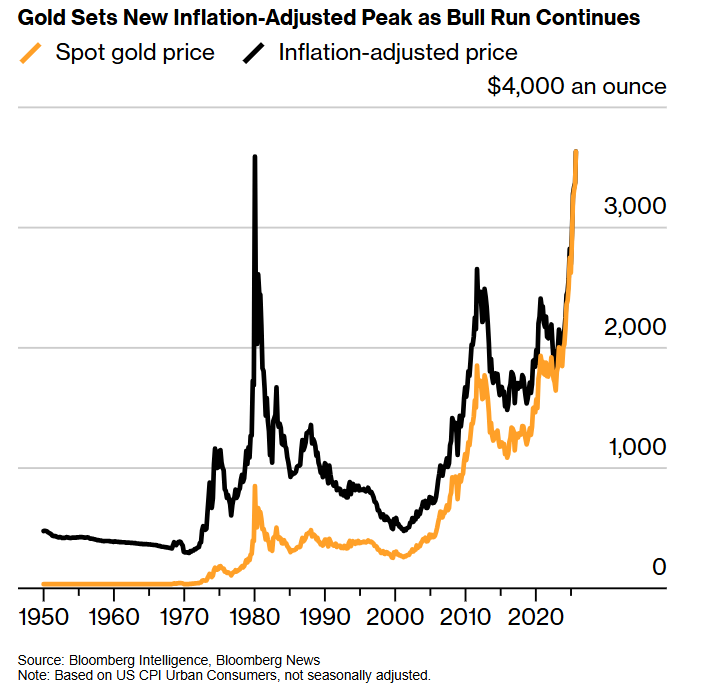
随着市场对美国经济路径的担忧升温,黄金价格持续上涨,并在本周二突破经通胀调整后的1980年峰 值,创下历史新高,三年牛市进入未知领域。 现货黄金本月迄今已上涨约5%,周二一度触及每盎司3674.27美元的历史新高。仅在2025年,金价就已 创下逾30次名义价格纪录。而最新一轮涨势突破了1980年1月21日的通胀调整后峰值,当时名义价格为 850美元。彼时的美国正面临货币崩溃、通胀飙升和经济衰退。 考虑几十年的消费者物价上涨,1980年的850美元相当于现在的约3590美元。需要注意的是,通胀调整 方法不同,部分估算会把1980年高点算得更低。无论如何,市场普遍认为黄金已稳稳突破1980年代水 平,再次凸显其作为抗通胀、对冲货币贬值"古老避险工具"的地位。 通胀、去美元化与美国政策担忧构成多重推力 今年以来,在特朗普总统减税、扩大全球贸易争端,以及对美联储独立性的威胁之下,黄金已上涨近 40%。美元和美国长期国债年初的抛售,凸显了市场对美国资产需求减弱的担忧,并引发美国债务能否 继续作为动荡时期避险资产的质疑。 前世行首席经济学家卡门·莱因哈特指出:"黄金反映的不仅是人们重新认识到通胀依然是问题,还有对 世界的 ...
黄金突破1980年通胀调整历史峰值!三年暴涨驶入未知水域
Jin Shi Shu Ju· 2025-09-11 23:15
Core Insights - Gold prices have surpassed the inflation-adjusted historical peak from 45 years ago, indicating a significant shift in market dynamics amid growing concerns about the U.S. economy [1][2] - The current surge in gold prices, which has seen a nearly 40% increase this year, reflects a broader trend of investors seeking safe-haven assets in response to economic uncertainty and inflation fears [2][3] Group 1: Price Movements and Historical Context - Spot gold prices have risen approximately 5% this month, reaching a record high of $3,674.27 per ounce, marking over 30 nominal record highs since 2025 [1] - The current gold price has surpassed the inflation-adjusted peak of $850 from January 1980, which is equivalent to about $3,590 today [1] - The volatility of the current gold price surge is significantly lower compared to the parabolic rise and subsequent fall in 1980, attributed to stronger market liquidity and broader investor participation [2] Group 2: Central Bank and Investor Behavior - The value of gold stored in London has exceeded $1 trillion for the first time, making it the second-largest asset in global central bank reserves, surpassing the euro [3][6] - Central banks are increasing their gold holdings to diversify away from the U.S. dollar and mitigate risks associated with sanctions against U.S. adversaries, particularly following the Russia-Ukraine conflict [6] - The shift from a unipolar to a multipolar world is accelerating the demand for gold among central banks and high-net-worth individuals, as gold becomes a key asset for diversification [6] Group 3: Economic Indicators and Future Outlook - Recent market trends suggest that expectations of imminent interest rate cuts by the Federal Reserve are driving gold prices higher, as lower rates typically enhance gold's appeal compared to interest-bearing assets [8] - Historical parallels are drawn to the 1970s when pressure on the Federal Reserve to maintain low rates led to a significant depreciation of the dollar and a subsequent gold bull market [8] - Investors are increasingly viewing gold as a safeguard against the devaluation of currency and rising debt levels, reinforcing its status as a reliable store of value [9]
9月以后,如果房价持续出现“暴跌”,有可能出现4大“困局”
Sou Hu Cai Jing· 2025-09-03 12:14
Core Viewpoint - The current real estate market in China is experiencing significant adjustments, with concerns about potential price declines affecting both individual homeowners and the broader economy [3][4][5]. Group 1: Market Trends - Recent data indicates a 0.3% month-on-month decline and a 1.7% year-on-year drop in the property price index across 70 major cities in China as of mid-2025 [3]. - First-tier cities show relative stability, while some third and fourth-tier cities have experienced price drops exceeding 5% [3][4]. Group 2: Individual Impact - Homeowners are facing psychological stress due to fears of "negative equity," where property values fall below outstanding mortgage balances, potentially affecting 8% of mortgage-holding families if prices drop by 20% [4][5]. - Behavioral changes among consumers, such as delaying major life decisions and reducing spending, are observed as a response to market uncertainties [4][5]. Group 3: Industry Effects - The real estate sector's downturn could disrupt related industries, including construction materials and home furnishings, leading to a significant decline in orders and sales [5][6]. - A notable 12% drop in sales of major home appliances linked to real estate transactions was reported in the second quarter of 2025 [6]. Group 4: Fiscal Consequences - Local governments are likely to face reduced revenue from land sales, which constituted 16.8% of their total financial resources in 2024, leading to potential cuts in public services and infrastructure projects [7][8]. - A specific city reported an 18% year-on-year decline in land sale revenues, impacting planned public projects [7]. Group 5: Financial System Risks - The banking sector is exposed to risks from real estate loans, with approximately 27% of total bank loans tied to the sector, raising concerns about rising default rates if property values decline [8]. - The non-performing loan ratio for residential mortgages has been on a slight upward trend, indicating growing financial strain [8]. Group 6: Recommendations and Future Outlook - Homeowners are advised to maintain a rational perspective on property value fluctuations and consider diversifying income sources to mitigate financial risks [9][11]. - Potential buyers should make informed decisions based on their financial capabilities, avoiding impulsive actions driven by market fears [11]. - Investors are encouraged to diversify their asset portfolios beyond real estate to reduce risk exposure [13].

避险需求推动黄金价格创新高
Sou Hu Cai Jing· 2025-09-03 08:45
Core Viewpoint - The global economic uncertainty has led investors to seek safe-haven assets, resulting in a surge in gold prices, which reached a new high of over $3500 per ounce on September 2, 2023 [1][4]. Group 1: Gold Market Dynamics - Gold prices hit $3501.59 per ounce during Asian trading, surpassing the previous record of $3500.10 set in April [1]. - The rise in gold prices is attributed to a weak dollar and expectations of interest rate cuts by the Federal Reserve, as inflation in the U.S. accelerates [2][5]. - Concerns over the independence of the Federal Reserve have intensified, prompting investors to sell dollars and buy gold as a hedge [2][4]. Group 2: Market Reactions and Influences - The price of silver also reached a 14-year high at $40.76 per ounce, driven by similar market sentiments [4]. - The pressure from former President Trump on the Federal Reserve and the recent court rulings regarding tariffs have contributed to the volatility in the market [2][4]. - Analysts note that geopolitical uncertainties, inflation worries, and concerns about the health of the U.S. economy have collectively driven gold prices up by 33% this year [6][7]. Group 3: Broader Economic Context - The expectation of a rate cut by the Federal Reserve is reinforced by the recent personal consumption expenditures report, which aligns with analyst forecasts [5]. - Central banks around the world are increasing their gold reserves as a strategy to diversify away from the dollar, further supporting the rise in gold prices [6].
2025年8月6日美元兑人民币汇率公布,今天换汇划算吗?
Sou Hu Cai Jing· 2025-08-08 01:23
Core Insights - The exchange rate of RMB against USD showed slight appreciation on August 6, 2025, with the central parity rate at 7.1366, indicating a stable market expectation for RMB [3][4] - The impact of RMB appreciation varies across different groups, benefiting individuals planning to travel or study abroad while posing challenges for export-oriented businesses [3][4] - The recent narrowing of RMB exchange rate fluctuations signals increased market confidence and stable cross-border capital flows, reflecting a balanced financial market sentiment [3][4] Exchange Rate Impact on Different Groups - RMB appreciation reduces exchange costs for travelers, students, and overseas shoppers, making it more economical for these groups [3][4] - Conversely, for export enterprises, RMB appreciation diminishes international competitiveness, potentially leading to reduced orders and profit margins [3][4] Underlying Factors of Exchange Rate Stability - Enhanced market confidence is indicated by the stability of the exchange rate, suggesting strong expectations for China's economic future [3][4] - The People's Bank of China (PBOC) has effectively intervened to maintain the exchange rate within a reasonable range, contributing to financial market stability [4][6] Recommended Exchange Strategies - For short-term exchange needs, a phased approach to currency exchange is advisable due to the current stability, rather than waiting for the lowest rate [4][6] - Investors in USD assets should consider factors beyond just the exchange rate, including USD interest rates and the international economic environment [4][6] - A strategy of gradual exchange and investment is recommended to mitigate risks associated with currency fluctuations [4][6] Broader Economic Implications - Exchange rate movements serve as indicators of international capital flow trends, reflecting the economic health of the country [4][6] - The confidence index related to exchange rates reflects investor sentiment regarding future economic developments [6]