
国产替代

Search documents
九强生物:预计2025年全年归属净利润盈利1.8亿元至2.18亿元
Sou Hu Cai Jing· 2026-01-28 10:16
Group 1 - The company expects a net profit attributable to shareholders of 180 million to 218 million yuan for the full year of 2025 [1] - The decline in profit is attributed to asset impairment provisions, with an estimated goodwill impairment provision of approximately 180 million yuan due to increased competition and policy impacts in the medical industry [1] - The company is undergoing goodwill impairment testing, which will be finalized after evaluation by qualified assessment and auditing institutions [1] Group 2 - The company's main business in the in-vitro diagnostics industry is facing pressure from policy changes, leading to a projected net profit of 360 million to 398 million yuan for 2025, a decrease of 25% to 32% year-on-year [2] - The company is actively developing its pathology business, optimizing its business structure, and enhancing its product line through new product development and cost reduction strategies [2] - Non-recurring gains and losses are expected to impact net profit by 7.07 million yuan in 2025, compared to 12.08 million yuan in the previous year [2] Group 3 - For the first three quarters of 2025, the company reported a main revenue of 1.012 billion yuan, a year-on-year decline of 18.24%, and a net profit of 272 million yuan, down 27.03% year-on-year [3] - In Q3 2025, the company’s single-quarter main revenue was 343 million yuan, a decrease of 17.39% year-on-year, with a net profit of 97.23 million yuan, down 20.96% year-on-year [3] - The company reported a debt ratio of 24.55%, with investment income of -1.04 million yuan and financial expenses of 31.04 million yuan, while maintaining a gross profit margin of 79.86% [3]

斯瑞新材的星辰与现实:13亿营收之上,商业航天能撑起多大想象?
市值风云· 2026-01-28 10:13
Core Viewpoint - The article highlights the rising interest in the commercial aerospace sector in China, particularly focusing on the company Sry New Materials (斯瑞新材), which has developed critical aerospace-grade high-strength and high-conductivity copper alloy materials, essential for rocket engine components [3][13]. Financial Performance - Sry New Materials' revenue grew from 570 million yuan in 2019 to 1.33 billion yuan in 2024, with a compound annual growth rate (CAGR) of approximately 18.6%. In the first three quarters of 2025, revenue reached 1.17 billion yuan, marking a year-on-year increase of 21.7% [4]. - The net profit attributable to the parent company increased from 30.5 million yuan in 2019 to 110 million yuan in 2024, with a CAGR exceeding 30%. In the first three quarters of 2025, net profit grew by 37.7% to 110 million yuan, nearly matching the total for the previous year [7]. - The gross margin has been gradually improving, with a 3 percentage point increase in the first three quarters of 2025 compared to the entire year of 2023, indicating a rise in high-value-added products [10]. Industry Context - The company is one of only two in China that has successfully developed aerospace-grade high-strength and high-conductivity copper alloy materials, which are crucial for the thrust chambers of rocket engines [16][18]. - The commercial aerospace sector in China is experiencing rapid growth, with significant investments and plans for satellite launches, aiming for a market scale of 7-10 trillion yuan by 2030 [15][16]. - Sry New Materials' products have been validated in key tests by leading domestic commercial rocket companies, addressing the long-standing issue of material erosion in rocket engines [18]. Business Segments - The company primarily operates in two business segments: high-strength and high-conductivity copper alloy materials, and medium-high voltage electrical contact materials, which together contribute approximately 70% of total revenue [20]. - The high-strength and high-conductivity copper alloy materials are used in various applications, including rail transportation, new energy vehicles, and 5G communication [21]. - In the medium-high voltage electrical contact materials segment, the company has achieved a domestic market share exceeding 60% and a global market share of about 50%, positioning itself as a leader in this niche [26]. Future Outlook - Although Sry New Materials has a strong technological foundation, its commercial aerospace business is still in the early stages, with revenue from this segment only surpassing 30 million yuan in 2024 [19]. - The company plans to expand production capacity to meet growing market demand, with a target of producing 300 tons of forgings and over a thousand sets of thrust chamber components annually [19]. - The potential for significant growth in the commercial aerospace sector hinges on the successful scaling of operations and the ability to meet market demands [29].



国产创新器械“第一股”抢滩背后:烧钱研发倒逼资本补血
Xin Lang Cai Jing· 2026-01-28 10:13
Group 1 - The core viewpoint of the article highlights an unprecedented wave of IPO applications from over 13 medical device companies in China, marking a significant shift in the industry as multiple sectors prepare to launch their "first stocks" [2][3][4] - The medical device market in China is projected to reach 1.22 trillion yuan by 2025, reflecting a growth of approximately 30% from 941.7 billion yuan in 2024, indicating a robust market outlook [4][15] - The reactivation of the fifth listing standard on the STAR Market has lowered the barriers for high R&D investment companies, facilitating the entry of innovative firms that may not yet be profitable [3][15][20] Group 2 - The competition for the title of "first stock" in various segments is intensifying, with companies like Core Medical and Tongxin Medical vying for leadership in the artificial heart market [5][17] - Notable companies such as Jinjiang Electronics and Saiwei Technology are also advancing their IPO processes, with Jinjiang Electronics having launched China's first domestic cardiac mapping system [6][18] - The financing landscape is shifting, with total financing in the first half of 2025 increasing by 17.01% year-on-year to 16.695 billion yuan, indicating a trend towards concentrated investment in validated innovative enterprises [4][16] Group 3 - Despite the promising outlook, many innovative medical device companies face significant profitability challenges due to high R&D costs and long development cycles, with Core Medical reporting R&D expenditures of 119 million yuan, 151 million yuan, and 87.5 million yuan from 2023 to mid-2025 [8][20] - Companies are adjusting their pricing strategies to penetrate the market, with Core Medical's average sales price for its commercialized product dropping from 290,400 yuan in 2023 to 229,600 yuan in the first half of 2025 [9][21] - The IPO process is seen as a critical pathway for these companies to secure low-cost funding, advance clinical research, and expand production capabilities [9][22]

「内存成本涨了上千元」,今年买车会更贵吗?
36氪· 2026-01-28 09:28
以下文章来源于中新经纬 ,作者龚宸芫 中新经纬 . 中新经纬是由中国新闻社主办的财经新媒体,拥有中国互联网新闻信息采编发布服务资质。以手机客户端(APP)等为主要传播平台,以"权威、前瞻、 专业、亲和"为特色宗旨,传播财经资讯、解读经济政策、讲述商界故事,打造精英的财经资讯平台。 自2025年下半年以来, 全球存储芯片价格持续走高。 文 | 龚宸芫 编辑 | 李晓萱 来源| 中新经纬(ID:jwview) 封面来源 | Unsplash "就靠抢!国产存储公司的门槛都被踏破了,大家都在抢(内存)产线、产能,能抢到就比别人快一步 。 " 某自主车企智能座舱相关负责人黄华(化名) 近日对中新经纬说。 自 2025 年下半年以来,全球存储芯片价格持续走高。在汽车领域,多家车企高管表示(存储芯片)涨价和供应紧张给企业带来了压力。 2025 年 12 月底,理想汽车供应链副总裁孟庆鹏公开表示, 2026 年汽车行业可能面临存储芯片供应危机,满足率或许不足 50% 。蔚来 董事长 李斌在 2026 年 1 月初的媒体沟通会上称,内存涨价已成为汽车行业今年最大的成本压力。 消费者今年买车,价格会更贵吗? 从种类看,汽车存储 ...

乔锋智能:2025年全年净利润同比预增51.04%—80.27%
2 1 Shi Ji Jing Ji Bao Dao· 2026-01-28 09:26
Core Viewpoint - QiaoFeng Intelligent has announced an annual performance forecast, expecting a significant increase in net profit for 2025, driven by growth in various sectors and enhanced operational capabilities [1] Group 1: Financial Performance - The company anticipates a net profit attributable to shareholders of 310 million to 370 million yuan for 2025, representing a year-on-year increase of 51.04% to 80.27% [1] - The expected net profit after deducting non-recurring gains and losses is projected to be between 300 million and 360 million yuan, with a year-on-year growth of 51.49% to 81.79% [1] Group 2: Growth Drivers - The rapid development of downstream industries such as consumer electronics and new energy vehicles, along with the recovery of the general equipment industry, has driven sales growth of the company's CNC machine tools [1] - The enhancement of production capacity and brand influence, along with the continuous release of capacity from fundraising investment projects, has significantly improved the company's delivery capabilities [1] - The mass production and market application of core components like precision spindles and high-end horizontal machining centers, as well as five-axis machining centers, are becoming new drivers of performance growth [1] Group 3: Market Environment - The upgrade of intelligent manufacturing, the demand for machine tool updates, and the acceleration of domestic substitution are providing a favorable operational environment and development support for the company's CNC machine tool business [1]
九强生物:2025年全年净利润同比预减59.07%—66.21%
2 1 Shi Ji Jing Ji Bao Dao· 2026-01-28 09:20
南财智讯1月28日电,九强生物发布年度业绩预告,预计2025年全年归属于上市公司股东的净利润为 18,000万元—21,800万元,同比预减59.07%—66.21%;预计2025年全年归属于上市公司股东的扣除非经 常性损益的净利润为17,093万元—21,093万元,同比预减59.48%—67.16%。业绩变动原因说明:1、资 产减值计提:公司控股子公司美创公司受医疗行业政策影响,量价承压,行业竞争日益加剧,经营受到 很大影响,出于谨慎性原则,判断相关资产组商誉存在减值迹象,公司本期拟计提商誉减值准备约1.8 亿元。截至本公告披露日,相关商誉减值测试工作尚在进行中,最终商誉减值准备计提金额,将在公司 聘请的具备证券期货从业资格的评估机构及审计机构进行评估和审计的基础上,由公司履行内部的相关 程序后确定。2、主营业务影响:报告期内,公司所处体外诊断行业受政策影响,一方面增值税税率调 整影响,另一方面业务受到医疗行业政策影响,量价承压,公司盈利能力下滑,若不考虑商誉减值计提 因素,经公司测算2025年度归属于上市公司股东的净利润预计在3.6亿-3.98亿之间,预计较上年同期下 降32%—25%。公司结合自身状况 ...
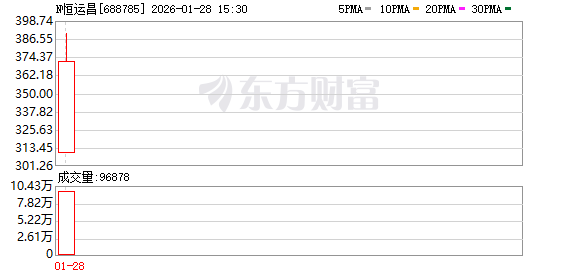
大涨超300%,深企境内上市“开门红”
Zhong Guo Ji Jin Bao· 2026-01-28 09:20
持续加码研发让技术优势不断巩固。截至2024年底,公司研发人员占比超40%,2022至2024年研发投入 连续增长,累计投入近1.14亿元,占同期累计营收的11.11%,复合年增长率达60.19%。目前已形成3大 基石技术和8大产品化支撑技术,覆盖信号采样、相位锁定等关键领域,推出的三代产品系列精准匹配 半导体制造对"快、准、稳"的核心需求。凭借硬核实力,公司还承担了工信部、科技部三项国家级课 题,2023年在中国大陆半导体行业国产等离子体射频电源系统厂商中市场份额位列第一。 技术突破转化为显著发展成果。2018年获得国内龙头设备商合作机会后,恒运昌产品于2020年通过验证 并实现批量出货,此后陆续与多家知名半导体设备商建立合作。2022至2024年,公司营收从1.58亿元跃 升至5.41亿元,净利润从2639万元增长至1.43亿元,实现规模与效益双丰收。资本也纷纷青睐,自2021 年起,国投创业、中电科等产业基金先后注资,为企业发展注入动力。2021年迁入宝安桃花源科技创新 园后,团队规模与研发生产设备持续升级,进一步夯实发展根基。 于恒运昌而言,此次上市并非终点,而是新的起点。恒运昌提出"守正创新"五年计 ...
海 利 得(002206) - 2026年1月28日投资者关系活动记录表
2026-01-28 09:04
Group 1: Company Overview and Strategy - The company has focused on the fiber sector for over 20 years, becoming a trusted partner for global automotive and tire enterprises, emphasizing innovation as a key driver for sustainable development [2][3] - The transition from "manufacturing" to "intelligent manufacturing" is a critical phase, with ongoing investments in R&D and technology breakthroughs [3] - The company aims to align its transformation with national strategic needs, setting clear goals for technology iteration and industrial upgrading over a five-year strategic cycle [3] Group 2: New Materials Development - Projects in new materials are progressing, focusing on high-performance fibers for applications in composite materials and hydrogen energy [4] - The company has achieved batch sales of PPS long fibers and is testing applications in hydrogen membrane fields [4] - The R&D efforts are concentrated on fiber products, showcasing innovation capabilities in new materials while also making progress in fine chemicals to achieve import substitution and reduce production costs [4] Group 3: Competitive Advantages - The company possesses over 20 years of experience in fiber spinning and modification, establishing a mature technology system in high-end automotive and industrial fibers [5] - It has a full supply chain capability from raw material processing to finished product production, ensuring cost control and quality stability [5] - The company has received certifications from multiple high-end clients, securing a place in core supply chains [5] Group 4: Strategic Projects and Collaborations - The implementation of LCP resin and spinning oil agent projects is a key move in the dual-driven strategy of stabilizing traditional business and seeking growth in emerging sectors [6] - A joint innovation center has been established with Donghua University, enhancing the company's core competitiveness in high-end new materials and promoting the application of research outcomes [7] Group 5: Market Trends and Future Outlook - The industry concentration is expected to increase, with high technical and customer certification barriers in the curtain fabric sector [8] - The rise of domestic new energy vehicles presents growth opportunities for automotive fiber businesses, particularly in safety belt and airbag fibers [9] - The company is expanding production capacity in Vietnam, focusing on polyester industrial yarn and curtain fabric to meet global demand [11] Group 6: Financial and Investment Strategy - The company plans to focus capital expenditures on expanding overseas production bases and industrializing new materials developed by its research institute over the next three years [14] - Investments are being made through an industrial fund to secure high-quality resources in new materials, particularly in high-performance fibers and life sciences [13]

天禄科技(301045) - 2026年1月28日投资者关系活动记录表
2026-01-28 08:56
Group 1: Fundraising and Project Adjustments - The company announced a change in fundraising strategy, terminating the "Expansion of Large-Sized Light Guide Plate Project" to enhance the efficiency of fund usage [1] - Remaining funds will be redirected to the TAC film project at Anhui Jiguang and the reflective polarizing film project at Suzhou Yijia [1] - The company aims to extend its business from light guide plates to adjacent fields, establishing a second growth curve through these optical films [1] Group 2: Market Analysis and Competitive Landscape - The demand for TAC film is projected to reach 1.229 billion square meters by 2025, with over 70% of panel production capacity located in mainland China [2] - TAC film constitutes over 50% of the cost of polarizing film materials, significantly impacting the profitability of polarizing film manufacturers [2] - Currently, the TFT-grade TAC film used in mainland China is heavily reliant on imports, with Japanese suppliers holding approximately 75% of the global market share [2] Group 3: Project Progress and Development - Anhui Jiguang obtained the construction permit for its factory in June 2025, with steady progress in construction [2] - Major equipment for the TAC film project is expected to be delivered and tested in the first half of this year [2] - Initial test results of trial films sent to downstream polarizing film and panel manufacturers show no significant discrepancies from internal testing results [2]
朗科科技:预计2025年净利润2100万元至3100万元
Sou Hu Cai Jing· 2026-01-28 07:33
朗科科技回复:感谢您的关注。公司将积极把握国产发展机遇,持续优化业务布局,拓展多元渠道。公 司于2026年1月21日披露了业绩预告,预计2025年归属于上市公司股东的净利润为2100万元至3100万 元,同比扭亏为盈。公司重视存储行业历史性机遇,将持续聚焦存储主业,继续推进降本增效、优化销 售策略等经营举措,不断提升盈利能力,积极回报投资者。 以上内容为证券之星据公开信息整理,由AI算法生成(网信算备310104345710301240019号),不构成 投资建议。 证券之星消息,朗科科技(300042)01月28日在投资者关系平台上答复投资者关心的问题。 投资者提问:公司产品属于部分自主可控,也算是国产替代的好苗子,但是不是因为国产的问题导致公 司营收和利润都比较低,相较于其他存储组装厂和存储经销商,公司完全处于行业下游。公司属于国 企,更应该担当起国产替代的使命,在行业处于发展最好的时刻,公司更应该抢占先机,扭亏为盈。公 司在这波存储红利中完全落后,公司应该深刻反省,积极做好市值管理,条件允许的话发业绩预告,希 望公司在这波浪潮中扭转颓势! ...
