美联储独立性

Search documents
美联储米兰:我们保持独立性的唯一途径是不参与货币政策以外的事务。
Sou Hu Cai Jing· 2025-11-12 18:29
美联储米兰:我们保持独立性的唯一途径是不参与货币政策以外的事务。 来源:滚动播报 ...
市场主流观点汇总-20251112
Guo Tou Qi Huo· 2025-11-11 23:30
Report Overview - The report objectively reflects the research views of futures and securities companies on various commodity varieties, tracks hot varieties, analyzes market investment sentiment, and summarizes investment driving logic [1] Market Data Commodities - From November 3 to November 7, 2025, PTA rose 1.70% to 4664.00, aluminum rose 1.41% to 21625.00, and other commodities also had different changes. Gold fell 0.07% to 921.26, and some commodities like palm oil, copper, etc., declined [2] A - shares - From November 3 to November 7, 2025, the Shanghai - Shenzhen 300 rose 0.82% to 4678.79, while the CSI 500 fell 0.04% to 7327.91 [2] Overseas Stocks - From November 3 to November 7, 2025, the Hang Seng Index rose 1.29% to 26241.83, while the Nasdaq Index fell 3.04% to 23004.54 [2] Bonds - From November 3 to November 7, 2025, the yield of China's 2 - year treasury bond changed from 2.84 to 1.43, and the 10 - year treasury bond yield decreased by 0.7 bp to 1.81 [2] Foreign Exchange - From November 3 to November 7, 2025, the euro - US dollar exchange rate rose 0.25% to 1.16, and the US dollar index fell 0.18% to 99.55 [2] Commodity Views Macro - financial Sector Stock Index Futures - Strategy views: Among 9 institutions, 3 are bullish, 1 is bearish, and 5 expect a sideways trend. Bullish logic includes long - term domestic policy support, the start of the global AI cycle, improved global capital market sentiment, and the likely easing of Sino - US trade relations. Bearish logic includes better - than - expected US employment and manufacturing, decline in China's PMI, high A - share valuation, and increased risk - aversion sentiment [4] Treasury Bond Futures - Strategy views: Among 7 institutions, 2 are bullish, 0 are bearish, and 5 expect a sideways trend. Bullish logic includes weak fundamentals supporting the bond market, the stock - bond seesaw effect, and central bank net investment. Bearish logic includes inflation repair, increased government bond issuance, and potential market sentiment disturbance [4] Energy Sector Crude Oil - Strategy views: Among 8 institutions, 1 is bullish, 3 are bearish, and 4 expect a sideways trend. Bullish logic includes OPEC's suspension of production increase, short - term interruption of Russian oil, expected end - year risk - asset trading, and cost - price support. Bearish logic includes unexpected US inventory build - up, tight dollar liquidity, expected global inventory build - up, and rising production from new oil fields [5] Agricultural Products Sector Rapeseed Oil - Strategy views: Among 8 institutions, 3 are bullish, 1 is bearish, and 4 expect a sideways trend. Bullish logic includes unexpected decline in rapeseed oil inventory, low inventory and low operating rate of domestic oil mills, and un - resumed domestic rapeseed crushing. Bearish logic includes lack of Chinese demand for Canadian rapeseed, weakening aquaculture demand, expected increase in imports, and potential impact of improved Sino - Canadian relations [5] Non - ferrous Metals Sector Copper - Strategy views: Among 7 institutions, 2 are bullish, 2 are bearish, and 3 expect a sideways trend. Bullish logic includes the expected end of the US government shutdown, slow recovery of overseas copper mines, consumption boost from the "15th Five - Year Plan", and long - term demand from emerging sectors. Bearish logic includes shrinking US manufacturing PMI, rising US dollar index, increasing domestic inventory, and high copper prices suppressing traditional consumption [6] Chemical Sector Glass - Strategy views: Among 7 institutions, 0 are bullish, 4 are bearish, and 3 expect a sideways trend. Bullish logic includes decreased inventory of key enterprises, low - price valuation support, stable and slightly rising spot prices, and long - term policy support. Bearish logic includes weak terminal demand, sufficient industry capacity, high - inventory dragging down prices, and consumption - season pressure [6] Precious Metals Sector Gold - Strategy views: Among 7 institutions, 2 are bullish, 1 is bearish, and 4 expect a sideways trend. Bullish logic includes concerns about the Fed's independence and US fiscal situation, geopolitical uncertainty, increased risk - aversion due to the US government shutdown, and high probability of December interest - rate cut. Bearish logic includes eased Sino - US trade relations, hawkish Fed remarks, strong US service data, and lack of clear bullish factors [7] Black Metals Sector Iron Ore - Strategy views: Among 8 institutions, 0 are bullish, 4 are bearish, and 4 expect a sideways trend. Bullish logic includes decreased global shipments, rising basis during price decline, and increased blast - furnace operating rate. Bearish logic includes continuous over - seasonal inventory build - up at ports, significant increase in arrivals, difficult de - stocking of downstream products, decreased molten iron production, and increased negative - feedback pressure on steel mills [7]
多空因素交织,贵金属持续调整
Yin He Qi Huo· 2025-11-10 07:15
Group 1: Report Industry Investment Rating - Not mentioned in the content Group 2: Core Viewpoints of the Report - The precious metal market is currently under pressure from the US macro - situation but also supported by multiple risk factors. It is expected to continue its consolidation in the high - level range. The trading strategy recommends short - term traders to use a band - trading approach, and long - term investors to maintain a low - buying strategy. Meanwhile, it is advisable to wait and see for arbitrage and options trading [5][6][7] - The interference with the Fed's independence by Trump may push up inflation in the medium - long term, which is one of the main drivers of the precious metal market's rise since late August [19] - The US economic growth shows signs of weakness. The GDP growth has a certain degree of deception, the labor market is cooling, and inflation is fluctuating. The Fed's interest - rate cut rhythm will be affected by inflation stickiness and employment market risks [27][34][48] - The Fed is about to end its balance - sheet reduction, which marks a key step in monetary policy shifting from "active tightening" to "neutral waiting and seeing" [51] - In the precious metal market, the supply and demand of gold are both increasing, with investment demand leading the growth. The supply of silver is relatively stable, and the demand is mainly affected by photovoltaic silver consumption [53][54][66] Group 3: Summary According to Relevant Catalogs Chapter 1: Weekly Core Points Analysis and Strategy Recommendation - **Comprehensive Analysis** - **US Macro - situation**: Fed officials have different views on the December interest - rate cut. Most are cautious, which has dampened market expectations for future interest - rate cuts. The US dollar index has rebounded, putting pressure on precious metals. However, risks such as the government shutdown, tariff legal debates, and labor market risks support precious metals [5] - **Fundamentals**: In October, gold ETFs had a net inflow of 54.9 tons. In Q3, there was a resonance in ETF, physical demand, and central bank gold - buying demand. Global gold ETF total holdings increased by 222 tons (a 30% quarter - on - quarter increase), bar and coin demand reached 316 tons (a 2.7% quarter - on - quarter increase), and global central bank gold - buying volume was 220 tons (a 28% quarter - on - quarter increase) [5] - **Futures Market**: Precious metals are currently under pressure and supported. The London gold range of $3900 - 4000, London silver range of $46 - 47 (Shanghai gold about 894 - 915 yuan, Shanghai silver about 11000 - 11200 yuan) show good support, but lack upward momentum. It is expected to continue to consolidate in the high - level range [6] - **Strategy Recommendation** - **Single - side Trading**: Short - term traders should mainly use a band - trading approach; long - term investors can continue the low - buying strategy [7] - **Arbitrage and Options**: Wait and see [7] Chapter 2: Macroeconomic Data Tracking - **Market Trading Focus**: The focus has shifted from tariff games to interest - rate cut games. Trump has repeatedly pressured the Fed to cut interest rates, which may affect the Fed's independence and lead to medium - long - term inflation, driving up the precious metal market [19] - **US Economy - GDP**: The Q2 GDP growth was 3.8%, higher than the expected 2.4%. However, the growth has a certain degree of deception. The net export item was abnormally high due to a large reduction in imports, and consumption and investment were weak [25][27] - **US Economy - Employment**: In August, the number of non - farm payrolls was 22,000, lower than the expected 75,000, and the unemployment rate was 4.3%. The labor market is cooling, and there are concerns about employment recession [34] - **US Economy - Inflation**: In September, the CPI data was better than expected, clearing the way for an October interest - rate cut. In August, the PPI was at a new low since June. Overall, inflation rebound is still moderate [45] - **Fed's Interest - rate Decision**: The October FOMC meeting dampened market expectations for an interest - rate cut. Powell's hawkish remarks led to a decline in the probability of a December interest - rate cut from over 90% to 70%. The future interest - rate cut rhythm will be affected by inflation and employment risks [46][47][48] - **Fed's Balance - sheet Reduction**: The Fed is about to end its balance - sheet reduction. The balance of the RRP account is nearly exhausted, and the bank reserve account is approaching the neutral level. Ending the balance - sheet reduction marks a shift in monetary policy [51] Chapter 3: Precious Metal Fundamental Data Tracking - **Gold - Supply and Demand**: In the first three quarters of 2025, the total gold supply was 3717 tons, a 1.2% year - on - year increase. The total demand also increased by 1% to 3717 tons. Investment demand dominated in Q3, and central bank gold - buying volume remained high, while jewelry consumption declined [53][54] - **Central Bank Gold - buying**: Since 2022, central banks around the world have been actively buying gold. Developing countries such as China, Poland, Turkey, and India are the main buyers. The reasons for gold - buying vary by country [63][64] - **Silver - Supply and Demand**: In 2024, the global silver supply was 31,573 tons, and the demand was 36,208 tons, with a supply - demand gap of 4634 tons. In 2025, the supply is expected to increase by 2%, and the demand is expected to decrease slightly, with a narrowing supply - demand gap [66] - **Silver Inventory**: The LBMA silver inventory has dropped to a historical low, with about 24,000 tons, but the freely - tradable amount is only about 6000 tons. The silver lease rate soared in October and has initially eased [69]
美元的困境与人民币的机遇|国际
清华金融评论· 2025-11-09 08:11
Core Viewpoint - The article discusses the significant challenges facing the US dollar's credibility in the long term, highlighting a potential restructuring of the international monetary system if allied nations collectively lose confidence in the dollar [1][6][7]. Group 1: Federal Reserve's Interest Rate Decisions - In September, the Federal Reserve restarted interest rate cuts, lowering rates by 25 basis points, which is not directly indicative of a weakening dollar credit [3][4]. - The Fed's dual mandate of price stability and maximum employment is under pressure, particularly with deteriorating employment data and inflation concerns stemming from Trump's tariffs [3][4]. - The Fed's decision to cut rates was made despite external pressures for larger cuts, indicating a commitment to its established policy path [4]. Group 2: Challenges Facing the Dollar - The Federal Reserve is facing a triple dilemma: policy indecision, confusion in monetary policy expectations, and threats to its independence [1][5]. - Trump's interventions in Fed policy and potential changes in leadership could further undermine the Fed's independence and the dollar's credibility [5][6]. - The ongoing trade policies and tariffs under Trump's administration are eroding the dollar's international standing and could lead to a reconfiguration of the global monetary order [6][7]. Group 3: Global Monetary System Dynamics - The article notes a significant increase in gold prices, reflecting a shift towards a multipolar international monetary system, with emerging markets increasing their gold reserves [6][12]. - The decline in the dollar's share of global reserves does not automatically benefit other non-dollar currencies, as they face their own structural challenges [12][13]. - The potential for a "de-dollarization" trend is highlighted, particularly if allied nations lose faith in the dollar due to ongoing US economic policies [6][7]. Group 4: Implications for China - China is encouraged to recognize the opportunity presented by the US's declining global economic leadership and to enhance the international status of the renminbi [13][14]. - Strengthening the domestic economy and improving the financial market system are crucial for increasing the attractiveness of renminbi assets [14][15]. - Historical lessons from the euro and yen's internationalization processes emphasize the importance of economic strength and the establishment of a robust currency settlement function [16][17].


实锤!政府停摆真不是意外!特朗普的屠刀,正伸向全美的命根子?
Sou Hu Cai Jing· 2025-11-09 05:22
Core Viewpoint - The current U.S. government shutdown is not merely a budget dispute but a significant political crisis centered around the "Big and Beautiful Act," which reveals deep societal divisions in the U.S. [7][16] Group 1: Legislative Impact - The "Big and Beautiful Act" redefines the standard for "poor," reflecting a strong sentiment against welfare dependency, which has garnered support from certain voter demographics [9][11] - The act includes tax cuts for specific groups, such as restaurant workers and blue-collar employees, aiming to attract Republican voters while simultaneously cutting welfare benefits for Democratic supporters [11][12] Group 2: Social and Economic Consequences - The new regulations under the act will require non-disabled adults to work at least 80 hours a month to qualify for Medicaid, potentially removing up to 12 million people from the program [12] - The act is projected to cause a revenue loss of $5 trillion to $6 trillion over the next decade, exacerbating an already high deficit rate of 6.4%, which could rise to 7.3% [17] Group 3: Political Dynamics - The shutdown provides an opportunity for the Trump administration to conduct a political purge, with approximately 150,000 federal employees believed to lean Democratic already leaving the government [14][20] - The conflict over the act represents a deeper struggle over defining who constitutes "the American people," with implications for welfare distribution and fiscal policy [16][22]

美联储独立性获华尔街力挺! 黄金短线强势拉升!
Jin Tou Wang· 2025-11-07 02:10
摘要今日周五(11月7日)亚盘时段,现货黄金目前交投于4000美元附近,截至发稿,现货黄金最新报 3996.69美元/盎司,涨幅0.52%,最高上探至4001.32美元/盎司,最低触及3973.19美元/盎司。目前来 看,现货黄金短线偏向看涨走势。 今日周五(11月7日)亚盘时段,现货黄金目前交投于4000美元附近,截至发稿,现货黄金最新报 3996.69美元/盎司,涨幅0.52%,最高上探至4001.32美元/盎司,最低触及3973.19美元/盎司。目前来 看,现货黄金短线偏向看涨走势。 【要闻速递】 隔夜黄金延续震荡格局,盘中金价一度下探至3960附近,但随后一根大阳线强势拉升,直冲3990一线。 由此可见,当前黄金仍处于震荡态势,不过我们看涨的决心坚定不移,目标仍锁定在4030一线,现价 3988可直接做多。 摩根大通首席执行官杰米·戴蒙表示,尽管美国总统特朗普多次公开呼吁降低利率,但他相信美联储将 保持政策独立性。 从黄金日线级别来看,正如昨日所分析,底部筑底信号明显。一根底部阳线强势止住跌势,且昨日收出 十字星,形成启明之星形态。目前K线已稳稳站上50均线,成功突破压制,关键的3950支撑位也得以守 ...
摩根大通首席执行官称阿根廷可能不需要银行贷款 美联储可能保持独立
Sou Hu Cai Jing· 2025-11-06 00:38
摩根大通首席执行官杰米-戴蒙周三表示,阿根廷可能最终不需要 银行贷款,并补充说阿根廷总统哈维 尔-米莱在整顿该国陷入困境的经济方面做得很好。"戴蒙在底特律接受采访时说:"大约有 1,000 亿美元 的外国资本可能会回到阿根廷。"现在有一些大公司想在那里投资。""上个月在布宜诺斯艾利斯与米莱 伊会面的戴蒙说:"如果米莱伊能在本届任期的剩余时间里继续执行他的政策,或许还能连任一届,那 么阿根廷就会发生翻天覆地的变化。他称米莱伊总统是 "自然的力量",并列举了阿根廷降低通胀和经 济增长的例子。戴蒙还表示,他相信美国联邦储备理事会将保持独立,不过他强调美国总统特朗普将继 续就利率问题发表看法,而总统通常都赞成降低利率。"总统已经明确表示他相信美联储的独立性。他 还明确表示,他将畅所欲言,"戴蒙说。"我认为美联储将保持独立。" ...
专访IMF前首席经济学家布兰查德:美国经济立于AI繁荣与关税阴影之间
2 1 Shi Ji Jing Ji Bao Dao· 2025-11-05 22:40
Core Insights - The U.S. economy is currently experiencing a complex scenario characterized by strong consumer spending, rising AI investments, and a softening labor market [1][3] - The growth is primarily driven by productivity improvements from AI investments, which have both direct and indirect effects on demand and confidence [1][3] - There is uncertainty regarding whether the current productivity growth is a short-term cyclical rebound or a long-term structural shift [1][3] Economic Dynamics - Two opposing forces are influencing the U.S. economy: trade and tariff pressures, which are negative, and the positive impact of AI [3][4] - The current economic growth is strong, with productivity growth being a key factor explaining the disparity between output and employment growth [3][4] - The potential for higher structural growth in the U.S. economy is acknowledged, but the exact nature of productivity growth remains uncertain [3][4] AI and Employment - While AI investments are significant, there are concerns that they may lead to structural unemployment as certain skilled jobs could be replaced [1][11] - Individuals are advised to develop transferable skills to mitigate the risks associated with over-specialization in fields vulnerable to AI [1][11] - The historical context suggests that technological advancements have led to some job losses, but the current situation may be different, particularly for skilled labor [11] Monetary Policy Outlook - The Federal Reserve's ability to lower interest rates is limited due to the mixed economic signals and the potential for inflationary pressures from tariffs [5][6] - Inflation is currently around 3%, which is above the Fed's target of 2%, leading to cautious monetary policy considerations [6][7] - The impact of tariffs on consumer demand and business investment is still unfolding, with uncertainty surrounding the long-term effects [8][9] Tariff Implications - Tariffs have not yet significantly impacted consumer behavior, but their effects may become more pronounced as import prices rise [8][9] - The uncertainty surrounding tariffs is causing businesses to be cautious in their investment decisions, potentially leading to a decline in overall investment [8][9] - The current fiscal implications of tariffs are limited, primarily serving as a source of government revenue without altering fiscal policy direction [8][9] Inflation Expectations - The potential for inflation to manifest from tariffs is acknowledged, but the timing and magnitude of such effects remain uncertain [9][10] - The credibility of the Federal Reserve's inflation target will play a crucial role in shaping long-term inflation expectations [10] - Short-term inflationary pressures may arise, but they are expected to subside if confidence in the Fed's target remains intact [10]
摩根大通CEO戴蒙:认为美联储将继续保持独立,但总统会直言不讳地表达自己的想法。
Sou Hu Cai Jing· 2025-11-05 20:41
来源:滚动播报 摩根大通CEO戴蒙:认为美联储将继续保持独立,但总统会直言不讳地表达自己的想法。 ...

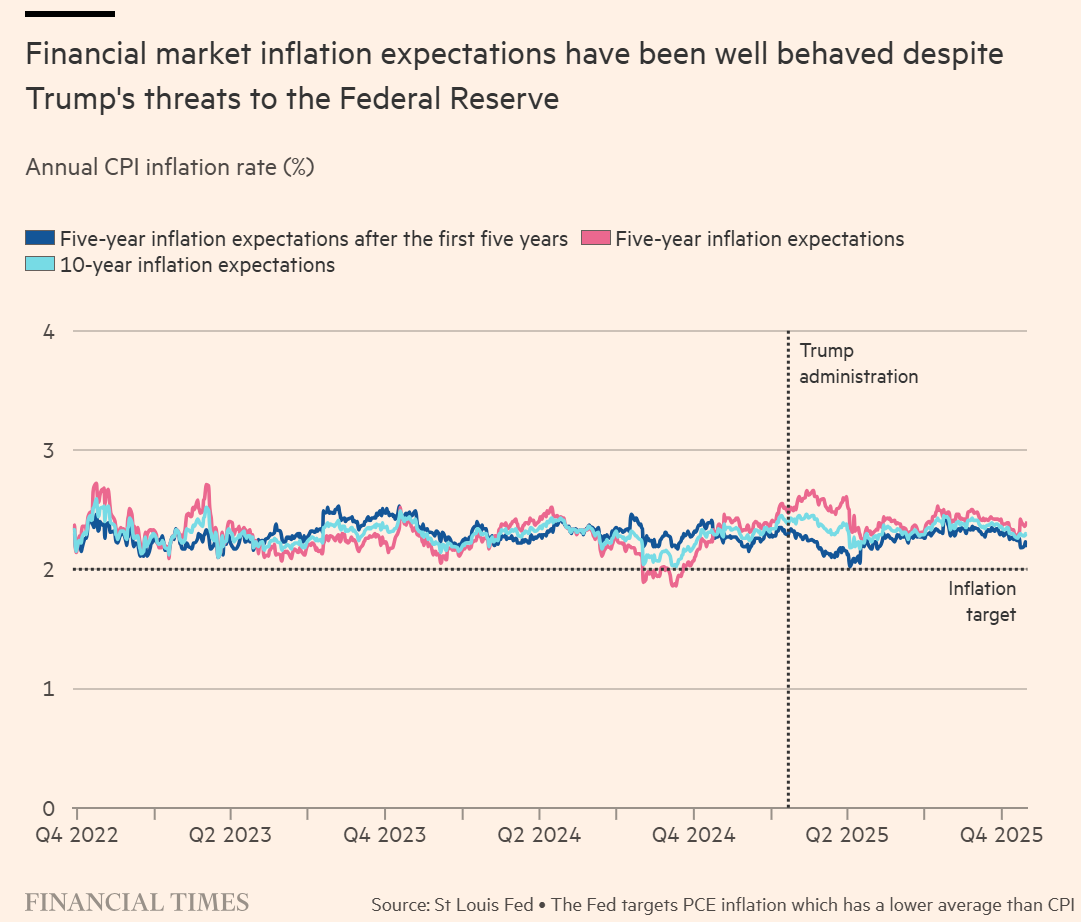
美联储独立性遭特朗普“组合拳”,市场为何不买账?
Jin Shi Shu Ju· 2025-11-05 09:26
在特朗普近一年的持续攻击下,美联储正承受重压。这位美国总统的辱骂、解雇美联储主席鲍威尔的威胁、试图解雇美联储理事库克的持续行动,以及为减 轻政府债务成本而明确要求降息——除此之外,财政部长贝森特还指控美联储自金融危机以来越权行事。 在此背景下,彼得森国际经济研究所(Peterson Institute for International Economics)上周举办的央行独立性主题会议,时机再好不过。这场会议值得称 道:既没有过度恐慌,也没有不切实际地为美联储的所有举措辩护。 所有参会者一致认为,独立性本身不应是目标;货币政策制定免受政治干预的权利,只有靠"结果"才能证明其合理性。对央行官员而言,这已是最令人安心 的共识。 经济学家分歧加剧 美联储曾放任美国银行"大到不能倒"、涉足气候政策,还监管出10%的通胀率——正因如此,不少经济学家支持贝森特的观点:美联储过去的糟糕决策凸显 其独立性过强,应当加以约束。例如,胡佛研究所的约翰·科克伦(John Cochrane)认为,美联储若要独立于政府运作,必须承担更有限的使命,且问责机 制需大幅强化。 他的观点引发了哈佛大学教授、前财政部长拉里·萨默斯(Larry ...