货币政策

Search documents
【权威访谈:开局“十五五”】货币政策精准发力 加力支持重点领域和薄弱环节
Yang Shi Wang· 2026-01-25 11:50
Core Viewpoint - The article emphasizes the importance of enhancing the central bank system and establishing a robust monetary policy framework as outlined in the "14th Five-Year Plan" [1] Monetary Policy and Financial Stability - The People's Bank of China (PBOC) aims for a moderate easing of monetary policy in 2025, with social financing scale and broad money supply expected to significantly exceed nominal GDP growth [1] - In December, the weighted average interest rates for new corporate loans and personal housing loans were both approximately 3.1%, indicating low overall financing costs [1] - The bond market has seen the issuance of 1.8 trillion yuan in technology innovation bonds, contributing to stable financial market operations [1] Focus Areas for Financial Support - Financial institutions will be guided to enhance support for key areas such as expanding domestic demand, technological innovation, and small and medium-sized enterprises [1] - A total of 500 billion yuan will be utilized for consumer services and pension re-loans to meet diverse financial needs in the consumption sector [1] - The quota for re-loans aimed at technological innovation and technological transformation has been increased to 1.2 trillion yuan, promoting the development of the bond market's technology sector [1] Future Directions - The PBOC plans to deepen institutional opening in the financial sector and advance the internationalization of the renminbi in an orderly manner [1]
美联储,突爆大消息!
证券时报· 2026-01-25 04:21
里德尔跃居美联储主席最大热门。 据预测平台Polymarket的数据,截至1月24日,贝莱德高管里克·里德尔当选美联储主席的概率已飙升至 54%,远远领先于排名第二的概率(29%),而在年初时 里德尔 当选的概率仅有4%。 目前,美联储主席的角逐仍在里德尔、 现任国家经济委员会(NEC)主任 哈塞特、现任美联储理 事沃勒以及美联储前理事沃什4人之间展开。 事实上,早在2025年9月,财政部长贝森特就曾面试过里德尔,当时他就被认为是美联储新主席的热门 候选人。当时双方会谈聚焦两大核心议题:一是当前及未来的货币政策走向,二是美联储运作相关的结 构性改革问题。 里德尔最契合特朗普政府胃口的,是他的降息主张,以及对赤字与通胀的"非典型"包容度。 货币政策方面,里德尔一贯主张,随着经济演变,美联储应将利率下调至约3%的"中性水平";财政问 题上,里德尔多次淡化市场对美国巨额政府赤字的担忧;通胀问题上,他提出,如果略高于目标的通胀 率有助于稳定债务动态并维持就业,那么这种通胀并非不可接受。 作为贝莱德全球固定收益首席投资官,里德尔管理着约2.4万亿美元的债券策略,其职业生涯始于雷曼 兄弟,是一名不折不扣的市场老将。他此前 ...


2026史海钩沉亲历一次科网泡沫,我们能学到什么?
Sou Hu Cai Jing· 2026-01-25 01:07
Core Insights - The article reflects on the dot-com bubble of the late 1990s, highlighting the interplay between capital and technology, and drawing parallels to current market sentiments regarding AI investments [2][11]. Group 1: Historical Context - The dot-com bubble began with the IPO of Netscape in 1995, leading to a surge in technology company IPOs, peaking in 1999 [11]. - The NASDAQ index reached its peak of 5048.62 on March 10, 2000, before a significant market downturn triggered by news of Japan's economic recession [11][6]. Group 2: Technological and Policy Drivers - The rise of the internet in the 1990s was fueled by technological advancements and supportive policies, such as the Telecommunications Act of 1996, which broke industry monopolies and spurred investment [3][25]. - The period saw a notable increase in labor productivity, which altered traditional relationships between inflation and employment, providing a macroeconomic basis for loose monetary policy [3][18]. Group 3: Monetary Policy Shifts - Initially, the Federal Reserve under Alan Greenspan adopted a "technology-friendly" monetary policy, believing that productivity gains would suppress inflation, leading to a delay in interest rate hikes [4][23]. - However, as inflation risks emerged, the Fed began to raise interest rates in 1999, ultimately shifting to a stance aimed at curbing the bubble, which contributed to the market's decline [4][24]. Group 4: Industry Dynamics and Risks - The combination of loose liquidity and optimistic sentiment led to a frenzy in sectors like telecommunications and internet services, with companies often relying on speculative financing models that increased credit risk [5][6]. - Many internet firms operated without profitability, relying on narratives and funding to sustain growth until cash flow issues arose [5][6]. Group 5: Bubble Collapse - The NASDAQ's peak was followed by a global sell-off triggered by negative economic news, revealing cash flow crises in several internet companies and leading to a cycle of defaults and downgrades [6][11]. - The collapse of the telecommunications and internet sectors was marked by financial scandals and declining demand, ultimately leading to the bubble's burst [6][7]. Group 6: Lessons and Reflections - The dot-com bubble illustrates the risks of unchecked credit expansion and the potential for localized risks to escalate into systemic crises [7]. - The article emphasizes the importance of rational investment and cost management to realize the true benefits of technological advancements, suggesting that historical patterns may repeat under similar conditions [7][11].

美联储主席,最大热门出炉
财联社· 2026-01-24 08:45
Core Viewpoint - The article discusses the potential candidacy of Rick Riedel from BlackRock for the position of Federal Reserve Chairman, highlighting his qualifications and the support he has garnered from various stakeholders, including President Trump and market participants [1][2][3]. Group 1: Candidate Profile - Rick Riedel is seen as a strong candidate for the Federal Reserve Chairman position due to his Wall Street experience and openness to Federal Reserve reforms, which aligns with the current administration's views [1][2]. - Riedel's lack of prior experience at the Federal Reserve is viewed as an advantage, distinguishing him from other candidates and allowing him to be perceived as an outsider [2][5]. - His public appearances and commentary on market conditions have received positive feedback from government insiders, further bolstering his candidacy [5]. Group 2: Market Reactions and Predictions - Support for Riedel among executives and investors at the Davos World Economic Forum has been notable, with a prediction platform indicating a 54% probability of his selection as Chairman, a significant increase from just 4% at the beginning of the year [3]. - Feedback from bond market participants has been favorable towards Riedel, indicating confidence in his potential leadership [2]. Group 3: Monetary Policy Views - Riedel has expressed concerns about the labor market and suggested that the Federal Reserve should lower the policy interest rate from the current range of 3.5%-3.75% to 3%, indicating a more aggressive approach to rate cuts than previously anticipated [6]. - He argues that high interest rates benefit wealthy savers while harming small business owners and low-income individuals, suggesting that rate cuts would be beneficial for a broader segment of the economy [6]. Group 4: Political Context - President Trump has indicated that he has completed interviews for the Federal Reserve Chairman candidates and may announce a decision soon, with Riedel being a prominent contender [8]. - There are concerns within Trump's inner circle regarding whether Riedel would follow the President's directives on interest rate cuts or maintain the Federal Reserve's independence [9]. - The selection of the next Federal Reserve Chairman is considered one of the most influential appointments of Trump's second term, especially given his previous dissatisfaction with the current Chairman, Jerome Powell [9][10].

21社论丨货币政策灵活高效,支撑“十五五”良好开局
21世纪经济报道· 2026-01-24 02:23
Core Viewpoint - The People's Bank of China (PBOC) will continue to implement a moderately accommodative monetary policy in 2026, focusing on promoting stable economic growth and reasonable price recovery, while emphasizing flexibility and precision in policy execution [1][5]. Group 1: Monetary Policy Adjustments - The PBOC will shift its policy focus from merely pursuing scale expansion to supporting high-quality development and price stability, indicating that tools like interest rate cuts will be used based on actual financing costs rather than a one-sided approach [1][2]. - The central bank plans to manage liquidity through a combination of long and short-term measures, with room for further rate cuts and reserve requirement ratio reductions in the first half of the year [2][5]. - Structural monetary policy tools will be optimized to focus on key areas, with expected expansions in technology innovation re-loan quotas and special loans for private enterprises potentially exceeding 1 trillion yuan [2][3]. Group 2: Structural Tools and Support Mechanisms - The PBOC has increased the technology innovation re-loan quota from 800 billion yuan to 1.2 trillion yuan, now including private enterprises with high R&D investments, marking a shift from identity-based support to capability-based selection [3]. - The integration of two tools (private enterprise bond financing support and technology innovation bond risk-sharing tools) aims to reduce financing costs for enterprises and enhance the success rate of bond issuance, particularly benefiting tech-oriented private enterprises [3]. - Risk prevention mechanisms will focus on proactive measures, with reforms in small financial institutions and the use of REITs and other tools to revitalize assets in the real estate sector [3]. Group 3: External Environment and Policy Independence - The easing of external constraints on China's monetary policy due to the Federal Reserve's interest rate cuts provides a window for interest rate adjustments, although the PBOC will maintain policy independence [4][5]. - The ongoing internationalization of the renminbi and the development of cross-border payment systems are expected to enhance the willingness of international markets to allocate assets in renminbi [5].

日本央行为何维持利率不变?
2 1 Shi Ji Jing Ji Bao Dao· 2026-01-23 23:20
Core Viewpoint - The Bank of Japan (BOJ) decided to maintain its policy interest rate at 0.75%, reflecting a careful balancing act amid concerns over fiscal deterioration and market pressures following the government's announcement of tax cuts and increased spending ahead of the upcoming elections [1][4]. Monetary Policy - The BOJ's decision to keep the interest rate unchanged is seen as a demonstration of the central bank's independence, which is crucial for price stability [5]. - The BOJ's economic outlook report revised core CPI forecasts, increasing the 2025 core CPI from 2.8% to 3% and adjusting GDP growth forecasts for 2025 and 2026 upwards, while slightly lowering the 2027 growth forecast [2]. Economic Context - The Japanese government announced plans for tax cuts and increased fiscal spending, leading to concerns about further fiscal deterioration and a subsequent drop in bond prices [1][3]. - The Japanese yen has been depreciating against the dollar and euro, with the exchange rate reaching historical lows, although the overall dollar depreciation against other currencies may mitigate further yen declines [3]. Market Reactions - The market had anticipated the BOJ's decision to maintain the interest rate, resulting in a muted reaction; however, this does not alleviate the downward pressure on Japanese government bond prices and the yen [4]. - The BOJ's previous interest rate hike in December was insufficient to halt the yen's depreciation trend, as the increase was modest and did not meet market expectations for a neutral rate adjustment [4]. Political Environment - The dissolution of the Japanese House of Representatives marks a significant political event, with elections scheduled for February 8, raising uncertainties about potential government interventions in the market during this transitional period [3][5].
21社论丨货币政策灵活高效,支撑“十五五”良好开局
Xin Lang Cai Jing· 2026-01-23 22:58
Core Viewpoint - The People's Bank of China (PBOC) will continue to implement a moderately accommodative monetary policy in 2026, focusing on promoting stable economic growth and reasonable price recovery as key considerations for monetary policy [1][4] Group 1: Monetary Policy Direction - The monetary policy will emphasize flexibility and precision while maintaining a moderately accommodative stance, shifting focus from mere scale expansion to supporting high-quality development and price stability [1][4] - The PBOC plans to adjust policy rates based on actual changes in corporate financing costs rather than solely aiming for unilateral reductions, stabilizing social financing costs within a reasonable range [1][3] Group 2: Liquidity Management - The PBOC intends to supplement market funds through a "combination of long and short" strategies, with room for further rate cuts and reserve requirement ratio (RRR) reductions in 2026 [2] - Innovative tools like buyout reverse repos will be utilized to smooth out short-term shocks from government bond issuance and maintain stable liquidity [2] Group 3: Structural Tools - Structural monetary policy tools will focus on key areas, aiming for a "precise drip irrigation" effect to support major strategies and weak links [2][3] - The PBOC has increased the quota for technology innovation re-loans from 800 billion yuan to 1.2 trillion yuan, now including "high R&D investment private enterprises" to ensure resources are allocated to genuine innovators [3] Group 4: Risk Management - The PBOC will enhance monitoring and assessment of systemic financial risks, accelerating reforms in small financial institutions to mitigate regional risks [3] - The management of cross-border capital flows will focus on dynamic balance, using macro-prudential tools to prevent short-term capital volatility [3] Group 5: External Environment - The easing of external constraints on China's monetary policy due to the Federal Reserve's rate cuts provides a window for interest rate adjustments, although policy changes will remain independent [4] - The ongoing process of renminbi internationalization and the development of cross-border payment systems are expected to enhance international market interest in renminbi assets [4]
2026年货币政策如何发力 专访中国人民银行行长
Xin Lang Cai Jing· 2026-01-23 20:58
Monetary Policy Outlook - The central bank plans to implement a flexible and efficient monetary policy, utilizing tools such as reserve requirement ratio (RRR) cuts and interest rate reductions to maintain ample liquidity and align social financing scale and money supply growth with economic growth and price level expectations [2] Support for Key Areas - A special fund of 500 billion yuan will be allocated for service consumption and elderly care loans, encouraging financial institutions to innovate financial products to meet diverse consumer needs [3] - The policy support for technological innovation will increase the loan quota for technology innovation and technological transformation to 1.2 trillion yuan, including support for private small and medium-sized enterprises (SMEs) with high R&D investment [3] - The financing accessibility for small and micro enterprises will be enhanced, with an increase of 500 billion yuan in agricultural and small enterprise loans, raising the total to 4.35 trillion yuan, and a dedicated 1 trillion yuan for private enterprise loans [3] Market Stability Measures - The central bank emphasizes the importance of maintaining market stability and managing expectations, ensuring the basic stability of the RMB exchange rate at a reasonable and balanced level [4] - There will be strengthened supervision of various markets, including bond, foreign exchange, money, bill, and gold markets, along with mechanisms to provide liquidity to non-bank institutions under specific scenarios [4] Credit Repair Policy - The recently implemented credit repair policy has shown positive effects, with many individuals receiving personal credit repairs and default records no longer displayed, indicating a compassionate approach to policy [5]
Week Ahead for FX, Bonds: Fed Rate Decision in Focus
WSJ· 2026-01-23 17:10
Core Viewpoint - The focus will shift back to economics and monetary policy in the upcoming week, with a Federal Reserve meeting expected to be the main event [1] Group 1 - The Federal Reserve meeting is anticipated to be a significant highlight in the coming days [1]

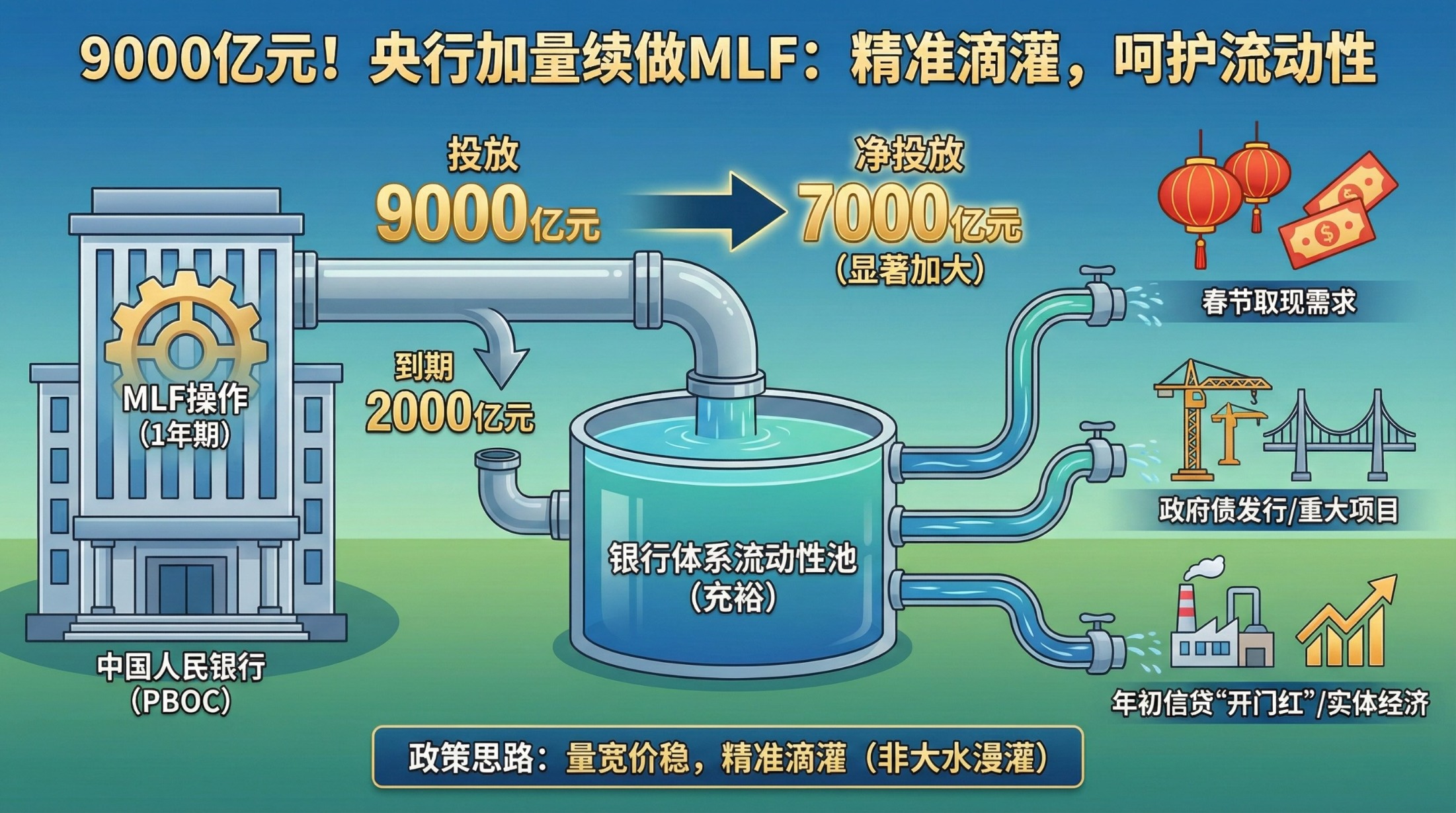
9000亿元!央行加量续做MLF
Zhong Guo Jing Ying Bao· 2026-01-23 16:51
Group 1 - The People's Bank of China (PBOC) announced a 900 billion yuan MLF operation to maintain liquidity in the banking system, with a net injection of 700 billion yuan after accounting for 200 billion yuan maturing this month [2][4] - The central bank's actions are aimed at stabilizing the financing environment for the real economy, particularly in light of seasonal cash withdrawals around the Spring Festival and the issuance of government bonds [2][3] - The PBOC's open market operations are crucial for monetary policy and liquidity management, with a total net injection of 6 trillion yuan in 2025 [2] Group 2 - Analysts believe the recent MLF operation is designed to support major projects and enhance economic recovery, especially with the early issuance of local government bonds [3][4] - The central bank has lowered the re-lending and rediscount rates by 0.25 percentage points to encourage financial institutions to support key sectors [4][5] - The PBOC is expected to continue its supportive monetary policy stance, with potential for further adjustments in reserve requirement ratios or MLF rates depending on economic and inflation data [4][5]