
去美元化

Search documents
贵金属数据日报-20260128
Guo Mao Qi Huo· 2026-01-28 03:28
2 2017 投资咨询业务资格:证监许可【2012】31号 ITG国贸期货 贵金属数据日报 | | | | | 国贸期货研究院 | | 投资咨询号: Z0013700 | | | 2026/1/28 | | --- | --- | --- | --- | --- | --- | --- | --- | --- | --- | | | | | | 贵金属与新能源研究中心 白素娜 | | 从业资格号:F3023916 | | | | | | 日期 | 伦敦金现 | 伦敦银现 | COMEX黄金 | COMEX白银 | AU2602 | AG2602 | AU (T+D) | AG (T+D) | | 内外盘金 | | (美元/盎司) | (美元/盎司) | (美元/盎司) | (美元/盎司) | (元/克) | (元/千克) | (元/克) | (元/千克) | | 银15点价 | 2026/1/27 | 5083. 88 | 109. 62 | 5079. 20 | 109.72 | 1151.76 | 28230.00 | 1142. 52 | 28394.00 | | 格跟踪 (本表数 | | | | | ...
金价屡创新高!黄金企业密集“扫货”,押注后市?
Sou Hu Cai Jing· 2026-01-28 03:25
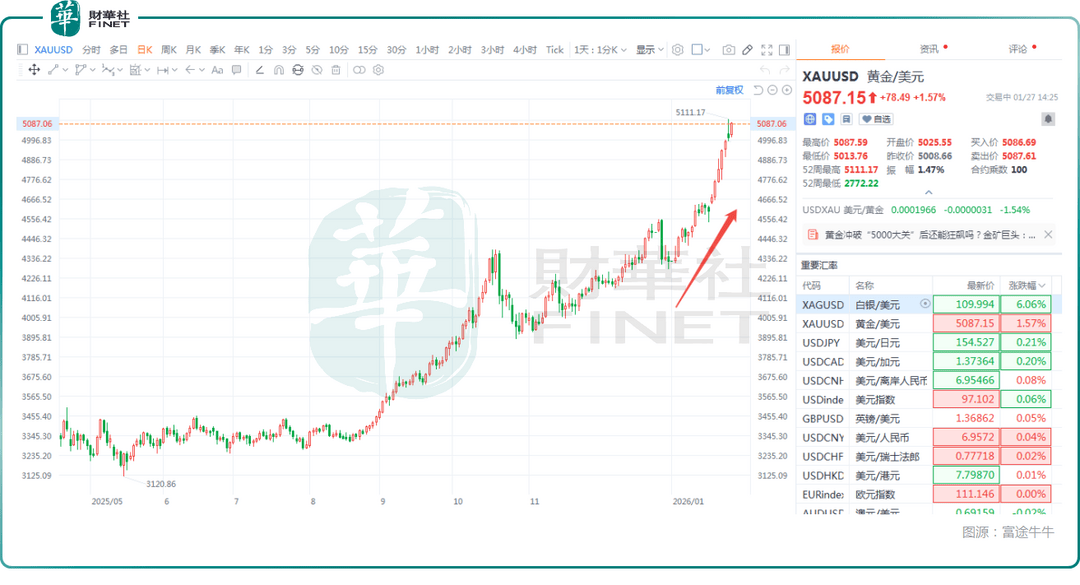
文|财华社 进入2026年,黄金的上涨之势未曾稍歇,金价还在一路攀升,并于1月26日历史首次突破5100美元的整数关口,但随后遭遇回落。而截至1月27日发稿时 间,金价再涨近1.6%,现报5085美元/盎司,非常接近前一日创下的历史新高价位。 有分析称,近年金价飙升主要围绕去美元化、美联储独立性、央行购金、美国关税、地缘冲突以及传统实际利率定价框架相关的通胀、就业及美联储降息 预期等逻辑交易。 多家企业购入金矿资产 同期,江西铜业也发出正式要约,拟以约8.67亿英镑现金收购英国上市公司索尔黄金(SolGold),其主要目标为拥有厄瓜多尔卡斯卡维尔铜金矿项目。 机构对黄金后市有何看法? 需要指出的是,金价新高之际的扩产引起了投资者的广泛关注。而从机构观点来看,金价的长期前景似乎仍有值得期待的地方。 建信期货今日发文称,从长周期看,地缘政治风险冲击全球政治经济贸易货币体系,地缘政治风险带来的避险需求和全球贸易货币体系重组带来的储备分 散化需求持续推高金价波动中枢;特朗普2.0以美国利益为核心推行关税武器化并循丛林法则重构地缘战略空间,全球政治经济贸易货币体系加速重组, 黄金长周期牛市基础进一步巩固,目前金价继续运 ...


见证历史!现货金站上 5200:黄金基金ETF为何是今日配置首选?
Sou Hu Cai Jing· 2026-01-28 03:25
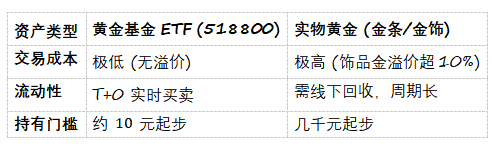
Core Viewpoint - The surge in gold prices, with spot gold exceeding $5200 per ounce, reflects a significant shift in global investment sentiment towards gold as a "ultimate credit asset" amid geopolitical tensions and a move away from the US dollar [1][2]. Group 1: Market Dynamics - The recent spike in gold prices is driven by three main factors: extreme risk aversion due to geopolitical events, particularly in Iran, and statements from former President Trump; central banks' aggressive gold purchases as a hedge against currency depreciation; and upward revisions of gold price targets by major financial institutions, with Goldman Sachs raising its target to $5400 and Bank of America to $6000 [2]. - As of January 28, 2026, the international gold price has increased by over 16% since the beginning of the year, indicating a strong bullish trend in the market [1]. Group 2: Investment Vehicle - Gold Fund ETF (518800) - The Gold Fund ETF (518800) has emerged as a superior investment option compared to high-premium gold jewelry or complex paper gold, showcasing unmatched professional advantages [3]. - The ETF has surpassed a scale of 37.2 billion yuan as of January 27, 2026, with high daily trading volumes, ensuring minimal slippage costs for investors during volatile market conditions [3]. - The product supports T+0 trading, allowing investors to capitalize on intraday price fluctuations and react swiftly to favorable geopolitical developments [4]. - Each ETF share is fully backed by physical gold contracts from the Shanghai Gold Exchange, eliminating concerns over insurance, storage, or liquidation discounts, with a total management and custody fee of only 0.6% [5]. Group 3: Strategic Recommendations - Investors are advised to maintain a core holding of 10%-15% in gold at the $5200 price level, suggesting a cautious approach to avoid premature exits [8]. - A strategy of gradual accumulation is recommended, particularly if prices retrace to the support levels of $5050-$5100, presenting an opportunity to increase holdings in the Gold Fund ETF [9].
里程碑时刻!现货黄金首次升破5200美元
Jin Tou Wang· 2026-01-28 03:21
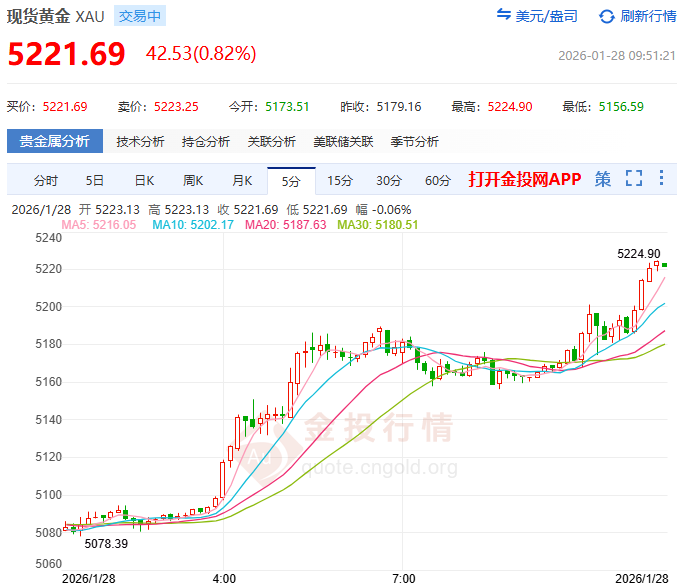
Core Insights - The international precious metals market has reached a milestone with spot gold breaking the $5200 per ounce mark for the first time, showing a cumulative increase of over 20% in January, which translates to an increase of more than $880 [1][3] - Spot silver also rose, reaching $114 per ounce, with a daily increase of 1.54% [1] - The domestic futures market followed suit, with Shanghai gold and silver contracts seeing significant daily increases of over 2% and 3% respectively [3] Market Performance - Precious metals prices have surged due to ongoing geopolitical and economic uncertainties, leading to high demand for safe-haven assets [3] - The SPDR Gold Trust, the largest gold ETF, saw an increase in holdings by 0.85 tons, while the iShares Silver Trust experienced a decrease of 126.86 tons [4] - Analysts from Deutsche Bank and Société Générale predict that gold prices could reach $6000 per ounce by the end of 2026, driven by geopolitical tensions, expectations of Federal Reserve rate cuts, and continued central bank purchases [4] Analyst Predictions - BMO Capital Markets suggests that gold could exceed $5000 per ounce in January 2026, with potential to reach $6350 per ounce by Q4 2026 and $8650 per ounce by Q4 2027, driven by central bank purchases and ETF inflows [5] - Citigroup has raised its short-term silver price forecast to $150 per ounce, citing optimism regarding industrial demand and silver's appeal as a safe-haven asset [5] Institutional Views - Analysts from Jin Yuan Futures note a shift in the silver-gold price ratio, indicating increased risk for silver prices after a rapid rise [6] - Guoyuan Futures highlights mixed short-term factors affecting the market, with bullish influences dominating despite short-term volatility risks [6] - Southwest Futures emphasizes the complex global trade and financial environment, suggesting that the recent surge in precious metals may lead to increased market volatility [7]
现货黄金突破5230美元再创历史新高!深市规模最大的上海金ETF(159830)近30日累计净流入3.80亿元,机构:全球央行持续购金为金价提供支撑
Sou Hu Cai Jing· 2026-01-28 03:15
华西证券认为,2026年金价涨幅或介于10%-35%,主要受美联储降息预期、美元信用根基不稳及地缘政 治风险推动。尽管2025年大涨后涨幅可能收敛,但全球央行持续购金为金价提供支撑,美联储人事变动 或强化宽松预期。 国贸期货指出,贵金属牛市底层逻辑稳固,去美元化趋势、美联储降息周期及地缘风险频发将持续推升 金价。短期需警惕市场获利了结风险,但中长期配置需求强劲,建议逢低做多策略。 每日经济新闻 上海金ETF(159830)最近30个交易日累计获资金净流入3.80亿元。截至2026年01月27日,上海金ETF (159830)最新规模为32.18亿元,再创上市以来新高,为深市同标的第一。 费率方面,上海金ETF(159830)管理费率0.25%,基金托管费率为0.05%,均低于同标的产品平均水 平,同时该ETF支持T+0交易。该ETF还配置了场外联接基金(联接A:014661,联接C:014662)。 消息面上,现货黄金突破5230美元,再创历史新高,主要受三方面利好提振。一是地缘风险升温,据东 方金诚研报,美欧格陵兰岛争端升级推升市场避险需求,欧洲养老基金出现抛售美债动向;二是美元信 用受疑,国泰海通证券指出 ...
2026年01月28日:期货市场交易指引-20260128
Chang Jiang Qi Huo· 2026-01-28 02:50
1. Report Industry Investment Ratings - **Macro Finance**: Long - term bullish on stock indices, suggesting buying on dips; government bonds are expected to move in a range [1] - **Black Building Materials**: Short - term trading for coking coal, range trading for rebar, and waiting and seeing for glass [1] - **Non - ferrous Metals**: Waiting and seeing or holding long positions in small quantities for copper; strengthening observation for aluminum; waiting and seeing for nickel; range trading or taking profit on previous long positions for tin; range trading for gold; bullish movement for silver; range - bound oscillation for lithium carbonate [1] - **Energy and Chemicals**: Range trading for PVC, caustic soda and soda ash for the time being, range trading for styrene, rubber, urea, and methanol; weak oscillation for polyolefins [1] - **Cotton Textile Industry Chain**: Oscillatory adjustment for cotton and cotton yarn, oscillatory movement for apples and jujubes [1] - **Agriculture and Animal Husbandry**: Opportunities for short - selling on rebounds for hogs; hedging post - festival contracts on rallies for eggs; being cautious about chasing highs and waiting for rebounds to hedge for corn; bearish on rallies for soybean meal; bullish oscillation for three major oils [1] 2. Core Views of the Report The report provides trading suggestions for various futures products based on their current market conditions, including macro - economic factors, supply - demand relationships, and cost factors. It also emphasizes the importance of paying attention to policy changes, inventory levels, and external market factors [1][5][7] 3. Summaries According to Relevant Catalogs Macro Finance - **Stock Indices**: Medium - to long - term bullish, suggesting buying on dips. Market is volatile due to factors such as the Fed's interest - rate decision, China's industrial profit data, and consumer spending intentions [5] - **Government Bonds**: Expected to move in a range. There is no significant negative news in the bond market, but there is limited downward space for bond yields without more capital inflows [5] Black Building Materials - **Coking Coal**: Short - term trading. The coal market shows short - term fluctuations, but the price increase may not be sustainable due to factors like weak downstream demand and stable supply [7] - **Rebar**: Range trading. The futures price is slightly higher than the valley - electricity cost of electric furnaces and lower than the flat - electricity cost. There is no significant supply - demand contradiction in the short term [7] - **Glass**: Waiting and seeing. The supply is stable, the market speculative demand is weak, and the downstream inventory is high. The price is expected to oscillate between 1050 - 1070 [8] Non - ferrous Metals - **Copper**: High - level oscillation. Macro factors provide support, but the fundamentals are weak. It is recommended to wait and see or hold long positions in small quantities, and beware of the risk of a pullback before the Spring Festival [9] - **Aluminum**: High - level oscillation. The supply of bauxite and alumina is relatively stable, and the demand is entering the off - season. It is recommended to strengthen observation [11] - **Nickel**: Oscillatory movement. The reduction of Indonesian nickel ore quotas has boosted the price, but the fundamentals are weak. It is recommended to wait and see [13] - **Tin**: Oscillatory movement. The supply of tin concentrate is tight, and the downstream demand is mainly for rigid procurement. It is recommended for range trading or taking profit on previous long positions [13] - **Silver**: Bullish movement. Geopolitical tensions and changes in the Fed's leadership expectations have pushed up the price. It is recommended to hold long positions and be cautious about new positions [15] - **Gold**: Range trading. Similar to silver, geopolitical and Fed - related factors have led to a higher price center. It is recommended for range trading and be cautious about chasing highs [15] - **Lithium Carbonate**: Range - bound oscillation. The supply is affected by mine production, and the demand from the energy - storage terminal is good. The price is expected to be bullish [17] Energy and Chemicals - **PVC**: The bottom may have been reached. The supply is high, the demand is weak, but the valuation is low. It is recommended for long - term low - buying and positive spread trading [17] - **Caustic Soda**: Low - level oscillation. The demand is weak, and the supply pressure is high. It is recommended to wait and see [19] - **Styrene**: Oscillatory movement. The price has rebounded due to export growth and device maintenance, but the valuation is high. It is recommended to be cautious about chasing highs [19] - **Rubber**: Oscillatory movement. The supply is shrinking, but the inventory pressure remains. The price is in a state of multi - empty tug - of - war [20] - **Urea**: Oscillatory movement. The supply is increasing, the demand from compound fertilizers is rising, and the inventory is at a low level. The price is expected to oscillate between 1730 - 1830 [21] - **Methanol**: Oscillatory movement. The supply is decreasing, the demand from methanol - to - olefins is weakening, and the traditional downstream demand is also weak [23] - **Polyolefins**: Weak oscillation. The supply is increasing, the demand from PE downstream is declining, and the price is expected to be weak with limited upside [24] - **Soda Ash**: Waiting and seeing. The supply is in excess, but the cost support is strong. It is recommended to leave the market temporarily [24] Cotton Textile Industry Chain - **Cotton and Cotton Yarn**: Oscillatory adjustment. The global cotton supply - demand situation has changed, and the internal - external price difference has put pressure on the domestic market. It is recommended to be cautious in the short term and optimistic in the long term [24] - **Apples**: Oscillatory movement. The packaging and shipping in the production areas have accelerated slightly, but the overall market is still weak [26] - **Jujubes**: Oscillatory movement. The purchase price of Xinjiang gray jujubes in the 2025 production season is in a certain range, and the acquisition is based on quality [26] Agriculture and Animal Husbandry - **Hogs**: Bottom - building oscillation. In the short term, the price is restricted by supply - demand game. It is recommended to short on rebounds for off - season contracts. In the long term, be cautious about being bullish due to high - level production capacity and cost reduction [28] - **Eggs**: Rebound from a low level. The current valuation is high, and it is recommended to hedge post - festival contracts on rallies. Also, consider hedging the 05 and 06 contracts due to the possible post - poned supply pressure [30] - **Corn**: Limited upside. In the short term, the supply - demand is balanced, and it is recommended to be cautious about chasing highs. In the long term, the supply - demand situation is relatively loose, restricting the price increase [32] - **Soybean Meal**: Low - level oscillation. The short - term support for the M2603 contract is at 3000 - 3030, and the pressure for the far - month 05 contract is at 2800 - 2850. It is recommended to be bearish on rallies [32] - **Oils**: Bullish oscillation. The three major oils are expected to move strongly. It is recommended to buy on dips and hold previous long positions [38]
国际金价突破5200美元/盎司大关,有色金属牛市持续,矿业ETF(561330)大涨超3%
Sou Hu Cai Jing· 2026-01-28 02:41
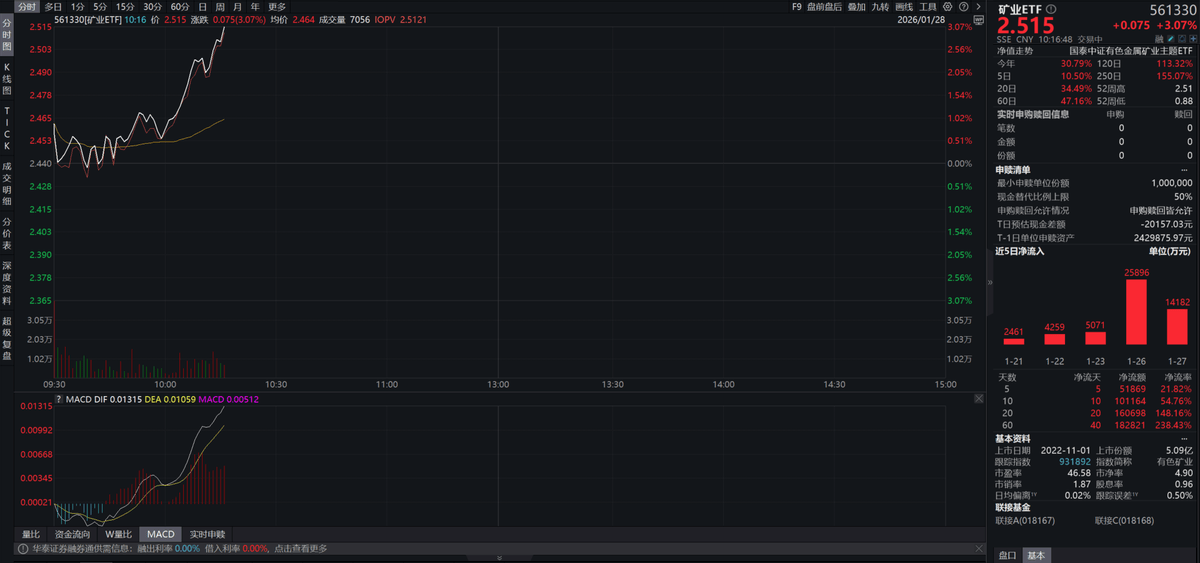
Core Viewpoint - Recent surge in international gold prices surpassing $5200 per ounce has initiated a structural bull market in the non-ferrous metals sector, with significant inflows into the mining ETF (561330) exceeding 1.6 billion yuan over 20 consecutive days [1][3] Group 1: Market Performance - The mining ETF (561330) has seen a broad increase in its constituent stocks, with most of the top ten stocks experiencing gains [3] - The top ten constituent stocks of the mining ETF include Zijin Mining, Luoyang Aluminum, and Northern Rare Earth, with Zijin Mining showing a 3.67% increase and Luoyang Aluminum a 3.68% increase [4] Group 2: Macro Drivers - The current bull market in non-ferrous metals is driven by multiple factors, including de-globalization, de-dollarization, and macroeconomic cycles [5] - De-globalization has led to resource nationalism, with major resource countries implementing export controls and taxes to secure strategic resources, increasing the geopolitical value of these resources [5] - The acceleration of de-dollarization is evidenced by countries like Denmark and Sweden reducing their U.S. Treasury holdings, while nations like India are repatriating gold reserves, indicating a shift away from dollar-denominated assets [6] - The synchronization of macro policy cycles between China and the U.S. is expected to provide support for global industrial metal prices, particularly in 2026 [7] Group 3: Gold Market Insights - Gold's rise above $5200 per ounce reflects a reassessment of its monetary attributes amid the de-dollarization trend, with central banks continuing to accumulate gold [8][9] - The demand for gold is being driven by geopolitical tensions and the increasing appeal of gold as a safe-haven asset [10] - Institutional investors are beginning to allocate gold as an alternative to U.S. Treasury bonds, marking a significant shift in asset allocation strategies [11] Group 4: Industrial and Energy Metals - Industrial metals like copper and aluminum are experiencing a shift in demand from traditional infrastructure to AI and energy revolution, while supply constraints persist due to resource nationalism and insufficient capital expenditure [12] - Copper is facing structural shortages due to increased demand from sectors like AI data centers and electric vehicles, while supply is hindered by declining ore grades and geopolitical disruptions [13] - Aluminum supply is constrained by domestic carbon goals and high energy costs abroad, with demand expanding into high-growth areas like lightweighting for electric vehicles [13] - Lithium demand is surging due to the growth of energy storage markets, leading to a tightening supply-demand balance [13] Group 5: Investment Strategy - The non-ferrous metals market is transitioning from futures prices to equity markets, with a focus on the mining ETF (561330) as a more stable investment option [15] - The mining ETF (561330) has outperformed other non-ferrous ETFs, with a cumulative increase of 296.64% since its inception in 2013, indicating strong historical performance [16] - The mining ETF focuses on upstream resource leaders, providing higher profit elasticity and valuation opportunities during price increases [21]
金融期货早评-20260128
Nan Hua Qi Huo· 2026-01-28 02:39
Report Industry Investment Rating No relevant content provided. Core Viewpoints of the Report - In the context of global geopolitical games, the strategic value of key mineral resources is continuously highlighted, and the pricing logic of related varieties has shifted from simple supply - demand to "resource security + commodity attribute" driven. The market's expectation of a loose monetary policy in major economies is rising, but the short - term market of strongly financial - attribute varieties is still volatile. China's industrial economy has entered a new stage of bottom - building and recovery, and industrial enterprise profits are expected to turn to moderate growth in 2026 [2]. - The "exchange rate inquiry" by the New York Fed may be an important signal of US - Japan joint intervention. The US dollar index is under pressure, and the RMB is expected to appreciate against the US dollar due to factors such as seasonal settlement demand and market expectations [4]. - The spring rally in the stock index market is expected to last until February, with small - and medium - cap indexes likely to continue to be strong, while large - cap indexes are relatively weak [8]. - In the bond market, it is recommended to hold medium - term long positions and wait and see in the short term [9]. - In the container shipping market, the near - term contracts are under pressure, while the far - term contracts may be driven up by factors such as trade improvement and geopolitical risks [10][12]. - For new energy commodities, lithium carbonate prices may strengthen in the short term, and industrial silicon prices are likely to rise in the short term, while polysilicon is still in the process of destocking [14][15][17]. - In the non - ferrous metals market, copper prices are affected by market sentiment, aluminum is expected to be volatile and strong, zinc has strong upward pressure, nickel - stainless steel is in a correction, tin prices are affected by news, and lead is in a narrow - range and weak oscillation [20][22][23][24][25][26][27][28][29]. - In the oil and fat market, oilseeds follow the rebound, and oils are expected to be strong in the short term, with palm oil being the strongest [30][33]. - In the energy and oil and gas market, fuel oil cracking is strong, low - sulfur fuel oil has limited upward momentum, asphalt is affected by geopolitical factors and may correct, and platinum and palladium are expected to rise in the medium - long term [36][38][40][45]. - In the chemical market, pulp prices may decline, PX - TA may have a phased correction, MEG may fluctuate widely, PP and PE are affected by macro - emotions, pure benzene and styrene market sentiment has declined, rubber is in a shock correction, urea is recommended to hold long positions, and glass and soda ash are in a repeated pattern [51][52][53][56][57][59][60][62][63][65][66][67][71][73][75][76]. - In the steel and iron ore market, rebar and hot - rolled coils are in a bottom - range oscillation, iron ore price fluctuations are narrowing, coking coal and coke are testing the lower support, and ferrosilicon and ferromanganese are oscillating weakly with cost support [77][78][79][80][81][83][84]. - In the agricultural and soft commodities market, live pigs are falling, cotton is recommended to buy on dips, sugar has limited upward potential, eggs are under pressure to fall, apples may be affected by the shortage of delivery products, dates may be in a low - level oscillation, and logs are recommended to wait and see [86][88][90][91][92][99][100][101][102][103]. Summary by Related Catalogs Financial Futures - **Macro**: The Fed Chair nominee may be announced this week. Japan's Prime Minister may resign if the ruling camp fails to win a majority in the House election. China's industrial enterprise profits in 2025 increased by 0.6% year - on - year, and the single - month growth rate in December turned positive [1][2]. - **RMB Exchange Rate**: Concerns about the US government's new shutdown risk. The on - shore RMB against the US dollar closed lower in the previous trading day, and the RMB is expected to appreciate against the US dollar [3][4]. - **Stock Index**: The spring rally is expected to last until February, with small - and medium - cap indexes likely to be strong, and large - cap indexes relatively weak [8]. - **Treasury Bond**: It is recommended to hold medium - term long positions and wait and see in the short term [9]. Commodities New Energy - **Lithium Carbonate**: The short - term price and basis may strengthen due to pre - holiday restocking demand [14][15]. - **Industrial Silicon & Polysilicon**: Industrial silicon prices are likely to rise in the short term, and polysilicon is in the process of destocking [16][17][18]. Non - Ferrous Metals - **Copper**: The market is affected by sentiment, and it is not recommended to open new positions above 100,000 yuan [20][22]. - **Aluminum Industry Chain**: Aluminum is expected to be volatile and strong, alumina may oscillate, and cast aluminum alloy is expected to be volatile and strong [23][24]. - **Zinc**: The upper pressure is large, and it is expected to be weakly volatile [24]. - **Nickel - Stainless Steel**: It is in a correction, and the short - term trend is affected by market sentiment [25][26]. - **Tin**: The price is affected by Indonesian news and a new model, and it is expected to be in a high - level wide - range oscillation [27][28]. - **Lead**: It is in a narrow - range and weak oscillation [29]. Oils and Fats - **Oilseeds**: They follow the rebound, but lack their own driving force [30]. - **Oils**: They are expected to be strong in the short term, with palm oil being the strongest [33]. Energy and Oil and Gas - **Fuel Oil**: Cracking is strong, but the fundamental situation is still poor [36][37]. - **Low - Sulfur Fuel Oil**: It has limited upward momentum, and the supply pressure is increasing [38][39]. - **Asphalt**: It is affected by geopolitical factors and may correct, and it is recommended to focus on the winter - storage situation of refineries [40][41][42]. Precious Metals - **Platinum & Palladium**: They are expected to rise in the medium - long term, and it is recommended to buy on dips [45][46]. - **Gold & Silver**: Spot gold is approaching 5,200, and it is recommended to buy on dips [47][49]. Chemicals - **Pulp - Offset Paper**: Pulp prices may decline, and offset paper may be affected by cost and supply factors [51][52]. - **PTA - PX**: They may have a phased correction, and it is recommended to buy on dips [53][56]. - **MEG - Bottle Chip**: It may fluctuate widely, and it is not recommended to short in the short term [57][59]. - **PP**: The short - term fundamental pressure is not large, and it is affected by macro - emotions [60][62]. - **PE**: The fundamental situation is weak, and it is recommended to wait and see [63][65]. - **Pure Benzene - Styrene**: The market sentiment has declined, and it is recommended to focus on export increments and downstream feedback [66]. - **Rubber**: It is in a shock correction, and it is recommended to wait and see or hold light positions [67][71][72]. - **Urea**: It is recommended to hold long positions [73][74]. - **Glass Soda Ash**: They are in a repeated pattern, with soda ash having an over - supply expectation and glass having a weak supply - demand pattern [75][76]. Steel and Iron Ore - **Rebar & Hot - Rolled Coil**: They are in a bottom - range oscillation, and the price ranges of rebar and hot - rolled coil are estimated [77][78]. - **Iron Ore**: The price fluctuations are narrowing, and the price has certain support [79][80]. - **Coking Coal & Coke**: They are testing the lower support, and the price may face pressure in the short term [81][83]. - **Ferrosilicon & Ferromanganese**: They are oscillating weakly with cost support [84]. Agricultural and Soft Commodities - **Live Pig**: The price is falling [86]. - **Cotton**: It is recommended to buy on dips and focus on downstream orders [88][89]. - **Sugar**: The upward potential is limited [90][91]. - **Egg**: The futures are trading the post - holiday off - season expectation in advance, and the price is under pressure to fall [91][92]. - **Apple**: The spot price is loose, and it is recommended to focus on the shortage of delivery products [99][100]. - **Date**: It may be in a low - level oscillation, and it is recommended to focus on downstream procurement [101]. - **Log**: The volatility has returned to a low level, and it is recommended to wait and see [102][103].
特朗普一席话,干崩美元!
Sou Hu Cai Jing· 2026-01-28 02:28
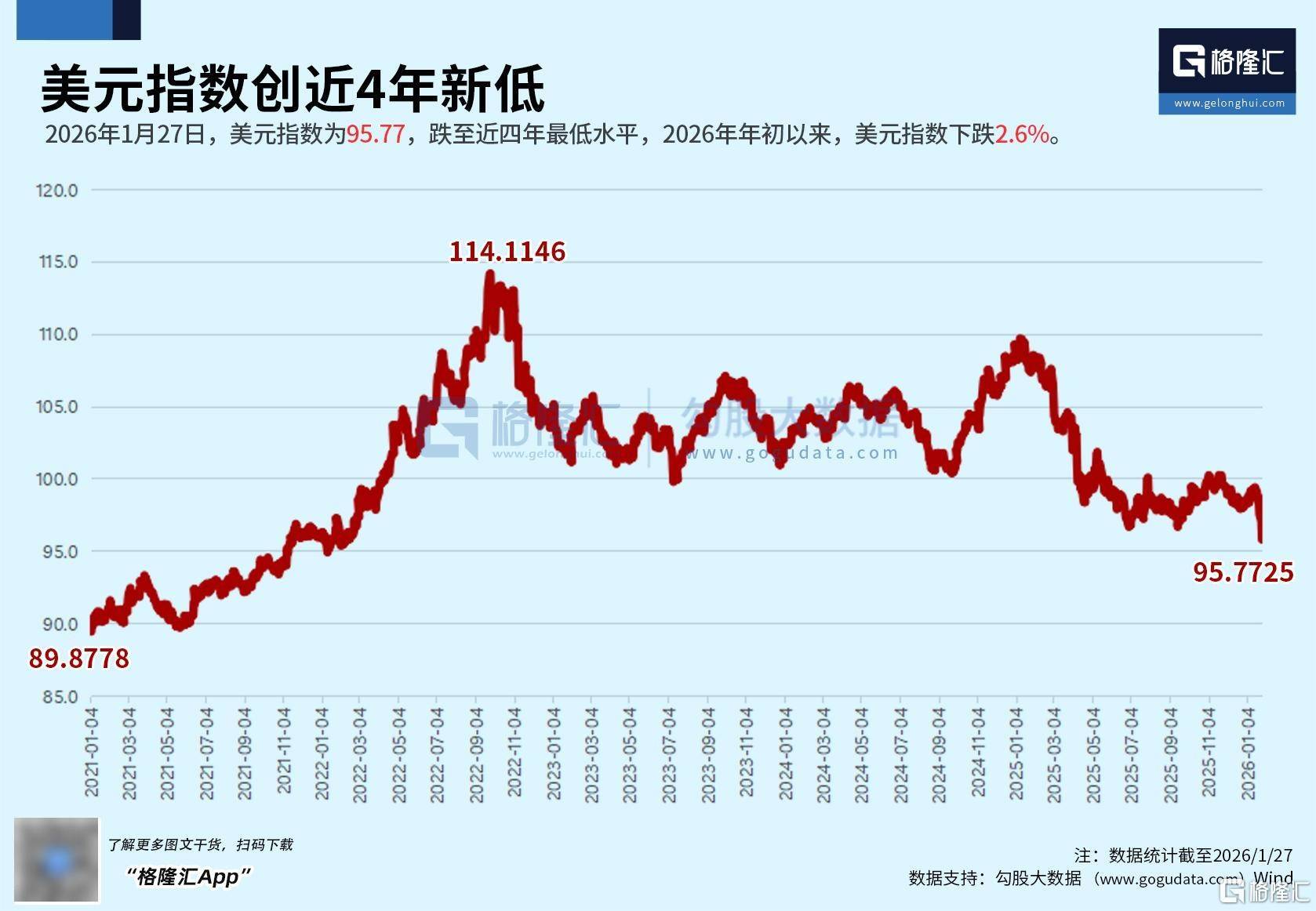
由于投资者受多重预期推动卖出美元,美东时间27日,美元对一揽子货币全面走低。此外,美国总统特朗普的一番言论加剧美元的崩跌态势,刺激金价进一 步上涨。 美元指数当天持续走低,尾盘时大幅下跌,日内暴跌1%,降至近4年来最低点。 在访问爱荷华州宣传其经济政绩期间,特朗普在接受记者采访时被问及他对美元目前的汇率是否满意,以及他是否认为美元在过去一年下跌10%后跌幅过 大。 特朗普表示,他不认为美元"跌得太多",并称美元"表现很棒"、汇率本就会波动。"我希望美元能够找到它自己的合理水平,这才是公平的做法。"他补充 道。 当被问及是否希望看到美元进一步贬值时,特朗普表示美元可能像"溜溜球"一样上下摆动,但他同时称这种做法不理想,并借机批评部分亚洲经济体试图通 过压低本币来获得竞争优势。 特朗普的言论进一步加剧了美元的跌势,此前美元已创下自去年其关税政策引发市场暴跌以来的最大跌幅,并加剧了人们对其反复无常的政策转向将导致海 外投资者撤离美国的担忧。 现货黄金首次突破5200美元/盎司,续创历史新高。2026年首月累涨超880美元,涨幅超20%。 特朗普的弱美元言论 美元此番下跌,部分原因是日元自上周以来突然反弹,交易员们担 ...
现货黄金首次突破5200美元/盎司,再创新高,黄金股票ETF(517400)大涨超2%,连续5日资金净流入超5.3亿元,资金积极布局
Mei Ri Jing Ji Xin Wen· 2026-01-28 02:20
Core Viewpoint - Spot gold has surpassed $5200 per ounce for the first time, reaching a new high, driven by a significant decline in the US dollar and geopolitical tensions [1] Market Performance - Gold stocks ETF (517400) surged over 2%, with net inflows exceeding 530 million yuan over five consecutive days [1] - In January, spot gold has accumulated a rise of over $880 [1] Geopolitical Factors - Increased geopolitical disturbances and accelerated de-dollarization are influencing gold prices [1] - Statements from Canadian Prime Minister and other geopolitical comments have catalyzed a "non-linear" breakout in gold [1] - Several countries, including Denmark and Sweden, have reduced or liquidated their US Treasury holdings, while nations like Cambodia, Indonesia, Egypt, and India are moving their gold reserves to Shanghai/Hong Kong or repatriating them [1] Future Outlook - The long-term logic for gold remains solid due to factors such as the Federal Reserve's interest rate cut cycle, increasing global uncertainties, and central banks purchasing gold [1] - In the medium to long term, gold prices are expected to rise, and investors may consider participating in future pullbacks and gradually accumulating positions [1] - Direct investment in physical gold and tax-exempt gold ETF (518800) are recommended, along with gold stocks ETF (517400) that covers the entire gold industry chain [1]