
全球化

Search documents
三一重工(600031):2025半年度业绩点评:Q2归母净利润同比+38%超预期,龙头充分受益于国内外共振
Soochow Securities· 2025-08-22 12:38
Investment Rating - The report maintains a "Buy" rating for SANY Heavy Industry [2][4] Core Views - In Q2 2025, the company's net profit attributable to shareholders increased by 38% year-on-year, exceeding expectations, benefiting from both domestic and international demand [2] - For H1 2025, total revenue reached 44.78 billion yuan, a year-on-year increase of 14.6%, with net profit attributable to shareholders at 5.22 billion yuan, up 46% year-on-year [2] - The company is expected to maintain rapid revenue growth in the second half of the year due to ongoing strong performance in excavator sales and a significant narrowing of declines in other segments [2] Financial Performance Summary - H1 2025 gross profit margin was 27.6%, up 0.8 percentage points year-on-year, while net profit margin was 11.9%, up 2.5 percentage points year-on-year [3] - The company reported a significant increase in operating cash flow, reaching 10.13 billion yuan in H1 2025, a 20.1% increase year-on-year [3] - The report forecasts net profits for 2025-2027 at 8.5 billion, 11.14 billion, and 12.71 billion yuan respectively, corresponding to P/E ratios of 21, 16, and 14 times [4][10] Business Segment Performance - Excavator sales revenue was 17.5 billion yuan, up 15% year-on-year, driven by domestic cyclical recovery and improved export conditions [2] - Crane sales revenue increased by 17.9% year-on-year to 7.8 billion yuan, benefiting from structural demand improvements in the domestic wind power sector [2] - Concrete machinery sales revenue decreased by 6.5% year-on-year to 7.44 billion yuan, but the decline was significantly narrowed compared to 2024 [2] Strategic Outlook - The company is positioned to benefit from a domestic cyclical upturn expected to last 2-3 years, supported by ongoing improvements in funding and replacement logic [4] - The global strategy includes expanding production capacity in key markets like Indonesia and the U.S., enhancing local advantages [4] - The company achieved 4.03 billion yuan in revenue from new energy products in 2024, a 23% year-on-year increase, with leading market shares in electric construction machinery [4]

菜鸟集团熊伟:全球化业务占比已过半,跨境物流还将再提速
2 1 Shi Ji Jing Ji Bao Dao· 2025-08-22 09:57
Core Viewpoint - Cainiao's globalization narrative is shifting from being a support function for Alibaba's ecosystem to taking on a market-leading role, with over 50% of its business now coming from global operations rather than Alibaba [1][4]. Group 1: Globalization and Market Position - Cainiao's global business now accounts for more than 50% of its overall operations, indicating its evolution into an independent logistics service provider catering to a global market [1]. - The company has established a cross-border logistics network covering over 200 countries and regions, with a recent upgrade to its European G2G logistics solution supporting e-commerce express delivery across 35 European countries [2]. - The goal is to reduce cross-border logistics time from an average of 5 working days to 5 calendar days [3]. Group 2: Development Phases - Cainiao's development can be divided into three phases: - The 1.0 era (2013-2018) focused on technology-driven solutions connecting merchants and logistics [4]. - The 2.0 era (2018-2023) expanded into cross-border, warehousing, and delivery services [4]. - The current 3.0 era emphasizes globalization and marketization as essential for survival and growth [4]. Group 3: Investment Strategy - The company is investing heavily in a "heavy asset" model, with examples including the establishment of eHubs in Hong Kong and Liège, Belgium, which are part of a long-term strategic plan [5]. - Despite short-term challenges, this heavy asset approach is expected to provide scale advantages and more reliable services in terms of efficiency and cost [5]. - Cainiao has built its own last-mile delivery networks in nine countries and plans to deepen investments in regions like Europe and Southeast Asia [5]. Group 4: Market Trends and Challenges - Despite global trade tensions and fluctuating tariff policies, Cainiao remains committed to its globalization strategy, as the growth of overseas e-commerce markets is accelerating [6]. - The company notes that while cross-border direct shipping faces challenges, the penetration rate of e-commerce in many countries is still low, indicating significant growth potential [6]. - The logistics industry is seeing a shift in market demand towards efficiency and cost-effectiveness, with a notable increase in the demand for faster delivery options [7][9]. Group 5: Pricing and Competition - Cainiao's main cross-border products include a $5 delivery option within 10 days, which has gained a 70% market share, while the $10 option for 5-day delivery accounts for 20-30% [8]. - The company argues that the notion of a price war in overseas markets is misleading, as improvements in delivery speed significantly boost repurchase rates [9]. - The logistics sector is increasingly favoring established service providers over smaller ones, as the complexity of providing reliable global express services rises [9].
福耀玻璃(600660):业绩表现超预期 全球化盈利韧性强劲
Xin Lang Cai Jing· 2025-08-22 08:26
Core Insights - The company reported a revenue of 21.447 billion yuan for H1 2025, representing a year-on-year increase of 16.95% [1] - The net profit attributable to shareholders reached 4.805 billion yuan, up 37.33% year-on-year, with Q2 net profit at 2.775 billion yuan, reflecting a 31.47% increase year-on-year and a 36.72% increase quarter-on-quarter [1] - The company's gross margin improved significantly from 35.40% in Q1 to 38.48% in Q2, an increase of 3.09 percentage points [1] Revenue and Profit Performance - The company achieved a net profit margin of 24.07% in Q2, an increase of 3.57 percentage points quarter-on-quarter and 1.83 percentage points year-on-year [2] - The net profit margin for H1 2025 was 22.42%, up 3.32 percentage points year-on-year [2] - The contribution of profits from the U.S. market increased, with H1 2025 net profit from the U.S. reaching 433 million yuan, a year-on-year increase of 11.80% [2] Growth Drivers - Revenue and gross margin growth were driven by several factors: significant ASP increase, higher proportion of high-value-added glass products, and robust overseas business performance, particularly in the U.S. and Europe [1] - The company’s cash flow remains stable, with capital expenditures for H1 2025 amounting to 2.861 billion yuan, including investments in production bases in the U.S., Anhui, and Fujian [2] Future Outlook - The company is expected to achieve revenues of 45.591 billion yuan, 51.706 billion yuan, and 60.418 billion yuan for 2025-2027, with net profits of 9.557 billion yuan, 10.708 billion yuan, and 12.457 billion yuan respectively [3] - The company is positioned for a 10-year growth cycle driven by expansion in the U.S. and Europe, as well as the globalization of Chinese automotive companies [2]

泡泡玛特(09992):25H1增长靓丽,全球化空间广阔
Dongxing Securities· 2025-08-22 06:45
Investment Rating - The report maintains a "Buy" rating for Pop Mart International Group Limited [2][11] Core Views - The company demonstrated rapid growth in H1 2025, with revenue reaching 138.8 billion RMB, a year-on-year increase of 204.5%, and net profit attributable to shareholders at 45.7 billion RMB, up 396.5% [3][10] - The domestic market continues to show strong growth potential, with H1 2025 domestic revenue at 82.8 billion RMB, a 135.2% increase year-on-year [4] - The overseas market also experienced explosive growth, with H1 2025 overseas revenue at 55.9 billion RMB, a staggering 314% increase year-on-year [5] - The company's IP matrix is expanding, with significant revenue contributions from various IPs, particularly THE MONSTERS, which generated 48.1 billion RMB, a 668% increase [6] - The company is expected to maintain strong growth momentum, with projected net profits of 110.7 billion RMB, 155.4 billion RMB, and 203.2 billion RMB for 2025, 2026, and 2027 respectively [11] Domestic Market Summary - Domestic revenue for H1 2025 reached 82.8 billion RMB, with offline sales at 50.8 billion RMB (up 117.1%) and online sales at 29.4 billion RMB (up 212.2%) [4] - The company opened 12 new retail stores, bringing the total to 443, with average store efficiency reaching a historical high [4] - Membership numbers increased by 28% to 59.12 million, indicating a growing consumer base [4] Overseas Market Summary - Overseas revenue for H1 2025 was 55.9 billion RMB, with significant growth in the Americas (1142% increase) and Europe (729% increase) [5] - The company opened 30 new stores in the Asia-Pacific region and 31 in the Americas, indicating a strong expansion strategy [5] - The report highlights that the overseas market still has substantial untapped potential, particularly in high-consumption areas like Europe and the Americas [5] Product Perspective Summary - The IP matrix is showing comprehensive growth, with THE MONSTERS leading at 48.1 billion RMB, followed by CRYBABY at 12.2 billion RMB [6] - Plush toys have become the largest product category, with revenues of 61.4 billion RMB, reflecting a 1276% increase [6] - The company is enhancing its supply chain capabilities, which is expected to support future growth [6] Financial Performance Summary - The gross margin for H1 2025 was 70.3%, a 6.3 percentage point increase year-on-year, with a net profit margin of 33.0%, the highest in history [10] - The report forecasts continued improvement in profitability due to strong sales and the increasing share of high-margin overseas business [10] - The company is expected to launch new products and expand into new markets, which will further drive revenue growth [10]

名创优品调高全年营收预期,旗下潮玩品牌二季度营收增超八成
Feng Huang Wang· 2025-08-21 23:11
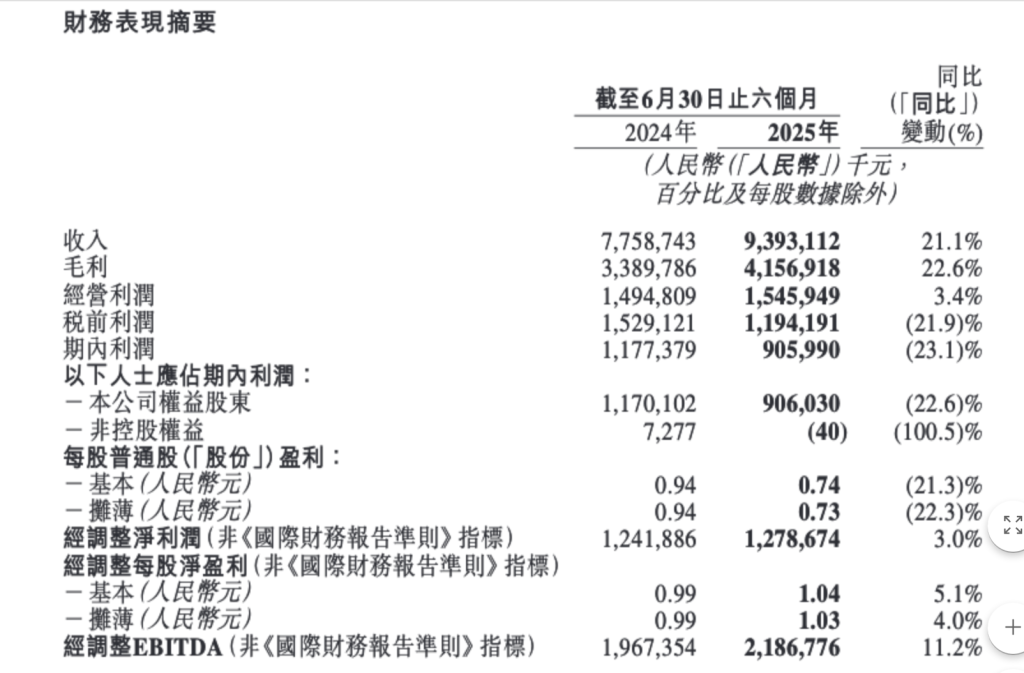
Core Insights - Miniso Group reported a total revenue of 9.39 billion RMB for the first half of 2025, representing a year-on-year growth of 21.1% [1][2] - The company expects its full-year revenue for 2025 to grow by no less than 25%, exceeding previous guidance [1][4] Financial Performance - Gross profit for the first half of 2025 was 4.16 billion RMB, with a gross margin of 44.3% [1][2] - Adjusted net profit for the same period was 1.28 billion RMB, reflecting a 3% increase year-on-year [1][2] - The company announced a mid-term dividend of $0.29 per ADS, with share buybacks and dividends totaling approximately 1.07 billion RMB, accounting for 84% of adjusted net profit [1] Revenue Drivers - Revenue growth was driven by a 11.4% increase in domestic sales, a 29.4% increase in overseas sales, and a 73% increase in revenue from the TOP TOY brand [1][3] - TOP TOY brand revenue reached 400 million RMB in Q2 2025, marking an 87% year-on-year increase [3] Store Expansion and Market Focus - As of June 30, 2025, Miniso had a total of 7,612 stores globally, with 4,305 in mainland China and 3,307 overseas [3] - The company is focusing on high-potential commercial areas for new store openings, particularly in the U.S., where new stores are performing significantly better than older ones [4] Future Outlook - Management is optimistic about accelerating growth, projecting Q3 revenue growth of 25% to 28% [4] - The company aims to maintain a stable and rapid pace of signing new artist collaborations, having already signed nine toy artists [4]

泡泡玛特(09992.HK):品牌、IP全球破圈 成长再提速
Ge Long Hui· 2025-08-21 19:54
Core Insights - The company reported a revenue of 13.88 billion yuan for 1H25, representing a year-on-year increase of 204%, and a net profit of 4.68 billion yuan, up 386%, exceeding previous forecasts [1] - The company's global brand recognition and IP value have rapidly increased, leading to significant growth in both revenue and profitability [1] Revenue Growth - Revenue by region: China 8.28 billion yuan (up 135%), Asia-Pacific 2.85 billion yuan (up 258%), Americas 2.26 billion yuan (up 1142%), Europe and others 480 million yuan (up 729%) [1] - Store count increased to 443 in China, 69 in Asia-Pacific, 41 in the Americas, and 18 in Europe, with significant expansions in the U.S. and Europe [1] IP and Product Development - Five major IPs generated over 1 billion yuan each, with THE MONSTERS achieving a revenue increase of 668% to 4.81 billion yuan, accounting for 34.7% of total revenue [2] - Revenue from plush toys increased by 1276%, with the company launching nearly 20 new products across various styles and materials [2] Profitability Improvement - Gross margin reached 70.3%, up 6.3 percentage points, driven by improved overseas sales and supply chain negotiation capabilities [2] - Adjusted net profit margin improved to 33.9%, reflecting operational leverage and cost management [2] Future Outlook - The company is optimistic about the potential for creating multiple successful IPs and expanding into new business areas such as toys, accessories, and content ecosystems [2] - Adjusted net profit forecasts for 2025 and 2026 have been raised by 13% and 15%, respectively, indicating strong growth potential [3]
泡泡玛特(9992.HK):全球超级品牌与超级IP 想象空间大
Ge Long Hui· 2025-08-21 19:54
Core Insights - The company reported a significant increase in revenue and profit for the first half of 2025, with total revenue reaching 13.876 billion yuan, a year-over-year increase of 204.4%, and a net profit attributable to shareholders of 4.574 billion yuan, up 396.5% [1] - The company is expanding its global presence, with notable growth in the Americas and Asia-Pacific regions, and a strong performance in its IP portfolio [2] Revenue Performance - Total revenue for 1H25 was 13.876 billion yuan, with a net profit of 4.574 billion yuan, reflecting a YoY increase of 204.4% and 396.5% respectively [1] - Revenue from the Chinese market was 8.28 billion yuan, a YoY increase of 135.2%, accounting for 60% of total revenue [1] - The Americas saw revenue of 2.26 billion yuan, a staggering YoY increase of 1142.3%, with 41 retail stores [1] - Asia-Pacific revenue reached 2.85 billion yuan, up 257.8% YoY, while Europe and other regions contributed 480 million yuan, a YoY increase of 729.2% [1] IP and Product Performance - The company’s IP portfolio is thriving, with five major IPs generating over 1 billion yuan in revenue, and 13 IPs exceeding 100 million yuan [2] - The leading IP, THE MONSTERS, generated 4.814 billion yuan, a YoY increase of 668.0%, making up 34.7% of total revenue [2] - Plush toy revenue reached 6.14 billion yuan, a YoY increase of 1276.2%, surpassing figures from figurines [2] Future Outlook - The company anticipates full-year revenue for 2025 to be no less than 30 billion yuan, with significant growth expected in the Asia-Pacific and North American markets [2] - The company plans to expand its store count from 140 to 200 by the end of the year, with future market entries into the Middle East, Central Europe, and Central South America [2] - Profit forecasts for 2025-2027 project net profits of 11.128 billion yuan, 15.332 billion yuan, and 20.295 billion yuan, representing YoY growth of 256.0%, 37.8%, and 32.4% respectively [2]
联想集团(00992.HK):全球PC龙头 2Q25AI PC加速渗透
Ge Long Hui· 2025-08-21 19:42
Group 1 - The company is the largest PC manufacturer globally, with a market share of 24.8% as of Q2 2025, and operates in 180 countries with approximately 80,000 employees [1] - Revenue for Q2 2025 reached $18.83 billion, a year-on-year increase of 21.9%, exceeding Bloomberg's expectation of $17.56 billion, with all three business segments outperforming expectations [1] - Adjusted net profit attributable to shareholders grew by 22% year-on-year to $3.9 billion, surpassing Bloomberg's forecast of $3.5 billion [1] Group 2 - The IDG segment achieved revenue of $13.46 billion in Q2 2025, marking a year-on-year increase of 17.8%, the highest growth in 15 quarters [2] - The growth in revenue and operating profit in the IDG segment is attributed to the accelerated penetration of AIPC and growth in mobile business, alongside a recovery in commercial demand [2] - The company is expected to achieve revenues of $77.38 billion, $83.68 billion, and $91.23 billion from 2025 to 2027, with adjusted net profits projected at $1.63 billion, $1.90 billion, and $2.21 billion respectively [2]

三一重工: 三一重工股份有限公司2025年半年度报告
Zheng Quan Zhi Xing· 2025-08-21 16:59
Core Viewpoint - SANY Heavy Industry Co., Ltd. reported significant growth in revenue and net profit for the first half of 2025, driven by strong domestic and international sales in the construction machinery sector [1][3]. Financial Performance - The company achieved operating revenue of 44.53 billion RMB, a year-on-year increase of 14.96% compared to 38.74 billion RMB in the same period last year [2][3]. - Total profit reached 6.08 billion RMB, reflecting a 47.51% increase from 4.12 billion RMB [2][3]. - Net profit attributable to shareholders was 5.22 billion RMB, up 46.00% from 3.57 billion RMB [2][3]. - The net cash flow from operating activities was 10.13 billion RMB, a 20.11% increase from 8.44 billion RMB [2][3]. Business Overview - SANY specializes in the research, manufacturing, sales, and service of construction machinery, including concrete machinery, excavators, and cranes [3]. - The company maintains a leading market position in concrete machinery globally and is the top brand in China for excavators and large-tonnage cranes [3]. Market Dynamics - Domestic sales of core products such as excavators and concrete machinery have seen comprehensive growth, while overseas markets remain robust, particularly in mineral development and energy infrastructure [3][4]. - The company’s overseas sales revenue reached 26.30 billion RMB, accounting for 60.26% of total revenue, with a year-on-year growth of 11.72% [3][4]. Strategic Initiatives - SANY is advancing its "globalization, digitalization, and low-carbon" strategy, focusing on high-end product upgrades and lean operational management [3][4]. - The company has established a global R&D system and is committed to low-carbon transformation, launching over 30 new energy products in the first half of 2025 [4][5]. Competitive Position - The company’s excavator sales revenue was 17.50 billion RMB, up 15.00%, maintaining its leading position in the domestic market [3][4]. - Concrete machinery sales revenue was 7.44 billion RMB, a decrease of 6.49%, yet it remains the global leader [3][4]. - The crane segment saw sales revenue of 7.80 billion RMB, an increase of 17.89%, with significant market share in large and medium-sized cranes [3][4]. Innovation and Technology - SANY has invested in digital transformation, establishing 33 "lighthouse factories" recognized for their advanced manufacturing capabilities [6][7]. - The company is focusing on smart manufacturing and has developed a comprehensive digital manufacturing platform to enhance operational efficiency [6][7]. Environmental Commitment - SANY is actively pursuing low-carbon technology in its machinery, with a focus on electric, hybrid, and hydrogen fuel technologies [4][5]. - The company has established a New Energy Technology Committee to oversee the development and application of low-carbon technologies [4][5].
泡泡玛特(09992):全球超级品牌与超级IP,想象空间大
Western Securities· 2025-08-21 13:05
Investment Rating - The report maintains a "Buy" rating for the company [5][9]. Core Insights - The company reported a revenue of 13.876 billion yuan for the first half of 2025, representing a year-over-year increase of 204.4%, and a net profit attributable to shareholders of 4.574 billion yuan, up 396.5% year-over-year [1][5]. - The company is expanding its global presence, with significant growth in the Americas and Asia-Pacific regions, and a strong performance in the domestic market [1][2]. - The company anticipates a full-year revenue of no less than 30 billion yuan for 2025, with plans to increase its store count in overseas markets [2][3]. Revenue and Profitability - In the first half of 2025, the company's revenue breakdown shows 8.28 billion yuan from China, 2.26 billion yuan from the Americas, 2.85 billion yuan from Asia-Pacific, and 480 million yuan from Europe and other regions [1]. - The adjusted net profit for the first half of 2025 was 4.710 billion yuan, with an adjusted net profit margin of 33.9% [1][5]. - The company expects net profits for 2025 to reach 11.128 billion yuan, with significant growth rates projected for the following years [3][8]. Market Expansion and IP Performance - The company has successfully launched multiple IPs, with five major IPs generating over 1 billion yuan in revenue in the first half of 2025 [2]. - The fastest-growing IP, "THE MONSTERS," generated 4.814 billion yuan, accounting for 34.7% of total revenue [2]. - The company plans to enter new markets in the Middle East, Central Europe, and Central South America, indicating a strong potential for future growth [2].