新消费

Search documents
古茗(1364.HK):深渠长流 万店耕新
Ge Long Hui· 2025-07-26 05:39
Core Viewpoint - The company, Gu Ming, has established itself as a leading player in the ready-to-drink tea market, leveraging supply chain efficiency to drive store expansion and achieve significant revenue growth in a competitive environment [1][2]. Company Overview - Gu Ming was founded in 2010 in Zhejiang, China, and has focused on supply chain as a core driver of growth, implementing a self-distribution system in 2013 and cold chain logistics in 2017 [1]. - By 2023, the company has developed a cold storage capacity exceeding 60,000 cubic meters and operates over 300 cold chain transport vehicles, creating an industry-leading warehousing and distribution network [1]. - In 2024, Gu Ming achieved revenue of 8.791 billion yuan, a year-on-year increase of 14.54%, and an adjusted net profit of 1.493 billion yuan, up 5.69% year-on-year [1]. Industry Insights - The ready-to-drink tea market has surpassed a trillion yuan in scale, evolving into a new consumption arena where tea products serve as a medium for lifestyle expression among young consumers [2]. - Gu Ming holds a 9% market share in overall GMV and an 18% share in the mass market, ranking second overall and first in the mass market segment in 2023 [2]. - The company has demonstrated resilience amid industry slowdowns, with average daily GMV per store reaching 6,800 yuan in 2023 and projected to be 6,500 yuan in 2024 [2]. Competitive Advantages - Gu Ming's competitive edge lies in its comprehensive support for franchisees and deep optimization of its supply chain, allowing for store expansion without sacrificing profit margins or quality [2]. - The company boasts the largest cold chain storage and logistics infrastructure in the industry, utilizing temperature-controlled vehicles to deliver fresh ingredients to 97% of its stores every two days [2]. - With an average delivery cost of 0.9% of GMV, Gu Ming's logistics efficiency is significantly better than the industry average of 2% [2]. - The company achieved a quarterly repurchase rate of 53% in 2023, surpassing the industry average of 30%, and has launched over 100 new products in 2024, leading the industry in product innovation [2]. Future Growth Potential - Gu Ming employs a regional density strategy for store openings, targeting 500 stores per province as a key scale node, and currently holds a 25% market share in the ready-to-drink tea market across eight provinces [3]. - The company has achieved the highest market share in Zhejiang, Fujian, and Jiangxi provinces, with a 45% share in the mass ready-to-drink tea market [3]. - By June 2025, Gu Ming aims to have a total of 10,403 stores across 20 provinces, with significant potential for expansion into untapped regions [3]. - The company has identified a potential store opening space of approximately 9,866 stores under a neutral assumption, with a 5-year CAGR of 15%, and up to 19,314 stores if it expands into currently unentered cities, with a 5-year CAGR of 25% [3].
【开源食饮】食品饮料仓位新低,建议布局白酒与新消费潜力股——行业点评报告
Sou Hu Cai Jing· 2025-07-25 20:24
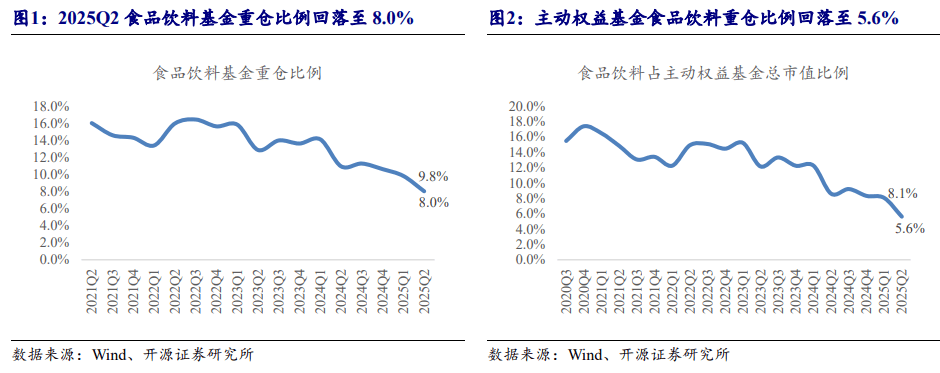
Group 1 - The core viewpoint of the articles indicates a significant decline in the allocation of food and beverage sectors by funds, reaching a new low since 2020, with the allocation ratio dropping from 9.8% in Q1 2025 to 8.0% in Q2 2025 [1][5][6] - Active equity funds have notably reduced their allocation to the food and beverage sector, with a decrease from 8.1% in Q1 2025 to 5.6% in Q2 2025, reflecting a 2.5 percentage point drop [1][5][6] - The decline in the food and beverage sector is attributed to the impact of the alcohol ban, which has further contracted consumption scenarios, particularly affecting traditional sectors like liquor [1][3][5] Group 2 - The proportion of active equity funds heavily invested in liquor has decreased from 6.57% in Q1 2025 to 3.97% in Q2 2025, a decline of 2.6 percentage points, indicating a widespread reduction in liquor holdings [2][11] - The overall market fund allocation to liquor has also fallen from 8.5% in Q1 2025 to 6.8% in Q2 2025, showing a similar trend of reduced investment in liquor [2][11] - Major liquor companies such as Luzhou Laojiao, Wuliangye, and Shanxi Fenjiu have seen significant reductions in fund holdings, while only a few companies like Kuaijishan and Shede Liquor experienced slight increases [2][11][20] Group 3 - The investment recommendation suggests strategically positioning in the liquor sector, as the current low expectations and valuations present potential opportunities for gradual accumulation [3][25][27] - The report anticipates that the liquor industry will find a bottom in the second half of the year, with expectations of a recovery in demand as the market adjusts to the impacts of the alcohol ban [3][27] - For new consumption targets, the focus should be on companies that can leverage channel expansion opportunities and emerging product categories, with recommendations including Ximai Food and Bai Run Shares [3][28]






瑞银:Q2公募基金港股持仓上升至18.8%!还将继续南下
Zhi Tong Cai Jing· 2025-07-25 10:44
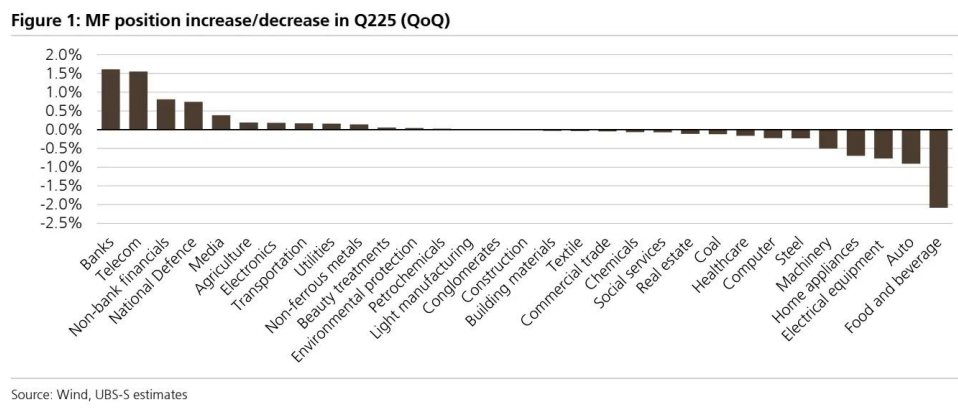
Group 1 - Public funds increased their holdings in the banking, telecommunications, and non-bank financial sectors by 1.6%, 1.6%, and 0.8% respectively in Q2 2025, while reducing their positions in food and beverage, automotive, and power equipment sectors by 2.1% and 0.9% [1] - The defense sector also saw increased interest from public funds due to heightened geopolitical uncertainties, ranking fourth in terms of increased holdings [1] - The holdings in the STAR Market by public funds rose by 0.4%, reaching a historical high of 14.8% [1] Group 2 - New fund issuance remained sluggish in Q2 2025, with a total of 59.9 billion units of actively managed equity and mixed funds issued, a year-on-year increase of 128%, but down 73% from the peak levels of 2020-2021 [4] - Active management funds have consistently outperformed the CSI 300 index since Q3, indicating potential for increased fund inflows as market performance improves [4] - Positive catalysts in high-holding sectors may lead to increased new fund issuance, providing additional liquidity and creating a positive feedback loop [4] Group 3 - Net inflows from southbound funds reached 273.9 billion RMB in Q2 2025, a year-on-year increase of 25%, with the financial sector seeing the largest inflow [5] - Public funds' holdings in Hong Kong stocks increased by 1.5%, reaching 18.8%, a rise of 6.6 percentage points from Q4 2024 [5] - The AH premium significantly decreased in the first half of 2025 due to liquidity differences between A-shares and H-shares, with expectations of maintaining mid-term low levels [5] Group 4 - The "national team" is estimated to have increased its holdings in A-share ETFs by over 200 billion RMB in Q2 2025, with 65% directed towards CSI 300 index ETFs [6] - The "national team's" actions reflect a commitment to stabilizing the capital market and providing downside protection for A-shares [6] - In extreme scenarios, the "national team" has the capacity to further increase holdings to stabilize the market [7]
国泰海通 · 首席大咖谈|精彩回放:批零社服刘越男谈新消费
国泰海通证券研究· 2025-07-25 10:12
本订阅号所载内容仅面向国泰海通证券研究服务签约客户。因本资料暂时无法设置访问限制,根据《证 券期货投资者适当性管理办法》的要求,若您并非国泰海通证券研究服务签约客户,为保证服务质量、 控制投资风险,还请取消关注,请勿订阅、接收或使用本订阅号中的任何信息。我们对由此给您造成的 不便表示诚挚歉意,非常感谢您的理解与配合!如有任何疑问,敬请按照文末联系方式与我们联系。 更多国泰海通研究和服务 亦可联系对口销售获取 重要提醒 法律声明 ...

对话联博:A股估值有吸引力,看好红利、新质生产力、新消费
2 1 Shi Ji Jing Ji Bao Dao· 2025-07-25 08:38
Group 1 - The core viewpoint is that the recent rise in US stock markets is driven by fundamental factors rather than valuation or sentiment, with corporate earnings outlook improving since April [2][4] - Major technology companies are showing strong growth, particularly in AI investments, which is expected to support overall market performance [2][6] - The US fiscal deficit is projected to remain high due to the "Big and Beautiful" bill, which may keep long-term interest rates elevated and increase market volatility [2][5] Group 2 - In the context of China's economic recovery and easing trade tensions, the pace of stimulus policies is expected to be gradual and focused on precision [4][5] - The proportion of stocks and funds in Chinese household asset allocation is only about 12%, indicating significant room for growth compared to the US average of around 40% [4][5] - The dividend levels of Chinese companies are improving, with the dividend yield of the CSI 300 index reaching approximately 3.5%, enhancing the attractiveness of the stock market relative to bonds [5][6] Group 3 - The A-share market is viewed as having attractive valuation levels, with a healthy overall sentiment and low issuance of equity funds [6][7] - Investors are encouraged to focus on high-quality stocks with stable cash flows and sustainable dividend growth in a low-interest-rate environment [7] - Three sectors are highlighted for potential strong performance: dividend stocks, new productive forces, and new consumption [6][7]
景顺:中美贸易回暖及二季度GDP超预期支撑中国股市走强 后市仍有持续上行动力
Zhi Tong Cai Jing· 2025-07-25 03:36
Group 1 - The Chinese stock market has recently strengthened, with the Shanghai Composite Index surpassing 3600 points, reaching a high not seen in over three and a half years [1] - The rise is attributed to the improvement in China-US trade relations and better-than-expected GDP data for the second quarter, which has increased domestic investors' risk appetite and confidence in current policy measures [1] - The ongoing upward trend in the stock market is expected to rely more on the transformation of consumption structure, particularly in the expansion of the service industry, experience-driven consumption, and innovations in pharmaceuticals and green technology [1] Group 2 - Investor sentiment towards Chinese stocks remains positive, with valuations still attractive compared to global and regional peers; more stimulus measures are anticipated in the second half of the year, along with the potential for a comprehensive trade agreement between China and the US [1] - Artificial intelligence continues to be a highlight in the Chinese market, with a focus on practical applications, large-scale adoption, and user-oriented tool development; a recent positive development is the US policy shift allowing AI chip exports to China [1] - The new consumption narrative in China is shifting from merely purchasing goods to deeper experiences and emotional connections, supported by government incentives such as subsidies [2]
17个新职业折射经济运行两重“新”意
Zheng Quan Ri Bao· 2025-07-24 16:13
Group 1 - The Ministry of Human Resources and Social Security has officially released the seventh batch of new occupations, including 17 new professions such as cross-border e-commerce operation manager and drone swarm flight planner, along with 42 new job types [1][2] - Since 2019, the Ministry has cumulatively published 110 new occupations, reflecting the evolving nature of "profession" and attracting a diverse workforce, while also indicating two aspects of economic renewal [1][3] - The first aspect of economic renewal is the accelerated cultivation and growth of new productive forces, with rapid technological advancements and the emergence of new industries, as evidenced by R&D expenditure reaching approximately 2.7% of GDP, surpassing the EU average [1][2] Group 2 - The rapid development of artificial intelligence is highlighted by the introduction of new job types such as "generative AI system tester" and "generative AI animation creator," showcasing the technology's impact across various sectors [2] - Emerging industries are thriving, with strategic emerging service enterprises reporting nearly 10% revenue growth in the first five months of the year, driven by innovation and industry integration [2] - The second aspect of economic renewal is the rise of new consumption patterns characterized by personalized and diversified consumption, reflecting structural changes in consumption content, scenarios, and philosophies [2][3]
2025Q2轻工板块基金持仓分析:新消费热度不减,潮玩、电子烟连续获增持
Minsheng Securities· 2025-07-24 08:53
Investment Rating - The industry investment rating is "Outperform the Market" [7][11][36] Core Insights - The report highlights that the public fund heavy position in the light industry sector is 0.86%, with a slight decrease of 0.01 percentage points compared to the previous quarter. This position ranks 19th among all sectors, with an increase in holdings primarily in the entertainment products and e-cigarettes sub-sector [4][36] - The light industry manufacturing index has shown a cumulative change of +7.83% in Q2 2025, outperforming the CSI 300 index by 6.57 percentage points [4][36] - The report emphasizes the sustained interest in new consumption trends, particularly in trendy toys and e-cigarettes, which have seen continuous increases in heavy positions [9][28][36] Summary by Sections Heavy Position Analysis - The public fund heavy position in the light industry for Q2 2025 is 0.86%, ranking 19th in allocation among sectors. The cumulative change in the light industry manufacturing index is +7.83% for Q2 2025, outperforming the CSI 300 index [4][14][36] Sub-sector Performance - The heavy position in the sub-sectors is as follows: entertainment products and e-cigarettes (1.25%), paper (0.23%), home furnishings (0.23%), and packaging printing (0.03%). The entertainment products and e-cigarettes sub-sector saw an increase of +0.48 percentage points [9][18][36] Northbound Capital Movements - Northbound capital has increased its holdings in companies such as Morning Glory (3.12%, +0.49 percentage points) and Oppein Home (1.91%, +0.36 percentage points). The report notes strategic collaborations that may enhance growth prospects for these companies [10][32][36] Investment Recommendations - The report maintains a positive outlook on new consumption sectors, suggesting that despite short-term volatility, the long-term growth logic remains intact. It recommends focusing on high-growth sectors and traditional home furnishing leaders [11][36]
开源证券:食品饮料仓位新低 建议布局白酒与新消费潜力股
Zhi Tong Cai Jing· 2025-07-24 06:57
开源证券发布研报称,当前行业仍在寻底,考虑到禁酒令同时打击餐饮,影响范围较广,判断纠偏动作 应不会太久,下半年白酒应能看到阶段性底部位置。从报表角度,考虑到二季度白酒需求受影响较大, 中报后市场大概率普遍下修盈利预测。综合判断下半年白酒板块应有布局机会,建议加大关注。新消费 标的短期由于中报预期变化而出现波动。该行建议在新消费标的中寻找符合产业发展趋势的优质公司并 长期持有。 开源证券主要观点如下: 2025Q2食品饮料仓位降至新低 从基金重仓持股情况来看(中全部市场基金,一级子行业),2025Q2食品饮料配置比例由2025Q1的9.8% 回落至8.0%水平,环比回落1.8pct,处于2020年以来新低位置。该行选取主动权益基金(普通股票、偏股 混合、灵活配置三类基金),从基金重仓持股情况来看,2025Q2食品饮料配置比例为5.6%,和2025Q1的 8.1%相比,下降2.5pct,说明二季度主动权益基金大幅减少食品饮料配置。二季度由于禁酒令的影响, 餐饮等消费场景进一步收缩,以白酒为代表的传统板块基本面情绪仍偏悲观,资金持续流出。7月份市 场风格切换,板块基本面探底叠加资金避险需求,该行预计会有部分资金回流 ...
国泰海通 · 首席大咖谈|批零社服刘越男:布局新消费,关注新政策
国泰海通证券研究· 2025-07-24 06:13
本订阅号所载内容仅面向国泰海通证券研究服务签约客户。因本资料暂时无法设置访问限制,根据《证 券期货投资者适当性管理办法》的要求,若您并非国泰海通证券研究服务签约客户,为保证服务质量、 控制投资风险,还请取消关注,请勿订阅、接收或使用本订阅号中的任何信息。我们对由此给您造成的 不便表示诚挚歉意,非常感谢您的理解与配合!如有任何疑问,敬请按照文末联系方式与我们联系。 法律声明 重要提醒 更多国泰海通研究和服务 亦可联系对口销售获取 ...