
货币贬值

Search documents
印尼央行:通胀压力或加剧,货币宽松受贬值担忧制约
Sou Hu Cai Jing· 2026-01-08 08:34
Core Viewpoint - The article discusses the challenges faced by Indonesia's central bank in formulating monetary policy due to high expansionary fiscal and monetary policies, which may exacerbate inflationary pressures this year [1] Group 1: Inflation and Economic Outlook - Indonesia is expected to experience increased inflationary pressures due to highly expansionary fiscal and monetary policies [1] - The upcoming harvest season and strengthened government price controls may alleviate some of these inflationary pressures [1] - Inflation is projected to remain within the target range, allowing the central bank room for further interest rate cuts to support growth [1] Group 2: Currency Concerns - Market concerns regarding the depreciation of the Indonesian rupiah may limit the central bank's ability to pursue a monetary easing cycle [1] - By 2025, the Indonesian rupiah is anticipated to be the second worst-performing currency against the US dollar among Asian emerging markets [1]
【环球财经】纽约金价6日涨超1% 银价大涨近6%重上80美元关口
Xin Hua Cai Jing· 2026-01-07 00:58
Group 1 - The core viewpoint of the articles highlights the significant rise in gold and silver prices driven by geopolitical tensions and strong market demand, with gold reaching $4505.70 per ounce and silver surpassing $80 per ounce [1][2] - The geopolitical unrest following the U.S. control of Venezuelan leaders has led to increased demand for safe-haven assets like gold and silver, indicating a shift in market sentiment towards these precious metals [1] - The World Gold Council reported that central banks purchased a net total of 45 tons of gold in November 2025, with total purchases from January to November 2025 nearing 297 tons, reflecting ongoing strong demand from emerging market central banks [1] Group 2 - Analysts from Saxo Bank noted that gold and silver are evolving from mere inflation hedges to foundational assets in the global economy, with gold being viewed as a key monetary asset and alternative to the U.S. dollar [2] - The report emphasizes that the strong performance of gold and silver at the beginning of 2026 indicates that the underlying drivers for price increases remain robust, with concerns over currency devaluation and fiscal sustainability continuing to support demand for hard assets [2] - UBS Wealth Management analysts predict that factors such as central bank gold purchases, increasing fiscal deficits, declining U.S. interest rates, and persistent geopolitical risks will drive gold prices to reach $5000 per ounce by the end of Q1 2026 [2]
纽约金价6日涨超1%,银价大涨近6%重上80美元关口
Xin Hua Cai Jing· 2026-01-07 00:54
纽约商品交易所黄金期货市场交投最活跃的2026年2月黄金期价6日上涨54.2美元,收于每盎司4505.70美 元,涨幅为1.22%。 受避险需求推动,黄金和白银价格当日继续走高。美国周末突袭委内瑞拉并强行控制马杜罗夫妇引发地 缘政治动荡。更重要的是,美国的行动引发了贵金属交易员对未来几个月地缘政治局势走向的思考。过 去一周,黄金、白银短期技术面也显著改善。当日白银价格站上每盎司80美元。 铜期货价格隔夜攀升至每磅6美元以上,创下历史新高。市场预期今年全球供应将进一步收紧。此外, 强劲的全球需求前景,尤其是来自电网升级、可再生能源项目和数据中心扩建的需求也支撑铜价。 世界黄金协会数据显示,2025年11月份各国央行净买入黄金45吨,2025年1月份至11月份累计买入量接 近297吨。新兴市场央行2025年继续保持着大规模的黄金购买势头。 盛宝银行(Saxo Bank)大宗商品分析师在最新发布的贵金属报告中指出,金、银在2026年新年伊始的 复苏表明,市场需求已展现出强大的韧性。黄金和白银不再仅仅是对冲通胀的基本投资工具,它们已转 变为全球经济的基石资产。黄金如今被视为重要的货币资产和美元的替代品,白银则是全球经 ...
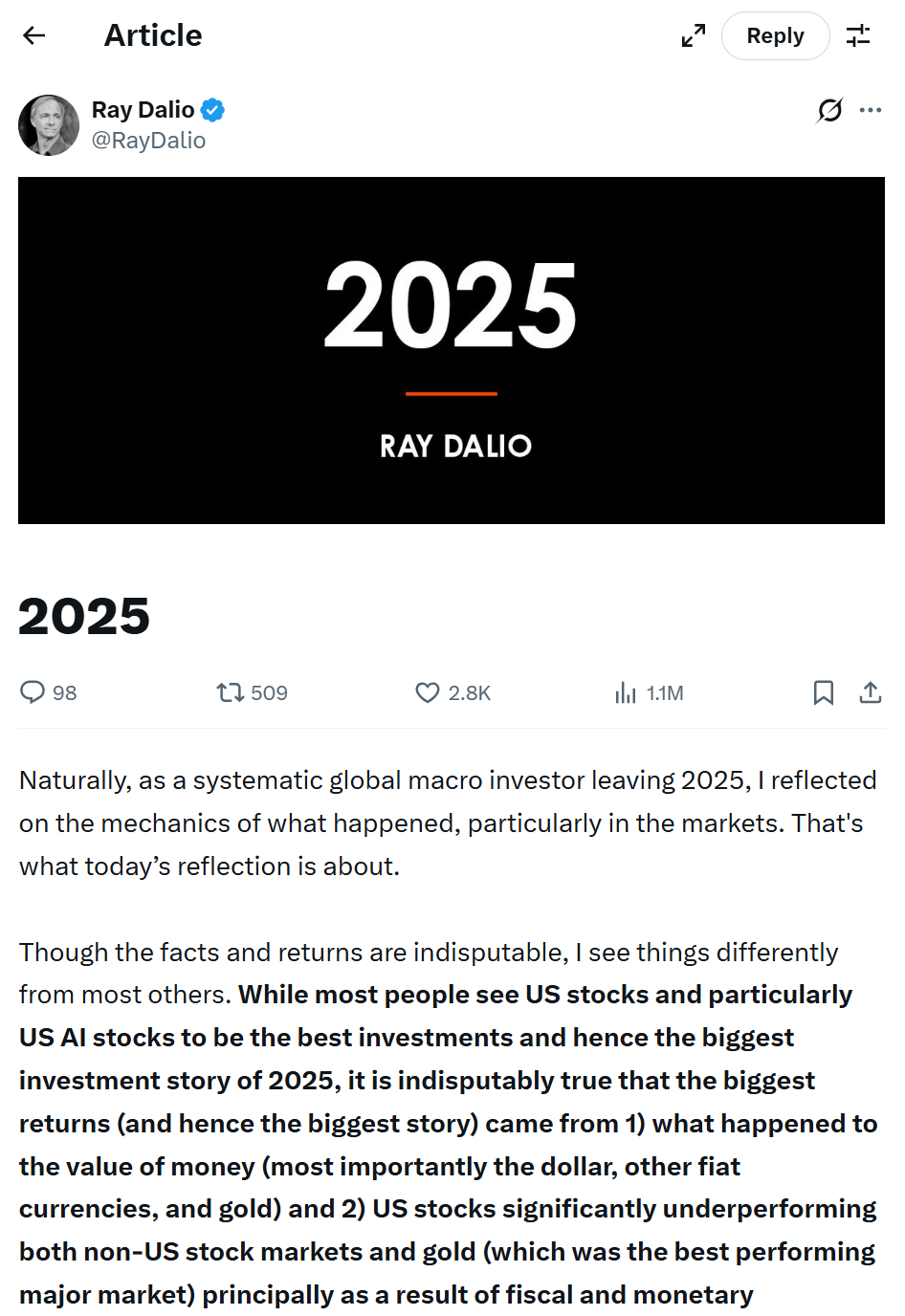
达利欧复盘2025年:除了AI泡沫,一定要看懂这场“货币贬值”的大戏
Jin Shi Shu Ju· 2026-01-06 09:13
Group 1: Currency Value Dynamics - The value of currencies has significantly declined, with the US dollar depreciating against major currencies such as the Japanese yen (down 0.3%), Chinese yuan (down 4%), euro (down 12%), Swiss franc (down 13%), and gold (down 39%) [3][4] - The best-performing investment was gold, with a return of 65% in USD terms, outperforming the S&P 500's return of 18% by 47% [3][4] - The depreciation of local currencies affects asset valuations, creating an illusion of stronger performance for assets priced in weaker currencies [4] Group 2: Bond Market Insights - The nominal returns on 10-year US Treasury bonds were 9% in USD terms, but -34% when measured in gold, indicating a decline in real value due to currency depreciation [5] - The supply-demand imbalance in the bond market has not yet become a severe issue, but there is a looming need to roll over nearly $10 trillion in debt [5] - The attractiveness of debt assets is diminishing, particularly at the long end of the yield curve, as the Federal Reserve appears inclined to maintain low real interest rates [5] Group 3: Stock Market Performance - US stocks significantly lagged behind non-US stocks and gold, with European stocks outperforming US stocks by 23%, Chinese stocks by 21%, and emerging market stocks by 34% [6] - The S&P 500 index's total return of 18% was driven by a 12% increase in earnings and a 5% rise in price-to-earnings (P/E) ratios [6][7] - The profitability improvements were attributed to a 7% increase in sales and a 5.3% rise in profit margins, with a notable portion of margin improvement linked to technological efficiencies [7] Group 4: Political and Economic Influences - The political landscape, particularly under the Trump administration, has significantly influenced market dynamics, with policies aimed at revitalizing American manufacturing and technology [11][12] - The shift from multilateralism to unilateralism in global politics has increased conflict risks and led to higher military spending and borrowing [13][14] - The growing wealth and income disparity has created a political environment where inflation concerns are more pronounced among lower-income groups, potentially impacting future elections [11][12] Group 5: Future Outlook - The interplay of debt, currency, market, and economic forces, along with domestic political dynamics and geopolitical tensions, will continue to shape the global economic landscape [14] - The potential for rising interest rates due to currency depreciation and supply-demand pressures could negatively impact credit and equity markets [8][9] - The ongoing AI boom and its implications for productivity and market valuations remain a critical area for future analysis [14]
达利欧年度复盘:美元等法币贬值 美股高回报只是“计价幻觉” 黄金跑赢一切
智通财经网· 2026-01-06 08:06
Group 1: Core Insights - The core narrative emphasizes that the significant investment story of 2025 is not the strong performance of U.S. stocks, but rather the dramatic changes in currency values and global asset allocation shifts, with gold emerging as the true winner [4][10]. Group 2: Currency and Asset Performance - The U.S. dollar depreciated against several currencies, including a 39% drop against gold, leading to a "valuation illusion" where U.S. stock performance appears strong in dollar terms but is weak when viewed through stronger currencies [10][11]. - The S&P 500 index recorded an 18% total return in dollar terms, but when measured against gold, it actually declined by 28% [10][12]. - Non-U.S. markets, including Europe, China, and Japan, outperformed U.S. stocks, with emerging markets showing an overall return of 34% [10][12]. Group 3: Economic and Political Dynamics - The disparity in profit distribution, where capitalists benefit more than workers, is leading to political unrest among the lower 60% of the population, potentially resulting in significant political conflict by 2027-2028 [6][8]. - The shift from multilateralism to unilateralism in global politics is increasing military spending and sanctions, further diminishing the attractiveness of dollar-denominated assets [8][19]. Group 4: Market Valuation and Investment Risks - U.S. stock valuations are seen as peaking, with equity risk premiums at historically low levels, indicating limited potential for future returns [14][15]. - Non-liquid markets, such as private equity and real estate, are under pressure due to rising debt extension challenges and low liquidity premiums, which may lead to value declines in these assets [7][15]. Group 5: Future Outlook - The anticipated political turmoil and wealth distribution conflicts are expected to have profound impacts on market dynamics, particularly as the wealth gap widens [8][16]. - The potential for rising interest rates due to supply-demand pressures could negatively affect credit and equity markets, further complicating the investment landscape [14][15].

黄金去年的疯狂难以复制?投行目标价现巨大分歧
Jin Shi Shu Ju· 2026-01-05 02:52
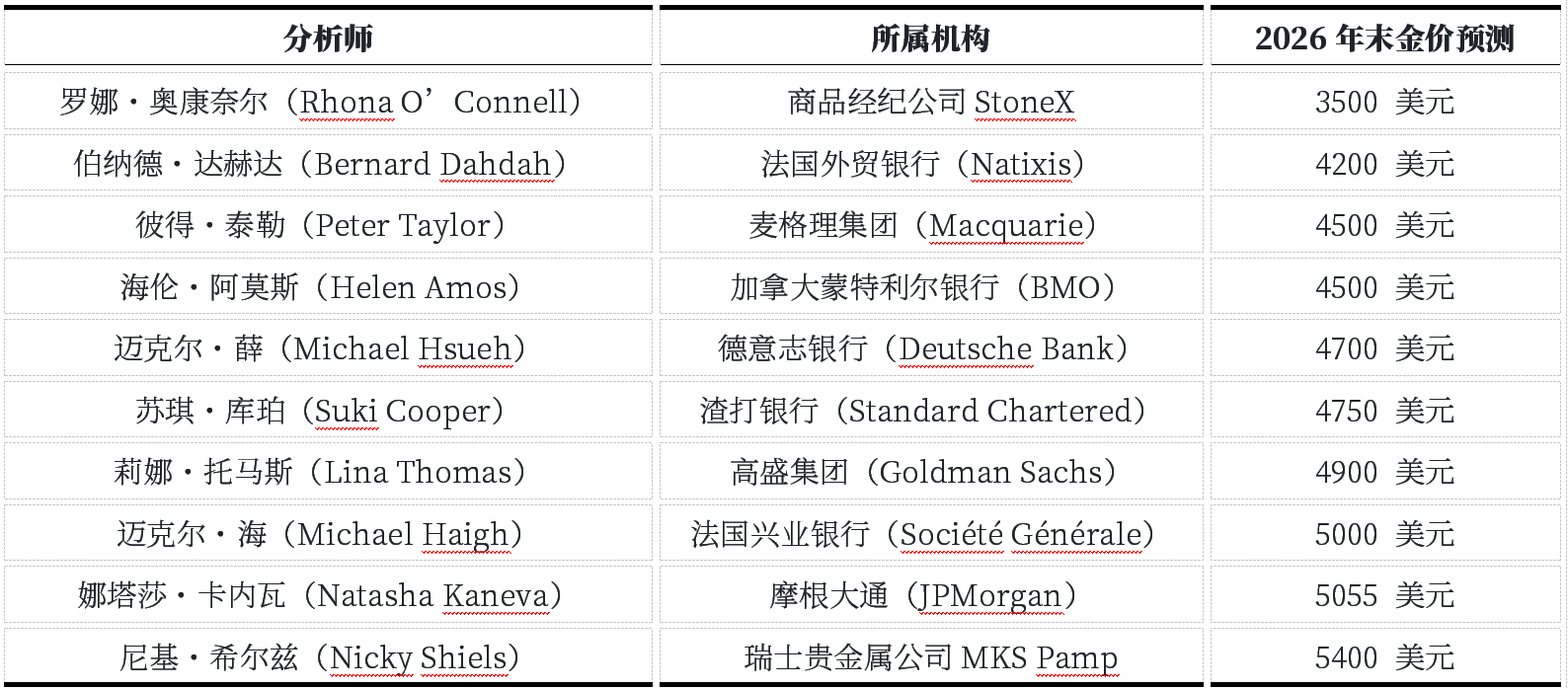
Core Viewpoint - The survey by the Financial Times indicates that gold prices are expected to continue their historic upward trend into 2026, reaching a new high, although analysts predict a slowdown in the pace of increase after a remarkable surge in 2025 [1] Group 1: Price Predictions - Analysts predict that gold prices, which surged by 64% in 2025, will rise nearly 7% by the end of 2026, reaching approximately $4,610 per ounce [1] - The most optimistic forecast comes from Nicky Shiels of MKS Pamp, who anticipates gold prices could reach $5,400 per ounce, representing a 25% increase [2] - The average predicted price for gold at the end of 2025 was underestimated, with actual closing prices significantly higher at $4,314 compared to the predicted $2,795 [3] Group 2: Influencing Factors - Continued demand from emerging market central banks and investor interest in safe-haven assets are expected to drive gold prices in 2026 [2] - Lina Thomas from Goldman Sachs notes that if investors diversify their asset allocations further, there could be significant upward potential for gold prices, with a potential year-end price of $4,900 [2] - Natasha Kaneva from JPMorgan forecasts that global central bank gold purchases will total around 755 tons in 2026, which, despite being lower than previous years, could still support prices approaching $6,000 by 2028 [3] Group 3: Diverging Opinions - There is a significant disparity between the most optimistic and pessimistic forecasts, with a $1,900 difference between the highest and lowest predictions [3] - The most pessimistic outlook from Rhona O'Connell of StoneX suggests that gold prices could drop to $3,500 due to a crowded market environment [4] - Factors such as declining jewelry demand and the anticipated end of the Federal Reserve's rate-cutting cycle are cited as potential downward pressures on gold prices [4][5]
“一份蛋炒饭10美金”、“40米长队囤货”,直击委内瑞拉现状
凤凰网财经· 2026-01-04 13:46
Group 1 - The article discusses a sudden military action in Venezuela, where a bombing occurred in Caracas, leading to chaos and confusion among the local population and expatriates [1][5][9] - The bombing targeted both civilian and military sites, with reports indicating that the strikes were precise and limited in scope, minimizing collateral damage to civilian buildings [10][12] - Following the bombing, there was a significant surge in consumer behavior, with supermarkets experiencing a tenfold increase in sales as residents rushed to stock up on essential goods [14][17] Group 2 - The article highlights the economic context of Venezuela, noting its vast oil reserves and the impact of political instability on the economy, which has led to hyperinflation and a devaluation of the local currency [26][27] - Expatriates in Venezuela expressed concerns about their businesses and inventory, particularly regarding the challenges of high shipping costs and currency depreciation affecting their operations [29] - The article also reflects on the mixed sentiments among the local population regarding the political situation, with some supporting the government and others the opposition, indicating a divided public opinion [27][28]

伊朗最高领袖: 应与抗议者进行对话 但骚乱行径必须得到制止
Yang Shi Xin Wen· 2026-01-03 11:29
本文来源:央视新闻 风险提示及免责条款 当地时间1月3日,伊朗最高领袖哈梅内伊针对近期国内骚乱事件表态。哈梅内伊表示,当一个商人看到 国家的货币形势、看到本国货币贬值、看到本国货币和外币价格波动不定,导致商业环境不稳定时,他 会说自己没法做生意了。他说的是实话,国家官员也承认这一点,目前总统和其他高级官员正在努力解 决这个问题。 他表示,外币汇率无缘无故地波动,涨跌不定,让商人不知所措,这不正常,这是敌人的伎俩,必须制 止这种行为,总统和其他一些官员正在努力纠正此事。因此,商贩们对该状况表示反对,这是理所应当 的。重要的是,一群受过训练的敌方雇佣兵聚集在人群后面煽动,高喊反伊朗的口号。哈梅内伊称,抗 议是合理的,但抗议与骚乱截然不同。官员应该与抗议者对话,但与骚乱者对话毫无意义,"必须对骚 乱者予以镇压"。滥用抗议活动,意图破坏国家安全,并引发骚乱的行径是绝对不可接受的,必须认清 敌人的所作所为。敌人会利用一切机会,伊朗的官员也在为此"作战"。 哈梅内伊强调,伊朗绝不向敌人退缩,在人民的支持下,伊朗将使敌人屈服。 市场有风险,投资需谨慎。本文不构成个人投资建议,也未考虑到个别用户特殊的投资目标、财务状况或需要 ...
伊朗发生骚乱 已致3死13伤
Xin Lang Cai Jing· 2026-01-02 04:03
自2018年美国宣布单方面退出伊核协议以来,伊朗遭受来自美西方多轮严厉制裁,货币贬值,通胀严 重,经济发展受到严重打击。 伊朗塔斯尼姆通讯社日前报道说,伊朗政府经济团队正在召开紧急会议,讨论处理近期出现在汇率、贸 易和民生方面的问题。 另据伊朗法尔斯通讯社1日报道,示威者当天在伊朗西南部恰哈尔马哈勒-巴赫蒂亚里省洛尔代甘破坏多 座政府大楼和银行。 报道说,示威者包括一些武装人员,他们向执法人员开火造成部分执法人员受伤,一些带头示威者被 捕。报道援引一名知情人士的话说,有2人在洛尔代甘发生的冲突中死亡,但未透露死者身份。 综合伊朗媒体1日报道,伊朗两个省份发生骚乱,已造成至少3人死亡、13人受伤。 伊朗国家电视台1日报道说,伊朗西部洛雷斯坦省库赫达什特前一晚发生骚乱,一名"动员穷人组织"志 愿军成员在维护公共秩序时身亡,另有13名执法人员和志愿军成员受伤。 ...
国投期货:美国债务膨胀和去美元化进程是支撑黄金的长期因素
Xin Lang Cai Jing· 2026-01-01 06:52
Core Viewpoint - The long-term factors supporting gold include the expansion of U.S. debt and the process of de-dollarization, with gold serving as a hedge against currency depreciation and systemic risks [1] Group 1: Gold Market Analysis - The trend of de-globalization and de-dollarization positions gold as an important strategic asset in the financial system [1] - Historical comparisons suggest that gold prices still have upward potential, although macroeconomic divergences may increase the frequency of price fluctuations at historical highs [1] - Expectations of economic soft landing and easing geopolitical tensions may lead to a transition of funds from safe-haven assets to risk assets, potentially weakening gold's upward momentum [1] Group 2: Silver Market Analysis - The current valuation framework for silver emphasizes its financial attributes and value analysis, using gold as a benchmark [1] - The reasonable valuation for silver, based on the gold-silver ratio, is considered to be below 50, which implies a fair silver price of 20,000 when gold prices remain unchanged [1]