绿色低碳

Search documents
20+数据中心液冷技术厂家盘点,建议收藏!
DT新材料· 2025-10-22 16:05
Core Viewpoint - The article emphasizes the critical role of liquid cooling technology in addressing the increasing thermal management challenges faced by data centers due to the rapid advancement of technologies like artificial intelligence and the Internet of Things. Traditional air cooling methods are becoming inadequate, making liquid cooling a key focus for sustainable development in data centers [5]. Summary by Sections Overview of Liquid Cooling Technology - Data centers are evolving towards "high performance, high density, and high energy consumption," with cooling systems accounting for approximately 40% of total energy consumption. Efficient heat dissipation is essential for sustainable development [5]. Company Profiles - **Shenzhen Envicool Technology Co., Ltd.**: Established in 2005, it specializes in precision cooling solutions for data centers and has a diverse product matrix including liquid cooling technologies widely used in high-power density servers [6][7]. - **Guangzhou Gaolan Energy-saving Technology Co., Ltd.**: Founded in 2001, it offers advanced cooling solutions with a focus on liquid cooling technologies, achieving a PUE as low as 1.08 in applications [10][12]. - **Sugon Information Industry Co., Ltd.**: With a comprehensive product system in liquid cooling, it has developed technologies that enhance heat exchange efficiency by over 15% [13][14]. - **Inspur Information**: A global leader in IT infrastructure, it holds a 5.5% market share in the global liquid cooling infrastructure market and has been the top provider in China for four consecutive years [16][17]. - **Ningchang Information Industry (Beijing) Co., Ltd.**: Focused on liquid cooling servers, it has developed a comprehensive system covering all scenarios of liquid cooling [20][22]. - **Sanhua Tongfei Refrigeration Co., Ltd.**: Established in 2001, it specializes in industrial temperature control technology and has developed solutions that significantly reduce energy consumption [24][26]. - **Jiangsu Likang Puting Precision Technology Co., Ltd.**: Founded in 2024, it focuses on efficient and energy-saving cooling solutions for data centers [27][28]. - **Nanjing Jialitu Room Environment Technology Co., Ltd.**: Established in 2003, it provides a full chain of services in environmental control, including liquid cooling solutions [31][33]. - **Kehua Data Co., Ltd.**: With a history dating back to 1988, it has developed liquid cooling solutions that achieve a PUE as low as 1.2 [36][37]. - **Shenzhen Keda Technology Co., Ltd.**: Founded in 1993, it offers comprehensive solutions for data centers, focusing on high-density liquid cooling products [39][40]. - **Guangdong Shenling Environment System Co., Ltd.**: Established in 2000, it provides integrated solutions for environmental control, including innovative liquid cooling systems [42][43]. - **Guangdong Haiwu Technology Co., Ltd.**: Focused on low-carbon solutions, it has developed a full-stack liquid cooling system adaptable to various power densities [46][47]. - **Shenzhen Green Cloud Technology Co., Ltd.**: A subsidiary of Wangsu Technology, it specializes in green data center solutions based on immersion cooling technology [50][51]. - **Yimikang Technology Group Co., Ltd.**: Established in 2002, it aims to lead in zero-carbon data center solutions, with a focus on various liquid cooling technologies [53][54]. - **Yuan Di (Guangzhou) Digital Technology Co., Ltd.**: Founded in 2021, it focuses on innovative liquid cooling products and solutions, achieving significant milestones in various industries [57][58]. - **Sichuan Chuanrun Co., Ltd.**: Established in 1992, it has developed dual technology routes in liquid cooling, achieving a PUE below 1.05 [61][62]. - **Changzhou Hester Technology Co., Ltd.**: With 25 years of experience, it has become a leader in liquid cooling technology, providing solutions for high-performance computing [64][65]. - **Beehe Electric (Taicang) Co., Ltd.**: Founded in 2006, it offers comprehensive thermal management solutions, including liquid cooling products [68][69]. - **Guangzhou Hashi Temperature Control Technology Co., Ltd.**: Established in 2023, it focuses on liquid cooling solutions and has developed a complete technical system for various applications [71][72]. - **Lanyang (Ningbo) Technology Co., Ltd.**: Founded in 2019, it provides comprehensive liquid cooling solutions for various industries, focusing on immersion cooling technology [73][74]. - **Zhejiang Yunchuang Zhida Technology Co., Ltd.**: A subsidiary of Zhejiang Kangsong, it offers customized liquid cooling solutions based on extensive experience in thermal management [77][78]. - **Henan Jingrui Cooling Technology Co., Ltd.**: Established in 2008, it provides solutions for various fields, including data centers [80][81]. - **H3C Group**: Offers high-density liquid cooling solutions to meet the growing performance demands of data centers [84]. Upcoming Events - The sixth Thermal Management Industry Conference and Expo will be held in 2025, focusing on thermal management technologies in data centers and consumer electronics, inviting industry professionals and researchers to participate [88].


中国东航与同济大学签署战略合作协议
Zhong Guo Min Hang Wang· 2025-10-22 02:20
Core Viewpoint - China Eastern Airlines Group has signed a strategic cooperation agreement with Tongji University to establish a comprehensive, deep, and sustainable partnership focusing on various fields including smart civil aviation, artificial intelligence, green low-carbon initiatives, and domestic aircraft operations [1][2]. Group 1: Strategic Cooperation - The agreement aims to leverage the strengths of both parties to build high-level research platforms, enhance technological innovation collaboration, and strengthen joint talent cultivation [1][2]. - The partnership will facilitate resource sharing and integrated development in key areas of the aviation industry [1][2]. Group 2: Industry Positioning - As a state-owned backbone airline, China Eastern Airlines plays a crucial role in the civil aviation sector, aligning its development with national strategies and optimizing its service offerings [2]. - The company has established a "3+5" industrial structure that includes full-service aviation, air logistics, and innovative economy aviation, alongside related industries such as aircraft maintenance and digital technology [2]. Group 3: Recent Achievements - In recent years, China Eastern Airlines and Tongji University have formed a technology innovation alliance focused on the aviation service industry, leading to significant advancements in aviation materials and smart transportation research [2]. - Projects like the "Machine Learning-Based Aviation Safety Report Digital Application Research" are at the forefront of national civil aviation innovation [2]. Group 4: Event Highlights - The signing ceremony was accompanied by the unveiling of the "Industry-Education Integration Innovation Practice Base" and a series of activities including a job fair and public courses at Tongji University [6]. - Key figures from both organizations, including the Chairman of China Eastern Airlines and the Secretary of the Party Committee of Tongji University, attended the event [6].

我国胶管胶带出口规模稳步增长
Zhong Guo Hua Gong Bao· 2025-10-22 02:04
Core Insights - The export of China's rubber hose and belt products is steadily increasing, while imports are gradually decreasing, indicating a strong domestic market expansion and improved domestic substitution capabilities [1][2] - From 2020 to the first half of 2025, the export scale of China's rubber hose and belt industry is significantly larger than that of imports, with the total export value of conveyor belts, hoses, and drive belts being approximately 3.5 times the import value and the total export volume about 15.4 times the import volume [1] Industry Performance - The conveyor belt sector shows strong self-sufficiency and significant export potential, although it faces anti-dumping investigations; the hose industry has been growing steadily, leading in export value among the three product categories, but still relies heavily on imports for high-value-added products; the drive belt sector has seen an increase in added value, with narrowing price gaps compared to foreign products, yet it remains less competitive internationally [1][2] Pricing Dynamics - Despite the growth in export scale, the industry continues to face a "low-price export, high-price import" situation, with the average export prices of all three product categories being lower than their import prices, indicating that exports are primarily mid-to-low-end products while high-value-added products are still imported [2] Strategic Recommendations - The industry should abandon low-quality, low-price competition and focus on mid-to-high-end markets to enhance core competitiveness and achieve qualitative and quantitative growth [2] - Increased R&D investment is necessary to align with trends in green low-carbon and new productivity, aiming for differentiated development and customized services [2] - The industry must be vigilant against global economic uncertainties and trade barriers, leveraging policy benefits such as "timely interest rate cuts" and "support for technological innovation" [2] - While maintaining traditional partnerships, the industry should capitalize on opportunities from initiatives like the "Belt and Road" and RCEP agreements to explore emerging markets and uncover export potential [2]
四川2025年前三季度GDP同比增长5.5% 新能源汽车产量同比增长1.7倍
Zheng Quan Shi Bao Wang· 2025-10-21 13:22
Economic Overview - Sichuan's GDP for the first three quarters of 2025 reached 49,322.2 billion yuan, with a year-on-year growth of 5.5% [1] - The primary industry added value was 3,978.7 billion yuan, growing by 3.5%; the secondary industry added value was 16,966.4 billion yuan, increasing by 5.2%; and the tertiary industry added value was 28,377.1 billion yuan, rising by 6% [1] Agricultural Sector - The total output value of agriculture, forestry, animal husbandry, and fishery was 8,257.7 billion yuan, with a year-on-year growth of 3.5%, accelerating by 0.2 percentage points compared to the first half of the year [1] - The planting industry achieved an output value of 5,410.2 billion yuan, growing by 3.6%, with economic crops contributing 97% to this growth [2] - Livestock production value reached 1,967.3 billion yuan, with a year-on-year increase of 1.4%, showing recovery in the livestock sector [2] Industrial Sector - The industrial added value above designated size grew by 7.1%, exceeding the previous year's growth by 0.5 percentage points [2] - The manufacturing sector's added value increased by 7.5%, with high-tech manufacturing growing by 11.6% [3] - Key industries such as automotive manufacturing and electrical machinery saw significant growth, contributing to a 3.5 percentage point increase in overall industrial growth [3] Retail and Consumer Goods - Retail sales of automobiles increased by 8%, with significant improvements in August and September, growing by 21.2% and 28.3% respectively [4] - Sales of communication equipment surged by 54.3%, while household appliances grew by 11.3%, indicating a positive trend in consumer spending [4]
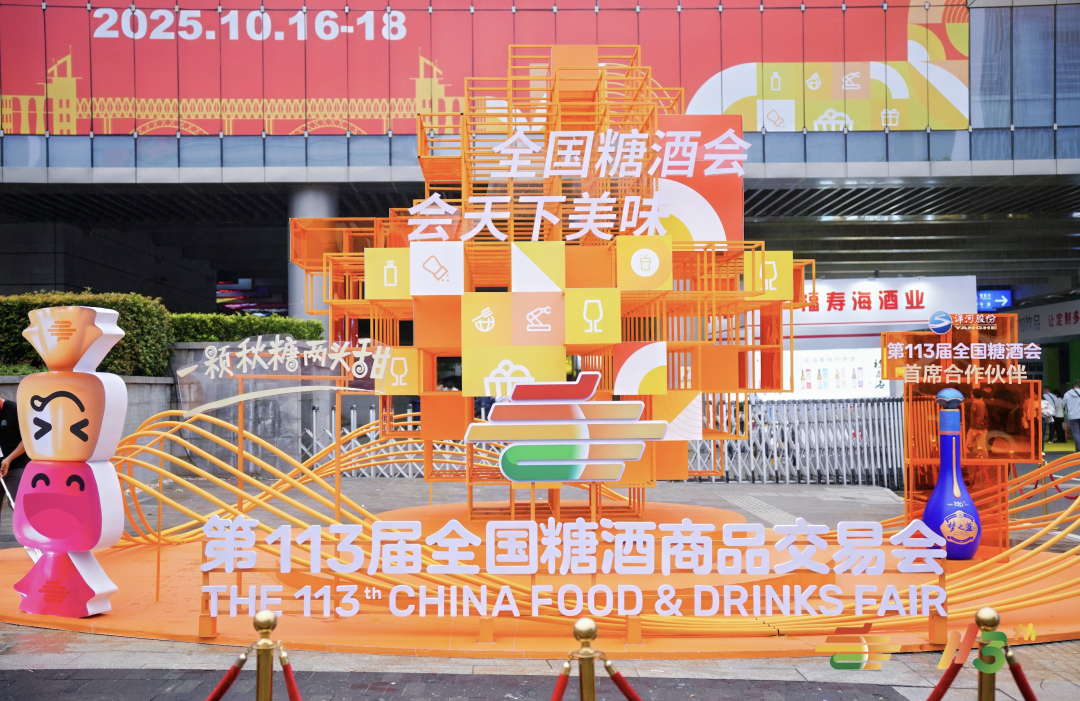
第113届全国糖酒商品交易会暨2025秋糖季圆满落幕
Qi Lu Wan Bao· 2025-10-21 08:31
Core Insights - The 113th National Sugar and Wine Commodity Fair was successfully held in Nanjing from October 16 to 18, showcasing its role as an industry "barometer" and "accelerator" through innovative product launches, authoritative forums, and green practices [1][3][5] Exhibition Highlights - The exhibition covered an area of 200,000 square meters with 10 major themed exhibition areas and 13 specialty zones, attracting 4,027 enterprises from over 40 countries and regions, presenting more than 300,000 innovative products [3][5][6] - Over 400,000 professional visitors attended, demonstrating the fair's enduring appeal and effectiveness in facilitating trade connections [6][9] Innovative Consumption Promotion - The "Autumn Sugar Season" initiative integrated city-wide activities, engaging over 10 million participants and generating direct economic benefits of 10.6816 billion yuan [4][27] - Various cultural and entertainment events were organized, significantly boosting local consumption, with participating restaurants reporting an average revenue increase of 35% [25][26] Industry Forums and Discussions - More than 30 high-profile industry forums were held, addressing topics such as AI-driven manufacturing and digital transformation, providing authoritative insights for industry development [15][17] - The main forum featured experts discussing the transition from technological innovation to value creation in the food and beverage sector [15][17] Technological Empowerment - The fair utilized digital platforms to enhance participant experience, achieving over 279,100 visits to its digital services, which improved matching efficiency and negotiation quality [18] Sustainability Initiatives - The event emphasized green practices, implementing measures to reduce carbon emissions and promote sustainable development within the exhibition industry [19] Media Coverage and Publicity - The fair garnered extensive media attention, with over 700 journalists covering the event, resulting in a total online exposure of 420 million times [20] Future Outlook - The next National Sugar and Wine Commodity Fair is scheduled for March 26-28, 2026, in Chengdu, aiming to continue supporting national consumption strategies and industry development [28]
前三季度关键数据出炉 读懂中国经济“秋季报”背后的信心和底气
Yang Shi Wang· 2025-10-21 04:20
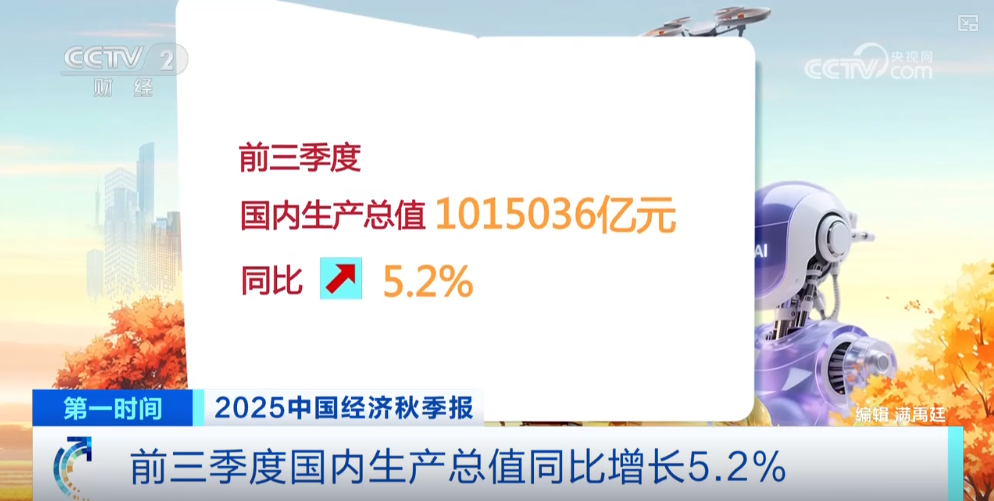
Economic Growth - China's GDP for the first three quarters of the year reached 10,150.36 billion yuan, with a year-on-year growth of 5.2%, accelerating by 0.4 percentage points compared to the same period last year [3] - The economic increment amounted to 396.79 billion yuan, with an increase of 136.8 billion yuan year-on-year [3] Industrial Performance - The industrial added value above designated size grew by 6.2% year-on-year, with the manufacturing sector increasing by 6.8% [3] - The proportion of added value from equipment manufacturing and high-tech manufacturing reached 35.9% and 16.7%, respectively [5] Consumer Market - The total retail sales of consumer goods reached 3,658.77 billion yuan, reflecting a year-on-year growth of 4.5%, with service retail sales growing by 5.2% [3][16] - Final consumption expenditure contributed 53.5% to economic growth, indicating that consumption remains the main engine of economic growth [5] Investment Trends - Manufacturing investment grew by 4.0% year-on-year in the first three quarters [3] - Investment in the automotive manufacturing sector maintained double-digit growth, driven by policies promoting the replacement of old vehicles [6][9] Employment and Prices - The urban survey unemployment rate remained stable compared to the first half of the year [3] - Core CPI inflation has expanded for five consecutive months, reflecting the effectiveness of policies aimed at expanding domestic demand and promoting consumption [3] International Trade - The total value of goods trade reached 3.361 trillion yuan, with a year-on-year growth of 4% [3] - The resilience of China's foreign trade has been highlighted, with a focus on upgrading export structures and expanding market reach [16] Technological Innovation - High-tech manufacturing added value grew by 9.6% year-on-year, with significant increases in the production of industrial and service robots [8][9] - The integration of technology and industry has led to a transformation of innovative potential into economic momentum, with substantial growth in renewable energy products [9][10] Energy Consumption - The total electricity consumption in the third quarter exceeded 1 trillion kilowatt-hours, with industrial electricity consumption showing rapid growth [12] - In Jiangsu, electricity consumption in advanced manufacturing increased significantly, particularly in the photovoltaic equipment sector [12]
5000亿元新型政策性金融工具加速落地
Jing Ji Wang· 2025-10-21 04:11
Core Points - The National Development and Reform Commission (NDRC) announced the establishment of a new type of policy financial tool with a total scale of 500 billion yuan, aimed at supporting technology innovation, expanding consumption, and stabilizing foreign trade to promote stable economic development [1][2][6] - The new policy financial tools will be used exclusively to supplement project capital, addressing funding bottlenecks caused by tight local finances [2][6] - Various regions have begun to implement these financial tools, with initial funding already allocated to projects in infrastructure, digital economy, and artificial intelligence [4][5] Summary by Sections Policy Framework - The new policy financial tools were proposed during a Central Political Bureau meeting on April 25, emphasizing support for major national strategic projects [2] - These tools are characterized as "quasi-fiscal" instruments, typically funded through financial bonds issued by policy banks, with project selection led by the NDRC and interest subsidies from the Ministry of Finance [2] Funding Allocation - The total scale of the new policy financial tools is set at 500 billion yuan, all designated for project capital supplementation [2][8] - Recent data indicates that the establishment of new policy financial tool companies has occurred, with registered capital amounts of 20 billion yuan, 10 billion yuan, and 5 billion yuan respectively [2] Regional Implementation - Various regions, including Jiangsu, Guangdong, and Zhejiang, have actively launched projects funded by the new policy financial tools, with specific allocations such as 3.199 billion yuan for a rail transit project in Jiangsu [4][5] - The funding is directed towards both traditional infrastructure and emerging sectors like digital economy and artificial intelligence [4] Economic Impact - The new policy financial tools are expected to leverage additional investments, with estimates suggesting that the 500 billion yuan could mobilize between 1.5 trillion to 2 trillion yuan in fixed asset investments [8] - The tools are designed to support long-term projects, particularly in sectors like digital economy and green technology, aligning with the goals of the 14th Five-Year Plan [7][8]
中银晨会聚焦-20251021
Bank of China Securities· 2025-10-21 02:11
Key Insights - The report emphasizes the "14th Five-Year Plan" as a pivotal period for advancing new productive forces, focusing on technological innovation, green transformation, high-end manufacturing, and digital integration [5][6] - The "14th Five-Year Plan" is expected to be officially implemented in 2026, with a focus on economic, technological, reform, and livelihood improvements, reinforcing green low-carbon initiatives and governance [5][6] - The report outlines a dual-core driving mechanism in the A-share market, where high-growth sectors like "Artificial Intelligence+" and high-end manufacturing are expected to resonate with policy and demand, while lower-tier sectors face competitive and pricing pressures [5][6] Industry Performance - The report provides a snapshot of market indices, with the Shanghai Composite Index closing at 3863.89, up by 0.63%, and the Shenzhen Component Index at 12813.21, up by 0.98% [3] - In the industry performance section, the telecommunications sector saw a rise of 3.21%, while the non-ferrous metals sector declined by 1.34% [4] Company Focus: Feiliwa - Feiliwa plans to increase its production capacity for quartz electronic yarn, with an investment of 624 million yuan aimed at enhancing competitiveness in the high-end PCB materials sector [9][10] - The company is actively developing high-end optical synthetic quartz material technology, which is expected to break the monopoly of foreign companies in this field [9][11] - The demand for quartz electronic cloth is anticipated to grow rapidly due to the upgrade of Ethernet switch chips, which require higher performance PCB materials [10]

双轨并行,中国碳市场十年演进:从试点到覆盖60%碳排放
Sou Hu Cai Jing· 2025-10-21 01:38
Core Insights - The article discusses the development and significance of China's carbon market, which has become the largest in the world, covering over 60% of the country's carbon emissions [2][24] - It highlights the transition from pilot programs in select cities to a national market, emphasizing the importance of regulatory frameworks and technological integration [4][7][10] Summary by Sections Development of Carbon Market - China initiated its carbon market with pilot programs in 2011 in cities like Beijing and Shanghai, which later provided valuable insights for the national market [4][5] - The national carbon market officially launched on July 16, 2021, initially including 2,162 power generation companies, covering approximately 4.5 billion tons of carbon emissions [5][7] Market Expansion and Performance - By 2025, the market is expected to expand to include steel, cement, and aluminum industries, adding around 2.5 billion tons of emissions to its coverage [7] - As of August 2025, the carbon market has traded nearly 700 million tons of allowances, with a transaction value exceeding 47.4 billion [8][10] Pricing and Impact on Emissions - The average carbon price in 2024 has increased significantly compared to 2021, with reduced volatility indicating growing confidence in the market [10] - Companies within the carbon market have shown a notable reduction in emission intensity, with their carbon emissions per unit of GDP being lower than non-participating firms [10] Future Goals and Regulatory Framework - The central government has set clear targets for the carbon market, aiming for comprehensive coverage of major industrial sectors by 2027 and a mixed allocation system by 2030 [13][14] - The transition from intensity-based allocation to total emissions control is planned, with a gradual increase in auctioned allowances [16][17] Challenges and Areas for Improvement - Current issues include excessive administrative intervention in allowance distribution, lack of financial instruments like carbon futures, and inconsistent data standards across regions [21][22] - Effective regulation requires collaboration among various departments to ensure funds are directed towards green initiatives and to prevent market manipulation [22] Future Developments - Plans for introducing carbon futures and establishing market makers are in place, with potential for alignment with the EU carbon market [24] - The article emphasizes the importance of understanding and participating in the carbon market for all stakeholders, as it plays a crucial role in achieving carbon neutrality goals [25][27]
能源早新闻丨全球首个!落地内蒙古
中国能源报· 2025-10-20 22:33
News Focus - The National Energy Administration is accelerating the construction of a credit system in the energy sector, aiming for a more complete regulatory framework and improved credit information sharing by the end of 2027 [2] - The Ministry of Transport has launched the "International Green Shipping Corridor Cooperation Initiative," proposing seven measures to promote international cooperation in green shipping [2] Domestic News - The National Energy Administration approved the safety registration of 19 hydropower station dams, including the Wengden Pumped Storage Power Station [3] - As of September 30, 2025, the total number of electric vehicle charging facilities in China reached 18.063 million, a year-on-year increase of 54.5% [3] - In September, the industrial power generation in China was 826.2 billion kWh, showing a year-on-year growth of 1.5% [3] - The added value of the lithium-ion battery manufacturing industry increased by 29.8% year-on-year in the first three quarters of 2025 [3] Automotive Industry - In September, the production and sales of new energy vehicles reached a historical high, with production and sales of 1.617 million and 1.604 million units respectively, marking year-on-year increases of 23.7% and 24.6% [4][5] International News - The UK government announced a clean energy job growth plan, aiming to create 400,000 new jobs in the clean energy sector by 2030 [6] - The South African government plans to invest approximately $126.7 billion to advance energy transition and address long-standing electricity supply issues [6] Corporate News - The world's highest voltage level converter station is undergoing annual maintenance, ensuring reliable electricity supply for the Yangtze River Delta region this winter and spring [7]