AI

Search documents
港股“大模型第一股”冲A 国泰海通“加盟”辅导
2 1 Shi Ji Jing Ji Bao Dao· 2026-02-14 03:58
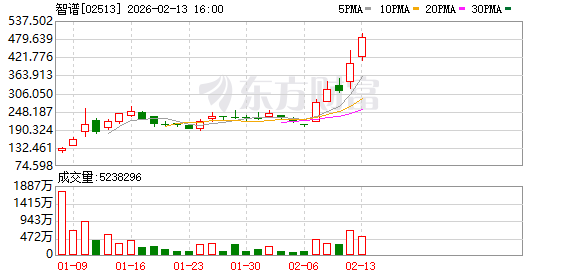
Core Viewpoint - The stock price of Zhiyuan Technology, known as the "first stock of large models" in Hong Kong, surged over 138.68% within five trading days, indicating strong market interest and momentum for AI-related companies [2][3] Group 1: IPO Developments - Zhiyuan Technology has updated its A-share IPO guidance report, adding Guotai Junan Securities as a new advisor alongside CICC, enhancing its advisory team [3][5] - The company previously withdrew its IPO guidance submitted in April 2025 and is now aiming for a listing on the Shanghai Stock Exchange's Sci-Tech Innovation Board [5][6] - The rapid re-initiation of A-share IPO guidance reflects Zhiyuan's commitment to establishing a dual capital platform ("A+H") [7] Group 2: Competitive Landscape - The competition among leading securities firms for IPO services in the AI sector is intensifying, with a focus on both speed and quality of submissions [3][12] - Guotai Junan Securities has a strong track record, having participated in 19 IPO projects on the Sci-Tech Innovation Board over the past three years, making it the top firm in terms of project count [8] - In contrast, CICC has been involved in 12 projects during the same period, highlighting the competitive dynamics between these top-tier firms [9] Group 3: Market Trends - The current environment allows unprofitable "hard tech" companies, including AI firms, to pursue IPOs, but the complexity of their technologies and business models leads to more rigorous scrutiny during the application process [14] - The collaboration between CICC and Guotai Junan Securities in past projects, such as the successful IPO of SMIC, showcases their established partnership in the hard tech sector [11][10]




神工股份股价波动,半导体板块走强
Jing Ji Guan Cha Wang· 2026-02-14 03:57
Group 1 - The stock price of ShenGong Co. experienced significant fluctuations, closing at 84.15 yuan on February 13, with a single-day increase of 0.35% and a trading volume of 466 million yuan, while the net inflow of main funds was 22.39 million yuan [1] - During the period from February 9 to February 13, the stock price reached a high of 86.50 yuan on February 13 and a low of 82.30 yuan on February 11, resulting in a cumulative decline of approximately 6.5% from the closing price of 89.98 yuan on February 9 [1] Group 2 - On February 13, the semiconductor equipment sector showed strength against the market trend, with stocks like ShenGong Co. rising. This was driven by record-high global semiconductor sales projected to reach 791.7 billion dollars in 2025, a year-on-year increase of 25.6%, and China's sales exceeding 200 billion dollars, fueled by strong demand from AI and data centers [2] - The commercial aerospace sector also became active due to record financing and technological breakthroughs, indirectly boosting sentiment in the semiconductor industry chain [2]

全球首家机器人9S店长沙开业;32颗亚马逊低轨卫星搭乘欧洲火箭入轨丨智能制造日报
创业邦· 2026-02-14 03:56
2.【32颗亚马逊低轨卫星搭乘欧洲火箭入轨】当地时间12日下午,欧洲阿丽亚娜6型火箭从法属圭亚 那库鲁航天中心成功发射。火箭搭载美国亚马逊低地轨道卫星计划的32颗卫星,约两小时后所有卫星 被顺利部署到预定轨道。据阿丽亚娜集团官网介绍,这次任务编号为VA267,是该公司与亚马逊低地 轨道卫星计划签订的18次阿丽亚娜6型火箭发射计划中的首次任务。阿丽亚娜集团首席执行官马丁·西 翁说,这次成功发射是阿丽亚娜6型火箭四个助推器版本的首次飞行。阿丽亚娜6型火箭于2024年7月 9日完成首次发射,本次任务是其第六次发射。该火箭有两种型号,分别装配两个和四个助推器。 (光明网) 1.【机构:预计HBM4验证将于2026年第二季度完成】2月13日,根据TrendForce集邦咨询最新 HBM产业研究,随着AI基础建设扩张,对应的GPU需求也不断成长,预期NVIDIA(英伟达) Rubin平台量产后,将带动HBM4需求。目前三大存储器原厂的HBM4验证程序已进展至尾声,预计 将在2026年第二季陆续完成。其中,Samsung(三星)凭借最佳的产品稳定性,预期将率先通过验 证,SK hynix(SK海力士)、Micron(美光) ...

桥水Q4大举增持英伟达和黄金股
Xin Lang Cai Jing· 2026-02-14 03:17
Core Insights - Bridgewater, the world's largest hedge fund, disclosed its latest U.S. stock holdings report (13F) on Friday, revealing significant investments in AI-related stocks such as Nvidia, Amazon, and Micron Technology, as well as an increase in holdings of Newmont Corporation, a leading gold producer, benefiting from rising gold prices [1] Group 1 - In the fourth quarter ending December 31, the total market value of Bridgewater's holdings reached $27.4 billion, up from $25.5 billion in the previous quarter [1] - During the third quarter, Bridgewater added 191 new positions, increased holdings in 450 positions, while reducing stakes in 395 positions and completely exiting 165 positions [1] - The top ten holdings of Bridgewater accounted for 36.33% of the total market value [1]

联想营收高增,杨元庆承诺“保持双位数增长”
2 1 Shi Ji Jing Ji Bao Dao· 2026-02-14 03:16
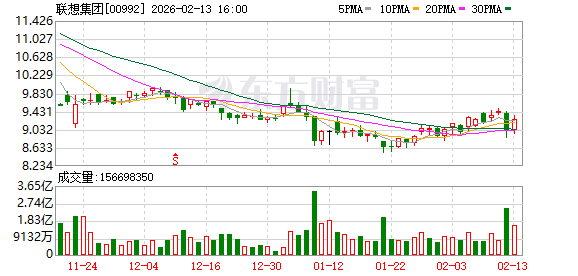
Core Viewpoint - Lenovo has reported its best-ever performance amid rising storage prices, with AI revenue surpassing 30% for the first time, and CEO Yang Yuanqing has committed to sustainable double-digit growth [1] Financial Performance - For the third quarter of the fiscal year ending December 31, 2025, Lenovo achieved revenue of 157.5 billion yuan, a year-on-year increase of over 18%, exceeding market expectations [1] - Adjusted net profit grew by 36% year-on-year, with profit growth outpacing revenue growth [1] - The company anticipates that the global PC market may remain flat or slightly decline in terms of shipment volume, but revenue will continue to grow due to rising average prices [3] AI Revenue Growth - AI-related revenue increased by 72% year-on-year, accounting for 32% of total revenue, marking a significant shift in Lenovo's business model [1][2] - AI PC and AI server segments experienced high double-digit growth, while AI mobile and AI services saw triple-digit growth [2] Business Segments Performance - The Intelligent Devices Group (IDG) reported revenue exceeding 110 billion yuan, a 14.3% year-on-year increase [3] - The Infrastructure Solutions Group (ISG) revenue reached 36.7 billion yuan, a 31% year-on-year increase, marking a historical high [4] - The Solutions and Services Group (SSG) achieved double-digit growth for the 19th consecutive quarter [3] Supply Chain and Cost Management - Yang Yuanqing emphasized Lenovo's "scale advantage" and "diverse supply" capabilities, allowing the company to maintain stable supply and competitive costs despite rising component prices [4] - The company reported a 15% year-on-year increase in adjusted operating profit for the IDG segment, with PC shipments growing by 15% [4] Strategic Initiatives - Lenovo has initiated a strategic restructuring of the ISG, with a one-time restructuring cost of 285 million USD, focusing on AI-driven product development and sales capabilities [4][5] - The company aims to prepare for a shift in AI demand from training to inference, predicting that inference will account for 80% of future demand [5] Partnerships and Collaborations - Lenovo has strengthened partnerships with major chip manufacturers like NVIDIA, AMD, and Intel, with collaborative projects reaching multi-billion dollar scales [6] - The company has launched an AI cloud super factory plan in collaboration with NVIDIA, aiming to quadruple the scale of their partnership over the next few years [6] Internal AI Adoption - Lenovo is actively integrating AI into its internal processes, with plans to increase AI usage from 20% to 30-40% in various departments over the next year [6][7]

2.14犀牛财经早报:“春躁”行情或将延续
Xi Niu Cai Jing· 2026-02-14 03:11
Group 1: Market Performance and Trends - The Shanghai Composite Index increased by 25.58% during the Year of the Snake, with the Shenzhen Component Index rising by 38.84%, the ChiNext Index by 58.73%, and the Sci-Tech Innovation Board Index by 64.20% [1] - Institutions predict that after the Spring Festival, the technology sector, particularly AI, is likely to regain its leading position in the market [1] - Historical data shows that the market generally performs well after the Spring Festival, with the Shanghai Composite Index rising in 7 out of the last 10 years during the first five trading days post-holiday [1] Group 2: Industry Developments - The precious metals market has entered a phase of consolidation after experiencing extreme volatility, with prices under pressure due to various macroeconomic factors [2] - Major automotive companies are increasingly investing in the robotics sector, with firms like Tesla and Chery transforming production lines to focus on robot manufacturing [2] - The pharmaceutical retail industry is undergoing a transformation driven by policy support, with a focus on industry consolidation and new business models [3] Group 3: Corporate News - Meituan expects a loss of approximately 23.3 billion to 24.3 billion yuan for the fiscal year 2025, a significant shift from a profit of about 35.8 billion yuan in 2024, primarily due to losses in its core local business segment [6] - Tianfeng Securities is under investigation by the China Securities Regulatory Commission for alleged violations related to financing and information disclosure [7] - Ningde Times, Luoyang Molybdenum, and Laopu Gold are set to be included in the Hong Kong Hang Seng Index, increasing the number of constituent stocks from 88 to 90 [8]
联想营收高增 杨元庆承诺“保持双位数增长”
2 1 Shi Ji Jing Ji Bao Dao· 2026-02-14 03:10
Core Viewpoint - Lenovo has reported its "historical best" performance despite rising storage prices, with AI revenue surpassing 30% for the first time, and CEO Yang Yuanqing has indicated a commitment to sustainable double-digit growth [2][6]. Financial Performance - For the third quarter of the fiscal year ending December 31, 2025, Lenovo achieved revenue of 157.5 billion yuan, a year-on-year increase of over 18%, exceeding market expectations [2]. - Adjusted net profit grew by 36%, with profit growth outpacing revenue growth [2]. AI Revenue Growth - AI-related revenue increased by 72% year-on-year, accounting for 32% of total revenue, marking a significant shift in Lenovo's business model [2][3]. - AI PC and AI server segments experienced high double-digit growth, while AI mobile and AI services saw triple-digit growth [3]. Supply Chain and Cost Management - Yang Yuanqing confirmed that Lenovo was not adversely affected by the shortage and price increases of memory supplies, maintaining higher profitability and faster growth than the market [2][5]. - The company anticipates that the global PC market may remain flat or slightly decline in terms of shipment volume, but revenue will continue to grow due to rising average prices [5]. Strategic Initiatives - Lenovo's mixed AI strategy has led to double-digit growth across all three major business groups: IDG (Intelligent Devices Group), ISG (Infrastructure Solutions Group), and SSG (Solutions and Services Group) [4]. - The ISG segment underwent a strategic restructuring, with a focus on AI-driven solutions, and is expected to achieve profitability soon [7]. Partnerships and Collaborations - Lenovo's collaboration with NVIDIA has quadrupled in scale over the past three to four years, with future goals to achieve similar growth [8][9]. - Partnerships with AMD and Intel focus on specific AI applications, contributing to significant business volumes [9]. AI Market Perspective - Yang Yuanqing addressed concerns about an AI investment bubble, asserting that while some areas may be overheated, AI as a whole represents an unstoppable trend [9][10].
对话联想CFO郑孝明:存储暴涨、AI竞赛与联想的拐点
2 1 Shi Ji Jing Ji Bao Dao· 2026-02-14 03:10
Core Viewpoint - Lenovo has reported its highest quarterly performance with revenue of 157.5 billion yuan and a net profit growth rate of 36%, driven by significant growth in AI-related revenue, which increased by 72% year-on-year, now accounting for 32% of total revenue [1] Group 1: Financial Performance - Lenovo's revenue reached 157.5 billion yuan, marking a historic high for a single quarter [1] - The net profit growth rate was 36%, with all three major business segments showing double-digit growth [1] - AI-related revenue grew by 72% year-on-year, contributing to 32% of total revenue [1] Group 2: Response to Storage Price Surge - The surge in storage chip prices is described as "unprecedented," driven by the explosive demand for AI model training from major tech companies [2] - Lenovo has implemented a 5% expense control strategy to manage rising costs without cutting R&D or growth investments [2][3] - As of December 2025, Lenovo's inventory reached 9.077 billion USD, up nearly 1.2 billion USD from March, with a significant portion of this inventory being locked in [3] Group 3: AI Strategy and Market Position - Lenovo is positioned as a "seller of shovels" in the AI race, benefiting from the capital expenditures of major tech companies on AI infrastructure [5] - The company has seen a 31% year-on-year growth in its Infrastructure Solutions Group (ISG), with AI server revenue experiencing high double-digit growth [5] - Lenovo's AI server orders have reached 15.5 billion USD, indicating strong demand [5] Group 4: Future Outlook and Valuation - Lenovo's market valuation is currently below 10 times earnings, while AI service providers typically exceed 20 times [7] - The company is undergoing a strategic restructuring aimed at optimizing costs and product mix, with a target of saving 1.4 billion yuan annually over the next three years [8] - There is a growing recognition of the value of AI at the endpoint, with Lenovo aiming to leverage its hardware to provide integrated AI services [9][11] Group 5: User Experience and AI Integration - Lenovo is focusing on enhancing user experience by optimizing its AI agent, "Lenovo Qira," to provide a unified personal assistant experience across devices [6][12] - The strategy involves integrating various independent models into Lenovo's AI agent, allowing users to interact seamlessly without switching between different models [13] - Lenovo's approach emphasizes the importance of integration capabilities as a competitive barrier in the evolving AI landscape [14]
新一轮俄美乌会谈即将举行!国内金属市场节前普遍收跌
Qi Huo Ri Bao· 2026-02-14 03:07
Market Performance - COMEX gold futures rose by 2.17% to $5050.50 per ounce, while COMEX silver futures increased by 1.98% to $77.180 per ounce [1] - The three major US stock indices closed mixed, with the Dow Jones up 0.10%, the Nasdaq down 0.22%, and the S&P 500 up 0.05% [1] - Major tech stocks like Apple and Nvidia fell over 2%, while Google and Meta dropped more than 1% [1] Domestic Metal Market - The domestic metal market saw a general decline before the Spring Festival, with significant drops in prices for tin and silver [3] - Shanghai gold futures fell by 1.61% to 1110.10 yuan per gram, while Shanghai silver futures dropped by 5.52% to 19782 yuan per kilogram [3] - The decline in gold and silver prices is attributed to weakened market sentiment and risk appetite, exacerbated by a significant drop in US stocks [3][4] Employment Data Impact - The US non-farm payroll data for January showed an increase of 130,000 jobs, significantly exceeding the market expectation of 70,000 [4] - This strong employment data has reduced the perceived necessity for the Federal Reserve to lower interest rates in the short term [4] - However, the total projected job growth for 2025 was revised down by 898,000, indicating that one month's data may not reflect a complete turnaround in the job market [4] Market Sentiment and Future Outlook - Analysts suggest that the gold and silver markets are currently in a "rebalancing" phase, with prices expected to remain volatile in the short term [5] - Long-term factors such as high global debt, geopolitical tensions, and structural shortages in silver are expected to support higher prices after adjustments [5] - The upcoming release of key macroeconomic data during the holiday period is anticipated to significantly influence precious metal prices post-holiday [6][7]
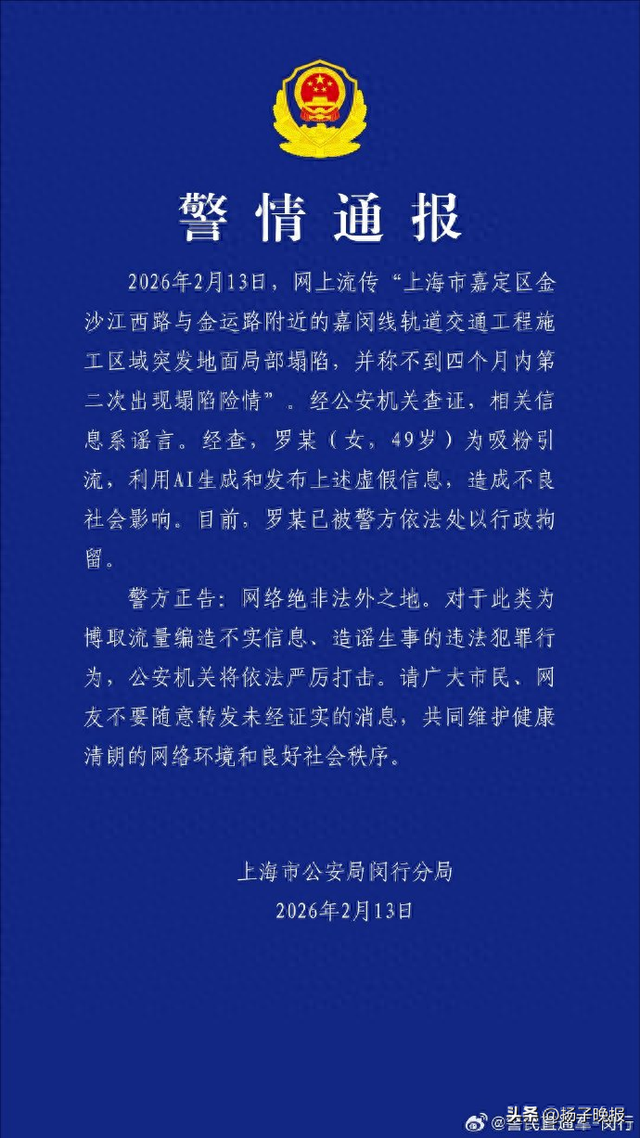
上海警方:罗某(女,49岁),拘留!为吸粉引流,用AI生成发布嘉闵线施工区发生地面塌陷虚假信息
Xin Lang Cai Jing· 2026-02-14 03:00
Group 1 - The Shanghai Public Security Bureau's Minhang branch reported a false rumor regarding a ground subsidence incident near the Jia Min Line construction area in Jiading District, Shanghai, which was claimed to be the second occurrence in less than four months [1] - The individual responsible for spreading the false information, identified as a 49-year-old woman named Luo, used AI to generate and disseminate the rumor for the purpose of gaining followers and traffic [1] - The police have issued a warning that the internet is not a lawless space and will take strict action against those who fabricate false information and create disturbances for personal gain [1]