全球央行购金

Search documents
金银价格同步拉升!年内国际金价50次刷新历史新高,现货白银涨超100%
Xin Lang Cai Jing· 2025-12-02 03:50
Core Viewpoint - The expectation of a Federal Reserve interest rate cut is rising, which is likely to boost gold prices significantly in the near future [1][9]. Federal Reserve and Economic Indicators - Federal Reserve Chairman Jerome Powell is scheduled to speak at a memorial event, with market speculation about potential new leadership at the Fed [1]. - The probability of a 25 basis point rate cut in December is now at 87.4%, a significant increase from 39.6% just weeks prior [1][9]. - Analysts from CITIC Securities suggest that declining inflation and a weakening labor market are contributing to the rising expectations for a rate cut, which would lower nominal and real interest rates, providing new momentum for gold prices [1]. Gold Market Performance - On December 1, the precious metals market saw a strong opening, with gold stocks leading gains in the A-share market [1]. - Spot gold prices have surged, breaking through $4,250 per ounce, with a year-to-date increase of over 62% [12]. - The New York futures gold price also exceeded $4,290 per ounce, reflecting the same year-to-date growth [12]. Silver Market Performance - Spot silver prices have risen for six consecutive trading days, reaching $57.81 per ounce, marking a year-to-date increase of over 100% [12][15]. - The New York futures silver price is reported at $58.37 per ounce, also showing a similar year-to-date growth [12][15]. Investment Trends - There has been a significant increase in investment in silver bars and related products, with sales reportedly up over 40% year-on-year [14]. - Analysts expect continued strong inflows into gold ETFs, driven by ongoing demand for gold as a safe-haven asset [10]. Central Bank Activity - Global central banks continue to purchase gold, with a reported net purchase of 39 tons in September, a 79% increase from August, marking the highest monthly net purchase since 2025 [16]. - The ongoing buying activity from central banks is anticipated to further support gold prices [16]. Future Price Projections - Analysts from Dongfang Securities predict that gold prices may continue to rise, potentially reaching $4,500 per ounce by the end of 2025 and possibly exceeding $5,000 per ounce in 2026 [17]. - Goldman Sachs has identified gold as a top commodity to buy, forecasting a potential rise to $4,900 per ounce later next year due to central bank purchases and declining interest rates [17].


国际金价4200美元只是起点?专家:后市看高至4400美元
Sou Hu Cai Jing· 2025-12-01 08:55
Core Viewpoint - The international gold price is experiencing a significant upward trend, primarily driven by market risk sentiment and expectations of interest rate cuts by the Federal Reserve, alongside ongoing geopolitical tensions in the Russia-Ukraine conflict [1] Group 1: Market Dynamics - As of December 1, spot gold rose by 0.38% to $4239.22 per ounce, with an intraday high of $4256.55 per ounce [1] - The volatility in market risk sentiment is a key factor influencing gold prices, with the expectation of a Federal Reserve interest rate cut being a dominant driver [1] Group 2: Geopolitical Factors - The unresolved situation in Ukraine continues to sustain market risk aversion, contributing to the demand for gold as a safe-haven asset [1] Group 3: Central Bank Behavior - Global central bank gold purchases are crucial to monitor, especially in December, which is a key settlement period; such purchases are seen as effective means to stabilize foreign exchange and financial markets, providing upward momentum for gold prices [1] Group 4: Investment Strategy - While some investment banks hold an optimistic outlook on future gold price increases, individual investors are advised to remain cautious, focusing on the resilience and sustainability of price levels above $4200 per ounce, with potential targets of $4300 and $4400 per ounce [1] - Investors are encouraged to maintain flexibility in their investment strategies, with small amounts of capital suggesting options like paper gold and bank-stored gold for asset allocation [1]
黄金、白银期货品种周报-20251201
Chang Cheng Qi Huo· 2025-12-01 01:16
Report Summary 1. Report Industry Investment Rating No investment rating information is provided in the report. 2. Core Views - Gold futures are in an upward trend, possibly at the end of the trend. Last week, the price showed a volatile and upward trend with a cumulative increase of 2.54%. In the short - term, it may maintain high - level volatility, and in the long - term, it is supported by central bank gold purchases and the easing cycle [7]. - Silver futures are in a strong upward phase, also possibly at the end of the trend. Last week, the price showed a volatile and strengthening trend. In the short - term, it may maintain high - level volatility, and in the long - term, it is supported by supply - demand balance and the easing cycle [31]. 3. Summary by Directory Gold Futures - **Mid - term Market Analysis** - **Trend Judgment**: The overall trend of Shanghai Gold futures is in an upward channel, possibly at the end of the trend [7]. - **Trend Logic**: Last week, the gold price was volatile and upward, with a 2.54% increase. It was driven by the strengthened expectation of the Fed's December interest rate cut, a weaker US dollar index, and continuous capital inflow. However, the upward momentum was restricted as the market had partially priced in the easing expectation before the December FOMC meeting. In the future, it may maintain high - level volatility in the short - term and be supported by central bank gold purchases and the easing cycle in the long - term [7]. - **Mid - term Strategy**: It is recommended to wait and see [8]. - **Variety Trading Strategy** - **Last Week's Strategy Review**: The Shanghai Gold contract 2602 was in short - term volatility. The upper pressure level was 960 - 970 yuan/gram, and the lower support level was 910 - 920 yuan/gram. It was recommended to wait and see [10]. - **This Week's Strategy Suggestion**: The Shanghai Gold contract 2602 may continue high - level volatility in the short - term. The upper pressure level is 960 - 970 yuan/gram, and the lower support level is 930 - 940 yuan/gram. It is recommended to wait and see [11]. - **Related Data Situation**: The report provides data on the price trends of Shanghai Gold and COMEX gold, SPDR gold ETF holdings, COMEX gold inventory, US 10 - year Treasury yield, US dollar index, US dollar against offshore RMB, gold - silver ratio, Shanghai Gold basis, and gold internal - external price difference [18][21][23][25][27]. Silver Futures - **Mid - term Market Analysis** - **Trend Judgment**: The overall trend of Shanghai Silver futures is in a strong upward phase, possibly at the end of the trend [31]. - **Trend Logic**: Last week, the silver price was volatile and strengthening. It was driven by the strengthened expectation of the Fed's December interest rate cut, continuous depletion of global silver inventory, recovery of industrial demand, and large - scale capital inflow. In the future, it may maintain high - level volatility in the short - term and be supported by supply - demand balance and the easing cycle in the long - term [31]. - **Mid - term Strategy**: It is recommended to wait and see [32]. - **Variety Trading Strategy** - **Last Week's Strategy Review**: The silver contract 2602 was in short - term consolidation. The upper pressure level was 12,000 - 12,200 yuan/kg, and the lower support level was 11,600 - 11,800 yuan/kg. It was recommended to wait and see [35]. - **This Week's Strategy Suggestion**: The silver contract 2602 may strengthen in short - term volatility. The upper pressure level is 12,500 - 13,000 yuan/kg, and the lower support level is 11,500 - 12,000 yuan/kg. It is recommended to buy on dips [36]. - **Related Data Situation**: The report provides data on the price trends of Shanghai Silver and COMEX silver, SLV silver ETF holdings, COMEX silver inventory, Shanghai Silver basis, and silver internal - external price difference [43][45][47].
三大因素或支持黄金明年继续“闪耀”
Sou Hu Cai Jing· 2025-11-28 17:10
Core Viewpoint - The gold market has experienced a strong bull run in 2023, with international gold prices increasing by 58.41% year-to-date, reaching a high of $4,100 per ounce as of November 27 [1] Group 1: Factors Supporting Gold Prices - Global central banks continue to purchase gold, with a net purchase of 39 tons in September, a 79% increase from August, marking the highest monthly net purchase in 2025 [1] - A survey indicated that 95% of central banks expect to increase their gold reserves in the next 12 months, the highest percentage since the survey began in 2019 [1] - Gold is becoming a preferred asset for central banks' diversified reserves, indicating long-term demand [1] Group 2: Economic Influences on Gold Prices - The deepening interest rate cut cycle by the Federal Reserve is expected to enhance gold's appeal as a non-yielding asset, with market expectations of approximately two rate cuts in 2026 [2] - The decrease in interest rates lowers the opportunity cost of holding gold, thereby increasing its attractiveness [2] Group 3: Geopolitical and Credit Risks - Heightened geopolitical tensions and ongoing trade friction are driving demand for safe-haven assets like gold [2] - The increasing scale of U.S. debt and concerns over dollar credit risk contribute to a long-term trend of "de-dollarization," further supporting gold prices [2]
机构看金市:11月28日
Xin Hua Cai Jing· 2025-11-28 06:54
Core Viewpoints - Short-term gold prices are expected to fluctuate within a high range, while the long-term focus is likely to continue moving upward due to various economic factors [1][2][4] Group 1: Market Analysis - Guotai Futures notes that despite a decrease in initial jobless claims in the U.S., the economic outlook remains mixed, with expectations for a Fed rate cut in December providing some support for precious metal prices [1] - Nanhua Futures emphasizes that central bank gold purchases and increasing investment demand will continue to push precious metal prices higher in the medium to long term, while short-term focus is on the Fed's rate cut expectations [2] - Wells Fargo highlights that declining interest rates, uncertainty, a weak dollar, and a pullback in cryptocurrencies are solid foundations for the next phase of gold price increases [3] Group 2: Technical Analysis - Guotai Futures identifies significant technical resistance for gold around $4,200 per ounce, with support levels at $4,000 and $3,900 [1][2] - Nanhua Futures also points out that the London gold market faces resistance at $4,250 per ounce and support at $4,000 per ounce, with silver showing similar patterns [2] - BCA Research suggests that gold is likely to remain within its current range due to the Fed's neutral stance, but anticipates a long-term upward trend by 2026 [4] Group 3: Economic Factors - Guotai Futures mentions that ongoing geopolitical uncertainties and unsustainable U.S. debt levels will likely increase dollar credit risk, supporting gold prices in the long run [1] - Wells Fargo indicates that the diversification trend in the market will further elevate gold prices, especially as competitors like AI-driven stocks and cryptocurrencies show relative weakness [3] - BCA Research maintains a neutral outlook for gold in the short term but expects a favorable environment for gold as real interest rates decline [4]

今日观点集锦-20251125
Xin Shi Ji Qi Huo· 2025-11-25 04:22
Report Industry Investment Ratings - No information provided Core Viewpoints of the Report - The short - term adjustment of the stock - bond market is expected, but the medium - term trend remains optimistic, and the high - tech industry continues to grow. The interest rate of treasury bonds is consolidating, and the market trend rebounds slightly [3]. - The coal - coke market is adjusting at a high level due to concerns about supply resumption. The supply and demand of finished products are expected to remain stable, and the impact of December's macro - policies on winter storage should be noted [4]. - The market's expectation of the Fed's December interest rate cut is less than 40%, and the long - term support for gold prices comes from the Fed's interest rate cut cycle, central bank gold purchases, and geopolitical risks [5]. - Log prices are expected to fluctuate at the bottom due to weak spot prices, increased supply, and weak demand [6]. - Natural rubber prices will continue to fluctuate in the short term due to strong cost support and weak demand [7]. - Soybean meal is expected to fluctuate weakly in the short term due to sufficient domestic supply and weak demand [8]. - Oil prices rise due to the increased probability of the Fed's December interest rate cut. PX, PTA, and MC show different supply - demand and price trends [9]. - Hog prices may remain volatile as sufficient supply is offset by increased consumption [10]. Summary by Related Categories Stock - Bond Market - The short - term adjustment of the stock - bond market is expected, with the medium - term trend remaining optimistic. The high - tech industry continues to grow. Treasury bond interest rates are consolidating, and the market rebounds slightly [3] Black Industry - Affected by import news and supply - guarantee meetings, the coal - coke market adjusts at a high level. The supply and demand of finished products are expected to be stable, and the impact of December's macro - policies on winter storage should be noted [4] Gold Market - The market's expectation of the Fed's December interest rate cut is less than 40%. The long - term support for gold prices comes from the Fed's interest rate cut cycle, central bank gold purchases, and geopolitical risks [5] Log Market - Spot log prices are weak, supply is under pressure, demand is hard to sustain, and prices are expected to fluctuate at the bottom [6] Rubber Market - Due to rainfall in the main production areas, cost support is strong. Demand is weak, and prices will continue to fluctuate in the short term [7] Soybean and Soybean Meal Market - US soybean export is weak, domestic supply is sufficient, and soybean meal is expected to fluctuate weakly in the short term [8] Oil and Chemical Market - Oil prices rise due to the increased probability of the Fed's December interest rate cut. PX, PTA, and MC show different supply - demand and price trends [9] Hog Market - Hog supply is sufficient, consumption may increase, and prices may remain volatile [10]
美联储内部分歧加剧,贵金属承压回落
Guo Mao Qi Huo· 2025-11-24 08:18
投资咨询业务资格:证监许可【2012】31号 【贵金属周报(AU、AG)】 美联储内部分歧加剧,贵金属承压回落 国贸期货 贵金属与新能源研究中心 2025-11-24 白素娜 从业资格证号:F3023916 投资咨询证号:Z0013700 本报告非期货交易咨询业务项下服务,其中的观点和信息仅供参考,不构成任何投资建议;期市有风险,投资需谨慎 周度观点摘要 ◆ 上周贵金属有所承压,周线整体收跌。主要影响因素分析如下:(1)美联储官员上 半周表态偏鹰,加上美联储10月会议纪要进一步暴露美联储内部对于12月降息的分歧日益 加剧,同时美国政府明确10月非农、CPI数据均不公布,这意味着美联储官员在年内最后 一次会议前可能将同时失去就业、通胀两项关键经济数据,不得不促使美联储谨慎控制降 息节奏。受此影响,美联储12月降息概率骤降,美股、比特币等资产全线下挫,流动性紧 缩下贵金属价格亦承压下挫。但随着恐慌指数回升,上周五晚间,美联储官员安抚市场, 称预计未来还会进一步降息,且有官员表态预计不久美联储将重新扩表,美联储降息预期 再度回升,流动性紧缩风险有所缓和,贵金属跌幅收窄。(2)俄罗斯央行开始抛售实物 黄金,一度对金价 ...
黄金、白银期货品种周报-20251124
Chang Cheng Qi Huo· 2025-11-24 06:22
Report Summary of Gold and Silver Futures 1. Investment Rating No investment rating is provided in the report. 2. Core Views - **Gold**: The overall trend of Shanghai Gold futures is in an upward channel, possibly at the end of the trend. Short - term gold prices may continue to fluctuate in the range of 910 - 970 yuan/gram, and the price center is expected to gradually rise in the medium - to - long term [7]. - **Silver**: The overall trend of Shanghai Silver futures is in a strong upward stage, currently at the end of the trend. Short - term silver prices may continue to fluctuate in the range of 11,600 - 12,200 yuan/kg, and the price center is expected to gradually rise in the medium - to - long term [33]. 3. Summary by Directory Gold Futures - **Mid - line Market Analysis** - **Trend Judgment**: The overall trend of Shanghai Gold futures is in an upward channel, possibly at the end of the trend. The core driving factors for the range - bound movement last week were fluctuations in US Treasury yields, differences in Fed policy expectations, and repeated market sentiment [7]. - **Trend Logic**: In the short term, gold prices may continue to fluctuate in the range of 910 - 970 yuan/gram. In the medium - to - long term, the price center is expected to gradually rise, supported by the continued trend of central bank gold purchases globally and the expectation of the Fed's interest - rate cut cycle [7]. - **Strategy Suggestion**: It is recommended to wait and see [8]. - **Variety Trading Strategy** - **Last Week's Strategy Review**: The Shanghai Gold contract 2602 was in short - term shock consolidation last week, with the upper pressure level at 960 - 970 yuan/gram and the lower support level at 900 - 910 yuan/gram. It was recommended to wait and see [10]. - **This Week's Strategy Suggestion**: The Shanghai Gold contract 2602 will continue to fluctuate in the short term, with the upper pressure level at 960 - 970 yuan/gram and the lower support level at 910 - 920 yuan/gram. It is recommended to wait and see [11]. - **Related Data Situation** - The report presents data on the price trends of Shanghai Gold and COMEX Gold, SPDR Gold ETF holdings, COMEX Gold inventory, US 10 - year Treasury yields, US dollar index, US dollar against offshore RMB, gold - silver ratio, Shanghai Gold basis, and gold internal - external price difference through charts [20][23][25]. Silver Futures - **Mid - line Market Analysis** - **Trend Judgment**: The overall trend of Shanghai Silver futures is in a strong upward stage, currently at the end of the trend. The core driving factors for the wide - range shock movement last week were differences in Fed policy expectations, the strengthening of the US dollar index, and the game of continuous destocking of spot inventory [33]. - **Trend Logic**: In the short term, silver prices may continue to fluctuate in the range of 11,600 - 12,200 yuan/kg. In the medium - to - long term, the price center is expected to gradually rise, supported by the tight global silver supply - demand situation (low inventory + resilient industrial demand such as photovoltaics) and the expectation of the Fed's interest - rate cut cycle [33]. - **Strategy Suggestion**: It is recommended to wait and see [34]. - **Variety Trading Strategy** - **Last Week's Strategy Review**: The Silver contract 2602 was in short - term shock consolidation last week, with the upper pressure level at 12,000 - 12,600 yuan/kg and the lower support level at 10,900 - 11,500 yuan/kg. It was recommended to wait and see [37]. - **This Week's Strategy Suggestion**: The Silver contract 2602 will continue to be in short - term shock consolidation, with the upper pressure level at 12,000 - 12,200 yuan/kg and the lower support level at 11,600 - 11,800 yuan/kg. It is recommended to wait and see [38]. - **Related Data Situation** - The report presents data on the price trends of Shanghai Silver and COMEX Silver, SLV Silver ETF holdings, COMEX Silver inventory, Shanghai Silver basis, and silver internal - external price difference through charts [45][47][49].
张尧浠:美联储降息前景仍在、金价震荡调整待走强
Sou Hu Cai Jing· 2025-11-24 00:47
Core Viewpoint - The outlook for gold prices remains optimistic despite recent fluctuations, driven by expectations of potential interest rate cuts by the Federal Reserve and ongoing geopolitical risks [1][5]. Market Performance - Gold prices opened at $4084.59 per ounce, hitting a weekly low of $3997.78 before reaching a high of $4132.38, ultimately closing at $4064.80, reflecting a weekly range of $134.6 and a decline of $19.79 or 0.48% [3]. - The market is currently experiencing a consolidation phase, with expectations of a bullish trend in the longer term, despite short-term resistance [3][5]. Federal Reserve Influence - The Federal Reserve has not indicated an end to the easing cycle, with many officials suggesting further policy loosening over time, which supports the case for future rate cuts [5]. - Recent strong employment data and mixed signals from Fed officials have tempered immediate rate cut expectations, but the overall sentiment remains that a rate cut in early next year is likely [5][9]. Geopolitical and Economic Factors - Ongoing geopolitical tensions and the potential for a global rate cut cycle in 2026 are providing strong support for gold prices [5]. - The absence of employment data due to government shutdowns raises concerns about decision-making and unemployment rates, further underpinning gold's appeal as a safe haven [5]. Technical Analysis - On a weekly basis, gold prices closed above the 10-week moving average, indicating potential for further gains, with the 10-week moving average serving as a key support level [7]. - The current price action suggests a consolidation within a triangular pattern, with key resistance at $4230 and support levels at $3930 and $4045 [9].
张尧浠:9月非农好坏参半、金价短期将维持震荡调整
Sou Hu Cai Jing· 2025-11-21 00:44
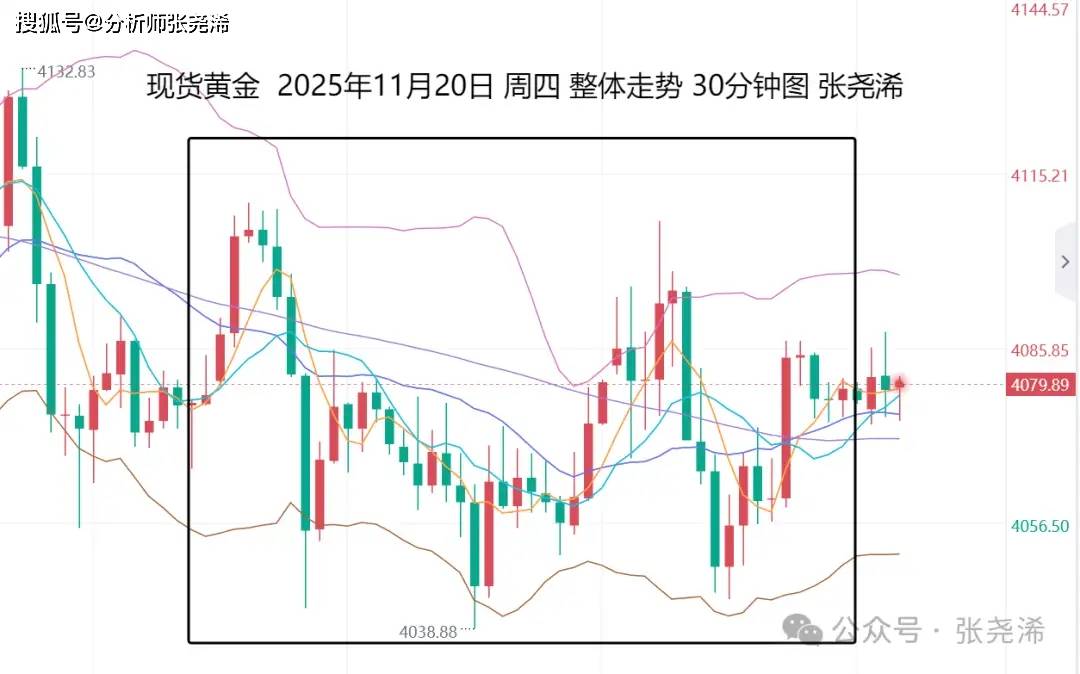
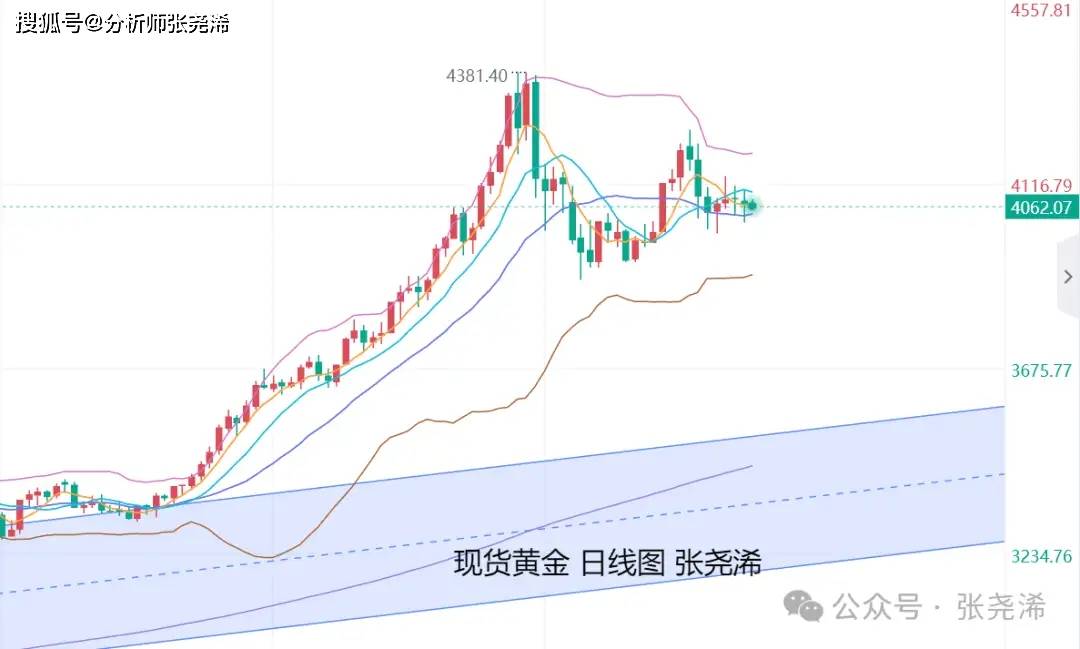
Core Viewpoint - The international gold price is expected to maintain a period of fluctuation and adjustment in the short term due to mixed signals from the non-farm employment data and ongoing hawkish comments from Federal Reserve officials [1][5][6]. Market Performance - On November 20, gold opened at $4077.91 per ounce, reached a high of $4109.92, and then fell to a low of $4038.65 before closing at $4077.22, with a daily fluctuation of $71.27 [3]. - The market anticipates mixed economic data releases, including the U.S. November PMI and consumer confidence index, which may continue to influence gold prices [3]. Economic Indicators - The strong performance of the September non-farm employment data and the Federal Reserve officials' reluctance to rush into rate cuts have reduced the likelihood of a December rate cut, but this could also be seen as a temporary alleviation of negative factors for gold prices [5]. - Long-term, the Federal Reserve is expected to continue easing policies, indicating that the rate cut cycle remains in play, supported by ongoing geopolitical risks and central bank gold purchases [6]. Technical Analysis - On a weekly basis, gold prices are currently supported by the 10-week moving average, suggesting potential for future strength if this support holds [8]. - The daily chart indicates that gold is in a triangular consolidation pattern, with key resistance at $4230 and support at $3930, guiding trading strategies [9]. Price Levels - Key support levels for gold are identified at $4050 and $4030, while resistance levels are at $4105 and $4130 [10].