
渠道变革

Search documents
家电门店升级提速 格力电器加速新业态落子
Zheng Quan Ri Bao· 2025-08-06 12:39
Core Viewpoint - Gree Electric Appliances is accelerating its store transformation with the opening of the first "Dong Mingzhu Health Home" store in Inner Mongolia, marking a strategic move to expand into the northwest market [2][3]. Group 1: Store Transformation and Market Strategy - As of May this year, the number of "Dong Mingzhu Health Home" stores has exceeded 600 nationwide, with over 300 flagship stores, accounting for more than 50% [2]. - Gree Electric aims to complete the transformation of 3,000 stores by 2025, reflecting a significant shift in the Chinese home appliance industry's channel transformation [2][3]. - The new store design emphasizes a "de-selling" concept, integrating living scenarios like living rooms and tea rooms, which represents a shift from product segmentation to scenario integration [3]. Group 2: Health Appliance Focus and Consumer Trends - Gree Electric is focusing on health appliances and smart home solutions, responding to consumer demands for health and lifestyle experiences [3][4]. - According to the "2025 China Home Appliance Health Trend White Paper," 83% of consumers are willing to pay a premium for health technology, indicating a shift in consumer preferences [3]. Group 3: Industry Context and Competitive Landscape - Gree Electric's channel transformation is part of a broader trend in the home appliance industry, with companies like Huawei and Xiaomi also exploring smart store concepts [6]. - The integration of AI systems and a comprehensive ecosystem in stores is seen as a competitive advantage, addressing the "one-stop shopping" pain points for health living [4][6]. - The transformation from single sales terminals to full-scenario experience services is reshaping the competitive landscape, with a focus on value competition rather than price competition [6].


能量饮料行业专题报告:复盘Monster:历年费用加码,次年利润均实现高增
ZHONGTAI SECURITIES· 2025-08-06 11:30
Investment Rating - The industry investment rating is "Overweight" [3][32]. Core Insights - The report emphasizes the growth logic of the energy drink industry from both macro and micro perspectives, highlighting the importance of channel strategies and operational expenses in driving market share and profitability [5][6]. - The analysis of Monster's historical performance indicates that significant increases in operational expenses often correlate with substantial profit growth in subsequent years, driven by channel transformations [5][9]. - The report suggests that Eastroc Beverage's investment in freezer displays is expected to enhance market share and sales efficiency in the long term, despite short-term cost increases [6][28]. Summary by Sections Review of Monster - Monster experienced four instances of over 50% year-on-year growth in operational expenses since 2000, with subsequent profit growth typically exceeding revenue growth [5][9]. - In 2006, Monster's market share in the U.S. energy drink market reached 23.4%, with a significant increase in sales driven by strategic partnerships and product offerings [10][17]. - By 2008, Monster surpassed Red Bull in market share, achieving a 29.2% share in convenience stores and gas stations, leading to a 93.21% increase in net profit the following year [15][20]. Eastroc Beverage - In the first half of 2025, Eastroc Beverage's sales expenses increased by 37.27% to 1.682 billion yuan, primarily due to a 61.20% rise in channel promotion expenses from freezer investments [28][29]. - The report anticipates that the freezer investments will enhance product visibility and sales efficiency, potentially increasing market share by 20-30% [31][32]. - The long-term outlook for Eastroc is positive, with expectations of improved profitability and market share through strategic channel enhancements [6][28].
中国银河:给予东方雨虹买入评级
Zheng Quan Zhi Xing· 2025-08-05 07:05
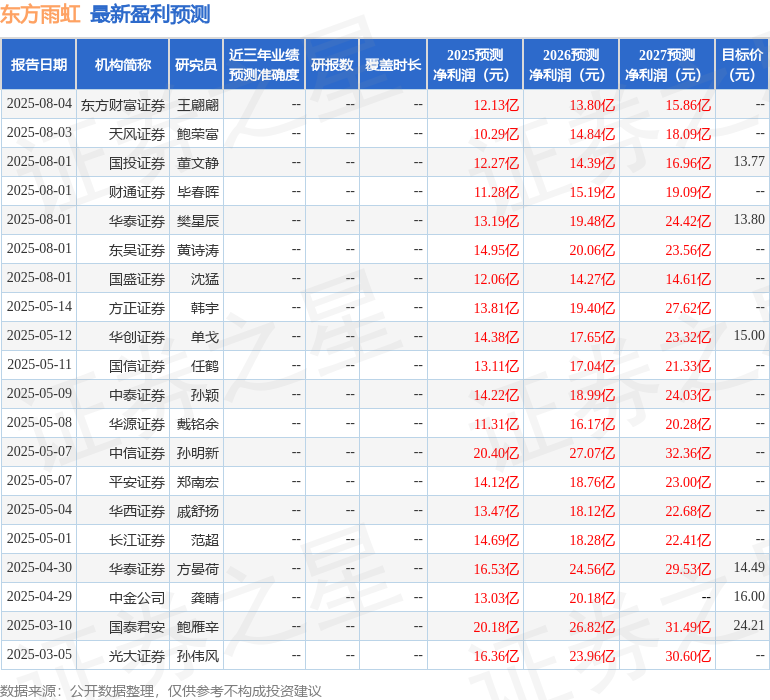
Core Viewpoint - The report highlights that Oriental Yuhong is accelerating its overseas expansion and price increases are expected to drive profit recovery, maintaining a "buy" rating for the company [1]. Financial Performance - In H1 2025, Oriental Yuhong achieved operating revenue of 13.569 billion yuan, a year-on-year decrease of 10.84%, and a net profit attributable to shareholders of 564 million yuan, down 40.16% year-on-year [2][3]. - Q2 2025 saw operating revenue of 7.614 billion yuan, a year-on-year decline of 5.64% but a quarter-on-quarter increase of 27.86%. The net profit for Q2 was 372 million yuan, down 37.52% year-on-year but up 93.42% quarter-on-quarter [2][3]. Revenue Breakdown - The decline in revenue is attributed to weak market demand, intensified industry competition, and aggressive price wars. Main business revenue saw a year-on-year decline across all product lines [3]. - In H1 2025, revenue from waterproof membranes, coatings, and mortar powder was 5.513 billion, 3.946 billion, and 1.996 billion yuan, respectively, with year-on-year changes of -8.84%, -17.11%, and +6.24% [3]. - Revenue from retail, engineering, and direct sales channels in H1 2025 was 5.059 billion, 6.347 billion, and 2.036 billion yuan, with year-on-year changes of -6.98%, -5.26%, and -28.01% [3]. Cost Management - The company managed to control expenses effectively, with a H1 2025 expense ratio of 17.06%, down 1.54 percentage points year-on-year. The sales, management, R&D, and financial expense ratios were 9.04%, 5.67%, 1.66%, and 0.69%, respectively [4]. - The gross profit margin for H1 2025 was 25.40%, a decrease of 3.82 percentage points year-on-year, while Q2's gross profit margin was 26.71%, down 2.11 percentage points year-on-year but up 2.97 percentage points quarter-on-quarter [4]. Overseas Expansion - The company's overseas business revenue reached 576 million yuan in H1 2025, a year-on-year increase of 42.16%, accounting for 4.25% of total revenue [5]. - Oriental Yuhong is actively expanding its global footprint, with ongoing construction of production bases in Houston, Saudi Arabia, Canada, and Malaysia, which are expected to contribute to revenue growth [5]. Investment Outlook - The company is positioned as a leader in the waterproofing industry, with ongoing channel reforms expected to enhance retail revenue and overall performance. The forecasted net profits for 2025, 2026, and 2027 are 1.308 billion, 1.931 billion, and 2.427 billion yuan, respectively [6].


渠道以退为进 合资品牌借机回血
Zhong Guo Qi Che Bao Wang· 2025-08-04 01:40
Core Insights - The retail market share of domestic brands in China's automotive market has increased by 7.5% year-on-year to 64% in the first half of the year, while joint venture brands have seen their market share decline to 36% [2] - The decline in market share for joint venture brands is attributed to the rise of new energy vehicles and the strong emergence of domestic brands, leading to significant challenges for joint ventures [2][8] - Joint venture brands are undergoing channel reforms to adapt to the changing market environment, focusing on strategies that emphasize efficiency and customer engagement [6][20] Market Performance - Despite the overall decline in market share, some mainstream joint venture brands have stabilized or even increased their sales due to product strategy adjustments and significant channel reforms [3][4] - For instance, FAW-Volkswagen's sales reached 436,100 units in the first half of the year, a 3.5% increase, driven by strong performances from key models [3] - Beijing Hyundai also reported over 100,000 units sold in the first half, with significant growth in specific models like the new Elantra and Tucson [4] Channel Strategy - Joint venture brands are shifting from aggressive expansion to channel optimization, focusing on reducing the number of underperforming dealerships while enhancing the quality of remaining outlets [8][16] - The strategy includes a focus on dealer profitability, with measures to ensure that dealers can sustain operations and remain engaged with the brand [15][17] - Companies like FAW-Volkswagen are implementing policies based on return on sales (ROS) to improve dealer performance and operational efficiency [5] Innovation and Adaptation - The automotive industry is experiencing profound changes with the rise of electric, intelligent, and digital vehicles, prompting joint venture brands to innovate their sales models [9][10] - There is a growing emphasis on digital tools to enhance customer engagement and streamline operations, allowing for better data sharing between online and offline channels [9] - Joint ventures are exploring new retail models, including direct sales and experiential centers, to adapt to consumer preferences and market dynamics [9][18] Future Outlook - The restructuring of the automotive market presents both challenges and opportunities for joint venture brands, which must leverage their existing channel networks to remain competitive [20] - The focus on dealer profitability and channel health is critical for sustaining market presence and preparing for future growth [17][20] - By transforming traditional sales channels into user-centric ecosystems, joint venture brands can better navigate the evolving landscape and enhance their market positioning [20]

沃尔沃渠道变革背后的焦虑:降价带不动销量,Q2首现季度亏损
凤凰网财经· 2025-08-01 13:48
Core Viewpoint - Volvo is undergoing significant changes in response to the dual pressures of the rising tide of new energy vehicles and intensified market competition, including a reform of its dealer management processes and a global workforce reduction of 3,000 employees [1][6]. Group 1: Response to New Energy Rise - Volvo will reform its dealer management processes in the second half of this year, shifting the focus from sales and management to the quality of consumer service [2]. - The company will implement a "one price" model, ensuring uniform pricing across all dealers, which aims to eliminate the price negotiation space that dealers traditionally relied on [2]. - The reform is a response to the increasing market share of new energy brands, which have rapidly gained traction with differentiated products and models [2]. Group 2: Operational Challenges and Cost-Cutting Measures - Volvo has initiated a global layoff plan affecting approximately 3,000 employees, with 1,200 positions in Sweden and 1,800 in other markets, as part of a broader cost-cutting strategy [6]. - The company reported a revenue decline of 11.7% to 82.9 billion Swedish Krona in Q1, with operating profit plummeting by 59.5% to 1.9 billion Swedish Krona [6][7]. - In Q2, Volvo experienced a further revenue drop of 8% to 93.5 billion Swedish Krona, marking the first quarterly operating loss since its IPO in 2021, primarily due to a one-time non-cash impairment charge of 11.4 billion Swedish Krona [7][8]. Group 3: Struggles in Electric Vehicle Transition - Volvo's sales performance is hindered by a lack of product updates and a slow transition to electric vehicles, with the company recently lowering its 2030 electrification target to 90%-100% electric and hybrid models [11][13]. - In the first half of this year, Volvo's electric vehicle sales in China fell by 57% to 940 units, while overall new energy vehicle sales accounted for only 9.97% of total sales [10][12]. - The company has shifted its strategy to focus on hybrid models, launching a new hybrid architecture to address the shortcomings in its electric vehicle offerings [12].

消费主权时代,白酒产业步入变革重构新阶段
Sou Hu Cai Jing· 2025-07-29 13:05
Core Viewpoint - The Chinese liquor industry is undergoing a significant transformation driven by changing consumer preferences, with product innovation being just the starting point for future competition [1][8]. Group 1: Product Innovation Trends - The industry is witnessing a resurgence in low-alcohol, small-packaged, and light-bottle products, which have become hot topics among major liquor companies [1][2]. - Major companies like Wuliangye and Luzhou Laojiao are launching low-alcohol products, with Luzhou Laojiao announcing the development of a 28-degree version of its flagship product [3][5]. - The rise of the Z generation is influencing the market, leading to increased demand for small-capacity liquor products, with companies like Yanghe and Shui Jing Fang introducing new small-packaged offerings [5][12]. Group 2: Consumer-Centric Changes - The shift towards a consumer-driven market is evident, with companies needing to adapt to the evolving consumer landscape to maintain sales and growth [7][9]. - The traditional business banquet and gift market for liquor is declining, while new consumption scenarios like family gatherings and personal enjoyment are emerging as growth areas [12][13]. - The industry is experiencing a significant drop in sales for business banquets, with a reported decline of 60%-80% in volume for this segment [12]. Group 3: Channel and Market Dynamics - The liquor distribution landscape is undergoing a transformation, moving from a "channel-driven" model to one focused on "user sovereignty," leading to challenges for traditional distribution channels [10][12]. - New sales channels, including direct purchases from supermarkets and e-commerce platforms, are becoming increasingly important as traditional distribution methods struggle [10][12]. - Companies are exploring innovative consumption scenarios and product expressions to better meet diverse consumer needs, as seen with Wuliangye's targeted product for the "golden list" celebration [12][13]. Group 4: Quality Expression and Branding - The industry faces challenges in effectively communicating the quality and value of its products to consumers, necessitating improvements in the quality expression system [13][15]. - The internationalization and youth-oriented strategies of liquor brands are critical, with companies actively seeking to engage younger consumers through low-alcohol products [15].


苏 泊 尔(002032) - 002032苏 泊 尔投资者关系管理信息20250725
2025-07-25 07:10
Group 1: Financial Performance - In the first half of 2025, the company achieved operating revenue of 11.478 billion yuan, a year-on-year increase of 4.68% [4] - The net profit attributable to shareholders was 940 million yuan, a slight decrease of 0.07% year-on-year [4] Group 2: Domestic and International Sales - Domestic sales revenue showed stable growth due to increased resource investment in core categories and the positive impact of the "trade-in" policy [4] - International sales revenue also experienced good growth, with major foreign clients' orders increasing compared to the same period last year [4] Group 3: Product Strategy - The company plans to focus resources on traditional advantageous categories while iterating products based on differentiated usage scenarios and target demographics [4] - New product categories such as desktop water purifiers and ice makers are being actively developed to enhance brand recognition and consumer acceptance [4] Group 4: Competitive Strategy - The company adheres to a long-term strategy of product innovation, aiming to provide high-quality, high-value-added products [4] - Efforts are being made to optimize product and price combinations, strengthen resource investment in core businesses, and implement strict cost control to maintain stable gross margins [5] Group 5: Dividend Policy - The company has maintained a high dividend payout ratio since 2021, with future dividend plans subject to adjustments based on capital expenditures and cash flow [5]

苏泊尔20250724
2025-07-25 00:52
Summary of Supor's Conference Call Company Overview - **Company**: Supor - **Industry**: Home Appliances Key Points Industry and Market Dynamics - The "old-for-new" policy positively impacted Supor's domestic sales, but its marginal effect is decreasing. Long-term growth relies on macroeconomic improvement and consumer willingness to spend [2][8] - Supor's export business faced challenges due to U.S. tariffs, with some orders shifting to Vietnam. The company is collaborating with Cyber and other clients to mitigate the negative impact of tariffs [2][7] - The company maintains the highest market share in core categories both online and offline, continuously launching new products to meet consumer demands [2][4] Financial Performance - In the first half of 2025, Supor achieved revenue of 11.478 billion yuan, a year-on-year increase of 4.68%. The net profit attributable to shareholders was 940 million yuan, a slight decline of 0.07% [3][24] - Domestic sales benefited from government subsidies, but the overall demand remains weak. The company plans to focus on product innovation and channel transformation to sustain growth [3][6] Product Innovation and Strategy - Supor is committed to product innovation, launching new products in emerging categories like floor washing machines, coffee machines, and water purifiers [2][12] - The company aims to balance high-end and low-end products to maintain stable profit margins despite price competition [2][9] Export and Tariff Impact - U.S. exports account for less than 20% of Supor's overall exports, with cookware primarily shipped from Vietnam. The company is expanding capacity in Vietnam but remains cautious about capital expenditure [4][10][16] - The gross margin for exports has been around 18%, but it has decreased due to tariffs and sales fluctuations [15] Future Outlook - For the full year, Supor expects sales growth but faces pressure on profit margins. Domestic growth will depend on product innovation and channel changes, while export growth relies on Cyber's organic growth in global markets [6][24] - The company is cautious about relying on short-term stimulus policies and emphasizes the need for long-term strategic execution [8][21] Competition and Pricing Strategy - Supor is focused on maintaining high-margin products and avoiding a price war, especially in the 500-1,000 yuan price range, which aligns with its long-term strategy [18][9] - The company is adapting to competitive pressures by enhancing product quality rather than engaging in price competition [9][18] Management and Governance - The CFO is currently serving as the acting CEO, and the company has established a modern corporate governance structure [19][20] Dividend Policy - Supor plans to maintain a dividend payout ratio between 50% and 80%, despite uncertainties regarding future capital expenditures [23] New Retail Channels - Supor is exploring new retail models, including instant retail, to adapt to changing consumer habits and enhance sales through various online platforms [22] Conclusion - Supor is navigating a challenging market environment with a focus on innovation, strategic partnerships, and maintaining profitability while adapting to external pressures such as tariffs and competition. The company remains committed to long-term growth strategies despite short-term challenges.
白酒周期调整下,关注渠道变革
Xiangcai Securities· 2025-07-20 12:06
Investment Rating - The industry investment rating is "Buy" (maintained) [3] Core Views - The food and beverage industry saw a slight increase of 0.68% from July 14 to July 18, 2025, underperforming the CSI 300 index by 0.41 percentage points [5][10] - The report highlights a cyclical adjustment in the liquor sector, particularly focusing on channel transformation and the establishment of provincial joint venture companies by Moutai to stabilize prices and develop regional cultural liquor [6][8] - The report suggests that consumer demand remains under pressure, and there is a need to focus on innovation in product categories, channels, and consumption scenarios while also identifying undervalued opportunities in traditional consumption areas [8][46] Summary by Sections Industry Performance - The food and beverage industry experienced a relative return of -3.5% over one month, -14.8% over three months, and -15.0% over twelve months [4] - The industry ranked 14th out of 31 sectors in terms of performance during the specified period [5] Liquor Sector Insights - As of July 18, 2025, the wholesale reference price for Moutai was 1930 RMB per bottle, a decrease of 0.77% from the previous week [6][22] - Moutai's strategy includes forming joint venture companies with local distributors to stabilize prices and develop cultural liquor products, with a target price of over 2000 RMB for these products [6] Investment Recommendations - The report recommends focusing on two main lines: stable demand leaders with strong risk resistance and companies actively innovating in new products, channels, and high-growth scenarios [8][46] - Specific companies to watch include Qingdao Beer, Andeli, Chengde Lulou, Shanxi Fenjiu, Guizhou Moutai, and Yanjinpuzi [8][46]
周观点:业绩分化持续,饮料正当旺季-20250720
GOLDEN SUN SECURITIES· 2025-07-20 09:27
Investment Rating - The report maintains an "Increase" rating for the food and beverage industry, indicating a positive outlook for the sector [6]. Core Insights - The beverage sector is currently in its peak season, with a focus on differentiated performance among companies. The report highlights three main investment themes in the liquor segment: leading brands, sustained regional benefits, and recovery-driven stocks [1][2]. - The report notes that the overall retail sales in June grew by 4.8% year-on-year, with the liquor category experiencing a slight decline of 0.7% [2]. - The beer segment faced slight pressure in June, with a year-on-year production decrease of 0.2%. However, the report suggests that the beer market remains in a high-demand season, and emphasizes the importance of focusing on high-growth products and companies [3]. Summary by Sections Liquor Industry - The report discusses the recent channel reforms initiated by Moutai, aimed at stabilizing prices and enhancing regional cultural product development. This is seen as a positive move for the industry, which has been under pressure due to weak consumption and pricing challenges [2]. - Leading liquor companies such as Moutai, Wuliangye, and Shanxi Fenjiu are expected to continue gaining market share, while companies like Jiuzi and Luzhou Laojiao are highlighted as potential recovery plays [1][2]. Beer and Beverage Sector - The beer production data indicates a slight decline, attributed to seasonal factors and market conditions. The report encourages investors to focus on companies with strong product lines and growth potential, such as Yanjing Beer and Zhujiang Beer [3]. - KKR's acquisition of an 85% stake in Dayao is noted, with Dayao being recognized for its established market presence and new product launches [3]. Food Sector - The report highlights the ongoing disclosure of mid-year performance forecasts, with companies like Zhou Hei Ya and Hao Xiang Ni showing improvements in profitability due to operational optimizations [4]. - However, companies like Ganyuan and Qiaqia are facing profit pressures, with significant expected declines in net profits for the first half of 2025 [4].