
黄金避险

Search documents
ETO Markets 市场洞察:黄金狂飙至4059美元,背后竟是这些原因!
Sou Hu Cai Jing· 2025-10-13 04:23
Core Viewpoint - Gold prices have surged due to escalating international trade tensions, geopolitical risks, expectations of Federal Reserve rate cuts, and political instability in various countries, reinforcing its status as a safe-haven asset [1] Group 1: International Trade Tensions - Recent trade frictions, particularly the U.S. administration's hardline stance on China's rare earth exports and potential tariffs, have driven gold prices higher as investors seek safety [3] - The complexity of the trade dispute has heightened market fears, making gold an attractive refuge for global capital [3] Group 2: Geopolitical Risks - The ongoing Russia-Ukraine conflict has intensified, with potential U.S. military support for Ukraine raising geopolitical uncertainties, further supporting gold prices [4] - Events in the Middle East and drone attacks in Ukraine have amplified investor concerns about escalating conflicts [4] Group 3: Federal Reserve Rate Cut Expectations - Market expectations for Federal Reserve rate cuts in October and December have bolstered gold prices, with a 97% probability for a 25 basis point cut in October and 92% in December [5] - The anticipated easing of monetary policy diminishes the attractiveness of the dollar, prompting investors to turn to gold as a hedge against inflation and economic slowdown [5] Group 4: U.S. Market Volatility - Recent volatility in U.S. bond and stock markets has highlighted gold's appeal as a safe-haven asset, with significant declines in major stock indices [6] - The drop in U.S. Treasury yields, alongside stock market turmoil, has reinforced gold's position in asset allocation strategies [6] Group 5: Future Outlook - The outlook for gold prices remains bullish, with upcoming economic reports and discussions from the Federal Reserve expected to influence market sentiment [8]


集体飙涨,冲上热搜!
中国基金报· 2025-10-13 04:21
Core Viewpoint - The article highlights the recent surge in gold prices, with spot gold exceeding $4060 per ounce, marking a new historical high, driven by geopolitical tensions and expectations of interest rate cuts by the Federal Reserve [2][4]. Gold Price Movement - On October 13, spot gold prices reached a peak of $4060.05 per ounce, reflecting a daily increase of 0.77% from the previous close of $4017.845 [3]. - COMEX gold also saw a rise, hitting a maximum of $4079.3 per ounce, with a peak increase of 1.97% [4]. Market Sentiment - Social media discussions indicate regret among investors for not purchasing gold at lower prices, with many expressing concerns that prices will continue to rise [7][8]. - The A-share gold sector remains strong, with companies like Xiaocheng Technology and Western Gold showing significant gains [9]. Economic Factors - The demand for gold as a safe-haven asset is high due to escalating geopolitical risks and anticipated interest rate cuts by the Federal Reserve, with a 97% probability of a 25 basis point cut in October and a 92% chance in December [9]. - Central banks globally are increasing their gold reserves, with China's gold holdings rising for 11 consecutive months, reaching 74.06 million ounces, which is 7.7% of its foreign reserves [10]. Domestic Gold Prices - Major domestic gold brands have raised their prices, with Chow Tai Fook's gold jewelry priced at 1190 RMB per gram, an increase of 10 RMB from the previous day [10][11]. - Other brands like Laomiao and Chow Sang Sang also reported price increases, reflecting the overall trend in the gold market [11][12].
申银万国期货首席点评:贸易担忧情绪缓解
Shen Yin Wan Guo Qi Huo· 2025-10-13 03:43
1. Report Industry Investment Rating - The report provides a "Bullish" or "Bearish" view for various commodities, with "Bullish" for corn, cotton, apple, zinc, silver, gold, iron ore, hot-rolled coil, rebar, and "Bearish" for crude oil, treasury bonds (T), treasury bonds (TL), and stock index (IM) [6] 2. Core Viewpoints of the Report - Trade concerns have eased, with US stock futures opening higher, S&P 500 futures up 1.1%, and Nasdaq futures up 1.4%. Brent crude futures rose more than 1% at the start, and cryptocurrencies rebounded on Sunday, with Ethereum up more than 10% overnight. Copper in New York rose more than 2% at the start of Asian trading on Monday [1] - After a high-level oscillation in September, the stock index is likely to enter a direction - selection phase again and maintain a bullish trend. In the short term, affected by Sino - US trade, market volatility may increase. The market style may shift towards value in the fourth quarter [2][13] - Gold may benefit from the resurgence of the trade war. Central banks around the world are continuously increasing their gold holdings, and investors' recognition of gold as a safe - haven and value - storage asset is rising [3][22] - The resurgence of the Sino - US trade war has led to a decline in oil prices. In the short term, oil prices tend to break downward. However, there is still a possibility of trade friction mitigation, and low oil prices may cause OPEC to slow down production increases [4][5][16] 3. Summary by Relevant Catalogs 3.1 Daily Main News Concerns 3.1.1 International News - The US Bureau of Labor Statistics will release the September Consumer Price Index (CPI) on October 24 at 8:30 am Eastern Time (20:30 Beijing time) [7] 3.1.2 Domestic News - China's Ministry of Commerce and General Administration of Customs have implemented export controls on relevant rare - earth items, which is a proper measure to improve the export control system [8] 3.1.3 Industry News - In September, China's Small and Medium - Sized Enterprise Development Index (SMEDI) was 89.0, down 0.1 point from August but higher than the same period last year. Some sub - indexes showed a stable and positive development trend [9][10] 3.2 Outer - Market Daily Earnings - From October 9 to 10, major outer - market indexes such as the S&P 500, European STOXX50, and FTSE China A50 futures declined. The US dollar index also fell, while gold and silver prices rose. ICE Brent crude oil fell 4.81% [11] 3.3 Morning Comments on Major Varieties 3.3.1 Financial - **Stock Index**: After a high - level oscillation in September, the stock index is likely to maintain a bullish trend. In the short term, trade issues may increase market volatility. The market style may shift towards value in the fourth quarter [2][13] - **Treasury Bonds**: Affected by US trade remarks, treasury bond yields have declined, and treasury bond futures prices are expected to remain strong until the end of October. The central bank may implement more relaxed monetary policies in the fourth quarter [15] 3.3.2 Energy and Chemicals - **Crude Oil**: The Sino - US trade war has led to a decline in oil prices. Trade friction affects oil prices through supply - chain disruption and risk - asset selling. In the short term, oil prices tend to break downward [4][5][16] - **Methanol**: The average operating load of coal - to - olefin plants has increased, and coastal methanol inventories are rising. Methanol is short - term bearish [17] - **Rubber**: The natural rubber futures rebounded slightly last week. Supply pressure may increase later, and the demand support is limited. The post - holiday trend of Shanghai rubber is expected to be oscillating and bullish [18] - **Polyolefins**: Polyolefin futures are running weakly. Prices are affected by cost fluctuations and market sentiment is cautious [19][20] - **Glass and Soda Ash**: Glass futures continue to be weak, and soda ash futures closed down. The market is waiting for autumn consumption to digest inventory and for policy changes [21] 3.3.3 Metals - **Precious Metals**: Gold may benefit from the resurgence of the trade war. Central banks' gold - buying and investors' recognition of gold as a safe - haven asset support its price [3][22] - **Copper**: The copper price rebounded in the morning. The supply of concentrates has been tight, and the Indonesian mine accident may lead to a supply - demand gap, supporting the copper price in the long term [23] - **Zinc**: The zinc price fell due to the decline in the copper price. The smelting output is expected to increase, and the domestic zinc price may be weaker than the foreign price [24] - **Lithium Carbonate**: Supply has increased, demand is in the peak season, and inventory is decreasing. The lithium salt price is supported, and there is an expectation of project resumption [25][26] 3.3.4 Black Metals - **Coking Coal and Coke**: The coking coal and coke futures were weak on Friday night. The fundamentals changed little during the holiday. The short - term price may fluctuate sharply [27] - **Iron Ore**: Steel mills' production enthusiasm is high, iron ore demand is supported, and global iron ore shipments have decreased. The market is expected to be oscillating and bullish [28] - **Steel**: The supply pressure of steel is increasing, and the inventory is accumulating. The market supply - demand contradiction is not significant. The market is expected to be bullish in the medium term, with hot - rolled coil stronger than rebar [29] 3.3.5 Agricultural Products - **Protein Meal**: The bean and rapeseed meal oscillated weakly at night. The USDA report is expected to lower the US soybean yield, but the report is postponed. The domestic market is well - supplied, and the market is expected to oscillate [30] - **Oils and Fats**: The oils and fats were weak at night. The MPOB report showed an increase in palm oil inventory, which may put short - term pressure on prices. In the long term, prices are expected to rise [31][32] - **Sugar**: The international sugar market is in the inventory - accumulation phase, and the domestic market is affected by new - season sugar production and import pressure. Sugar prices are expected to oscillate [33] - **Cotton**: The US cotton price fell. The domestic cotton market is affected by new - cotton supply and weak downstream demand. The price is expected to be oscillating and bearish [34] 3.3.6 Shipping Index - **Container Shipping to Europe**: The EC index oscillated downward. The off - season trading may have ended, and the near - term market will enter a game for the year - end peak season. The short - term peak - season expectation may weaken due to the trade war, and the far - term market is affected by the Red Sea resumption progress [35]
现货黄金升至4060美元再创新高,上海金ETF(159830)盘中涨超2%居同标的第一,机构:避险+流动性因素黄金或续涨
2 1 Shi Ji Jing Ji Bao Dao· 2025-10-13 02:21
Group 1 - The A-share market opened lower on October 13, with the CSI A500 index dropping over 1%, while the precious metals sector showed strength [1] - The Shanghai Gold ETF (159830) saw a 2.31% increase, leading in its category with a trading volume exceeding 10 million yuan [1] - The CSI A500 ETF Tianhong (159360) fell by 1.36%, tracking the CSI A500 index which reflects the performance of 500 large-cap, liquid stocks across various industries [1] Group 2 - Wheaton Precious Metals Corp's CEO Randy Smallwood predicts gold prices will exceed $5,000 next year, driven by geopolitical tensions and supply constraints [2] - Guosheng Securities notes that the U.S. government shutdown and global trade disruptions are increasing demand for gold as a safe haven [2] - Minsheng Securities highlights that the reduction in U.S. ADP employment numbers in September raises expectations for interest rate cuts, supporting strong demand for gold and driving prices higher [2]
现货黄金继续冲高,商品黄金相关ETF早盘集体涨超2%
Sou Hu Cai Jing· 2025-10-13 02:09
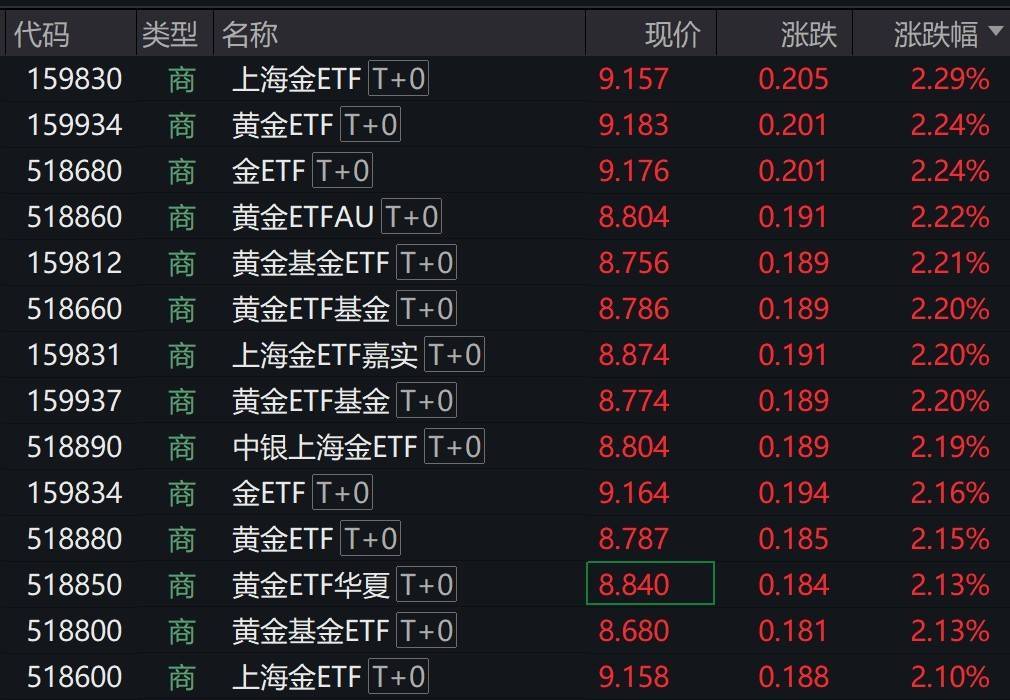
Group 1 - The core viewpoint of the news is that gold prices are rising due to heightened demand for safe-haven assets amid escalating geopolitical risks, tensions in international trade, and expectations of interest rate cuts by the Federal Reserve [1] - Gold-related ETFs experienced a collective increase of over 2% in early trading, reflecting strong market interest in gold as a protective investment [1] Group 2 - Specific gold ETFs and their performance include: - Shanghai Gold ETF T+0: Current price 9.157, up 0.205, an increase of 2.29% [2] - Gold ETF T+0: Current price 9.183, up 0.201, an increase of 2.24% [2] - Gold ETF Fund T+0: Current price 8.756, up 0.189, an increase of 2.21% [2] - Other notable ETFs also showed similar increases ranging from 2.10% to 2.29% [2]
万联晨会-20251013
Wanlian Securities· 2025-10-13 00:37
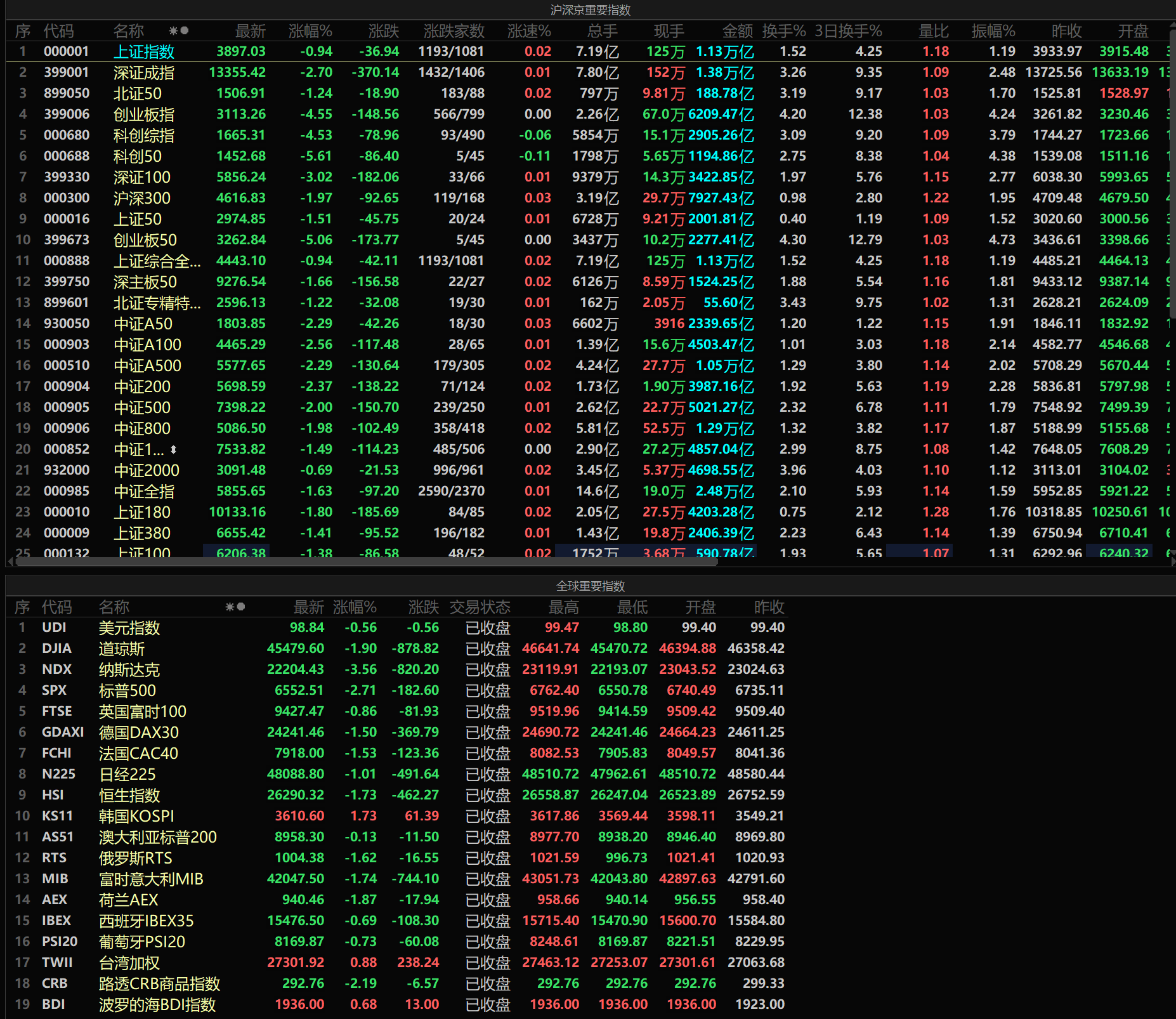
Core Insights - The A-share market experienced a decline, with the Shanghai Composite Index falling by 0.94% to 3,897.03 points, and the Shenzhen Component Index dropping by 2.7% [1][7] - The total trading volume in the Shanghai and Shenzhen markets reached 2.52 trillion yuan, with sectors such as building materials, coal, and textiles leading the gains, while electronics, power equipment, and computers faced losses [1][7] - The Hong Kong Hang Seng Index closed down 1.73% at 26,290.32 points, reflecting a broader trend of declines across major global indices, including a 1.9% drop in the Dow Jones and a 3.56% drop in the Nasdaq [1][7] Industry Analysis Beverage Industry - The new tea beverage market is transitioning from rapid growth to a focus on value, with increasing competition leading to a shift from high-priced, heavily marketed products to more sustainable, frequent consumption models [9][12] - The market is expected to see a concentration of power among leading companies that can effectively manage supply chains and target lower-tier markets, which remain key growth areas [9][12] - Companies are encouraged to innovate products to meet health demands and explore overseas markets while maintaining cost control and operational efficiency [9][12] Food and Beverage Manufacturing - The profit of major industrial enterprises in China showed a positive growth of 0.9% year-on-year for the first eight months of 2025, with significant improvements noted in August, where profits increased by 20.4% compared to the previous month [14][15] - Within the consumer goods sector, essential food and beverage manufacturing industries reported positive profit growth, while optional consumption sectors remained subdued [14][15] - The report suggests focusing on sectors like liquor, dairy, and beverages, which are expected to benefit from macroeconomic policies and declining raw material costs [16][17] Blood Products Industry - The blood products sector underperformed the market, with a 4.86% decline in September, attributed to short-term performance pressures and market sentiment shifts [18][19] - The industry is facing challenges such as price declines and cash flow pressures, but long-term prospects remain positive as leading companies consolidate and enhance their operational capabilities [18][19] - Key focus areas include the integration of upstream plasma resources and the development of high-margin products to improve revenue structures [20]
贸易担忧情绪缓解:申万期货早间评论-20251013
申银万国期货研究· 2025-10-13 00:33
Core Viewpoint - The article discusses the easing of trade concerns, with positive movements in stock futures and commodities, while highlighting the impact of U.S.-China trade tensions on various markets [1][4]. Group 1: Stock Indices - U.S. stock futures opened higher, with the S&P 500 futures up 1.1% and Nasdaq futures up 1.4% [1]. - The market experienced a significant pullback due to escalating U.S.-China trade tensions, with a trading volume of 2.53 trillion yuan [2]. - The financing balance increased by 50.8 billion yuan to 2.429195 trillion yuan, indicating a potential shift towards a bullish trend despite short-term volatility [2][12]. Group 2: Precious Metals - Gold prices reached a new high, surpassing $4,060 per ounce, driven by renewed trade tensions and a lack of pressure from traditional bearish factors [3][20]. - Central banks continue to increase their gold holdings, reflecting a growing recognition of gold as a safe-haven asset amid rising global tensions [3][20]. Group 3: Oil Market - Oil prices fell approximately 4% following the announcement of a 100% tariff on Chinese goods, indicating the significant impact of trade tensions on global supply chains [4][14]. - The trade war is expected to disrupt supply chain efficiency, leading to reduced demand for oil and petrochemical products [4][15]. - Market sentiment has shifted towards safe-haven assets like gold and the U.S. dollar, resulting in a potential downward trend for oil prices [4][15]. Group 4: Economic Indicators - The Chinese Ministry of Commerce announced export controls on rare earths, emphasizing the need for dialogue with the U.S. to resolve trade issues [1][8]. - The Small and Medium Enterprises Development Index (SMEDI) in China showed a slight decline to 89.0 in September, indicating challenges amid a complex external environment [9].

突发“黑天鹅”,全球都在跌;唯有黄金多头,傲视群雄!
Sou Hu Cai Jing· 2025-10-12 01:40
Core Viewpoint - The global financial markets are experiencing a downturn, while gold and silver are rising, indicating that gold remains the only universally recognized safe-haven asset during times of risk [1][2]. Market Performance - Major indices in China, including the Shanghai Composite Index, Shenzhen Component Index, and ChiNext Index, all reported declines, with the Shanghai Composite Index down by 0.94% to 3897.03 and the Shenzhen Component Index down by 2.70% to 13355.42 [3]. - In the U.S., the Dow Jones Industrial Average fell by 1.90% to 45479.60, marking significant losses across major indices, including the Nasdaq and S&P 500, which experienced their largest single-day declines since April [4]. Gold Market Analysis - Following a drop in gold prices, it was noted that this was merely a correction, with expectations for a continued upward trend, supported by key price levels [6][8]. - The recent surge in gold prices is attributed to global economic downturns, trade tensions, and increasing government debt, with predictions suggesting that gold could rise to $7000 per ounce before the end of the current U.S. administration [10]. - The current global debt is approximately $340 trillion, and if gold were to be linked to this debt, the potential price could reach $48959 per ounce, indicating significant upside potential [10]. Silver Market Analysis - Silver has recently shown strong performance, breaking above the historical resistance level of $50, with expectations for a continued bull market potentially reaching $100 [14]. - The recent volatility in silver prices suggests that while the bullish trend is strong, there may be significant price corrections ahead as the market adjusts [13].
关税阴云再聚,黄金避险价值几何?
Sou Hu Cai Jing· 2025-10-11 10:47
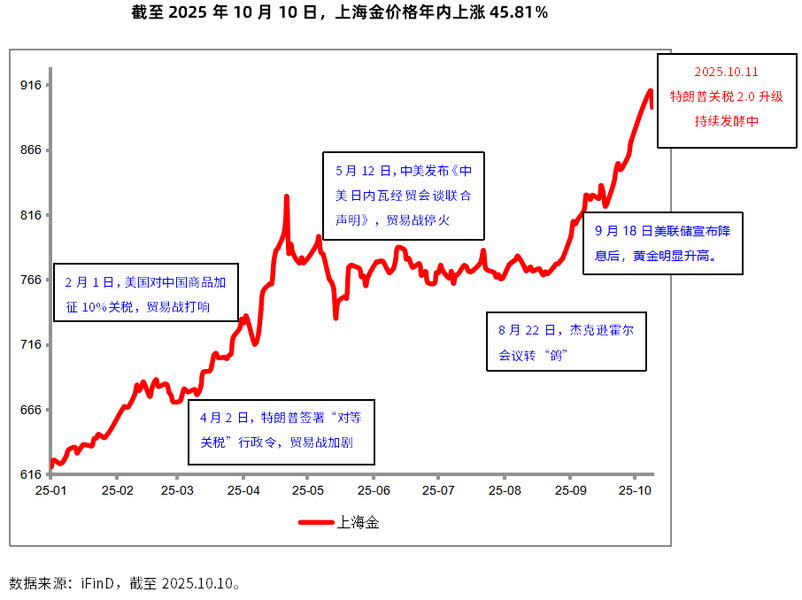
Core Viewpoint - The recent announcement by President Trump to impose an additional 100% tariff on Chinese goods starting in November has reignited a trade war, leading to significant declines in European and American stock markets, while gold prices surged due to its safe-haven appeal [1]. Group 1: Historical Performance of Gold - Historically, gold has performed well as a safe-haven asset during trade tensions, economic uncertainty, or geopolitical turmoil, evidenced by an 18.93% increase in gold prices during the last trade war from February 1 to May 12, 2025 [2]. Group 2: Current Market Dynamics - The core support logic for gold remains unchanged with the renewed tariff threats, and the medium to long-term outlook for gold is still positive [4]. - The Federal Reserve's interest rate cuts are a key driver of gold price fluctuations, with a 25 basis point cut announced in September and two more cuts expected this year, which could positively impact gold prices [5]. - A survey by the World Gold Council revealed that 95% of central banks plan to increase their gold holdings in the next 12 months, with the People's Bank of China having increased its gold reserves for 11 consecutive months, indicating a rising status of gold as a reserve asset amid de-dollarization [6]. - The weakening of the US dollar enhances the attractiveness of gold for holders of other currencies, while increasing geopolitical uncertainties are driving investors towards traditional safe-haven assets like gold [7]. Group 3: Investment Strategies - For investors looking to participate in the gold market without the risk of "chasing highs," gold ETFs are considered an ideal investment tool, offering low entry barriers, low transaction costs, and good liquidity. The gold ETF (518680) has ranked No. 1 in performance among its peers over the past year as of the end of Q3 [8].
基差方向周度预测-20251010
Guo Tai Jun An Qi Huo· 2025-10-10 11:13
Group 1: Report Industry Investment Rating - No relevant information provided Group 2: Core Viewpoints of the Report - The policy stance is prudent and steady with new focuses on supporting small - and micro - enterprises and stabilizing foreign trade. The profit of industrial enterprises above designated size increased by 20.4% year - on - year in August, with equipment manufacturing leading the growth and profits of enterprises of different sizes improving. The market may have expectations for further policies as the 4th Plenary Session of the 20th CPC Central Committee is approaching. During the National Day holiday, gold reached a record high due to yen depreciation and rising US dollar index, domestic travel and consumption recovered moderately. After the holiday, the Shanghai Composite Index broke through 3900 points but then had a sharp correction, especially in the semiconductor sector. Leveraged funds were active, and the total A - share trading volume rebounded to 2.5 trillion after the holiday. Most broad - based indexes rose in the four trading days around the National Day, with CSI 500 rising over 2% and others having 1 - 2% increases. The ChiNext Index quickly declined. In terms of basis, recent basis fluctuations were large, with the basis of IC and IM widening significantly and annualized basis rates reaching around 9% and 13% respectively [2] Group 3: Summary According to Related Catalogs 1. Weekly Forecast Conclusion - The model predicts that the basis of IH, IF, IC, and IM will move in the directions of strengthening, weakening, strengthening, and strengthening respectively next week [4] 2. Recent Forecast Conclusion - For IH and IF, the actual basis changes are shown in the range from - 1.00% to - 0.25%, and for IC, the actual basis changes are shown in the range from - 1.00% to 1.00% [3] 3. This Week's Review - The central bank's Q3 regular meeting before the National Day did not provide guidance on incremental easing measures. The 8 - month industrial enterprise profit increased by 20.4% year - on - year. The Politburo meeting in September discussed the "15th Five - Year Plan". During the National Day, gold hit a record high, domestic consumption recovered moderately. After the holiday, the Shanghai Composite Index broke through 3900 points and then corrected, especially in the semiconductor sector. Leveraged funds were active, and the total A - share trading volume rebounded to 2.5 trillion. Most broad - based indexes rose around the National Day, and the ChiNext Index declined. The basis of IC and IM widened significantly [2]