
M1

Search documents
2025年7月金融数据点评:信贷需求偏弱,社融增速或已见顶
Hua Yuan Zheng Quan· 2025-08-14 04:07
Report Industry Investment Rating - The report is bullish on the bond market, predicting that the yield of the 10Y Treasury bond will fluctuate between 1.6% - 1.8% in the second half of 2025 and may gradually return to around 1.65%, and the 5Y national stock secondary will fall below 1.9%. It is also bullish on long - duration sinking urban investment and capital bonds, urban investment dim sum bonds and US dollar bonds, and strongly recommends perpetual bonds of Minsheng, Bohai, and Hengfeng Banks, and pays attention to capital bond opportunities of Tianjin Bank, Beibu Gulf Bank, and China Property Insurance [2]. Report's Core View - In July 2025, credit demand was weak, with a rare negative growth in new loans. The growth rates of M2 and M1 both rebounded. Social financing increased year - on - year, but its growth rate may have reached a phased peak. The report is bullish on the bond market [1][2]. Summary by Relevant Content Credit Situation - In July, new loans were - 500 million yuan, a rare negative growth, indicating weak credit demand. The near - zero interest rate of 1 - month term transfer discount at the end of July reflected poor credit delivery. The reduction of time deposit rates in May may increase the pressure of early mortgage repayment. Individual loans decreased by 48.93 billion yuan, including a decrease of 38.27 billion yuan in short - term individual loans and 11 billion yuan in medium - and long - term individual loans. Corporate short - term loans decreased by 55 billion yuan, corporate medium - and long - term loans decreased by 26 billion yuan, and bill financing increased by 87.11 billion yuan. Credit demand may be weak in the long term due to low capacity utilization in manufacturing, weak real estate investment, and limited infrastructure investment space [2]. M2 and M1 Situation - Since January 2025, the central bank has adopted a new M1 caliber, which further includes personal current deposits and customer reserves of non - bank payment institutions on the basis of the previous M1. As of the end of July 2025, the balance of the new - caliber M1 reached 111.06 trillion yuan. The new - caliber M1 growth rate in July was 5.6%, a 1 - percentage - point increase from the end of the previous month, related to the stock market recovery and a low year - on - year base. The M2 growth rate in July was 8.8%, a 0.5 - percentage - point increase from the previous month [2]. Social Financing Situation - In July, the social financing increment was 1.16 trillion yuan, a year - on - year increase of 0.39 trillion yuan, mainly from the net financing of government bonds and corporate bonds. The increment of RMB loans to the real economy was - 42.63 billion yuan, a year - on - year decrease of 34.55 billion yuan; undiscounted bank acceptance bills were - 16.38 billion yuan; corporate bond net financing was + 27.91 billion yuan; government bond net financing was 1.24 trillion yuan, a year - on - year increase of 0.56 trillion yuan. The social financing growth rate at the end of July was 9.0%, a 0.1 - percentage - point increase from the end of the previous month and a 1 - percentage - point increase from the beginning of the year. It is expected that in 2025, new loans will be similar year - on - year, government bond net financing will increase significantly year - on - year, social financing will increase significantly year - on - year, the social financing growth rate may rise first and then fall, and may reach about 8.2% at the end of the year. Due to the misalignment of government bond issuance rhythms, the social financing growth rate may have reached a phased peak in July and may decline in the next few months [2]. Bond Market Outlook - The financial data in July reflected weak financing demand in the real economy. The recent bond market correction was mainly due to the non - bank sentiment fluctuations caused by the strong stock market, rather than changes in the economic fundamentals. In 2025, the bond market lacks a trending market and requires correct band operations. The report predicts that the yield of the 10Y Treasury bond will fluctuate between 1.6% - 1.8% in the second half of the year, and currently, with the central bank's continuous easing, it is fully bullish on the bond market [2].
2025年7月份金融数据点评:信贷扩张季节性回落,存款资金入市节奏提速
EBSCN· 2025-08-14 02:54
Investment Rating - The report maintains a "Buy" rating for the banking industry, indicating an expected investment return exceeding 15% over the next 6-12 months compared to the market benchmark index [1]. Core Insights - The report highlights a seasonal decline in credit expansion, with a notable increase in the pace of deposit funds entering the market. The July financial data shows a year-on-year increase in M2 by 8.8% and M1 by 5.6%, while new RMB loans decreased by 500 billion, reflecting a drop of 3.1 trillion year-on-year [3][4][35]. Summary by Sections Credit Market Overview - In July, new RMB loans decreased by 500 billion, with a growth rate of 6.9%, down 0.2 percentage points from June. Economic activity showed signs of slowing, with the manufacturing PMI at 49.3, indicating contraction [4][5]. - Cumulatively, from January to July, new RMB loans totaled 12.9 trillion, a decrease of 660 billion year-on-year, with the second quarter seeing a similar trend [5][18]. Corporate Loans - New corporate loans in July amounted to 600 billion, down 700 billion year-on-year. The report notes a significant seasonal decline in short-term loans, with a negative growth of 5.5 trillion in July [17][19]. - The report indicates that the demand for medium to long-term loans remains weak due to economic uncertainties, with the average interest rate for new corporate loans at 3.2% [19][31]. Retail Loans - Retail loans saw a significant decline, with a total of -4.893 trillion in July, reflecting a decrease of 2.793 trillion year-on-year. The report attributes this to weak consumer demand and low willingness to leverage among residents [28][30]. - The average interest rate for new personal housing loans remained stable at 3.1%, indicating continued pressure on the mortgage market [30][31]. Social Financing - In July, the total social financing increased by 1.16 trillion, with a growth rate of 9%, up 0.1 percentage points from June. The report emphasizes the role of government bonds in supporting social financing growth [35][39]. - The contribution of bank acceptance bills to social financing has increased significantly, accounting for 61% of the new social financing in July [39][40]. Monetary Supply - The report notes that M2 growth exceeded expectations at 8.8%, while M1 growth was recorded at 5.6%. The narrowing gap between M2 and M1 growth rates suggests a marginal improvement in monetary activation [41][43]. - Total deposits in July increased by 500 billion, with a year-on-year increase of 1.3 trillion, indicating a strong deposit growth trend despite the overall credit contraction [43][46].
新增贷款转负,意料之外
HUAXI Securities· 2025-08-14 02:01
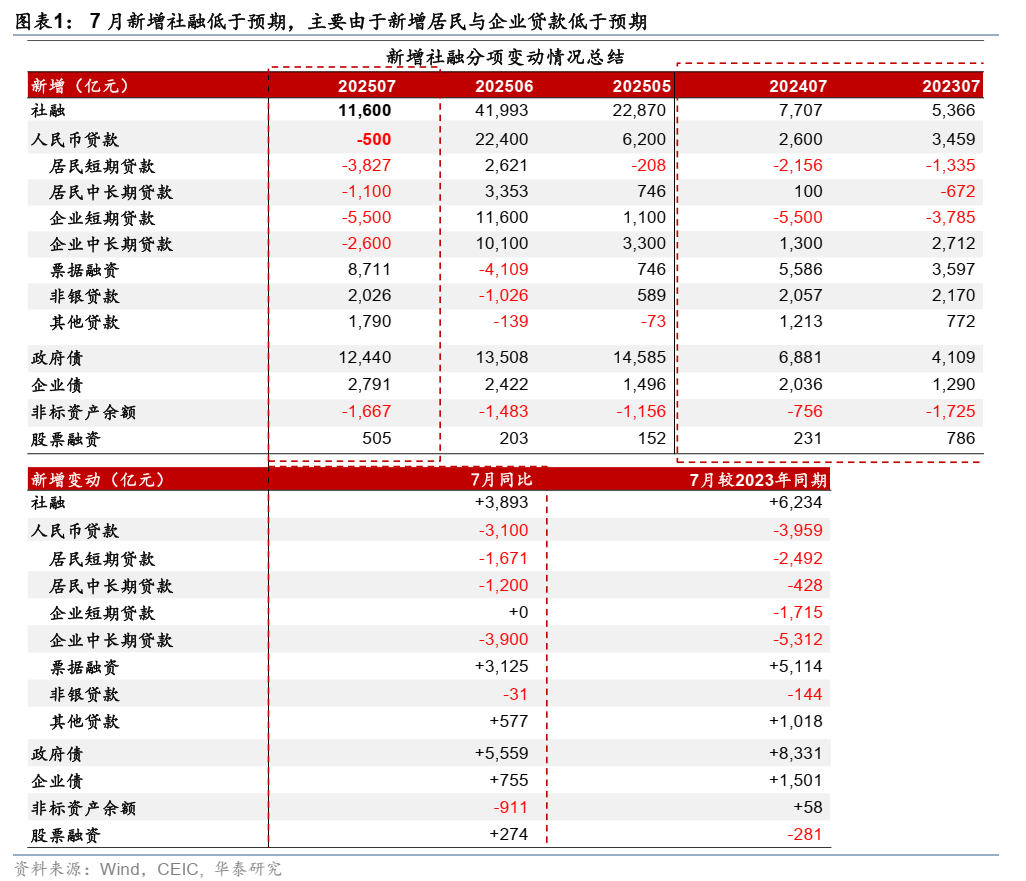
Loan and Financing Data - New social financing (社融) in July was 11,600 billion CNY, a year-on-year increase of 3,893 billion CNY, but below the market expectation of 14,100 billion CNY[1] - New RMB loans turned negative at -500 billion CNY, a decline of 3,100 billion CNY year-on-year, marking the first negative value since July 2005[1] - The scale of new government bonds reached 12,440 billion CNY in July, an increase of 5,559 billion CNY year-on-year, contributing significantly to new social financing[2] Economic Demand and Loan Trends - New loans to the real economy fell sharply to -4,263 billion CNY, setting a historical low since data collection began[2] - New household loans were -4,893 billion CNY, a decrease of 2,793 billion CNY year-on-year, indicating weak consumer demand[3] - New corporate loans were 600 billion CNY, with short-term loans at -5,500 billion CNY and medium to long-term loans at -2,600 billion CNY, the latter marking the first negative value since August 2016[4] Financial Market Insights - M1 money supply grew by 5.6% year-on-year, exceeding the expected 5.3%, but this growth is attributed to a low base effect rather than active deposit mobilization[5] - Non-bank financial institutions saw an increase in deposits by 2,100 billion CNY, while household deposits decreased by 1,100 billion CNY, suggesting a shift of funds from banks to non-bank entities[6] - The overall financial data for July indicates a slow recovery in demand, necessitating potential monetary easing measures to stimulate economic activity[6]
7月金融数据解读:低基数+权益上涨,存款继续修复
Huachuang Securities· 2025-08-14 01:44
1. Report Industry Investment Rating No relevant content provided. 2. Core Viewpoints - In July 2025, new RMB loans decreased by 50 billion yuan, with a year - on - year decrease of 310 billion yuan, and the credit balance growth rate dropped to 6.9%. New social financing scale reached 1.16 trillion yuan, with a year - on - year increase of 389.2 billion yuan, and the stock growth rate of social financing rose from 8.9% to 9%. The year - on - year growth rate of M2 increased from 8.3% to 8.8%, and the growth rate of the new - caliber M1 increased from 4.6% to 5.6%. Overall, July's credit performance was lower than market expectations, with bills being the main support. Among social financing sub - items, government bonds increased by 555.9 billion yuan year - on - year, supporting the social financing growth rate to remain high. In terms of deposits, under the low - base effect, the M1 growth rate continued to rise, and M2 was mainly driven by non - bank deposits [5][8]. 3. Summary by Related Catalogs 3.1 Credit: Both the household and corporate sectors performed mediocrely - **Household Sector**: In July, both short - term and medium - to - long - term loans were relatively weak, with a combined decrease of 489.3 billion yuan. Short - term loans decreased by 382.7 billion yuan, 167.1 billion yuan less than the same period last year, possibly due to the overdraft effect of the June shopping festival. Medium - to - long - term credit decreased by 110 billion yuan, 120 billion yuan less than the same period last year. The year - on - year growth rate of the trading area of commercial housing in 30 large - and medium - sized cities was - 18.6%, and the decline was larger than last month. The trading of second - hand houses was relatively weak, and medium - to - long - term household loans showed negative growth again since April [2][10]. - **Corporate Sector**: In July, corporate medium - to - long - term loans decreased by 260 billion yuan, 390 billion yuan more than the same period last year. The growth rate of the loan balance dropped slightly to 6.9%. Existing policy tools had limited driving effects on corporate loans, and subsequent policy - based financial tools might support corporate medium - to - long - term loans. Corporate short - term loans decreased by 550 billion yuan, basically the same as last year. Bill financing increased by 871.1 billion yuan, 312.5 billion yuan more than the same period last year. With the weak loan issuance, the demand for bills to "fill the gap" increased significantly [2][15][16]. 3.2 Social Financing: Government bonds still provided support, and the willingness to issue corporate bonds continued - **Government Bonds**: In July, the issuance scale of government bonds was large, with a new increase of 1.24 trillion yuan, 555.9 billion yuan more than the same period last year. According to the current issuance plan, government bonds would still support social financing in July, but from August to the end of the year, they might see a year - on - year decrease. If no additional bonds were issued at the end of the year, the peak of the annual social financing growth rate might appear in July [3][17]. - **Corporate Bonds**: In July, the willingness to issue corporate bonds was still strong, with a new increase of 27.91 billion yuan, 7.55 billion yuan more than the same period last year. With relatively low bond yields, the willingness to issue bonds increased seasonally, which might also "siphon" corporate loans. Un - discounted bills decreased by 16.39 billion yuan, close to the same period last year, and off - balance - sheet bills continued to be transferred to on - balance - sheet [3][21]. 3.3 Deposits: The growth rates of M1 and M2 continued to rise - **M1**: In July, the new - caliber M1 decreased by 2.9 trillion yuan, 832.4 billion yuan more than the same period in 2024, which was at a relatively high seasonal level. The wealth effect of the equity market supported the activation of funds to some extent, and the year - on - year reading of M1 increased significantly from 4.6% to 5.6%. - **M2**: Among the sub - items of M2, non - bank deposits were the main support. Driven by the recovery of the equity market, non - bank deposits increased by 2.14 trillion yuan in July, 1.39 trillion yuan more than the same period in 2024. After the cross - quarter in July, corporate deposits showed an outflow state, decreasing by 1.46 trillion yuan, but due to the low - base effect of the general deposit outflow after manual interest compensation in 2024, the decrease was 320.9 billion yuan less year - on - year [3][23][30].
宏观经济点评:广义货币高增的背后
KAIYUAN SECURITIES· 2025-08-14 01:44
Credit and Financing - In July, the social financing scale increased by 1.2 trillion RMB, lower than the expected 1.4 trillion RMB and significantly down from the previous value of 4.2 trillion RMB[2] - RMB loans saw a negative growth of 50 billion RMB, against an expectation of -15 billion RMB and a previous increase of 2.24 trillion RMB[2] - New corporate loans in July were 60 billion RMB, a year-on-year decrease of 70 billion RMB[4] Consumer and Corporate Lending - In July, household loans decreased by 489.3 billion RMB, a year-on-year reduction of 279.3 billion RMB[3] - The implementation of the personal consumption loan subsidy policy in September is expected to boost household leverage willingness[3] - Corporate medium and long-term loans decreased by 390 billion RMB year-on-year, indicating a seasonal decline in corporate credit[4] Monetary Supply and Market Trends - M2 growth rate increased to 8.8%, while M1 growth rate rose to 5.6% in July[6] - Non-bank deposits saw a significant increase of 1.39 trillion RMB year-on-year, contributing to the rise in M2[6] - The stock market's performance in July led to a notable shift of household deposits towards non-bank deposits, indicating a potential trend continuation[6] Government Bonds and Financing - In July, new government bond financing amounted to 1.244 trillion RMB, a year-on-year increase of 555.9 billion RMB, contributing positively to social financing[5] - The issuance of special government bonds is expected to maintain strength into August, with a gradual slowdown anticipated in September[5] Economic Outlook and Risks - The financial data for July reflects seasonal volatility, with credit and social financing showing a "temperature difference" that requires careful observation[7] - Risks include potential underperformance of policy execution and unexpected economic downturns[7]
7月货币加速、贷款减速的背后
Sou Hu Cai Jing· 2025-08-14 00:55
Core Viewpoint - July's social financing data indicates that while M1 and M2 growth exceeded market expectations, new loans and social financing fell short, reflecting changes in financing structure, seasonal factors, and shifts in household investment behavior [1][2][3] Monetary Supply - In July, M2 expanded by 8.8% year-on-year, while M1 grew by 5.6%, both surpassing Bloomberg's consensus expectations of 8.3% and 5.2% respectively [1][7] - The year-on-year growth rate of M1 increased from 4.6% in June to 5.6% in July, partly due to low interest rates and the reactivation of deposits by residents and enterprises [7] - M2's year-on-year growth rate rose from 8.3% in May to 8.8% in July, significantly higher than the expected 8.3% [8] Social Financing - July's new social financing amounted to 1.16 trillion yuan, lower than the expected 1.63 trillion yuan, but showed a year-on-year increase of 389.3 billion yuan [6][10] - Government bond net issuance in July was 1.24 trillion yuan, contributing approximately 4.1 percentage points to the year-on-year growth of social financing [2][6] - The net issuance of government bonds in the first seven months of the year reached 8.9 trillion yuan, an increase of 4.9 trillion yuan year-on-year, indicating a proactive fiscal policy [3][4] Loan Dynamics - New RMB loans in July decreased by 500 billion yuan, contrasting with the expected increase of 300 billion yuan, reflecting weak demand from the private sector, particularly in the real estate market [2][4][5] - The total amount of short-term and medium-to-long-term loans for residents fell by 287.1 billion yuan year-on-year, primarily due to weakened demand in the real estate sector [2][4] - Corporate short-term and medium-to-long-term loans decreased by 5.5 billion and 2.6 billion yuan respectively, indicating a decline in financing demand amid rising uncertainties [5][6] Fiscal Policy Impact - The acceleration of social financing growth in July was supported by the front-loaded issuance of government bonds, which is expected to continue influencing the broad credit cycle positively [3][4] - The overall fiscal expenditure growth in the first half of the year was 8.9%, significantly higher than the -2.8% recorded in the same period last year [4] - The sustainability of fiscal stimulus in the latter half of the year may face uncertainties, particularly in light of potential reductions in government bond issuance compared to the previous year [4]

普林格与盈利周期跟踪:“水”往股市流
Tianfeng Securities· 2025-08-13 23:44
Group 1 - The core viewpoint of the report emphasizes that identifying performance turning points is crucial for the market to emerge from the bottom-seeking phase, with market bottoms typically appearing 1-2 quarters ahead of performance turning points [4] - The report highlights that while the Plinger synchronous indicators are essential, they should be analyzed in conjunction with leading indicators to improve the accuracy of economic bottom assessments [4][5] - The report indicates that the key to breaking out of the bottom-seeking phase lies in the sustainability of M1 recovery, with household medium and long-term loans being a more critical indicator [4][5] Group 2 - The report notes that in July, the manufacturing PMI fell to 49.3%, remaining in the contraction zone, indicating a slight decline in macroeconomic conditions [6][7] - It mentions that the social financing scale increased by 1.16 trillion yuan in July, which is 389.3 billion yuan more than the same period last year, with a slight recovery in new government bonds but a negative turn in new RMB loans [12][22] - The report states that M1 and M2 both showed year-on-year increases in July, with M1 at +5.6% and M2 at +8.8%, reflecting a rebound in excess liquidity [9][12] Group 3 - The report discusses that the decline in household medium and long-term loans is significant, with July showing a year-on-year decrease of 9.68%, compared to the previous value of -1.32% [15][16] - It highlights that the DR007 rate fell to an average of 1.52% in July, indicating a stabilization of liquidity prices, which is a necessary condition for the market to find a bottom [18][19] - The report concludes that the overall economic environment is characterized by a recovery in leading indicators, while synchronous and lagging indicators are showing slight declines, suggesting a complex market outlook [22][23]
前7个月新增社融23.99万亿元 7月末M2余额同比增长8.8%
Zheng Quan Ri Bao· 2025-08-13 16:29
Group 1 - The core viewpoint of the articles indicates that the financial data for July shows a stable and supportive monetary environment for the real economy, with significant growth in social financing and money supply [1][2] - As of the end of July, the total social financing scale was 431.26 trillion yuan, reflecting a year-on-year growth of 9%, while the broad money (M2) balance reached 329.94 trillion yuan, growing by 8.8% [1][3] - The increase in loans, particularly in corporate and household sectors, demonstrates a solid support for the real economy, with a total loan balance of 268.51 trillion yuan, marking a 6.9% year-on-year increase [1][2] Group 2 - The acceleration in the issuance of government bonds has significantly contributed to the increase in social financing scale, aligning with a more proactive fiscal policy to support the economy [2] - The narrowing gap between M1 and M2 indicates improved liquidity and efficiency in the financial system, reflecting effective market stabilization policies and a recovery in economic activities [3] - The increase in M0, M1, and M2 balances suggests a positive trend in monetary circulation, with M0 growing by 11.8% year-on-year, M1 by 5.6%, and M2 by 8.8% [3]
【广发宏观钟林楠】如何理解信贷与M1的分化
郭磊宏观茶座· 2025-08-13 14:16
Core Viewpoint - The social financing (社融) in July increased by 1.16 trillion yuan, which is below the market average expectation of 1.41 trillion yuan, but shows a year-on-year increase of 389.3 billion yuan. The stock growth rate of social financing is 9.0%, up by 0.1 percentage points from the previous month [1][6]. Summary by Sections Social Financing and Credit - The decrease in real credit amounted to 426.3 billion yuan, which is a year-on-year reduction of 345.5 billion yuan. This aligns with the decline in bill rates and the BCI (Business Climate Index) reflecting a weaker financing environment for enterprises [1][7]. - Factors contributing to the decline in real credit include seasonal variations in credit issuance, a tightening of production and capital expenditures by some enterprises due to "anti-involution" policies, and improved cash flow for SMEs following the implementation of regulations to clear overdue payments [1][7]. Government and Corporate Financing - Government bond financing increased by 1.2 trillion yuan, a year-on-year increase of 555.9 billion yuan, reflecting active fiscal policies and a low base from the previous year. However, the base for government bonds will significantly increase starting in August, potentially shifting the impact from support to a drag on social financing [2][10]. - Corporate bond financing increased by 279.1 billion yuan, a year-on-year increase of 75.5 billion yuan, primarily due to a relatively loose liquidity environment and low financing costs for credit bonds [2][10]. Currency and Monetary Indicators - Foreign currency loans decreased by 8.6 billion yuan, a year-on-year reduction of 80.4 billion yuan, indicating a generally positive expectation for exchange rates among enterprises [3][11]. - M1 growth rate was 5.6%, up by 1.0 percentage points from the previous month, influenced by factors such as low base effects and increased net fiscal spending on the real economy [3][12]. - M2 growth rate was 8.8%, up by 0.5 percentage points, primarily driven by accelerated net fiscal spending on the real economy. There is a notable trend of residents moving deposits to non-bank financial institutions [4][13]. Overall Economic Outlook - The divergence between credit data and M1 growth suggests that both indicators may reflect macroeconomic conditions with some distortion. The low credit data in July raises the probability of monetary and financial policies stabilizing financing demand and promoting data recovery [5][14]. - The BCI for July was reported at 46.09, down from 49.12, indicating a deteriorating financing environment for enterprises [8].

2025年7月金融数据解读:社融表现积极,对实体经济有较好支撑
Tebon Securities· 2025-08-13 13:41
Group 1: Credit and Financing Performance - In July, new social financing (社融) increased by 1.16 trillion yuan, up by 389.3 billion yuan year-on-year, indicating strong support for the real economy[3] - From January to July 2025, cumulative social financing reached 23.99 trillion yuan, an increase of 5.12 trillion yuan compared to the same period last year[3] - The net financing of government bonds was 8.9 trillion yuan, up by 4.88 trillion yuan year-on-year, reflecting active fiscal policy support[3] Group 2: Credit Data Analysis - In July, new RMB loans showed a decrease of 500 billion yuan, with household short-term and medium-to-long-term loans dropping by 382.7 billion yuan and 110 billion yuan respectively[3] - As of the end of July, the total RMB loan balance was 268.51 trillion yuan, growing by 6.9% year-on-year, with a total increase of 12.87 trillion yuan from January to July[3] - The impact of local government debt replacement on credit performance is noted, with net financing of government bonds affecting credit data[3] Group 3: Monetary Indicators - By the end of July, M2 (broad money) stood at 329.94 trillion yuan, growing by 8.8% year-on-year, an improvement from June's 8.3%[3] - M1 (narrow money) reached 111.06 trillion yuan, with a year-on-year growth of 5.6%, up from June's 4.6%[3] - The continuous improvement in M1 and M2 indicates a relatively ample liquidity environment, supporting macroeconomic operations and corporate profitability[3] Group 4: Risk Considerations - Potential risks include unexpected changes in domestic fiscal and monetary policies, geopolitical risks, and a potential downturn in the real estate market[3]