消费升级

Search documents
以“两新”促提质,加速释放政策效能
Sou Hu Cai Jing· 2025-10-25 04:22
Core Insights - The "Two New" policy has significantly boosted retail sales in the home appliance sector, with refrigerator sales increasing by 48.3% and television sales by 26.8% in the first three quarters of the year [1] - Industrial enterprises have accelerated equipment updates, with machinery procurement amounts rising by 9.4% year-on-year [1] - The policy has effectively stimulated consumer demand for green, smart, and high-quality products, contributing to industrial upgrades and economic growth [1] Group 1 - The implementation of the "Two New" policy has led to substantial fiscal support, with national public budget expenditures reaching 20.81 trillion yuan, including 710.5 billion yuan for science and technology, marking a 6.5% increase [1] - Local governments are aligning their funding and support policies with central directives to ensure the smooth execution of the "Two New" initiatives, such as equipment purchase subsidies and digital transformation incentives [2] - The policy aims to benefit both consumers and enterprises, emphasizing the importance of effective implementation to maximize its impact [2] Group 2 - The "Two New" policy not only facilitates equipment updates but also drives technological advancements, enhancing product quality and production efficiency [3] - To further strengthen the policy's impact, there is a need for improved policy coordination, addressing supply-demand bottlenecks, and optimizing the business environment [3] - Continuous implementation of the "Two New" policy is expected to stimulate domestic demand and transform policy effectiveness into developmental momentum for the Chinese economy [3]
Z世代的“双十一”消费新场景
Sou Hu Cai Jing· 2025-10-24 14:38
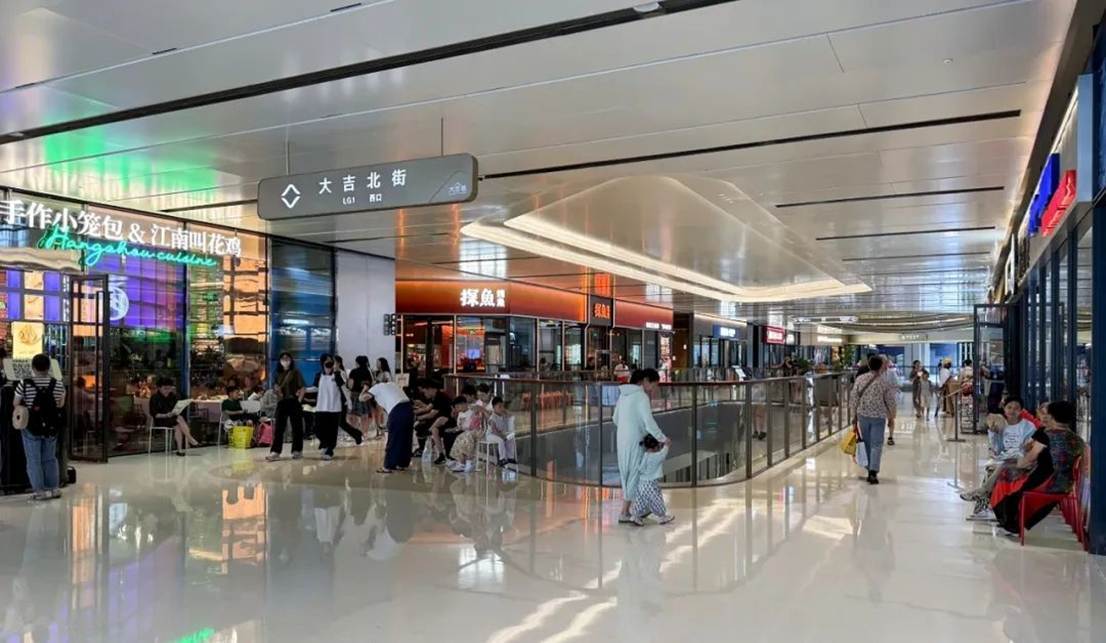
Core Insights - The integration of brand IP with fragmented reading experiences is attracting younger consumers, particularly Generation Z, who are willing to pay a premium for emotional value [1] - The shift from universal subsidies to targeted subsidies in Beijing's consumption policies aligns with the needs of Generation Z, focusing on essential household products and smart home devices [3] - The rapid logistics improvements, including "minute-level delivery" and reduced delivery times, enhance consumer experience and meet the demands of fast-paced urban lifestyles [4] Group 1: Consumer Behavior and Trends - Young consumers are increasingly motivated by emotional value and personal interests, with over 40% of them willing to spend for these reasons [1] - The upcoming Double Eleven shopping festival in Beijing is characterized by government subsidies and platform discounts, making it easier for consumers to shop without extensive preparation [2] - The emergence of new shopping experiences, such as unique brand offerings and cultural integration in shopping districts, reflects the evolving preferences of younger consumers [5][8] Group 2: Policy and Economic Impact - Beijing's policies, including the implementation of digital product purchase subsidies and consumption vouchers, are designed to stimulate consumer spending and upgrade consumption structures [3] - The targeted subsidy strategy for 2025 focuses on essential goods, aligning with the consumption characteristics of Generation Z, which prioritize both necessity and quality [3] - The government's collaboration with platforms to provide financial incentives ensures that subsidy funds are directed towards meeting consumer needs effectively [3] Group 3: Logistics and Delivery Innovations - The introduction of advanced logistics technologies has significantly improved delivery times, with some products being delivered within minutes, compared to previous delays of days [4] - Companies like JD Logistics and Cainiao are leveraging technology to enhance delivery efficiency, which is crucial for meeting the expectations of modern consumers [4] - The support from government policies aimed at reducing logistics costs further facilitates the development of a more efficient logistics ecosystem in Beijing [4] Group 4: Cultural and Market Dynamics - The rise of new shopping districts, such as Dajixiang, showcases a blend of traditional and modern consumer experiences, attracting young shoppers with unique offerings [5][8] - The focus on local cultural elements and the promotion of domestic brands align with government initiatives to foster a new wave of consumer trends [7][8] - The revitalization of historical neighborhoods through modern retail experiences reflects a strategic approach to enhance urban consumer environments while preserving cultural heritage [8]

“娃哈哈”品牌重磅回归!食品饮料ETF天弘(159736)连续7日“吸金”,消费布局正当时?
Sou Hu Cai Jing· 2025-10-24 05:45
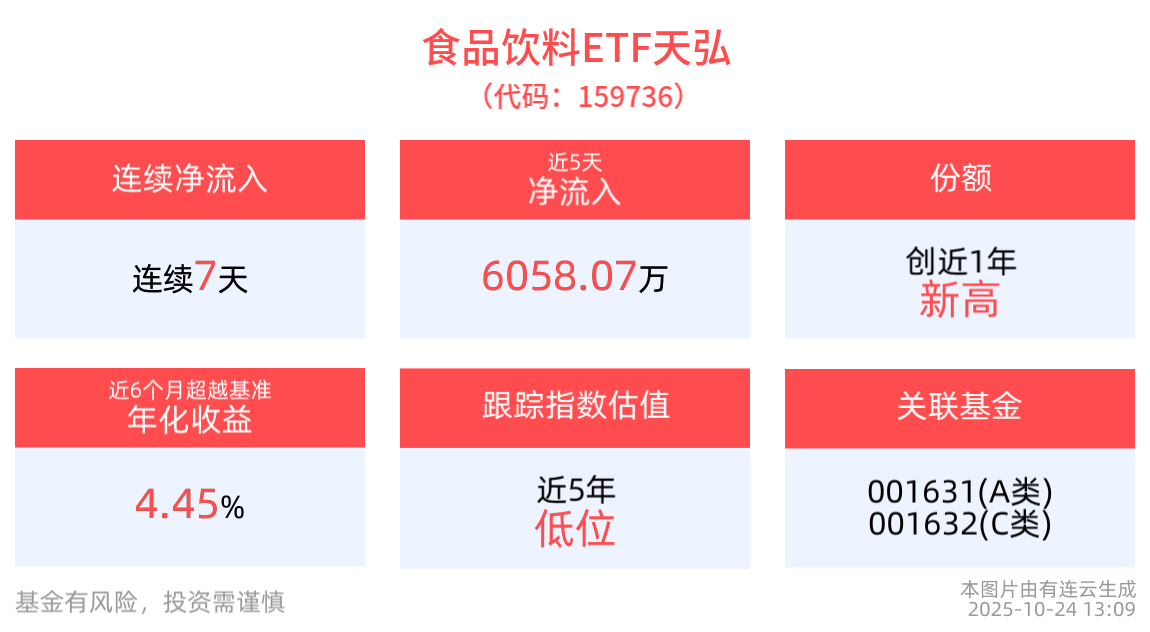
Core Viewpoint - The Tianhong Food and Beverage ETF (159736) is experiencing a rebound with significant net inflows, indicating strong investor interest in the food and beverage sector, particularly amidst recent market fluctuations [3][4]. Fund Performance - As of October 24, 2025, the Tianhong Food and Beverage ETF (159736) has seen a trading volume of 21.35 million yuan, with a net subscription of 18 million shares [3]. - The fund has reached a total share count of 7.804 billion, marking a one-year high as of October 23, 2025 [4]. - Over the past week, the fund has recorded continuous net inflows, with a peak single-day inflow of 21.634 million yuan, totaling 76.619 million yuan in net inflows [4]. Market Trends - The Tianhong Food and Beverage ETF (159736) tracks a diverse index covering essential sectors such as alcohol, beverages, and food, which enhances its resilience against single-industry volatility, making it suitable for long-term investment in consumer upgrades [5]. - The Central Securities A500 ETF (159360) has also shown positive performance, with a 1.05% increase and a trading volume of 37.40 million yuan as of October 24, 2025 [4]. Industry Insights - Recent reports indicate a significant shift in the beverage market, with the reactivation of the "Wahaha" brand by Zong Fuli, reversing a previous decision to introduce a new brand [5]. - The Fourth Plenary Session of the 20th Central Committee emphasized the importance of boosting consumption and effective investment, aiming to strengthen the domestic market and enhance economic resilience [6]. Analyst Opinions - CITIC Securities has noted that the autumn sugar and wine fair met expectations, with the industry actively engaging consumers and expanding market demand. They predict that the industry fundamentals may bottom out in the third quarter of 2025, with the second half of the year showing potential recovery trends [7].
GDP增长5.2%,解码中国经济“三季报”
3 6 Ke· 2025-10-24 02:47
Core Insights - China's GDP for the first three quarters grew by 5.2% year-on-year, indicating a steady economic performance amidst a complex international environment [1][2] - The quarterly GDP growth rates showed a mild recovery trend: 5.4% in Q1, 5.2% in Q2, and 4.8% in Q3, with a quarter-on-quarter growth of 1.1% in Q3, suggesting a gradual accumulation of internal economic momentum [1][2] Economic Overview - The total GDP reached 10,150.36 billion yuan, with a growth rate that outpaced both the previous year and the same period last year by 0.2 and 0.4 percentage points respectively, maintaining a leading position among major global economies [2] - Industrial production demonstrated strong resilience, with a 6.2% year-on-year increase in the added value of industrial enterprises above designated size, particularly in equipment manufacturing and high-tech manufacturing, which grew by 9.7% and 9.6% respectively [2] - The service sector also showed steady recovery, with a 5.4% year-on-year increase in added value, led by the information transmission, software, and IT services sector, which grew by 11.2% [2] Consumption and Employment - The consumer market continued to recover, with total retail sales of consumer goods growing by 4.5% year-on-year, driven by strong sales in essential and some upgraded goods, with categories like food, sports and entertainment products, and jewelry seeing retail growth rates exceeding 10% [2][3] - The policy of replacing old consumer goods with new ones has shown significant effects, with retail sales in categories such as home appliances, furniture, and communication equipment also growing around 20% [3] - Employment and prices remained stable, with an average urban unemployment rate of 5.2% and a slight decrease of 0.1% in the Consumer Price Index (CPI) year-on-year [3] New Growth Drivers - New economic drivers are accelerating, with the added value of the lithium-ion battery manufacturing industry growing by 29.8% and the production of new energy vehicles increasing by 29.7% [3] - The total import and export volume reached 33,607.8 billion yuan, with a year-on-year growth of 4.0%, and private enterprises' imports and exports grew by 7.8%, accounting for 57.0% of the total [3] Expert Insights - Experts noted that the economic growth rate is relatively high compared to global standards, with the IMF predicting a global growth rate of 3.2% for 2025 [4] - Recommendations for enhancing consumer capacity include improving wage determination mechanisms and increasing the proportion of labor remuneration in initial distribution [5] - The importance of innovation and R&D investment is emphasized, with R&D intensity increasing from 1.91% in 2012 to 2.68% in 2024, and a significant rise in the share of basic research funding [5][6]
上海以时尚之名,燃动消费升级引擎
Guo Ji Jin Rong Bao· 2025-10-23 11:39
10月22日至23日,上海以"时尚+消费"双主线点燃城市活力,利郎LESS IS MORE 2025"由石至形"设计师联合系列发布秀与2025上海"进口嗨购节"暨"国 别商品文化缤纷月"启动仪式接连登场,通过设计赋能、文化融合与政策创新,展现上海"文旅商体展"联动促进消费升级的画面。 整个系列以"石"为起点,以"结构"为形态,从安平桥蕴含的石构智慧出发,延伸到现代几何建筑的结构语言,像是在时间与空间的折叠中,探寻当代男 装从自然之物到文化符号的演变过程。 消费联动:进口嗨购节打造全场景消费生态 10月23日,2025上海"进口嗨购节"暨"国别商品文化缤纷月"在虹桥品汇启动,通过"进口精品+国别新品"双主线,覆盖"食、行、游、购、娱"五大场 景。 上海市商务委二级巡视员刘朝晖在致辞中表示,上海"进口嗨购节"自2020年首次举办以来,累计推出近300项进口主题活动,带动进口商品销售累计达 60亿元。"国别商品文化缤纷月"着力搭建国际经贸合作平台和人文交流平台,推动国别文化交流和共融。 为整合品牌优势,凝聚平台资源,今年首次将"进口嗨购节"和"国别商品文化缤纷月"两个主题的活动合并举办。活动期间,10余家"6+36 ...

卧龙觉醒!隆鑫通用:业绩后来居上,摩托车龙二重生记
市值风云· 2025-10-23 10:09
Core Viewpoint - The article highlights the impressive growth of Longxin General (隆鑫通用) in the motorcycle industry, particularly in terms of profit and market share, following its restructuring and the strategic leadership of Zuo Zongshen, a prominent figure in the motorcycle sector [4][9][11]. Group 1: Financial Performance - Longxin General expects a net profit of 1.52 billion to 1.62 billion yuan for the first three quarters of 2025, representing a year-on-year increase of 69.13% to 80.26% [4]. - In contrast, Chuncheng Power (春风动力) reported a net profit of 1.42 billion yuan for the same period, showing a year-on-year growth of 30.9% [6]. - Longxin General's revenue for the first half of 2025 reached 9.75 billion yuan, a year-on-year increase of 27.2%, with a net profit of 1.07 billion yuan, reflecting an 82.3% growth [17]. Group 2: Market Position and Strategy - Longxin General, along with Chuncheng Power and Qianjiang Motorcycle (钱江摩托), is recognized as one of the "three strong" players in the domestic motorcycle market, with a market share of 14.3% in the 250cc and above segment [13]. - The company has maintained its position as the leading exporter of motorcycles for 19 consecutive years, with a market share of 14.2% in the 250cc and above category, an increase of 5 percentage points from 2022 [12][13]. - Longxin's high-end motorcycle brand "Wuji" has successfully established a foothold in the market, contributing to its export strength and overall performance [14][15]. Group 3: Global Market Opportunities - The domestic market for mid-to-large displacement motorcycles is experiencing significant growth, with a year-on-year increase of 38.7% in sales during the first four months of 2025 [19]. - The global market for motorcycles with a displacement of 250cc and above is estimated to be around 5.5 million units in 2024, providing substantial opportunities for domestic manufacturers to expand internationally [19]. Group 4: Cash Flow and Dividends - Longxin General has consistently maintained positive operating and free cash flows, with a strong cash conversion capability reflected in its financial statements [21][25]. - As of mid-2025, the company reported nearly 8.6 billion yuan in cash, with minimal short-term and long-term debt [28]. - The company has increased its dividend payout significantly, with a total dividend of 820 million yuan in 2024, representing a payout ratio of 73.3%, which is notably higher than the previous average of around 30% [32].


大疆全景相机、运动相机全面霸榜京东热卖榜
Ge Long Hui· 2025-10-23 10:04
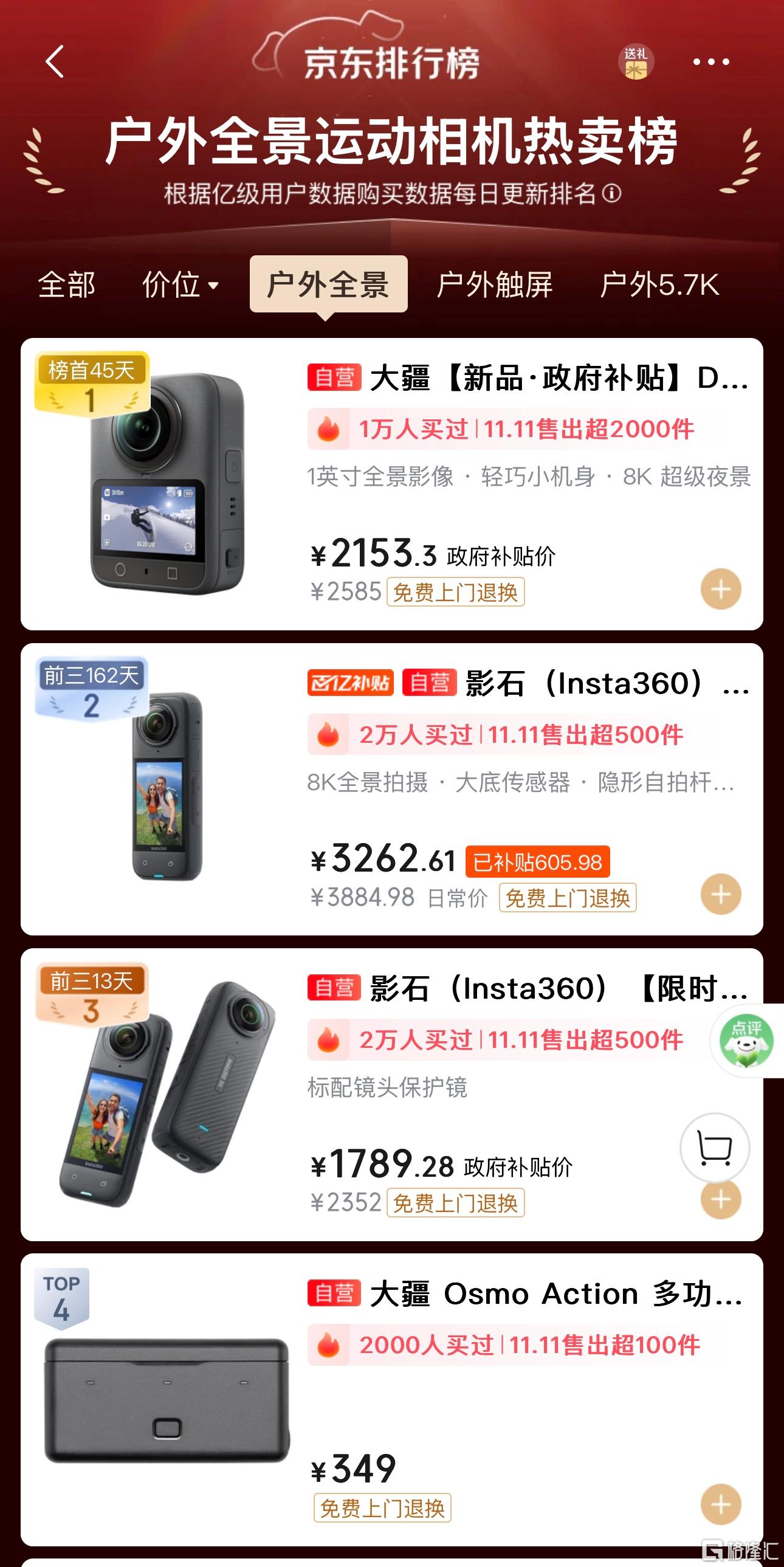
Core Insights - DJI products have dominated sales on JD.com during the Double Eleven shopping festival, with the Osmo 360 camera ranking first in the "Outdoor Panorama Sports Camera Hot Sales List" for 45 consecutive days [1] Market Trends - The sports camera market is experiencing a consumption upgrade trend, driven by the growing demand for diverse scenarios such as cycling, skiing, and travel. User needs are evolving from single-function recording to professional-grade image quality, portability, stabilization, and ecosystem applications [4] - Innovations in these areas are becoming core factors driving consumer purchases of sports cameras [4] Company Performance - DJI's continuous dominance across multiple categories demonstrates its leading technological ecosystem, which has established a strong market moat [4] - The success of the Osmo series sports cameras is attributed to two main factors: the expansion and maturation of the Osmo product line, making it a preferred choice for video creators and lifestyle documenters, and the increasingly comprehensive Osmo ecosystem that empowers professional users while lowering the barriers for ordinary consumers to capture high-quality moments [4]
卤味高价策略还能躺赢市场吗
Xin Lang Cai Jing· 2025-10-23 08:06
Core Viewpoint - Despite high prices for marinated food, leading national chain companies in this sector are experiencing disappointing performance in 2024, with significant revenue declines reported across major brands [1] Company Performance - Huang Shang Huang reported a revenue of 1.739 billion yuan in 2024, a year-on-year decrease of 9.44%, marking the lowest since 2018 [1] - Ziyan Food achieved a revenue of 3.363 billion yuan in 2024, down 5.28% year-on-year [1] - Zhou Hei Ya's total revenue for 2024 was 2.451 billion yuan, reflecting a 10.7% decrease compared to the previous year [1] - Juewei Food's revenue for 2024 was approximately 6.257 billion yuan, which represents a decline of 13.84% year-on-year [1] Industry Challenges - The marinated food industry is facing multiple challenges, including market saturation due to rapid expansion in recent years, leading to increased competition [1] - Consumer demands are evolving with a focus on product quality, taste, and health, while some brands have failed to keep pace with innovation and quality improvements [1] - The rise of online channels and the development of new retail models have disrupted traditional offline store operations [1]
“赛事+”“情绪价值”“品质化”……消费向新而行 提质、焕新亮点持续显现
Yang Shi Wang· 2025-10-23 03:01
Core Viewpoint - China's consumption upgrade is at a critical stage, presenting significant opportunities as the second-largest consumer market globally. The article highlights new practices in Shanghai as it develops into an international consumption center by 2025 [1]. Group 1: Urban Revitalization and Consumer Engagement - The West Bund in Xuhui District has transformed industrial relics into a vibrant cultural and commercial landmark, showcasing successful urban revitalization efforts [3]. - A recent extreme sports event attracted nearly 900 athletes from 34 countries, with about 80,000 attendees, marking a 60% increase compared to 2024 [5]. - The New Heaven and Earth shopping district has seen a 40% increase in foot traffic due to various community events, with some merchants reporting sales increases of 2-3 times during these events [11]. Group 2: Innovative Consumption Experiences - The launch of a themed dining cruise on the Suzhou River has created a unique dining experience, contributing to record visitor numbers for both the cruise and nearby shopping areas [13]. - Shanghai has introduced night-time consumption vouchers and extended operating hours in key areas, enhancing the "Night Shanghai" consumption experience [14]. - The integration of sports events with tourism is emerging as a significant trend, with various locations in the Yangtze River Delta exploring new business models that combine sports, culture, and travel [16]. Group 3: Diverse Consumer Demands - Young consumers are increasingly seeking experiences that provide emotional value, as seen in the popularity of indoor climbing facilities and pet-friendly accommodations [27][30]. - The silver economy is also evolving, with travel agencies responding to older consumers' desires for high-quality, slow-paced travel experiences [29][32]. - Policies are being implemented to support the growth of the silver economy, including the introduction of "silver tourism trains" to cater to older travelers [33].

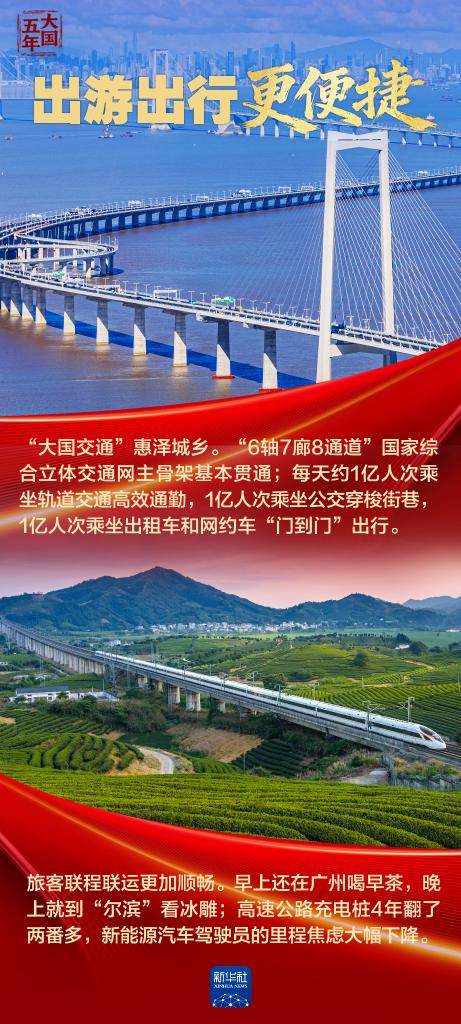
大国五年丨“十四五”,改变你我生活
Xin Hua She· 2025-10-23 01:54
Core Points - The article emphasizes the achievements made during the "14th Five-Year Plan" period, highlighting improvements in the quality of life for the Chinese population, including better transportation, healthcare, and environmental conditions [1][2]. Group 1: Infrastructure and Services - A total of 5,510 "quarter-hour" convenient living circles have been established, serving over 125 million residents [7]. - Over 95% of administrative villages now have direct access to express delivery services, enhancing logistics from farms to consumers [7]. - The national number of regional medical centers has reached 125, benefiting over 400 million people through cross-province medical billing [11]. Group 2: Economic Growth and Consumption - The consumer market remains the second largest globally, with service consumption growing rapidly; residents' service expenditure reached 46.1% [9]. - The grain production has achieved a continuous increase for 21 years, with the national grain output expected to exceed 1.4 trillion jin in 2024 [22]. Group 3: Education and Talent Development - Basic education has achieved balance in 2,895 counties, with preschool enrollment rates at 92% and higher education enrollment rates at 60.8% [15]. - Higher education institutions have produced 55 million graduates, with vocational education supplying over 70% of new high-skilled talent for modern industries [17]. Group 4: Environmental Improvements - By 2024, PM2.5 concentration in cities is projected to drop to 29.3 micrograms per cubic meter, with good air quality days reaching 87.2% [19]. - Approximately 2,000 high-emission vehicles have been eliminated during the "14th Five-Year Plan," contributing to environmental protection efforts [21]. Group 5: Cultural and Community Development - There are 3,248 public libraries and nearly 44,000 community cultural institutions, with public cultural services increasingly accessible online [27]. - The number of television users has surpassed 1 billion, and online video users have reached 1.09 billion, indicating a vibrant cultural landscape [28].