
贸易保护主义

Search documents
美单边关税让全球经济面临更大不确定性(国际论坛)
Ren Min Ri Bao· 2025-06-01 22:03
美国是日本汽车产业的最大出口市场。据野村证券预测,美国征收汽车关税或致马自达陷入亏损、丰田 营业利润下降30%。汽车产业是日本的支柱产业之一,提供了超过550万个就业岗位。美国如果加征关 税,将导致日本汽车企业收益恶化,进而对日本经济产生冲击。 (作者为日本无限合同会社首席经济师) (文章来源:人民日报) 20世纪30年代,贸易保护主义盛行,国际贸易的相互限制是造成当时经济萧条的一个重要原因。1948 年,关贸总协定临时生效,逐步将不同经济制度、不同发展阶段、不同意识形态的国家都纳入关税和贸 易问题的谈判中,从而建立起战后多边贸易体制的基本原则和框架。此后40多年里,发达国家的平均关 税从36%减到4.7%,发展中国家和地区的平均关税在同期也下降到13%,世界贸易总额增长了10倍以 上。1995年,在关贸总协定的基础上,成立了世界贸易组织。 国际社会普遍认为,多边贸易体制的最大受益者是美国。在该体制下,美元是国际贸易中的主要结算货 币。许多贸易顺差国用通过贸易获得的美元购买美国国债。通过发行美元和美国国债,美国可以享受从 世界各地购买商品和服务的"美元特权",获得了来自全球各地的大量物美价廉的商品。美国肆意加 ...
36万亿债务高悬!美国移民金卡闹剧,中美博弈的明牌与暗棋
Sou Hu Cai Jing· 2025-05-31 22:24
Group 1 - The ongoing economic relationship between China and the United States is a significant variable influencing the global economy, especially in the context of trade and financial disputes [1] - The U.S. stock market has experienced significant fluctuations from 2007 to 2025, with a notable rise from a low of around 6000 points in 2009 to a peak of 45000 points by December 2024 [2] - The trade protectionism policies implemented by Trump, including tariffs on China, have disrupted global supply chains and heightened inflation concerns [4] Group 2 - The U.S. stock market faced a sharp decline from 45000 points in December 2024 to 36600 points by April 2025, a drop of nearly 9000 points, prompting policy adjustments from Trump [5] - China's stock market also experienced a significant drop, falling 220 points from 3300 to 3050, but is viewed as having a lower valuation compared to the U.S. market [6] - The U.S. has engaged in quantitative easing, resulting in a total debt of approximately 36.7 trillion dollars, with a looming repayment pressure of 6.5 trillion dollars by June 2025 [8] Group 3 - The trade conflict between the U.S. and China remains a potential source of volatility, with past tariffs being reduced but still subject to future negotiations [11] - China's stock market holds significant growth potential amidst the U.S.-China economic rivalry, emphasizing the need for improved capital market infrastructure and investor confidence [12] - The integration of technology and finance is crucial for the healthy development of China's stock market, which is essential for sustainable economic growth [14]


沃尔玛涨价,仅仅是个开始
Jing Ji Ri Bao· 2025-05-31 21:54
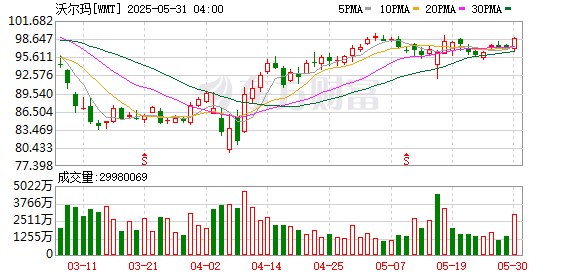
Core Viewpoint - Walmart's decision to raise prices on certain products in the U.S. due to increased costs from U.S. tariff policies highlights the conflict between U.S. economic policy and market dynamics, raising concerns among consumers and drawing criticism from President Trump [2][3]. Group 1: Price Increase and Economic Impact - Walmart plans to implement price increases that will become more noticeable in June, as the company faces significant supply chain cost increases due to tariffs imposed by the U.S. government [3][4]. - The company's first-quarter financial report showed a net profit of $4.49 billion, a decrease of over 12% year-on-year, indicating the financial strain caused by rising costs [3][4]. - Other companies are also raising prices in response to tariffs, including Microsoft, Ford, Mattel, Whirlpool, Ferrari, and Hermès, suggesting a widespread trend affecting various sectors of the U.S. economy [4][5]. Group 2: Consumer Sentiment and Economic Indicators - The Michigan Consumer Sentiment Index fell to 50.8 in May, marking a continuous decline for five months and the lowest level since June 2022, reflecting growing pessimism among American households regarding the economic outlook [5]. - The U.S. GDP contracted by 0.3% in the first quarter, marking the first negative growth in three years, which may further impact consumer spending and economic growth expectations [5]. - The U.S. government's tariff policies are projected to increase the tax burden on American households by $1,200 by 2025, exacerbating the financial strain on consumers [4][5].

特朗普关税让东南亚从中国进口增2成
36氪· 2025-05-30 13:23
以下文章来源于日经中文网 ,作者日经中文网 日经中文网 . 编制日经指数的《日本经济新闻》的中文版。提供日本、中国、欧美财经金融信息、商务、企业、高科技报道、评论和专栏。 4月中国对东盟出口额按美元计算同比增长21%。一方面,对美国的出口下降21%。对美国出货量下降的中国造个人电脑和智能手机流入东 南亚。美国总统特朗普的高关税政策是背后原因…… 来源| 日经中文网(ID:rijingzhongwenwang) 美国总统特朗普的高关税政策是背后原因。美国针对世界各国征收的对等关税已将加征部分的生效暂缓了90天。在越南,利用这 一过渡期提前向美国供货的动向加强,4月对美出口同比增长3成以上。 封面来源 | IC Photo 受特朗普关税的影响,东南亚的来自中国的进口正在扩大。4月对美国出货量下降的中国造个人电脑和智能手机流入东南亚。由于 美国对等关税部分暂缓实施,东南亚出现紧急增加对美出口的动向,与此同时,来自中国的零部件采购也在增加。 中国海关总署的数据显示,4月中国对东盟(ASEAN)出口按美元计算同比增长21%。增幅高于3月的12%。针对4月将对华加征 关税提高至145%的美国,中国方面的出口下降21%,而 ...
成批黄金直运黄金,特朗普突然发现情况不妙,中国还防了他一手
Sou Hu Cai Jing· 2025-05-30 10:20
Core Insights - China's gold imports surged to 127.5 tons in April, a 73% month-on-month increase, marking an 11-month high, while simultaneously reducing its U.S. Treasury holdings by $18.9 billion to $765.4 billion [1][3] - The reduction in U.S. Treasury holdings reflects a broader trend of decreasing confidence in U.S. creditworthiness, exacerbated by rising national debt, which has reached $36.1 trillion, and a growing fiscal deficit [1][3] - The increase in gold imports indicates a shift towards safer assets amid global economic instability, with central banks globally purchasing over 1,000 tons of gold annually from 2022 to 2024, significantly higher than the average of 473 tons from 2010 to 2021 [3][5] Economic and Trade Relations - The U.S. credit risk is impacting the attractiveness of U.S. Treasuries, with the Trump administration's erratic economic policies and trade protectionism contributing to a decline in investor confidence [3][5] - China's strategy of reducing U.S. Treasury holdings while increasing gold reserves is a response to uncertainties in U.S.-China trade relations, aiming to mitigate potential losses from unfavorable U.S. economic measures [5][9] - China is actively diversifying its trade partnerships, notably strengthening ties with ASEAN, which includes completing negotiations for a new version of the China-ASEAN Free Trade Area, thereby reducing reliance on the U.S. market [8][9] Market Dynamics - The price of gold has been on an upward trend, driven by ongoing global monetary easing and geopolitical tensions, which enhance its appeal as a safe-haven asset [5] - The shift in Australia's trade policy, emphasizing its partnership with China over the U.S., reflects China's growing significance in the global economic landscape and challenges the U.S.'s strategy to isolate China [8][9] - Overall, China's actions in reducing U.S. debt holdings and increasing gold investments are part of a broader strategy to safeguard its economic interests amid a complex international environment [9]
不断反转!特朗普关税战遭司法拉锯战,最高法院将“终结一切”?
Di Yi Cai Jing· 2025-05-30 06:03
Core Viewpoint - The Trump administration is currently facing multiple lawsuits challenging its tariff measures, with at least seven legal challenges underway [1][2]. Group 1: Legal Proceedings - The U.S. Court of International Trade ruled that the International Emergency Economic Powers Act (IEEPA) does not grant the president unlimited authority to impose tariffs, leading to a historic decision to potentially abolish various tariffs [4]. - Following this ruling, the Trump administration quickly filed an appeal to the U.S. Court of Appeals, seeking to suspend the decision, indicating a willingness to escalate the matter to the Supreme Court if necessary [5]. - The appeals court has temporarily stayed the lower court's ruling, allowing for further legal debate, with a timeline set for submissions from both parties [4][5]. Group 2: Tariff Policy and Alternatives - The Trump administration is exploring alternative legal avenues to implement tariffs, including invoking the Trade Expansion Act of 1962, which allows for tariffs on specific goods [6]. - Despite the challenges, the administration's trade advisors have indicated that they may pursue other methods to impose tariffs, even if they lose the current legal battles [6]. - The ongoing legal disputes and potential alternative tariff measures could prolong uncertainty in trade policy, impacting market reactions and economic conditions [2][6]. Group 3: International Reactions - The Chinese government has criticized the U.S. tariffs as unilateral measures that violate World Trade Organization principles, indicating a broader international discontent with U.S. trade practices [7].
21深度|特朗普关税战被裁定“越权”背后:三大关键悬念待解
2 1 Shi Ji Jing Ji Bao Dao· 2025-05-29 13:34
Core Viewpoint - The U.S. International Trade Court ruled against President Trump's tariff policy, stating that he overstepped his authority by imposing tariffs on countries with trade surpluses with the U.S. This ruling challenges the legality of the tariffs and emphasizes the constitutional power of Congress in regulating trade [1][2][3]. Group 1: Legal Challenge and Court Ruling - The U.S. International Trade Court's ruling on May 28, 2023, blocked Trump's tariff policy, asserting that the President does not have the authority to impose broad tariffs without Congressional approval [2][3]. - The lawsuit was initiated by a coalition of 12 states, arguing that Trump's tariff policy was an unlawful exercise of power [2]. - The court's decision undermines Trump's use of the International Emergency Economic Powers Act (IEEPA) as a legal basis for imposing tariffs, which could lead to the cancellation of tariffs imposed under this act [2][3]. Group 2: Implications for Trade Policy - The ruling is expected to significantly impact the Trump administration's trade agenda, potentially limiting its ability to use tariffs as a tool for trade protectionism [3][6]. - The decision may embolden other countries in their negotiations with the U.S., as it strengthens their position against U.S. trade pressures [3][9]. - The ruling could lead to a reassessment of U.S. trade policies, as domestic pressures from affected industries and political divisions grow [9][10]. Group 3: Market Reactions - Following the court's decision, there was a notable market reaction, with the S&P 500 and Nasdaq futures rising over 1%, indicating optimism regarding a potential easing of trade tensions [7][8]. - The ruling is likely to influence sectors such as technology and industrials, which may see gains, while defense and domestic steel industries could experience pullbacks [8]. - The overall market sentiment reflects a belief that the tariff policies may become more moderate in the future, despite ongoing uncertainties [9].
硅产业链新闻动态
中国有色金属工业协会硅业分会· 2025-05-29 07:01
1、美国太阳能制造商要求政府立即封堵东南亚光伏组件进口关税漏洞 美国国际贸易委员会(USITC)上周针对东南亚四国(柬埔寨、马来西亚、泰国、越南)太阳 能产品的损害终裁结果,正引发本土制造商与进口商的激烈博弈。美国太阳能制造商联盟 (SEMA)等组织近日公开呼吁,要求USITC最迟在6月2日前公布最终关税细则,否则可能因程序 漏洞导致大量东南亚组件在新关税生效前突击涌入美国市场。 2025年5月25日,土耳其贸易部发布第2025/8号公告称,应土耳其生产商申请,对原产于中 国的太阳能电池板接线盒(参考英语译文:Junction Boxes for solar panels)启动反倾销调查。 本案倾销调查期为2024年全年,损害调查期为2022年1月1日~2024年12月30日。涉案产品的土 耳其税号为8544.42.90.00.11、8544.60.10.00.11、8544.60.90.00.00。公告自发布之日起生 效。 利益相关方应于公告发布37日内提交调查问卷。 3、泰国停止对光伏等行业投资优惠 据泰媒报道,泰国投资委员会(BOI)19日召开会议,出台4项措施帮助泰国企业应对美关税 和外部挑战。 一是 ...





特朗普关税霸权被斩首,高盛紧急解密白宫四大后手
Jin Shi Shu Ju· 2025-05-29 06:13
美国法院对特朗普关税下"截杀令",白宫竟有四种方式满血复活!高盛拆解闹剧:先诱杀空头杠杆盘, 再剿灭追涨资金? 周三晚间,国际贸易法院(Court of International Trade,CIT)一个由拜登时代任命的活跃派法官小组和 一位里根时代遗留下来的保守派成员联手搅乱了特朗普的贸易政策,似乎叫停了他的所有"解放日关 税"。CIT这个机构此前几乎无人知晓。市场的第一反应是"特朗普的关税恐怖统治即将终结",推动美元 急速飙升,标普500期货突破6000点,距离技术性牛市仅一步之遥。 但高盛首席政治经济学家亚历克·菲利普斯(Alec Phillips)在周三晚间发布的报告《法院叫停大部分关 税加征,但白宫可通过上诉或其他关税授权恢复》中指出:这不过是场虚张声势的闹剧。虽然裁决构 成"挫折",但特朗普政府不仅能通过上诉翻盘,在等待最高法院裁决期间还有多种规避手段。即便最高 法院意外维持原判,白宫仍可通过其他法律工具继续推进关税政策。 CIT此次仅叫停特朗普政府根据《国际紧急经济权力法》(International Emergency Economic Powers Act, IEEPA)实施的关税,涉及今 ...

珠海港(000507):珠海港 24年业绩有韧性 25年Q1季度利润同比增 38%
Xin Lang Cai Jing· 2025-05-29 00:29
Core Insights - Zhuhai Port reported a total operating revenue of 5.125 billion RMB for 2024, a year-on-year decrease of 6.07%, while net profit attributable to shareholders increased by 5.37% to 292 million RMB [1] - The company plans to distribute a cash dividend of approximately 58.9 million RMB for 2024, representing about 20.2% of the annual net profit, with a dividend yield of approximately 1.2% based on the closing stock price on the report date [1] Segment Analysis - **Port and Shipping Logistics**: Revenue was 2.06 billion RMB, down 19.4% year-on-year, accounting for 40.2% of total revenue. Gross profit decreased by 2.3% to 520 million RMB, representing 38.9% of gross profit. The decline was primarily due to a 22.5% drop in container volume resulting from reduced demand for imported pulp [2] - **New Energy**: Revenue reached 2.43 billion RMB, an increase of 3.3% year-on-year, making up 47.5% of total revenue. However, gross profit fell by 4.6% to 650 million RMB, which is 48.3% of gross profit. The decline was attributed to extreme weather conditions and a decrease in comprehensive electricity prices following the extension of the Dali Wind Farm's operational life, leading to a 46.95% drop in operating profit [2] - **Investment and Others**: Revenue was 630 million RMB, up 15.9% year-on-year, contributing 12.3% to total revenue. Gross profit increased by 47.4% to 170 million RMB, accounting for 12.8% of gross profit. The significant growth was due to a decrease in the cost of capital for investment projects and increased returns [2] Investment Outlook - The company is optimistic about its four strategic directions and the continued incubation of its two subsidiaries, which are expected to enhance future performance. The substantial year-on-year increase in net profit for Q1 2025 is attributed to improvements in the core port and shipping business and optimized product sales from subsidiaries [3]
