
股债跷跷板

Search documents
股强债弱!债市收益率上行,纯债基金上周业绩不理想,但有含权债基单周涨超6%
Sou Hu Cai Jing· 2025-10-27 10:48
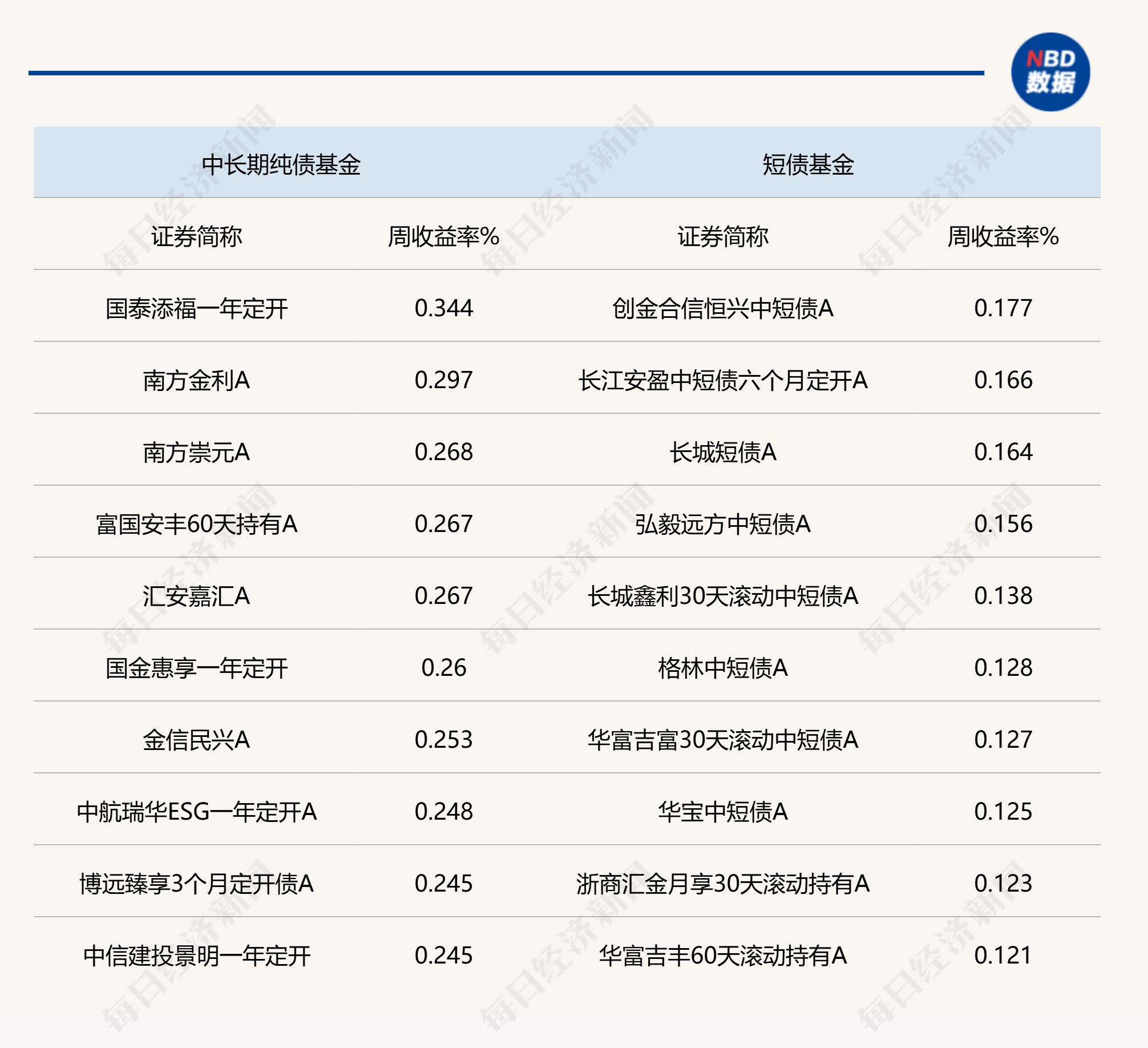
Core Viewpoint - The recent rebound in A-shares has led to a withdrawal of funds from the bond market, resulting in an increase in bond yields, while pure bond funds have underperformed compared to bond funds with rights [1][2]. Group 1: Market Performance - A-shares experienced a strong performance in the latter half of last week, supported by favorable news, which caused a shift in funds away from the bond market, leading to an increase in bond yields [2]. - The yield on the 10-year government bond rose from 1.82% to 1.85%, while the yield on the 5-year AAA corporate bond decreased slightly from 2.1% to 2.08% [2]. - The average performance of medium to long-term pure bond funds was only 0.02%, a decline from the previous week, while short-term bond funds averaged 0.04% [2]. Group 2: Fund Performance - Some bond funds with rights achieved significant weekly returns, with the Jin Ying Yuan Feng A fund recording a return of 6.01% and 16 secondary bond funds exceeding 2% in returns [2][6]. - The performance of pure bond funds was disappointing, with many yielding less than those with rights, highlighting a divergence in fund performance [2]. Group 3: Market Outlook - The market is currently experiencing a "stock-bond seesaw" effect, with expectations of policy changes influencing bond market dynamics, particularly regarding the anticipated "double reduction" policy [1][4]. - Analysts express caution regarding the bond market, suggesting that the potential for further interest rate cuts is limited, and the necessity for aggressive monetary policy is reduced due to existing fiscal tools [4]. - The overall economic environment is expected to remain under pressure in the fourth quarter, with a likelihood of continued adjustments in the bond market [3][4].

股债跷跷板再度来袭,震荡略偏空
Ning Zheng Qi Huo· 2025-10-27 09:06
1. Report Industry Investment Rating - No relevant information provided 2. Core View of the Report - The bond market is mainly in a volatile state, influenced by the stock - bond seesaw and liquidity factors. The operation of bond futures is more difficult. In the fourth quarter, the bond market may form a slightly bearish volatile pattern under the action of the stock - bond seesaw [2][30] 3. Summary According to the Table of Contents Chapter 1: Market Review - The stock - bond seesaw logic has led the bond market into a continuous downward trend, but on the weekly level, it is still in a high - level volatile trend. On the daily level, it is at the neckline of the long - term high - level volatility and has a demand for a volatile rebound. The combination of liquidity and the stock - bond seesaw logic increases the difficulty of bond market operation [9] Chapter 2: Overview of Important News - On October 27, the central bank will conduct a 900 billion yuan MLF operation with a 1 - year term, and the net MLF injection this month will reach 200 billion yuan, which is the 8th consecutive month of increased MLF renewal [13] - The Fourth Plenary Session of the 20th Central Committee announced the goal of achieving significant leaps in economic, technological, national defense, comprehensive national strength and international influence by 2035 [15] - In September, the added value of large - scale industries increased by 6.5% year - on - year, and the total retail sales of consumer goods in September was 4.1971 trillion yuan, a year - on - year increase of 3.0% [15][16] - From January to September 2025, the national fixed - asset investment (excluding rural households) was 37.1535 trillion yuan, a year - on - year decrease of 0.5% [15] Chapter 3: Analysis of Important Influencing Factors 3.1 Economic Fundamentals - In September, the overall economic data showed that the endogenous driving force of the economy was strengthening, and the downward pressure on the economy was weakened. If counter - cyclical regulation continues to increase, the economic fundamentals will be continuously bearish for the bond market [17] 3.2 Policy Aspect - The central bank will continue to implement a moderately loose monetary policy. In August, the narrowing of the M1 - M2 gap indicated that economic activities had increased. The year - on - year growth rate of the stock of social financing increased slightly, and the monthly new social financing mainly relied on government bond issuance [20] 3.3 Capital Aspect - After July 25, DR007 continued to decline, and the cost of funds decreased. The Fed's interest rate cut in the second half of the year may open up more space for domestic monetary policy easing, but the adjustment of domestic monetary policy depends on domestic demand. The central bank will conduct a 900 billion yuan MLF operation on October 27 to maintain liquidity [23] 3.4 Supply - demand Aspect - The National Development and Reform Commission will allocate the third batch of funds for the replacement of old consumer goods with new ones this year. The issuance of special bonds and special treasury bonds has basically been realized, and the market is waiting for the effects and implementation of relevant policies [25] 3.5 Sentiment Aspect - The stock - bond cost - performance ratio has broken through the short - term volatile range and declined, indicating that the market's attention to the stock market is greater than that to the bond market. The short - term bonds are more affected by the capital aspect, and the long - term bonds are more affected by the stock - bond seesaw [27] Chapter 4: Market Outlook and Investment Strategy - After the successful conclusion of the Fourth Plenary Session of the 20th Central Committee, the A - share market broke through the volatile range and rose. The economic data in September showed that the downward pressure on the economy increased, and counter - cyclical regulation may continue to increase. The bond market operation is difficult under the combined action of the stock - bond seesaw and liquidity. In the fourth quarter, the bond market may be in a slightly bearish volatile pattern [30]
信用周报20251026:2025Q3,理财资负两端有何变化?-20251027
Western Securities· 2025-10-27 09:03
1. Report Industry Investment Rating No relevant content provided. 2. Core Viewpoints of the Report - In Q3 2025, the "deposit shift" boosted the scale of bank wealth management to grow beyond expectations. The market is dominated by fixed - income wealth management products, but hybrid products showed significant growth momentum. The scale of "fixed - income +" wealth management products also increased [1][12][18]. - In Q3 2025, cash and bank deposits were increased on the asset side, and the proportion of bonds decreased. The leverage ratio of wealth management products dropped to a recent low [24][25]. - In the future, the scale of bank wealth management is expected to continue growing due to the "comparison effect" caused by the decline in deposit interest rates. The wealth management industry needs to build a more refined and systematic asset allocation and risk management system [2][27][30]. - In the short term, credit bonds may fluctuate under the influence of factors such as Sino - US trade negotiations, the new public fund fee policy, and the stock - bond seesaw. The short - to - medium - term credit bonds still have allocation value, and long - term and ultra - long - term bonds may have room for spread compression [3][39]. 3. Summary According to Relevant Catalogs 3.1 2025 Q3 Bank Wealth Management Market Observation 3.1.1 Liability Side - As of the end of Q3 2025, the total market wealth management product scale was 32.13 trillion yuan, a year - on - year increase of 9.42%, and a single - quarter increase of 1.46 trillion yuan in Q3, higher than the same period in history [12]. - The year - on - year growth of wealth management scale deviated from the weekly high - frequency data of Puyi Standard. The large growth in wealth management scale in Q3 with a general performance in the bond market was due to the mismatch between wealth management asset allocation and the bond market structure. Wealth management mainly held short - term credit bonds [15]. - Fixed - income wealth management products dominated the market, while hybrid products showed significant growth in Q3. The scale of "fixed - income +" wealth management products reached 17.83 trillion yuan, accounting for 57.8% of the total wealth management scale [18]. - The proportion of wealth management products of wealth management companies increased quarter by quarter, exceeding 90% at the end of Q3 [20]. 3.1.2 Asset Side - As of the end of Q3 2025, the proportion of cash and bank deposits rose to 27.5%, and the proportion of bonds, the largest allocated asset, decreased to 40.4%, a 1.4 - percentage - point decrease from the end of Q2 [24]. - The leverage ratio of wealth management products dropped to 106.65%, a year - on - year and quarter - on - quarter decrease of 0.84 and 0.8 percentage points respectively [25]. 3.1.3 Summary and Outlook - In Q3 2025, the bank wealth management market performed well, with a strong year - on - year scale growth. Fixed - income products contributed the largest scale increment, and the layout of equity - related products increased [26]. - In the future, the scale of bank wealth management is expected to grow, and the wealth management industry needs to build a more refined and systematic asset allocation and risk management system [27][30]. 3.2 Credit Bond Yield Overview - From October 20 - 24, 2025, credit bond yields mostly declined. Non - financial credit bonds performed better than financial bonds, and long - term non - financial credit bonds performed better than short - to - medium - term ones [4][31]. - In terms of different varieties, the yields of urban investment bonds all declined, with long - term bonds performing better. The yields of most industrial bonds declined, and the overall performance was weaker than that of urban investment bonds. The yields of most financial bonds increased [31][32]. 3.3 Primary Market 3.3.1 Issuance Volume - From October 20 - 24, 2025, the credit bond issuance scale increased both year - on - year and quarter - on - quarter, and the net financing scale increased quarter - on - quarter and decreased year - on - year. The net financing scale of urban investment bonds and financial bonds increased quarter - on - quarter, while that of industrial bonds decreased [43]. 3.3.2 Issuance Cost - The average credit bond issuance interest rate decreased quarter - on - quarter. The average issuance interest rates of industrial bonds and financial bonds decreased by 0.8bp and 10bp respectively, while that of urban investment bonds increased by 1.3bp [50]. 3.3.3 Issuance Term - The average credit bond issuance term increased quarter - on - quarter. The average issuance terms of urban investment bonds, industrial bonds, and financial bonds increased by 0.19 years, 0.04 years, and 0.04 years respectively [51]. 3.3.4 Cancellation of Issuance - From October 20 - 24, 2025, the number and scale of cancelled credit bond issuances increased quarter - on - quarter [52]. 3.4 Secondary Market 3.4.1 Trading Volume - Except for the decline in the trading volume of bank perpetual bonds and insurance sub - bonds, the trading volume of other credit bond varieties rebounded. The trading volume of urban investment bonds and industrial bonds increased by more than 100 billion yuan [59]. 3.4.2 Trading Liquidity - The turnover rates of urban investment bonds, industrial bonds, and financial bonds all decreased. For urban investment bonds, the turnover rate of bonds with a term of less than 1 year decreased the most; for industrial bonds, the turnover rates of bonds with terms of less than 1 year, 1 - 3 years, and more than 10 years decreased; for financial bonds, the turnover rates of bonds with terms of 3 - 5 years and 5 - 7 years decreased, while others increased [61]. 3.4.3 Spread Tracking - Except for a slight 1bp widening of the 10 - year AAA - rated urban investment bonds, the spreads of other urban investment bonds narrowed. The 7 - year bonds had the largest narrowing amplitude, up to 10bp [68]. - Except for the widening of the spread of AAA - rated automobile industry in industrial bonds, the spreads of other industries narrowed. The average narrowing amplitude of AAA - rated industrial bonds was slightly smaller than that of AA - rated ones [73]. - The spreads of bank secondary capital bonds and perpetual bonds mostly narrowed, and the spreads of securities firm sub - bonds and insurance sub - bonds also mostly narrowed [74][75]. 3.5 Weekly Hot Bonds Overview - The top 20 urban investment bonds, industrial bonds, and financial bonds in terms of liquidity scores were selected for investors' reference [78]. 3.6 Credit Rating Adjustment Review - According to domestic rating agencies, there were no bond rating adjustments last week [83].
宁证期货今日早评-20251027
Ning Zheng Qi Huo· 2025-10-27 02:10
Report Summary 1. Report Industry Investment Ratings No industry investment ratings are provided in the report. 2. Core Views - **Gold**: The US September CPI data led to market expectations of Fed rate - cuts. The strong US dollar is bearish for gold, but gold buying power remains strong. Gold is expected to oscillate at a high level in the medium - term [1]. - **Soda Ash**: The domestic soda ash market is weakly stable. The 01 contract is expected to oscillate in the short - term, with support at 1220. It is recommended to wait and see or do short - term long on dips [2]. - **Rebar**: The medium - long - term over - capacity in the steel industry may be alleviated, but short - term impact is limited. Rebar demand is improving but at a low level. The price is expected to oscillate at a low level in the short - term [4]. - **Iron Ore**: Supply is relatively stable, and demand is supported by high iron - water levels. However, the profit contraction of steel mills and the end of the peak season limit demand. The price is expected to oscillate in the short - term [5]. - **Coking Coal**: Supply is tightening, and demand from downstream and intermediate sectors is strong. The coal price is strong, and the futures price is expected to be supported in the short - term [6]. - **Pigs**: With increased demand due to lower temperatures and reduced slaughter pressure, the pig price may strengthen after adjustment. The futures price is expected to rebound at the bottom in the short - term [7]. - **Palm Oil**: As the traditional production - reduction season approaches in November, the futures price may recover. However, due to expected ample supply, the spot price is under pressure. The price is expected to oscillate in the short - term [7]. - **Soybeans**: Imported soybean spot market is firm, and domestic demand is strong. Bean 2 is expected to stabilize in the short - term. Domestic new - season soybeans are strong [8]. - **Medium - Long - Term Treasury Bonds**: Liquidity is loose, which supports the bond market. But with the stock market breaking through the previous range, the bond market operation is more difficult. It is expected to oscillate with a slightly bearish bias in the medium - term [9]. - **Silver**: US economic data in October is positive, which is bullish for silver. With a high probability of rate - cuts in October, the downside is limited. It is long - term bullish and short - term oscillating [9]. - **PVC**: Domestic PVC production is expected to increase, while demand is entering the off - season. The price is expected to oscillate in the short - term, with support at 4695 for the 01 contract. It is recommended to wait and see [10]. - **Methanol**: Domestic methanol production is at a high level, and downstream demand is stable. The port inventory is accumulating slightly. The 01 contract is expected to oscillate weakly in the short - term, with resistance at 2300. It is recommended to wait for further stabilization [11]. - **Crude Oil**: The crude oil market is in a game between short - term geopolitical bullish factors and long - term supply - demand bearish factors. A short - term low - level bullish approach is recommended [11]. 3. Summary by Variety Gold - US September CPI rose 3% year - on - year, lower than expected. Core CPI and service inflation slowed. The market fully priced in two 25 - basis - point Fed rate cuts [1]. - The strong US dollar is bearish for gold, but buying power remains strong. Gold may oscillate at a high level in the medium - term [1]. Soda Ash - The national mainstream price of heavy - quality soda ash is 1271 yuan/ton, with stable recent prices. Weekly production is 74.05 tons, down 3.93% week - on - week [2]. - Total inventory of soda ash manufacturers is 170.21 tons, up 0.09% week - on - week. The float glass market has stable start - up, rising inventory, and average trading [2]. Rebar - The blast - furnace start - up rate of 247 steel mills is 84.71%, up 0.44 percentage points week - on - week. The iron - making capacity utilization rate is 89.94%, down 0.39 percentage points [4]. - Steel mill profitability is 47.62%, down 7.79 percentage points week - on - week. Daily average pig - iron output is 239.9 tons, down 1.05 tons week - on - week [4]. Iron Ore - The total inventory of imported iron ore at 45 ports is 14423.59 tons, up 145.32 tons week - on - week. The daily average port clearance volume is 312.65 tons, down 3.07 tons [5]. - The number of ships at ports is 107, down 17. Supply is stable, and demand is supported by high iron - water levels, but profit contraction affects demand [5]. Coking Coal - The capacity utilization rate of independent coking enterprises is 73.47%, down 0.77%. Daily coke production is 64.61 tons, down 0.68 tons [6]. - Coke inventory is 58.64 tons, up 1.35 tons. Coking coal inventory is 1029.70 tons, up 32.33 tons. Supply is tightening, and demand is strong [6]. Pigs - As of October 24, the average slaughter weight of pigs is 123.21 kg, down 0.22 kg. The weekly slaughter start - up rate is 35.3%, down 0.34% [7]. - The profit of purchasing piglets for breeding is - 279.65 yuan/head, up 67.28 yuan/head. The self - breeding profit is - 149.54 yuan/head, up 53.28 yuan/head [7]. Palm Oil - The estimated export volume of Malaysian palm oil from October 1 - 25 is 1283814 tons, down 0.4%. The futures price may recover in November, but spot price is under pressure [7]. Soybeans - In the 43rd week (October 18 - 24), the actual soybean crushing volume of domestic oil mills is 236.74 tons, with a start - up rate of 65.13%. The 44th - week start - up rate is expected to decline slightly [8]. Medium - Long - Term Treasury Bonds - The central bank will conduct 900 billion yuan of MLF operations on October 27, with a net investment of 200 billion yuan. Liquidity is loose, but the bond market operation is difficult due to the stock market [9]. Silver - The US October manufacturing, service, and composite PMI are all better than expected. Economic data is positive for silver, and the downside is limited due to expected rate - cuts [9]. PVC - The price of East China SG - 5 type PVC is 4600 yuan/ton, down 10 yuan/ton. The capacity utilization rate is 76.57%, down 0.12% week - on - week [10]. - Social inventory is 103.52 tons, down 0.13% week - on - week. Domestic production is expected to increase, and demand is entering the off - season [10]. Methanol - The market price of methanol in Jiangsu Taicang is 2240 yuan/ton, down 10 yuan/ton. The domestic weekly capacity utilization rate is 87.4%, down 2.13% [11]. - Port inventory is 151.22 tons, up 2.08 tons week - on - week. The 01 contract is expected to oscillate weakly in the short - term [11]. Crude Oil - After the US sanctions on Russian oil companies, Reliance Industries stops buying Russian oil. The market is in a game between short - term geopolitical and long - term supply - demand factors [11].
周观:政策扰动期,债市且战且退(2025年第41期)
Soochow Securities· 2025-10-26 13:38
Group 1: Report Industry Investment Rating - No relevant content provided Group 2: Core Viewpoints of the Report - The current probability of further interest rate cuts is low, and even if a cut occurs, its downward push on interest rates will be limited. It is recommended to approach the bond market with a volatile mindset and be cautious about chasing up [1][16][17] - After the release of inflation data lower than market expectations, the market generally believes that the Fed will continue to cut interest rates next week. However, inflation risks are rising, and the market has overlooked the possibility of an inflation rebound [4][19][26] Group 3: Summary by Directory 1. One - Week Viewpoints Q1: Impact of "double - cut" expectations on the bond market - This week (2025.10.20 - 2025.10.24), the yield of the 10 - year active Treasury bond rose 3.5bp from 1.745% last Friday to 1.78% [1][12] - Throughout the week, the bond market traded around trade - war news and expectations of further monetary policy easing. The trade - war was highly affected by external factors, while the expectation of monetary policy easing was triggered by news of small and medium - sized banks lowering deposit rates and weak economic data [16] Q2: Future changes in US Treasury yields after the release of a series of US economic data - This week (10.20 - 10.24), the short - and long - term US Treasury yields slightly recovered from the previous downward trend. US stocks rose, and the gold price dropped significantly. The overseas market's risk - aversion sentiment declined marginally [2][19] - In September, the US CPI increased by 0.1% year - on - year, falling short of market expectations across the board. The US Markit PMI in October reached the second - highest level this year, exceeding expectations. The September CPI data strengthened the expectation of interest rate cuts, and the market expects two more cuts this year [4][19][22] 2. Domestic and Overseas Data Aggregation 2.1 Liquidity Tracking - From 2025/10/20 to 2025/10/24, the total net injection in the open - market operations was 781 billion yuan [30] 2.2 Domestic and Overseas Macroeconomic Data Tracking - The total transaction area of commercial housing generally increased. Steel prices showed mixed trends, and LME non - ferrous metal futures official prices all rose [56][58] - Compared with half a month ago, both short - and long - term US Treasury yields declined. The term spread between the 10 - year and 2 - year US Treasury bonds decreased, while that between the 10 - year and 3 - month US Treasury bonds increased [75][76][79] 3. One - Week Review of Local Government Bonds 3.1 Primary Market Issuance Overview - This week, 79 local government bonds were issued in the primary market, with a total issuance amount of 247.228 billion yuan, a repayment amount of 80.51 billion yuan, and a net financing amount of 165.751 billion yuan. The main investment directions were comprehensive, urban and rural infrastructure construction, and shantytown renovation [86] 3.2 Secondary Market Overview - This week, the stock of local government bonds was 53.64 trillion yuan, with a trading volume of 33.994 billion yuan and a turnover rate of 0.63%. The top three provinces with the most actively traded local government bonds were Guizhou, Guangdong, and Shandong [102] 3.3 This Month's Local Government Bond Issuance Plan - No detailed content provided other than the plan exists 4. One - Week Review of Credit Bonds 4.1 Primary Market Issuance Overview - This week, 527 credit bonds were issued in the primary market, with a total issuance of 468.291 billion yuan, a total repayment of 335.832 billion yuan, and a net financing of 132.459 billion yuan, a decrease of 47.204 billion yuan compared with last week [107] 4.2 Issuance Interest Rates - The issuance interest rates of short - term financing bonds decreased by 0.73bp, medium - term notes increased by 3.91bp, enterprise bonds increased by 47.45bp, and corporate bonds decreased by 7.76bp [119] 4.3 Secondary Market Transaction Overview - This week, the total trading volume of credit bonds was 360.658 billion yuan [120] 4.4 Maturity Yields - The maturity yields of short - term financing bonds, medium - term notes, enterprise bonds, and urban investment bonds all decreased [123][124][126] 4.5 Credit Spreads - The credit spreads of short - term financing bonds and medium - term notes narrowed comprehensively, those of enterprise bonds generally narrowed, and those of urban investment bonds narrowed comprehensively [128][132][134] 4.6 Rating Spreads - The rating spreads of short - term financing bonds and medium - term notes generally narrowed, those of enterprise bonds showed a differentiated trend, and those of urban investment bonds generally narrowed [136][139][144] 4.7 Trading Activity - This week, the top five most actively traded bonds in each bond type are listed in the report, and the industrial sector had the largest weekly trading volume of bonds, reaching 226.81 billion yuan [149][150] 4.8 Issuer Credit Rating Changes - There were no bonds with upgraded ratings or outlooks this week [151]
国债周报:债市延续震荡,关注年底配置力量-20251025
Wu Kuang Qi Huo· 2025-10-25 14:02
Report Industry Investment Rating No relevant content provided. Core Viewpoints of the Report - The current uncertainty in tariff progress is high, and the short - term decline in market risk appetite is conducive to the repair of the bond market. In the fourth quarter, the bond market still needs to focus on the fundamentals and institutional allocation power. The bond market is expected to maintain an overall shock under the background of weak domestic demand recovery and improved inflation expectations. If the stock market cools down and the allocation power gradually increases, the bond market is expected to repair shockingly [11]. - The economic growth rate in the third quarter slightly exceeded expectations. Exports were resilient in September, and the growth rate of industrial added value exceeded expectations. However, the growth rates of consumption and investment continued to slow down. In the future, attention should be paid to the driving effect of new policy - based financial instruments and the incremental debt balance limit of 500 billion yuan on the growth rate in the fourth quarter [11]. Summary According to Relevant Catalogs 1. Weekly Assessment and Strategy Recommendation Economic and Policy Situation - The GDP growth rate in the third quarter exceeded expectations, showing a pattern of strong supply and weak demand. In September, industrial added value remained resilient, while the consumption and investment sectors continued to recover weakly. The "anti - involution" has boosted price expectations, but the coordination between demand and production still needs to be observed. The Fourth Plenary Session emphasized achieving the annual economic and social development goals, and the pressure to achieve the goals this year is not great. Policy may focus more on the connection with next year, and there is no strong need for additional measures in the fourth quarter. Overseas, the US inflation data in September was slightly lower than expected, strengthening the logic of further interest rate cuts [10]. - In the first three quarters, China's GDP was 1,015,036 billion yuan, with a year - on - year increase of 5.2% at constant prices. In September, social consumer goods retail sales were 419.71 billion yuan, a year - on - year increase of 3.0%. From January to September, national fixed - asset investment (excluding rural households) was 3,715.35 billion yuan, a year - on - year decrease of 0.5%. In September, the added value of large - scale industries increased by 6.5% year - on - year [10]. - From January to September, the sales area of newly built commercial housing in China was 658.35 million square meters, a year - on - year decrease of 5.5%. National real estate development investment was 677.06 billion yuan, a year - on - year decrease of 13.9%. The funds in place for real estate development enterprises were 722.99 billion yuan, a year - on - year decrease of 8.4% [10]. - The new Japanese Prime Minister is preparing an economic stimulus plan worth more than 13.9 trillion yen (about $92.19 billion) [10]. - In the first three quarters of this year, China's total foreign - related payments and receipts reached $11.6 trillion, a record high for the same period. Cross - border capital inflows were $119.7 billion, and the bank settlement and sales surplus was $63.2 billion, both higher than the same period last year. In September, the cross - border income and expenditure of non - bank sectors such as enterprises and individuals totaled $1.37 trillion, a month - on - month increase of 7% [10]. - On the morning of October 25, the economic and trade teams of China and the United States began economic and trade consultations in Kuala Lumpur, Malaysia [10]. - In September, the US unadjusted CPI increased by 3% year - on - year, lower than the expected 3.1%. The core CPI increased by 3% year - on - year, also lower than the expected 3.1% [10]. - The preliminary value of the US S&P Global Manufacturing PMI in October was 52.2, and the service PMI preliminary value was 55.2, both exceeding expectations [10]. Liquidity - This week, the central bank conducted 867.2 billion yuan in reverse repurchase operations, with 789.1 billion yuan in reverse repurchases maturing, resulting in a net investment of 78.1 billion yuan. The DR007 interest rate closed at 1.41% [11]. Interest Rates - The latest 10 - year treasury bond yield was 1.85%, a week - on - week increase of 2.52 BP; the 30 - year treasury bond yield was 2.21%, a week - on - week increase of 1.20 BP. The latest 10 - year US treasury bond yield was 4.02%, with no week - on - week change [11]. Summary - The current bond market is expected to maintain an overall shock. In terms of rhythm, attention should be paid to the seesaw effect between stocks and bonds. If the stock market cools down and the allocation power gradually increases, the bond market is expected to repair shockingly [11]. 2. Futures and Spot Markets - The report presents the closing prices, annualized discounts, settlement prices, and net basis of T, TL, TF, and TS contracts, as well as the closing prices and trading volumes of TS and TF contracts [16][22][25][28]. 3. Main Economic Data Domestic Economy - In the second quarter of 2025, China's GDP actual growth rate was 5.4%, exceeding market expectations. In September, the manufacturing PMI was 49.8%, an increase of 0.4 percentage points from the previous value, while the service PMI was 50.1%, a decrease of 0.4 percentage points from the previous value [45]. - In September, the CPI decreased by 0.3% year - on - year, and the core CPI increased by 1.0% year - on - year. The PPI decreased by 2.3% year - on - year. In terms of month - on - month data, the CPI increased by 0.1%, the core CPI remained unchanged, and the PPI remained unchanged [54]. - In September, China's exports increased by 8.3% year - on - year, and imports increased by 7.4% year - on - year. Exports to the US decreased by 27.0% year - on - year, while exports to ASEAN increased by 15.6% year - on - year [57]. - In September, the industrial added value increased by 6.4% year - on - year, and the social consumer goods retail sales increased by 3.0% year - on - year [60]. - From January to September, fixed - asset investment decreased by 0.5% year - on - year, real estate development investment decreased by 13.9% year - on - year, infrastructure investment (excluding electricity) increased by 1.1% year - on - year, and manufacturing investment increased by 4.0% year - on - year [63]. - In September, the new construction area of houses decreased by 18.9% year - on - year, and the construction area of houses decreased by 9.4% year - on - year [66]. - In September, the completion - end data decreased by 15.45% year - on - year, and the new - house sales data in 30 large - and medium - sized cities weakened recently [69]. Foreign Economy - In the second quarter, the US GDP nominal annualized figure was $3,033.1 billion, with an actual year - on - year growth rate of 1.99% and a quarter - on - quarter growth rate of 3.0%. In September, the US unadjusted CPI increased by 3% year - on - year [72]. - In August, the US durable goods orders were $312.4 billion, a year - on - year increase of 7.63%. The seasonally - adjusted non - farm employment population increased by 22,000, and the unemployment rate was 4.3% [75]. - In September, the US ISM manufacturing PMI was 49.1, and the non - manufacturing PMI was 50. In the second quarter, the EU GDP increased by 1.5% year - on - year and 0.2% quarter - on - quarter [78]. - In September, the eurozone CPI increased by 2.2% year - on - year, the core CPI increased by 0.1% month - on - month. The manufacturing PMI was 49.8, and the service PMI was 51.3 [81]. 4. Liquidity - In September, the M1 growth rate was 7.2%, and the M2 growth rate was 8.4%. The M1 - M2 scissors difference continued to narrow. The social financing increment was 3.53 trillion yuan, a year - on - year decrease of 233.9 billion yuan [86]. - In September, the growth rate of social financing in the government bond segment slowed down, while the financing of the real - economy sector remained stable. The social financing growth rate of residents and enterprises was 5.94%, and the government bond growth rate was 20.20% [89]. - In September, the MLF balance was 5.85 trillion yuan, and the net MLF investment was 300 billion yuan. This week, the central bank conducted 867.2 billion yuan in reverse repurchase operations, with a net investment of 78.1 billion yuan, and the DR007 interest rate closed at 1.41% [92]. 5. Interest Rates and Exchange Rates - The report presents the changes in various market interest rates including repurchase rates, treasury bond yields, and US treasury bond yields [95]. - The report also shows the trends of treasury bond yields, bank - to - bank pledged repurchase rates, US treasury bond yields, and exchange rates [99][102][104].
【银行】如何看待理财三季报的3个“异象”?——《中国银行业理财市场季度报告(2025年三季度)》点评(王一峰/董文欣)
光大证券研究· 2025-10-25 00:06
Core Viewpoint - The report highlights the growth and stability of the Chinese banking wealth management market as of Q3 2025, despite market fluctuations in equities and bonds, with a notable increase in total assets under management and a shift in asset allocation strategies [5][6]. Group 1: Wealth Management Scale and Growth - As of Q3 2025, the total wealth management scale reached 32.13 trillion, with a quarterly increase of 1.46 trillion, reflecting a year-on-year growth of approximately 600 billion, and a growth rate of 9.4% compared to Q2 2025 [6][8]. - The estimated total scale may have exceeded 33 trillion by the end of Q3, driven by the "deposits outflow" phenomenon [6]. Group 2: Product Structure and Composition - The structure of wealth management products remained stable, with fixed-income products accounting for 97.1% of the total, maintaining a narrow fluctuation around this central point since 2024 [7]. - Open-ended wealth management products accounted for 80.6% of the total, with a slight decrease of 0.3 percentage points from Q2 2025, while closed-end products saw an increase in their market share [7]. Group 3: Asset Allocation Trends - By the end of Q3 2025, the total asset allocation reached 34.33 trillion, with a quarterly increase of 1.36 trillion, primarily driven by cash and deposits, which increased by 1.27 trillion [8]. - The proportion of cash and deposits rose to 27.5%, marking a recent high, while bond assets saw a decrease to 53.5% [8]. Group 4: Market Position of Wealth Management Companies - Wealth management companies' market share surpassed 90% for the first time, reaching 91.1% as of Q3 2025, with a continuous expansion of distribution channels [9]. - The number of distribution channels increased to 583, reflecting a year-on-year growth of 35 channels, indicating a strengthening competitive position for wealth management companies [9].

“存款搬家”持续 银行理财三季度存续规模增1.46万亿元
Guo Ji Jin Rong Bao· 2025-10-24 19:59
Core Insights - The banking wealth management market has seen a significant increase in the scale of existing products, driven by a "deposit migration" phenomenon amid declining interest rates [1][2]. Group 1: Market Overview - As of the end of Q3 2025, the total scale of bank wealth management products reached 32.13 trillion yuan, a year-on-year increase of 9.42% [2]. - The number of existing wealth management products rose to 4.39 million, an increase of 10.01% year-on-year [2]. - The growth in scale is attributed to the "price effect" leading to deposit disintermediation, despite pressure on net asset values [2][3]. Group 2: Product Dynamics - The dominance of wealth management companies has increased, with their products accounting for 91.13% of the total market scale [3]. - The number of banks offering wealth management products has decreased from 194 to 181, with a year-on-year decline of 28.01% in the scale of bank-managed products [3]. - The appeal of closed-end products has risen, with their scale reaching 6.24 trillion yuan, while open-end products saw a slight decline [4]. Group 3: Product Structure and Investor Behavior - The market saw a total of 6,048 new closed-end products launched in Q3 2025, representing 76.90% of all new products [4]. - Investors are increasingly favoring closed-end products for their higher yields, especially in a volatile market environment [4]. - Wealth management companies are adjusting their product structures to increase the issuance of closed-end products to optimize asset allocation and enhance overall yield [4].
中加基金权益周报︱科技板块高位调整,债市呈现利差压缩行情
Xin Lang Ji Jin· 2025-10-24 07:52
Market Overview and Analysis - The primary market saw the issuance of government bonds, local government bonds, and policy financial bonds amounting to 276 billion, 32.3 billion, and 142.4 billion respectively, with net financing of 16.6 billion, -19.8 billion, and 23.3 billion [1] - Non-financial credit bonds totaled 401.2 billion in issuance, with a net financing amount of 182 billion [1] - One new convertible bond was issued, expected to raise 1.7 billion [1] Secondary Market Review - Long-term interest rate bonds and perpetual bonds performed well, influenced by factors such as the stock-bond relationship, liquidity easing, and institutional behavior [2] Liquidity Tracking - The central bank conducted a 1 trillion buyout reverse repurchase operation for six-month terms, with a total buyout of 4 trillion this month, marking the highest level in nearly seven months, indicating continued liquidity easing [3] Policy and Fundamentals - The Ministry of Finance set a local bond balance limit of 500 billion [4] - September's import and export data and M1 exceeded expectations, while credit, social financing, and CPI were slightly below expectations [4] - In the overseas market, a video call between US and China trade leaders raised concerns about the credit quality of US regional banks, with Powell hinting at the end of balance sheet reduction; US Treasury yields fell, and US stocks initially rose before declining [4] Equity Market - A-shares experienced strong risk aversion, with the Wande All A index dropping 3.45% over the week; the previously high-performing TMT sector led the decline, with electronics down 7.14%, media down 6.27%, and communications down 5.92%, while banks and coal stocks led the gains [5] - Trading volume decreased, with an average daily trading volume of 2.19 trillion, down 234.579 billion week-on-week [5] - As of October 16, 2025, the total financing balance for All A was 2.440123 trillion, an increase of 10.908 billion from October 9 [5] - Future focus includes the progress of US-China negotiations and the sustainability of market style shifts [5] Bond Market Strategy Outlook - Ahead of the Fourth Plenary Session and the upcoming high-level US-China talks, the policy environment is expected to remain stable, with a low likelihood of contractionary measures, providing trading opportunities in the bond market based on changes in risk appetite and expectations of easing policies [6] - However, bond trading space remains highly dependent on fundamental trends and geopolitical developments, necessitating close attention to third-quarter GDP data and policy signals from key meetings and public statements [6] - In the current uncertain environment, the focus should be on controlling volatility, with increased allocation value in reasonably valued bank convertible bonds [6]
宁证期货今日早评-20251024
Ning Zheng Qi Huo· 2025-10-24 02:43
Group 1: Report Core Views - The supply and demand still suppress oil prices, but short - term geopolitical trends support oil prices, with a short - term low - level bullish mindset for oil [1] - The risk - aversion sentiment rises again, gold rebounds slightly, and the US dollar index has increased downward pressure, which is bullish for gold. Gold may oscillate at a high level in the medium term [1] - China's rubber inventory continues to decline, and the tire operating rate increases, driving the market upward. A low - level bullish mindset is adopted for rubber [3] - PTA has many maintenance expectations, low polyester inventory, and poor polyester operating load. It is advisable to follow the upward trend of crude oil and take a low - level bullish operation [3] - The futures price of lithium carbonate continues the oscillating and strengthening trend. In October, although the supply increases steadily, the strong demand in the power and energy storage fields will lead to a tight supply situation [4] - The demand for steel products recovers this week, the supply - demand contradiction eases, and the high cost supports steel prices. Steel prices may oscillate in the short term [5] - The supply - demand structure of coking coal is tight in the short term, and the market sentiment is positive. Coking coal prices are expected to continue to rise slightly [5] - After the Fourth Plenary Session of the 20th CPC Central Committee, the stock market may react in the short term. The bond market operation is difficult, with a medium - term slightly bearish oscillating mindset [6] - Although silver follows gold's decline, due to the almost certain interest rate cut in October, the decline of silver is limited. It is long - term bullish, short - term oscillating, and there are opportunities to go long [6] - The upward trend of national hog prices slows down. After the oscillating adjustment, there may be a bullish expectation. Hog futures prices stop falling and rebound, maintaining a bottom - oscillating and rebounding pattern [7] - The production of Malaysian palm oil increases, and the inventory pressure increases. The domestic supply is abundant, and the demand is weak. Palm oil will maintain an oscillating and weakening trend in the short term [7] - The spot market of imported soybeans is strong, and domestic demand is strong. Bean No. 2 oscillates and stabilizes, and Bean No. 1 maintains a bullish pattern [8] - The domestic methanol operating rate is high, the downstream demand is stable, and the port inventory accumulates slightly. The methanol 01 contract is expected to oscillate weakly in the short term [10] - The float glass operation is stable, the inventory rises, and the downstream demand is weak. The domestic soda ash market oscillates weakly and stably, and the soda ash 01 contract is expected to oscillate in the short term [11] - The supply - side pressure of polypropylene eases slightly, the demand - side operating rate rises slightly, and the inventory decreases. The PP 01 contract is expected to oscillate in the short term [12] Group 2: Specific Product Data and Analysis Crude Oil - On October 23, the US imposed new sanctions on Russia, and a US B - 1B bomber approached the Venezuelan coast [1] Gold - Putin said that US sanctions on Russia would not have a major impact on the Russian economy, and the US - Russia meeting was postponed [1] Rubber - In September 2025, China's rubber tire outer - tube production was 103.487 million, a year - on - year increase of 0.2%. From January to September, the production increased by 1.5% year - on - year to 8.99386 billion. The tire capacity utilization rate continued to rise [3] PTA - PTA social inventory is 314.13 million tons, a decrease of 5.03 million tons from the previous period. PTA capacity utilization rate is 75.98%, and polyester comprehensive capacity utilization rate is around 87.51% [3] Lithium Carbonate - SMM battery - grade lithium carbonate index price is 74,821 yuan/ton, a daily increase of 458 yuan/ton. The average price of battery - grade lithium carbonate is 74,800 yuan/ton, a daily increase of 450 yuan/ton [4] Steel and Coking Coal - As of October 23, the weekly output of rebar was 2.0707 million tons, an increase of 59,100 tons from last week. The factory inventory was 1.8463 million tons, a decrease of 100 tons from last week. The social inventory was 4.3748 million tons, a decrease of 189,300 tons from last week [5] - This week, the capacity utilization rate of 523 coking coal mines was 85.1%, a decrease of 2.3% from the previous period. The daily output of raw coal was 1.91 million tons, a decrease of 51,000 tons from the previous period [5] Bonds - The Fourth Plenary Session of the 20th CPC Central Committee announced the goal of achieving significant leaps in various strengths and reaching the level of medium - developed countries in per capita GDP by 2035 [6] Silver - Vice - Premier He Lifeng will lead a delegation to Malaysia for Sino - US economic and trade consultations from October 24 to 27 [6] Hog - On October 23, the average wholesale price of pork in the national agricultural product market was 17.62 yuan/kg, a decrease of 0.6% from the previous day [7] Palm Oil - From October 1 - 20 in Malaysia, the production of crude palm oil increased by 10.77% compared with the same period last month [7] Soybean - The IGC predicts that the global soybean production in the 2025/26 season will decrease by 1 million tons year - on - year to 428 million tons, the trade volume will increase by 2 million tons to 187 million tons, and the consumption will decrease by 1 million tons to 430 million tons [8] Methanol - The market price of methanol in Jiangsu Taicang is 2,250 yuan/ton, an increase of 8 yuan/ton. The domestic weekly capacity utilization rate of methanol is 87.4%, a decrease of 2.13%. The downstream total capacity utilization rate is 75.11%, a weekly decrease of 1.53% [10] Soda Ash - The mainstream price of heavy - grade soda ash nationwide is 1,271 yuan/ton. The weekly output of soda ash is 740,500 tons, a decrease of 3.93%. The total inventory of soda ash manufacturers is 1.7021 million tons, a weekly increase of 0.09% [11] Polypropylene - The mainstream price of East China drawn - grade polypropylene is 6,597 yuan/ton, an increase of 43 yuan/ton. The capacity utilization rate of polypropylene is 75.01%, a decrease of 0.29% from the previous day [12]