资金面

Search documents
货币市场日报:1月6日
Xin Lang Cai Jing· 2026-01-06 13:19
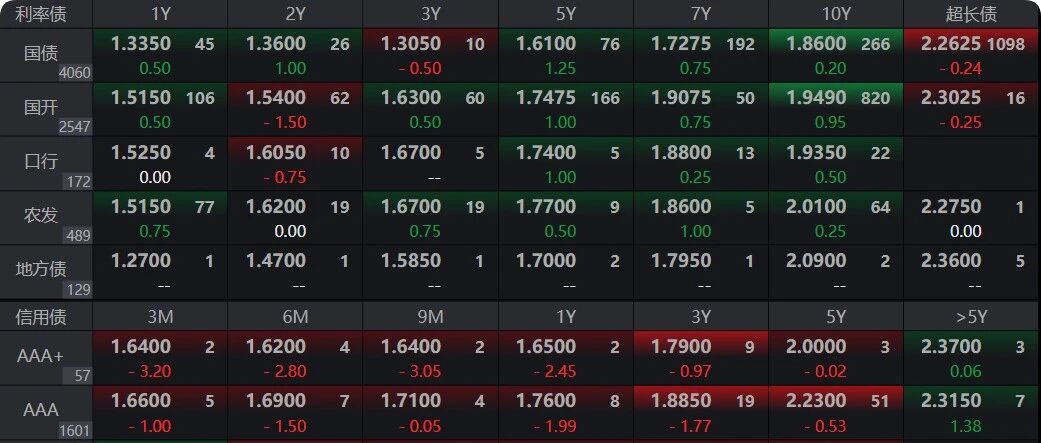
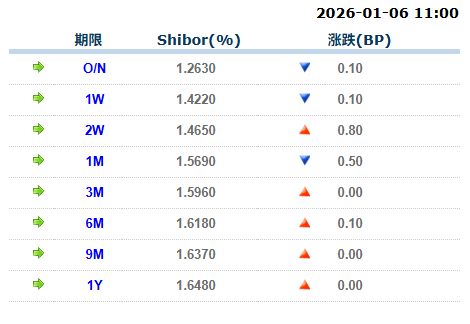
Group 1 - The People's Bank of China conducted a 162 billion yuan 7-day reverse repurchase operation at an interest rate of 1.40%, unchanged from previous levels, resulting in a net withdrawal of 2963 billion yuan due to 3125 billion yuan of reverse repos maturing on the same day [1] - The Shanghai Interbank Offered Rate (Shibor) showed slight fluctuations, with the overnight Shibor decreasing by 0.10 basis points to 1.2630%, and the 7-day Shibor also down by 0.10 basis points to 1.4220%, while the 14-day Shibor increased by 0.80 basis points to 1.4650% [1] - In the interbank pledged repo market, short-term funding rates remained stable, with DR001 and R001 weighted average rates unchanged or down by 0.1 basis points, while DR007 and R007 rates increased slightly [4] Group 2 - The overall funding environment was described as loose, with various rates for overnight and 7-day repos showing a downward trend throughout the day, indicating a continued easing of the funding conditions [8] - In the secondary market for negotiable certificates of deposit, trading sentiment was active, with yields for various maturities showing an upward trend, particularly for 1M and 3M maturities which increased by approximately 2 basis points and 1 basis point respectively [9] - The People's Bank of China emphasized the importance of maintaining a moderately loose monetary policy to support high-quality economic development and stabilize financial markets during its recent work meeting [12][13]

日度策略参考-20260106
Guo Mao Qi Huo· 2026-01-06 02:51
Report Industry Investment Rating No relevant information provided. Report Core Viewpoints - Short - term, the stock index may continue a relatively strong trend, but attention should be paid to the impact of overseas geopolitical events on market risk appetite. In the long - term, the stock index is expected to rise in 2026 based on 2025 [1]. - Asset shortage and weak economy are beneficial to bond futures, but the central bank has recently warned of interest - rate risks, and attention should be paid to the Bank of Japan's interest - rate decision [1]. - Different commodities have various trends, including price increases, oscillations, and potential reversals, with corresponding investment strategies recommended [1]. Summary by Related Catalogs Macro Finance - Short - term, the stock index may continue to be strong, and in the long - term (2026), it is expected to rise on the basis of 2025 due to factors like continuous policy efforts, inflation recovery, capital market reform, and the support of Central Huijin [1]. - Asset shortage and weak economy benefit bond futures, but the central bank warns of interest - rate risks, and the Bank of Japan's interest - rate decision should be watched [1]. Metals Non - ferrous Metals - Copper: The price has further increased due to weak industry fundamentals but positive macro sentiment and continuous premium. However, short - term adjustment risks should be guarded against, and the upward trend is expected to continue [1]. - Aluminum: Domestic electrolytic aluminum has accumulated inventory, but positive macro sentiment and the early fermentation of supply - tightness expectations are likely to keep the price strong [1]. - Alumina: The supply side has a large release space, and the weak industry fundamentals put pressure on the price. However, the current price is near the cost line, so it is expected to oscillate [1]. - Zinc: The fundamentals have improved, the cost center has moved up, recent negative factors have been mostly realized, and market sentiment is volatile, leading to price oscillations [1]. - Nickel: Positive macro sentiment, concerns about supply due to Indonesian events, slow inventory accumulation, and unconfirmed Indonesian policies are likely to keep the short - term price strong. It is recommended to go long at low prices and control risks [1]. - Stainless Steel: Positive macro sentiment, concerns about raw - material supply, a rebound in nickel - iron prices, a slight reduction in social inventory, and an increase in January production plans are likely to keep the short - term futures price strong. It is recommended to go long at low prices, and enterprises should wait for opportunities to sell and hedge [1]. - Tin: The industry association's initiative has put pressure on the price, but considering the tense situation in Congo - Kinshasa, the supply may still be affected. After a short - term decline, the downward space is limited, and low - long opportunities near the support level are recommended [1]. - Precious Metals: Geopolitical risks and international - order uncertainties have boosted the demand for hedging, making the price strong in the short - term. However, the high VIX of silver indicates potential risks. Platinum and palladium are expected to fluctuate widely in the short - term, and platinum can be bought at low prices or a [long - platinum short - palladium] arbitrage strategy can be adopted in the long - term [1]. Black Metals - Iron Ore: There is a combination of weak reality (weak direct demand, high supply, and inventory accumulation) and strong expectation (potential supply disturbances from energy - consumption control and anti - involution). The near - month contract is restricted by production cuts, while the far - month contract has upward potential [1]. - Steel (including Rebar): The valuation of the price is not high, and it is not recommended to short. Positions in cash - and - carry arbitrage can take rolling profits [1]. - Glass: Supply and demand are acceptable, and the valuation is low, so the downward space is limited, and it may be under pressure to oscillate [1]. - Soda Ash: It follows the trend of glass, with acceptable supply and demand, low valuation, and limited downward space, and may oscillate under pressure [1]. - Coking Coal: The fourth - round spot price cut has started. After the futures price dropped to the corresponding position and rebounded, attention should be paid to whether it can reach a new low during the implementation of the price cut. There is a high possibility of wide - range oscillations [1]. - Coke: The logic is the same as that of coking coal [1]. Energy and Chemicals - Crude Oil: OPEC + has suspended production increases until the end of 2026, the uncertainty of the Russia - Ukraine peace agreement, and US sanctions on Venezuelan oil exports have an impact on the price [1]. - Fuel Oil: The short - term supply - demand contradiction is not prominent, and it follows the trend of crude oil. The probability of the 14th Five - Year Plan's rush - work demand is falsified, the supply of Marey crude oil is sufficient, and the asphalt profit is high [1]. - Asphalt: The cost is strongly supported, the spot - futures price difference is low, and the mid - stream inventory may tend to accumulate [1]. - Rubber: For natural rubber, the mid - stream inventory may tend to accumulate, and the price oscillates. For BR rubber, the futures position has declined, the price increase has slowed down, the processing profit is gradually repaired, it maintains high - level operation in terms of production and inventory, and the spot trading is weak [1]. - PTA: The PX market has experienced a sharp increase, and the domestic PTA maintains high - level operation, benefiting from stable domestic demand and the recovery of exports to India since the end of November [1]. - MEG: Two sets of MEG devices in Taiwan, China, are planned to stop production due to efficiency reasons. The price has rebounded rapidly due to supply - side news, and the downstream polyester operating rate is over 90%, with better - than - expected demand [1]. - Short - fiber: The price continues to fluctuate closely following the cost [1]. - Styrene: The Asian styrene market is generally stable. Suppliers are reluctant to reduce prices due to continuous losses, while buyers keep pressing prices due to weak downstream demand and profit compression. The market is in a weak - balance state, and the short - term upward momentum depends on overseas market drive [1]. - Steam: The upward space is limited due to insufficient domestic demand, but there is support from anti - involution and the cost side [1]. - Propylene: The supply pressure is large, the downstream improvement is less than expected, the cost is strongly supported by high - level propylene monomers and rising crude - oil prices, and there is a risk of rising crude - oil prices due to intensified geopolitical conflicts [1]. - PVC: The global production in 2026 is expected to be low, but currently, new capacity is being released, the supply pressure is increasing, and the demand is weak [1]. - Chlorine: The inventory pressure in Shandong is large, the supply pressure is high due to high - level operation and few overhauls, the non - aluminum demand is in the off - season, and the cost support is weakened by the rising price of liquid chlorine [1]. - LPG: The January CP has risen unexpectedly, providing strong cost - end support. Geopolitical conflicts in the US, Venezuela, and the Middle East have increased the short - term risk premium. The EIA weekly C3 inventory is in an accumulation trend, with a temporary slowdown in overseas demand. The domestic PDH maintains high - level operation but is deeply in deficit, and the overseas olefin blending - oil demand is acceptable [1]. New Energy and Silicon Industry - Polysilicon: There is production increase in the northwest and decrease in the southwest. The December production plan has decreased. A capacity storage platform company has been established, with a long - term expectation of capacity reduction. The terminal installation in the fourth quarter has increased marginally. Large enterprises are willing to support the price but not to deliver. The short - term speculative sentiment is high [1]. - Lithium Carbonate: It is the traditional peak season for new - energy vehicles, the energy - storage demand is strong, the supply - side production resumption has increased, and the price has risen rapidly in the short - term [1]. Agricultural Products - Palm Oil: The MPOB December data is expected to be negative, but it may reverse under themes such as seasonal production reduction, the B50 policy, and US biodiesel. If the price gaps up due to geopolitical events, short - selling can be considered [1]. - Soybean Oil: It follows the trend of other oils in the short - term, and waiting for the January USDA report is recommended [1]. - Rapeseed Oil: News of blocked trader purchases and Australian seed imports has led to a large rebound in the single - side price and the 1 - 5 spread, but it is difficult to change the subsequent loosening of the fundamental situation. A decline in sentiment is expected, and short - selling on rebounds can be considered [1]. - Cotton: The domestic new - crop harvest is expected to be good, but the purchase price of seed cotton supports the cost of lint. The downstream operation rate remains low, but the yarn - mill inventory is not high, with rigid restocking demand. The cotton market is currently in a situation of "having support but no driver", and attention should be paid to factors such as the central government's No. 1 Document in the first quarter of next year, planting - area intentions, weather during the planting period, and peak - season demand [1]. - Sugar: There is a global surplus and a large supply of domestic new - crop sugar, with a strong consensus on short - selling. If the futures price continues to fall, the cost support is strong, but the short - term fundamentals lack continuous driving forces, and attention should be paid to changes in the capital side [1]. - Corn: The grass - roots grain - selling progress is relatively fast, the current port and downstream inventory levels are still low, and most traders have not started strategic inventory building. The spot price is expected to be strong in the short - term, and the futures price is expected to have limited decline and then maintain an oscillating and strengthening trend [1]. - Soybeans: Attention should be paid to the adjustment in the January USDA report and the impact of Brazilian harvest selling pressure on CNF premiums. The M05 contract is expected to be relatively weak, while the M03 - M05 spread is expected to be in a positive - arbitrage situation in the short - term, but caution should be exercised due to potential changes in customs policies, soybean auctions, and directional policies [1]. - Pulp: The 05 contract is expected to oscillate in the range of 5400 - 5700 yuan/ton due to the tug - of - war between "strong supply" and "weak demand" [1]. - Logs: The spot price has shown signs of bottom - rebounding, and the downward space of the futures price is limited. However, the January overseas quotation has slightly declined, and there is a lack of upward - driving factors in the spot - futures market. It is expected to oscillate in the range of 760 - 790 yuan/m³ [1]. Livestock - Hogs: The spot price has gradually stabilized recently, with demand support. The slaughter weight has not been fully cleared, and the production capacity still needs to be further released [1].
国债期货:供给担忧叠加权益走强 期债承压偏弱
Jin Tou Wang· 2026-01-06 02:11
Market Performance - The 30-year treasury futures contract closed down 0.05%, while the 10-year contract rose 0.03%. The 5-year and 2-year contracts fell by 0.02% and 0.03% respectively. The yields on major interbank bonds mostly increased, with the 10-year government bond yield rising by 2.1 basis points to 1.8615%, and the ultra-long government bond yield increasing by 3.05 basis points to 2.282% [1] Funding Conditions - The central bank announced a 135 billion yuan 7-day reverse repurchase operation at a bid rate of 1.4%, unchanged from the previous rate. On the same day, 482.3 billion yuan of 7-day reverse repos matured, resulting in a net withdrawal of 468.8 billion yuan. In the interbank market, the weighted rate of DR001 rose by 2.05 basis points to 1.2624%, while DR007 increased by 0.26 basis points to 1.4312%. In the exchange repo market, the weighted average rate of GC001 fell by 47.61 basis points to 1.5044%, and GC007 decreased by 21.11 basis points to 1.5329%. The overnight SHIBOR was reported at 1.264%, up by 0.6 basis points, while the 1-week SHIBOR fell by 0.5 basis points to 1.423% [2] Operational Recommendations - The new redemption fee regulations for bond funds that took effect on December 31 had a weaker-than-expected negative impact on the bond market. Coupled with market expectations of a relaxation in banks' EVE indicators, this is expected to benefit long-term bond demand. However, concerns over the supply of government bonds at the beginning of the year have led to a weak market sentiment, affecting futures trading. The central bank's announcement of a bond purchase of only 50 billion yuan was below expectations, although the funding conditions remain stable and ample, which is relatively favorable for short-term bonds. The market is expected to experience increased volatility due to consistent behavior among participants, and stabilization or recovery of long-term bonds may require clearer government bond supply structures [3]
每日债市速递 | 央行单日净回笼4688亿
Wind万得· 2026-01-05 22:35
Open Market Operations - The central bank announced a 135 billion yuan reverse repurchase operation with a fixed rate of 1.40% on January 5, with a total bid and awarded amount of 135 billion yuan. On the same day, 482.3 billion yuan of reverse repos matured, resulting in a net withdrawal of 468.8 billion yuan [1]. Funding Conditions - The interbank market remains generally loose, with the D R001 weighted average interest rate rising over 2 basis points to 1.26%. Overnight quotes in the anonymous click (X-repo) system are around 1.25%, with supply exceeding 100 billion yuan. Non-bank institutions are financing overnight with credit bonds at rates of 1.42%-1.43%. Seasonal patterns are expected to keep overnight rates low, but tax periods and credit issuance may soon exert tightening pressure. The latest overnight financing rate in the U.S. is 3.87% [3]. Interbank Certificates of Deposit - The latest transaction for one-year interbank certificates of deposit among national and major joint-stock banks is around 1.62%, showing a slight decline from the previous day [7]. Government Bond Futures - The closing prices for government bond futures show a 0.05% drop in the 30-year main contract, a 0.03% increase in the 10-year main contract, and a 0.02% drop in the 5-year main contract. The 2-year main contract also fell by 0.03% [12]. Key News - The National Development and Reform Commission has arranged over 100 billion yuan in funding for the Yangtze River protection project. The Ministry of Commerce and eight other departments released a notice to promote green consumption through various measures, including increasing the supply of green agricultural products and encouraging the purchase of certified green products [13]. - The issuance of local government bonds is set to begin in 2026, with Shandong Province leading by issuing 72.381 billion yuan [13]. - The interbank trading association has issued a notice to improve the preservation of bond trading records, highlighting issues with internal controls and compliance among some institutions [13]. Global Macro - The Bank of Japan's Governor, Kazuo Ueda, indicated that if wages, growth, and inflation continue to meet expectations, the central bank will proceed with interest rate hikes. The Japanese economy remains resilient, with moderate increases in wages and prices anticipated [15]. - The Bank of Thailand's monetary policy committee is closely monitoring economic and financial risks, considering further easing of monetary policy to support economic recovery, with an expected growth rate of 2.2% for Thailand in 2025 [15].

时隔34个交易日,上证指数盘中重回4000点
Jin Rong Jie· 2026-01-05 03:37
Group 1 - The core viewpoint is that incremental capital entering the market will not be the main factor for the market to reach a new level in 2026, with the biggest expectation gap coming from the balance between external and internal demand [1] - The trend of imposing tariffs externally and subsidizing domestic demand is expected to be a major direction, with this year being an important starting point [1] - The market is likely to experience a higher probability of upward fluctuations at the beginning of the year, considering the relatively low capital enthusiasm at the end of last year [1] Group 2 - The A-share cross-year market trend is unfolding as expected, with the liquidity and exchange rate environment at the beginning of this year being significantly better than the previous two years [1] - The strong renminbi exchange rate and favorable external environment may lead to a "New Year Red" market for A-shares after the New Year [1] - Multiple positive factors, including renminbi appreciation, concentrated benefits in the technology sector, improved macroeconomic expectations, and positive signals in the capital market, are expected to drive the A-share cross-year market [1] Group 3 - On January 5, the Shanghai Composite Index returned to 4000 points after 34 trading days, with a rise of 0.85% to 4002.40 points [2] - Insurance stocks led the gains, while sectors such as brain-computer interfaces and semiconductors were active [2]



国债周报:债期超长端弱势不改-20260105
Guo Mao Qi Huo· 2026-01-05 02:50
投资咨询业务资格:证监许可【2012】31号 【国债周报(TL&T&TF&TS)】 债期超长端弱势不改 樊梦真 从业资格证号:F3035483 投资咨询证号 :Z0014706 报告日期:2026-1-5 本报告非期货交易咨询业务项下服务,其中的观点和信息仅供参考,不构成任何投资建议;期市有风险,投资需谨慎 本报告非期货交易咨询业务项下服务,其中的观点和信息仅供参考,不构成任何投资建议,期市有风险,投资需谨慎 主要观点 01 PART ONE 主要观点 周度行情一览 • 上周国债期货市场小幅走弱。市场交易主线围绕跨年资金面博弈与基本面预期分化展开。一方面,12月制造业PMI站上荣枯线一度引发债市调整,但随后市场意 识到经济修复的持续性仍需观察,尤其是11月工业企业利润同比降幅扩大至13.1%的数据,强化了基本面弱复苏的预期。另一方面,跨年资金仍有波澜,年前几 个交易日,资金价格大幅波动走高,尤其是31日。政策层面,财政部与发改委联合下达首批625亿元消费品以旧换新补贴资金,但补贴范围收窄、比例下调,市 场解读为财政政策发力更侧重精准性,而非大规模刺激,对债市供给冲击的担忧有所缓解。此外,央行四季度货币政策委员 ...
每日债市速递 | 本周央行公开市场将有13236亿元逆回购到期
Wind万得· 2026-01-04 22:34
Group 1: Open Market Operations - The central bank conducted a 365 billion yuan 7-day reverse repurchase operation on January 4, with a fixed interest rate of 1.40%, and the full bid amount was accepted [1] - On the same day, 4,701 billion yuan in reverse repos matured, resulting in a net withdrawal of 4,336 billion yuan [1] Group 2: Funding Conditions - The scale of the central bank's reverse repurchase operations significantly decreased on the first trading day of 2026, indicating a relaxed interbank market liquidity [3] - After the year-end, the weighted average rate for overnight repos dropped by over 8 basis points to around 1.25% [3] - The latest overnight financing rate in the U.S. is reported at 3.87% [3] Group 3: Interbank Certificates of Deposit - The latest transaction for one-year interbank certificates of deposit in the secondary market is around 1.625% [7] Group 4: Key News and Information - The State Council's report on urban-rural integration development suggests a significant reduction or elimination of household registration restrictions in most Chinese cities [13] - The central bank is set to have 13,236 billion yuan in reverse repos maturing this week, with specific amounts maturing from Monday to Wednesday [13] Group 5: Global Macro - The U.S. has reportedly captured Venezuelan President Maduro, leading to international condemnation and calls for adherence to international law [15] Group 6: Bond Market Events - Vanke will hold a bondholder meeting on January 16, 2026, to discuss adjustments to the repayment arrangements [17] - E-House Holdings disclosed progress on offshore debt restructuring, aiming for completion by 2026 [17] - The Trading Association issued a severe warning to Yunnan Trust for facilitating unauthorized trading in the interbank bond market [17]

平安证券:26年1月利率债月报:再通胀对债市的影响路径-20260104
Ping An Securities· 2026-01-04 13:05
Report Industry Investment Rating - The report does not mention the industry investment rating. Core Viewpoints of the Report - In December 2025, the weakening of the US dollar and the improvement of risk appetite led to a steeper curve overseas, while in China, loose funds drove the yield curve to steepen. The bond market remained volatile due to the supply - demand contradiction at the long end [2]. - In 2026, the PPI is facing three positive factors: the tail - lifting factor, imported inflation, and the continued effectiveness of the "anti - involution" policy. Under the neutral scenario, the PPI is expected to turn positive in the second quarter of 2026 and reach around 1.2% by the end of the year. The mild re - inflation needs to resonate with other factors to significantly affect the bond market [3][55]. - Currently, the bond market is in a wait - and - see state. It is expected to remain volatile in the short term, lacking the motivation and space for trend trading. There are some structural opportunities, such as the follow - up rise opportunity of 5 - 7Y China Development Bank bonds and the compression opportunity of credit spreads [4]. Summary by Directory PART1: December 2025 - Curve Steepening Driven by Overseas and Domestic Factors Overseas - In December 2025, the Fed announced reserve management - style purchases (RMP) and continued to cut interest rates. The US dollar index weakened, liquidity improved, the US stock market rose, and risk appetite recovered. The US bond yield curve steepened due to factors like Fed's short - term bond purchase, market concerns about Fed independence, and rising commodity prices. Precious and industrial metals performed well, with copper benefiting from AI demand and gold and silver supported by geopolitical events [10][16]. Domestic - In November 2025, the domestic economic fundamentals showed a divergence between quantity and price, and in December, both supply and demand declined. The capital market was generally loose, and the overnight interest rate hit a new low for the year. The bond market remained volatile due to the long - end supply - demand contradiction, and the yield curve steepened [17][23]. - In terms of institutional behavior, large banks and insurance companies, as allocation players, increased their bond - buying in the secondary market in December. Large banks added some policy - related financial bonds and focused on 5 - 7 - year varieties. Insurance companies mainly added long - term treasury bonds. Trading players became conservative. Rural commercial banks mainly invested in certificates of deposit, funds reduced duration and mainly sold long - term treasury bonds, and wealth management products seasonally reduced bond allocation and slightly increased credit bond allocation [26][35][47]. PART2: How the 2026 Re - inflation Narrative May Affect the Bond Market 2026 PPI's Three Positive Factors - The tail - lifting factor can support the PPI to turn positive in the second half of 2026 even without new price - increasing factors [55]. - Imported inflation may occur as overseas capital expenditure and manufacturing investment are likely to rise in 2026. The US deficit rate may expand, and the Fed's new round of easing may release emerging market countries' capital expenditure demand [57]. - The "anti - involution" policy has shown a supporting effect on the PPI. Since August 2025, the month - on - month PPI of the mining industry has turned positive, driving the overall PPI to turn positive since October [60]. PPI Forecast under Different Scenarios - Under the pessimistic scenario, the PPI is expected to turn positive in the second half of 2026 with an average monthly PPI growth rate of 0%. Under the neutral scenario, with a monthly average PPI growth rate of 0.1%, the PPI is expected to turn positive in the second quarter of 2026 and reach around 1.2% by the end of the year. Under the optimistic scenario, with a monthly average PPI growth rate of 0.2%, the PPI is expected to turn positive in April 2026 and exceed 2% in the second half of the year [67]. PPI's Impact on the Bond Market - Historically, during the four PPI upward cycles since 2009, three typical upward periods were driven by the resonance of domestic and overseas demand or supply - demand. The PPI and the bond market generally move in the same direction, but there were several periods of divergence, mainly due to strong economic recovery expectations or PPI being mainly affected by the supply side while the domestic demand did not improve significantly and the monetary policy remained loose [69][71]. - In 2026, the mild re - inflation needs to resonate with other factors such as total demand, central bank's capital management, financial institutions' liability - side stability, and the flow of activated household deposits to significantly affect the bond market. The trading of typical total assets based on re - inflation may have limited odds [78]. PART3: Bond Market Strategy for January 2026 - In January 2026, the bond market may still be in a wait - and - see period. Potential risks include government bond supply pressure, the spring rally in the equity market, and the first - quarter credit boom. Potential positive factors include the possible relaxation of large banks' bond - allocation pressure and the relatively loose capital market, with a higher probability of a reserve - requirement ratio cut than an interest - rate cut in January [81]. - The bond market is expected to remain volatile in the short term, lacking the motivation and space for trend trading. Structurally, there are opportunities such as the follow - up rise of 5 - 7Y China Development Bank bonds and the compression of credit spreads in credit bonds [4][83].
牛市中后期,有哪些信号要注意?|第425期直播回放
银行螺丝钉· 2025-12-30 14:00
Core Viewpoint - The article discusses the performance of A-shares and Hong Kong stocks over the past year, indicating that they have experienced significant growth and are currently in a bull market phase, although signs suggest it may be in the later stages [3][4][8]. Group 1: Market Performance - Over the past year, A-shares and Hong Kong stocks have seen substantial increases, with the Hang Seng Index rising by 52.52% and the CSI All Share Index increasing by 60.43% [6]. - From the lowest point in September 2024 to the highest point in October 2025, the CSI All Share Index rose by 61.93%, indicating a technical bull market [8]. - As of December 26, 2025, the market has experienced a correction of approximately -6.47%, which is less severe than previous corrections in 2024 and early 2025, suggesting that A-shares remain in a bull market [8]. Group 2: Market Characteristics - The current bull market has been characterized by significant gains in small-cap and growth stocks, with some reaching overvaluation levels, indicating that the latter part of the bull market may have been reached [10]. - Dividend stocks have not seen substantial gains and may have potential for future rallies, as they have underperformed compared to broader indices [12]. - By the end of December 2025, many stocks are considered not cheap, with the market rating around 4.1 stars, indicating that while some undervalued stocks exist, many are at or above normal valuation levels [14][23]. Group 3: Market Signals - Key signals to watch in the later stages of a bull market include market valuations, with the valuation table updated daily indicating the overall market's status [16][18]. - The "Screw Star Rating" system is used to assess whether the market is cheap or expensive, with a rating of 4 stars indicating a late bull market phase where most stocks are overvalued [20][23]. - As of December 2025, the market is rated at 4.1 stars, with most stocks returning to normal valuations and very few considered overvalued [23].

【笔记20251230— 债农:抢跑开始了吗?】
债券笔记· 2025-12-30 12:18
Core Viewpoint - The article emphasizes that "expectation differences" are the basis for trading decisions, as without these differences, there are no discrepancies or volatility in the market [1]. Market Overview - The market is experiencing mixed movements with expectations of a better PMI and a balanced, slightly loose funding environment [3]. - The central bank conducted a 3,125 billion yuan reverse repurchase operation, with 593 billion yuan maturing today, resulting in a net injection of 2,532 billion yuan [3]. - Funding rates remain stable, with DR001 around 1.24% and DR007 slightly increasing to approximately 1.69% due to year-end factors [3]. - The stock market showed fluctuations but ultimately closed flat, while the bond market anticipates a better PMI, leading to an overall rise in interest rates [3]. Bond Market Insights - The 10-year government bond yield opened slightly higher at 1.86% and fluctuated within a narrow range, with the lowest point reaching 1.85% before rising again in the afternoon due to concerns over upcoming PMI data [3]. - The article notes that the recent surge in lithium carbonate futures prices, which increased over 66%, has led to losses for industrial companies, highlighting the disconnect between futures hedging and spot market prices [3]. Trading Sentiment - The article discusses the sentiment among bond traders, suggesting that the "running ahead" may refer to preemptively exiting positions, indicating a potential miscalculation regarding the expected decline in interest rates in December [3]. - The stock market is also mentioned to be engaging in speculative activities, with references to seasonal trading patterns [3].