即时零售

Search documents
从红蓝黄三大平台竞速看即时零售重构万亿消费生态-申万宏源
Sou Hu Cai Jing· 2025-08-31 17:45
Core Insights - The instant retail industry is transforming the consumption ecosystem with a focus on "30-minute delivery" and comprehensive category coverage, with major players like Meituan, Alibaba (Taobao Flash Purchase), and JD (Seconds Delivery) competing on differentiated strategies. The industry scale is expected to reach 3.8 trillion yuan by 2029, but risks such as subsidy withdrawal and slower-than-expected consumer recovery should be monitored [1][2][3] Industry Overview - Instant retail is characterized by its ability to meet "immediate demand" through a model of "online ordering + offline delivery," distinguishing itself from traditional e-commerce and community e-commerce. The rise of smaller households (17.8% single-person households) and a young consumer base (72% aged 18-35) are driving high-frequency instant consumption, with 66% of consumers willing to pay a premium for convenience [1][2][3] Market Size and Competitive Landscape - The non-food instant retail market is projected to reach 751.5 billion yuan in 2024, growing to 1.6 trillion yuan by 2029 (CAGR of 16%). When combined with the food delivery market (2.2 trillion yuan, CAGR of 7%), the total market size will reach 3.8 trillion yuan. Competition is concentrated among Meituan, Alibaba, and JD, each leveraging their strengths in merchant resources, user engagement, and delivery efficiency [2][3][4] Differentiated Strategies - Meituan focuses on a "flash warehouse + rider network + digital operations" model, aiming for over 30,000 flash warehouses by 2024 and achieving daily orders exceeding 150 million. Alibaba integrates Ele.me's 4 million riders with Taobao's traffic, while JD emphasizes quality delivery with a 40% merchant approval rate and low commission rates to attract quality merchants [2][3][4] Future Trends - The industry is shifting from price competition to a focus on "quality + efficiency," with lower-tier markets becoming new battlegrounds as rural income growth outpaces urban areas. The product range is expanding from food to include electronics and fresh produce. Investment opportunities are seen in companies with supply chain and fulfillment advantages, such as Alibaba, JD, and Meituan [3][4][5] Consumer Behavior - The demand for convenience and the willingness to pay for it are driving the growth of instant retail. The average household size is declining, leading to a shift in consumption patterns towards on-demand purchasing. In 2023, 47% of consumers reported purchasing on demand, and 29% indicated a preference for immediate replenishment [1][2][3][4] Supply Chain and Technology - The growth of instant retail is supported by an increasing number of delivery riders, which reached 0.12 billion in 2023, and advancements in technology such as AI scheduling and unmanned delivery systems. For instance, Meituan's drone deliveries exceeded 450,000 orders in a year, showcasing the efficiency improvements in the sector [1][2][3][4] Investment Recommendations - Companies with strong supply chain capabilities, precise user operations, and efficient instant delivery systems are expected to lead the industry. The market is projected to expand significantly, with major platforms investing heavily to cultivate the market and create a competitive environment that fosters healthy growth [3][4][5]



节日消费助推即时零售火热,美团七夕非餐饮即时零售日订单超2700万单
Sou Hu Cai Jing· 2025-08-31 17:08
Core Insights - On Qixi Festival, Meituan's non-food instant retail order volume reached a record high of 27 million, driven by the "Flash Purchase Gifts" demand [1][4] - The overall gift consumption scale for Meituan's flash purchase also hit a new peak, with significant increases in sales across various categories including flowers, electronics, beauty products, and jewelry [1][4] Group 1: Sales Performance - The sales of flowers on Meituan reached a new high, with significant growth in high-priced categories such as digital products, beauty care, and jewelry [4] - On Qixi Festival, sales of electric shavers and children's smartwatches increased by over 6 times year-on-year, while neck massagers saw a growth of over 3 times [4] - Sales of gold jewelry increased by over 6 times, and pearl jewelry grew by 4 times, indicating a strong demand for premium gifts [4] Group 2: Consumer Behavior - Consumers are shifting from traditional gifts like flowers and chocolates to a more diversified and quality-oriented approach, leading to a dual increase in order volume and average transaction value [4] - The trend of instant retail is becoming an important growth driver for brands and retailers, with over 500 brands experiencing multiple-fold growth in sales on the platform [4]


分众传媒20250829
2025-08-31 16:21
Summary of the Conference Call for 分众传媒 Company Overview - **Company**: 分众传媒 (Focus Media) - **Industry**: Advertising and Media Key Points Industry and Market Trends - **Advertising Demand**: Overall advertising demand remained stable in the first half of 2025, with no significant market recovery. However, certain sectors, particularly the internet and cosmetics, showed growth [3][4] - **Instant Retail Impact**: Instant retail has increased investment since July, changing consumer purchasing habits and positively impacting the economy. It is expected to peak before the Spring Festival in 2026 [4] - **Consumer Behavior**: The "碰一碰" project on Alipay has seen over 500,000 daily active users, with a significant portion of users aged 25-39, indicating a younger demographic engagement [8] Advertising Performance - **Sector Performance**: The cosmetics sector performed well, aided by partnerships with data banks from 天猫 (Tmall) and 抖音 (Douyin). Other sectors like food and electronics also showed growth, while alcohol, dairy, and automotive sectors faced challenges [3][5] - **Advertising Efficiency**: AI technology has significantly reduced advertising production costs from 100,000-500,000 yuan to 2,000-3,000 yuan, enhancing the effectiveness of both online and offline advertising [18] Partnerships and Collaborations - **Data Partnerships**: Collaborations with 天猫 and 抖音 have allowed for better advertising effectiveness evaluation, particularly in the cosmetics sector, establishing a new online-offline resonance model [5] - **"碰一碰" Project**: This project utilizes NFC technology to enhance user experience and reduce costs associated with traditional SMS marketing, allowing for personalized coupon distribution [6][9] Advertising Strategies and Innovations - **Targeted Advertising**: The project has shown a conversion rate of 20%-30% for sample distribution in the cosmetics sector, with a success rate of 5%-8% for full-link sampling [10][11] - **Future Advertising Models**: The pricing model for future advertising will include brand CPM and provide back-end services to track sales conversion impacts [17] International Expansion - **Overseas Market Presence**: The company has expanded to 11 countries with nearly 180,000 points, focusing on video media. The Korean market has turned profitable, while expansion into Australia and the Middle East is ongoing [15][16] - **Cultural Export Initiatives**: The company is involved in cultural export projects to enhance international brand influence [15] Technology and AI Integration - **AI in Advertising**: AI has been integrated into 90% of creative production processes, significantly improving efficiency and reducing production time from months to days [19] - **Client Service Enhancement**: AI technology is being used to standardize high-quality service delivery to large clients, ensuring consistent output even with staff changes [21] Future Outlook - **Market Positioning**: The company plans to optimize its advertising strategies across various sectors, focusing on high-potential areas like instant retail and platform-based merchants [12] - **Talent Development**: There is a strong emphasis on recruiting experienced personnel for both domestic and international expansion, with a focus on building a diverse and skilled team [24] Financial Performance - **Dividend Policy**: The company has maintained a stable cash dividend policy, with an average payout rate exceeding 100% over the past three years [20] This summary encapsulates the key insights and developments discussed during the conference call, highlighting the company's strategic direction, market performance, and future initiatives.

即时零售收入同比增12%,阿里猛攻本地生活
Bei Jing Shang Bao· 2025-08-31 14:59
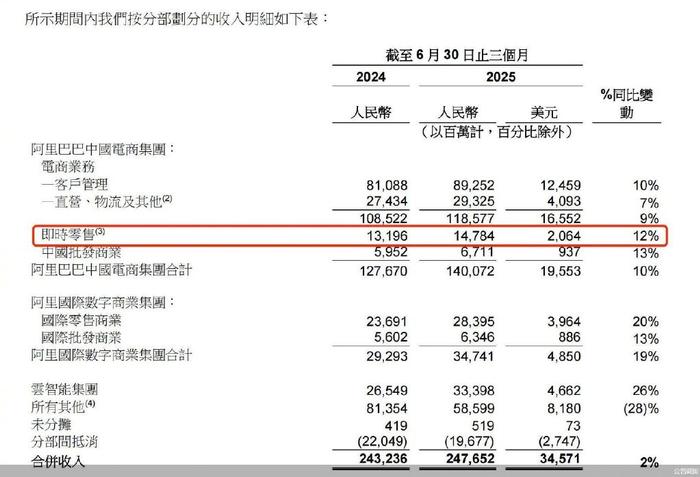
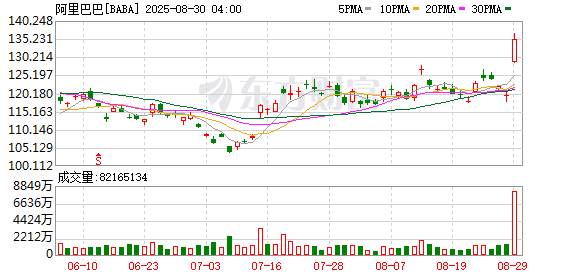
Core Viewpoint - Alibaba Group has released its Q1 FY2026 financial report, focusing on e-commerce and cloud business, with significant growth in instant retail revenue driven by resource integration and membership connectivity [1][3]. Financial Performance - Alibaba's total revenue for Q1 FY2026 reached RMB 247.65 billion, a 2% year-on-year increase, while net profit surged by 76% to RMB 42.38 billion [6]. - The Chinese e-commerce group's revenue was RMB 140.07 billion, reflecting a 10% year-on-year growth, with instant retail revenue at RMB 14.78 billion, up 12% [3][6]. - The international digital commerce group reported revenue of RMB 34.74 billion, a 19% increase, and the cloud intelligence group saw a 26% rise in revenue to RMB 33.4 billion [4][3]. Business Restructuring - Alibaba has restructured its business segments, retaining the Chinese e-commerce group, international digital commerce group, and cloud intelligence group, while merging previously separate units into "all others" [3]. - The restructuring aims to enhance focus on core business areas and improve operational efficiency [3]. Market Competition - The competition in the local lifestyle market is intensifying among Alibaba, JD.com, and Meituan, with each company investing heavily to capture market share [7][10]. - Alibaba has allocated RMB 500 billion in subsidies for its "Taobao Flash Purchase" initiative to attract users and merchants, reflecting a significant increase in marketing expenses [7][8]. User Engagement and Growth Strategies - Alibaba's monthly active consumers and daily order volume have reached new highs, with 300 million monthly active buyers in instant retail and 80 million daily orders [8][9]. - The company is focusing on enhancing user experience and optimizing logistics to reduce costs as order volumes stabilize [11]. Future Outlook - Alibaba anticipates that its investments in instant retail and flash purchase will generate an additional RMB 1 trillion in transaction volume over the next three years [9]. - The competitive landscape is expected to remain dynamic, with companies finding differentiated market spaces rather than fixed shares [11].
阿里即时零售3年剑指万亿新蛋糕 蒋凡是“关键先生”?
Mei Ri Jing Ji Xin Wen· 2025-08-31 13:49
"火力全开"的阿里,交出了一份"投入期"的成绩单。 8月29日,阿里巴巴集团发布2026财年第一季度财报(2025年4月至6月),收入为2476.52亿元人民币, 同比增长2%。若不考虑高鑫零售和银泰的已处置业务收入,同口径收入同比增长将为10%。净利润为 423.82亿元人民币,同比增长76%。 上述财报还提及,阿里巴巴中国电商集团本季度的经调整EBITA(息税及摊销前利润)为383.89亿元人 民币,相较去年同期下降21%,主要是由于对"淘宝闪购"以及用户体验、用户获取和科技的投入所致, 部分被阿里巴巴中国电商集团的双位数收入增长所抵销。 具体来说,在阿里本次财报中,饿了么App产生的收入和"淘宝闪购"服务产生的收入一同被纳入了阿里 巴巴中国电商集团下的"即时零售"业务中统计。财报显示,2025年4月至6月,该即时零售业务收入为 147.84亿元人民币,同比增长12%,主要是得益于"淘宝闪购"所带来的订单量增长。 在当晚的分析师电话会上,阿里巴巴集团CEO(首席执行官)吴泳铭明确表示,以AI(人工智能)+云 为核心的科技平台、购物与生活服务融合的大消费平台,是阿里巴巴集团面临的两大历史性战略机遇。 值得注 ...
即时零售收入同比增12% 阿里猛攻本地生活
Bei Jing Shang Bao· 2025-08-31 13:42
Core Viewpoint - Alibaba Group has released its Q1 FY2026 financial report, focusing on e-commerce and cloud business, with significant growth in instant retail revenue driven by resource integration and membership connectivity [2][3][6]. Business Restructuring - In the Q1 FY2026 report, Alibaba restructured its business segments, retaining the China e-commerce group, international digital commerce group, and cloud intelligence group, while merging previously separate units into an "all other" category [3]. - The China e-commerce group's revenue reached 140.07 billion yuan, a 10% year-on-year increase, with instant retail revenue reported for the first time at 14.78 billion yuan, up 12% [3]. - Customer management revenue grew by 10% to 89.25 billion yuan, supported by new software service fees and improved penetration from "full-site promotion" [3]. International and Cloud Business Performance - The international digital commerce group's revenue was 34.74 billion yuan, a 19% increase, with adjusted EBITA losses narrowing significantly from 3.7 billion yuan to 59 million yuan [3]. - The cloud intelligence group's revenue grew by 26% year-on-year to 33.4 billion yuan, marking a three-year high, driven by increased adoption of AI-related products [4]. Overall Financial Performance - The group's total revenue was 247.65 billion yuan, a 2% year-on-year increase, while net profit surged by 76% to 42.38 billion yuan [5]. Investment Strategy - Alibaba's domestic e-commerce growth is attributed to the integration of Ele.me and Fliggy, enhancing business synergy and member benefits [6]. - Significant investments were made in the "Taobao Flash Purchase" initiative, with 50 billion yuan allocated for user and merchant subsidies [7]. - Operating cash flow decreased by 39% to 20.67 billion yuan, reflecting the impact of these investments [7]. Competitive Landscape - The competition among Alibaba, Meituan, and JD.com in the local lifestyle market is intensifying, with each company adopting aggressive strategies to capture market share [10]. - Instant retail is seen as a critical battleground, focusing on user engagement, merchant partnerships, and logistics capabilities [10][11]. - The market dynamics suggest that the competition will remain fluid, with each platform finding its unique positioning over time [12].
美团试图穿越“非理性时期”
3 6 Ke· 2025-08-31 10:50
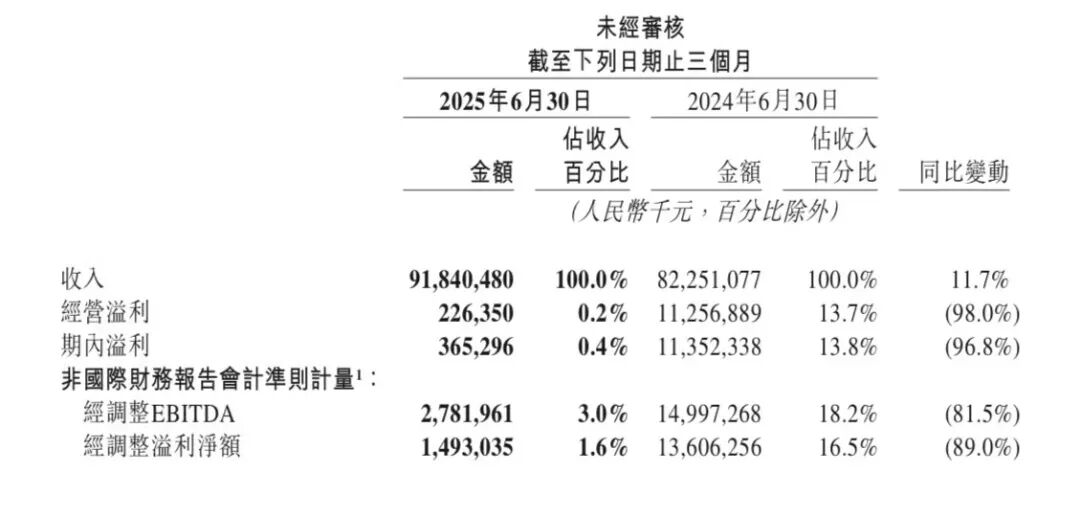
Core Insights - The second quarter marked the true beginning of the "takeout war," with Meituan's performance under scrutiny amid fierce competition [1] - Meituan's revenue reached 91.84 billion RMB, a year-on-year increase of 11.7%, but the core local business segment saw a significant decline in operating profit [2][3] - The company is focusing on long-term growth strategies despite short-term pressures from competition and increased costs [5][18] Financial Performance - Revenue for the second quarter was 91.84 billion RMB, up 11.7% from the previous year [2] - Operating profit dropped by 98% to 226.35 million RMB, with a significant decline in profit margins [2] - Sales costs increased by 27% to 61.4 billion RMB, driven by higher rider subsidies and marketing expenses [7] Business Adjustments - Meituan has restructured its new business segments, focusing resources on the more promising "Xiaoxiang Supermarket" and reducing losses from the poorly performing "Meituan Youxuan" [3][4] - The new business segment's revenue grew by 22.8% year-on-year, primarily due to the expansion of Xiaoxiang Supermarket and overseas operations [4] Competitive Landscape - The intense competition has led to a surge in user engagement, with monthly active users surpassing 500 million and daily order volumes reaching a record high of 150 million [5][12] - Despite the increase in order volume, the average order value (AOV) has declined, indicating a mismatch between demand stimulation and revenue generation [6] Strategic Focus - Meituan's management emphasizes a return to fundamental business principles: supply, delivery service, and pricing [5][18] - The company is committed to sustainable investments that enhance long-term capabilities rather than engaging in unsustainable spending [8][17] Innovations and Future Plans - Meituan is expanding its "Brand Satellite Store" initiative, aiming to open over 10,000 stores by the end of the year [8] - The "Raccoon Canteen" model is being developed to streamline operations for merchants, with a target of 1,200 locations in three years [11] - The company aims to achieve a daily order volume of 1 billion by 2025, with a profit target of 1 RMB per order [12][17]
全文|阿里Q1业绩会实录:预计未来3年内 闪购跟即时零售为平台带来1万亿的新增成交
Xin Lang Cai Jing· 2025-08-31 09:56
Core Viewpoint - Alibaba reported its Q1 FY2026 earnings with revenue of 247.65 billion yuan, a 2% year-over-year increase, and a net profit of 42.38 billion yuan, a 76% increase year-over-year. However, non-GAAP net profit decreased by 18% to 33.51 billion yuan [1] Financial Performance - Revenue for Q1 FY2026 was 247.65 billion yuan, up 2% year-over-year [1] - Net profit reached 42.38 billion yuan, reflecting a 76% year-over-year increase [1] - Non-GAAP net profit was 33.51 billion yuan, down 18% year-over-year [1] Cloud Business - Alibaba Cloud's revenue growth accelerated to 26% year-over-year, driven by strong demand for AI products and services [9] - The company anticipates continued growth in cloud revenue due to increasing AI-related applications and demand [10] Instant Retail and Delivery Business - Alibaba has significantly invested in instant retail and delivery services, with a focus on the Taobao Flash Purchase business [2] - Daily peak orders for Taobao Flash Purchase reached 120 million, with a monthly active user base of 300 million, marking a 200% increase since April [3] - The integration of Taobao and Ele.me is expected to enhance resource efficiency and improve overall business performance [17] Operational Efficiency - The company aims to improve operational efficiency in its delivery services, with a focus on optimizing user and order structures [5] - The logistics costs are expected to decrease as order volumes stabilize, leading to better unit economics [6] Market Strategy - Alibaba plans to expand its instant retail offerings by integrating offline brand stores into the Taobao Flash Purchase platform, targeting a total of one million brand stores [8] - The company is also exploring additional services for users, such as in-store pickup and group buying [12] Investment Focus - Alibaba is committed to investing 380 billion yuan over three years in AI and consumer sectors, balancing short-term and long-term returns [12][18] - The company recognizes the strategic importance of both AI and consumer sectors, with ongoing investments in supply chain and user engagement [13][18]
被遗忘的社区团购
投资界· 2025-08-31 07:15
Core Viewpoint - Community group buying has been recognized as a significant failure in the internet industry, with major players incurring substantial losses and ultimately leading to a rapid decline in the sector's viability [1][3]. Group 1: Industry Overview - The community group buying sector experienced explosive growth in 2020, followed by a swift decline, with major companies like Meituan and Pinduoduo reporting cumulative losses exceeding 80 billion yuan from 2020 to 2024 [1][3]. - Major players such as Meituan, Pinduoduo, Alibaba, and Didi invested heavily in community group buying, with Alibaba's Taocai Cai reportedly spending at least 20 billion yuan to secure a top market position [4][3]. - The community group buying model was initially seen as a cost-effective alternative to traditional retail, with lower prices and reduced delivery costs compared to other models like front warehouses [6][8]. Group 2: Business Model Analysis - Community group buying utilized a "next-day delivery + self-pickup" model, significantly reducing operational costs compared to traditional delivery methods [6][4]. - The model aimed to streamline supply chains by minimizing intermediaries, reducing markup rates from 45% to below 20% [8]. - Despite its initial promise, the community group buying sector faced challenges such as high operational costs, limited profit margins, and regulatory scrutiny, leading to a decline in market viability [10][14]. Group 3: Market Dynamics - By mid-2022, Pinduoduo and Meituan held a combined market share of 76%, but both companies shifted focus towards reducing losses rather than aggressive competition [12][14]. - The community group buying sector's struggles were exacerbated by the rise of instant retail, which offered a more efficient and profitable alternative, leading to questions about the future viability of community group buying [22][24]. - Instant retail's market size reached 650 billion yuan in 2023, significantly overshadowing community group buying, which faced increasing competition from established players like JD and Alibaba [22][24].


3年1万亿!阿里还有更大目标!
Sou Hu Cai Jing· 2025-08-31 03:54
Core Insights - Alibaba's e-commerce segment CEO, Jiang Fan, highlighted the success and future strategy of Taobao Flash Purchase, emphasizing its role in the "instant retail" market [1] - The financial report for Q1 FY2026 showed revenue of 247.65 billion yuan, a 10% year-on-year growth when excluding sold businesses, and a net profit of 42.38 billion yuan, up 76% year-on-year [1] - CEO Wu Yongming reiterated the company's focus on consumer spending and AI + cloud strategies, which have shown positive results, particularly in the growth of the cloud intelligence group's revenue [1] Financial Performance - The Q1 FY2026 revenue reached 247.65 billion yuan, with a net profit of 42.38 billion yuan, marking a 76% increase year-on-year [1] - The overall revenue growth of 10% year-on-year reflects the effectiveness of the company's strategic focus [1] Taobao Flash Purchase Insights - Taobao Flash Purchase achieved 300% growth in monthly active users, reaching 300 million, and daily active riders increased threefold to 2 million [1] - The service has become a significant growth driver for brands, with 395 non-food brands achieving over 1 million yuan in monthly sales, and 66 brands exceeding 10 million yuan [2] - Daily order volume for Taobao Flash Purchase surpassed 10 million for three consecutive days in early August [2] Strategic Developments - The number of Alibaba's flash warehouses exceeded 50,000, with order volume growing over 360% year-on-year, and 25% of supply coming from Alibaba's ecosystem [4] - The transition of Tmall Supermarket from a B2C model to a near-field flash purchase model indicates a strategic shift towards instant retail [4] - The company anticipates that flash purchase and instant retail will generate an additional 1 trillion yuan in transactions over the next three years [2]