
宽基指数

Search documents
【ETF观察】9月1日宽基指数ETF净流出110.51亿元
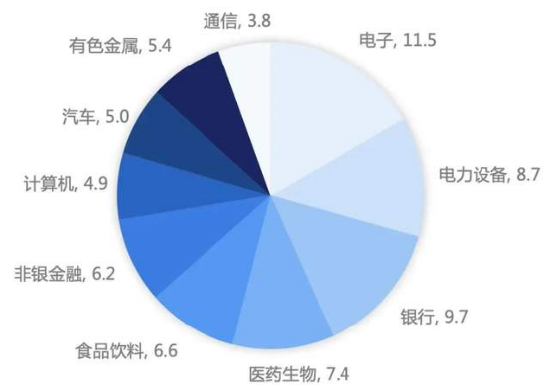
Sou Hu Cai Jing· 2025-09-01 23:53
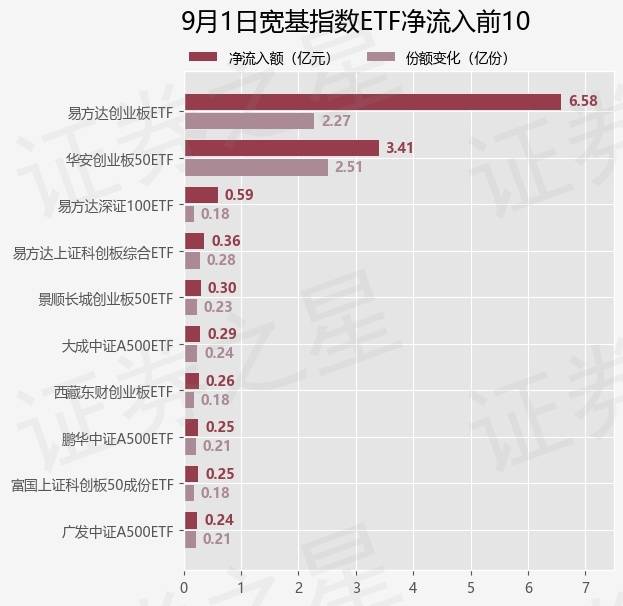
Summary of Key Points Core Viewpoint - On September 1, a total of 11.051 billion yuan was net withdrawn from broad-based index ETFs, with a cumulative net outflow of 43.19 billion yuan over the past five trading days, indicating a trend of capital withdrawal from these funds [1]. Fund Performance - On the same day, 46 broad-based index ETFs experienced net inflows, with the E Fund ChiNext ETF (159915) leading with an increase of 227 million shares and a net inflow of 658 million yuan [1][3]. - Conversely, 175 broad-based index ETFs saw net outflows, with the Huatai-PB CSI 300 ETF (510300) having the largest outflow of 2.361 billion yuan and a reduction of 513 million shares [1][4]. Top Net Outflows - The top ten ETFs with the highest net outflows on September 1 included: - Huatai-PB CSI 300 ETF: -2.361 billion yuan, -513 million shares [4][5] - Huaxia SSE 50 ETF: -1.323 billion yuan, -426 million shares [4][5] - Huaxia SSE Sci-Tech 50 ETF: -1.175 billion yuan, -828 million shares [4][5] - Huaxia CSI 500 ETF: -410 million yuan, -363 million shares [4][5]. Fund Size and Changes - The latest sizes of the funds with significant net outflows were as follows: - Huatai-PB CSI 300 ETF: 419.835 billion yuan [5] - Huaxia SSE 50 ETF: 181.736 billion yuan [5] - Huaxia SSE Sci-Tech 50 ETF: 81.741 billion yuan [5].

市场继续上攻,A500ETF易方达(159361)、沪深300ETF易方达(510310)等助力布局核心资产
Sou Hu Cai Jing· 2025-09-01 13:19
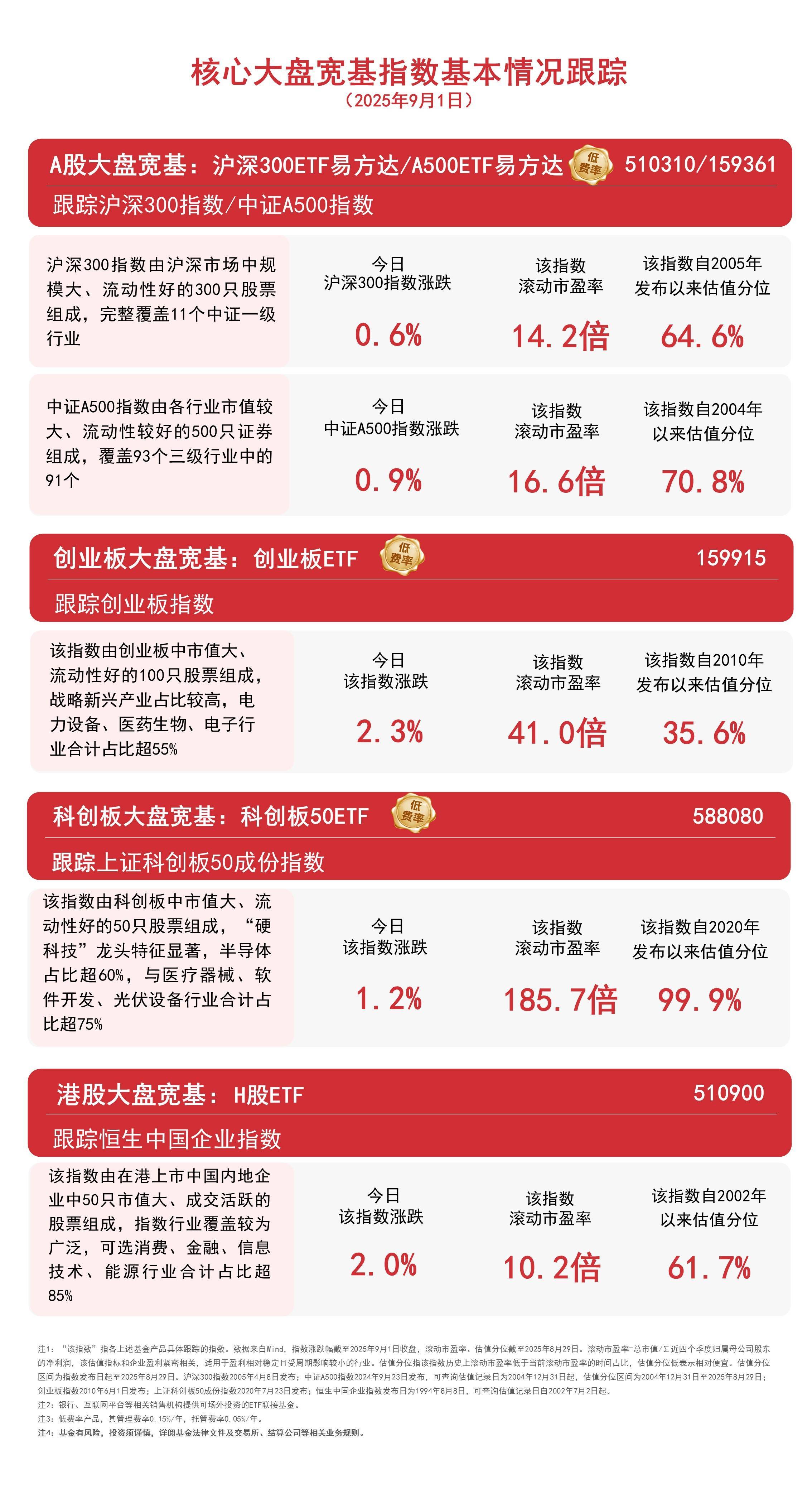
Market Performance - The A-share market saw all three major indices strengthen, with a total market turnover of 2.78 trillion yuan [1] - The CSI A500 index rose by 0.9%, the CSI 300 index increased by 0.6%, the ChiNext index surged by 2.3%, and the STAR Market 50 index climbed by 1.2% [1] - The Hang Seng China Enterprises Index also experienced a rise of 2% [1] Sector Performance - The leading sectors in terms of gains included precious metals, non-ferrous metals, innovative pharmaceuticals, CPO, and storage chips [1] - Conversely, sectors that faced declines included insurance, airport and shipping, securities, military equipment, banking, and gaming [1] Index Composition - The ChiNext index consists of 100 stocks with high market capitalization and liquidity, with a significant proportion in strategic emerging industries, particularly in electric equipment, pharmaceuticals, and electronics, which together account for over 55% [3] - The STAR Market 50 index is composed of 50 stocks from the STAR Market, showcasing prominent technology leaders, with semiconductors making up over 60% and medical devices, software development, and photovoltaic equipment industries collectively accounting for over 75% [3]
股指月报:国内外宏观变量再袭,杠杆资金催生泡沫行情-20250901
Zheng Xin Qi Huo· 2025-09-01 08:40
Group 1: Core Views - Short - term macro factors will increase market disturbances, but long - term policy guidance is bullish. In September, overseas focus on the Fed's interest - rate decision and the progress of the Russia - Ukraine issue, while domestic attention is on the 14th Five - Year Plan and Q4 economic policy guidance [4]. - The real estate market is in a weak state with both new and second - hand housing sales at low levels, but there is potential for improvement during the "Golden September and Silver October". The service industry is structurally differentiated and resilient at high levels, and the manufacturing industry is rebalancing after tariff policy disturbances [4]. - Domestic and overseas liquidity is tending to be loose. The domestic stock market has attracted leveraged funds and household deposits, but the pressure of share unlocks is increasing, and market divergence has emerged [4]. - After a sharp short - term rise, the valuation of each index has reached a relatively high historical level, and the stock - bond premium rate at home and abroad is low, so the attractiveness of allocation funds is average [4]. - It is recommended to adopt a high - selling and low - buying strategy for stock index futures in September. Consider going long on IF and IH during sharp drops or a short - term arbitrage opportunity of going long on IF and short on IM [4]. Group 2: Market Review Global Stock Market Performance - In the past month, A - shares led the rise, and German stocks led the decline. The performance order is:科创50 index > ChiNext Index > Shanghai Composite Index > Nikkei 225 > Hang Seng Tech Index > NASDAQ > S&P 500 > FTSE Emerging Markets > FTSE Europe > German DAX [8]. Industry Performance - In the past month, the communication industry led the rise, and the banking industry led the decline. The order is: communication > electronics > non - ferrous metals > computer > new energy… > transportation > steel > construction > coal > bank [12]. Futures Performance - In the past month, the basis rates of the four major stock index futures (IH, IF, IC, and IM) changed by 0.07%, 0.34%, - 0.04%, and - 0.23% respectively. The discounts of IF and IH narrowed. The inter - period spread rates (current month and next month) changed by - 0.09%, 0.21%, 0.33%, and 0.29% respectively, and the inter - period discounts of IF, IC, and IM significantly converged. The inter - period spread rates (next quarter and current month) changed by - 0.04%, 0.7%, 1.14%, and 1.36% respectively, and the long - term discounts of IF, IC, and IM converged significantly [21]. Group 3: Fund Flows Margin Trading and Stabilizing Funds - In August, margin trading funds flowed in 259.09 billion yuan, and the margin balance accounted for 2.39% of the circulating market value of the Shanghai and Shenzhen stock markets, an increase of 0.06%. The scale of passive stock ETF funds increased by 321.65 billion yuan to 3.49364 trillion yuan, with a share redemption of 14.8 billion shares last month and a subscription of 215.2 billion shares in the latest week [24]. Industrial Capital - In July - August, equity financing was 20.78 billion yuan, with 3 companies. IPO financing was 2.56 billion yuan, private placement was 18.21 billion yuan, and convertible bond financing was 3.22 billion yuan. In August, the market value of share unlocks was 539.34 billion yuan, an increase of 250.95 billion yuan from the previous month [27]. Group 4: Liquidity Monetary Supply - In August, the central bank's OMO reverse repurchase matured at 7.235 trillion yuan, and the reverse repurchase was 7.8518 trillion yuan, with a net monetary injection of 61.68 billion yuan. MLF had a net injection of 3 billion yuan, with a continuous net injection for six months and an increasing margin [29]. Monetary Demand - In August, the net monetary demand for national debt was 828.88 billion yuan, local debt was 804.34 billion yuan, and other bonds was 544.59 billion yuan. The total net monetary demand for the bond market was 2177.81 billion yuan [32]. Fund Price - In August, DR007, R001, and SHIBOR overnight rates changed by - 3.8bp, - 14.5bp, and - 6bp respectively. The inter - bank certificate of deposit issuance rate decreased by 0.8bp, and the CD rate of joint - stock banks rebounded by 4bp. The fund price rebounded slightly at a low level [35]. Term Structure - In August, the yield curve steepened significantly. The long - end yields of national debt and policy - bank bonds rebounded, and the long - end credit spread between national debt and policy - bank bonds widened [39]. Sino - US Interest Rate Spread - In August, the US 10 - year Treasury yield decreased by 11.0bp, the inflation expectation decreased by 2.0bp, and the real interest rate decreased by 9.0bp. The Sino - US interest rate spread inversion narrowed by 20.04bp, and the offshore RMB appreciated by 1.22% [42]. Group 5: Macroeconomic Fundamentals Real Estate Demand - As of August 28, the weekly transaction area of commercial housing in 30 large and medium - sized cities seasonally rebounded but was at a low level compared to the same period in 2019. Second - hand housing sales decreased seasonally. The real estate market is in a weak state, but rigid demand supports the lower limit [45]. Service Industry Activity - As of August 29, the subway passenger volume in 28 large cities remained high, with a year - on - year increase of 4.5% compared to last year and 51% compared to 2021. The traffic congestion delay index in 100 cities rebounded, and the service industry's economic activity is trending towards a natural and stable growth level [48]. Manufacturing Tracking - In August, the capacity utilization rates of the manufacturing industry declined under the anti - involution policy. The average operating rate of the chemical industry chain related to external demand increased by 0.58% [52]. Freight Flow - Freight and passenger flows remained at relatively high levels. The postal express and civil aviation sectors grew strongly, while highway transportation was relatively weak, and railway transportation rebounded significantly [57]. Import and Export - China's exports continued to grow strongly. After three rounds of Sino - US negotiations, a 90 - day exemption was extended, and Q3 exports were stronger than the season, which may continue [60]. Overseas Situation - In July, US PCE inflation continued to rebound, and the market's optimistic expectation of the Fed's interest rate cut this year has weakened. The market expects 2 interest rate cuts in 2025, with a total cut of about 50bp [62][66]. Group 6: Other Analyses Valuation - In the past month, the stock - bond risk premium was 2.64%, a significant decrease of 0.43% from the previous month. The foreign capital risk premium index was 3.63%, a decrease of 0.42% from the previous month. The valuations of the SSE 50, CSI 300, CSI 500, and CSI 1000 indices were at relatively high levels in the past 5 years [69][74]. Quantitative Diagnosis - According to seasonal patterns, the stock market is likely to be in a state of seasonal shock and decline in September, with a growth style that first outperforms and then corrects. It is recommended to pay attention to the arbitrage opportunity of shorting IC and IM and going long on IF and IH [77].
“电风扇”行情愈演愈烈,布局创业板ETF天弘(159977)、科创综指ETF天弘(589860)及中证A500ETF天弘(159360)等优质宽基指数
Xin Lang Cai Jing· 2025-09-01 07:48
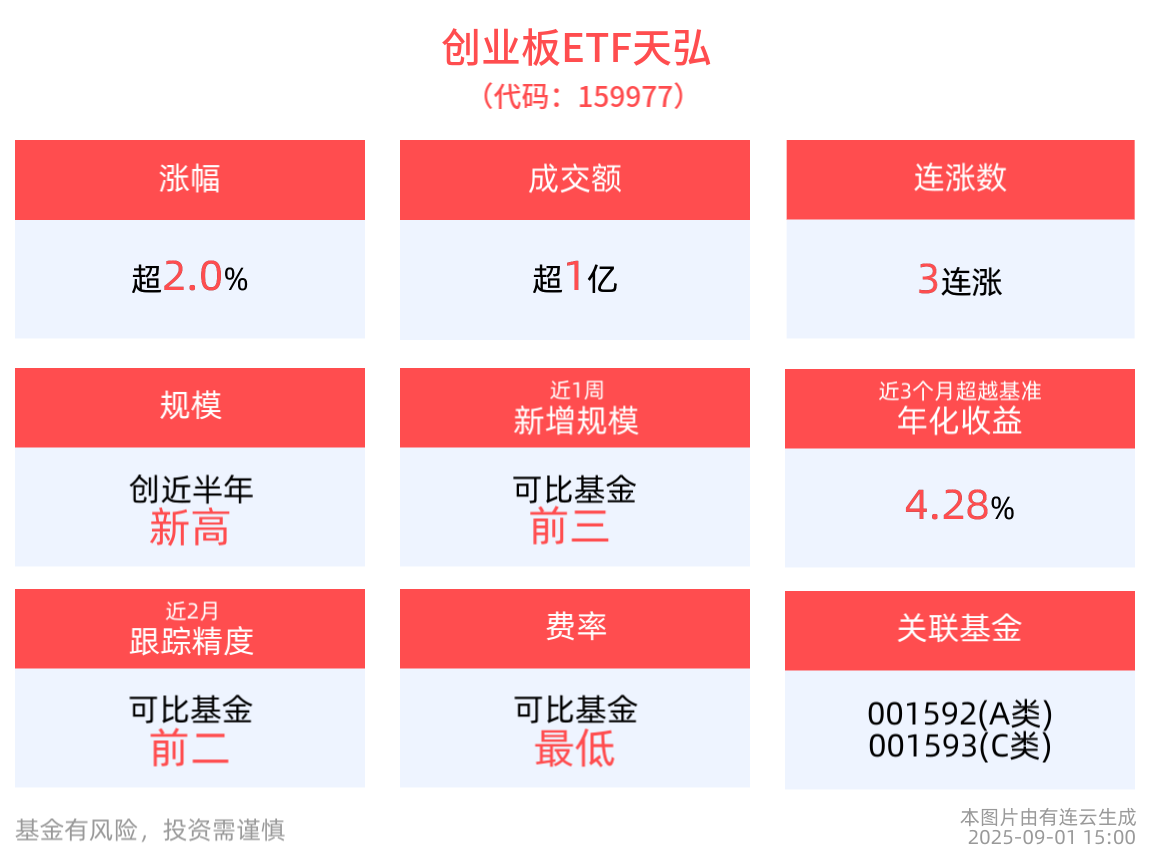
Core Insights - The Tianhong ChiNext ETF (code: 159977) has seen a 2.06% increase, marking three consecutive days of gains with a trading volume of 113 million yuan [6] - The Tianhong Sci-Tech Index ETF (code: 589860) rose by 1.90%, with a turnover rate of 12.1% and a trading volume of 49.59 million yuan, indicating active market participation [6] - The Tianhong CSI A500 ETF (code: 159360) increased by 0.50%, also achieving three consecutive days of gains, with a turnover rate of 3.54% and a trading volume of 63.59 million yuan [6] Fund Performance - As of September 1, 2025, the Tianhong ChiNext ETF (159977) reached a new high in scale at 9.655 billion yuan, the highest in the past six months [7] - The Tianhong ChiNext ETF encompasses four high-growth sectors: pharmaceuticals, new energy, computing power, and brokerage, with a valuation at the 38.36th percentile of its ten-year history, indicating it is undervalued compared to broad-based indices [7] - The Tianhong Sci-Tech Index ETF covers 97% of the Sci-Tech board's market value, focusing on hard technology and balancing investments in semiconductors, artificial intelligence, and biomedicine, with over 80% in strategic emerging industries [7] Economic Indicators - According to the National Bureau of Statistics, the manufacturing PMI, non-manufacturing business activity index, and comprehensive PMI output index for August were 49.4%, 50.3%, and 50.5%, respectively, showing a slight increase from the previous month [7] - Analysts suggest that the economic indicators reflect positive changes in China's economy, with expectations for continued release of domestic demand potential in September and the fourth quarter [7] Market Outlook - Huatai Securities indicates that the extension of short-term tariff exemptions and expectations of Federal Reserve rate cuts may improve risk appetite, with a shift towards fundamentals expected in the medium term [8] - China Galaxy Securities anticipates that the market will maintain a high central tendency, with active trading and supportive policies driving market conditions, while structural allocation opportunities should be monitored [8]

ETF周报(20250818-20250822)-20250825
Mai Gao Zheng Quan· 2025-08-25 07:12
Group 1: Report Industry Investment Rating - Not provided in the content Group 2: Core Viewpoints of the Report - In the secondary market, during the sample period from August 18 - 22, 2025, the top - performing A - share and overseas major broad - based indices were科创50, ChiNext Index, and CSI 300, with weekly returns of 13.31%, 5.85%, and 4.18% respectively. Among Shenwan primary industries, communication, electronics, and comprehensive had the highest returns at 10.84%, 8.95%, and 8.25%, while real estate, coal, and pharmaceutical biology had lower returns at 0.50%, 0.92%, and 1.05% respectively [1][10][17]. - Regarding ETF product performance, during the sample period, broad - based ETFs had the best average performance with a weighted average return of 5.12%, while QDII ETFs had the worst with - 0.61%. In terms of the listing board, ETFs related to the Science and Technology Innovation Board and the Science and Technology Innovation and Entrepreneurship 50 had better performance, with weighted average returns of 13.01% and 10.85% respectively. US and Japanese stock ETFs had poor performance, with - 2.78% and - 2.65% respectively [21]. - For ETF fund flows, industry - themed ETFs had the largest net capital inflow of 254.09 billion yuan, and broad - based ETFs had the smallest at - 161.16 billion yuan. From the perspective of the listing board, Hong Kong stock ETFs had the largest net inflow of 214.47 billion yuan, and Science and Technology Innovation Board - related ETFs had the smallest at - 144.18 billion yuan [2][25]. Group 3: Summary by Relevant Catalogs 1. Secondary Market Overview - Index returns: During the sample period,科创50, ChiNext Index, and CSI 300 had the highest weekly returns at 13.31%, 5.85%, and 4.18% respectively. The PE valuation quantile of CSI 300 was the highest at 100.00%, and that of the Nikkei 225 was the lowest at 73.36% [10]. - Industry returns: Among Shenwan primary industries, communication, electronics, and comprehensive had the highest returns at 10.84%, 8.95%, and 8.25%, while real estate, coal, and pharmaceutical biology had lower returns at 0.50%, 0.92%, and 1.05% respectively. In terms of valuation, social services, light manufacturing, and building materials had the highest valuation quantiles at 100.00%, and agriculture, forestry, animal husbandry and fishery, household appliances, and comprehensive had lower quantiles at 35.12%, 55.37%, and 62.81% respectively [17]. 2. ETF Product Overview 2.1 ETF Market Performance - By product type: Broad - based ETFs had the best average performance with a weighted average return of 5.12%, and QDII ETFs had the worst with - 0.61%. - By listing board: ETFs related to the Science and Technology Innovation Board and the Science and Technology Innovation and Entrepreneurship 50 had better performance, with weighted average returns of 13.01% and 10.85% respectively. US and Japanese stock ETFs had poor performance, with - 2.78% and - 2.65% respectively. - By industry sector: Technology sector ETFs had the best average performance with a weighted average return of 12.53%, and biomedical sector ETFs had the worst with 1.55%. - By theme: Chip semiconductor and artificial intelligence ETFs had better performance, with weighted average returns of 15.09% and 14.57% respectively. Bank and dividend ETFs had relatively poor performance, with 0.91% and 1.10% respectively [21][23]. 2.2 ETF Fund Flows - By category: Industry - themed ETFs had the largest net capital inflow of 254.09 billion yuan, and broad - based ETFs had the smallest at - 161.16 billion yuan. - By listing board: Hong Kong stock ETFs had the largest net inflow of 214.47 billion yuan, and Science and Technology Innovation Board - related ETFs had the smallest at - 144.18 billion yuan. - By industry sector: Financial and real estate sector ETFs had the largest net inflow of 141.32 billion yuan, and technology sector ETFs had the smallest at - 53.84 billion yuan. - By theme: Non - bank and innovative drug ETFs had the largest net inflows of 142.21 billion yuan and 31.74 billion yuan respectively. Chip semiconductor and military - industry ETFs had the smallest at - 78.85 billion yuan and - 5.73 billion yuan respectively [2][25][28]. 2.3 ETF Trading Volume - By category: Broad - based ETFs had the largest increase in the average daily trading volume change rate at 27.34%, and commodity ETFs had the largest decrease at - 28.91%. - By listing board: CSI 500 ETFs had the largest increase in the average daily trading volume change rate at 76.67%, and Japanese stock ETFs had the largest decrease at - 15.32%. - By industry sector: The consumer sector had the largest increase in the average daily trading volume change rate at 48.26%, and the biomedical sector had the largest decrease at - 5.57%. - By theme: Non - bank and innovative drug ETFs had the highest average daily trading volumes in the past 5 days at 367.55 billion yuan and 104.62 billion yuan respectively. Consumer electronics and artificial intelligence ETFs had the largest increases in the average daily trading volume change rate at 52.58% and 38.65% respectively. Central state - owned enterprises and innovative drug ETFs had the largest decreases at - 8.12% and - 7.01% respectively [34][37][40][43]. 2.4 ETF Margin Trading - During the sample period, the net margin purchase of all equity ETFs was - 2.48 billion yuan, and the net short - selling was 2.32 billion yuan. Southern CSI 500 ETF had the largest net margin purchase, and Southern CSI 1000 ETF had the largest net short - selling [2][48]. 2.5 ETF New Issuance and Listing - During the sample period, 9 funds were established and 8 funds were listed [3][50].
一周市场数据复盘20250822
HUAXI Securities· 2025-08-24 13:18
- The report uses the Mahalanobis distance of recent weekly price and trading volume changes to measure industry crowding[3][17] - Last week, the home appliances and non-ferrous metals industries experienced significant short-term crowding[4][17] - The first quadrant represents industries with rising prices and volumes, while the third quadrant represents industries with falling prices and volumes. Points outside the ellipse indicate industries with price and volume deviations exceeding the 99% confidence level, signifying short-term significant crowding[17]
晕了晕了!科创50刚创近三年新高,机构就疯狂出逃,ETF份额竟跌至近一年新低
Mei Ri Jing Ji Xin Wen· 2025-08-23 02:25
Group 1 - The core viewpoint of the article indicates that the stock indices collectively rose this week, with approximately 20 billion yuan net inflow into stock ETFs and cross-border ETFs in the Shanghai and Shenzhen markets [1][5] - The Shanghai Composite Index closed at 3825.76 points, up 3.49% for the week, while the Shenzhen Component Index closed at 12166.06 points, up 4.57% [1] - Major industry theme ETFs such as securities, chemicals, and fintech saw significant net inflows, while chip-related ETFs experienced substantial sell-offs [1][6] Group 2 - The total trading volume in the Shanghai and Shenzhen markets reached 12.73 trillion yuan, with the Shanghai market accounting for 5.3 trillion yuan and the Shenzhen market 7.43 trillion yuan [1] - The top three ETFs with the highest net inflows were the securities ETF (39.56 billion yuan), chemical ETF (22.76 billion yuan), and brokerage ETF (20.83 billion yuan) [6][7] - In contrast, chip-related ETFs, including the semiconductor ETF and the sci-tech chip ETF, saw significant net outflows of 23.26 billion yuan and 15.2 billion yuan, respectively [8][9] Group 3 - The article highlights that the chemical and fintech ETFs reached near one-year highs in terms of fund shares, indicating strong investor interest [9][11] - Analysts suggest that the Chinese chemical industry may undergo a revaluation due to reduced global capacity expansion, potentially leading to higher dividend yields [11] - The fintech sector is expected to benefit from ongoing policy support and market reforms, which could enhance the revenue of financial IT companies [13] Group 4 - The article mentions that 27 ETFs had trading volumes exceeding 10 billion yuan, with the Hong Kong Securities ETF surpassing 120 billion yuan in weekly trading volume [13][14] - Six new ETFs are set to be launched next week, tracking sectors such as Hong Kong stocks, sci-tech artificial intelligence, and comprehensive growth in the ChiNext market [15][16]
想跑赢指数,究竟难在哪儿?
Xin Lang Ji Jin· 2025-08-20 10:07
Core Viewpoint - The A-share market is experiencing a significant rise, with the Shanghai Composite Index reaching a ten-year high and the total market capitalization exceeding 100 trillion yuan, leading to increased bullish sentiment among investors [1] Group 1: Market Performance and Investor Sentiment - Despite the overall market rally, many investors feel they are not profiting or even lagging behind the index, humorously referring to themselves as "missing the bull market" [1] - Since 2018, only four out of over 2000 equity mutual funds have consistently outperformed the CSI A500 index annually [1] Group 2: Challenges in Beating the Index - The acceleration of market rotation and increased volatility make it challenging for investors to consistently select winning sectors and stocks [2] - The structure of broad market indices, such as the CSI A500, is evolving towards greater balance, with traditional sectors like finance and real estate decreasing in weight, while emerging industries are gaining prominence [2] - Behavioral biases among retail investors, such as chasing trends and high-frequency trading, can negatively impact their returns [2] Group 3: Advantages of Broad Market Indices - Broad market indices provide a diversified investment approach, reducing risk by including a variety of quality stocks across different sectors [3] - The CSI A500 index covers a wide range of industries, ensuring representation of both traditional and emerging sectors, as well as different investment styles [4] - The balanced and diversified nature of broad market indices like the CSI A500 enhances their adaptability, performing well across different market conditions [5] Group 4: Comparison of Broad Market Indices - The CSI A500 index has a lower weight in traditional sectors compared to the CSI 300 index, incorporating more emerging industry leaders, which aligns better with the overall A-share market [7] - As of August 18, the CSI A500 index has increased by 9.32% year-to-date, outperforming the CSI 300 index, which rose by 7.74% [9] - Historically, the CSI A500 index has shown superior long-term performance, with a total increase of 363.05% since its inception, compared to 293.61% for the CSI 300 index [10] Group 5: Investment Products and Institutional Interest - The CSI A500 ETF (159338) closely tracks the CSI A500 index and has a competitive fee structure, making it suitable for long-term investment [13] - Institutional investors, particularly insurance companies, have significantly invested in the CSI A500 ETF, indicating confidence in its future performance [13][15]
牛市来了,还适合买宽基指数吗?
雪球· 2025-08-20 08:36
Core Viewpoint - The article discusses the challenges and considerations of identifying "mainline sectors" during a bull market, suggesting that broad-based indices may be a more pragmatic choice for most investors [4][6][18]. Group 1: Mainline Investment Temptation and Identification Challenges - In bull markets, mainline sectors often yield significant excess returns, with data showing that in 2020, the top three industry indices had returns of 190.96%, 138.41%, and 135.19%, while the CSI 300 index only rose by about 27.21% [6][7]. - The difficulty of accurately identifying mainline sectors beforehand is highlighted, as many investors may only realize what the mainline was after the market has moved [8][10]. Group 2: Real Obstacles in Mainline Identification - Three main obstacles to identifying mainline sectors are discussed: 1. Extreme internal differentiation within industries complicates stock selection, as seen in the 2025 market where the ground equipment sector had a 103.73% annual increase, but individual stocks within the sector varied significantly in performance [10]. 2. The acceleration of valuation bubbles poses greater risks than broad indices, as high valuations can lead to significant corrections if industry progress does not meet expectations [10][11]. 3. Behavioral biases can interfere with investment discipline, leading to premature profit-taking or overconfidence, which can result in substantial losses [11]. Group 3: Unique Value of Broad-Based Indices - Broad-based indices offer unique advantages in risk diversification, stable returns, and operational convenience. They provide a better risk-return ratio through cross-industry and cross-market capitalization allocation [12][13]. - Historical data shows that broad-based indices like the CSI 300 had significantly lower maximum drawdowns compared to industry indices during bull and bear markets [13][15]. - The operational convenience of broad-based indices is enhanced by a well-established ecosystem of investment tools, such as ETFs, which lower the barriers for non-professional investors [16]. Group 4: Conclusion and Strategy - The article concludes that while broad-based indices may not outperform leading mainline sectors, they are often a better choice for ordinary investors due to their ability to mitigate emotional trading and provide stable returns [18][19]. - A suggested investment strategy for ordinary investors is the "core-satellite" approach, allocating 60%-80% of the portfolio to broad-based ETFs to capture market beta, while using 20%-40% for selective participation in mainline sectors to manage risk exposure [19].

3700点新高攻略:宽基为盾,行业主题为矛
2 1 Shi Ji Jing Ji Bao Dao· 2025-08-19 10:39
Core Viewpoint - The article discusses the current investment landscape in China, highlighting the balance between high-growth sectors and stable broad-based indices as investors navigate market volatility [1][2]. Group 1: Broad-based Indices - Broad-based indices serve as a stable foundation for investment, reflecting the overall market performance and helping to mitigate risks associated with concentrated investments [2][3]. - The CSI A500 Index exemplifies a balanced approach, covering all primary and secondary industries, with significant weights in electronics, power equipment, pharmaceuticals, and computers, which are expected to benefit from profit recovery [3]. - Since July, the CSI A500 Index has increased nearly 10%, with the A500 ETF (159361) being the only product in its category to achieve net inflows of approximately 3 billion yuan, bringing its total size to over 18 billion yuan [3]. Group 2: Thematic Indices - For investors seeking higher returns, thematic indices focusing on specific sectors can complement broad-based indices, allowing for a more dynamic investment strategy [4]. - The humanoid robotics sector has gained significant attention, with the corresponding ETF tracking the National Robotics Industry Index showing a cumulative increase of 27.8% over four months, outperforming similar indices [4][5]. - The innovative drug sector has also seen remarkable growth, with the Hang Seng Innovative Drug Index experiencing a year-to-date increase of over 110%, driven by a surge in overseas licensing transactions [5][6]. - The Hang Seng Innovative Drug ETF (159316) tracks an index that exclusively focuses on innovative drug companies, providing a pure investment vehicle for this rapidly growing sector [6].