
通胀预期

Search documents
日本国债与日元何时何故将迎来拐点?
Hua Er Jie Jian Wen· 2026-01-26 14:23
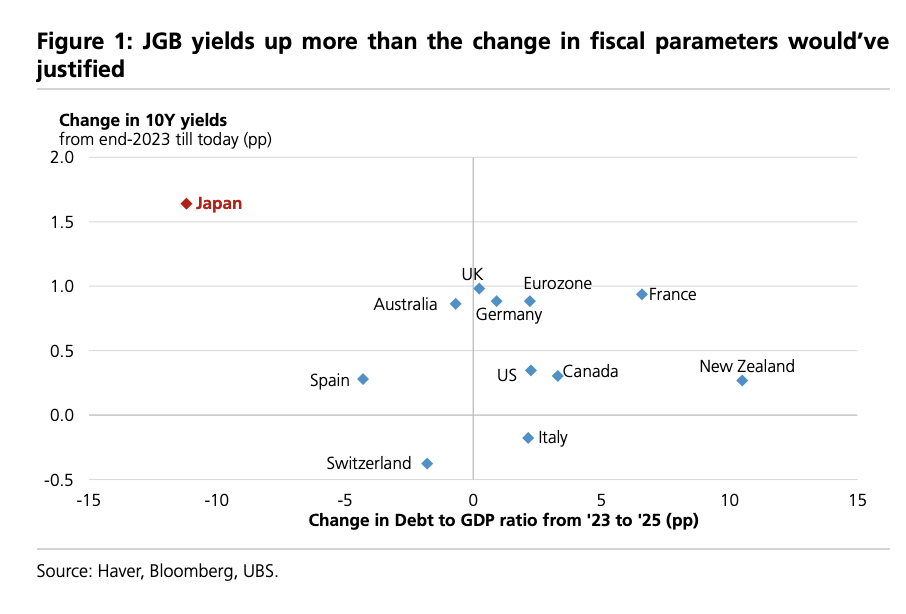
Core Viewpoint - UBS's latest global strategy report highlights that the recent sharp rise in Japanese Government Bond (JGB) yields has significantly exceeded what can be explained by fiscal fundamentals, primarily driven by a re-evaluation of inflation expectations. The report anticipates that inflation will cool to around 1.5% by mid-year, which will be a key turning point for JGB and yen trends [1][6][11]. Group 1: Market Signals - The volatility in JGB yields is not indicative of a systemic risk event similar to the UK's 2022 "Truss crisis," as the Japanese stock market remains resilient, suggesting investors should avoid panic selling in interest-sensitive sectors [1][20]. - With the attractiveness of JGB yields increasing, a significant repatriation of domestic funds from overseas bond markets is expected after the new fiscal year starts in April, leading to a reallocation towards Japanese government bonds [1][21]. - A decline in inflation will drive up real interest rates, providing support for the yen, as real rates have a more significant impact on exchange rates compared to nominal interest differentials [1][9][10]. Group 2: Fiscal Fundamentals - Despite concerns about Japan's fiscal situation, recent data shows a clear disconnect between the volatility in JGB yields and actual fiscal fundamentals. Japan's public debt as a percentage of GDP has decreased by 11 percentage points since 2023, while the average for developed economies has increased by 2 percentage points [2][5]. - Japan's fiscal deficit is projected to be around 2% of GDP by 2026, significantly lower than the developed economies' average of 4.9%. Additionally, Japan's government interest payments account for only 1.3% of GDP, compared to 3.3% for developed economies [2][5]. Group 3: Inflation and Interest Rates - The surge in JGB yields is primarily driven by market inflation expectations rather than fiscal deficit pressures. Current inflation in Japan is mainly influenced by structural factors such as food prices, while underlying service sector inflation remains around 1% [6][11]. - If inflation cools as expected, it will more effectively enhance real yields than the Bank of Japan's interest rate policies, thereby providing crucial support for both JGBs and the yen [9][16]. Group 4: Market Dynamics - The traditional correlation between the yen and nominal interest rate differentials has weakened, with real interest rate differentials now serving as the core anchor for pricing. The theoretical value of USD/JPY based on real interest differentials aligns closely with current market rates [13][16]. - Japan's external position remains robust, with a net international investment position of +92% of GDP, contrasting sharply with the UK's -2.6% during its crisis. Japan also maintains a current account surplus of 4.8% of GDP, providing a stronger buffer against market volatility [17][20]. Group 5: Investment Trends - The primary risk to the market is not foreign investors selling JGBs but rather the potential large-scale repatriation of domestic funds from overseas bond markets, as JGB yields have surpassed globally hedged bond yields [21]. - The Japanese stock market shows significant structural differentiation, with a few stocks contributing to the majority of the Nikkei 225 index's gains, indicating a concentrated market driven by foreign investors and corporate buybacks, while domestic investors remain net sellers [21].


宏观与大宗商品周报:冠通期货研究报告-20260126
Guan Tong Qi Huo· 2026-01-26 11:44
Report Summary 1. Market Overview - Global capital markets experienced significant volatility and divergence, influenced by Trump's tariff threats and yen fluctuations. The VIX index rose slightly, the yen strengthened after depreciation, the US dollar declined sharply, US and Japanese stocks faced pressure, while gold and silver reached new highs. The RMB appreciated, A - shares continued to correct and diverge, and the BDI index soared. Commodities showed increased differentiation [5][10]. - In the domestic market, the bond market rebounded, stock indices showed mixed performance, and commodity sectors remained strong with continued divergence. The growth - style stocks outperformed the value - style. The Wind Commodity Index had a weekly increase of 10.07%, with 6 out of 10 commodity sectors rising and 4 falling [6][16]. 2. Fed Interest Rate Expectations - The CME FedWatch tool indicates that the probability of the Fed maintaining the interest rate at 3.5 - 3.75% in January remains at 95.4%, and the probability of a 25 - bp cut to 3.25 - 3.5% is 4.6%. The market expects 1 - 2 rate cuts in 2026. The Fed's interest - rate decision is expected to keep the rate unchanged, and investors will focus on dissenting votes and accompanying statements to assess future rate - cut timing and rhythm [7][67]. 3. Sector Analysis 3.1 Capital Flows - The commodity futures market saw a significant overall inflow of funds last week. The non - ferrous metals, chemical, and precious metals sectors had the most obvious inflows, while the agricultural products sector had a significant outflow [18]. 3.2 Variety Performance - Most domestic commodity futures rose last week. The top - rising varieties were lithium carbonate, platinum, and Shanghai silver, while the top - falling ones were glass, live pigs, and iron ore [22]. 3.3 Volatility Characteristics - The volatility of the international CRB Commodity Index decreased, the Wind Commodity Index's volatility increased, and the Nanhua Commodity Index's volatility decreased. Among sectors, the coal - coking - steel - ore and grain sectors had significant volatility declines, while the chemical and oil - and - fat sectors had notable increases [25]. 4. Macro Logic 4.1 Stock Market - The four major domestic stock indices continued to correct and diverge last week. Growth - style stocks were stronger, and value - style indices declined. The valuation changes of stock indices diverged, and the equity risk premium (ERP) was at a one - year low [30][31]. 4.2 Commodities - Commodity price indices rose strongly, and inflation expectations rebounded strongly. The performance difference between commodities and stocks increased, and the difference between domestic and international commodity futures returns changed little [40][47]. 4.3 US Treasury Bonds - US Treasury yields showed mixed performance, with little change in maturity. The term spread fluctuated narrowly, real interest rates were under pressure, and the gold price reached a new high. US Treasury rates rose, the China - US spread narrowed, inflation expectations increased, financial conditions were loose, the US dollar index declined, and the RMB strengthened [57][60]. 4.4 US Economic Indicators - The US high - frequency "recession indicator" was strong, the Citi Economic Surprise Index rebounded, and the 10Y - 3M Treasury spread widened significantly and then fluctuated narrowly [62]. 5. Central Bank Policies 5.1 Fed - The Fed is likely to maintain the interest rate in January, and the market expects 1 - 2 rate cuts in 2026 [7][67]. 5.2 Bank of Japan - The Bank of Japan maintained the benchmark interest rate at 0.75%. The yen depreciated significantly and approached 160 against the US dollar. The market expects joint US - Japan intervention in the foreign exchange market [71][72]. 6. Impact of Yen Fluctuations - The yen's sharp fluctuations, especially rapid appreciation, can lead to the unwinding of global yen carry trades, resulting in tightened global market liquidity and asset - price volatility. It has different impacts on various asset classes, such as being negative for global bonds and stocks, positive for safe - haven assets, and causing oscillations and differentiation in commodities [85][86]. 7. Upcoming Events - This week, important economic data and central - bank meetings include US durable - goods orders, German business climate index, Canadian and Brazilian central - bank rate decisions, and the Fed's FOMC meeting [89].
邦达亚洲:日本央行干预预期升温 美元日元大幅下挫
Xin Lang Cai Jing· 2026-01-26 11:09
另外,日本央行上周五维持政策利率在0.75%不变,但上调中长期通胀预测,行长植田和男明确表态若 经济形势如预期发展将继续提高利率,为进一步收紧政策留下空间。植田和男在随后的新闻发布会上强 调,潜在通胀将继续温和上升,12月加息后金融环境仍保持宽松。他同时就近期长期利率快速上升表态 称,日本央行将在特殊情况下灵活开展债券操作,可能采取措施鼓励稳定收益率的形成。植田和男在阐 述未来政策路径时表示,若经济形势如预期般发展,日本央行将继续提高利率。他指出,加息影响广泛 波及实体经济和物价尚需相当一段时间,将密切审视过去加息对企业、家庭活动、经济和物价产生的各 种影响。 今日需要关注的数据有,德国1月IFO商业景气指数和美国11月耐用品订单月率初值。 黄金/美元 上周五黄金大幅攀升,续刷历史高位,现汇价交投于5060附近。除贸易紧张局势挥之不去激发的避险情 绪持续对黄金构成支撑外,地缘紧张局势升温也是支撑黄金攀升的重要因素。此外,美元指数走软也对 黄金构成了有力的支撑。今日关注5100附近的压力情况,下方支撑在5000附近。 美元/日元 上周五美元/日元大幅下挫,刷新4周低位,现汇价交投于154.00附近。除获利回吐和 ...

金价破5000、银价破100!这不仅是避险,更是全球信用的重定价
Sou Hu Cai Jing· 2026-01-26 10:06
近期贵金属市场的表现足以载入金融史册。黄金价格已正式突破 5000 美元/盎司,白银也在极短时间内站稳了 100 美元 关口。面对如此高位, 市场在震惊之余也产生了巨大的分歧:这究竟是阶段性的顶点,还是一个新时代的起点? 阿萨交易学院分析师 Eden 认为,如果简单将此次狂飙归结为避险情绪,显然低估了本轮行情的强度。金银同步走强的背后,折射出的是全球 金融体系底层的结构性裂变。 从宏观视角来看,金银的大幅上涨反映了美元体系长期承压的公信力。近期美国在多个地缘方向上的动作——从对委内瑞拉、伊朗的激进举 措,到对格陵兰岛的主权表态,以及对北约成员国反复无常的关税威胁,都让美元作为全球储备货币所提供的"规则红利"受到侵蚀。 当投资者意识到资产配置换来的不再是体系稳定,而是更高的政策不确定性时,黄金和白银便成了重新定价风险的唯一锚点。这种从"制度信 任"向"硬资产信任"的迁移,是支撑金价站稳 5000 美元的核心基石。 阿萨交易学院分析师 Zero 指出,主要经济体近期在军费、公共安全及基础设施上的支出计划表明,全球财政约束正在弱化。这种财政扩张往 往伴随着货币供给的变相增加,从而抬高中长期的通胀预期。 在法币购买力 ...

【comex黄金库存】1月23日COMEX黄金库较上一交易日持平
Jin Tou Wang· 2026-01-26 07:12
摘要1月23日,COMEX黄金库存录得1124.21吨,较上一交易日持平;COMEX黄金周五(1月23日)收 4982.20美元/盎司,上涨1.25%,comex黄金价格日内最高上探至4991.40美元/盎司,最低触及4901.20美 元/盎司。 美国2025年三季度GDP上修、通胀温和上涨,失业人数低于预期,凸显经济韧性。地缘方面,特朗普试 图吞并格陵兰岛并对多个欧洲国家加征高额关税以及突然的转折,避险情绪冲高回落,通胀上升压力、 贸易格局重塑以及信用货币根基动摇在所难免。 1月23日,COMEX黄金库存录得1124.21吨,较上一交易日持平;COMEX黄金周五(1月23日)收 4982.20美元/盎司,上涨1.25%,comex黄金价格日内最高上探至4991.40美元/盎司,最低触及4901.20美 元/盎司。 美联储降息预期不强、通胀预期回升、美国经济增长向好削弱贵金属的金融属性,欧美贸易战担忧略有 消退,但仍有逢低买盘支撑,美欧协议细节不排除会有新变数;中期来看美国制造业疲软、全球政策不 确定性挑战经济增长前景、美联储降息大趋势、去美元化趋势等令美元承压,驱动贵金属上涨。 最新comex黄金库存数据: ...
狂飙50%!黄金行情是央行还是散户在主导?
Jin Rong Jie· 2026-01-26 04:44
地缘冲突的持续升级为金价上涨提供短期催化。中东冲突升级当日,金价单日涨幅突破1.5%,带动上 海金ETF在8天内净流入4亿元资金。不同于2008年金融危机期间散户恐慌性抛售黄金换取流动性,当前 散户转而与机构同步增持黄金,今年黄金投资产品的资金净流入规模已达去年同期三倍。 黄金在过去五个月内累计涨幅突破50%,市场对行情主导力量的讨论持续升温,各国央行的大规模购金 计划与散户投资者的配置热情,成为核心争论焦点。 波兰央行1月20日发布公告,宣布将增持150吨黄金,使其储备总量提升至700吨。这一动作并非个例, 近年来全球央行年度购金量持续维持在千吨级别,机构的长期配置行为形成价格托底效应。中国央行已 连续15个月增持黄金,截至2026年1月储备规模较2024年10月提升12%,增加超800万盎司。数据显示, 当前全球央行持有的黄金市值已达3.93万亿美元,超过其持有的美国国债规模,反映出各国在去美元化 趋势下对资产安全边界的重视。 市场有风险,投资需谨慎。本文为AI基于第三方数据生成,仅供参考,不构成个人投资建议。 本文源自:市场资讯 作者:观察君 通胀预期与政策转向预期成为金价上涨的深层支撑。美联储降息预期 ...
宏观周周谈-当前的核心矛盾是什么
2026-01-26 02:49
Summary of Key Points from Conference Call Records Industry and Company Overview - The discussion primarily revolves around macroeconomic trends, inflation expectations, and the performance of various industries in the context of the Chinese and U.S. markets. [1][2][3] Core Insights and Arguments Market Sentiment - Market sentiment has improved, particularly in second and third-tier cities, indicating a recovery in market activity to about 50-66% of previous levels. [2] Inflation Expectations - A "pork-oil resonance" phenomenon is anticipated in 2026, signaling the end of deflation and a return to inflation, with a CPI central tendency expected to reach 0.5% and PPI likely turning positive in Q3. [1][3][4] Industry Focus - Industries that may benefit from the positive PPI include resource-related sectors and raw materials, while the technology sector's valuations are no longer seen as advantageous. [1][4] U.S. Stock Market Outlook - The U.S. stock market is expected to experience a rally from May to August 2026, potentially boosting related sectors such as computing power. However, the main focus remains on the implications of PPI turning positive. [1][6] PPI Impact on Industries - Positive PPI is expected to favor industries such as construction materials, non-ferrous metals, steel, and basic chemicals, while sectors like machinery, automotive, electronics, pharmaceuticals, and home appliances show strong alpha correlation but weak beta correlation. [1][7][8] Currency Exchange Rate - The Chinese yuan is projected to appreciate significantly, with the effective exchange rate expected to return to levels seen at the end of 2024. This appreciation will benefit yuan-denominated assets, including Hong Kong stocks. [1][9] Geopolitical Risks - Geopolitical risks are increasing due to the disintegration of the old international order, U.S. strategic adjustments, and rising global political uncertainties. Key areas of concern include the Russia-Ukraine conflict, the situation in Iran, and developments in U.S.-China relations. [1][10][11] Other Important but Potentially Overlooked Content Specific Industry Dynamics - The relationship between PPI and various industries has shifted, with some sectors like real estate losing their previous correlation with PPI, while others have become more competitive due to changes in consumer behavior and market dynamics. [1][7][8] Recent Developments in Geopolitical Situations - The situation in Greenland has shown signs of easing, with diplomatic negotiations taking precedence over military threats. However, tensions remain in the Middle East, particularly regarding Iran and the ongoing Russia-Ukraine conflict. [10][11][12][14] U.S.-China Relations - Recent developments indicate a potential stabilization in U.S.-China relations, with high-level diplomatic engagements expected to continue throughout the year. [15][16]
波黑今年预期通胀率为3.2%,2027年预计为2.8%
Shang Wu Bu Wang Zhan· 2026-01-24 14:46
根据公布的调查结果,2026年通胀预期为3.2%,较去年9月的调查轮次上升0.1个百分点。同时,预 计通胀走势将在2027年逐步趋稳,预期通胀率将降至2.8%。这一下降趋势表明价格压力正逐渐缓解, 经济框架趋于稳定。(驻波黑使馆经商处) 波黑国家台1月22日报道。波黑央行持续开展季度性通胀预期调查,最新一轮调查显示,2026年预 期通胀率出现小幅上调。 (原标题:波黑今年预期通胀率为3.2%,2027年预计为2.8%) ...
【环球财经】黄金、白银再创历史新高 国际白银价格突破100美元大关
Xin Hua Cai Jing· 2026-01-24 02:07
Group 1: Gold and Silver Market - The February 2026 gold futures price on the New York Commodity Exchange closed at $4983.00 per ounce, with an increase of 1.42% [1] - Continued safe-haven demand and chart-based buying, along with strong bullish technical indicators, are driving gold and silver prices higher [1] - International gold prices are approaching $5000 per ounce, while silver prices have surged past $100 per ounce, both reaching historical highs [1] Group 2: Economic Indicators and Monetary Policy - The Bank of Japan raised its inflation expectations, leading to an increase in short-term bond yields, while long-term bond pressures are easing after significant sell-offs earlier in the week [1] - The Bank of Japan maintained its policy interest rate at 0.75% and adjusted four out of six inflation expectations in its latest quarterly outlook report, indicating potential future increases in borrowing costs [1] - Mixed economic data was released, with the University of Michigan's consumer confidence index for January 2026 at 56.4, up from 52.9 in December but down from 71.7 in January 2025 [2] - The preliminary services PMI for January was reported at 52.5, unchanged from December, while the manufacturing PMI slightly improved to 51.9 from 51.8 in December [2]
1 月密歇根大学消费者信心指数终值 56.4,一年期通胀预期 4.0%
Xin Lang Cai Jing· 2026-01-23 15:51
(来源:吴说) 美国密歇根大学消费者调查显示,2026 年 1 月消费者信心指数终值为 56.4,环比 +6.6%,但同比仍 -21.3%。当前经济状况指数升至 55.4,消费者预期指数为 57.0。一年期通胀预期降至 4.0%,为 2025 年 1 月以来最低;长期通胀预期小幅升至 3.3%。 ...