
避险需求

Search documents
王召金:5.20黄金早盘低开延续下行,行情策略分析及操作建议
Sou Hu Cai Jing· 2025-05-20 02:03
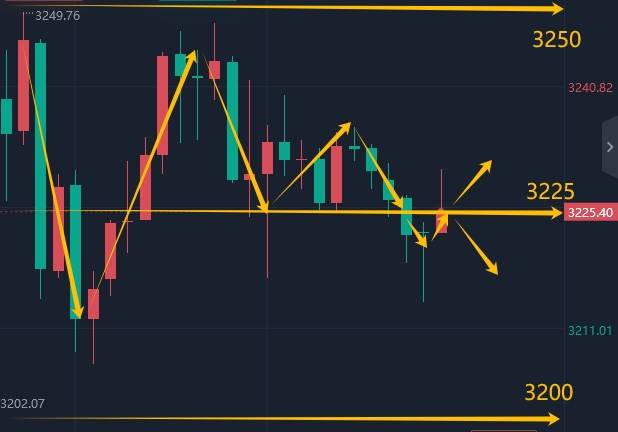
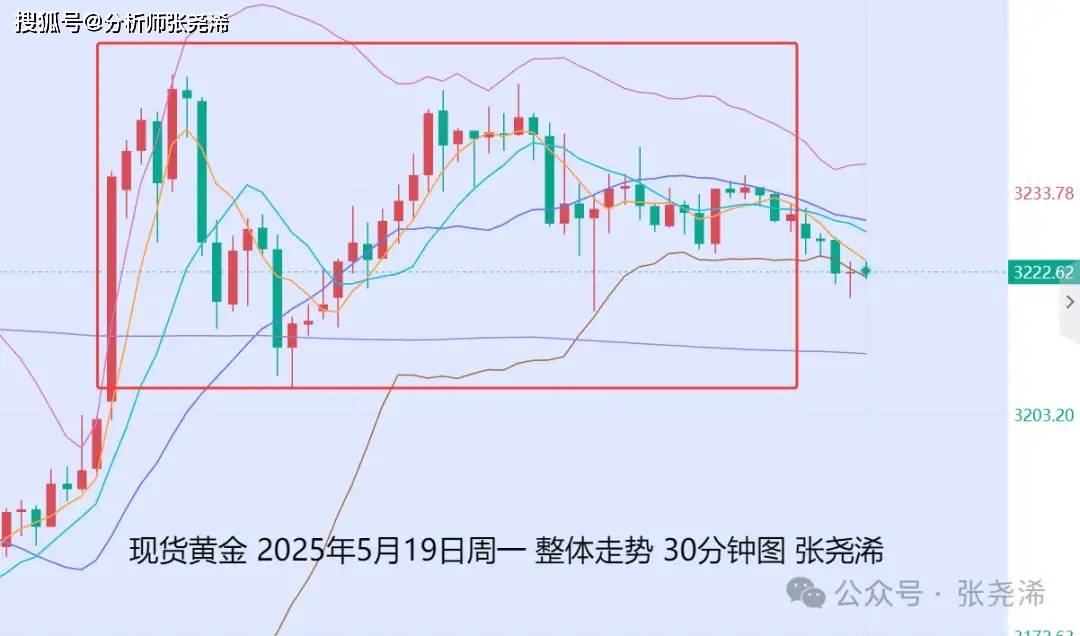
Group 1 - The gold market is experiencing unprecedented volatility this year, characterized by significant price fluctuations and a shift from "black swan" events to daily occurrences of $100 price swings [1] - Factors contributing to this volatility include tariff disputes, geopolitical tensions, de-dollarization trends, fluctuating Federal Reserve policies, and global recession expectations [1] - Recent trading patterns indicate a bearish sentiment, with gold prices fluctuating around 3222, and key resistance and support levels identified at 3250 and 3200 respectively [3] Group 2 - The silver market opened with slight gains, supported by key technical levels, while a weakening dollar and renewed trade tensions have increased safe-haven demand [6] - Silver prices are currently hovering around 32.33, with potential upward movement if they break through the resistance at 32.65, targeting 33.00 [6] - Short-term trading strategies for silver suggest focusing on selling on rebounds and buying on dips, with critical resistance and support levels identified at 32.65-32.75 and 32.20-32.10 respectively [6]

金价距高点回调近10%,关注黄金基金ETF(518800)回调布局机会,T+0交易
Sou Hu Cai Jing· 2025-05-20 01:49
Group 1 - The core viewpoint of the articles indicates that gold prices have recently experienced a pullback of over 10% from their peak at the end of April, primarily due to a decline in risk aversion as the US and China have canceled 91% of tariffs, easing tensions and reducing risk premiums [1] - Despite the recent pullback, the medium to long-term outlook for gold remains positive, driven by significant increases in central bank gold purchases since 2020, which have remained high for three consecutive years, signaling positive sentiment to other gold buyers [1] - Geopolitical risks, such as ongoing Middle East conflicts and slow progress in Russia-Ukraine negotiations, may lead to a temporary increase in safe-haven demand for gold [1] Group 2 - The recent downgrade of the US sovereign credit rating by Moody's from Aaa to Aa1, following similar actions by other major rating agencies, raises concerns about the US sovereign bond market and challenges to the dollar's credit system amid excessive money supply and fiscal deficit monetization [1] - The trend of "de-dollarization" globally suggests that gold may emerge as a new pricing anchor, potentially enhancing the upward momentum for precious metals [1] - Investors are encouraged to consider accumulating gold ETFs (518800) and their corresponding funds during price pullbacks, as these funds invest in gold spot contracts and offer better liquidity and convenience compared to physical gold [2]
张尧浠:地缘局势及贸易风险不定、金价回踩支撑仍待走强
Sou Hu Cai Jing· 2025-05-20 00:36
Core Viewpoint - The international gold market is experiencing fluctuations due to geopolitical tensions and trade risks, with prices currently stabilizing around key support levels while awaiting a stronger upward movement [1][4][9]. Price Movement - On May 19, gold opened at $3218 per ounce, reached a low of $3206.49, and a high of $3249.60, closing at $3230.09, marking a daily increase of $12.09 or 0.38% [1]. - Compared to the previous week's closing price of $3198.78, gold rose by $31.31, reflecting a 0.98% increase [2]. Geopolitical and Economic Influences - The market is influenced by escalating geopolitical tensions and President Trump's comments on the Federal Reserve's interest rate policies, alongside Moody's downgrade of the U.S. sovereign credit rating, which has heightened market risk aversion [4][9]. - The potential for renewed negotiations between Russia and Ukraine has reduced immediate demand for gold as a safe haven, contributing to price volatility [4][9]. Technical Analysis - The monthly chart indicates a strong resistance level, with the price remaining above the 5-10 month moving averages and a significant trendline support [6][11]. - The weekly chart shows that gold has not breached the 10-week moving average, suggesting a potential for a wide-ranging consolidation phase, with a focus on the $3100-$3440 range [13]. - The daily chart indicates that gold has rebounded from the ascending trendline and 60-day moving average support, with expectations for further upward movement as long as these support levels hold [15]. Market Outlook - The overall sentiment remains cautiously optimistic for gold prices to strengthen in the future, despite the current lack of strong bullish catalysts [8][9]. - The market will continue to be influenced by trade agreements and geopolitical developments, with gold expected to maintain a volatile trading pattern [6][9].
美国信用评级被下调引发避险需求,黄金强势反弹,美盘能否进一步走高?金十研究员高阳正在直播分析,点击进入直播间
news flash· 2025-05-19 11:24
美国信用评级被下调引发避险需求,黄金强势反弹,美盘能否进一步走高?金十研究员高阳正在直播分 析,点击进入直播间 相关链接 ...
【期货热点追踪】黄金过山车行情再现!穆迪历史性下调美国评级点燃避险需求,但黄金价格反弹能持续多久?
news flash· 2025-05-19 09:58
期货热点追踪 黄金过山车行情再现!穆迪历史性下调美国评级点燃避险需求,但黄金价格反弹能持续多久? 相关链接 ...
鹏华基本面投教系列|近期金价大幅波动,还能配置吗?
Sou Hu Cai Jing· 2025-05-19 09:51
Core Viewpoint - Recent fluctuations in gold prices are primarily driven by a decrease in safe-haven demand due to easing global trade tensions and geopolitical situations [2][3] Group 1: Recent Gold Price Performance - Gold prices have shown significant volatility, with COMEX gold futures experiencing a cumulative decline of 4.32% from May 12 to May 16, marking the largest weekly drop since November 2024 [1] Group 2: Factors Influencing Gold Price Decline - The decline in gold prices is attributed to reduced safe-haven demand as global tariff negotiations have made significant progress, leading to a substantial reduction in bilateral tariffs between China and the U.S. [2] - The resumption of negotiations between Russia and Ukraine, along with a ceasefire between India and Pakistan, has further alleviated geopolitical tensions, contributing to the decrease in demand for gold as a safe-haven asset [2] - The Federal Reserve's signals indicating a reluctance to cut interest rates have delayed market expectations for rate cuts, diminishing the attractiveness of gold [2] - Large-scale profit-taking activities have also contributed to price disturbances, as some investors opted to secure gains following a rapid increase in gold prices [2] Group 3: Future Outlook for Gold Prices - Most institutions predict that gold prices may continue to experience volatility in the short term, but the long-term investment rationale for gold remains intact [3] - According to China International Capital Corporation (CICC), further progress in U.S.-China tariff negotiations could enhance risk appetite, potentially leading to a decline in COMEX gold prices below $3,000 per ounce [3] - Zhongtai Securities suggests that short-term factors, such as the retreat of rate cut expectations, may exert pressure on gold prices [3] - In the medium to long term, the real yield on 10-year U.S. Treasury bonds is at a high level, and the U.S. economy is gradually moving towards stagflation, indicating a trend towards the restructuring of the U.S. dollar credit system, which may support higher gold prices [3] - From a long-term perspective, gold assets are still considered an important component of asset allocation, and investors should develop reasonable investment strategies based on their goals and risk tolerance while monitoring market dynamics [3]
秦氏金升:5.19黄金冲高回落,伦敦金行情走势分析及操作建议
Sou Hu Cai Jing· 2025-05-19 04:17
周一亚洲早盘,现货金一度冲高至3,245美元/盎司,随后维持在3,230美元上方震荡。 消息面解读:穆迪调降美国主权信用评级至Aa1后,市场对美国财政赤字与经济前景的担忧升温,避险买盘重返贵金属市场,上周创下六个月来最大周跌幅 的颓势被部分收复。美元指数回落与美债收益率下滑共同为金价提供支撑。穆迪下调评级虽在意料之外,却凸显美国财政挑战的中长期风险,叠加全球地缘 冲突与关税不确定性,使黄金的避险和对冲价值再度凸显。与此同时,美联储理事巴尔的最新表态也值得关注。他虽认为美国经济基础稳固,但也警告称贸 易争端可能令前景蒙阴。这种"鹰中带鸽"的言论,进一步巩固了美元的强势地位,间接加剧了黄金的跌势。 5月17日,美国金融市场迎来一场"黑色风暴"——国际评级机构穆迪突然将美国主权信用评级从顶级"AAA"下调至"AA+",这是美国三年内第三次失去三大 评级机构的最高评级。这一决定如同一枚深水炸弹,瞬间引发股债汇三杀,美国国债收益率飙升,黄金价格则因避险需求逆势走强。现在穆迪评级的影响金 价飙升,在周评分析中,我表述出看空的的思路,也解析看空的缘由。今日亚盘高点也与我们周评布空的点位吻合,截止发文最低报价3214附近,如 ...
【期货热点追踪】穆迪下调美国主权信用评级,全球大宗商品期货市场或迎来连锁反应!能源和有色金属期货或面临下行压力,贵金属期货或将受益于避险需求,农产品期货则需关注……
news flash· 2025-05-19 01:22
Core Insights - Moody's has downgraded the U.S. sovereign credit rating, which may trigger a chain reaction in the global commodity futures market [1] Group 1: Impact on Energy and Metals - Energy and non-ferrous metal futures are likely to face downward pressure due to the credit rating downgrade [1] Group 2: Safe-Haven Assets - Precious metal futures are expected to benefit from increased demand for safe-haven assets in light of the downgrade [1] Group 3: Agricultural Products - Agricultural futures will require close monitoring as the market reacts to the broader implications of the credit rating change [1]

黄金ETF爆赚30%背后:90%散户正在为泡沫买单!
Sou Hu Cai Jing· 2025-05-17 03:29
Group 1 - Recent fluctuations in gold prices have seen a drop from 830 yuan per gram to 760 yuan, highlighting the complexity of the current market dynamics driven by both safe-haven demand and speculative fervor [1] - The U.S. Treasury bonds, traditionally viewed as a safe haven, are facing increased credit risk concerns due to rising debt levels, with the 10-year Treasury yield surging 49 basis points in one week, marking the largest weekly increase [3] - The global trade outlook has worsened, with the WTO's trade barometer dropping to 95.5, the lowest since 2009, further boosting demand for gold as a safe-haven asset [3] Group 2 - Speculative bubbles have rapidly expanded, with global gold ETF sizes increasing by over 30% in 2023, and some regional funds seeing growth exceeding 50% [5] - The S&P Global Gold Mining Index has risen over 50% this year, with some individual company stock prices doubling [5] - The leverage in the gold futures market reached a historical high, with 28% of long positions using more than three times leverage, indicating significant irrationality in the market [5] Group 3 - Rational investors are advised to establish a scientific valuation system, focusing on key indicators such as the scale of U.S. debt, which has surpassed $35 trillion, reflecting the stability of the dollar credit system [7] - Central bank gold purchases have provided long-term support for gold demand, with global central bank purchases reaching 387 tons in the first half of 2023, a 52% year-on-year increase [7] - The share of gold in foreign exchange reserves has risen to 15.6% in 2023, up 4.2 percentage points since 2020, further supporting gold prices [7] Group 4 - Inflation levels validate gold's anti-inflation characteristics, with historical data showing that when CPI growth exceeds 3%, gold's average annual return reaches 10.2% [9] - The dollar's performance significantly impacts gold prices, with the dollar index fluctuating from 107.3 to 103.5 in 2023, affecting gold's pricing power [11] - The ongoing de-dollarization process has seen the dollar's share in global settlement currencies drop from 72% in 2000 to 59% in 2023, diminishing its influence on gold pricing [11] Group 5 - Historical cycles of gold prices indicate that it plays a crucial role during global monetary system restructurings, with significant price increases observed during past bull markets [11][13] - The current environment suggests a "high volatility, slow bull" characteristic for the gold market, with structural support from central bank purchases and de-dollarization trends [14] - The World Bank predicts a 25% increase in global gold demand by 2030, with emerging markets contributing 65% of this growth, providing ongoing momentum for gold prices [14]

商品日报(5月16日):商品大面积转跌 欧线原油及碳酸锂显著回落
Xin Hua Cai Jing· 2025-05-16 10:41
Group 1 - The domestic commodity market showed a general decline on the 16th, with only a few products like silicon iron, gold, and silver experiencing slight gains [2] - Gold and silver prices saw a minor rebound due to significant overnight gains in overseas precious metals, but were limited by exchange rate factors and a drop in overseas prices during the Asian session [2] - Silicon iron prices rose by 0.92% on the 16th, supported by a reduction in supply, as indicated by a decline in the operating rates and daily production of independent silicon iron enterprises [2] Group 2 - The European shipping line experienced a downturn after a period of significant increases, attributed to supply pressures and a lack of seasonal demand support [3] - The oil prices continued to decline due to increased supply expectations and a rise in U.S. inventory data, alongside potential agreements between the U.S. and Iran [4] - Carbonate lithium prices fell over 4%, driven by a continued decrease in lithium ore prices and a weak demand outlook, with expectations of oversupply persisting into June [4]