
哑铃策略

Search documents
红利+科技”哑铃策略!港股央企红利ETF10月跑赢大盘,资金逆势抢筹港股通科技ETF基金,机构:短期波动带来更好入场时机
Ge Long Hui· 2025-10-23 05:41
Group 1 - The market continues to show a trend of dividend gains while technology stocks are experiencing a contraction, with the Hang Seng Technology Index down over 11% since October 3 [1] - The Hong Kong Central Enterprise Dividend Index has increased by over 4% during the same period, outperforming the broader market [1] - The current volatile market conditions may persist ahead of significant events such as the 15th Five-Year Plan meeting, the Federal Reserve's interest rate decision, and the deadline for "reciprocal tariffs" on November 11 [1] Group 2 - A "barbell strategy" combining dividend and technology investments is suggested as a suitable allocation choice for the near future, reflecting recent capital flows [1] - The Hong Kong Central Enterprise Dividend ETF has seen a net inflow of 310 million yuan this month, with a gain of over 4% [1] - The Hang Seng Technology Index's recent pullback enhances its allocation value, with over 300 million yuan flowing into the Hong Kong Technology ETF in October, totaling over 700 million yuan in net inflows over the last 20 trading days [1] Group 3 - Institutional consensus indicates that under a low interest rate environment, high dividends, and sustained long-term capital inflows, dividend equity assets remain attractive [1] - For Hong Kong technology stocks, increased AI capital expenditure by major players and the potential for Federal Reserve rate cuts are expected to support resilience in the medium to long term [1] - The macro liquidity and fundamental logic are anticipated to play a significant role in the fourth quarter [1] Group 4 - The barbell strategy products include the Hong Kong Central Enterprise Dividend ETF (513910), which has a slight decline of 0.06% and includes major stocks like COSCO Shipping, Orient Overseas International, and China National Offshore Oil [1] - The Hong Kong Technology ETF (159101) has a decline of 0.87% and includes over 60% of the seven major technology giants such as Alibaba and Tencent, with a special focus on innovative pharmaceuticals [2]
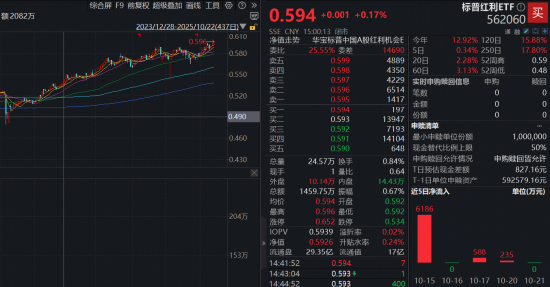
又双叒创新高!标普红利ETF(562060)场内溢价收涨0.17%三连阳
Xin Lang Ji Jin· 2025-10-22 09:09
Core Viewpoint - The A-share market is experiencing a collective decline, but high dividend sectors continue to perform well, with the S&P A-share Dividend Index leading the way, indicating a long-term positive trend in the stock market [1][4]. Market Performance - On October 22, the three major A-share indices weakened collectively, with overall market volume decreasing. The S&P A-share Dividend Index rose by 0.20%, marking three consecutive days of gains [1]. - The S&P Dividend ETF (562060) also saw a steady increase, closing up 0.17% and reaching a new high of 0.596 yuan during the day, with strong buying power [1]. Fund Inflows - Despite recent market fluctuations, the dividend sector has seen increased capital inflows, with the S&P Dividend ETF (562060) attracting over 110 million yuan in the last 10 trading days [1][4]. Stock Performance - The S&P A-share Dividend Index's constituent stocks showed significant gains, with notable performers including Su Yan Jing Shen (up 5.93%), Dai Mei Co. (up 4.43%), and China National Offshore Oil Corporation (up 3.51%) [3]. - The top 10 gainers in the S&P A-share Dividend Index on October 22 included stocks with estimated weights and notable price increases [3]. Dividend Outlook - According to Everbright Securities, dividend assets have returned to relatively low levels, and many A-share companies are expected to announce quarterly dividends by the end of October, potentially reigniting the upward momentum of dividend assets [4]. - The S&P A-share Dividend Index emphasizes dividend stability and sustainable profitability, with a strict 3% individual stock weight limit, leading to a more balanced market capitalization distribution [5]. Historical Performance - The S&P A-share Dividend Index has shown a one-year return of 12.71%, outperforming other mainstream dividend indices [6]. - The index's cumulative return from 2005 to September 2025 reached 2469.11%, with an annualized return of 17.73%, highlighting its long-term investment potential [7].

A股收评 | 三大指数集体收跌 成交再度缩量!资金抱团银行
智通财经网· 2025-10-22 07:17
Market Overview - The market experienced a collective decline with all three major indices closing lower, and trading volume decreased to 1.6 trillion yuan [1] - There is a mixed sentiment in domestic equity funds, with some capital continuing to focus on leading growth stocks while others rotate back to lower positions [1] Sector Performance - Key sectors showing strength include real estate, home appliances, and banking, with Agricultural Bank of China hitting a new high after 14 consecutive days of gains [1] - The real estate sector continued its upward trend, with Yingxin Development achieving three consecutive daily limits [1] - The power chip concept saw a surge, with Cambrian Technology rising over 7% at one point [1] - Conversely, sectors such as gold and other non-ferrous metals faced significant declines, with Hunan Silver hitting the daily limit down [1] Investment Strategy - Dongfang Securities suggests a short-term index may maintain a fluctuating upward trend, awaiting the resolution of overseas risk disturbances [1] - The "dumbbell strategy" is recommended, focusing on defensive sectors like state-owned enterprise reforms, infrastructure, and consumption, while also targeting technology growth stocks with strong earnings support [1] Future Outlook - Huazhong Securities anticipates that the current phase of adjustment is nearing its end, with a focus on growth as the optimal investment theme moving forward [9] - The report emphasizes the importance of sectors benefiting from a new growth cycle, particularly in AI computing infrastructure and related applications [9] - Shenyuan Hongyuan predicts that the market's effective breakthrough will rely on technology leadership, with a potential for a significant rally in the fourth quarter of 2025 [7]

险资下半年调研超4700次,泰康资管“最疯狂”
3 6 Ke· 2025-10-21 11:36
Group 1 - Insurance capital is accelerating its layout in the equity market under policy guidance, with a total of over 4700 company visits since the second half of 2025 [1][2] - Leading asset management and pension insurance companies are the main players in this trend, with Taikang Asset Management conducting over 280 visits, followed by Dajia Asset Management and Huatai Asset Management [1][2] - The technology and pharmaceutical sectors are the primary focus areas, with companies like Maiwei Biotech and Borui Pharmaceutical receiving multiple visits [1][4] Group 2 - The research activity is widespread across various A-share sectors, with over 70% of visits concentrated in Shenzhen Main Board, ChiNext, and STAR Market [2] - Some stocks have shown strong market performance post-insurance visits, with companies like Zhongji Xuchuang and Taotao Automotive doubling their stock prices [2] - Pension insurance companies are also actively participating, with Ping An Pension leading with 171 visits, focusing on both large-cap and small-cap companies [3][4] Group 3 - The dual focus on technology and pharmaceuticals reflects a strategic adjustment in asset allocation due to the low interest rate environment, aiming to build a balanced investment portfolio [3][5] - The pharmaceutical sector, particularly innovative drugs, is attractive for insurance funds due to its long-term investment nature, aligning with the stable characteristics of insurance capital [5] - The hard technology sector is experiencing multiple breakthroughs, with companies like Jing Sheng Machinery and Huichuan Technology being frequently visited [5][6] Group 4 - Traditional sectors, particularly bank stocks, remain a key focus for insurance capital, with a clear "growth in technology + high dividend" strategy [6] - Regional banks are gaining attention, with Jiangsu Bank receiving 17 visits, indicating a shift from the previous preference for state-owned banks [6]
中证A500一周年回检:投资组合的“稳定器”
聪明投资者· 2025-10-21 07:07
Core Insights - The article highlights the performance of the CSI A500 Index, which has shown both expected stability and unexpected strengths over the past year [4][6][8] - The index has outperformed the CSI 300 Index by approximately 4 percentage points, with a cumulative increase of 45.08% since its launch [8][22] - The article emphasizes the index's ability to capture new productivity and industry upgrades, making it a valuable asset in investment portfolios [11][21] Performance Evaluation - The CSI A500 Index has demonstrated a balanced performance amidst market volatility, successfully reflecting its balanced attributes during style rotations [6][7] - The index's performance is attributed to key contributors from high-end manufacturing sectors, which are not covered by the CSI 300 [9][11] - The index has maintained a lower annualized volatility and maximum drawdown compared to the CSI 300 and small-cap indices, indicating robust risk management [16][18] Market Dynamics - Institutional investors have shown increased interest in the CSI A500 ETF, with a 25.11% rise in holdings, reaching over 93% [18][20] - The shift in insurance capital towards the CSI A500 ETF, with a more than 50% increase in holdings, signals a growing recognition of the index as a core asset in long-term investment strategies [20][21] Growth and Global Recognition - The total scale of ETFs tracking the CSI A500 Index reached 183.495 billion, indicating significant market trust for a newly launched index [22][25] - The launch of a CSI A500 ETF by DWS in Europe marks a notable step in the global recognition of A-share core assets [28] Investment Strategies - The article discusses the "core + satellite" strategy, positioning the CSI A500 as a stable core asset in investment portfolios [31] - The "barbell strategy" is also highlighted, where the CSI A500's lower correlation with various asset classes enhances diversification and overall risk-return profile [32] - The index is deemed suitable for long-term funds due to its stable profitability and strong industry representation [33]

新强旧弱,产强需弱
GOLDEN SUN SECURITIES· 2025-10-20 12:19
Report Industry Investment Rating No relevant content provided. Core View of the Report The current economy shows significant differentiation and a general weakening trend, increasing the necessity for policy intervention to stabilize growth. For the bond market, the weakening fundamentals and loose liquidity will drive a trend of strengthening. There may be some risk disturbances in the first half of Q4, and interest rates may decline more smoothly in the second half. The situation where interest rates deviated from both fundamentals and liquidity in Q3 needs to be corrected. The short - term escalation of trade conflicts and the decline in risk appetite have promoted the correction process of the bond market. However, the lack of cooperation from allocation - type institutions, potential bond - selling pressure from banks, and the impact of public fund fee reform still exist, and interest rate declines may not be smooth. The dumbbell strategy is preferred, and short - term credit/certificates of deposit + long - term high - elasticity products offer higher cost - effectiveness [4][22]. Summary Based on Related Content Economic Growth and Outlook - The GDP growth rate slowed down in Q3 2025, with a real growth rate of 4.8% and a nominal growth rate of 3.7%, the lowest since Q4 2022. Although the full - year target of 5% can be achieved, there is still pressure on nominal growth. Considering the high base of Q4 last year (1.5% for real GDP growth on a quarterly - on - quarterly basis), if the quarterly - on - quarterly growth rate in Q4 does not increase significantly, there may be a continued slowdown in the year - on - year growth rate [1][7]. Economic Structural Differentiation - **Supply vs. Demand**: Supply is strong while demand is weak. In September, the industrial added - value growth rate increased by 1.3 percentage points to 6.5%, and the service industry's GDP increased by 5.6% year - on - year, remaining flat compared to the previous month. However, the consumer market and investment continued to weaken. The growth rate of social retail sales slowed to 3.0%, and the single - month fixed - asset investment growth rate slowed to - 8.4% [1][7]. - **External vs. Domestic Demand**: External demand is strong while domestic demand is weak. In September, exports increased by 8.3% year - on - year, with the growth rate increasing by 4.0 percentage points compared to the previous month, driving the year - on - year growth rate of export delivery value to increase by 4.2 percentage points to 3.8%, which in turn boosted the industrial added - value growth rate. However, domestic consumption and investment continued to decline [2]. - **New vs. Old Economy**: New economy sectors such as the Internet and new energy are growing rapidly, while old economy sectors such as real estate and infrastructure are continuously weakening. In September, the production index of the information transmission, software, and information technology service industries in the service sector increased by 12.8% year - on - year, with the growth rate increasing by 0.7 percentage points compared to the previous month. The added - value of the automotive industry in industrial added - value increased by 16% year - on - year, up 7.6 percentage points from the previous month. In contrast, real estate and infrastructure investment declined by 21.3% and 8.0% respectively in September [2]. Consumption Analysis - The growth rate of residents' disposable income slowed down, which restricted consumption. In Q3, the single - quarter year - on - year growth rate of residents' per capita disposable income was 4.52%, a decrease of 0.56 percentage points compared to the previous quarter. The year - on - year growth rate of residents' per capita consumption expenditure was 3.4%, a decrease of 1.8 percentage points compared to the previous quarter. In September, the year - on - year growth rate of social retail sales was 3.0%, a decrease of 0.4 percentage points compared to the previous month. Among the main sub - sectors of social retail sales, the year - on - year growth rates of many industries such as gold, silver, and jewelry, and sports and entertainment products declined. Although the growth rates of four industries with concentrated subsidies (household appliances, furniture, communication products, and office supplies) still supported the year - on - year performance of social retail sales, the policy effect has diminished [3][12]. Investment Analysis - **Overall Investment**: In September, the year - on - year growth rate of fixed - asset investment was - 8.4%, with the decline narrowing by 0.9 percentage points compared to the previous month. However, the year - on - year declines in the three major industries further widened [15]. - **Manufacturing Investment**: In September, the year - on - year growth rate of manufacturing investment was - 1.9%, with the decline increasing by 0.6 percentage points compared to the previous month. Due to weak downstream and terminal demand, corporate profitability was under pressure, which continued to suppress investment willingness [15]. - **Infrastructure Investment**: In September, the year - on - year growth rate of infrastructure investment was - 8.0%, with the decline increasing significantly by 1.6 percentage points compared to the previous month. The high base from the same period last year deepened the investment decline. Although the easing of the base pressure and the implementation of some fiscal incremental policies (such as the Ministry of Finance's release of 500 billion yuan in remaining quotas on October 17) can mitigate the investment slowdown to some extent, the overall impact is limited, and infrastructure investment is expected to continue to decline year - on - year [15]. - **Real Estate Investment**: In September, the year - on - year decline in real estate investment continued to widen, reaching - 21.3%, and the cumulative year - on - year decline in real estate investment continued to fall to - 13.9%. The year - on - year decline in real estate sales also widened, with the sales area falling by 11.9% year - on - year. Although the declines in new construction and completion narrowed, overall, the downward trend in real estate investment continued, increasing the need for policy support [19].
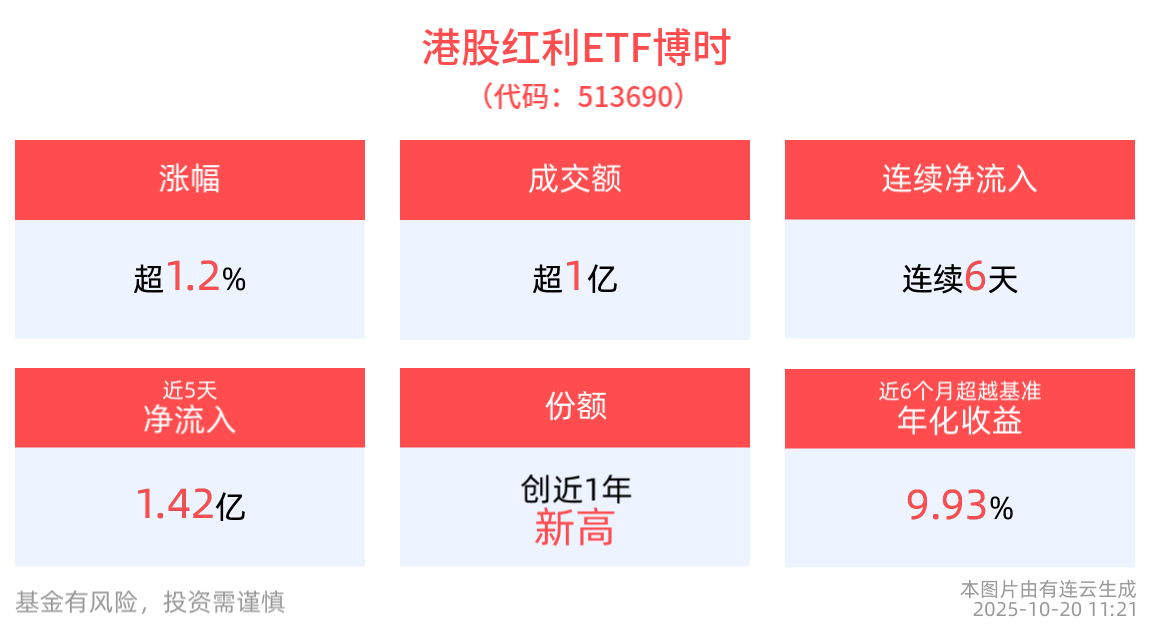
性价比与确定性凸显,红利资产获资金青睐,港股红利ETF博时(513690)涨超1%,连续6日获资金净流入
Xin Lang Cai Jing· 2025-10-20 03:41
Core Insights - The Hang Seng High Dividend Yield Index has increased by 0.97% as of October 20, 2025, with notable gains in stocks such as China Petroleum (up 3.96%) and Xinyi Glass (up 2.86%) [3] - The BoShi Hang Seng High Dividend ETF has seen a price increase of 1.29%, reaching 1.1 yuan, and has accumulated a 0.65% rise over the past week [3] - The A-share market has shown significant structural differentiation, with low valuation high dividend sectors gaining traction amid a volatile environment [3] Market Trends - High dividend blue-chip stocks, particularly in the banking sector, have performed well, with the banking index rising for seven consecutive days [4] - Agricultural Bank has notably achieved 11 consecutive days of positive daily closes, reaching a historical high [4] - Analysts suggest that after a tech growth phase, dividend assets may become more attractive as they have returned to relatively low levels [4] Investment Strategies - The banking sector's dividend yield has improved post-correction, making it a compelling option for medium to long-term investment [4] - The "dumbbell strategy" combining high dividend assets with high valuation tech growth stocks is expected to remain effective in the fourth quarter [4] - The BoShi Hang Seng High Dividend ETF has seen a significant inflow of funds, totaling 163 million yuan over six days, with a peak single-day inflow of 49.21 million yuan [4][5] Fund Performance - The BoShi Hang Seng High Dividend ETF closely tracks the Hang Seng High Dividend Yield Index, which reflects the performance of high dividend securities available through the Hong Kong Stock Connect [5] - As of October 8, 2025, the top ten weighted stocks in the index accounted for 28.98% of the total index weight [5] - The latest fund size of the BoShi Hang Seng High Dividend ETF is 5.536 billion yuan, with a record high of 5.119 billion shares [4][5]
波动加剧,资金两手布局!上周超12亿元抢筹食品饮料ETF,黄金ETF华夏10连“吸金”
Ge Long Hui A P P· 2025-10-20 03:22
Group 1 - The core viewpoint of the articles highlights significant market volatility post-holiday, with technology stocks experiencing notable corrections while international gold prices reached historical highs [1] - There was a net inflow of over 60 billion yuan into the ETF market last week, with the top three attracting funds being SGE Gold 9999, Hang Seng Technology, and CSI Bank Index [1] - The food and beverage sector, particularly the food and beverage ETF (515170), saw a rare net inflow of 1.21 billion yuan last week, indicating strong investor interest in this segment [1] Group 2 - The current market sentiment is influenced by concerns over escalating trade tensions and renewed expectations for a Federal Reserve rate cut in October [1] - The "dumbbell strategy" is suggested for current market conditions, focusing on leading stocks in the food and beverage sector, which includes major brands like Moutai and Wuliangye [3] - The lowest fee gold ETF, Huaxia Gold (518850), is highlighted for its T+0 trading capability, appealing to investors seeking liquidity [4] Group 3 - The mid to long-term outlook suggests that 2026 could be a significant year for economic resonance between China and the U.S., enhancing the allocation value of cyclical sectors amid a recovering PPI backdrop [2] - The discussion around the "14th Five-Year Plan" starting on October 20 is expected to bring policy catalysts that could influence market dynamics, particularly in promoting domestic demand [1]





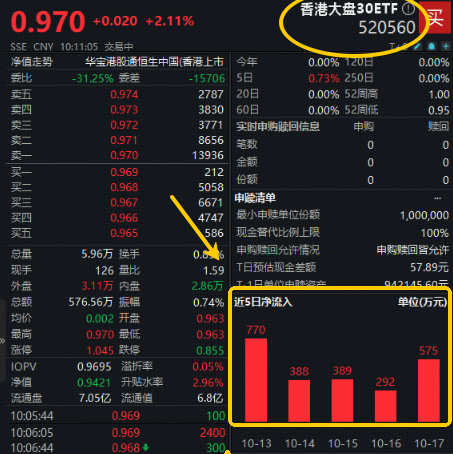
日日净买入?上市5日资金连日抢筹!一手抓“科技+红利”香港大盘30ETF(520560)盘中劲升2%!
Xin Lang Ji Jin· 2025-10-20 02:28
Group 1 - The Hong Kong large-cap 30 ETF (520560) has shown a strong performance since its listing on October 13, with a price increase of 2% and a fund size of 681 million yuan as of October 20 [1] - Major constituent stocks such as Alibaba-W, SMIC, and ZTO Express have all risen over 4% [1] - The ETF has experienced a net inflow of 24 million yuan over the past five trading days, indicating strong investor interest [1] Group 2 - The Hang Seng Technology sector is benefiting from the AI technology cycle and application explosion, with hardware demand driven by cloud computing and AI [2] - E-commerce and local services are seeing a recovery in GMV growth due to policy support, while the OTA tourism market is also rebounding [2] - The Hong Kong large-cap 30 ETF closely tracks the Hang Seng China (Hong Kong-listed) 30 Index, which consists of 30 high-liquidity large-cap stocks across various sectors [2] Group 3 - The top ten holdings of the Hang Seng China (Hong Kong-listed) 30 Index account for over 74% of the total weight, indicating a high concentration of investments [3] - The total market capitalization of the index's constituent stocks is approximately 3208.25 billion yuan [3]
性价比与确定性凸显 红利资产获资金青睐
Shang Hai Zheng Quan Bao· 2025-10-19 12:31
Core Viewpoint - Following the holiday, there is a shift in funds towards dividend assets due to "high cut low" demand, adjustments in the tech sector, and the calendar effect in Q4, leading to a concentration of purchase limits on several dividend funds [1] Group 1: Dividend Fund Purchase Limits - Multiple dividend funds have recently announced purchase limits, with Manulife Fund stating that from October 17, single accounts cannot exceed 1 million yuan in purchases [2] - Similarly, Jianxin Fund has set a limit of 10 million yuan for its dividend-focused fund, while other funds have varying limits ranging from 10 million to 250,000 yuan [2] - The frequent implementation of purchase limits is attributed to the need to protect existing fund holders and ensure stable fund operations [2] Group 2: Increased Demand for Dividend Assets - Recent data indicates a rising preference for dividend assets, with the net subscription of Huabao CSI Bank ETF reaching 4.9 billion units, the highest among all ETFs [3] - The Huatai-PB CSI Dividend Low Volatility ETF also saw a significant increase in net subscriptions, totaling 1.88 billion units in October compared to only 390 million units in September [3] Group 3: Defensive Investment Strategies - In light of global trade uncertainties, there is a heightened demand for defensive asset allocations, benefiting large financial and dividend assets [4] - Analysts suggest that dividend assets have returned to relatively low levels, and with upcoming quarterly reports and potential dividend distributions, these assets may drive A-share market growth [4] - A fund manager indicated a consensus in the industry that Q4 will see a "high cut low" strategy, with a shift from tech stocks to financial technology sectors, which are expected to offer better investment value and certainty [4] Group 4: Investment Strategies in Low-Interest Environments - In a low-interest-rate environment, a "barbell strategy" combining high-dividend assets with high-valuation tech growth remains effective in Q4 [5] - The attractiveness of dividend assets, particularly for institutional investors like insurance funds, has significantly increased following the tech growth phase [5]