国补政策

Search documents
老板电器(002508):核心主业保持强韧性,盈利能力有所提升
Huachuang Securities· 2025-09-16 09:27
Investment Rating - The report upgrades the investment rating of the company to "Strong Buy" [2][8] Core Views - The company's core business remains resilient, with an increase in profitability despite a slight decline in revenue [2][8] - The company reported a revenue of 4.61 billion yuan for H1 2025, a year-on-year decrease of 2.6%, and a net profit attributable to shareholders of 710 million yuan, down 6.3% year-on-year [2][8] - In Q2 2025, the company achieved a revenue of 2.53 billion yuan, reflecting a year-on-year growth of 1.6%, and a net profit of 370 million yuan, up 3.0% year-on-year [2][8] Financial Performance Summary - The company’s total revenue is projected to grow from 11,213 million yuan in 2024 to 12,843 million yuan in 2027, with a compound annual growth rate (CAGR) of approximately 4.4% [4] - The net profit attributable to shareholders is expected to increase from 1,577 million yuan in 2024 to 1,870 million yuan in 2027, reflecting a CAGR of about 5.7% [4] - The earnings per share (EPS) is forecasted to rise from 1.67 yuan in 2024 to 1.98 yuan in 2027 [4] Market Position and Competitive Advantage - The company maintains a leading market position in key product categories, with market shares in range hoods, gas stoves, dishwashers, and integrated machines ranking first or third [8] - The company benefits from national subsidy policies, which support demand recovery despite the challenging real estate market [8] Profitability and Cost Management - The gross margin improved to 50.4% in H1 2025, up 1.6 percentage points year-on-year, driven by a better product mix and higher sales of high-margin products [8] - The net profit margin reached 14.7% in Q2 2025, an increase of 0.2 percentage points year-on-year, attributed to stable expense management and increased gross margins [8] Investment Recommendations - The report suggests that while short-term demand is pressured by the real estate market, the company is well-positioned for medium to long-term growth through diversified product development [8] - The target price is set at 25.4 yuan, indicating potential upside from the current price of 19.47 yuan [4][8]

即时零售国补首度覆盖Apple新品,北京市民可在美团闪购预订新款Apple Watch
Bei Jing Shang Bao· 2025-09-11 05:42
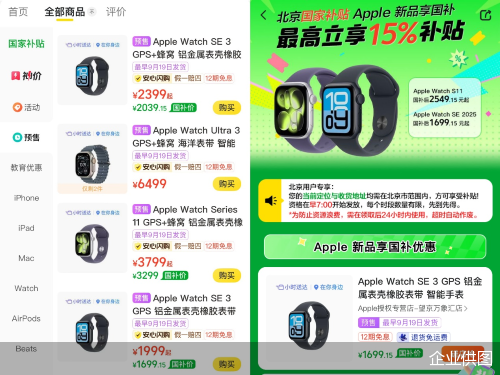
Group 1 - The new Apple Watch is available for pre-order on Meituan's flash purchase platform, with consumers in Beijing able to reserve it at a national subsidy price [1] - This marks the first time national subsidies have been applied to Apple products through an instant retail platform, offering consumers a "30-minute national subsidy new product delivery" experience [3] - The national subsidy policy has expanded to instant retail platforms this year, significantly boosting digital consumption, with mobile phone sales on Meituan's platform increasing threefold and Apple store sales more than doubling since the subsidy implementation [3] Group 2 - As the instant retail platform becomes a key channel for purchasing digital products, the launch of Apple products this year features new highlights, including the first-time application of national subsidies [3] - Meituan's flash purchase has introduced a dedicated IP for the launch of consumer electronics, "Meituan Lightning New Products," providing preferential traffic and resource exposure to help brands gain additional business growth through "instant retail product launches" [3]



格力承压
经济观察报· 2025-09-05 06:33
Core Viewpoint - Gree Electric Appliances is facing significant pressure in the market, with a decline in revenue and increasing competition from brands like Midea and Xiaomi, indicating a potential shift in market dynamics [2][9][12]. Revenue and Profitability - In the first half of 2025, Gree reported revenue of approximately 973 billion yuan, a year-on-year decrease of 2.46%, while net profit attributable to shareholders was about 144 billion yuan, a year-on-year increase of 1.95% [2][9]. - Compared to Midea and Haier, Gree is the only company among the three to experience negative revenue growth [2][9]. Market Position and Competition - Gree's market share in the air conditioning sector has declined to 23.25%, down approximately 4.07% year-on-year, while Xiaomi's market share has increased to 10.94%, up 3.43% [2][13]. - The competitive landscape is shifting, with Midea and Haier showing stronger performance, particularly in the mid to high-end segments, while Gree's product offerings remain more traditional [4][5][10]. Consumer Preferences - Consumers are increasingly favoring more affordable products, with a notable shift towards low-end air conditioning units priced below 2100 yuan, which now account for over 50% of sales [6][4]. - The economic environment has led to more conservative purchasing habits among consumers, impacting Gree's sales performance [10][4]. Product Diversification and Strategy - Gree's product diversification beyond air conditioning has not yet gained significant traction, with a heavy reliance on air conditioning for approximately 79% of its revenue [10][11]. - Gree's strategy emphasizes maintaining product quality and avoiding price wars, as articulated by its market director, who expressed confidence in the brand's long-term prospects despite current challenges [15][8]. Emerging Competitors - Xiaomi is rapidly gaining market share in the home appliance sector, with significant growth in its IoT and consumer product revenue, indicating a shift in consumer preferences towards smart and affordable appliances [12][13]. - Xiaomi's sales performance in air conditioning and other home appliances has shown remarkable growth, with air conditioning unit shipments exceeding 540 million, reflecting a 60% year-on-year increase [13][14].

“国补”重启利好汽车消费,专家预计将带来10%销量增长
Di Yi Cai Jing· 2025-09-05 01:32
Group 1 - The new batch of subsidy funds has led to a tightening of the "national subsidy" policy in 20% of regions, affecting customer conversion for some dealerships significantly [1][2] - In August, the overall performance of the car market was stable, with passenger car sales expected to reach around 2 million units, showing improvement compared to July [1][2] - Over 75% of dealerships reported significant negative impacts on sales due to policy adjustments, with nearly 30% experiencing sales declines exceeding 15% [2] Group 2 - The government is expected to invest over 180 billion yuan in vehicle replacement subsidies this year, which is projected to drive a 10% increase in sales [3] - The "two new" policies are anticipated to continue supporting consumer demand for vehicle purchases throughout the year, with September expected to see a traditional sales peak [2] - Upcoming large autumn auto shows and the proximity of holidays like Mid-Autumn Festival and National Day are expected to boost consumer interest and purchasing intentions [2]
九阳股份(002242):Q2外销有所承压,期待经营改善
Guotou Securities· 2025-09-01 07:37
Investment Rating - The investment rating for Joyoung Co., Ltd. is maintained at "Buy-A" with a 12-month target price of 11.73 CNY [3][4]. Core Views - Joyoung's revenue for the first half of 2025 was 3.99 billion CNY, a year-on-year decrease of 9.1%, with a net profit attributable to shareholders of 120 million CNY, down 30.0% year-on-year. The second quarter alone saw revenue of 1.99 billion CNY, down 14.4% year-on-year, and a net profit of 20 million CNY, down 53.2% year-on-year. The decline in external sales is attributed to adjustments in related party transactions, but there is optimism for recovery in domestic sales due to government subsidies stimulating small appliance consumption [1][2]. Summary by Sections Financial Performance - In H1 2025, domestic sales revenue increased by 0.2% year-on-year, while external sales revenue decreased by 48.7% year-on-year. The second quarter's external sales are expected to have declined further [1]. - The gross margin for Q2 was 28.1%, an increase of 0.9 percentage points year-on-year, primarily due to a higher proportion of domestic sales [2]. - The net profit margin for Q2 was 1.1%, a decrease of 0.9 percentage points year-on-year, influenced by fluctuations in non-core business and a decline in revenue scale [2]. Future Outlook - The company is expected to show significant operational elasticity as government subsidies continue to boost domestic small appliance consumption and as export business stabilizes. EPS forecasts for 2025, 2026, and 2027 are 0.29 CNY, 0.42 CNY, and 0.50 CNY, respectively [3][4]. Valuation Metrics - The projected P/E ratios for 2025, 2026, and 2027 are 35.1, 24.1, and 20.1, respectively, indicating a potential recovery in profitability [7][9].

老板电器(002508):25H1中报点评:Q2营收利润恢复增长,盈利能力企稳回升
Haitong Securities International· 2025-08-28 03:36
Investment Rating - The report maintains an "Outperform" rating for the company with a target price of RMB 28.48, indicating an expected upside from the current price of RMB 19.79 [2][5]. Core Insights - The company reported a revenue of RMB 4.60 billion for H1 2025, a year-on-year decrease of 2.58%, but Q2 revenue showed a recovery with RMB 2.53 billion, a year-on-year increase of 1.57% [3][10]. - The net profit for H1 2025 was RMB 0.71 billion, down 6.28% year-on-year, while Q2 net profit increased by 2.96% to RMB 0.37 billion [3][10]. - The company plans to distribute a mid-term dividend of RMB 0.5 per share, continuing its dividend strategy [3][10]. Financial Performance - In Q2 2025, the gross profit margin reached 48.56%, up 1.26 percentage points year-on-year, leading to a net profit margin of 14.68%, an increase of 0.20 percentage points [4][11]. - For H1 2025, the overall gross profit margin was 50.53%, a year-on-year increase of 2.25 percentage points, while the net profit margin was 15.45%, down 0.61 percentage points [4][11]. - The company maintains a strong market position, with offline retail market shares of 31.2% for range hoods, 31.4% for stoves, and 27.7% for all-in-one machines, all ranking first in the industry [4][12]. Revenue Breakdown - The revenue from range hoods and gas stoves was RMB 2.21 billion and RMB 1.16 billion, respectively, both showing a decline of 2.4% and 1.1% year-on-year [4][12]. - The dishwasher and all-in-one machine segments achieved revenues of RMB 340 million and RMB 300 million, respectively, with year-on-year growth of 6.0% and 6.2% [4][12]. Valuation and Future Outlook - The company is expected to benefit from national subsidy policies, which have positively impacted retail performance, offsetting challenges from the real estate downturn [5][13]. - EPS forecasts for 2025, 2026, and 2027 are RMB 1.78, RMB 1.90, and RMB 2.08, respectively, with a PE valuation of 16x for 2025 [5][13].
瑞尔特20250827
2025-08-27 15:19
Summary of the Conference Call for 瑞尔特 Company Overview - 瑞尔特 reported a revenue decline of 18% year-on-year for the first half of 2025, with a net profit drop of 6.8% due to intense market competition, weak demand for new homes, and varying execution of national subsidy policies [2][3][4]. Key Points Financial Performance - Total revenue for the first half of 2025 was approximately 920 million yuan, a 15.5% decrease year-on-year, with a net profit of about 51.66 million yuan, down 43% [3]. - In Q2 2025, revenue was 508 million yuan, down 18% year-on-year, while net profit was around 30 million yuan, a decrease of 6.8% [3]. - The overall gross margin was approximately 30%, with a slight decline due to lower average prices of branded products [4][19]. Market Dynamics - The smart toilet and cover category, which accounts for about 57% of total revenue, saw a decline of approximately 22% [5]. - The domestic market, representing about 63% of total revenue, decreased by 27%, primarily due to a drop in OEM business [5]. - Despite tariff impacts, the overseas market, which constitutes about 36% of total revenue, experienced a slight growth of 0.6% compared to the previous year [5]. Challenges and Risks - The domestic OEM business faced significant pressure, with major clients' order share dropping from 30% to 20%, and an expected overall order volume reduction of about two-thirds for the year [10][21]. - Currency exchange losses amounted to nearly 800,000 yuan in the first half, a significant drop from previous year's gains of over 5 million yuan [7]. Product and Channel Strategy - The company is focusing on upgrading stores and diversifying product categories, with approximately 1,200 dealer outlets and around 700 new channels primarily through JD's offline self-operated stores [6]. - The introduction of AI health smart toilets aims to enhance product functionality and tap into new market segments [4][27]. Regulatory Environment - The implementation of the 3C certification has positively impacted the market, with a noticeable increase in the share of mid-to-high-end products priced above 3,000 yuan [16]. - The national subsidy policy is expected to have a limited effect in the second half of 2025, with demand remaining weak [18]. Future Outlook - The company plans to maintain a cautious approach to sales expenses, particularly in brand promotion, while focusing on expanding its presence in JD's offline self-operated stores [24]. - There is an ongoing effort to address the aging population's needs with products designed for elderly users, including adjustable smart toilets [30]. - The company aims to diversify its business and expand into emerging markets to mitigate revenue pressures and enhance overall profitability [31]. Sales Performance - During the 618 shopping festival, the best-selling products were full smart toilets priced between 3,000 and 4,500 yuan, benefiting from national subsidies that lowered consumer prices [28]. - The sales of non-smart products remained in the single-digit range, with efforts to increase their proportion not meeting expectations [29]. Conclusion - 瑞尔特 is navigating a challenging market landscape with a focus on product innovation, channel expansion, and addressing demographic trends, while managing financial pressures and regulatory changes. The outlook remains cautious, with a commitment to improving profitability and exploring new growth avenues.

国补推动,B站盈利
2 1 Shi Ji Jing Ji Bao Dao· 2025-08-26 12:59
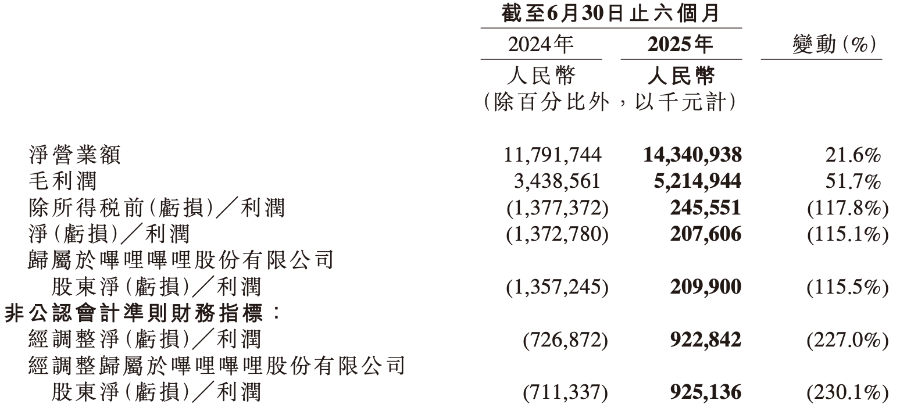
Core Viewpoint - Bilibili (B站) is entering a steady profitability cycle, with significant revenue growth and a shift from losses to profits in Q2 2025 compared to the same period in 2024 [1][5][19] Financial Performance - Bilibili's revenue for Q2 2025 increased by 20% year-on-year to 7.338 billion RMB, while net profit reached 218 million RMB, a turnaround from a net loss of 608 million RMB in Q2 2024 [1] - Adjusted net profit for the same period was 561 million RMB, compared to a loss of 272 million RMB in the previous year [1] - For the first half of 2025, Bilibili reported a net operating revenue of 14.34 billion RMB, a 21.6% increase from 11.79 billion RMB in 2024 [4] Comparison with Competitors - In contrast, iQIYI's revenue declined by 11% to 6.63 billion RMB, with a net loss of 133.7 million RMB, compared to a net profit of 68.7 million RMB in the same quarter last year [2][3] - Bilibili is widening the gap with iQIYI in terms of financial performance [3] Revenue Breakdown - Bilibili's revenue sources in Q2 2025 included 39% from value-added services, 33% from advertising, 22% from games, and 6% from IP derivatives and other businesses [6] - Advertising revenue grew by 20% to 2.45 billion RMB, with brand advertising and performance advertising increasing by approximately 30% [6][7] User Engagement and Growth - Daily active users increased by 7% to 109 million, while monthly active users rose by 8% to 363 million [12] - The average user spent 105 minutes per day on the platform, a 6-minute increase from the previous year [12] - The number of paying users reached 31 million, with over 80% being annual subscribers or auto-renewal users [12] Strategic Advantages - Bilibili's unique content ecosystem allows it to benefit from national subsidy policies, particularly in the home appliance sector [11] - The gaming sector remains a significant advertising contributor, with game revenue increasing by 60% to 1.61 billion RMB [9][10] Cost Management and Profitability Outlook - Bilibili's gross margin improved by 6.6 percentage points to 36.5%, driven by high growth in gaming and advertising [17] - The company aims to maintain a gross margin target of 40% to 45% in the medium term, with operational expenses expected to decrease in the second half of the year [17][18]

国补推动,B站盈利丨文娱财报观察
2 1 Shi Ji Jing Ji Bao Dao· 2025-08-26 12:53
Core Viewpoint - Bilibili (B站) is entering a steady profitability cycle, with significant revenue growth and a shift towards positive net profit, contrasting with its competitor iQIYI's declining revenue and increasing losses [1][2]. Financial Performance - In Q2 2025, Bilibili's revenue increased by 20% year-on-year to 7.338 billion yuan, with a net profit of 218 million yuan, compared to a net loss of 608 million yuan in the same period of 2024 [1]. - Adjusted net profit for the same period was 561 million yuan, up from a loss of 272 million yuan in 2024 [1]. Revenue Breakdown - Bilibili's revenue sources in Q2 included: - Value-added services: 39% - Advertising: 33% - Gaming: 22% - IP derivatives and others: 6% [3]. - Advertising revenue grew by 20% to 2.45 billion yuan, with brand advertising and performance advertising increasing by approximately 30% [3][4]. User Engagement - Daily active users increased by 7% to 109 million, while monthly active users rose by 8% to 363 million [7]. - The average daily usage time per user was 105 minutes, a 6-minute increase from the previous year [7][8]. Market Trends - Bilibili's gaming revenue surged by 60% to 1.61 billion yuan, with popular titles maintaining user engagement [5]. - The company noted a significant increase in advertising revenue from home appliances, driven by national subsidy policies [4][5]. Cost Management and Profitability - Bilibili's gross margin improved by 6.6 percentage points to 36.5%, supported by high growth in gaming and advertising [11]. - The company aims to maintain a mid-term gross margin target of 40% to 45% and expects operational expenses to decrease in the second half of the year [11]. Cash Position - As of June 30, Bilibili had cash and cash equivalents, along with short-term investments, totaling 22.29 billion yuan [12].
【A股收评】三大指数涨跌不一,果链、游戏板块走强!
Sou Hu Cai Jing· 2025-08-26 08:20
Market Performance - The three major indices showed mixed results, with the Shanghai Composite Index down 0.39%, the Shenzhen Component Index up 0.26%, and the ChiNext Index down 0.76% [2] - Over 2,700 stocks rose in the two markets, with a total trading volume of approximately 2.68 trillion yuan [3] Apple Supply Chain Stocks - Apple-related stocks experienced significant movements, with GoerTek (002241.SZ) and Lingyi iTech (002600.SZ) rising by 10%, and Luxshare Precision (002475.SZ) increasing by over 6% [3] - GoerTek, as a leading player in the Apple supply chain, has benefited from the AI wave, achieving six consecutive quarters of year-on-year growth in net profit attributable to shareholders from Q1 2024 to Q2 2024 [3] Consumer Electronics Sector - The high demand in the consumer electronics sector is attributed to both AI stimulation and domestic "national subsidy" policies, which are reviving mid-range consumption and driving structural recovery in mobile phones and tablets [3] Livestock Industry - Livestock stocks showed strong performance, with Xiaoming Co. (300967.SZ) rising over 10% and Muyuan Foods (002714.SZ) increasing by over 7% [3] - The National Development and Reform Commission reported that the average pig-to-grain price ratio fell below 6:1, entering a warning zone, prompting the government to initiate central frozen pork reserves [4] Gaming Sector - The gaming sector saw positive movements, with 37 Interactive Entertainment (002555.SZ) rising by 10% and other companies like Digital Soul (603258.SZ) and Giant Network (002558.SZ) also increasing [4] - A report from Guotai Junan highlighted that the National Press and Publication Administration approved a record 166 domestic online games on August 25, 2025, indicating a stable approval rhythm and a rich supply of gaming products [4] Beauty and Personal Care Sector - The beauty and personal care sector performed well, with Shuiyang Co. (300740.SZ) rising over 10% and other companies like Proya Cosmetics (603605.SH) and Huaxi Biological (688363.SH) also increasing [5] - According to a report from Dongfang Securities, the domestic cosmetics industry is entering a phase of steady and high-quality development, driven by economic growth, demographic shifts, cultural confidence, and the rise of domestic brands [5] Declining Sectors - The banking, securities, and semiconductor sectors faced declines, with companies like Chipone Technology (688521.SH) dropping over 9% and Haiguang Information (688041.SH) down over 6% [5] - The military and rare earth sectors also weakened, with China Rare Earth (000831.SZ) and Northern Rare Earth (600111.SH) falling nearly 7% [5]