均值回归

Search documents
市场“一半是海水,一半是火焰”,下半年分化延续or风格切换?︱“重阳S4”圆桌2025年三季度
重阳投资· 2025-07-01 06:19
Core Viewpoint - The market has shown a highly differentiated structure in the first half of the year, with sectors like technology, innovative pharmaceuticals, and new consumption performing well, while traditional sectors lag behind. The underlying reasons for this divergence and the outlook for the second half are discussed [1][5]. Group 1: Market Dynamics - The primary drivers of the current market dynamics are macroeconomic factors and technological innovation, with China's aging population and deflationary pressures resembling Japan's past, but with stronger innovation capabilities [7][8]. - The traditional industries are still in a phase of low adjustment, while emerging industries, particularly in technology and innovative pharmaceuticals, are thriving [8][9]. - The market is experiencing a revaluation of Chinese assets, with sectors like innovative pharmaceuticals and technology being the focus of this revaluation [9][10]. Group 2: Investment Strategies - The market's volatility in April due to the Trump tariff war highlighted the importance of distinguishing between short-term fluctuations and fundamental risks to companies' core competitiveness [9][10]. - The investment strategy emphasizes maintaining high positions in promising stocks during market downturns, as short-term volatility can present buying opportunities for fundamentally strong companies [10][11]. Group 3: Future Market Trends - The market is expected to continue experiencing both internal differentiation within sectors like technology and innovative pharmaceuticals, as well as potential style shifts towards undervalued sectors [17][18]. - The transition from a "beta" driven market to one focused on "alpha" suggests that investors should prioritize individual stock performance over broad sector trends [14][20]. Group 4: Innovative Pharmaceuticals Outlook - The innovative pharmaceutical sector has strong long-term fundamentals, with significant clinical data and increasing international recognition, indicating a promising future despite recent adjustments [22][23]. - The sector is expected to benefit from favorable policy changes and a growing international market presence, with many companies still undervalued despite recent gains [24][26]. - Identifying true leaders in the innovative pharmaceutical space will be crucial, as not all companies will perform equally well in the future [27].


身高175cm,在山东是个什么水平?
36氪· 2025-07-01 00:02
山东人海拔遥遥领先。 文 | 那日苏 编辑 | 果栗乘 来源| 地球知识局(ID:diqiuzhishiju) 封面来源 | 壹图网 以下文章来源于地球知识局 ,作者地球知识局 地球知识局 . 人文+地理+设计,全球视野新三观。 合作请联系:xiaobaibai_9999(注明品牌和需求) 当其他省份还在讨论" 男性1米8 算不算高 "时,总有山东网友表示:1米8只是男生的基础配置。在 山东 随便找个班级,让后排的 男生站一排,身高都不低于一支南方篮球校队的首发。 那么问题来了,这究竟是网友们的吹水还是事实真相, 山东真的人均巨人吗? 男性身高1米75,在山东到底是个什么水平? 是不是真的,来山东看看就知道了 (图:壹图网) 中国身高看山东 人的个子高不高,是对比出来的。和人均1米4的非洲俾格米人相比,中国人人都是巨人;要是和男性平均身高1米84的荷兰对 比,中国人又显矮了不少。 所以要想知道山东人的身高在什么位置,先要和中国整体对比一下。 互联网上大家人均1米8,各大社媒评论区里的"我朋友1米9"、"我同学2米2",这种无法验证的信息没什么用处。 中国人现在身高 到底什么水平 ,我们先来看几组数据。 根据《 ...

山东人175cm是个什么水平?
虎嗅APP· 2025-06-30 13:40
以下文章来源于地球知识局 ,作者地球知识局 地球知识局 . 人文+地理+设计,全球视野新三观。 合作请联系:xiaobaibai_9999(注明品牌和需求) 当其他省份还在讨论"男性1米8算不算高"时,总有山东网友表示:1米8只是男生的基础配置。在山 东随便找个班级,让后排的男生站一排,身高都不低于一支南方篮球校队的首发。 那么问题来了,这究竟是网友们的吹水还是事实真相,山东真的人均巨人吗?男性身高1米75,在山 东到底是个什么水平? 一、中国身高看山东 人的个子高不高,是对比出来的。和人均1米4的非洲俾格米人相比,中国人人都是巨人;要是和男 性平均身高1米84的荷兰对比,中国人又显矮了不少。 所以要想知道山东人的身高在什么位置,先要和中国整体对比一下。 互联网上大家人均1米8,各大社媒评论区里的"我朋友1米9"、"我同学2米2",这种无法验证的信息 没什么用处。中国人现在身高到底什么水平,我们先来看几组数据。 根据《中国居民营养与慢性病状况报告 (2020年) 》,中国18~44岁的男女平均身高分别为 169.7cm和158cm。 相比2015年,中国人还是长高了不少▼ 本文来自微信公众号: 地球知识局 , ...

地缘震荡下的资产配置迁移:透视全球资金增持外汇黄金的逻辑
Sou Hu Cai Jing· 2025-06-30 01:07
Core Insights - Central banks globally have net purchased gold for 16 consecutive quarters, with an annual increase of 1,297 tons, marking the highest level since the decoupling of the dollar from gold in 1971 [1] Group 1: Structural Advantages of the Forex Gold Market - The international mainstream trading market offers three key characteristics for XAU/USD products compared to traditional gold investment channels [3] - Continuous trading across markets allows investors to respond in real-time to sudden events, exemplified by a 3.5% price fluctuation on the night of the Russia-Ukraine conflict in 2022 [5] - The correlation coefficient between the dollar index and gold prices has remained above -0.8, making dual-direction trading tools effective for hedging against currency depreciation during the Federal Reserve's rate hike cycle [5] - The average daily trading volume in the forex market exceeds $7.5 trillion, with precious metal-related currency pairs accounting for 12.7%, ensuring liquidity even during market sell-offs [5] Group 2: Risk Management for Individual Participation - It is crucial to ensure regulatory compliance by choosing brokers regulated by multiple authorities such as the UK's FCA and Australia's ASIC [5] - As of 2023, only 37% of forex brokers meet the A-class regulatory standards set by the International Organization of Securities Commissions (IOSCO) [5] - Investors should be aware of hidden costs during periods of increased volatility and utilize methods like the "three-step verification" to assess actual trading costs [5]

债市情绪面周报(6月第4周):一致预期下7成固收卖方看多债市-20250623
Huaan Securities· 2025-06-23 11:00
Report Industry Investment Rating No relevant content provided. Core Views of the Report - The current market has a strong consensus on the bond market. Geopolitical and macro - environmental factors are favorable to the bond market, and the monetary policy is in a loosening trend. The impact of supply logic is expected to slow down in the third quarter. One can continue to explore convex points on the curve and certain bond types with spreads, and should also set up right - side profit - taking strategies at the end of the half - year [3]. - More than 70% of fixed - income sellers are bullish on the bond market this week, and the sentiment has significantly warmed up. The sentiment index of both sellers and buyers is approaching the annual high, with more than half of the institutions being bullish [4]. Summary by Directory 1. Seller and Buyer Markets 1.1 Seller Market Sentiment Index and Interest - rate Bonds - The weighted sentiment index this week is 0.55, and the unweighted index is 0.68, up 0.11 from last week. 72% of institutions are bullish, 21% neutral, and 7% bearish [11]. 1.2 Buyer Market Sentiment Index and Interest - rate Bonds - The buyer sentiment index this week is 0.35, up 0.12 from last week. 52% of institutions are bullish, and 48% are neutral [12]. 1.3 Credit Bonds - Market hot topics include seasonal entry of wealth management products and market's expectation of monetary easing. After the quarter - end, the scale of wealth management products expands, and the central bank maintains a loose capital environment [18]. 1.4 Convertible Bonds - This week, institutions hold a neutral - to - bullish view. 23% of institutions are bullish, and 77% are neutral [20]. 2. Treasury Futures Tracking 2.1 Futures Trading - As of June 20, the prices, trading volumes, and open interests of TS/TF/T/TL treasury futures contracts all increased, while the trading - to - open - interest ratios generally decreased [22][23]. 2.2 Spot Bond Trading - On June 20, the turnover rate of 30Y treasury bonds and interest - rate bonds increased, while that of 10Y CDB bonds decreased [31][34]. 2.3 Basis Trading - As of June 20, the basis of the TS contract widened, and the net basis of TS and T contracts widened. The IRR of TF slightly decreased, while others increased [39][43]. 2.4 Spread Trading - As of June 20, except for the narrowing of the inter - delivery spread of the T contract, other inter - delivery spreads and all inter - product spreads widened [51].
霍华德·马克斯最新谈投资的反人性智慧:成功绝不会来自显而易见的事 | 大家谈
高毅资产管理· 2025-06-20 01:54
Core Viewpoint - The essence of successful investing lies in emotional stability and the ability to remain calm amidst market noise and uncertainty. Investors should focus on long-term strategies rather than short-term fluctuations and avoid being swayed by market sentiment [4][20][35]. Group 1: Market Valuation and Investment Strategy - Current market indicators suggest that the U.S. stock market may be overvalued, with the S&P 500's expected P/E ratio at approximately 22, compared to a historical average of around 16 [6][7][10]. - Investing at high valuations can lead to lower future returns, as illustrated by a JP Morgan chart showing that buying at a P/E of 22 could yield annualized returns between -2% and +2% over the next decade [16][18]. - The importance of entry price is emphasized, as the amount invested at the outset significantly impacts long-term returns [17]. Group 2: Emotional Stability in Investing - Successful investors maintain emotional stability, especially during extreme market conditions, and can assess market sentiment to determine risk levels [19][22][35]. - The ability to act contrary to prevailing market emotions is crucial; investors should buy during market downturns when fear is prevalent and sell during euphoric peaks [24][30][66]. - The concept of "mean reversion" is highlighted, where investors often misjudge the market's future based on recent events, leading to poor decision-making [60][66]. Group 3: Long-Term Investment Perspective - A longer investment horizon is recommended, with the idea that holding stocks for at least five years can help investors navigate through complete business cycles [37][43]. - Frequent trading and short-term performance metrics are deemed less important than maintaining a focus on long-term growth and sound investment principles [48][49][52]. - The narrative suggests that emotional reactions to market volatility can hinder investment success, advocating for a patient and disciplined approach [51][52]. Group 4: Understanding and Accepting Risk - Investors must accept that risk is inherent in the pursuit of returns, and high returns are typically associated with high risk [72][75]. - The distinction between perceived risk and actual risk is crucial; high-risk assets may not always yield high returns, and understanding this difference is key to successful investing [80][81]. - Investors should evaluate their risk tolerance and the risks associated with potential investments before making decisions [85][86]. Group 5: The Nature of Excess Returns - Achieving excess returns requires identifying opportunities that are not immediately obvious to the majority of investors, as evident opportunities often come with high prices [89][92]. - The importance of independent thinking and the ability to challenge mainstream views is emphasized as a pathway to achieving superior investment outcomes [98][101]. - The narrative concludes that true investment success is not derived from obvious choices but from the ability to discern value where others do not [92][110].

基金经理请回答 | 对话姜诚:价值投资的超额收益,究竟源自什么?
中泰证券资管· 2025-06-19 10:13
Core Viewpoint - The discussion emphasizes the balance between idealism and realism in investment management, highlighting that achieving ideal outcomes requires addressing real-world challenges [4][5][6]. Group 1: Investment Philosophy - The investment philosophy is rooted in value investing, aiming to help more people achieve financial success through this approach [7]. - The gap between ideal and reality is acknowledged, with the understanding that while ideals may be distant, practical solutions must be found to bridge this gap [5][6]. - The focus is on making ideals a reality rather than allowing them to remain unattainable [6]. Group 2: Performance Evaluation - Performance evaluation is not solely based on quantitative metrics like net asset value growth but also includes client experience and satisfaction [7][10]. - The goal is to increase the proportion of clients who earn money, with ongoing exploration of what constitutes "doing well" in investment management [7][10]. - The anxiety regarding future performance and client trust is acknowledged, emphasizing the need for consistent results to build and maintain trust [9][10]. Group 3: Market Perspective - The discussion includes insights on the banking sector, particularly regarding interest margins, which have been narrowing but may experience short-term recovery due to recent changes in deposit interest rates [31][32]. - The investment strategy for banking stocks is based on a long-term perspective rather than short-term trends, with a focus on acceptable pricing despite ongoing challenges [32][33]. Group 4: Decision-Making Process - The decision-making process for investments is described as an intersection of price and understanding, where both elements must align for a purchase to be justified [26][28]. - The importance of thorough research and understanding of market conditions is emphasized, particularly in relation to emerging sectors like new consumption and innovative pharmaceuticals [26][28]. Group 5: Strategy and Individuality - Investment strategies are not ranked as better or worse; rather, their effectiveness depends on the individual investor's characteristics and goals [17][18]. - The alignment between a fund manager's strategy and their personal attributes is crucial for achieving successful outcomes [19][20].

以伊冲突背景下 高盛聚焦能源板块双轨机遇:天然气与炼油领跑,油服与页岩均值回归
智通财经网· 2025-06-18 08:44
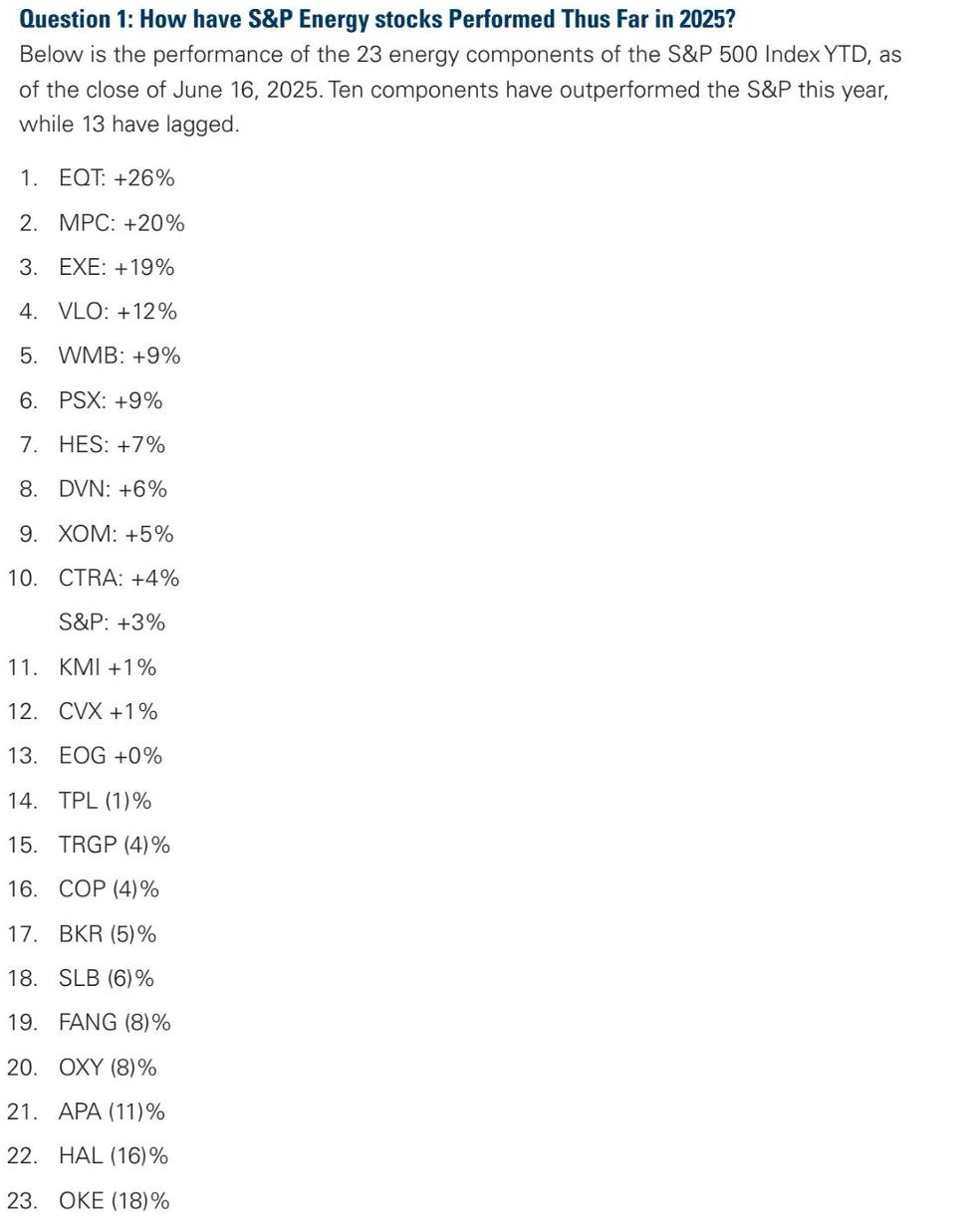
Core Viewpoint - Goldman Sachs reports a significant divergence in the performance of the 23 energy stocks within the S&P 500 index in 2025, with an overall trend that remains roughly in line with the broader market, which is up approximately 3% year-to-date [1][3]. Energy Sector Performance - The S&P 500 energy sector has shown a stark divergence, with the top five performing stocks outperforming the bottom five by nearly 29% [1][3]. - As of June 16, 2025, ten energy components have outperformed the S&P 500, while thirteen have lagged behind [4][3]. - The worst-performing stock, OKE, has seen a decline of nearly 18% year-to-date [3][6]. Strong Segments - Natural gas and refining sectors are leading the momentum, with strong performance driven by solid underlying factors [5][1]. - Natural gas prices, despite recent volatility, remain robust in the long term, supporting the performance of natural gas stocks [5][9]. - Refining profits are high due to strong demand and limited capacity increases, particularly benefiting refiners along the U.S. Gulf Coast [5][9]. Underperforming Segments - Oilfield services and upstream exploration sectors have lagged significantly, attributed to lowered earnings expectations amid a persistent oversupply in the crude oil market [7][8]. - Companies like Halliburton are expected to see a decline in earnings per share (EPS) by approximately 21% in 2025 compared to 2024, reflecting negative sentiment in the market [8][11]. Future Outlook - Goldman Sachs maintains a positive outlook on strong natural gas and refining stocks, expecting continued momentum in these segments [9][10]. - The firm identifies potential mean reversion opportunities in underperforming stocks, particularly in the upstream shale oil sector, with companies like Diamondback Energy and Halliburton showing promise for recovery [10][11]. - The financial health of companies like EQT and Valero is highlighted, with expectations for continued strong performance supported by favorable market conditions [9][10].
做显而易见的事,赚不到超额收益!霍华德·马克斯最新谈:投资的反人性智慧
聪明投资者· 2025-06-16 07:01
Core Viewpoint - The essence of successful investing lies in identifying companies with sustainable growth and ensuring that borrowed funds are lent to those capable of repayment [3][53]. Group 1: Investment Philosophy - Howard Marks emphasizes that outstanding investors remain emotionally stable and are not swayed by market noise [4][33]. - He highlights the difficulty of investing, stating that if emotions drive decisions, it becomes even harder to succeed [5][71]. - The current market environment is characterized by high valuations, with the S&P 500's expected P/E ratio around 22, above the historical average of 16 [7][10]. Group 2: Market Conditions and Strategies - Marks categorizes market states into three: expensive, cheap, and reasonable, suggesting that if valuations are merely reasonable, no action is typically warranted [11][12]. - He advises against excessive trading, advocating for a long-term investment approach, as staying in the market is more beneficial than trying to time it perfectly [13][42]. - Historical data indicates that buying at high P/E ratios (like 22) often leads to low future returns, typically between -2% and +2% over the next decade [15][14]. Group 3: Emotional Control and Decision Making - Successful investors share a common trait of emotional stability, which is crucial during extreme market conditions [33][22]. - Marks stresses the importance of recognizing market sentiment, whether optimistic or pessimistic, to make informed investment decisions [19][20]. - He warns against the common pitfalls of fear of loss and the fear of missing out (FOMO), which can lead to poor investment choices [67][68]. Group 4: Long-Term Investment Mindset - Marks suggests that the best investment opportunities often arise during economic downturns when fear prevails, making it difficult for investors to buy [27][30]. - He advocates for a longer holding period to ride out market fluctuations, as emotional reactions to short-term events can hinder long-term success [36][42]. - The key to successful investing is to focus on fundamental analysis rather than being distracted by short-term market noise [50][51]. Group 5: Risk and Return - Marks explains that higher returns are typically associated with higher risks, and investors must understand the risks they are taking [77][81]. - He emphasizes that risk should not be taken lightly; it requires thorough understanding and calm judgment [80][73]. - The true challenge in investing lies in balancing risk and return while maintaining a clear understanding of market dynamics [113][112].

做显而易见的事,赚不到超额收益!霍华德·马克斯最新谈:投资的反人性智慧
聪明投资者· 2025-06-16 06:54
Core Viewpoint - The essence of successful investing lies in identifying companies with sustainable growth and ensuring that borrowed funds are lent to those capable of repayment [3][53]. Group 1: Investment Philosophy - Howard Marks emphasizes that outstanding investors remain emotionally stable and are not swayed by market noise [4][33]. - He highlights the difficulty of investing, stating that if emotions drive decisions, it becomes even harder to succeed [5][72]. - The current market environment is characterized by high valuations, with the S&P 500's expected P/E ratio around 22, above the historical average of 16 [7][10]. Group 2: Market Conditions - Marks categorizes market states into three: expensive, cheap, and reasonable, suggesting that if valuations are merely reasonable, no action is typically warranted [11][12]. - He warns against excessive trading and emphasizes the importance of staying invested over time rather than attempting to time the market [13][42]. Group 3: Emotional Stability - Successful investors share a common trait of emotional stability, which allows them to make rational decisions during market extremes [33][72]. - Marks advises that the best buying opportunities often arise during economic downturns when fear prevails, yet most investors are reluctant to buy at such times [27][30]. Group 4: Long-term Perspective - Marks argues for a longer investment horizon, suggesting that many investors would benefit from extending their holding periods to ride out market fluctuations [35][42]. - He believes that the key to investment success is to focus on fundamental analysis rather than short-term market movements [51][52]. Group 5: Risk Management - Understanding and accepting risk is crucial for achieving higher returns, as higher potential returns come with increased uncertainty [72][78]. - Marks stresses that risk should be assessed based on thorough understanding and judgment, rather than blind speculation [80][87]. Group 6: Identifying Opportunities - True excess returns are unlikely to come from obvious opportunities; instead, investors should seek undervalued or overlooked assets [91][92]. - Marks emphasizes the importance of independent thinking and the ability to identify when the market consensus is incorrect [98][101].