成长风格

Search documents
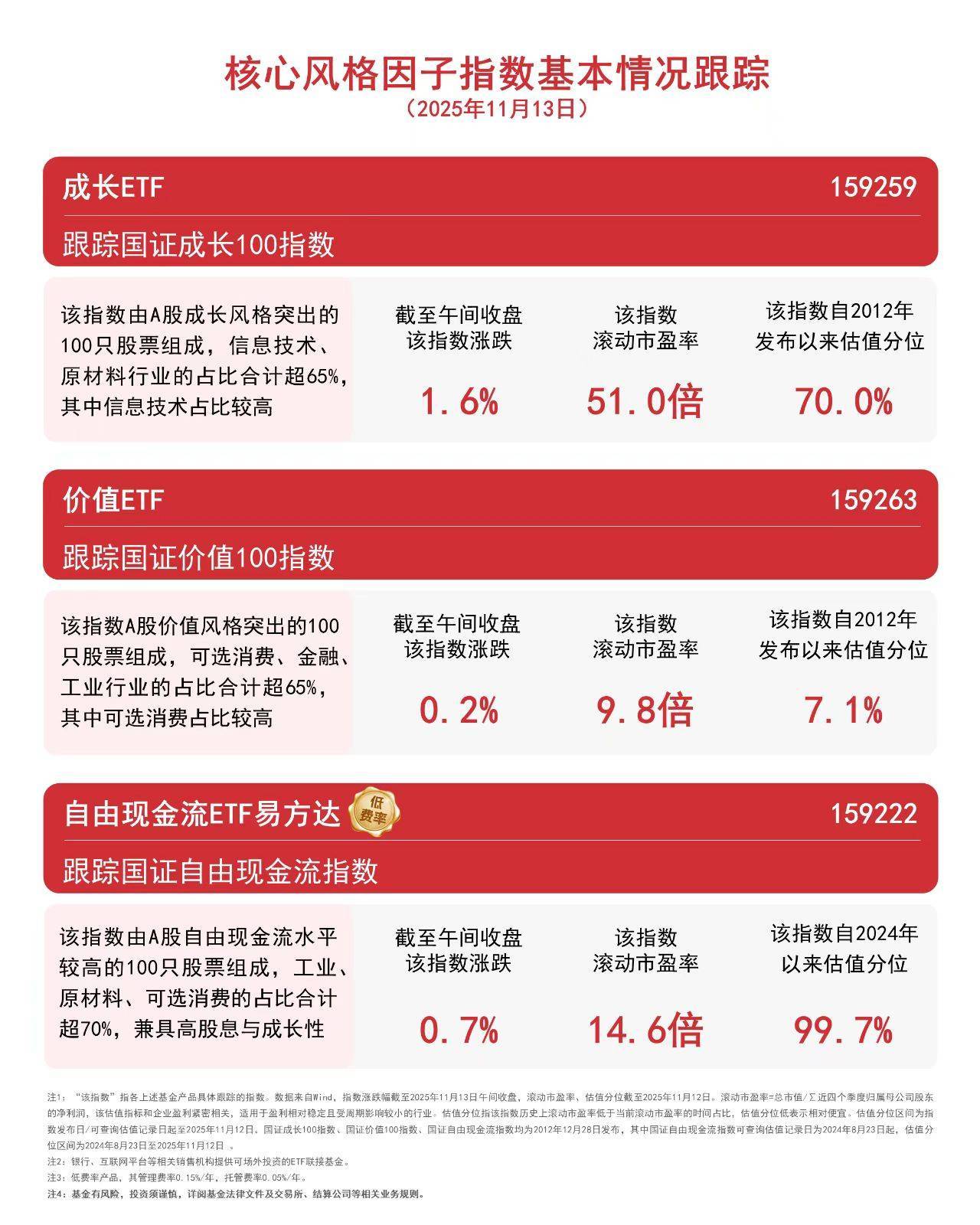
成长风格早盘走强,关注成长ETF(159263)、自由现金流ETF易方达(159222)等投资价值
Sou Hu Cai Jing· 2025-11-13 05:08
Core Viewpoint - Technology growth stocks have made a strong comeback, with significant increases in the new energy and AI sectors, as evidenced by the performance of various indices [1] Group 1: Index Performance - The Guozheng Growth 100 Index rose by 1.6%, indicating a strong performance in growth-oriented stocks within the A-share market [1] - The Guozheng Free Cash Flow Index increased by 0.7%, reflecting a focus on companies with high free cash flow rates, combining high dividends and growth potential [1] - The Guozheng Value 100 Index saw a modest rise of 0.2%, suggesting a stable performance in value-oriented stocks [1] Group 2: Investment Opportunities - The Guozheng Growth 100 Index emphasizes stocks in high-growth sectors such as electronics, communications, and computers, aligning with the economic transformation trends [1] - The Growth ETF (159263) and the E Fund Free Cash Flow ETF (159222) track the aforementioned indices, providing investors with tools to capitalize on these investment styles [1]

[11月12日]指数估值数据(价值风格持续强势;市场风格轮动,我们该如何投资)
银行螺丝钉· 2025-11-12 14:08
Core Viewpoint - The article discusses the recent market trends, highlighting the rotation between value and growth styles, and the performance of various indices, particularly focusing on the banking sector and its impact on investment strategies [10][31]. Group 1: Market Performance - The overall market experienced a slight decline, with the CSI All Share Index down by 0.41% [1]. - The Shanghai and Shenzhen 300 indices also saw minor declines, with small-cap stocks declining more significantly [2]. - Value style has been on the rise for several weeks, with dividend and free cash flow indices reaching new historical highs [3][4]. Group 2: Style Rotation - The market has seen significant style rotation this year, with value style being strong in the first two quarters, particularly represented by the banking index [10][11]. - After the banking index reached a high valuation, the market shifted towards growth style in the third quarter, with the ChiNext index rising over 50%, marking the highest quarterly increase in a decade [23][24]. - By the fourth quarter, the market reverted to a strong value style, with both high and low bank proportion indices performing well [31]. Group 3: Investment Strategies - The article emphasizes the importance of maintaining a long-term investment perspective, suggesting that investors who adhere to low valuation buying and patience can achieve returns [36]. - Despite the overall positive market performance, over 40% of retail investors are still at a loss due to chasing trends and failing to adapt to style rotations [39][40]. - The correct investment approach is to buy undervalued assets and sell overvalued ones, as indicated by the saying "贵上极则反贱,贱下极则反贵" [41].
在稳健基石上捕捉高弹性,鹏华基金陈大烨解码成长风格“固收+”
2 1 Shi Ji Jing Ji Bao Dao· 2025-11-11 11:09
Core Viewpoint - The article discusses the increasing demand for stable asset appreciation in a low-interest-rate environment, highlighting the role of "fixed income +" products as a balanced investment strategy for families [1][2]. Group 1: Investment Strategy - The "fixed income +" strategy combines equity and debt to provide both stability and growth potential, requiring fund managers to skillfully navigate market volatility and identify long-term opportunities [1][3]. - Chen Daye, a fund manager at Penghua Fund, emphasizes a growth-oriented approach within the "fixed income +" framework, focusing on sectors like technology and high-end manufacturing to enhance returns while maintaining a stable base [2][11]. Group 2: Risk Management - Chen Daye outlines a risk-return optimization system for managing "fixed income +" products, which includes establishing a systematic risk budget and withdrawal management mechanism [4][5]. - The strategy involves assessing historical volatility across industries to control positions and implementing a maximum drawdown strategy to mitigate risks during market downturns [6][8]. Group 3: Market Insights - Chen identifies key market trends and opportunities, noting that A-shares often exhibit structural bull markets driven by capital flows, which can be leveraged for "fixed income +" products [7][9]. - He stresses the importance of understanding macroeconomic conditions and industry trends to avoid the pitfalls of "fixed income -" scenarios, particularly during bear markets [8][10]. Group 4: Growth Focus - The article highlights Chen's unique focus on growth stocks within the "fixed income +" product category, adapting to changing macroeconomic environments and identifying potential growth sectors over time [11][12]. - Chen's background in artificial intelligence informs his investment decisions, particularly in the technology sector, where he anticipates significant growth opportunities [12][13]. Group 5: Future Outlook - Looking ahead, Chen expresses optimism about the long-term performance of equity markets, particularly for companies that can generate free cash flow and have global competitiveness [16]. - The investment focus is shifting towards sustainable business models in AI and technology, with an emphasis on cash flow generation rather than just infrastructure [16].
中波“固收+”的成长派样本:以进攻姿态,守财富增长
2 1 Shi Ji Jing Ji Bao Dao· 2025-11-11 10:58
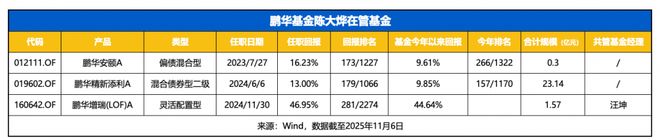
Core Insights - The article discusses the increasing demand for stable asset appreciation among investors in a low-interest-rate environment, highlighting the role of "fixed income +" products as a balancing tool in asset allocation [1] - It emphasizes the need for fund managers to enhance their capabilities in capturing returns while controlling drawdowns amidst market volatility [1][4] Group 1: "Fixed Income +" Strategy - The "fixed income +" strategy is characterized by a combination of equity and debt, aiming to provide both stability and growth potential [1] - Chen Daye, a fund manager at Penghua Fund, shares insights on constructing and managing a growth-oriented "fixed income +" product, focusing on the art and science of asset allocation [1][4] - The strategy is discussed in the context of a high-profile interview series on long-term and value investing, indicating its relevance in current market conditions [1] Group 2: Fund Management Experience - Chen Daye has 8 years of experience in securities and 4 years in fund management, currently managing three funds, including Penghua Jingxin Tianli and Penghua Anyi, with a high institutional ownership ratio [2][3] - The funds managed by Chen Daye are positioned to provide higher returns than pure bond funds while maintaining a level of volatility that investors can tolerate [3][5] Group 3: Risk-Return Optimization - The "fixed income +" products managed by Chen Daye are categorized as medium volatility, focusing on growth sectors while implementing a systematic risk budget and drawdown management mechanism [5][6] - The strategy includes identifying market trends and structural opportunities, emphasizing the importance of valuation discipline in stock selection [6][7] Group 4: Macro Risk Management - Chen Daye discusses the importance of macroeconomic indicators in avoiding the pitfalls of "fixed income -" products, particularly during periods of poor equity performance [8][10] - Historical analysis reveals that significant market downturns are often linked to macroeconomic changes, underscoring the need for proactive risk management [9][10] Group 5: Growth-Oriented Investment Logic - The article highlights Chen Daye's unique approach to focusing on growth-oriented assets within the "fixed income +" framework, adapting to changing macroeconomic conditions [11][12] - The strategy aims to provide a stable return while allowing investors to benefit from societal development dividends through a balanced asset allocation [11][12] Group 6: Focus on Technology and AI - Chen Daye's investment strategy includes a forward-looking approach to technology sectors, particularly AI, supported by his academic background in artificial intelligence [12][15] - The emphasis is on identifying sustainable business models within the AI space, with a cautious approach to investment timing and validation of revenue generation capabilities [15][16] Group 7: Future Outlook - The article concludes with an optimistic view on the long-term performance of equity markets, particularly in the context of China's economic transition to high-quality growth [16] - Chen Daye identifies two key asset categories for future focus: technology-driven companies with global competitiveness and dividend-paying stocks that generate free cash flow [16]
策略观点:市场波动延续,保持定力对待-20251109
China Post Securities· 2025-11-09 13:45
Market Performance Review - The A-share market continues to experience volatility, with large-cap indices leading the gains. The Shanghai 50 index rose by 0.89%, and the CSI 300 index increased by 0.82%, while the STAR 50 index showed a slight increase of 0.01% after significant fluctuations throughout the week [3][12] - In terms of style, cyclical stocks maintained strong performance, while stability and financial styles shifted from decline to growth compared to the previous week. Consumer stocks were the only style index to decline this week [3][12] - Large-cap stocks significantly outperformed small-cap stocks, with the core asset indices, such as the Moutai index and the Ningbo combination, both experiencing declines of 0.98% and 1.27%, respectively [3][12] Industry Insights - The third-quarter reports indicate a reversal in the "anti-involution" theme, with industries such as power equipment (up 4.98%), coal (up 4.52%), oil and petrochemicals (up 4.47%), steel (up 4.39%), and basic chemicals (up 3.54%) leading the gains. Conversely, sectors like beauty care (-3.10%), computers (-2.54%), pharmaceuticals (-2.40%), automobiles (-1.24%), and food and beverages (-0.56%) performed poorly [4][13] - The market has recognized a general profit improvement in industries aligned with the "anti-involution" theme following the third-quarter reports, gaining broader market consensus [4][13] Future Outlook and Investment Strategy - The outlook for the market suggests continued volatility, with a dual vacuum period in policy and performance expected from November to December. The lack of significant movement in household deposits indicates a potential weakness in future capital support, limiting upward space for A-shares [5][30] - The investment strategy emphasizes maintaining a growth style, with a focus on sectors that meet the "dilemma reversal + high growth" composite pricing requirements, particularly in photovoltaic equipment. Additionally, sectors that have lagged since September and are positioned favorably in the "14th Five-Year Plan" are also recommended [5][30]
权益基金月度观察(2025/11):价值风格占优,持仓逐渐多元-20251108
Huafu Securities· 2025-11-08 14:13
- The report introduces a quantitative model for evaluating equity funds' performance. The model uses 22 benchmark indices as independent variables and fund returns as dependent variables. A univariate linear regression is conducted for each index, and the rolling window regression is applied with a 6-month window to calculate the R² matrix for each fund. The index with the highest average R² over the last six periods is selected as the performance reference index. The corresponding regression equation result is used as the performance outcome [16][17] - The report evaluates the overall strategy of public equity funds by analyzing the goodness-of-fit (R²) of funds relative to single indices. In October 2025, the average R² value was 0.7357, with 4.73% of funds exceeding 0.9 and 34.44% below 0.7. This indicates a loss of market concentration and a trend toward diversified holdings among public funds [35] - The report categorizes equity funds into five styles: large-cap, mid-small-cap, value, growth, and sector themes. In October 2025, value funds performed the best with a median return of 3.7%, while growth funds showed the most significant polarization, with the best return at 8.2% and the worst at -10.5% [22][23] - The report highlights the performance of sector-themed funds, with cyclical funds achieving an average return of 3.1% in October 2025. Among cyclical funds, the best performer was the "Coal Equal Weight LOF" with a return of 9.9%. In the technology sector, the best performer was "Caitong Growth Preferred A," with a return of 13.6% [25][28] - The report identifies high-rated funds that demonstrate excellent performance, risk control, and investment strategy. For example, in the mid-small-cap category, "Huitianfu Balanced Selection Six-Month Holding" achieved a recent score of 10 with an R² of 0.74, while "Hongde Zhixuan Qiyuan A" scored 10 with an R² of 0.95 [55][56] - The report also tracks newly rated funds, defined as those receiving their first rating in the current month and managed by fund managers with less than three years of experience. In October 2025, seven such funds were identified, with most benchmarked against the CSI 500 index [61][63][64] - The report highlights funds with significant rating upgrades, reflecting improved performance and management optimization. For instance, "泉果思源三年持有 A" (Quanguo Siyuan Three-Year Holding A) was upgraded and benchmarked against the "New Energy Vehicle" index [65][66]
哪些二级债基适配高波市场环境?
Shenwan Hongyuan Securities· 2025-11-07 08:45
1. Report Industry Investment Rating - No information provided about the industry investment rating in the report. 2. Core Views of the Report - Secondary bond funds have diverse strategies and significant differences in risk - return indicators. Higher -仓位 products generally perform better in 2025, with products having an excessively high convertible bond position achieving an average return of 14.43%, while low -仓位 products only have an average return of 3.88% [3][4]. - There are four strategies to select offensive secondary bond funds: high -仓位 convertible bond strategy, growth - style strategy, Hong Kong stock strategy, and tool - type product strategy [3][10]. 3. Summary by Related Catalogs 3.1 Strategy 1: High -仓位 Convertible Bond Funds - High -仓位 convertible bond funds vary in style. There are currently 64 secondary bond funds with an average convertible bond position exceeding 30%, including conservative, aggressive, and extreme - style products [20]. - A three - dimensional selection system is used to evaluate high - elasticity products based on three core indicators and five sub - indicators, focusing on high elasticity, good holding experience, and high cost - effectiveness [19][20]. - Some high - performance high -仓位 convertible bond funds are recommended, such as Huabao Enhanced Income A, with a 924 - since return of 50.44%, and Guangda Tianyi A, with a 924 - since return of 55.05% [22]. 3.2 Strategy 2: Growth - Style Funds - Growth - style funds are identified by a weighted average stock PE above 30 times. Fund evaluation focuses on holding experience (number of new high days, maximum drawdown recovery speed) and risk - return cost - effectiveness (Sharpe ratio) [52]. - Many growth - style secondary bond funds are listed, such as Invesco Great Wall Jinyi Yuli A, with a 924 - since return of 8.53%, and Penghua Enjoy A, with a 924 - since return of 11.92% [51]. - Different investment strategies of growth - style funds are analyzed, including industry rotation (e.g., Yongying Steady Enhancement, Huashang Credit Enhancement), industry concentration and stock dispersion (e.g., Huashang Credit Enhancement, Huashang Anheng), and the balance between booming growth and quality growth (e.g., Invesco Great Wall Jinyi Fengli, Penghua Double Debt Plus) [55][58]. - Some growth - style funds' investment in popular technology tracks is studied. For example, Yongying Steady Enhancement invests more in the cloud - computing theme, and Xingye Income Enhancement invests more in the semiconductor theme [64][65]. 3.3 Strategy 3: Hong Kong Stock Strategy Funds - The proportion of Hong Kong stock investment in secondary bond funds has been increasing continuously, reaching 11.21% in Q3 2025. Secondary bond funds invest in Hong Kong stocks through the Hong Kong Stock Connect, with an investment limit of up to 50% of the stock assets [98][99]. - Some secondary bond funds with relatively stable Hong Kong stock positions are mentioned, such as Huatai - PineBridge Double - Xin Tianli, Invesco Great Wall Jinyi Zunli, and China - Europe Fengli [99]. - The investment style of Hong Kong - stock secondary bond funds focuses on scarce, low - valuation, high - dividend, and high - quality growth stocks. They do not only invest in scarce Hong Kong - listed assets but also in stocks listed in both Hong Kong and A - shares, and prefer sectors such as technology innovation, finance, and medicine [100][103]. 3.4 Strategy 4: Tool - Type Products - Some secondary bond funds have clear track/style characteristics, such as the dual - innovation strategy (e.g., Fuguo Xingli Enhancement, Penghua Enjoy (Science and Technology Innovation 100 Enhancement)) and the micro - cap strategy (e.g., CITIC Prudential Anxin Return) [3]
世界互联网大会开幕,成长风格仍是主线
Mei Ri Jing Ji Xin Wen· 2025-11-07 02:18
招商证券认为,关税冲击缓和、增量政策释放边际利好,或支撑港股四季度反弹。从整个四季度来看, 机构重申"先抑后扬"的大势研判观点。市场关心的风格切换更可能是一个"渐进式"或"波浪式"的过程, 而非简单的"翻转开关",预计未来阶段随着市场风险偏好改善,成长风格仍将是未来一段时间的主线, 建议重点关注互联网行业。 2025年世界互联网大会乌镇峰会盛大开幕,以"AI共生、智启未来"为主题,吸引了全球顶尖企业参与, 集中展示了从大模型、具身智能到"AI+"全产业的突破性成果。 人工智能已成为驱动互联网行业发展的核心引擎,其与实体经济各领域的深度融合正开启巨大的增长空 间。结合此前国家出台的扩大服务消费政策,其中明确鼓励"AI+消费"与文旅IP联动,这为互联网行业 提供了清晰的政策风向和庞大的落地场景。在技术突破与政策红利的双重驱动下,互联网行业正迎来一 个与千行百业共生共荣的黄金发展期,前景广阔。 11月7日盘中,港股互联网板块整体承压下行,多只热门个股调整明显,狮腾控股、哔哩哔哩领跌,恒 生互联网ETF(513330)盘中一度跌超1%。 ...
四类基金画像:加仓、减仓、调仓、极致风格:——25Q3基金季报专题研究
Huachuang Securities· 2025-11-06 05:16
Group 1 - The overall change in public fund holdings shows an increase in allocation to electronics and communications, while reducing allocation to banks and food & beverage sectors [1][8] - In Q3 2025, the top five industries with increased holdings were electronics (up 6.6 percentage points), communications (up 3.9 percentage points), new energy (up 2.7 percentage points), non-ferrous metals (up 1.3 percentage points), and media (up 0.5 percentage points) [1][8] - The top five industries with decreased holdings included banks (down 3.1 percentage points), food & beverage (down 1.8 percentage points), home appliances (down 1.5 percentage points), military industry (down 1.4 percentage points), and automobiles (down 1.4 percentage points) [1][8] Group 2 - The report categorizes funds into four types: increasing, decreasing, adjusting, and extreme styles, with a focus on their respective investment behaviors [7][13] - Increasing funds showed a balanced and strengthened growth style, adding positions in biopharmaceuticals, chemical pharmaceuticals, and semiconductors while reducing positions in military electronics, power grid equipment, and white goods [15][17] - Decreasing funds significantly reduced their exposure to TMT (Technology, Media, and Telecommunications), increasing positions in consumer electronics, environmental governance, and batteries while decreasing holdings in semiconductors, communication equipment, and software development [15][17] Group 3 - Adjusting funds displayed a clear style adjustment, increasing allocations to batteries, industrial metals, and consumer electronics while reducing positions in city commercial banks, state-owned banks, and electric power [15][17] - Extreme style funds made internal adjustments within their respective styles, with growth funds increasing positions in photovoltaic and reducing wind power, while value funds increased allocations to real estate development and reduced insurance [15][17] Group 4 - The report highlights that the consensus buy direction includes consumer electronics, batteries, and industrial metals, while the consensus sell direction includes biopharmaceuticals, social media, and software development [15][17] - The top five industries with the highest net purchases by increasing funds were pharmaceuticals (1.8 billion), electronics (0.8 billion), and media (0.5 billion), while the top three industries with the highest net sales were military industry (-0.9 billion), transportation (-0.9 billion), and banks (-0.9 billion) [18][27]
[11月4日]指数估值数据(螺丝钉定投实盘第388期发车;养老指数估值表更新)
银行螺丝钉· 2025-11-04 14:03
Market Overview - The overall market has declined, returning to a rating of 4.2 stars, with large-cap stocks experiencing less decline compared to mid and small-cap stocks, as evidenced by the 1.6% drop in the CSI 500 index [1] - The value style has shown resilience during market fluctuations, with indices related to dividends and value experiencing good upward momentum [1] - The banking index has risen over 2%, approaching previously high valuation levels after a significant correction [1] Market Trends - The ChiNext board has seen a more significant decline compared to other indices [2] - Hong Kong stocks have also experienced declines, closely mirroring the fluctuations in A-shares [3] - Recent market volatility has not been substantial, with the overall market showing a correction of about 3% from its peak in October [5][6] - The rapid market increase in the third quarter has led to a natural correction phase, with the ChiNext achieving its largest quarterly gain in the last decade [8][7] Investment Strategies - The current investment strategy involves pausing regular investments in the index-enhanced portfolio as it has returned to normal valuation, while continuing to hold existing positions [15] - The active selection portfolio is still being invested in regularly, although it is nearing normal valuation levels [15] - The "Monthly Salary Treasure" investment strategy, which consists of 40% stocks and 60% bonds, is recommended for stable market participation due to its low volatility and built-in rebalancing strategy [15] Performance Metrics - The performance of the CSI 500 index is approximately 23% with a price-to-earnings ratio of about 24 times, indicating it is nearing high valuation [35] - The CSI Dividend index has shown a profit of around 9%, also reaching normal valuation levels [35] - The article emphasizes the importance of patience in waiting for future investment opportunities when valuations return to low levels [38]