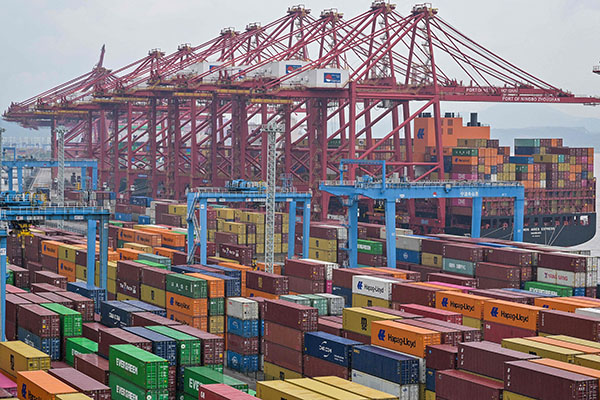
贸易争端

Search documents
俄罗斯诺镍:高利率和贸易争端将带来负面影响
Wen Hua Cai Jing· 2025-06-30 01:41
Core Viewpoint - Nornickel anticipates a decline in financial performance for the year due to low metal prices, high interest rates, a strong ruble, and global trade disputes [1] Group 1: Financial Performance - Nornickel expects significant negative impacts on financial indicators due to high geopolitical uncertainty, escalating trade disputes, risks of global economic slowdown, and tightening monetary policies [1] - The company faces challenges from a strong ruble, low metal prices, inflation, and high debt servicing costs [1] - The Russian central bank's key interest rate of 20% is seen as a major drag on the economy, leading to a substantial slowdown this year [1] Group 2: Investment and Dividends - Difficult conditions have forced Nornickel to reduce investments and postpone certain projects [1] - The board of directors has recommended not to pay dividends for the 2024 performance, stating that increasing debt levels to pay dividends is inappropriate [1] Group 3: Market Outlook - Nornickel's vice president, Anton Berlin, predicts that the palladium market will remain balanced in 2025, while the nickel market will be oversupplied [2] - The automotive industry, a major consumer of these metals, is still in crisis [2] - Berlin criticized Indonesia for flooding the global market with cheap nickel, harming other producers, and noted that approximately 40% of nickel producers are currently operating at a loss [2] - Nornickel aims to ensure that global trade disputes do not affect its export volumes and intends to sell all of its produced products [2]
特朗普宣布中止与加拿大所有贸易谈判 因后者征收数字服务税
智通财经网· 2025-06-27 23:42
Group 1 - The core issue revolves around Canada's decision to implement a digital services tax (DST) on U.S. tech companies, which has led to heightened tensions in U.S.-Canada trade relations [1][2] - President Trump announced the immediate termination of all trade negotiations with Canada in response to the DST, labeling it a direct attack on the U.S. [1] - The digital services tax will affect both local and international tech companies, including major U.S. firms like Amazon, Google, and Meta, and is set to be enforced starting June 31, 2023 [2] Group 2 - The U.S. and Canada have maintained a close economic relationship, with bilateral goods trade totaling approximately $762 billion in 2023 [2] - Following Trump's announcement, financial markets reacted with the S&P 500 and Nasdaq indices initially declining before recovering to close higher, indicating market sensitivity to trade tensions [1]
WTO就加拿大对中国电动汽车等产品收附加税设立争端解决小组
Di Yi Cai Jing· 2025-06-24 09:29
Core Viewpoint - China is taking necessary measures to firmly protect the legitimate rights and interests of its enterprises in response to Canada's imposition of additional tariffs on Chinese electric vehicles, steel, and aluminum products, which China claims violate WTO rules [1][4]. Group 1: Dispute Resolution and Tariff Measures - The WTO's Dispute Settlement Body (DSB) has agreed to establish a dispute resolution panel regarding China's complaint about Canada's additional tariffs on electric vehicles and steel/aluminum products [1][2]. - Canada will impose a 100% additional tariff on all imported electric vehicles from China starting October 1, 2024, and a 25% additional tariff on steel and aluminum products from China starting October 22, 2024 [1][2]. - The trade value affected by the 100% tariff on electric vehicles is approximately $1.7 billion, while the tariffs on steel and aluminum products involve $950 million and $720 million, respectively [4]. Group 2: China's Response and Negotiation Stance - China has formally requested consultations and further negotiations regarding the additional tariffs, asserting that these measures are inconsistent with multiple provisions of the GATT [2][3]. - Despite the establishment of a dispute resolution panel, China remains open to constructive dialogue with Canada to amicably resolve the dispute [4][7]. - China's ambassador to Canada emphasized the potential for cooperation in the electric vehicle sector, which could benefit consumers and help Canada achieve its climate goals [4][5]. Group 3: Countermeasures and Additional Disputes - In response to Canada's tariffs, China has initiated an anti-discrimination investigation and announced countermeasures, including additional tariffs on certain Canadian agricultural and seafood products [6][7]. - The countermeasures include a 100% tariff on canola oil, oilseed meal, and peas, as well as a 25% tariff on specific seafood and pork products, effective March 20, 2025 [6].
奥升德计划关闭在华己二胺工厂
Zhong Guo Hua Gong Bao· 2025-06-24 02:45
Group 1 - The core point of the article is that Ascend Performance Materials plans to close its hexamethylenediamine production facility in Lianyungang, China, within the next few months due to market changes and ongoing trade disputes [1] - The Lianyungang facility, which was established less than a year ago, represents Ascend's first overseas chemical production base with a total investment of approximately 4.2 billion yuan [1] - The facility had an annual production capacity of 200,000 tons of hexamethylenediamine, accounting for 15% of China's total capacity for this chemical [2] Group 2 - Ascend's decision to close the Lianyungang plant follows a comprehensive assessment of its long-term viability in a changing market and regulatory environment [1] - The closure is expected to exacerbate the short-term supply tightness of hexamethylenediamine in the market, potentially increasing costs for downstream product manufacturers and leading to price adjustments and market restructuring [2] - Other operations of Ascend in China, such as the Suzhou production base, will continue to operate as usual [1]
中方被摆了一道!欧盟翻脸太快,刚拿稀土就取消对话,对外释放信号强烈
Sou Hu Cai Jing· 2025-06-23 08:07
据环球时报报道,欧盟委员会日前单方面宣布取消中欧高层经济对话,距中国对欧开放稀土绿色通道仅三天。 欧盟资料图 欧盟资料图 欧盟取消对话的时间点耐人寻味。7月是欧盟对华电动车加征关税的最后决定期限。同时,特朗普威胁对欧盟汽车征收50%关税的言论甚嚣尘上。欧盟显然 试图以"终止谈判"向中方施压,同时向美国展示协调立场以换取关税豁免。冯德莱恩在抱怨美国对欧盟钢铝高关税的同时,却提议"美欧联手对付中国原材 料主导",被批短视。特朗普政府在中东的军事行动进一步牵制全球注意力。6月21日,美军B-2隐形轰炸机对伊朗三处核设施实施精确打击。特朗普在社交 媒体宣布行动成功并要求伊朗"结束战争"。这种单边行动与欧盟取消对华对话形成战略呼应,强化了西方阵营的对抗姿态。 欧盟委员会以"当前经贸议题缺乏实质进展空间"为由,取消了原定7月下旬举行的中欧高层经济对话。这一决定正值中国刚为欧盟企业开通稀土出口审批绿 色通道三天后。当时,欧盟委员会主席冯德莱恩正在G7峰会现场与美国协调立场。她特意展示由稀土材料制成的磁铁,暗示欧美将联手应对中国在关键资 源领域的主导地位。 贸易争端已造成实质性损害。2025年前四个月,中国对欧电动汽车出口量 ...

贸易争端中,加拿大投资者买入美国债券数量创2023年以来新高
news flash· 2025-06-17 17:10
Core Viewpoint - The ongoing trade tensions have not diminished Canadian investors' interest in U.S. assets, as they continue to significantly purchase U.S. government bonds [1] Group 1: Investment Trends - In April, Canadian investors net bought 9.2 billion CAD (approximately 6.8 billion USD) in U.S. government bonds, marking the largest single investment since November 2023 [1] - During the same month, amidst escalating tariff tensions, investors also purchased 1.1 billion CAD in U.S. Treasury bonds while reducing their holdings in U.S. stocks [1] - Prior to this, in February, Canadian investors had reached a record high investment in U.S. stocks amounting to 29.8 billion CAD [1]
为2008年以来增速最慢,世界银行大幅下调全球经济增长预期
Sou Hu Cai Jing· 2025-06-11 02:03
Group 1 - The World Bank has significantly lowered its global economic growth forecast, with nearly 70% of economies experiencing downward revisions due to tariffs and increased policy uncertainty [1] - The World Bank projects a global economic growth of 2.3% in 2025, a decrease of 0.4 percentage points from the January forecast, marking it as the slowest growth year since 2008 [1] - Developed economies are expected to grow at 1.2% in 2025, with the US growth forecast reduced to 1.4%, the Eurozone at 0.7%, and Japan also at 0.7% [1] Group 2 - Emerging markets and developing economies are projected to grow at 3.8%, a reduction of 0.3 percentage points from the January forecast, with growth slowdowns expected across various regions [2] - The World Bank has not revised its growth forecast for China this year, citing new fiscal policies that can offset the impact of rising trade barriers [2] - Global trade volume growth is expected to be 1.8% and 2.4% for this year and next, respectively, both lower than previous forecasts [2] Group 3 - The World Bank's Chief Economist indicated that resolving trade disputes through agreements could lead to higher global economic growth than currently predicted [4] - The OECD has also downgraded its global economic growth forecast for this year and next, now expecting a GDP growth of 2.9% [4] - The OECD has revised the US economic growth forecast down to 1.6% for this year, while raising the overall inflation expectation to 3.2% [4]
A股午后突发!涨超1400%,这些基金经理赚翻了!
天天基金网· 2025-06-10 11:13
1、今天,A股午后突然回落,三大指数集体收跌,创业板指跌超1%,发生了什么? 2、 泡泡玛特股价再创历史新高,近1年时间累计上涨超1400%,哪些基金经理押中了?新消费还能上车吗? 3、 上天天基金APP搜索【777】注册即可 领98元券包 , 优选基金10元起投!限量发放!先到先得! 真话白话说财经,理财不说违心话 --这是第1362 篇白话财经- - 今天,A股港股午后突然回落,三大指数集体收跌,创业板指跌超1%。 摘要 (图片来源:东方财富APP,统计截至2025/6/10,不作投资推荐) 两市成交额超1.42万亿,盘面上,航运、游戏板块涨幅居前,半导体、通信、券商板块跌幅居前。 机构分析指出, 当前主要市场都已经修复了对等关税的冲击,较高的预期和关税本身的变数都可能诱发波动。 但波动也带来了配置机会。 A股午后突发 午后,A股港股突然下跌,沪指、恒生指数集体翻绿,到底发生了什么? (图片来源:东方财富APP,统计截至2025/6/10,不作投资推荐) 1、中美大消息。 分析人士认为 可能还是与贸易争端有关。 当地时间6月9日下午,中美经贸磋商机制首次会议在英国伦敦举行。而当地时间6月10日,中美经贸磋 ...
沪锌:震荡整理延续,库存拐点趋近
Zheng Xin Qi Huo· 2025-06-09 12:44
目 录 第一部分:核心观点 第二部分:产业基本面供给端 第三部分:产业基本面消费端 第四部分:其他指标 研究员:潘保龙 投资咨询号:Z0019697 研究员:王艳红 投资咨询号:Z0010675 核心观点 宏观:6月7日讯,美联储哈克表示,在美国金融体系面临日益增长的挑战之际,赤字必须受到控制,对当前政府财政状况"非常担忧"。哈 克还表示:"在关键数据方面,我们正变得越来越盲目。我们担忧经济数据的质量正在下降。不确定性使得预测货币政策前景变得非常困难 。但在不确定性之中,今年晚些时候美联储仍有可能降息。 基本面:上周锌价延续震荡整理走势,宏观方面相对平淡,进入6月份,传统淡季趋近,关注社库拐点。从大的基本面格局看,供给端锌矿 周期性供给转宽正在落地,2025年内外几个大的锌矿项目均有增产安排,全球锌矿产量回升带动锌矿现货TC边际持续走强。矿端增产传导至 冶炼端,在冶炼利润回暖之下,国内炼厂开工率提升,延期检修,精炼锌产量边际恢复,且预计矿端和冶炼端的增产形势会延续下去。需求 一侧,贸易争端可能拖累全球经济增速,锌需求总量存收缩隐忧,即使各国快速达成新的贸易协议,全球经济增速维持韧性,锌的总需求也 难有增量预期 ...
航运价格飙升,美零售巨头被曝要求中国供应商承担货运成本
Guan Cha Zhe Wang· 2025-06-07 12:42
Group 1 - U.S. retail giants, under pressure from tariffs, initially sought to have Chinese suppliers bear the cost of tariffs but later agreed to have U.S. parties cover the costs after discussions with Chinese authorities [1] - Recently, U.S. retailers have attempted to shift the burden of shipping costs onto Chinese suppliers, exacerbated by a surge in shipping prices due to increased imports during the tariff suspension period [1][4] - Major U.S. retailers, including Walmart and Nike, are negotiating with Chinese suppliers to share up to 66% of the U.S. tariff costs, which were previously absorbed by U.S. buyers [2] Group 2 - Shipping costs have skyrocketed, with rates for containers to the U.S. West Coast reaching $6,000 to $7,000, nearly double the rates from late May [4] - The cost of shipping from Ningbo-Zhoushan Port to the U.S. West Coast has increased to $3,000, three times the price from April, raising concerns among exporters about their ability to absorb these costs [4] - The shipping industry is facing capacity shortages due to a surge in demand, with significant delays expected in restoring normal shipping operations [4][5] Group 3 - The Ningbo-Zhoushan Port is taking measures to handle the increased export orders, anticipating a recovery in shipping volumes to the U.S. following the tariff reductions [5] - The port plans to enhance service levels and improve operational efficiency to accommodate the expected rise in shipping demand [5]