
人民币汇率

Search documents
2025年5月外汇储备数据点评:结汇需求或开始释放
Tebon Securities· 2025-06-08 07:57
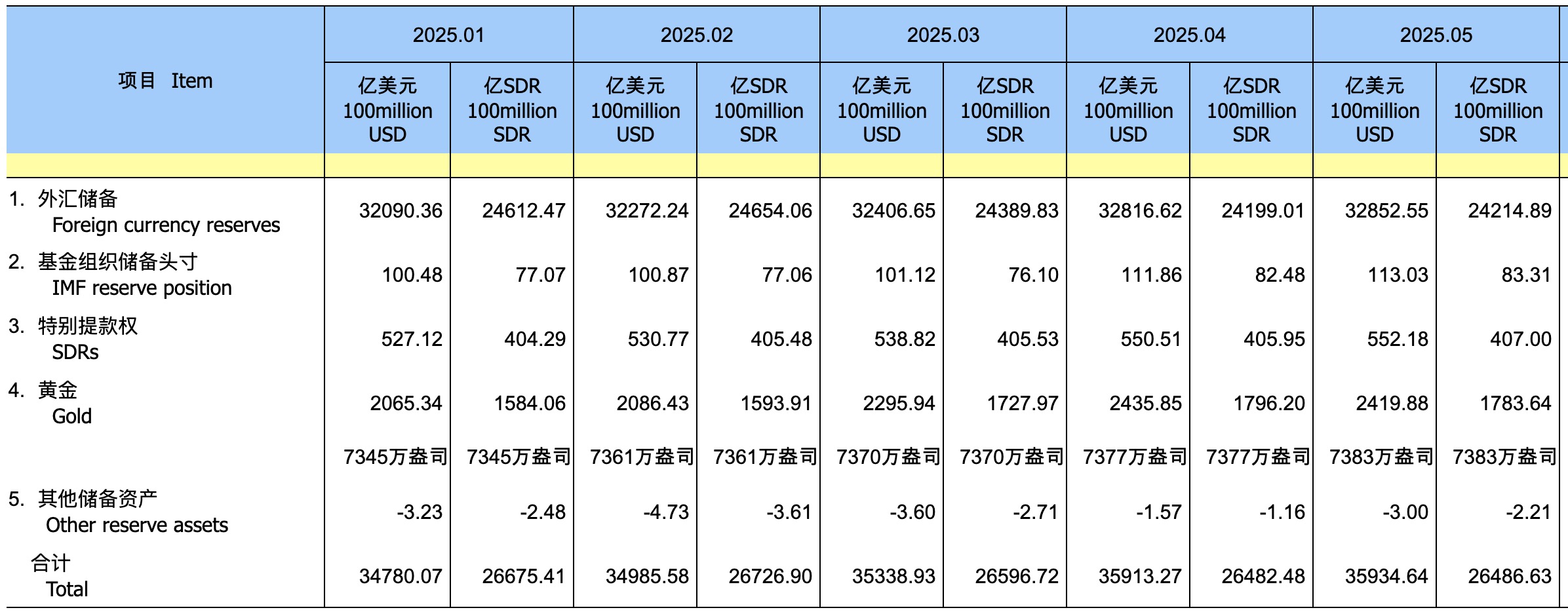
Valuation Effects - As of the end of May, China's foreign exchange reserves reached $3,285.255 billion, an increase of $3.59 billion month-on-month[6] - The valuation effect from rising bond yields in major economies is expected to negatively impact foreign reserves, estimated to decrease by around $20 billion[6] - The overall valuation and interest effects are estimated to reduce foreign exchange reserves by approximately $19 billion[6] Trading Factors - Excluding foreign capital flows, the net settlement and other currency demand are expected to contribute to an increase in foreign reserves of about $13 billion[7] - The trading factors are projected to lead to an increase in foreign reserves of approximately $23 billion[7] - The anticipated inflow of foreign capital into RMB assets is estimated to be around $10 billion due to improved market sentiment and easing trade tensions[7] Currency Outlook - The RMB exchange rate is expected to stabilize within the range of 7.1 to 7.2 as the impact of trade tensions dissipates[8] - The dollar index decreased by 0.2% from the end of April, contributing to a more favorable exchange rate environment for the RMB[6] Monetary Policy - The central bank's monetary policy is expected to maintain a supportive stance, with potential for further easing in the second half of the year[9] - Structural monetary policy tools are likely to focus on enhancing existing measures to support consumption and trade[9] Risk Factors - Risks include potential unexpected changes in the Federal Reserve's monetary policy and geopolitical developments affecting exchange rates[9]
国际投行上调!人民币汇率看涨,2026或破6.7大关?
Huan Qiu Wang· 2025-06-08 03:17
Economic Growth Outlook - Several international investment banks, including Deutsche Bank and Morgan Stanley, have raised their economic growth forecasts for China in the second half of the year, anticipating a long-term strengthening of the RMB exchange rate [1][3] - Deutsche Bank's chief economist for China, Xu Yi, noted that the combination of loose monetary policy and accelerated fiscal policy is expected to support the economy, with a 0.2 percentage point increase in the 2025 economic growth forecast [3] - Morgan Stanley also revised its growth expectations for the next two years, citing reduced urgency for new policies due to easing external shocks, with a focus on stabilizing the economy and emphasizing technological innovation [3] Currency Exchange Rate Predictions - The RMB has appreciated by 2% against the USD this year, but has depreciated by approximately 5% against a trade-weighted basket of currencies [4] - Deutsche Bank predicts that the RMB/USD exchange rate will rise to 7.0 by the end of 2025 and further to 6.7 by the end of 2026, supported by long-term trade competitiveness [4] - Morgan Stanley expects a moderate appreciation of the RMB against the USD, attributing this to a weakening of the dollar's safe-haven status and increased demand for hedging against currency risk [4] Monetary Policy Insights - Deutsche Bank anticipates that the People's Bank of China will reduce the frequency of interest rate cuts, opting instead for liquidity support through reserve requirement ratio cuts and loan facilities, projecting a policy rate of 1.3% by the end of 2025 [4] - Morgan Stanley forecasts that the decision-makers will utilize existing policy space and quasi-fiscal tools to stimulate the economy, potentially introducing fiscal stimulus of 500 billion to 1 trillion RMB, along with further interest rate cuts of 15-20 basis points and a 50 basis point reserve requirement ratio cut [4]



人民币汇率看涨!国际投行,最新发声!
证券时报· 2025-06-08 02:05
近日,德意志银行、摩根士丹利等多家国际投行发布下半年经济展望,纷纷上调中国2025年经济增速预期,同时预计贸易竞争力有望长期支撑人民币走强。德银研 究预测2025年底人民币兑美元汇率将升至7.0,2026年底进一步升至6.7,维持对美元结构性看跌的观点,并预计美债期限溢价将继续上升。 摩根士丹利全球外汇团队预计,美元将在今明两年继续大幅走弱,背后有三个主要原因:在政策的高度不确定下,"美元的避风港地位"有所降低;全球投资者对美 元资产的汇率风险对冲需求增加;美国经济增长放缓幅度大于其他主要经济体。 上调经济增长预测 早在今年4月,德意志银行中国区首席经济学家熊奕提出看涨离岸人民币,中美贸易关税从峰值回落进一步支持了该预测,同时他认为中国经济增长预测有进一步 上调的空间,鉴于实现全年"5%左右"的增长目标,预计中国将采取更加积极的政策。 近日,熊奕在下半年经济展望报告中表示,中国宽松的货币政策和财政政策的加快有望持续发力,服务业产出和零售表现也展现出韧性,随着中美经贸关系的缓 和,上调中国2025年经济增速预测0.2个百分点。上行风险可能来自为实现5%的增长目标而通过预算调整加大刺激力度,而下行风险则可能源于中 ...

上调!国际投行,最新发声!
券商中国· 2025-06-07 23:24
Core Viewpoint - Several international investment banks, including Deutsche Bank and Morgan Stanley, have raised their economic growth forecasts for China in 2025, anticipating that trade competitiveness will support a stronger RMB in the long term [1][2]. Economic Growth Forecasts - Deutsche Bank's chief economist for China, Xu Yi, has raised the 2025 economic growth forecast by 0.2 percentage points, citing resilient service sector output and retail performance, along with a more proactive policy stance to achieve the annual growth target of around 5% [2][3]. - Morgan Stanley has also adjusted its economic growth forecasts for China, increasing the growth estimates for the next two years by 0.3 and 0.2 percentage points, respectively, due to reduced urgency for new policies following external shocks [3][4]. - Nomura has raised its GDP growth forecast for China's second quarter from 3.7% to 4.8% and increased the annual GDP growth forecast by 0.5 percentage points, reflecting positive developments in US-China trade talks [3]. Currency Outlook - Deutsche Bank predicts that the RMB will strengthen against the USD, forecasting an exchange rate of 7.0 by the end of 2025 and 6.7 by the end of 2026, supported by improved trade competitiveness [5][6]. - Morgan Stanley also expects a moderate appreciation of the RMB, noting that the RMB depreciated by 11.5% during the 2018-2019 US-China tariff increases, which partially offset the tariff impacts [5][6]. Monetary Policy Expectations - Deutsche Bank anticipates that the People's Bank of China will reduce the frequency of interest rate cuts, focusing instead on reserve requirement ratio cuts and liquidity support [7]. - Morgan Stanley expects the government to potentially introduce an additional fiscal stimulus of 500 to 1,000 billion RMB to support infrastructure investments, alongside further interest rate cuts [7].

【财经分析】我国外汇储备规模连续五个月上升 金价走势趋弱央行继续增持黄金
Xin Hua Cai Jing· 2025-06-07 08:43
Core Insights - As of the end of May, China's foreign exchange reserves increased by $3.6 billion to $328.53 billion, marking the fifth consecutive month of growth, although the increase was significantly lower than the previous month's $41 billion rise [3] - The increase in foreign reserves is attributed to a combination of exchange rate adjustments and asset price changes, with non-USD currencies contributing positively while bond prices declined [3] - China's gold reserves reached 73.83 million ounces, marking a net increase for the seventh consecutive month, despite a slight decrease in the proportion of gold reserves relative to total foreign reserves [5][6] Foreign Exchange Reserves - The foreign exchange reserves stood at $328.53 billion as of May, reflecting a $3.6 billion increase from April [3] - The increase was primarily driven by the appreciation of non-USD currencies and fluctuations in global asset prices, with the dollar index showing a slight decline [3] - The average daily trading volume in the domestic foreign exchange market reached $47.8 billion, a 13% increase month-on-month, indicating heightened trading activity [4] Gold Reserves - China's gold reserves increased by 60,000 ounces to 73.83 million ounces, with a total value of approximately $241.99 billion, accounting for 7.37% of total foreign reserves [5] - The gold price experienced a decline of 0.7% in May, marking the first monthly drop in five months, influenced by macroeconomic factors [5][6] - Analysts suggest that the central bank's continued accumulation of gold is a strategic move to enhance the credibility of the national currency and support the internationalization of the renminbi [6]
中金研究 | 本周精选:宏观、策略、固定收益
中金点睛· 2025-06-07 00:50
Strategy - The article discusses the accelerating trend of A to H listings in the Hong Kong stock market, with nearly 50 A-share companies planning to list in Hong Kong, of which 23 have submitted materials or have been approved [3][4] - The recent H-share listing of CATL has intensified this trend, achieving the highest IPO financing globally for the year and leading to a rare situation where H-shares are more expensive than A-shares [3][4] - Key questions addressed include the reasons behind the increasing A to H listings, the premium of H-shares over A-shares, and the implications for the Hong Kong market in both the short and long term [3] Macroeconomy - The article highlights three confusions regarding the RMB exchange rate, noting the recent appreciation of the RMB against the USD despite advancements in China's manufacturing technology and efficiency [7] - It points out the historical high gap between the nominal effective exchange rate and the real effective exchange rate of the RMB, as well as the unprecedented divergence between the nominal effective exchange rate and the USD exchange rate in recent years [7] - The article suggests that the RMB may have short-term appreciation potential against the USD due to unfulfilled depreciation pressures on the USD and the accumulation of funds awaiting settlement from China's current account [7]

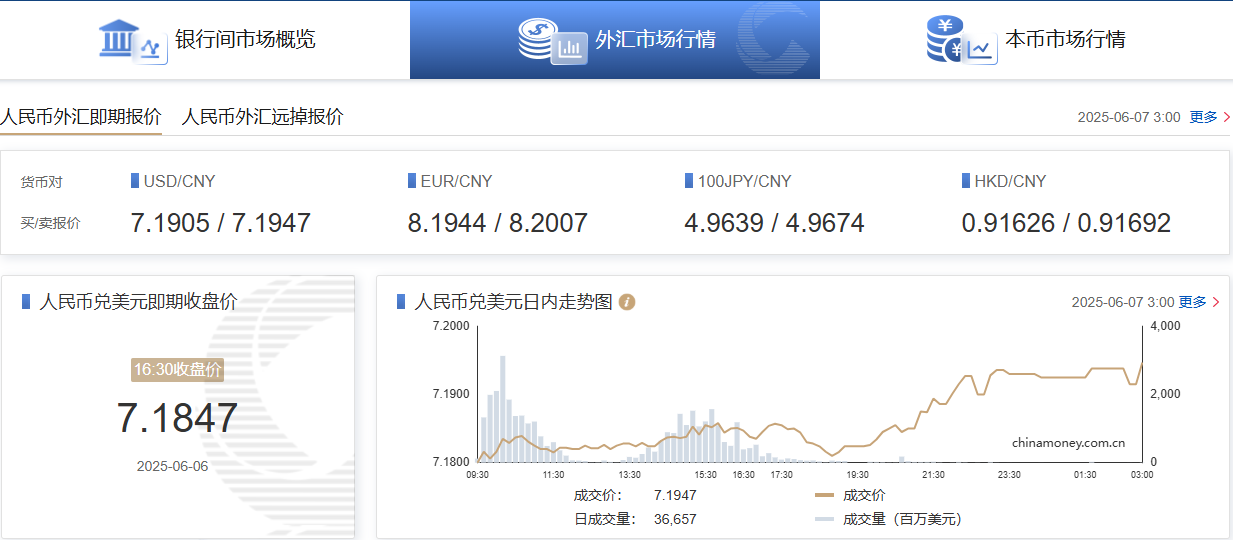
在岸人民币兑美元(CNY)北京时间03:00收报7.1947元,较周四夜盘收盘跌157点。成交量366.57亿美元。
news flash· 2025-06-06 19:07
Core Viewpoint - The onshore Chinese yuan (CNY) closed at 7.1947 against the US dollar, reflecting a decline of 157 points from the previous night’s close [1] Summary by Relevant Sections - **Exchange Rate Movement** - The CNY experienced a depreciation against the USD, closing at 7.1947 [1] - This represents a drop of 157 points compared to the previous trading session [1] - **Trading Volume** - The trading volume for the CNY was reported at 36.657 billion USD [1]
贸易不确定性升温,汇率节奏未变
Hua Tai Qi Huo· 2025-06-06 06:21
Report Industry Investment Rating - No relevant content provided Core Viewpoints - The RMB is expected to run strongly. In the short term, its trend is stronger than market expectations, mainly driven by the US dollar's correction and settlement. Despite rising tariff disturbances, the RMB's sensitivity to external trade uncertainties has decreased, and the exchange rate is generally running strongly [41][43] Summary by Directory 1. Quantity and Price and Policy Signals Quantity and Price Observation - The implied volatility of the USD/CNY option is declining. The 3 - month implied volatility curve shows that the Call - end and Put - end volatilities are equal, indicating a weakened market expectation for future USD/CNY volatility [4] - Regarding the term structure, data on the New Exchange's USD/CNY futures premium/discount, bank forward premium/discount, and US - China interest rate differentials for different time periods (this week, last week, last month) are presented, but no specific conclusions are drawn [8] Policy Observation - The policy counter - cyclical factor hovers around 0% and shows fluctuations. The 3 - month CNH HIBOR - SHIBOR spread shows a fluctuating trend without a clear unilateral trend [10] 2. Fundamentals and Views Macroeconomic Aspects - **US Economy** - Fed's interest rate cut and liquidity: By 2025, the Fed's interest rate cut is priced at 49.4bp, and the pricing of the US interest rate cut has declined. The TGA account balance on May 28 was $436.6 billion, and the Fed's reverse repurchase balance was $173.6 billion. Multiple Fed officials are concerned that Trump's tariff policies may cause inflation and impact the economy and employment [18] - The risk of economic downturn is rising. Employment is mixed (US non - farm payrolls in April decreased moderately, and the unemployment rate remained flat), inflation is falling, and the economy is marginally declining (fiscal spending has decreased, the April economic sentiment has declined, and retail sales in April have rebounded) [20] - The 30 - year US Treasury yield has exceeded 5%. Factors include the Fed Chairman's adjustment of the policy framework, the downgrade of the US sovereign debt rating, the continuous rolling over of US Treasury bonds, the possible arrival of the "X - date" in August, and Trump's tax - cut bill [24][28] - **China's Economy** - The economic structure is differentiated. In April, the overall data faced external pressure, but there may be a new round of "rush to export" under the easing of tariffs [35] - In May, the national PMI was 49.5, with a month - on - month value of 0.5, a year - on - year value of 0, and a difference of 0.2 from the recent average. Production increased by 0.9 to 50.7, and new orders increased by 0.6 to 49.8, with production higher than orders. Among different industries, intermediate goods, equipment, and consumer goods industries rebounded, while raw materials declined [37] Tariff Events - **Tariff Negotiations** - In the latest week, there have been many major events in the US tariff field. The US International Trade Court ruled that Trump's tariff executive order was over - stepped, but Trump also proposed to increase steel tariffs. The US government has requested countries to submit trade negotiation plans by June 4th [21] - Trade negotiations among 15 key countries and regions show a differentiated pattern. For example, the UK and the US have signed an agreement, China - US negotiations have faced new discriminatory measures from the US, and India may be the next to reach an agreement with the US [21] - **Possible Negotiation Framework: "Tariff + Quota"** - India has proposed various tariff adjustment and market access plans, such as significantly reducing the average tariff difference with the US and implementing zero - tariff arrangements for some products [23] - The UK and the US have reached a principle - based framework agreement, including tariff adjustments for various products such as beef, automobiles, and steel, as well as cooperation in other aspects like intellectual property and defense [23] - China and the US have agreed to adjust tariffs and cancel some counter - measures after the Geneva economic and trade talks [23] Other Events - **The "Big and Beautiful" Bill** - It has been submitted to the Senate, and there are increasing differences within the Republican Party. The bill includes tax reform, medical reform, immigration policy, defense budget, energy policy, and education and welfare reform, which will have various economic impacts such as reducing federal tax revenue and increasing the deficit [29][30][31] - **US May "Rush to Import"** - The performance of the manufacturing sub - items in May was average. Output increased by 1.4% (previous value - 4.3%), self - owned inventory decreased by 4.1% (previous value - 2.6%), new export orders decreased by 3% (previous value - 6.5%), imports decreased by 7.2% (previous value - 3%), and new orders increased by 0.4% (previous value - 3.7%) [32] 3. Risk Assessment - The range of the basis fluctuation of the USD/CNY futures from May 2022 to the present (nearly 3 years) is between - 1100 and 900 [46]
2025年5月境外人民币市场综述
Sou Hu Cai Jing· 2025-06-06 02:53
Core Insights - The offshore (CNH) and onshore (CNY) RMB appreciated against the USD in May, with the average daily price difference (absolute value of CNY-CNH) decreasing by 108 basis points to 62 basis points [1][3] - The CFETS RMB exchange rate index and the indices referencing the BIS and SDR currency baskets showed mixed results, with the former two declining and the latter increasing [1][3] - The issuance of offshore RMB bonds decreased, with 88 bonds issued amounting to 34.682 billion, a 3.8% decrease from the previous month [5] Offshore RMB Deposits in Hong Kong and Taiwan - As of April 2025, offshore RMB deposits in Hong Kong increased by 7.4% to 1,030.895 billion, while Taiwan's deposits rose by 1.6% to 112.725 billion [2] Offshore RMB Foreign Exchange Market - On May 30, the CNH/USD exchange rate closed at 7.2065, appreciating by 0.87%, while the CNY/USD rate closed at 7.1953, appreciating by 0.94% [3] - The CFETS RMB exchange rate index stood at 95.96, down 0.25%, with the BIS index at 101.58, down 0.50%, and the SDR index at 90.93, up 0.54% [3] Offshore RMB Derivatives Market - The 1-year CNH swap points settled at -1846 basis points, down 163 basis points, while the CNY 1-year swap points were at -2060 basis points, down 107 basis points [4] - The trading volume for USD/CNH futures on the Hong Kong Stock Exchange reached 2.4909 million contracts, a 13.0% increase, while the open interest decreased by 21.0% to 31,000 contracts [4] Offshore RMB Bond Market - The offshore RMB bond market saw a total of 88 bonds issued in May, a decrease of 7 from the previous month, with a total issuance amount of 34.682 billion [5] Offshore RMB Money Market - As of the end of May, the CNH HIBOR rates for overnight, 7-day, 3-month, and 1-year were 2.0442%, 1.7946%, 1.7697%, and 1.9403%, reflecting mixed changes [6] - The average interest rate differentials between offshore and onshore borrowing rates increased for overnight and 7-day terms, while decreasing for 3-month and 1-year terms [6] Dynamics of Foreign Institutions in Domestic Interbank Market - By the end of May, the number of foreign institutions participating in the domestic interbank foreign exchange market reached 232, an increase of 1 from the previous month [7] - The total number of foreign institutions and their products in the domestic interbank currency market rose to 5723, with various categories showing slight increases [7] Trading Volume in Domestic Interbank Market - In May, the total trading volume of foreign institutions in the domestic interbank foreign exchange market was 27,551.68 billion, a decrease of 17.1% [8] - The trading volume in the domestic interbank money market increased by 18.1% to 8,680.54 billion [8]

东吴证券晨会纪要-20250606
Soochow Securities· 2025-06-06 01:35
Group 1: Macro Strategy Insights - The report indicates that exchange rates and non-tariff barriers may become more critical tools in trade conflicts, potentially replacing tariffs as the primary means of trade engagement [1][9][10] - Domestic foreign trade enterprises believe that due to fundamental conflicts, the Sino-US trade negotiations may experience significant ups and downs, necessitating ongoing risk management for exports to the US [1][9] - If tariffs fail to achieve their intended competitive goals, the US government may resort to non-tariff barriers and currency manipulation, drawing parallels to historical trade competition phases [1][9] Group 2: Currency and Economic Indicators - The report suggests that the RMB exchange rate may gradually decline to the range of 7.17-7.18, with expectations of a dual-directional fluctuation between 7.15 and 7.22 [11][12] - The ECI index indicates a slight recovery in supply and demand, but the manufacturing PMI remains in a contraction zone, reflecting weak overall economic momentum [13] - The report highlights that the US trade deficit has narrowed significantly, with April imports showing a historic decline of 19.8%, indicating a slowdown in the "import rush" effect driven by tariff policies [16][17] Group 3: Fixed Income and Structured Financing - The report notes that the valuation of city investment ABS is less correlated with duration compared to credit bonds, suggesting that shorter-duration ABS may offer better risk-return profiles [3][4] - The weighted average coupon rate of city investment ABS is approximately 3.25%, which is lower than the overall market for credit bonds, indicating a favorable financing environment for structured products [18] - The report emphasizes the importance of the quality of underlying assets and the issuing entity's qualifications in determining the valuation of city investment ABS [4][18] Group 4: Company-Specific Insights - Pinduoduo's Q1 2025 performance fell short of expectations, leading to a downward adjustment in profit forecasts for 2025-2027, reflecting a strategic focus on ecosystem investment for sustainable growth [6] - Gilead Sciences' ASC40 acne treatment achieved all primary and secondary endpoints in Phase III trials, demonstrating superior efficacy compared to FDA-approved alternatives [7] - The report on SOTON Robotics indicates a significant drop in revenue for Q1 2025, but an increase in gross margin, suggesting potential for recovery through new product launches and market expansion [8]