
新兴产业

Search documents
冀时海报丨传统动能焕新升级 新兴产业亮点频现 河北九大工业主导产业累计增速均保持正增长
Xin Lang Cai Jing· 2025-12-27 06:23
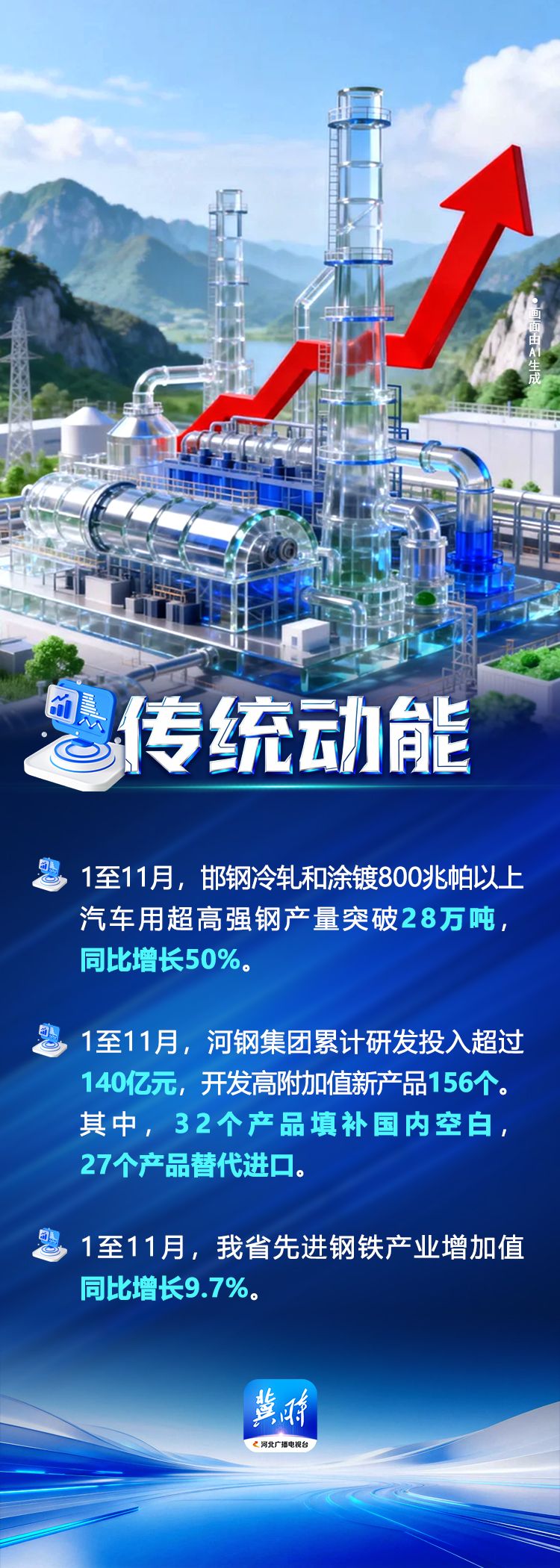
Group 1 - The core viewpoint of the article highlights the positive growth of nine major industrial sectors in Hebei Province, with all showing cumulative growth rates remaining positive [1] - The province's industrial economy has maintained steady growth, with notable achievements in traditional and emerging industries [1] - Five companies, including Shougang Zhixin, have been listed in the Hurun Global Unicorn List 2025, indicating a strong presence in the innovation sector [1] Group 2 - From January to November, the production of ultra-high-strength steel for automotive use in Handan Steel reached over 280,000 tons, a year-on-year increase of 50% [4] - Hebei Steel Group's R&D investment exceeded 14 billion yuan, resulting in the development of 156 high-value-added new products, with 32 filling domestic gaps and 27 replacing imports [4] - The added value of the advanced steel industry in the province grew by 9.7% year-on-year [4] Group 3 - The added value of strategic emerging industries in the province increased by 10.6% year-on-year from January to November, outpacing the provincial average by 2.7 percentage points [7] - The robotics industry in the province saw significant growth, with industrial and service robot production increasing by 45.9% and 102.1% respectively [7] Group 4 - The added value of the equipment manufacturing industry in the province grew by 10.4% year-on-year, contributing 2.1 percentage points to the overall industrial growth [9] - Investment in industrial equipment and tools increased by 32.6%, accounting for 58.3% of industrial investment contributions [9] Group 5 - High-tech industry investment in the province rose by 23.2% year-on-year, contributing 1.5 percentage points to overall investment growth and accounting for 24.5% of fixed asset investment [14]


新兴产业“未来已来”,中国科技创新如何“惊艳”世界
2 1 Shi Ji Jing Ji Bao Dao· 2025-12-27 02:16
Core Viewpoint - The article emphasizes the rapid growth and transformation of China's economy driven by innovation, particularly through strategic emerging industries and future industries, which are reshaping the industrial landscape and enhancing global competitiveness [6][11]. Group 1: Economic Transformation - The "14th Five-Year Plan" prioritizes the construction of a modern industrial system and the strengthening of the real economy, focusing on nurturing emerging and future industries as a strategic task [5]. - Continuous increases in R&D investment and the rising contribution of strategic emerging industries to GDP highlight a clear shift towards an innovation-driven economy [8][9]. Group 2: Industry Growth - Strategic emerging industries are becoming the main force in China's economic transformation, with significant growth in sectors such as low-altitude economy, commercial aerospace, and renewable energy [11][12]. - The market size of the low-altitude economy has doubled over four years, while the commercial aerospace sector has seen a substantial increase in launch frequency and satellite numbers [12][13]. Group 3: R&D Investment - R&D expenditure has steadily increased for four consecutive years, with the intensity of R&D investment rising significantly [9]. - The value added by strategic emerging industries is projected to continue expanding, with a notable increase in their share of GDP [9][10]. Group 4: Future Industries - Future industries, including quantum technology and brain-computer interfaces, are experiencing rapid advancements and commercialization, positioning China as a leader in global technology competition [15][17]. - The artificial intelligence sector is expected to exceed 700 billion yuan in 2024, maintaining a growth rate of over 20% annually, with China leading in AI patent applications [17][18].

“国家队”超千亿“耐心资本”投向硬科技 中投、国投、深创投联手管理
Zhong Guo Jing Ying Bao· 2025-12-27 00:29
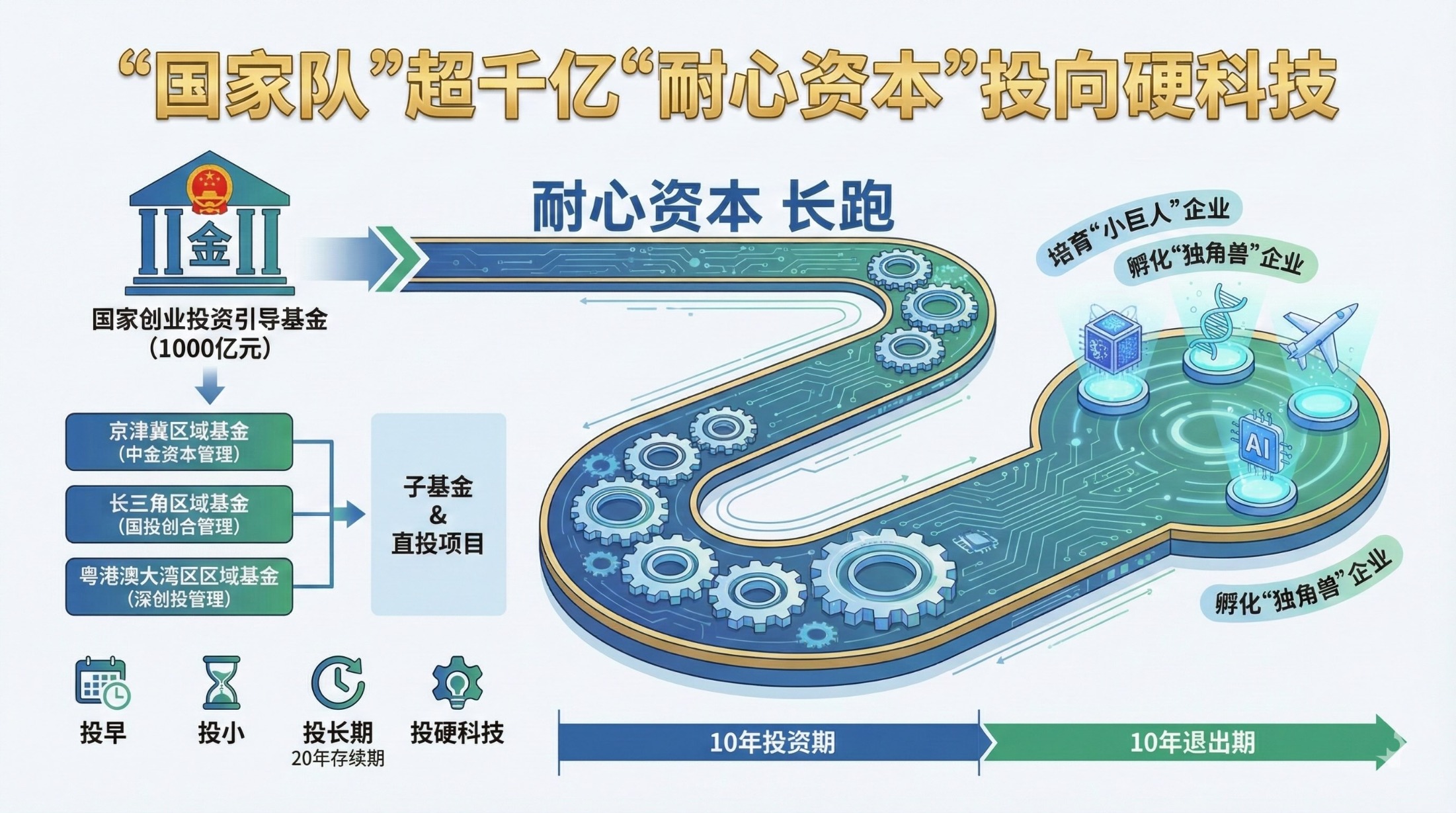
白京羽解释称,科创企业的成长壮大是一场"马拉松",需要资本长期、稳定的陪伴。国家创业投资引导基金设置20年存续期,其中10年为投资期、10年为退 出期,通过更长久的投资期限,为企业提供稳定的长周期资金支持;同时,以更为宽松的退出安排,为企业发展留出空间,用耐心资本陪伴企业"长跑",培 育更多专精特新的"小巨人"和"独角兽"企业。 在投资导向方面,白京羽表示,引导基金坚持"投早、投小、投长期、投硬科技"的"四投"原则,重点引导和带动创投市场发展。基金将以种子期、初创期企 业为主要投资对象,对此类企业的投资规模占比不低于基金总规模的70%。 在资金来源方面,财政部经济建设司司长郭方明在发布会上介绍,根据国务院批复方案,国家创业投资引导基金使用超长期特别国债资金出资,在国家层面 由财政出资1000亿元;在区域基金和子基金层面,则积极引导和鼓励社会资本参与。 据了解,国家创业投资引导基金采用"基金公司—区域基金—子基金"的三层架构运行。目前,京津冀创业投资引导基金、长三角创业投资引导基金、粤港澳 大湾区创业投资引导基金均已完成工商注册,未来3只区域基金的总规模均将超过500亿元。 区域基金是落实国家战略意图的重要载体 ...
发展新质生产力不是齐步走
Xin Lang Cai Jing· 2025-12-26 23:07
Core Viewpoint - The Central Economic Work Conference emphasizes the development of "new quality productivity" tailored to local conditions, indicating a direction for addressing current issues and promoting both traditional industry upgrades and emerging industry cultivation [1] Group 1: Development of New Quality Productivity - The concept of new quality productivity is not limited to emerging industries but includes the upgrading of traditional industries, showcasing a dual development model where both sectors thrive together [1] - From January to November this year, the added value of China's high-tech manufacturing industry has maintained rapid growth, particularly in emerging fields like electronic materials and integrated circuits, while traditional industries such as coal and chemicals have also seen steady growth due to technological upgrades [1] - Different regions are exploring differentiated approaches, with some focusing on new materials and others on future industries like quantum computing and aerospace information, highlighting a trend towards localized and specialized development [1] Group 2: Green Production and Economic Benefits - New quality productivity is fundamentally linked to green productivity, as evidenced by significant growth in clean energy generation and the rapid increase in production of green products like wind power equipment and electric vehicles from January to November [2] - Western regions are leveraging their ecological advantages to develop large-scale photovoltaic projects, while eastern regions are integrating green manufacturing with digital economy initiatives to promote low-carbon transformations across the industry chain [2] - The approach to developing new quality productivity should be precise and tailored rather than uniform, emphasizing the need for differentiated strategies based on regional strengths [2] Group 3: Key Strategies for Implementation - The development strategy should include classified guidance to avoid a one-size-fits-all approach, focusing on regional strengths such as quantum technology in resource-rich areas and smart agriculture in agricultural hubs [3] - Strengthening innovation integration is crucial, requiring the establishment of public service systems to facilitate deep collaboration between industry, academia, and research, thereby overcoming barriers to technology transfer [3] - Institutional support must be improved to align with new quality productivity, enhancing market roles in resource allocation and utilizing policy tools like green finance and technological transformation subsidies to support regional development [3]
国家创业投资引导基金正式启动 未来将推动在三个区域设立超过600只子基金
Zheng Quan Ri Bao· 2025-12-26 16:42
12月26日,国家发展改革委、财政部发起设立的国家创业投资引导基金(以下简称"引导基金")启动仪 式在北京举行。引导基金开创性设立"基金公司—区域基金—子基金"三层架构。其中,国家层面由财政 出资1000亿元,在区域基金、子基金层面积极鼓励社会资本参与。 财政部相关负责人表示,引导基金在区域基金及子基金层面,积极面向地方政府、金融机构、国有企 业、民营企业等,通过千亿元级财政资金,预计将撬动万亿元级社会资本。 (文章来源:证券日报) 另据霍福鹏透露,未来,引导基金将推动在京津冀、长三角、粤港澳大湾区三个区域设立超过600只子 基金,服务新兴产业和未来产业发展。 国家发展改革委创新和高技术发展司司长白京羽表示,下一步,引导基金将从两个方面持续发力。一方 面,汇聚各类社会资本,为新兴产业、未来产业注入金融活水。引导基金将与基金管理机构一道,重点 围绕创新创业活跃地区,对集成电路、人工智能、航空航天、低空经济、生物制造、未来能源等领域的 早期项目和种子企业,加大基金投资力度,努力带动各类金融机构以及民间资本共同投资。另一方面, 集聚各类创新要素,为创新型企业发展提供优质服务。在提供资金支持的同时,引导基金还将打造高 ...

氪星晚报|MiniMax与快看漫画达成“AI+IP”合作,上线首个AI互动漫画;联想将推出超级AI智能体;国家创业投资引导基金将重点支持新兴产业和未来产业
3 6 Ke· 2025-12-26 11:24
Group 1: Company Developments - Xiaopeng Motors officially entered the Mauritius market after establishing a strategic partnership in December, following its entry into the Qatar market [1] - Xiaomi has applied for multiple trademarks related to its Ultra series, with some already successfully registered [2] - MiniMax has partnered with Kuaikan Manhua to launch the first AI interactive comic, integrating AI technology into the comic industry [3] - Mango Super Media's wholly-owned subsidiary has established a new equity investment fund with a capital contribution of approximately 356 million RMB [4] Group 2: Investment and Financing - "Hai Sida Sodium Star" has completed over 100 million RMB in strategic financing, with investors including Baiyun Financial Holdings and Guangdong Guoyan Industrial Investment [5] - "Xingyi Space" has completed nearly 300 million RMB in Pre-A round financing, primarily for the construction of overseas measurement and control stations and technology R&D [6] - Shanghai Blueprint Aviation Technology Co., Ltd. has announced 500 million RMB in A round financing, focusing on core technology development [7] - Weina Star completed 1.56 billion RMB in equity financing throughout 2025, aimed at R&D investment and capacity expansion [8] Group 3: New Products - Lenovo plans to launch its first global "AI Super Intelligent Agent" during CES, which will have capabilities similar to the Doubao mobile assistant [10] - Huawei announced the launch of the new Huawei WiFi X product in March 2026, featuring transparent antenna technology and supporting the Harmony ecosystem [11] Group 4: Industry Trends - The Industrial Robot Quality Strong Chain project has completed 33 key tasks, marking significant progress in standards, measurement, testing, and certification [12] - Various regions in China have added over 1.1 billion RMB in subsidies to boost the automotive market as the year-end approaches [12] - The National Venture Capital Guidance Fund will focus on supporting emerging and future industries, enhancing investment in early-stage projects in sectors like semiconductors and AI [12] - The Ministry of Industry and Information Technology emphasized the implementation of a new round of key industry growth plans, promoting the supply of green and age-friendly products [13]
产业创新是建构中国经济增长新的核心支柱
Guo Ji Jin Rong Bao· 2025-12-26 10:08
Core Insights - The upcoming year 2026 marks the start of China's 15th Five-Year Plan, emphasizing the implementation of industrial innovation projects to enhance the country's industrial structure and establish a modern industrial system with global competitiveness [1] Group 1: Industrial Innovation Strategy - China aims to create emerging pillar industries and strategically position future industries, focusing on sectors like new energy, aerospace, and quantum technology, which are characterized by long-term and dynamic features [3] - The strategy includes a new national system to concentrate resources on technological advancements and infrastructure, leveraging the complete industrial system and vast market advantages to facilitate the commercialization of new technologies [4] Group 2: Global Innovation Standing - According to the 2025 Global Innovation Index, China ranks 4th globally, achieving its highest position ever, while also being the second in key technology fields like biotechnology and quantum technology, closing the gap with the U.S. [5] - China has 24 of the world's top 100 innovation clusters, with the Shenzhen-Hong Kong-Guangzhou cluster now ranked first globally, surpassing the Tokyo-Yokohama cluster [5] Group 3: Policy and Financial Support - Various government departments have issued guidelines to promote strategic emerging industries, emphasizing the need for comprehensive financial services throughout the innovation lifecycle [6] - The government is focusing on creating application scenarios in digital economy and AI, aiming to build a robust ecosystem for emerging and future industries [6] Group 4: Industry Development and Collaboration - China has seen the emergence of around 350 companies in the brain-computer interface sector, and has established the largest solar panel production base globally, showcasing a collaborative approach to industrial innovation [7] - The government is promoting a systematic approach to accelerate the development of industrial clusters, emphasizing the integration of infrastructure, technology research, and market needs [9] Group 5: Future Industry Challenges and Strategies - Future industries face more complex risks, necessitating a diversified technological approach and the establishment of pilot application scenarios to foster innovation [10] - Regulatory frameworks are evolving to support innovation, including the introduction of "regulatory sandboxes" and a focus on digital regulation to create a conducive environment for future industries [11] Group 6: Investment and Risk Management - Establishing a risk-sharing mechanism is crucial for future industry development, with a focus on a tiered layout system and government-market collaboration to attract investment [12] - Innovative financial tools are being developed to support long-term investments in future industries, including insurance products tailored for technology transfer and key equipment development [12] Group 7: Talent and Innovation Ecosystem - Cultivating a high-level innovation ecosystem is essential, with initiatives to support leading enterprises and foster new entities in future industries [13] - There is a shared policy focus on enhancing infrastructure, original innovation, and the integration of technology and industry to strengthen the overall innovation capacity [13]
嘉实基金:新兴产业引领成长 深度把握多元机遇
Di Yi Cai Jing· 2025-12-26 09:03
Core Viewpoint - The "14th Five-Year Plan" emphasizes the importance of emerging and future industries, identifying key sectors such as new energy, new materials, aerospace, and low-altitude economy, which are crucial for building a modern industrial system and fostering new productive forces [3][4]. Emerging Industries - The four major emerging industries highlighted are new energy, new materials, aerospace, and low-altitude economy, while six future industries include quantum technology, biomanufacturing, hydrogen and nuclear fusion, brain-computer interfaces, embodied intelligence, and sixth-generation mobile communication [3]. - Emerging industries have established clear industrial forms and development models, transitioning from "quantitative accumulation" to "qualitative leaps," presenting significant growth opportunities [3]. Investment Insights - Investment in emerging industries requires a deep understanding of the entire cycle from technological emergence to commercial realization, focusing on pioneering companies that can define the future and build competitive barriers [3]. - The core themes of advanced manufacturing revolve around "development, safety, and low carbon," indicating a strategic focus for investors [3]. New Energy and New Materials - New energy is essential for economic operation, with the "14th Five-Year Plan" introducing the "Energy Power" strategy to accelerate the construction of a new energy system and expand green electricity applications [6]. - New materials are critical for modern economies and high-end manufacturing, with increasing demand driven by technological advancements and applications in AI and new energy [6]. - The investment landscape includes over 15 actively managed funds focused on new energy and new materials, with notable performance metrics indicating substantial returns [8]. Aerospace and Low-altitude Economy - The aerospace sector is becoming a strategic focal point for national competition, with significant market opportunities emerging from commercial space exploration and advancements in green aviation and smart manufacturing [11]. - The low-altitude economy is recognized as a new growth engine, with a clear market scale and timeline outlined by the government, presenting investment opportunities across various sectors [11]. Fund Performance - Several funds have shown exceptional performance, such as the Jia Shi Environmental Low Carbon Fund, which has achieved a net value growth of 223.4% since its inception, significantly outperforming its benchmark [8]. - The Jia Shi New Energy and New Materials Fund has also demonstrated strong returns, with a net value increase of 173.43% since its establishment [8]. Product Offerings - Jia Shi Fund has systematically laid out a range of products in the new energy and new materials sectors, including ETFs that cover upstream materials, power generation, and energy storage, ensuring comprehensive market coverage [9]. - The high-end equipment ETF tracks a specialized index, providing investors with targeted exposure to the aerospace and high-end manufacturing sectors [12].
全国工业和信息化工作会议在京召开 部署2026年重点工作
Zheng Quan Ri Bao Wang· 2025-12-26 08:21
Core Viewpoint - The national industrial and information technology work conference held on December 25-26 outlines the achievements and future tasks for the industrial economy, emphasizing steady growth and resilience in the face of new challenges. Group 1: Industrial Economic Performance - The industrial economy is expected to show steady progress, with telecommunications business volume and software business revenue projected to grow by approximately 9% and 12% year-on-year, respectively, while digital industry revenue is expected to increase by around 9% [1] - The resilience of industrial and supply chains continues to strengthen, with key manufacturing industry chains advancing high-quality development and breakthroughs in several landmark technologies and products [1] Group 2: Technological Innovation and Development - Significant breakthroughs in industrial technology innovation have been achieved, with the added value of high-tech manufacturing and equipment manufacturing industries increasing by 9.2% and 9.3% year-on-year, respectively, from January to November [1] - The core industry of artificial intelligence has surpassed one trillion yuan, and exports of new energy vehicles have exceeded 2 million units [1] Group 3: Manufacturing Transformation and Upgrading - Over 7,000 advanced-level and 500 excellent-level smart factories have been established, with more than 20,000 industrial 5G private network projects and over 8,000 5G factories nationwide [2] - The cumulative number of technology and innovation-oriented small and medium-sized enterprises has exceeded 600,000, with high-tech enterprises reaching 504,000 [2] Group 4: Key Focus Areas for 2026 - The conference emphasizes ten key areas for 2026, including consolidating the positive trend of the industrial economy, enhancing the resilience and safety of industrial chains, and accelerating technological innovation capabilities [4][5][6] - Specific initiatives include promoting high-quality development of key industry chains, optimizing traditional industries, and fostering emerging and future industries such as integrated circuits and biotechnology [5][6] Group 5: Information and Communication Industry Development - The information and communication industry is set to undergo high-quality development, with initiatives like the "broadband upgrade" project and the acceleration of mobile IoT development [6] - The total number of 5G base stations reached 4.758 million by the end of October, with 5G technology integrated into 91 out of 97 national economic categories [2] Group 6: Governance and Policy Implementation - The modernization of industry governance is progressing steadily, with significant reform measures being implemented to address "involution" competition [3][7] - The focus will be on enhancing the effectiveness of industry governance, improving the quality of supply, and fostering international cooperation [7]
工信部:推进AI+制造专项行动,培育一批重点行业智能体
Nan Fang Du Shi Bao· 2025-12-26 08:17
Core Insights - The conference highlighted the expected growth in telecommunications and software business revenues by approximately 9% and 12% respectively for 2025, with digital industry revenue also projected to grow by around 9% [1] - The manufacturing sector is undergoing a transformation, with significant increases in high-tech and equipment manufacturing value added, and the establishment of numerous advanced smart factories and green factories [1] - The meeting outlined ten key focus areas for 2026, emphasizing the cultivation of emerging industries such as integrated circuits, new materials, and artificial intelligence [2] Group 1 - The total telecommunications business volume and software business revenue are expected to grow by 9% and 12% respectively in 2025 [1] - The value added of high-tech manufacturing and equipment manufacturing increased by 9.2% and 9.3% year-on-year [1] - The core AI industry has surpassed 1 trillion yuan, and exports of new energy vehicles have exceeded 2 million units [1] Group 2 - The conference set a focus on nurturing emerging industries, including integrated circuits, new displays, and aerospace [2] - There is a strong emphasis on the deep integration of information technology and industrialization, with initiatives to create high-quality industry data sets and digital transformation scenarios [2] - The meeting also stressed the importance of improving industry governance efficiency and curbing low-price, low-quality competition [2]