量化紧缩

Search documents
2025年第四季度市场展望报告:从贸易战到降息与刺激政策-瀚亚投资
Sou Hu Cai Jing· 2025-11-15 02:09
Core Insights - The report by Hanya Investment focuses on the evolution of global trade patterns, central bank interest rate cuts, and policy stimulus, reviewing market performance in Q3 2025 and predicting trends for Q4 2025 and 2026 [1] Market Performance Overview - Global markets experienced a broad rally in Q3 2025, driven by the extension of the US-China trade truce, optimism surrounding AI, and expectations of Federal Reserve interest rate cuts [7] - The S&P 500 index rose by 7.8%, while the Nasdaq index increased by 11.2%. Emerging markets outperformed developed markets with a 10.9% rise, led by China's A-shares (+20.8%) and Taiwan (+14.7%), while India saw a decline of 6.6% [7][8] - Fixed income markets showed volatility, with US Treasury yields declining across the board, and the 10-year Treasury yield falling to 4.16%. Emerging market dollar bonds led with a 4.8% increase [10] - In the foreign exchange market, the US dollar index rose by 0.9% but was down 9.9% year-to-date. The Chinese yuan and Hong Kong dollar performed well, while the New Taiwan dollar and South Korean won depreciated significantly [11] Macroeconomic Outlook - The macroeconomic outlook indicates differentiated growth, with the US and East Asian economies expected to slow down in Q4 2025 and into H1 2026. The Federal Reserve is anticipated to cut rates by 25 basis points in October and December [2][16] - China's economic growth may decline due to a slowdown in credit growth, with GDP growth targets for 2026 set between 4.5% and 5%. New stimulus policies will focus on consumer subsidies and technology investments [17] - India's economy is showing signs of recovery, supported by fiscal and monetary stimulus, while ASEAN economies are relying on domestic demand and policy easing to counteract growth slowdowns [2][16] Monetary Policy and Currency Outlook - The monetary policy environment is entering a loosening phase, with the Federal Reserve expected to continue rate cuts and end quantitative tightening. Other Asian central banks, including those in China and India, are also expected to lower rates [21] - The US dollar is projected to depreciate by 3%-5% in 2026, while the Chinese yuan may appreciate moderately. Other Asian currencies are expected to remain weak until a clear trend of dollar depreciation emerges [2][21] Asset Allocation Strategy - The report suggests a short-term optimistic stance on risk assets, particularly in emerging and Asian markets, while maintaining a neutral long-term outlook. In fixed income, US Treasuries are favored, along with emerging market dollar bonds and Asian credit bonds [3][29] - The report highlights ongoing policy stimulus in Asia, with countries like China, India, and Indonesia implementing measures such as fiscal transfers, tax cuts, and credit support to boost economic recovery [3][17]


融资市场警报拉响!华尔街警告美联储:坐视不管或重演2019年“钱荒” 危机
智通财经网· 2025-11-13 13:48
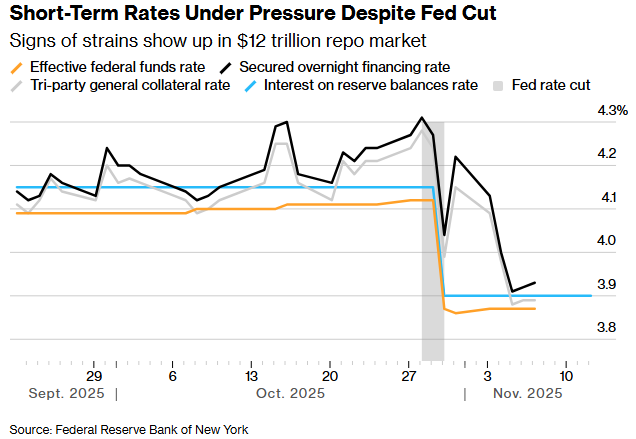
Core Viewpoint - The ongoing pressures in the $12 trillion short-term funding market are prompting calls for the Federal Reserve to take stronger actions to alleviate the situation, including increasing short-term market loans or directly purchasing securities [1][4]. Group 1: Market Pressures - Key short-term interest rates have remained high, including benchmark rates related to overnight repurchase agreements and the Federal Reserve's own policy target rate, which has risen four times in the past two months [1]. - The increase in U.S. Treasury issuance has drawn cash from the short-term market, leading to reduced funds in the banking system [4]. - The recent government shutdown has delayed federal spending that could have boosted liquidity, exacerbating the situation [4]. Group 2: Federal Reserve Actions - The Federal Reserve has indicated a potential adjustment in its balance sheet policy due to recent market pressures, with some investors believing that actions may be too slow to prevent reserve scarcity [1][4]. - New York Fed officials have suggested that rising financing costs signal that bank reserves are no longer abundant, indicating that the Fed may need to purchase assets soon [4]. - The Fed's recent decision to halt the reduction of Treasury holdings starting December 1 has not alleviated market pressures [4]. Group 3: Market Stability and Risks - The lack of sufficient liquidity could increase volatility and weaken the Fed's ability to control interest rate policies, potentially leading to broader impacts on the Treasury market [5]. - Historical context is provided by the 2019 incident where a key overnight rate surged to 10%, prompting the Fed to inject $500 billion into the financial system [5]. - Despite current market stability, there are concerns about year-end volatility as banks typically reduce repo market activity for regulatory purposes [6]. Group 4: Federal Reserve Officials' Perspectives - Cleveland Fed President expressed that some volatility in front-end rates is acceptable as long as they remain within a certain range, with current reserves at $2.85 trillion [9]. - Dallas Fed President indicated that if repo rates remain high, the Fed will need to purchase assets, emphasizing that the scale and timing of purchases should not be mechanical [10]. - Market participants are frustrated by the lack of clarity regarding the desired levels for money market rates and the overall control of the money market [10].
美股前瞻 | 三大股指期货涨跌不一 美国联邦政府结束历史最长停摆
智通财经网· 2025-11-13 12:30
Market Overview - US stock index futures showed mixed performance ahead of the market opening, with Dow futures up 0.01%, S&P 500 futures down 0.15%, and Nasdaq futures down 0.20% [1] - European indices displayed varied results, with Germany's DAX down 0.65%, UK's FTSE 100 down 0.54%, France's CAC40 up 0.37%, and the Euro Stoxx 50 down 0.05% [2][3] Oil Prices - WTI crude oil increased by 0.79% to $58.95 per barrel, while Brent crude oil rose by 0.73% to $63.17 per barrel [3][4] Economic Events - The US federal government ended a 43-day shutdown after President Trump signed a temporary funding bill, allowing most government agencies to operate until January 30, 2026 [4] - New York Fed officials indicated that the Fed may soon initiate asset purchases to maintain liquidity, citing rising overnight financing costs as a sign of insufficient bank reserves [5] Corporate News - Disney reported better-than-expected Q4 profits, driven by strong performance in streaming and theme parks, and announced a 50% increase in dividends along with a doubling of its stock buyback plan [7] - Pfizer plans to sell its remaining stake in BioNTech, marking the end of a significant partnership that generated substantial revenue during the pandemic [8] - Cisco's Q1 results exceeded expectations, with an 8% year-over-year revenue increase to $14.9 billion, driven by growth in AI-related spending [9] - JD.com reported Q3 total revenue of 299.06 billion yuan, a year-on-year increase of 14.85%, while net profit decreased by 55.03% [10] - Bilibili turned a profit in Q3 with a net profit of 469 million yuan, showing significant growth in user engagement metrics [10] - Starbucks employees initiated an indefinite strike affecting at least 65 stores across 40 cities, potentially impacting holiday sales [12]

鸽鹰交锋加剧!政府停摆放大政策盲区 美联储步入关键观察期
Xin Hua Cai Jing· 2025-11-13 01:54
新华财经北京11月13日电(崔凯)在美国联邦政府部分停摆导致关键经济数据发布中断的背景下,美联 储官员近期密集发声,围绕是否在12月继续降息展开激烈辩论。多位具有投票权与非投票权的地区联储 主席及理事在公开讲话中释放出截然不同的政策信号,反映出决策层在通胀顽固与劳动力市场走弱之间 的艰难权衡。 尽管如此,威廉姆斯认为将量化紧缩持续至11月底"完全合理",并反对市场要求提前终止缩表的呼声。 他还重申常备回购便利(SRF)工具的有效性,鼓励银行积极使用,称其"无需担心污名化或其他障 碍"。 关于利率政策,威廉姆斯未对12月是否降息作出明确表态,仅强调"通胀高企且目前未见回落迹象,同 时经济展现出一定韧性"。他同时反驳了达拉斯联储主席洛根关于转向以回购利率为政策基准的建议, 坚持联邦基金利率仍是合适的政策锚点。 降息节奏争议升级官员立场两极分化 美联储理事斯蒂芬·米兰(Stephen Miran)持续呼吁加快宽松步伐。他周三再次表示,当前货币政策"过 于紧缩",应进一步降低利率以缓解经济下行风险。米兰主张单次降息50个基点,最低限度也应为25个 基点,并强调货币政策具有12至18个月的滞后效应,"若仅依据当前数据制 ...
纽约联储官员:美联储或很快启动资产购买以维持流动性
智通财经网· 2025-11-12 23:45
Core Insights - The New York Fed official Roberto Perli indicated that rising overnight financing costs suggest that bank reserves are no longer ample, prompting the Fed to potentially buy assets soon to maintain ideal liquidity levels [1] - Perli's comments align with New York Fed President Williams' earlier statements, suggesting that the Fed is close to achieving "ample reserves" and that the next step would be to gradually resume asset purchases [1] - Despite the Fed's announcement to end quantitative tightening (QT) on December 1, market liquidity remains tight, raising concerns about the Fed's potential intervention in the money market before concluding balance sheet reduction [1] Group 1 - Roberto Perli highlighted that indicators, including rising money market rates, strongly indicate that reserves are no longer ample [1] - Perli noted an increase in the use of the Fed's standing repo facility over the past two months, predicting that investors will use this tool more broadly and significantly in the future [1] Group 2 - Williams previously stated that the Fed may soon need to purchase bonds to expand its balance sheet, assessing when bank reserves transition from "slightly above adequate" to "adequate" [2] - He emphasized the complexity of determining when the Fed will need to inject cash into the system, closely monitoring various market indicators related to the federal funds market and repo market [2]
“美联储三把手”:联储可能很快开始重启购债,以便管理流动性
Hua Er Jie Jian Wen· 2025-11-12 20:24
Core Viewpoint - The Federal Reserve may soon need to restart bond purchases as a technical measure to maintain control over short-term interest rates, according to John Williams, President of the New York Fed [1][2]. Group 1: Federal Reserve's Strategy - Williams indicated that the next step in the Fed's balance sheet strategy will involve assessing when reserves reach a sufficient level, at which point asset purchases will begin to maintain adequate reserve levels [2]. - He emphasized that determining when the system reaches sufficient reserves is an "imprecise science" and that multiple market indicators will be closely monitored to assess reserve demand [2][3]. - The Fed's balance sheet has decreased from a peak of $9 trillion in 2022 to approximately $6.6 trillion currently due to quantitative tightening (QT) measures [3]. Group 2: Market Conditions and Concerns - Recent volatility in the short-term financing market has raised concerns on Wall Street, prompting warnings from major investment banks that ongoing funding pressures may force the Fed to take more rapid actions, including potentially restarting asset purchases [2][3]. - The effectiveness of the Standing Repo Facility (SRF) has been highlighted, with Williams encouraging banks to utilize this tool without fear of negative stigma [3]. Group 3: Impact of Stablecoins - Stephen Miran, a Fed governor, noted that the growth of stablecoins could potentially lower the Fed's benchmark interest rate by 0.4 percentage points and increase demand for U.S. Treasury securities and other dollar-denominated liquid assets [4]. - Miran's independent estimates suggest that the impact of stablecoins could account for 30%-60% of savings during the period from 2000 to 2010 [4].
每日机构分析:11月11日
Xin Hua Cai Jing· 2025-11-11 08:44
Group 1 - Deutsche Bank's Chief Investment Officer for emerging markets indicates that the dollar remains attractive for arbitrage due to the Federal Reserve's cautious approach to interest rate cuts, but there is uncertainty regarding the policy path next year, especially if the new Fed chair adjusts the rate cut pace [2] - Goldman Sachs warns that the onset of a Fed rate cut cycle may fuel asset bubbles, with credit spreads recently widening from 2.76% to 3.15%, reflecting a decrease in risk appetite. Tech investment spending is nearing its peak, with the five major tech companies expected to spend $349 billion in capital expenditures by 2025 [2] - The Committee for a Responsible Federal Budget (CRFB) cautions that President Trump's proposed "tariff dividend" of at least $2,000 per person will significantly increase the deficit, potentially adding $6 trillion over ten years, which is double the expected tariff revenue during the same period [2] Group 2 - Morgan Stanley notes that the end of quantitative tightening (QT) by the Fed does not equate to a restart of quantitative easing (QE), as it involves optimizing asset structure without expanding the balance sheet. The key factor affecting market duration and liquidity is the U.S. Treasury's debt issuance strategy, not the Fed's bond-buying actions [1] - Bank of America highlights that the surge in AI capital expenditures and off-balance-sheet financing is masking future profit pressures, with the actual lifespan of AI hardware being only 3-5 years, posing a depreciation risk that may impact financial reports post-2026 [1] - JPMorgan warns that global investment in AI data centers will require at least $5 trillion over the next five years, far exceeding the capacity of any single financing channel. The investment-grade bond market can provide $1.5 trillion, while there remains a $1.4 trillion gap that will need to be filled by private credit and government funding [1]


美国参议院通过临时拨款法案,投资者乐观情绪提振有色
Zhong Xin Qi Huo· 2025-11-11 02:16
Report Industry Investment Rating No relevant content provided. Core Views of the Report - The passage of the temporary appropriation bill by the US Senate has boosted investors' optimism in the non - ferrous metals market. The macro - environment has repeated expectations but overall remains stable. In the short - to - medium term, supply disruptions support base metal prices, and prices will continue to fluctuate. There are opportunities for aluminum ingot price increases and low - buying opportunities for copper and tin. In the long term, with potential domestic stimulus policies and supply disruptions in copper, aluminum, and tin, the prices of these metals are expected to rise [1]. Summary by Related Catalogs 1. Overall Market Analysis - **Macro - environment**: The US Senate passed a temporary appropriation bill to avoid a government shutdown until January 30, 2026. The 14th Five - Year Plan suggestions are out, increasing the expectation of economic - stabilizing policies. The Fed cut interest rates in October and will end the balance - sheet lock - up process in December, but Powell said a rate cut in December is uncertain [1]. - **Supply - demand situation**: The raw material supply remains tight and is spreading to the smelting end. Overseas aluminum smelting faces potential disruptions. Terminal demand is slightly weak, with a decline in automobile sales growth in October and an expanded decline in air - conditioner production schedules from November to December. The current supply - demand of base metals is slightly weak, but there are expectations of tight supply [1]. 2. Individual Metal Analysis Copper - **View**: Copper prices have stopped falling and stabilized as inventories decline. - **Information analysis**: The Fed cut interest rates by 25 basis points, and the decision on further rate cuts in December is uncertain. The US financial system's liquidity may still be deteriorating. In October, China's electrolytic copper production decreased month - on - month by 2.94 tons (2.62%), and increased year - on - year by 9.63%. As of November 10, copper inventories dropped by 0.74 tons to 19.59 tons. - **Main logic**: Macro factors and tight liquidity in the US money market led to a short - term adjustment in copper prices. On the supply side, copper mine supply disruptions increased, and the cost and difficulty of scrap copper recycling rose, leading to a decline in production. On the demand side, copper spot turned to a premium, and inventory started to decline, indicating increased downstream purchasing willingness. - **Outlook**: Copper prices are expected to be volatile and moderately strong in the medium - to - long term due to supply constraints and disruptions [7][8]. Alumina - **View**: The fundamentals are still in surplus, and alumina prices are under pressure and fluctuating. - **Information analysis**: On November 10, alumina spot prices in different regions showed different trends, and the warehouse receipts remained unchanged. - **Main logic**: Macro sentiment amplifies price fluctuations. Although there are some fluctuations in high - cost production capacity and environmental factors cause disruptions, the supply contraction is not obvious, and the inventory is still increasing strongly in China [9]. Aluminum - **View**: Aluminum prices are fluctuating at a high level as inventories accumulate. - **Information analysis**: On November 10, the average price of SMM AOO aluminum decreased by 50 yuan/ton. Aluminum rod and ingot inventories showed different trends, and the warehouse receipts increased. Some overseas aluminum plants have extended their operations, and China's un - wrought aluminum and aluminum product exports decreased in October. - **Main logic**: The macro - environment is volatile. On the supply side, domestic production capacity and operating rate are high, and there are marginal disruptions overseas. On the demand side, the traditional peak season has passed, and the terminal demand is stable. - **Outlook**: In the short term, aluminum prices are expected to be volatile and moderately strong. In the medium term, the price center may continue to rise [10][11][12]. Aluminum Alloy - **View**: Aluminum alloy prices are fluctuating at a high level as scrap aluminum supply remains tight. - **Information analysis**: On November 10, the price of ADC12 remained unchanged, and the automobile sales decreased slightly in October. - **Main logic**: The cost of scrap aluminum is strongly supported. On the supply side, there are risks of production cuts in some alloy plants. On the demand side, there is marginal improvement, and the warehouse receipts are increasing. - **Outlook**: In the short term, prices are expected to be volatile and moderately strong. In the medium term, prices are expected to fluctuate due to uncertain policies and raw material disruptions [13][15]. Zinc - **View**: Zinc prices are fluctuating at a high level as the export window opens. - **Information analysis**: On November 10, the spot premiums of zinc in different regions were negative. As of November 10, the zinc ingot inventory increased slightly. A mine in Australia postponed high - grade zinc ore mining. - **Main logic**: The macro - environment is optimistic. On the supply side, the short - term zinc ore supply is loose, and the smelting profit is good, with high production. The export window has opened, relieving domestic supply pressure. On the demand side, the domestic consumption is entering the off - season. - **Outlook**: Zinc prices are expected to be volatile in the short term and may decline in the long term [16]. Lead - **View**: Lead prices are fluctuating as social inventories accumulate slightly. - **Information analysis**: On November 10, the price of scrap electric vehicle batteries remained unchanged, and the price of lead ingots increased slightly. The social inventory and warehouse receipts increased. - **Main logic**: On the supply side, the profit of secondary lead smelting increased, and the production increased. On the demand side, the lead - acid battery plants resumed production, and the demand is in the peak season. - **Outlook**: Lead prices are expected to be volatile and moderately strong [17][18]. Nickel - **View**: Nickel prices are fluctuating as the current supply - demand is loose. - **Information analysis**: On November 10, the LME nickel inventory increased, and the domestic warehouse receipts decreased. Indonesia cracked down on illegal nickel mining, and there were developments in mining governance. - **Main logic**: Market sentiment dominates the price. The supply of nickel ore is loose, the production of intermediate products has recovered, and the inventory has accumulated. - **Outlook**: Nickel prices are expected to fluctuate [19][20]. Stainless Steel - **View**: Stainless steel prices are fluctuating and rising as warehouse receipts continue to decline. - **Information analysis**: The stainless steel warehouse receipts decreased. The price of nickel - iron and chromium decreased. The Indonesian government allocated funds for mining and smelting projects. - **Main logic**: The cost support for steel prices is weakening. The production of stainless steel increased in October, but the downstream demand's acceptance of price increases is limited. The social inventory increased slightly, and the warehouse receipts are at a low level. - **Outlook**: Stainless steel prices are expected to fluctuate within a range [21]. Tin - **View**: Tin prices are fluctuating at a high level as the Shanghai tin inventory continues to decline. - **Information analysis**: On November 10, the LME tin warehouse receipts remained unchanged, and the Shanghai tin warehouse receipts decreased. The spot price of tin increased. - **Main logic**: There are continuous supply disruptions in tin. The production increase in Wa State may be postponed, and there are problems in other production areas. The domestic tin ore supply is tight, and the processing fee is low. - **Outlook**: Tin prices are expected to be volatile and moderately strong [23]. 3. Market Index - On November 10, 2025, the comprehensive index, specialty index (including commodity 20 index, industrial products index), and PPI commodity index of the non - ferrous metals market all showed increases, with the increase rates being 0.65%, 0.71%, 0.48%, and 0.37% respectively. The non - ferrous metals index increased by 0.58% on that day, 0.85% in the past 5 days, 1.60% in the past month, and 7.76% since the beginning of the year [144][145].
PPL International平台:美元走软提振降息预期 提振现货黄金走强
Sou Hu Cai Jing· 2025-11-10 07:04
Core Insights - The article discusses the recent trends in gold investment, highlighting the continuous increase in gold reserves by the People's Bank of China and the implications of the U.S. government shutdown on economic forecasts [3]. Market Analysis - The world's largest gold ETF held 1,042.06 tons of gold as of November 7, with an increase of 1.71 tons from the previous day and a net increase of 2.86 tons for the month [2]. - The People's Bank of China has increased its gold reserves for 12 consecutive months, with October showing continued growth [3]. - The U.S. government shutdown has lasted 38 days, affecting federal employee salaries and leading to concerns about a potential slowdown in GDP growth for Q4 [3]. - Wall Street analysts warn that the combination of three years of quantitative tightening and significant government debt issuance is pushing bank reserves into a precarious situation [3]. Economic Indicators - A New York Fed survey indicates that 71% of respondents expect the unemployment rate to rise in the next year, double the rate from the previous year [3]. - Short-term inflation expectations have decreased, while consumer confidence in the U.S. is nearing record lows, contributing to a weaker dollar and increased expectations for interest rate cuts [3]. - The price of spot gold in Hong Kong rose to $3,999.68 per ounce amid these economic conditions [3]. Technical Analysis - For short-term trading, the support level for gold is around $3,985.00, with bullish targets set at $4,020.00 and $4,028.00 if the price remains above this level [4]. - Alternative strategies suggest a bearish outlook if the price falls below $3,985.00, targeting $3,964.00 and $3,948.00 [5]. - The RSI technical indicator is currently near the neutral zone, indicating potential for further price movement [7].

从国会僵局看市场波动:美国政府关门如何影响金融资产
Sou Hu Cai Jing· 2025-11-10 06:18
Core Insights - The U.S. federal government has been shut down for 37 days, surpassing historical records, due to a lack of consensus on the budget between the two parties in Congress [2] - Arthur Hayes, co-founder of BitMEX, noted that since the debt ceiling was raised in July, Bitcoin (BTC) has dropped by 5% and liquidity has decreased by 8%, with the U.S. Treasury General Account (TGA) draining funds from the system [2] - The shutdown is expected to create uncertainty in financial markets, leading to increased volatility, particularly in the stock and bond markets [3] Impact on Financial Markets - Government shutdowns typically lead to heightened market uncertainty, causing investors to worry about government efficiency and policy continuity, which increases market volatility [3] - The interruption of federal spending directly affects certain businesses and economic activities, particularly those reliant on government contracts, potentially delaying revenues and impacting stock prices [3] - Long-term shutdowns may affect credit ratings and interest rates, as concerns about U.S. fiscal health could lead to rating adjustments and increased borrowing costs [3] Historical Context - In the 2013 shutdown lasting 16 days, the S&P 500 index rose approximately 3.1%, indicating limited sensitivity to short-term political events [4] - During the 2018-2019 shutdown of 35 days, the S&P 500 initially dropped about 2.7% but later rebounded over 10% as negotiations progressed and economic fundamentals stabilized [5] Bitcoin Market Analysis - Bitcoin recently experienced a drop, briefly falling below $100,000 but stabilizing at $103,500, with a noted decline of about 27% over the past month [6] - The market is currently under liquidity pressure due to the government shutdown, and it remains uncertain when policy changes will occur [6] - Recent data shows that Bitcoin has dropped about 10% in the past week, with nearly $1 billion flowing out of spot Bitcoin ETFs, indicating weak market sentiment [7] - Long-term holders have sold over 827,000 BTC, amounting to approximately $86 billion, marking the largest monthly sell-off since July [7]